



Abstract
Research evidence suggests children experiencing adversity are at risk of language disparities in early childhood. This puts these children at risk of poor language outcomes, perpetuating disadvantage in later development and academic life. This study aimed to investigate associations between Early Childhood Education and Care (ECEC) attendance, hours of attendance and quality in a cohort of 2-year-old children experiencing adversity with their language outcomes at age five. Pregnant women experiencing adversity, based on women meeting two or more of 10 factors on a brief risk factor survey, were recruited from maternity hospitals in Victoria and Tasmania, Australia. At age 2 years, ECEC data was collected via survey, including ECEC attendance, amount of time spent and ECEC quality (using the Australian government’s national measure of quality, the National Quality Standard assessment) (n = 161). At age 5 years, child language outcomes were measured using a standardised language assessment. This data was analysed using logistic regressions and the non-parametric Kruskal–Wallis test to identify associations. After adjusting for potential confounders, we found language scores at age five were higher, on average, for children who attended ECEC at age two compared to those who did not attend. However, hours of attendance and ECEC quality, was not found to be associated with language outcomes. Findings suggest ECEC attendance in the early developmental years (birth to age 3 years) may be a protective factor against social disadvantage factors and contribute to positive language development for children experiencing adversity. This information is important for the ECEC sector, policymakers and families to advocate, enable and ensure high-quality ECEC is accessible, particularly for children experiencing adversity.
Introduction
Child language skills at school entry contribute to school-age academic and social-emotional skills, which in turn are important for educational attainment, employment and mental health in adulthood (Brownell et al., 2016; Burchinal et al., 2020; Felfe and Huber, 2017; Holliday et al., 2014). Children with low language skills at school entry fall behind their peers; risk factors include: low socioeconomic status (SES), low maternal education or being part of a minority ethnic, racial, or indigenous group, among other factors (Brownell et al., 2016; Greenwood et al., 2020; Holliday et al., 2014; Sylva et al., 2004). Children experiencing socioeconomic disadvantage (whereby disadvantage is defined by a range of measures such as parental education, income and parental employment) at school entry are more likely to have lower language skills than their more advantage peers, which may result in lifelong negative impacts on social and health outcomes (Black et al., 2017; Law et al., 2011). However, nurturing, responsive caregiving, from both parents and non-parental caregivers, may be protective of socioeconomic disadvantage by supporting early brain development (Black et al., 2017). This study explores the associations between Early Childhood Education and Care (ECEC) and language outcomes for children experiencing adversity. For the purpose of this study, adversity refers to socioeconomic (such as parental unemployment) and psychosocial (such as poor mental health) adversity experienced in early childhood that can have long-term negative impacts on employment, education, mental health and wellbeing (Price et al., 2022).
Environmental influences on language development
Home language environment
Children experiencing adversity and disadvantage are more likely to be at risk of poor language skills in early childhood, in part, through the adult interactions and language input they experience (Cloney et al., 2016; Greenwood et al., 2020). The life course perspective framework depicts language inequalities increasing over time, maintaining a cycle of disadvantage over generations (Black et al., 2017). Bronfenbrenner’s bioecological systems theory outlines multiple environmental sources that influence language development; particularly for those developmentally vulnerable (Bronfenbrenner, 1979). The child’s environment in the years prior to age three has been found to have a strong direct association with language development (Brownell et al., 2016); ages birth to three referred to throughout this paper as early developmental years. A European population-based cohort study found that low maternal education increased risks of low language outcomes for a cohort of pre-term children at age two (Sentenac et al., 2020). This is consistent with findings of Lean et al. (2018), who found social adversity was associated with cognitive and language outcomes at 2 and 5 years of age in a cohort of pre-term children. The impact of adversity in early childhood on language outcomes is further highlighted by Bhopal et al. (2019) who utilised data from a randomised controlled trial and found that adversity in children at age 12 months was strongly associated with poorer language outcomes at child age 18 months.
Research has explored ECEC settings of disadvantaged children to identify factors associated with improved language development (Greenwood et al., 2020). Predictors that positively impact language development include ECEC attendance (Niklas et al., 2018), responsive teachers (Landry et al., 2014), and provision for teacher training (Sylva et al., 2004). Therefore, ECEC during the early developmental years can potentially act as a protective factor for children experiencing adversity who may be exposed to vulnerable home learning environments.
ECEC settings
ECEC has experienced rapid growth in policy attention and international research in many countries in recent decades, with increasing consensus regarding the importance of quality ECEC to improving children’s learning and developmental outcomes (Ishimine et al., 2010; OECD, 2019). For example, in Australia, where the current study takes place, there has been rapid growth of the ECEC sector and a government commitment to improve national quality of all types of ECEC services (Ishimine et al., 2010). This is evident by the Universal Access National Partnership, a national reform policy implemented to increase ECEC attendance for children, especially for vulnerable and disadvantaged populations (Council of Australian Governments [COAG], 2018). The policy is supported by Australian Early Development Census data, demonstrating preschool engagement in the year prior to school entry has improved children’s developmental outcomes (Goldfeld et al., 2016). However, further data analysis showed that despite the national reform policy, disadvantaged children, such as those from non-English speaking, rural, remote, Indigenous or economically disadvantaged backgrounds were two-times less likely to attend ECEC compared to the rest of the population (O’Connor et al., 2016). Furthermore, a longitudinal study using data from the Australian E4Kids study found that 3–4-year-old disadvantaged children often had suboptimal levels of ECEC participation, associated with low attendance hours and a later start to ECEC compared to their peers (Gilley et al., 2015). Further work exploring the importance of ECEC attendance focussing on children at risk is crucial to further support and reduce inequities in child development.
There is now a wealth of evidence demonstrating that high-quality ECEC is associated with positive language outcomes at school entry; with most longitudinal studies researching ECEC from age three (Arteaga et al., 2014; Felfe and Huber, 2017; Sylva et al., 2004; Votruba-Drzal et al., 2015
ECEC quality
In ECEC settings, quality refers to the characteristics of ECEC, such as group size, educator-child ratio and educators’ qualifications, as well as children’s day-to-day experiences in ECEC settings, including educator-child interactions, which are considered proximal determinants of child development (Slot et al., 2015). Indicators of high-quality ECEC that can support children’s language development include educator training, quality of educator-child verbal interactions, high caregiver-child ratio and increased language learning opportunities (Justice et al., 2018; Sylva et al., 2004). Educator training directly improves teaching quality and the language environment, and has led to positive language outcomes, particularly for children in high poverty or at-risk settings (Burchinal, 2018; Markussen-Brown et al., 2017; Romano and Woods, 2018). High-quality ECEC supports language use and exposure, with increased opportunities for language rich educator-child interactions, effectively increasing language acquisition of at-risk children (Greenwood et al., 2020; Votruba-Drzal et al., 2015).
In Australia, formal ECEC is subject to National Quality Standard (NQS) ratings that set the benchmark for mandatory regulation, assessment and quality (Australian Childrens Education and Care Quality Authority ACECQA [ACEQA], 2013). Formal ECEC settings typically include long day care, family day care and occasional care. In a study comparing the NQS assessment with quality scores from research-based quality rating scales, the NQS assessment was shown to capture common elements measured by research-based quality rating scales (Siraj et al., 2019). However, although an association was demonstrated, quality levels of those services with a high-quality NQS rating were at basic levels of quality on average, according to quality rating scales.
High-quality ECEC can support children’s language outcomes, particularly for children experiencing social and economic adversity (Landry et al., 2014; Sylva et al., 2004). Nores et al. (2019) explored centre-based, high-quality ECEC for disadvantaged infants and toddlers in Columbia, finding positive effects for language skills just 8 months from programme commencement. This is echoed by the Early Childhood Longitudinal Study, which found immigrant children in ECEC programmes had greater language skills, compared to children of native parents (Votruba-Drzal et al., 2015), supporting high-quality ECEC’s influence in promoting language skills.
ECEC attendance
ECEC attendance is often quantified by whether a child attends ECEC and the duration spent. ECEC attendance varies from full-time or part-time differing between days and hours spent in childcare. A longitudinal cohort study (Sylva et al., 2004) found high-quality ECEC predicted positive language outcomes in regard to the number of sessions, years and months attended (r = 0.48). However, it was found that part-time or full-time ECEC did not better predict positive language outcomes. A limitation with this finding is that majority of the children attended ECEC part-time; the results may be more generalisable if the study included a more balanced cohort of children. Furthermore, teacher-reports on ECEC attendance in the Australian Early Development Census found that preschool engagement was associated with improved developmental outcomes such as language, cognitive and communication skills (Goldfeld et al., 2016). This study lacked information about ECEC quality, making it difficult to conclude whether it was solely ECEC attendance or quality and attendance that contributed to improved outcomes. Hence, higher ECEC attendance contributes to positive language outcomes, but ECEC quality must be accounted for.
Language outcomes are dependent on both ECEC attendance and quality. ECEC programmes, for example centre-based settings, are often of high-quality (Tayler et al., 2015), adhering to established standards and accountability (Nores et al., 2019). A population study noted that high attendance at a low quality ECEC may be detrimental, and further perpetuate language disadvantage and disparity experienced by disadvantaged children (Cloney et al., 2016). In contrast, attendance at high-quality ECEC, such as formal, centre-based programmes, has been shown to contribute to higher reading skills, diminishing early literacy inequalities and increased interactions and language development opportunities (Felfe and Huber, 2017; Niklas et al., 2018; Votruba-Drzal et al., 2015). In addition, high-quality ECEC programmes that are characterised by higher quality teacher–child interactions, clear communication and an environment that supports children’s acquisition of English language skills have been shown to positively affect bilingual children’s English language learning, highlighting that the needs of children from linguistically diverse backgrounds may in part be addressed by ensuring the provision of high- quality ECEC (Niklas et al., 2018).
Attendance at high-quality ECEC settings is important for children experiencing adversity. A longitudinal cohort study of children from low-income minority backgrounds (Arteaga et al., 2014) examined the long-term effects of 1 year of preschool compared with 2 years. Many of the children in the study participated in a high-quality preschool programme, called Child-Parent Centers (CPC), so to adjust for potential bias due to non-random selection into 1 or 2 years of CPC preschool, authors employed propensity score methods. Results showed children who attended 2 years of preschool had higher standardised school readiness scores, were less likely to receive special education, and less likely to commit crime than those who attended the programme for a year. Therefore, both attendance and duration in high-quality ECEC programmes may interact and produce positive language outcomes for children experiencing adversity.
Aim
Regular attendance in high-quality, formal ECEC may support children’s development, particularly for children experiencing adversity. However, there is a paucity of research examining the association between ECEC attendance and language outcomes in the early developmental years. Thus, the aim of this study is to determine the associations between attending ECEC and ECEC quality at age 2 years and language outcomes at age five. Specifically, in an Australian sample of mothers and children experiencing adversity:
Does ECEC attendance at 2 years predict better child language outcomes at age five?
Is ECEC quality associated with better child language outcomes at age five?
Methods
Study design and participants
This study is nested within the right@home trial, a longitudinal randomised controlled trial in Australia (Goldfeld et al., 2017). Right@home was conducted at the Murdoch Children’s Research Institute (MCRI), measuring the effectiveness of sustained, nurse home visiting offered to pregnant women experiencing adversity. This study uses data from the control arm only to exclude potential intervention effects and does not report on right@home outcomes.
Right@home recruitment occurred across 10 maternity hospitals in Victoria and Tasmania from April 2013 to September 2014. Eligibility criteria was based on women meeting two or more of 10 factors on a brief risk factor survey. Risk factors included: young pregnancy (<23 years), not living with another adult, no support during pregnancy, smoker, poor/fair/good health (compared to very good/excellent health), long term illness, anxious mood, not completing secondary education, absent household income and/or never having a job before. Exclusion criteria included women with limited spoken English or experience of critical events during pregnancy or birth. Each participant provided signed, informed consent. In total, 722 participants were recruited, completed an initial baseline assessment at home, and were randomised to intervention and control arms. A total of 359 women were randomised to the control arm, with 161 women (44.8%) completing home surveys at child age 2 years and home language assessments at child age 5 years (Figure 1). Data was missing for a proportion of children at the 5-year-old follow up. Missing data was due to mothers not having permanent care of the child, living circumstances not permitting assessment, child refusal or unable to complete assessment. Given missing data may be for those in the most disadvantaged circumstances or for children who found the assessment too difficult, our findings may underrepresent the proportion of children experiencing language difficulties in this cohort. Ethical approval for right@home was approved by the following Human Research Ethics Committees: Royal Children’s Hospital (HREC Number: 32296A).
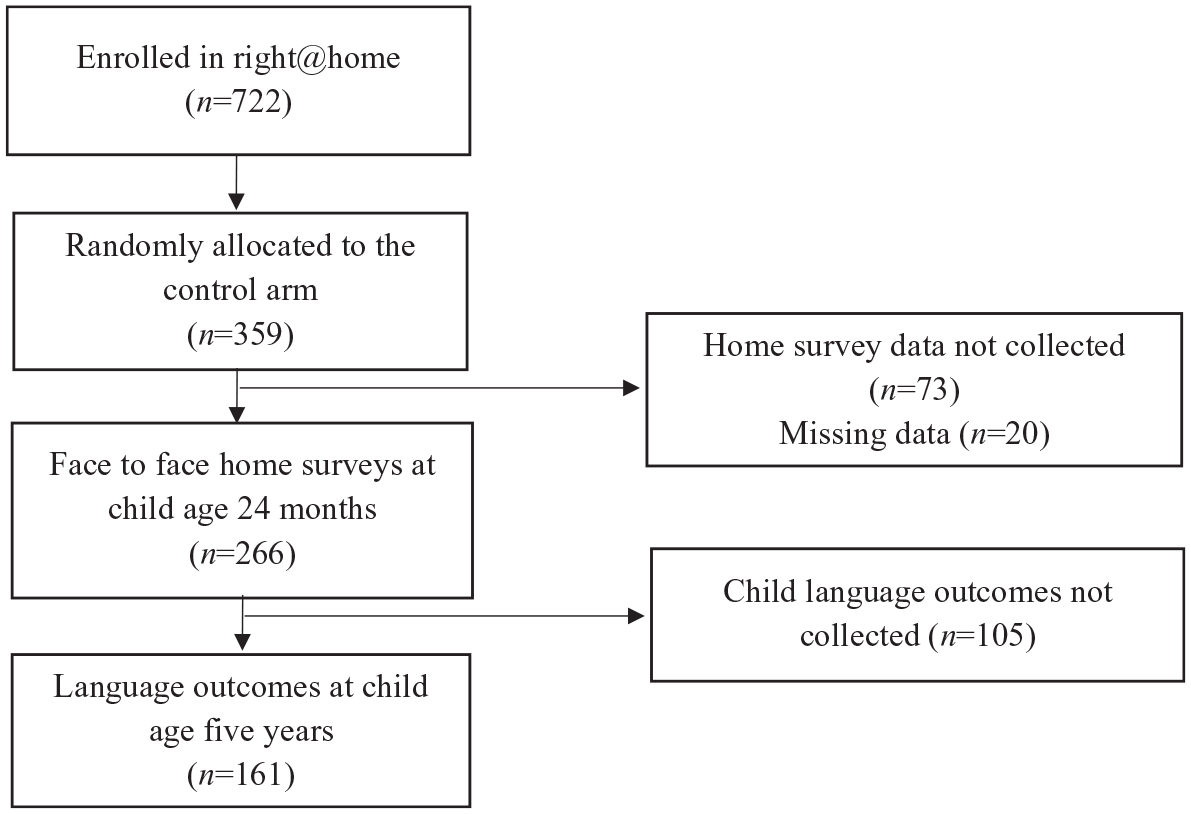
Participant flow diagram for current study.
Procedure
At child age 2 years, right@home researchers conducted a face-to-face survey in the home. ECEC items were one component of the survey and relevant to this study. A proxy measure of ECEC quality was obtained by the right@home team linking ECEC provider name and postcode to NQS ratings (Nguyen et al., 2019). NQS ratings are part of the Australian National Quality Framework for rating ECEC (see measure section for further detail). At child age 5 years, right@home researchers conducted follow-up home visits, which included a language assessment.
Measures
ECEC variables
Predictor variables at age two included: ECEC attendance (Yes/ No), ECEC type (long day care, family day care, occasional care, informal care), duration in ECEC (hours per week). Selection of variables was based on previous literature exploring associations between these variables and child language outcomes (Arteaga et al., 2014; Burchinal, 2018; Goldfeld et al., 2016; Patel et al., 2016). ECEC quality was determined by NQS overall ratings, which are determined from a rating of seven quality areas. The overall NQS ratings are defined as: excellent (service promotes exceptional education and care, demonstrated leadership and is committed to continual improvement), exceeding, meeting, working towards and significant improvement required (service does not meet one of the seven quality areas or a section of the legislation). The seven quality areas used to derive the overall rating (ACEQA, 2013) are: Educational programme and practice, Children’s health and safety, Physical environment, Staffing arrangements, Relationships with children, Collaborative partnerships and Governance and leadership.
Child language outcomes
Child language outcomes at age five were derived from the Comprehensive Expressive Language Fundamentals-5 (CELF-5); a standardised and widely used language assessment (Wiig et al., 2013). The CELF-5 subtests (expressive vocabulary, sentence structure and word structure) produce a standardised core language score (M (mean) = 100, SD (standard deviation) = 15). The CELF-5 has acceptable to excellent test-retest stability in children aged five and excellent interrater reliability (Coret and McCrimmon, 2015).
Potential confounder variables
Based on previous literature, potential confounders shown to be associated with language outcomes were included. Potential confounders in this study included: child sex, child’s main language, birth order, maternal age, maternal mental health, maternal education level, family history of communication difficulties and socioeconomic index for areas (SEIFA) score (Reilly et al., 2010). Maternal mental health was measured using the Depression Anxiety Stress Scales (DASS), which includes subscales for anxiety, depression and stress (Lovibond and Lovibond, 1995). SEIFA scores are standardised to a distribution (M =1000, SD = 100) for the Australian population, with more advantaged areas receiving higher scores (Australian Bureau of Statistics, 2016).
Statistical analysis
Minitab® Statistical Software (2020) was used for statistical analyses. For the first research aim, participants were split into two groups: ECEC attendance versus no attendance. Assumptions of normality were met, and linear regression models were fitted. Firstly, unadjusted linear regression models individually tested ECEC attendance as predictors of core language scores. Analyses were extended to adjust for potential confounder variables.
Participants were then grouped by the ECEC type received. Participants under occasional care (n = 2) and other formal care (n = 1) were excluded due to low sample size. Assumptions of normality were met, and regression models were fitted. Regression models tested ECEC type as predictors of language scores. Analyses were extended, adjusting for potential confounders. Time spent in ECEC as a predictor of later language was examined by further restricting the sample to participants attending long day care (LDC) or family day care (FDC) with time data available (n = 78% and 48.4%). Regression models tested hours of attendance as predictors of language scores for those in FDC and LDC. Analyses were extended to adjust for potential confounder variables.
The second research aim was addressed by restricting the study sample to participants where quality ratings were available (n = 48% and 29.8%). Assumptions of normality were not met, hence the non-parametric Kruskal–Wallis test was used to compare differences in NQS ratings on language scores.
Results
Baseline characteristics of women and children in the right@home study are presented in Table 1. Approximately half the participants (49.6% [178/359]) in the right@home control arm were not included in the current study due to missing data at either the 2 or 5 years follow up.
Baseline characteristics of mothers and children in the right@home control group who provided data vs those not providing data for the current study.

n > 161 as Australian ECEC categories are not mutually exclusive and children can attend more than one type of ECEC.
N = 151–161 for current study (some missing participant data on one or more variables).
N = 28–178 for no data provided (some missing participant data on one or more variables).
Characteristics of participants that were recruited in right@home control arm and excluded in current study due to missing data at 2 or 5 years follow up.
Overall, participants without follow up data had a slightly lower SEIFA score (M = 953.7, SD = 65.7) than those included in the current study (M = 954.6, SD = 64.9). The average SEIFA score of participants included was just under half a standard deviation lower than the Australian population, in line with expectations that study families were more disadvantaged than the average Australian family.
In this study, less than 10% of mothers did not have English as their main language. 19.3% (31/161) of mothers did not complete high school. Overall maternal mental health ratings were in the normal range for stress (M = 5.4, SD = 3.8) and depression (M = 2.8, SD = 3.1), and in the mild range for anxiety (M = 3.2, SD = 2.9). First-born children comprised of 34.2% (55/161) of participants. 55.3% (89/161) of participants had a family history of communication difficulties.
Descriptive statistics
The proportion of 2-year-olds attending ECEC was 58.4% (94/161) (Table 1). LDC was the most attended type of ECEC (32.9% [53/161]) followed by informal care (24.8% [40/161]) and then FDC (15.5% [25/161]). There was some overlap in ECEC attendance, with 17.4% (28/161) of children attending two types of ECEC at age two.
ECEC attendance
Table 2 shows that in unadjusted and adjusted models, ECEC attendance at 2 years was associated with improved language scores at 5 years. In the unadjusted regression model, ECEC attendance was associated with greater language scores (coefficient: 6.26; CI (confidence interval): 1.26–11.25; p = 0.001) The association attenuated in the fully adjusted model (coefficient: 5.80; CI: 0.14–11.46; p = 0.05). ECEC attendance was associated with language scores at age five, with average language scores one-third of a standard deviation higher for those children attending ECEC compared with those not attending ECEC even after adjusting for confounders. Significant confounder variables included child gender, with girls scoring over a third of a standard deviation higher than boys (coefficient: 7.07; CI: 1.82–12.32; p = 0.01), and children with a main language other than English, having a language score at age five almost one standard deviation lower (coefficient: −13.20; CI: −24.09 to 2.31; p = 0.02) compared to those with English as their main language.
Associations between ECEC attendance (predictor variables) and CELF core language score (outcome variables).

R2 = 3.71% and adjusted R2 = 16.16%.
Table 3 shows that in both unadjusted and adjusted models of ECEC type, LDC attendance at 2 years was associated with improvement in language scores at 5 years when compared with no ECEC attendance. In fully adjusted models, average language scores of children attending LDC at age two were found to be significantly higher when compared to those not attending (coefficient: 7.22; CI: 0.76–13.69; p = 0.029). However, language scores of children attending FDC or informal care were not significantly greater than those not attending.
Associations between ECEC type (predictor variables) and CELF-5 core language score (outcome variables).

R2 = 3.88% and adjusted R2 = 17.36%.
As in the previous set of analyses, girls had on average higher language scores by more than a third of a standard deviation than boys at age five (coefficient: 7.69; CI: 2.31–13.07; p = 0.005) and children with a main language other than English had an average language score at age five almost one standard deviation below those whose main language was English (coefficient: −12.74; CI: −23.77 to 1.72; p = 0.024).
For LDC, there was no evidence of an association between hours per week attended and language scores (p = 0.41). Similarly, there was no evidence of a relationship (p = 0.28) between hours spent in FDC and language scores.
ECEC quality
The distribution of children in LDC by quality rating was as follows: exceeding NQS (n = 18), meeting NQS (n = 20), and working towards NQS (n = 10). A Kruskal–Wallis test showed no evidence that NQS quality was associated with language scores (H(2) 2.00, p = 0.37). Children who attended LDC with meeting NQS (M =98.6, SD = 14.5) had an average language score higher than those attending LDC with exceeding NQS (M =95.6, SD = 14.2) or those attending LDC working towards NQS (M =91.2, SD = 21.1); but there was no significant difference between these average scores.
Discussion
This study aimed to identify if ECEC attendance at age two in a cohort of children experiencing adversity predicted language outcomes at age 5. It also aimed to identify if differing ECEC quality was associated with language outcomes at age five.
The finding that ECEC attendance predicted language outcomes supports previous findings that ECEC is associated with better language outcomes due to environmental exposure of increased language learning interactions, opportunities and experiences (Goldfeld et al., 2016; Niklas et al., 2018; Sylva et al., 2004). Evidence suggesting ECEC attendance positively impacts on language outcomes primarily consist of children attending ECEC from age 3 to 5 (Arteaga et al., 2014; Felfe and Huber, 2017; Sylva et al., 2004; Votruba-Drzal et al., 2015). The current study extends these findings to ECEC attendance being beneficial at age two. However, it is important to note that research has also shown that it is not only attendance that matters, but that it is exposure to high-quality learning experiences in ECEC that are critical, especially for children experiencing adversity (Balladares and Kankaraš, 2020). Additionally, child sex and having a main language other than English were associated with language outcomes at age 5. This replicates findings from the population-based Early Language in Victoria Study, which identified these factors at age two as predictive of language ability at age four (Reilly et al., 2010). The E4Kids study found that bilingual children in Australia have lower English language verbal abilities prior to starting school compared to children who speak English as their main language at home, but it must be noted that this is not an indication of a language delay (Niklas et al., 2018). In fact, children from non-English speaking backgrounds often catch up with their monolingual peers when given access to English-speaking environments (Cattani et al., 2014). In contrast, Reilly et al. (2010) identified measures of social disadvantage (lower maternal education, low SES and a family history of speech and language problems) predicted lower language ability. While previous studies have identified measures of social disadvantage as predictors of lower language ability (Reilly et al., 2010), social disadvantage was not associated with lower language ability in the current study, suggesting that ECEC attendance at age two may potentially lessen impacts of social disadvantage on language outcomes. This aligns with previous studies demonstrating the protective role ECEC appears to play in the language development of disadvantage children (Greenwood et al., 2020; Sylva et al., 2004). Thus, ECEC attendance at age two may result in better language abilities at age five for children experiencing adversity.
Type of ECEC appeared to be important in the current sample. LDC was the only ECEC type that predicted better language outcomes. This may be explained by the definition of LDC in Australia, which are centre-based services and are subject to mandatory regulation, assessment and quality ratings; ensuring consistent standards (ACEQA, 2013). Previous ECEC studies have exclusively explored LDC due to consistent quality standards and structured programmes that encourages and engages children to facilitate language development (Felfe and Huber, 2017; Niklas et al., 2018; Votruba-Drzal et al., 2015).
As previously stated, child sex and having a main language other than English contributed to later language outcomes; however, this was not the case for social disadvantage factors potentially attributing to the protective role of LDC (Greenwood et al., 2020; Sylva et al., 2004). Potential reasons FDC and informal care were not associated with language outcomes may, in part, be due to absent quality ratings leading to inconsistent care provided, specifically inconsistencies in educator-child verbal interactions, language learning opportunities, educator-child ratio and/or provision of educator training, which have been suggested ECEC components that support language outcomes of developmentally vulnerable children (Justice et al., 2018; Sylva et al., 2004; Votruba-Drzal et al., 2015). This study comprises of children experiencing adversity, including those from low SES backgrounds, who are prone to attending lower quality ECEC settings (Cloney et al., 2016). This study supports previous findings that attending LDC provides an enriching environment that may potentially be more beneficial for language outcomes at age five for children experiencing adversity. However, establishing more structured and consistent quality measurements for other ECEC types (i.e. FDC and informal care settings) may help better determine any associations with language outcomes.
The hours attended per week spent in LDC or FDC were not shown to predict language outcomes in this sample. However, findings must be interpreted with caution as less than half the participants had hours of attendance data available (48.4% [78/161]). Research evidence regarding time spent in ECEC on language outcomes is mixed. Some studies have found associations with improved language outcomes and between sessions, years, months, or hours of attendance in ECEC (Arteaga et al., 2014; Patel et al., 2016; Sylva et al., 2004). Conversely, time in the form of full-time or part-time attendance were not associated with positive language outcomes (Sylva et al., 2004). For children experiencing adversity, potential reasons such as parental beliefs, parental preferences and reduced socioeconomic resources, have been identified as barriers to consistent ECEC engagement (O’Connor et al., 2016).
ECEC quality was not shown to be associated with child language scores. However, ECEC quality data was only available for children attending LDC (32.9% [53/161]). Previous studies have found that centre-based ECEC leads to better language outcomes, as their high-quality traits contribute to language use and exposure, leading to more opportunities for educator-child language interactions and increasing language acquisition of at-risk children (Greenwood et al., 2020; Niklas et al., 2018; Nores et al., 2019; Votruba-Drzal et al., 2015). More specifically, a prospective longitudinal study of children from low-income homes found communication facilitating behaviours from teachers were positively associated with growth in child language trajectories, particularly for grammar and vocabulary skills (Justice et al. (2018). The current study determined quality using overall NQS ratings; derived from ratings of seven quality areas ranging from the physical environment, teacher-children relationships, governance and leadership, which were found not to be associated with language outcomes. Further research analysing individual NQS domains such as educator-child relationships may identify specific areas that contribute to child language outcomes.
Strengths and limitations
A key strength of this longitudinal study was the large sample of Australian children experiencing adversity with ECEC attendance data collected at age 2, as the majority of ECEC research has focussed on age three onwards (Arteaga et al., 2014; Felfe and Huber, 2017; Sylva et al., 2004; Votruba-Drzal et al., 2015). Study limitations include the attrition rate. Over half of the children were not retained at follow up; those that dropped out had lower SEIFA scores on average than those retained, suggesting the results may not be representative of those from the most disadvantaged backgrounds. Secondly, data was restricted to subsamples regarding ECEC hours attended and ECEC quality. This may have impacted the ability to detect the presence of associations due to a lack of statistical power. In addition, overestimation effects may have occurred as majority of the children included attended LDC. A balanced cohort of children across ECEC types may avoid any potential overestimation effects. Lastly, the survey items for ECEC attendance were collected via parent-report and could not be validated with ECEC services or government subsidy records. Therefore, estimated ECEC variables such as duration in ECEC were potentially more susceptible to random error or recall bias.
Implications
This study adds to ECEC research, particularly for children experiencing adversity in the early years (birth to 3 years). Findings suggest ECEC attendance at 2 years may benefit language outcomes for children experiencing adversity. More specifically, LDC may have some benefit for language outcomes. In Australia, the Universal Access Partnership (COAG, 2018) encourages developmentally vulnerable children to participate in ECEC in the year prior to school entry. This study reinforces the importance of policies and programmes that enable access and participation for children experiencing adversity, particularly during the first 3 years. Greater support for children experiencing adversity to access high-quality ECEC in their early years is imperative as they are two-times less likely to attend ECEC compared to other children in the Australian population (O’Connor et al., 2016). Promoting high-quality ECEC access and participation may be vital to reducing inequities in these children’s language trajectories, potentially lessening social disadvantage impacts on their language development.
Conclusion
ECEC attendance at age two predicted improved language outcomes at age five in a sample of children experiencing adversity. These findings highlight the importance for policies, advocacy and awareness in ensuring equity of access to high-quality ECEC for all children.
Footnotes
Acknowledgements
The data used in this paper were provided by the right@home Consortium, comprising the Centre for Community Child Health, Murdoch Children’s Research Institute; Translational Research & Social Innovation (TReSI), School Of Nursing And Midwifery, Western Sydney University; and ARACY, the Australian Research Alliance for Children and Youth. The authors acknowledge and express their gratitude to all those involved in the right@home project.
Funding
The author(s) received no financial support for the research, authorship, and/or publication of this article.
