




Abstract
This qualitative study examined families’ experiences supporting young children’s (ages 3–8) remote learning during the COVID-19 pandemic. Twenty-three participants completed open-ended questions in an online survey and three of those participants shared further in an online, recorded focus-group interview. Parents revealed young children’s challenges with remote learning and the multiple strategies families took up to support their young learners, including many forms of managing and facilitating online work, several forms of communicating to seek support, information, or changes, and multiple forms of motivating their child(ren) to stay engaged and complete activities. Parents also shared the tensions that arose with more unfettered access to their child(ren)’s online classrooms, teachers’ variation in communication, and families differing levels of participation due to multiple responsibilities. The findings demonstrate both the challenges and families’ creative strategies to bolster their child(ren)’s remote learning, and they inform teachers and school personnel of the importance of developing continued recalibration of communication, family support, and family input on home learning experiences when young children cannot engage with in-person learning.
Introduction
During the COVID-19 pandemic that began in 2020, education for children around the world shifted as schools closed and many moved for a time to remote learning. An early study by UNICEF (2020) found that although there were large numbers of children without access to remote learning during school closures, 94% of countries they analyzed offered “at least one type of remote learning that involved digital and/or broadcast instruction, though only 60% provided this type for the pre-primary education level” (n.p.). Initial reviews of the first pandemic-related studies have noted many challenges teachers and families faced when supporting young children in distance learning during the COVID-19 pandemic shutdowns (see Gayatri, 2020; Jalongo, 2021). When schools initially shuttered their doors, many rapidly shifted to remote communications, tools, lessons, and interactions. Early childhood educators—who typically provide culturally responsive, hands-on, play-based, choice-connected experiences in face-to-face settings—were forced to think of ways to share learning remotely, as children’s homes suddenly became their classrooms, and more responsibility shifted onto families. As mediators of remote experiences for their children, families had an inside view of their child(ren)’s academic activities in ways not often experienced previously.
For families with access, pandemic-situated remote learning was offered in variety of modalities, including synchronous online lessons shared live and/or asynchronous pre-recorded video lessons/instruction shared via digital platforms (e.g. video-calls, social media interactions, email, text messages, phone calls), and/or instructional worksheets or packets shared digitally, mailed, or physically delivered to families (see Byun and Slavin, 2020; Dias et al., 2020; Dong et al., 2020; McKenna et al., 2021; Soltero-González and Gillanders, 2021; Washington Post, 2020; Yıldırım, 2021). In some countries, educational content was also provided via televised educational activities (Byun and Slavin, 2020; Pellegrini and Maltinti, 2020). Early studies have indicated that distance learning with online/digital components were shared through synchronous lessons for whole classes simultaneously (Ahmad and Zabadi, 2020; Lau and Lee, 2021; Steed and Leech, 2021; Timmons et al., 2021), small group interactions (Lau and Lee, 2021; Steed and Leech, 2021), or even conducted online individually (see Steed and Leech, 2021). Hybrid or fully remote learning persisted for some children throughout the 2020-2021 school year (see Barnett and Jung, 2021; Newell and Machi, 2021; Tarrant and Nagasawa, 2020).
Across all these formats, early studies have begun to reveal logistical, technical, and school-based challenges (Abuhammad, 2020; Dias et al., 2020; Inan, 2021; McKenna et al., 2021; Tarrant and Nagasawa, 2020) as well as families’ difficulties in supporting young learners at home. Families have reported feeling overwhelmed (Barnett and Jung, 2021) and unprepared to support remote learning (Abuhammad, 2020; Otero-Mayer et al., 2021) and have cited children’s struggles with disinterest, attention, and engagement as well as difficulties with home- versus school-routines (Soltero-González and Gillanders, 2021; Timmons et al., 2021; Yıldırım, 2021). Further, families have shared beliefs that online teaching offers less supportive learning environments than in-person schooling due to child(ren)’s lack of social interactions, lack of focus on learning, lower self-regulation skills, inability to treat remote learning like school, as well as parents’ feelings of inadequate teaching authority when compared to teachers (Dong et al., 2020). Families in Hong Kong reported “children’s lack of focus/interest, disruptions by other family members, lack of resources, parents’ lack of patience, insufficient time, parents’ lack of relevant knowledge, lack of space, [and parents’] lack of understanding of the instructions” (Lau and Lee, 2021: 7), while families in the United States shared struggles with “balancing responsibilities, non-positive learner motivation, accessibility issues, and learning outcomes” (Ogurlu et al., 2020: 50). Researchers in Indonesia noted additional remote learning challenges could include families’ “lacking teaching mastery” as well some families’ cultural expectations for learning to occur at school rather than at home (Firmanto et al., 2020: 102). Even with the many struggles, some families shared positive aspects of remote learning, including children’s opportunities for more play time and family time, less hectic schedules, and in some cases, improved language skills (Egan et al., 2021). Additional remote-learning benefits shared by parents included more time with and knowledge of their child(ren) as well as improved understandings of what teachers do (Timmons et al., 2021).
Through all these early reports of families’ struggles and benefits associated with young children’s remote schooling, we are still learning what strategies families enacted as they became co-educators during this unprecedented distance learning during the COVID-19 pandemic. The current study sought to understand families’ experiences with young child(ren) (ages 3–8) during distance learning, including (a) what families did to support children’s online experiences, and (b) any perceived challenges or benefits connected with distance learning. This general qualitative study of early childhood distance learning experiences can offer additional insights into how families responded to many of the struggles reported in the early studies of pandemic remote learning.
Methods and data collection
The current study is part of a larger qualitative, grounded theory study on teachers’, families’, and children’s experiences during distance learning amidst the COVID-19 pandemic. In this subsection of the larger study, basic interpretivist qualitative research methods and some classic grounded theory methods (Glaser, 1978, 1992) were used to gather families’ experiences supporting their young child(ren)’s distance learning. Data were collected in two ways: through an online, anonymous survey, emailed and shared via social media in August 2020, and via a focus group interview conducted in mid-March 2021 with volunteers from the initial survey. In keeping with classic grounded theory approaches (Glaser, 1978, 1992), review of literature was saved for after data collection and initial analysis procedures, so as “to not to contaminate, be constrained by, inhibit, stifle, or otherwise impede the researcher’s efforts to generate categories, their properties, and theoretical codes from the data that truly fit, are relevant, and work” (Glaser, 1992: 31). This research strategy aligned well with the current study as data collection and analysis occurred when the first studies on families’ experiences with remote learning during the COVID-19 pandemic were only just emerging. In classic grounded theory, the initial focus is to find participants’ main concerns within a given setting or situation. Therefore, the initial survey included broad, open-ended questions, and the focus group interview included more targeted questions that arose through survey data analysis.
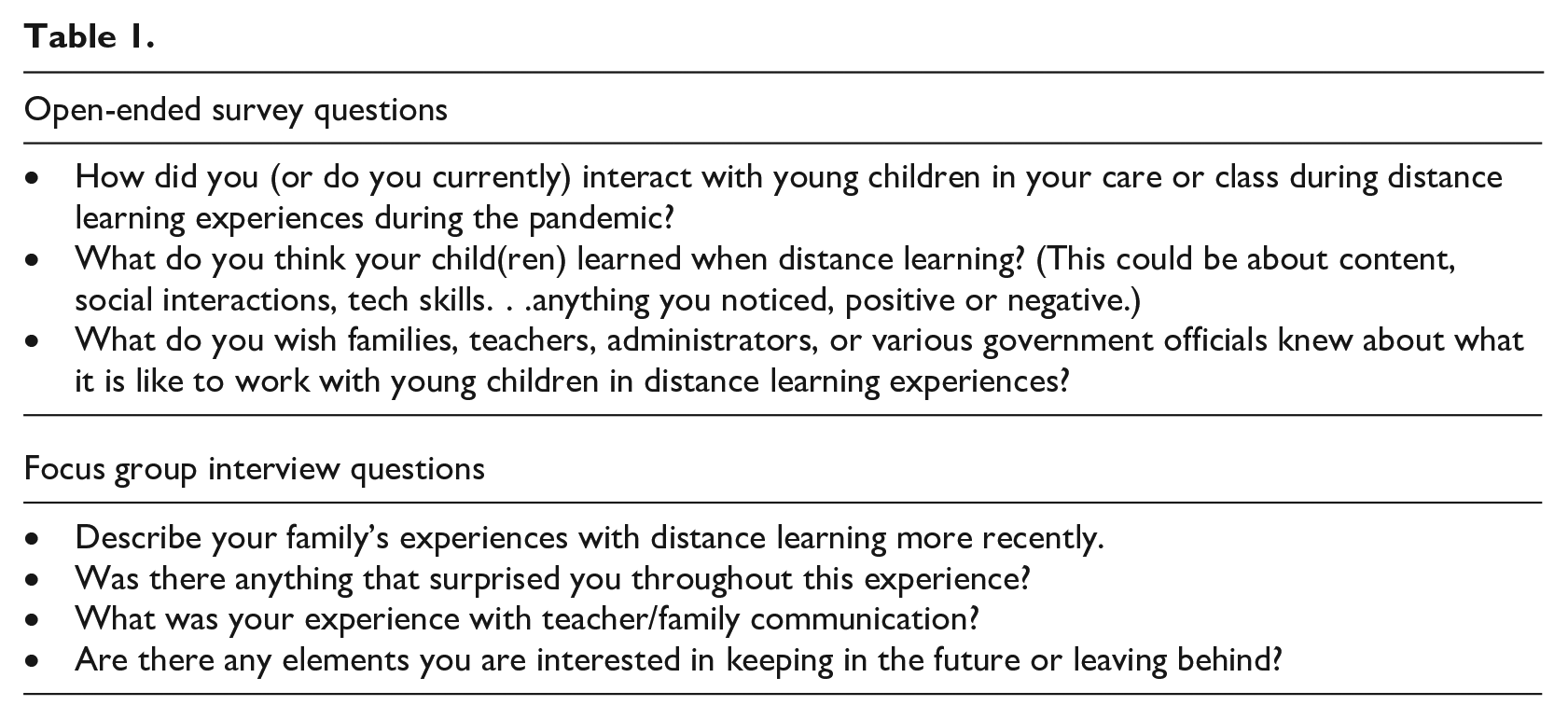
The anonymous online survey included four questions about participants’ roles, relationship to and ages of their child(ren)/student(s), and any other demographic information they wished to share, followed by six open-ended questions about remote learning experiences. A final question included information on how to participate in a later focus-group interview. Focus-group interview questions included open-ended questions, all of which were shared with consenting participants before the meeting. Table 1 below includes only those survey/focus-group questions that centered on family-experience within the larger study.
Participants
In August 2020 and March 2021, 35 people responded to the anonymous survey, with 23 people completing most or all the survey questions. Responses with fewer than four questions answered were removed, resulting in 23 completed surveys. Respondents included caregivers/families, and/or teachers, of children ages 3–8 participating in online learning through public or private schools, from states in the southwest and east coast of the United States. Eleven survey respondents indicated interest in further interviews, five of whom shared contact information, and three of whom coordinated with the researcher to participate in a focus group interview conducted and recorded in mid-March 2021 over Zoom. In the shared data samples below, survey respondents are referred to by their type—caregiver (C), teacher (T), both (B), or focus group (F), and a unique number (e.g. C1, F2, etcetera).
The focus-group participants (described broadly here to protect confidentiality) were three mothers from distinct locations across the United States (two in urban southwestern cities and one in an urban east coast city) with young children in public or private school kindergarten, first, or second grades, including one family participating in an 80/20 dual language (Spanish/English) school. One family included twins, and two families had additional children over the age of eight. By March 2021, two of the focus group participants’ young children had moved back to in-person schooling at least part time, with 1–2 days per week online and/or occasional remote learning due to quarantine or weather-events. The third family’s children were fully remote due to respiratory-health issues and participated in hybrid classrooms containing a mix of in-person and online students. One family had a middle schooler receiving special education services and was taking action to help a younger child access learning supports and possible additional services. All three mothers worked, with two working remotely and the third working mostly in-person with intermittent remote-work days.
Data analysis
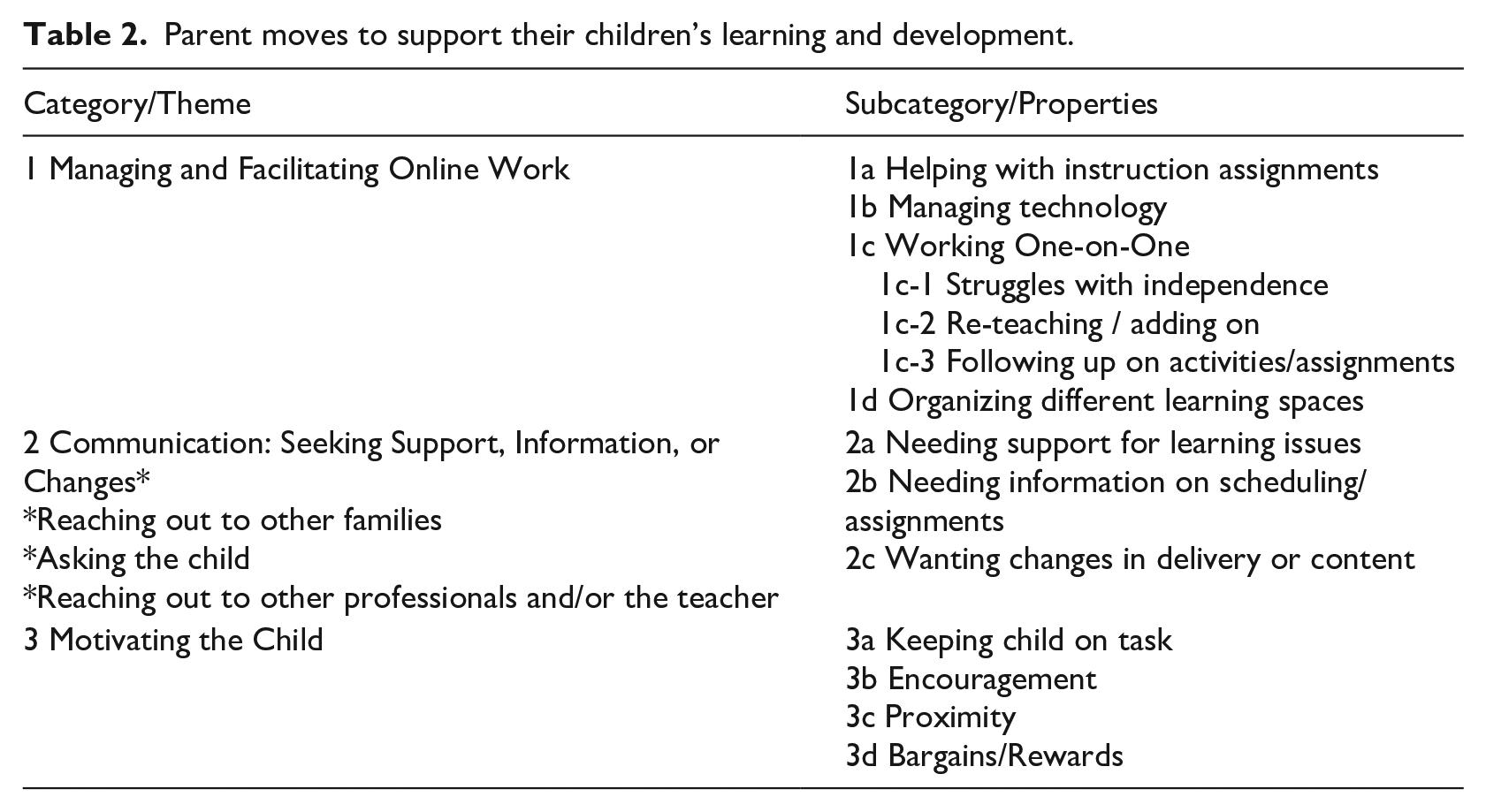
All sources, including online survey results of parents/teachers, the video-recorded focus group interview, and the focus group transcript, were uploaded to Atlas.ti qualitative data analysis and research software and initial coding began with the survey data. Surveys were initially analyzed with line-by-line open-coding to search for parents’ main concerns, from which emerged examples of children’s engagement and disengagement, struggles, and parents’ responses. This was followed by sorting codes into categories and properties of categories, accompanied by memo-writing as categories emerged. Emerging categories and memo-writing were used to craft the focus group questions. The focus group interview transcription was coded for existing categories/properties as well as any possible new ones. From this process emerged the overarching theme of parent moves to support their child(ren)’s learning and development, and related categories of parents’ strategies to manage and facilitate online work, communicate, and motivate the child. Selective coding followed for these categories, and through constant comparative analysis they were sorted and re-sorted to the sub-categories and properties of each category, all included in Table 2.
Findings
In both survey and focus group responses, participants reported a variety of learning activities with differing levels of interest and engagement for young learners, but because content was delivered online, families, rather than teachers, had to manage or greatly support children’s access to and completion of activities. Across all participants, parents made many moves to support and help their child(ren) during online schooling including: (1) managing and facilitating online work, (2) communicating to seek support, information, or changes, and (3) motivating their child. Each of the categories and sub-categories with properties are outlined in Table 2.
Parent moves to support their children’s learning and development.
Category 1: Managing and facilitating online work
Parents and caregivers shared multiple strategies for managing and facilitating their young learners’ online classwork. Types of management and facilitation included helping with assignment instructions; managing technology; working one-on-one with a child to assist in struggles with independence, re-teaching, following-up; and even organizing different learning spaces. Table 3 includes subcategories of the ways parents in the current study worked to manage and facilitate online work, with selected data samples to give voice to parents’ experiences.
Managing and facilitating online work.
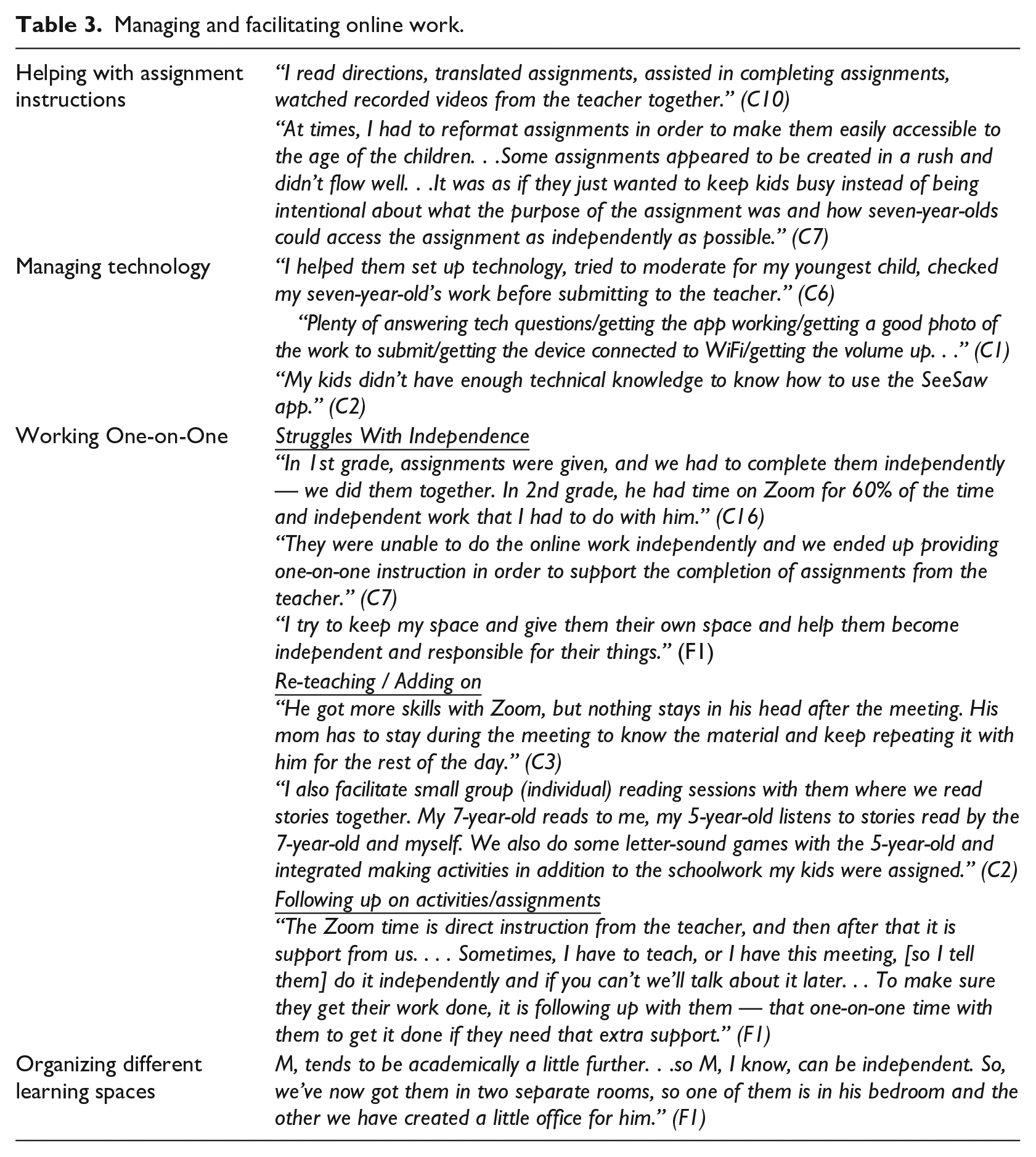
These management and facilitating tasks sometimes required extensive time from parents/caregivers and time was limited for some due to their own work responsibilities. Some families expressed frustration and even embarrassment when they felt they did not have as much time as other parents to sit beside their child continuously, as shared by one mom:
“I feel embarrassed sometimes because sometimes I’m like, ‘Don’t we have math today — where is everybody?’ And they [the other parents] say, ‘No, the teacher said we weren’t going to have math today. You do this instead.’ And I’m like, ‘Oh, how embarrassing,’ you know, that I didn’t catch on to that. . .. And it’s those parents that do have — that are able to dedicate more time to their children.” (F1)
Another mother shared concern that differences in parents’ availability to help might lead to challenges with equity and fairness. She noted:
“I get the impression that the kids whose parents are constantly listening in are doing a ton of help with the schoolwork in a way that is not conducive to equality. So, parents that are working and trying to get a bunch of things done might not be paying attention. . .I remember we were at the playground and [another parent] said, ‘How did your kid do on the test?’ I didn’t even know he HAD a test. . .but would I have known that if he was in school?” (F2)
Families recognized differences in their participation levels, with some families having more time and opportunity to provide additional help. This led to questions about equity and differences between home- and classroom-based learning. As these and other questions arose, families reported turning to others for information, support, or even changes.
Category 2: Communication: Seeking support, information, or changes
Even with multiple strategies to manage and facilitate child(ren)’s remote learning, families sometimes needed assistance and reached out to other parents, school professionals, teachers, or even their child for information. Table 4 includes subcategories of the reasons parents reached out for help: needing support for learning issues, seeking information on scheduling or assignments, or wanting changes in delivery or content. For each subcategory, data samples are also included to share parent voices.
Communication: Seeking support, information, or changes.
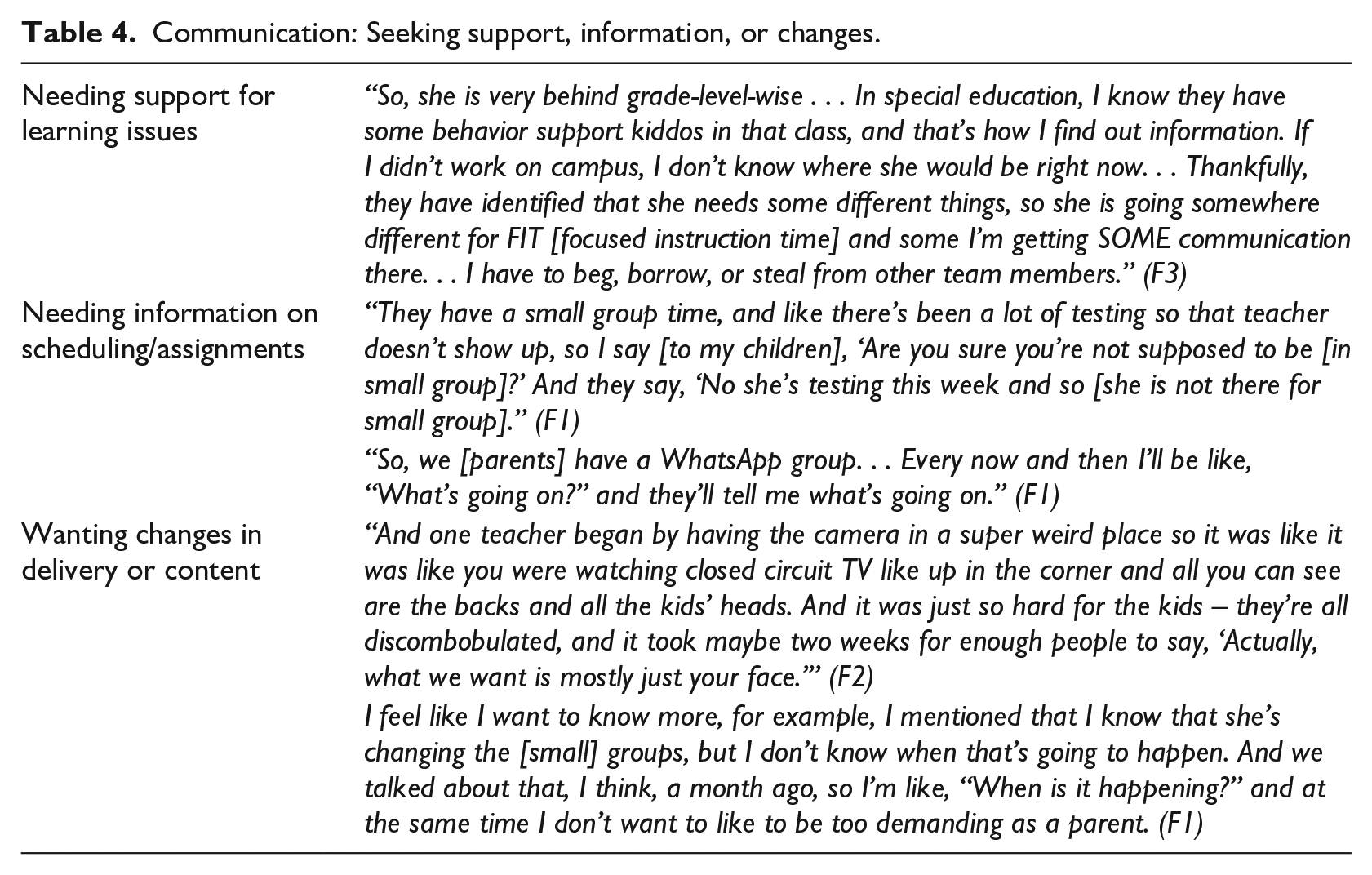
Families in the current study sought answers to their questions about learning issues, scheduling/assignments, and/or desired changes by asking other families, school personnel, the teacher, or even their child. When families reached out to other families for support, they often did so through informal chats at community playgrounds, via email or even through social media programs like WhatsApp. Several participants also shared examples of asking their children about key information such as when they were supposed to be online, why the teacher was not present, and when certain activities or modalities would occur or change.
Family members also reported needing help from teachers but noted differences in communication levels, with some teachers sharing more frequently and with more flexible/interactive technology communication skills. In one example, a mom shared how communication was different for each of her children:
“So, it’s different for all three kids and part of it is just my kids’ personal situations. So, the first grader, she has a teacher that has been around a very, very, very long time and is really good at what she does, [name]. So, you know, I have zero questions — I get great communication. But part of that is also a personal relationship — I worked in her classroom, you know, for a long time. (F3)
This mom went on to explain the limited communication with her middle child’s new-to-the-profession teacher who was also learning to teach online, and the seamless communication with her older child’s special education support team. This mom used her previous knowledge of technology accessibility tools and her earlier connections with classroom special education personnel to learn about the classroom activities and additional supports she could use to help one of her children who was struggling.
Another mom shared examples of the ways in which, when compared to face-to-face learning, online learning offered less interaction with the main teacher: “And so now like, in terms of communicating with a teacher, it’s whenever she sends the weekly newsletter. And that’s pretty much it. Or if she has a direct question for me, or if I have a direct question about something for them. So, there isn’t a lot of communication.”(F1)
This mother went on to share examples of other teachers who found ways to communicate online more interactively with students, though sometimes in surprising ways (e.g. a physical education teacher offering more interactive and technologically appropriate activities than those shared by the technology teacher).
Several families noted the balance they tried to strike between reaching out to a teacher versus giving her/him space to manage online teaching flow and practices. Families shared examples of teachers’ differing levels of facility with online teaching, and that sometimes led to struggles around when to ask for help. In one example, a mom shared:
“At the same time, I don’t want to be too demanding as a parent, just because I’m a former teacher and I want to respect her, and she knows I’m a former teacher. So, I want to respect that. So now, I think, ‘What am I, what am I going to be,’ you know? Do I need to be compassionate, or do I need to be demanding as a parent? And so I try to balance that.” (F1)
As families worked to navigate their roles in supporting their child(ren)’s home-based learning, some parents also shared examples of breaches in typical boundaries between parents and teachers. Parents experienced unexpected inclusion in online learning, such as when children carried technology along when asking parents for help (even into private spaces), or when parents interacted with children without knowing the teacher was online listening. Some parents even expressed the strangeness of these breaches in typical interaction patterns, with parents able to wander in and out of class at any time, or to sit beside their child throughout any class session. In the focus group, one mom shared:
“So, there are weird ways we’re paying more attention, and I feel like it must be awkward for teachers, because every time they admonish a kid who’s not paying attention on Zoom, they must be thinking that a parent can be right next door, and this can be really awkward. So, I imagine that teachers are looking forward to the more natural boundaries and also some inclusion for parents at a special moment, which is nice for everyone.” (F2)
As parents took on these different strategies to manage and facilitate their child(ren)’s learning, and communicated needs for help in multiple ways, they also shared examples of strategies they used to motivate their child(ren) to stay engaged in learning.
Category 3: Motivating the child
As found in previous studies, parents in the current study reported children’s struggles with attention and motivation during distance learning, and respondents in surveys and the interview shared moves they made to motivate their child(ren), such as trying to keep them on task (sometimes with a struggle), encouragement, proximity, and bargains/rewards. Table 5 includes each of these sub-categories of motivation along with sample quotes from the data to evidence parents’ strategies.
Motivating child.
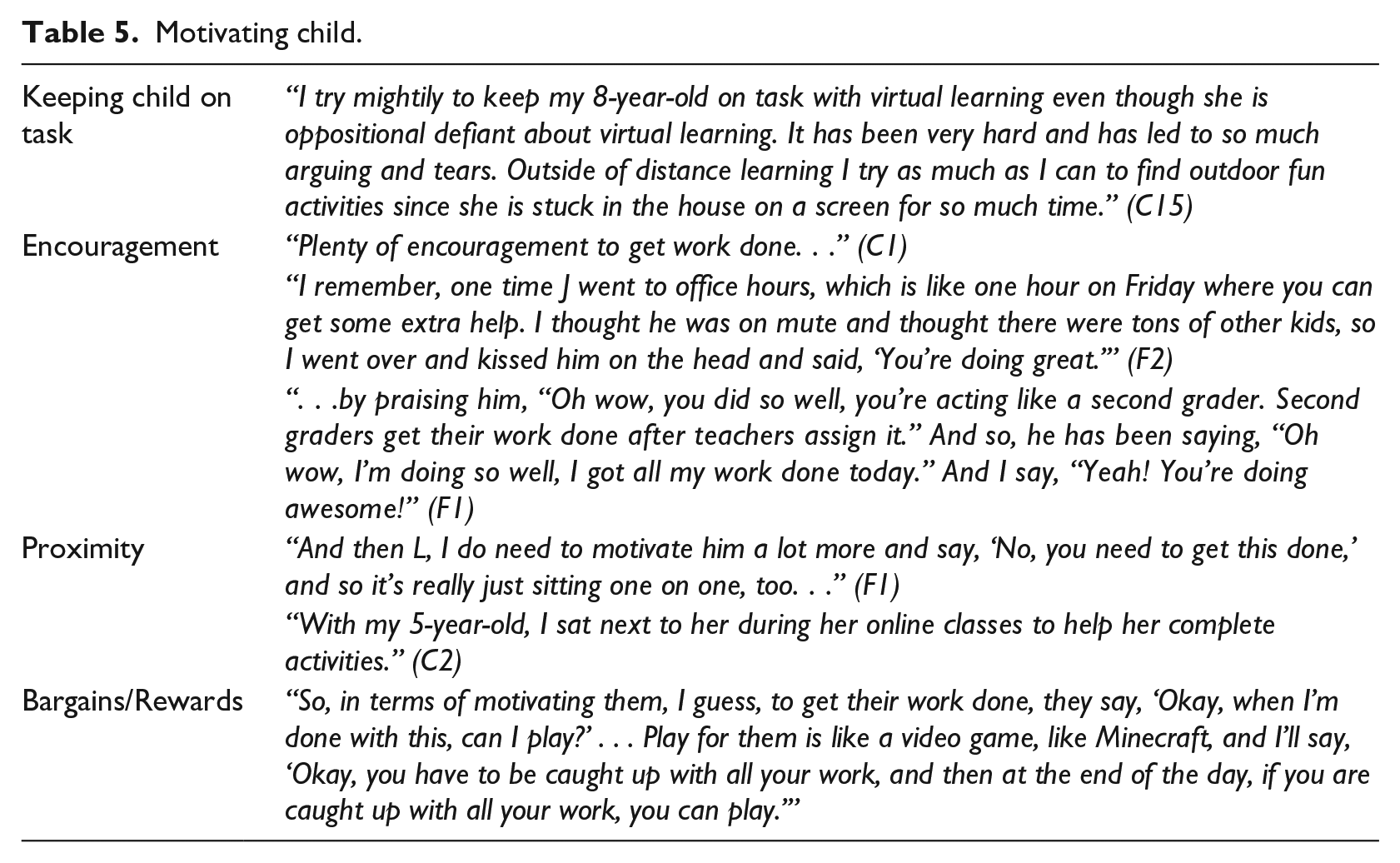
Parents used multiple strategies to keep their learners on task, and some also shared beliefs that children needed support and interactions with teachers and other peers to help with engagement and motivation. One parent summarized:
At this age [5], my son needs direct interaction with other human beings such as kids and teachers. Interacting with educators and classmates over online applications such as ZOOM seems to not work for my son. Several times he feels ignored when the teacher talks with others and doesn’t hear him talking or gives time to other kids to have their turn in talking without distraction by muting every other child. At this age, my son needs interactions more than instructions. He needs to learn discipline though direct interactions not remote ones. He needs a real play time with other kids of his age, not chatting with them. (C3)
This parent, like others in the current study, voiced the motivating influence that a teacher and other children could have on a child’s learning. However, remote learning at home did not seem to afford children the same modes of peer and teacher motivation and interaction as those experienced in the face-to-face classrooms.
Discussion
Families in the current study reported that young children needed lots of help to engage in the online activities provided during remote learning, which added more parent responsibilities than typical in teacher-led, in-person classrooms. In the current study, families cited younger children’s challenges with completing work independently and manipulating technology effectively, which required parents to manage multiple log-ins, digital work submission, changing schedules, and communication issues. Some families also took up the work of re-teaching material or concepts. However, even families with many resources for re-teaching concepts did not always have time or awareness that their child might need additional support. This could be especially challenging for families juggling home-teaching along with many other responsibilities, as found by several early pandemic studies (see Barnett and Jung, 2021; Dong et al., 2020; Soltero-González and Gillanders, 2021). Emerging research has reported examples of families supplementing pandemic remote learning by hiring tutors (see Kim et al., 2021), providing workbooks, finding YouTube videos, using computer games (Soltero-González and Gillanders, 2021), supplying materials (or using different ones), and offering learning experiences through typical home activities (Yıldırım, 2021). However, as found by Kim et al. (2021) there have been noted differences in families’ abilities and time to provide supplemental resources when disaggregated by location, wealth, and caregiver literacy. The current study highlights how much families manage and facilitate young children’s online learning, and the findings suggest schools and teachers should consider ways to support differing levels of family participation.
In addition to children’s need for support in managing the tasks of online learning, parents in the current study also had to keep young learners motivated and engaged during remote learning. Family strategies included directly keeping a child on task, encouragement, proximity, and bargaining and rewards. In part, parents connected children’s lack of motivation with remote learning activities that involved low-level thinking, repetitive drills, and less interaction. These findings echo early pandemic-related studies (see Ogurlu et al., 2020; Soltero-González and Gillanders, 2021) and suggest that during remote learning, children might be better served with more hands-on, interactive activities in which they can make, write, create, explore, experiment, and share their learning with small groups of fellow students and the teacher. Well-designed, interactive activities might help children develop independence and possibly lessen the amount of time families spend motivating young learners to participate in and stay engaged with learning tasks.
In addition to facilitating, supporting, and motivating, families also wrestled with how to find information and help for their young learners. Families in the current study reported differences in levels of communication with their child(ren)’s teacher(s). This adds to findings of earlier pandemic distance-learning studies in which parents reported a range of interaction levels with teachers ranging from no interaction to only once per week, to once per day, up to 2 to 3 times per day (Dong et al., 2020). Even when children can engage synchronously with teachers during remote learning, they might need additional help outside the window of synchronous interactions, as noted by parents in Abuhammad’s (2020) study. Early research has suggested, and this research confirms, the importance of opportunities for synchronous small-group teaching or teacher-to-student learning times (Dias et al., 2020), as well as opportunities for students to develop interactions with each other and even with learning coaches (Abuhammad, 2020; Ogurlu et al., 2020). Further, families need teachers to keep communication lines open when distance learning occurs at home. Soltero-González and Gillanders (2021) found parents felt more comfortable reaching out to teachers when communication was provided more regularly and included guidance, well-being checks, encouragement, and resource information, and was provided with flexible communication modes (via phone, text, email, video conferences, social media) available at various times of day.
Even with communication difficulties, there were other ways families had more access than ever before to young children’s “classroom” experiences, as those with time and access could view and interact with teaching any time classes were online. Similar to the findings of Byun and Slavin (2020), the current study confirmed that families with multiple children learning online at home could observe multiple teachers, lessons, and interaction styles. This unfettered access gave rise to even more parent questions, such as why teachers were teaching content a certain way, or if/when certain teaching strategies would occur or change. Further, families could see and compare teachers’ strengths, struggles, content delivery, assessment, and management. Some families in the current study reported confusion around boundaries of when to step in, when to step back, and whether there were inequities arising from differences in parental affordances of time or ability to help. In addition parents shared ways they reached out to others when home/school communication broke down. However, it is possible that reaching out to others instead of the teacher could inhibit the acquiring of deeper support or even special services children might need. Thus, the current study confirms the importance of school planning for unfettered access, parent questions, and student learning needs. Schools could provide parental education to help families prepare for online learning (as suggested by Dong et al., 2020), and could include resources, tools, information on learning platforms, and multiple communication strategies, as suggested by Ogurlu et al. (2020), as well as consistent check-ins on student experiences and engagement so as to provide additional supports, resources, and altered teaching strategies as needed.
Just prior to submission of this article for publication, Budhrani et al. (2021) published a study of Philippine parent support of elementary students’ online learning during the pandemic, extending a conceptual framework by Jered Borup and colleagues of a spectrum of parental involvement in high school students’ (pre-pandemic) online learning. Budhrani et al. (2021) found that families early in the COVID-19 pandemic engaged in supporting, organizing, facilitating, motivating, nurturing, and monitoring (pp. 160–161) elementary students. As a grounded theory influenced study, the current project neither began with nor fit data into an existing theoretical framework, but findings reveal that even many months into remote learning, some parents in the United States used a few similar strategies to those reported by parents in the Philippines during early experiences of pandemic-influenced remote learning. Further, the current study evidences young children’s continued necessity for support, motivation, and communication even after many months of remote learning. This suggests the urgency for schools and teachers to consider the heavy responsibilities placed on parents/families throughout the entire course of remote online learning, and the significant need for continued recalibration of communication and support between educators and families.
Limitations
Limitations of the current study include small sample size, limited demographic information, responses from discrete points in time, and missing children’s voices. A larger sample size and deeper details on family socioeconomic and cultural backgrounds could offer a more nuanced overview of children’s and families’ experiences with remote learning. Further, future studies could gather data in multiple closed systems (e.g. teacher reporting, teacher/family surveys, teacher/family focus groups) in single geographic locations over time. Finally, all the information on children’s experiences was gathered from teachers’ and parents’ shared perspectives, rather than from children themselves. Deeper understanding of children’s perspectives of online remote learning could help early childhood educators and families better plan activities that are accessible, engaging, interesting, and meaningful for young learners.
Conclusion
Many of the early pandemic studies on remote learning have noted teachers’ and families’ struggles in supporting young learners across a distance, and this study confirms these challenges. As noted by one caregiver in the online survey, “The whole experience is still very high touch for parents” (C1). However, even amidst the challenges, this study highlights the multiple strategies families took up to support their child(ren)’s learning at home and includes caregivers’ own voices. School personnel and teachers planning or involved in continued remote learning for young children should acknowledge these positive efforts by families and offer additional support and ways for families to connect with each other. Continuous recalibration with families can also serve as indicators of families experiencing time and access challenges. Further, consistently checking in with families as co-teachers can offer educators important insights into children’s remote learning struggles and successes, as well as families’ rich funds of knowledge (Moll et al., 1992) and creative strategies for supporting their young learners at home.
Footnotes
Declaration of conflicting interests
The author declared no potential conflicts of interest with respect to the research, authorship, and/or publication of this article.
Funding
The author received no financial support for the research, authorship, and/or publication of this article.
