



Abstract
This qualitative study examined the interplay between teacher facilitation, children’s uptake of vocabulary and reasoning strategies, and the roles children assumed as learners as they experienced instruction grounded in Connected Teaching and Learning ([CTL] an interdisciplinary instructional framework that leverages key practices from culturally responsive pedagogies and meaningful use of multimodal text sets. Analyses suggest (1) students assumed more active roles in their learning as they “enacted” the work of scientists and (2) varied teacher facilitation practices and children’s vocabulary and reasoning uptake were key factors in children’s shift to more active roles. Although findings suggest CTL is a promising instructional framework, findings also underscore the significance of how teachers act on the instructional framework.
Keywords
Children’s school achievement has long varied by income, language, and ethnic status (Ho and Kao, 2018). While there is no question that disciplinary knowledge is fundamental to school achievement, increasingly scholars argue that achievement differences are rooted in inequities in students’ learning opportunities (Darling-Hammond, 2013; Welner and Carter, 2013). These differences are often referred to as opportunity gaps—i.e. “cumulative differences in access to key educational resources that support learning at home and at school: expert teachers, personalized attention, high-quality curriculum opportunities, good educational materials, and plentiful information resources” (Darling-Hammond, 2013: 77). Recognition of vast differences in learning opportunities has reinforced the longstanding call for equitable and just educational opportunities for all—a call that some scholars emphasize cannot be realized without implementing practices that connect and build upon students’ lived experiences and empower students as learners. Culturally responsive pedagogies (CRP) represent one key way to do so (Gay, 2018; Ladson-Billings, 1995). Further, in an age when digital texts dominate how children and adults learn and play outside of school, many argue this instruction must also incorporate multimodal texts (Ito et al., 2013; Kimmerle et al., 2015)—i.e. texts (digital or nondigital) wherein authors use combinations of modes (e.g. print, images, sound, and animation) to communicate (Kress, 2010).
Evidence demonstrates the positive impact on students’ learning outcomes with CRP (Aronson and Laughter, 2016) and meaningful access to high-quality digital texts (e.g. Higgins et al., 2019). Yet, too few young children have access to classrooms that effectively leverage CRP (Sleeter, 2012) and a multimodal curriculum (Svärdemo Åberg and Åkerfeldt, 2017). Such inequities may be explained, in part, by a dearth of research in early grades linking CRP and a multimodal curriculum to academic outcomes (e.g. disciplinary knowledge). Given this evidence and the strong links between early and later achievement (Duncan et al., 2007), access to CRP with well-integrated multimodal texts may be especially important to young children.
To address this problem, we developed and examined use of Connected Teaching and Learning (CTL), an instructional framework grounded in CRP and meaningful multimodal text use in a first grade, urban, U.S. classroom. We focused on teaching practices and student outcomes to characterize the practices that support students’ interdisciplinary learning. With following sections, we explicate the literature that grounds CTL. Then, we describe details of the study examining how the teacher facilitated (1) children’s uptake of vocabulary and reasoning strategies and (2) the role children assumed as they experienced instruction grounded in CTL.
Interdisciplinary knowledge
To support academic achievement, and in turn, access to key opportunities in our world, students must hold deep, interdisciplinary knowledge. Interdisciplinary knowledge comprises knowledge of discipline-specific content, concepts, and related vocabulary (e.g. science, mathematics) and how knowledge of individual disciplines are connected (Taguma and Barrera, 2019). Deep interdisciplinary knowledge (i.e. knowledge networks comprising numerous, well-organized concepts [Bransford et al., 2000] within and among disciplines) permits experts and practitioners in various disciplines to draw from their knowledge to imagine, create, innovate, and solve-problems in the “real-world.”
Building deep interdisciplinary knowledge is complex. Not only must students hold disciplinary knowledge (e.g. concepts, vocabulary), they must use this knowledge to engage in the complex thinking and reasoning that supports real-world application (e.g. use science practices to solve problems). While many students benefit from how disciplinary content is taught, too often, students of diverse backgrounds do not. An explanation for this differential learning may lie in inequitable access to key curricular resources (Darling-Hammond, 2010 ) and overemphasis of cognitive factors (e.g. disciplinary knowledge), thereby deemphasizing the social and cultural dimensions (Gay, 2018; Lee, 2020; Skerrett, 2020
Leveraging social and cultural dimensions of knowledge development
Because learning is shaped by social and cultural influences, many scholars argue that it is critical that teachers understand and meaningfully leverage children’s lived experiences (Gay, 2018). To do so requires that teachers know their students and create instructional space that values, recognizes, and encourages diverse ways of thinking, talking, and learning. Further, teachers must actively help students connect in-school learning with their worlds (Kimmerle et al., 2015), including use of multimodal texts, as technology is deeply integrated into children’s out-of-school lives (Rideout and Robb, 2019). Meaningfully leveraging social and cultural dimensions makes knowledge accessible and relevant (e.g. Bricker et al., 2014), while also affirming and expanding students’ identities (Gay, 2018; Ladson-Billings, 1995). This, in turn, empowers students as active agents in their own learning and opens access to later academic and career opportunities.
Yet, too few young children have access to classrooms that effectively leverage social and cultural factors (Sleeter, 2012) and a multimodal curriculum (Svärdemo Åberg and Åkerfeldt, 2017). Rather, use of standardized curricula—i.e. mandated, narrow, and prescribed curricula that emphasize the cognitive structures of learning is wide-spread in U.S. schools (Sleeter, 2012). Moreover, although some schools offer social and cultural programing, they tend to be offered separately from academic programs (Lee, 2020). Such curricula assume all students acquire the same content through the same instruction at similar rates (Milner, 2013; Smargorinsky et al., 2002), and minimize the role of other essential elements (e.g. connecting learning to students’ lived experiences and knowledge co-construction).
Although a partial solution lies in opening up curriculum for connections to students’ lived experiences, collaborative knowledge building, and meaningful use of multimodal texts, many teachers are challenged to do so (e.g. Crocco and Costigan, 2007; Flores, 2007) without violating curricular mandates. Because growing evidence suggests a positive impact on student outcomes when integrating cultural and social factors, we next consider CRP and meaningful multimodal text use to do so.
Culturally relevant pedagogies
Although CRP frameworks differ (e.g. Gay, 2018; Ladson-Billings, 1995), overall, CRPs target equitable learning opportunities through practices such as (1) connecting instruction to students’ lived experiences and interests, (2) holding high expectations while enabling access to academic content, (3) connecting to and building upon students’ language repertoires, (4) developing collective expertise through co-construction, and (5) raising awareness of and disrupting systemic inequities. Emerging evidence links CRP to positive student outcomes including motivation and engagement (e.g. Morrell and Duncan-Andrade, 2002; Savage et al., 2011) and academic outcomes in mathematics (e.g. Portes et al., 2018; Powell et al., 2016; Sharif Matthews and López, 2019), social studies (e.g. Choi, 2013; Ensign, 2003; Stovall, 2006), science (Dimick, 2012), and literacy (e.g. Lopez, 2016; Portes et al., 2018; Powell et al., 2016).
Meaningful access to multimodal text
Recent, rapid technological advances have shifted the primary format for reading from nondigital to digital (Compano et al., 2020), even for young children. For example, by age 6, 85% of children use technology in some way (Erikson Institute, 2016) and by age 11, 53% of children own a smartphone (Rideout and Robb, 2019). The varying modes (Kress, 2010) and “participatory nature” (Jenkins et al., 2006) of multimodal texts provide children differing pathways for making sense of and communicating understanding and connect to children’s out-of-school experiences. Yet, multimodal text access (particularly digital) remains infrequent and uneven globally (Robinson et al., 2020). Even contexts that infuse multimodal texts, nondigital forms of literacy are more highly valued and recognized (Svärdemo Åberg and Åkerfeldt, 2017).
Without consistent access, key opportunities for learning are lost, especially in light of research demonstrating positive effects of digital texts on motivation (e.g. Higgins et al., 2019; Rosas et al., 2003), mathematics achievement (e.g. Cheung and Slavin, 2013; Clements et al., 2011; Ran et al., 2021), early language and literacy outcomes (Cviko et al., 2012; Lysenko and Abrami, 2014; Savage et al., 2013; Smeets and Bus, 2015), and science content knowledge (e.g. Hussein et al., 2019). In addition to academic outcomes, evidence suggests meaningful digital text use promotes creativity and collaboration (Kucirkova et al., 2014) and development of identities (e.g. school, family, cultural [Kucirkova, 2017]).
In sum, building deep interdisciplinary knowledge is key in bolstering students’ academic outcomes and positioning them to access opportunities in the world. Students’ development of interdisciplinary knowledge cannot be fully realized without linking school-based learning with students’ lived experiences. However, few students have access to classrooms that meaningfully leverage these critical connections. An important question, then, is how can we disrupt this “disconnect” between school-based learning and students’ lived experiences to support deep interdisciplinary learning? In response, drawing from evidence related to interdisciplinary knowledge development and practices tapping into the social and cultural factors, we developed Connected Teaching and Learning (CTL).
What is connected teaching and learning?
CTL is an instructional approach that draws from CRP related practices and meaningful multimodal text use to build deep interdisciplinary knowledge and empower students as learners. CTL emphasizes four connections. First, given the significance of rich knowledge networks to knowledge development (Bransford et al., 2000), teachers support cognitive connections to build rich knowledge networks. For example, relationships among concepts are explicitly identified and displayed (e.g. using a concept map). Second, teachers make interdisciplinary connections (e.g. build literacy to develop and share science knowledge). Interdisciplinary connections help children engage in the work of scientists, readers, mathematicians, etc. (Taguma and Barrera, 2019) and provides opportunities for “real world” application (e.g. engage in science practices) as children connect learning in and out-of-school. Third, teachers frequently connect in (e.g. classroom instruction, snack) and out-of-school contexts (e.g. playground, home) to students’ experiences, affirm and expand students’ identities, and build “collective” capacities and deep knowledge (Kimmerle et al., 2015; Scardamalia, 2002). Finally, teachers meaningfully connect digital and non-digital texts (i.e. multimodal text sets conveying focal disciplinary content with links to students’ worlds) to develop knowledge, collaborate, and communicate in and out of school (Ito et al., 2013). Emphasizing these connections aligns with CRP as high expectations are held while students (1) connect disciplinary content to their lived experiences and (2) develop interdisciplinary knowledge as part of a community (through collaboration and co-construction) in which differing ways of thinking and learning are valued, contribute to students’ growing learning, and connect to their world. Use of multimodal texts, like those children use outside the classroom, create multiple pathways for building and sharing understanding.
This study examined how one teacher shaped children’s (1) uptake of vocabulary and reasoning strategies and (2) roles in their learning as they experienced CTL instruction. We focused on teaching practices and student outcomes to characterize the practices that supported students’ interdisciplinary learning. We examined vocabulary and reasoning strategies relevant to science to capture key aspects of interdisciplinary knowledge. We also considered the role children assumed to capture the extent to which children were academically empowered—i.e. positioned to actively and collaboratively develop deep knowledge (Dimick, 2012).
Methods
Setting and participants
Twenty-two first graders (15 boys and eight girls) attending a U.S. urban school serving culturally- and linguistically-diverse children living in high-poverty participated. Children’s ages ranged between six and seven. Seven were identified as English learners (indicated by statewide standards), although all children spoke a first language other than English (18 spoke Spanish; two spoke Somali; three spoke Arabic). The participating teacher was a seasoned first-grade educator with ample experience integrating technology and expressed interest in interdisciplinary instruction.
Intervention and materials
The intervention comprised a 4 week interdisciplinary unit, Energy and Motion with four lessons. Each lesson was distributed across 4 days for 30–35 minutes per day (Table 1). Lessons were grounded in CTL and evidence-based practice (e.g. explicit teaching, authentic tasks). Multimodal text sets relevant to students’ lives were fundamental resources, comprising non-digital (e.g. informational text, concept maps, classroom talk, hands-on inquiry) and digital texts (e.g. online videos, games). For example, to help students connect potential and kinetic energy to their everyday lives, students viewed and discussed the video Energy showing children using energy (e.g. running, jumping). To recognize and value students’ ways of thinking and understanding and foster collective expertise, children’s ideas about potential and kinetic energy from discussion were documented on a concept map.
Lesson activities by day.
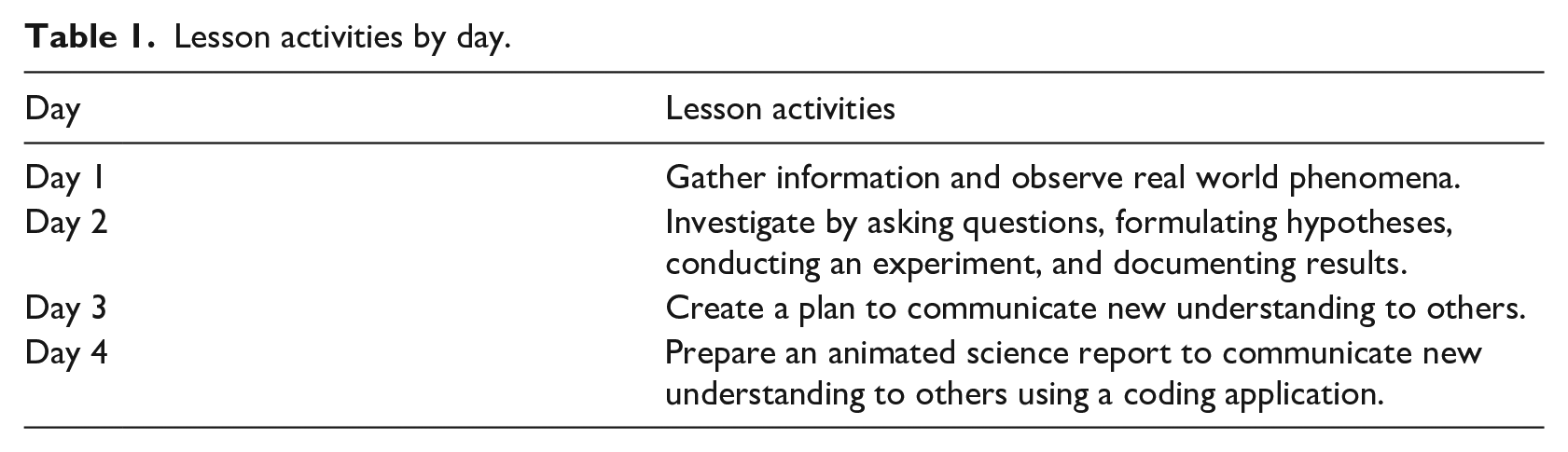
Math (e.g. graphing), reading (e.g. reading about energy, vocabulary development), and writing (e.g. note taking, science reports) were incorporated. Lessons concluded with children composing animated science reports using a coding application; parent letters were sent home to support home-school connections.
Data collection and sources
All lessons were video-recorded with a camera positioned discreetly (corner of the teacher’s desk) on a mini-tripod and transcribed (documenting talk and gestures) by a research assistant (RA). We purposefully selected eight lesson segments (Days 1 and 2 of each lesson) because they were discussion-based and best captured children’s contributions. During later lesson segments (Days 3 and 4), children composed science reports with less discussion.
Analyses
To capture children’s interdisciplinary learning and teacher facilitation, thematic analyses (Nowell et al., 2017) occurred in three phases. In Phase I, we coded transcripts for talk related to teaching actions and children’s uptake of vocabulary and reasoning strategies. First, we co-reviewed lesson transcripts, identifying trends regarding (1) teacher support of science practices and vocabulary learning and reasoning strategies and (2) the pathways students used to uptake vocabulary and reasoning strategies. Based on trends, we created a codebook and applied codes to lesson transcripts, repeating this process until reaching coding saturation (Figure 1 [Bowen, 2008]). Then, the RA was trained to code all lesson transcripts using the final codebook. To establish interrater reliability, the RA and first author independently coded one randomly-selected lesson. Analyses revealed 97% agreement (Cohen’s k = 0.67). Thereafter, the RA independently coded remaining lessons and calculated frequencies.
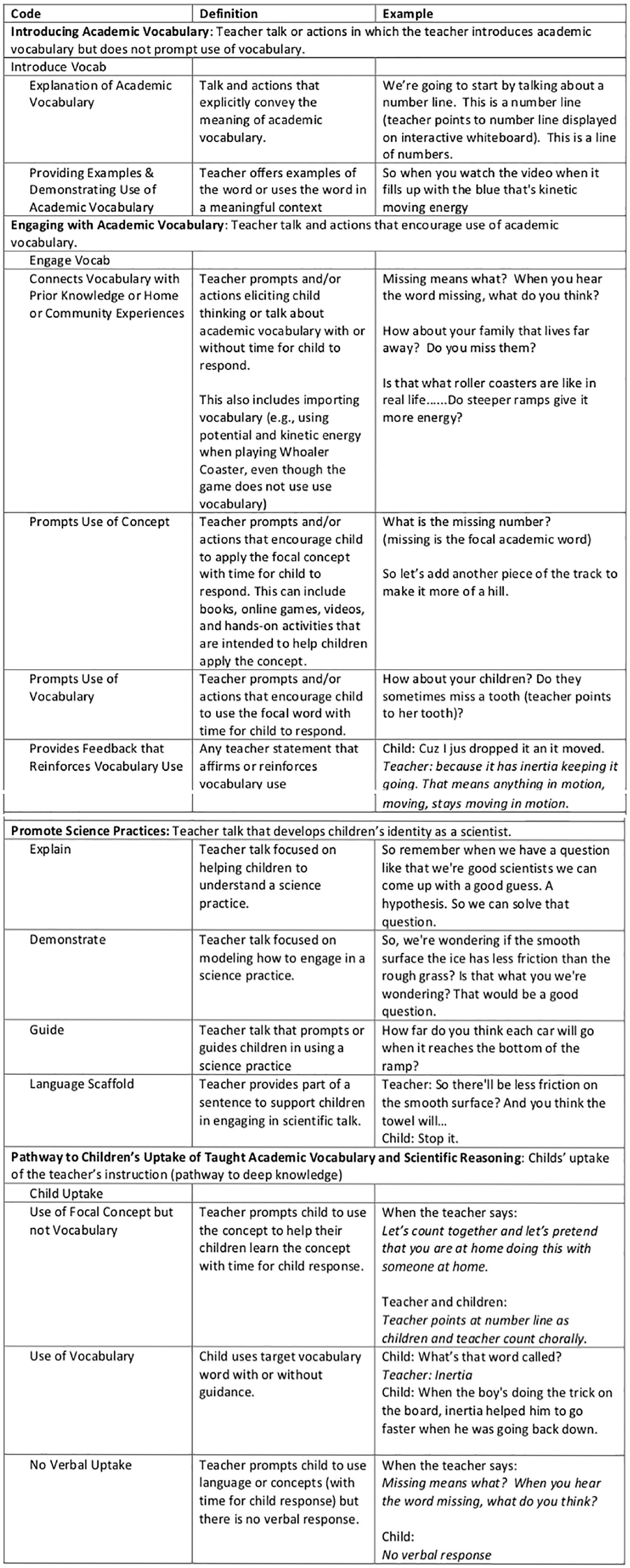
Coding manual.
In Phase II, to capture relations between teacher facilitation and children’s roles, the first author and an independent coder with expertise in classroom talk used collaborative coding to examine interaction patterns between teacher and students. We examined interactions rather than individuals’ utterances, as roles are formed in a social context through interactions with others (Wagner and González-Howard, 2018). We used collaborative coding to benefit from coders’ varying expertise and reached agreement on each code through collaborative discussion (Smagorinsky, 2008). In the “first pass,” we coded when and how frequently children participated in discussion and interaction patterns including (1) who initiated and how initiation occurred (e.g. teacher prompts a prediction, teacher poses a question), (2) the child’s type of talk (e.g. observation, prediction, challenge), and (3) the teacher’s response (e.g. recast, compliment, prompt for elaboration, invite to build on). In the “second pass,” to capture the full range of roles and interaction, we examined “exchanges” (i.e. the turn occurring just prior to and after a focal child spoke) to identify similarities and differences in children’s participation quality. We then identified seven children whose frequency and participation quality varied. Because of close similarities among a few children, we narrowed further analysis to four children that were most distinct and illustrative of the types of interaction.
In the “third pass,” we examined patterns among interaction codes. Four primary roles emerged: participant, contributor, collaborator, and co-constructor. A participant reflected exchanges wherein the child predominantly followed along or reiterated a teacher or peer’s utterance. A contributor reflected exchanges wherein the child predominately offered a brief concept-focused response to a teacher prompt, and the exchange ended. A collaborator reflected exchanges wherein a child’s response focused on target concepts (i.e. clarifying or elaborating) without new ideas. A co-constructor reflected exchanges with multiple turns where a child introduced new information that extended a concept. Across transcripts, we then collaboratively coded all exchanges for each child for role.
In Phase III, we reviewed codes to identify themes that explain the interplay among teacher facilitation, children’s uptake, and children’s role. Three initial themes were identified. We then reviewed themes to be sure that they were grounded in the data. This led us to collapse three themes into two overarching themes.
Findings
Below, we report findings regarding teaching actions and children’s uptake and relations between teacher facilitation and children’s roles in their learning. Then, we identify themes across findings to describe the interplay between teacher facilitation and child outcomes.
Teaching actions and children’s uptake of vocabulary and reasoning strategies
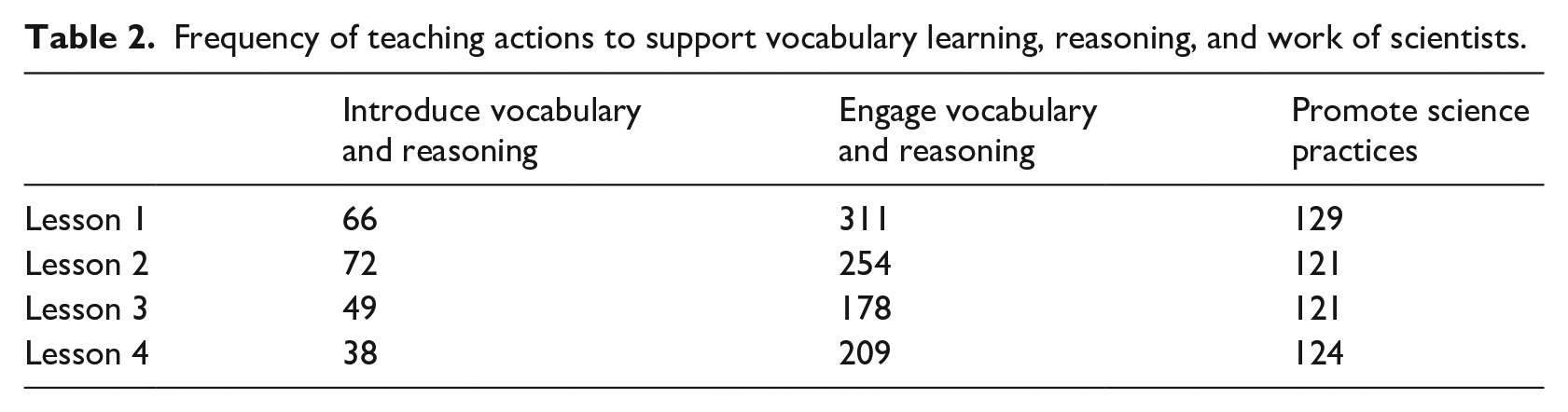
Findings show that across lessons, the teacher consistently promoted science practices, while a different pattern was evident with vocabulary and reasoning strategies (Table 2). The teacher introduced (e.g. explained and demonstrated) and engaged (e.g. prompted vocabulary use, provided feedback) new vocabulary and reasoning strategies with a frequency in Lessons 1–2, that decreased in remaining lessons. Yet, children’s uptake did not follow suit—i.e. although children’s uptake of concepts and reasoning decreased between Lessons 1 and 2 (consistent with the decrease in teacher prompting), their uptake remained consistent across Lessons 2–4 (Table 3).
Frequency of teaching actions to support vocabulary learning, reasoning, and work of scientists.
Frequency of child’s uptake of vocabulary and reasoning across lessons.

Teacher facilitation and children’s roles
Findings suggest that three children’s roles shifted across lessons (See Figure 2), and the teacher influenced these shifts, in differing ways. Below we describe interaction patterns that illustrate these shifts.
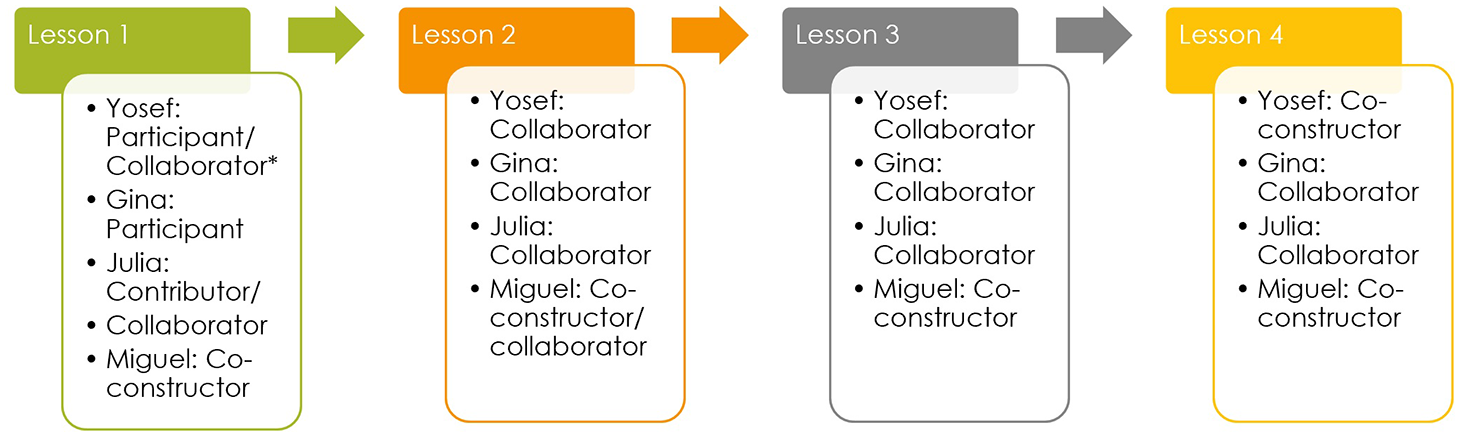
Children’s roles across lessons.
Yosef
Similar to all children, Yosef participated when invited by the teacher. However, his role shifted from participant in Lesson 1 to co-constructor in Lesson 4. Initially, Yosef repeated the teachers’ comments, and the teacher recast and complimented his responses, thereby recognizing his way of thinking and communicating as a valuable contribution to their community. The exchange below occurred as children discussed the video Energy during Lesson 1.
How else can we use energy in our daily lives? We can eat food (gestures eating food) and it gives us energy. How else can we use energy in our everyday life?
When you eat food and it gives you energy and you can run.
Yep, then you have energy. Then you can run so you can start moving and playing. That’s a good example.
As lessons progressed, Yosef shared his thinking about focal concepts, while the teacher prompted him to build onto others’ ideas, clarify, or elaborate. In one instance, the teacher guided children in asking questions about their observations about energy for a car atop a ramp. She drew upon Yosef’s and another child’s observations to model posing a question. Doing so positioned Yosef as a collaborator with his peers, thereby reinforcing collaboration to build collective expertise.
By Lesson 3, Yosef’s responses became more elaborate as the teacher continued to prompt, scaffold, and recognize his contributions. Below, children discussed a video about how inertia keeps a skateboard moving. A child shared his thinking, and Yosef added on.
I was thinking that [inaudible].
It was rolling and rolling. I like how you said that too. Go ahead Yosef.
When you use your feet, don’t use your hands cuz if you use your hands, it will go slow.
Yeah, maybe your feet make a little more energy–a bigger push.
You have to use your feet. And when you have a ramp, you jump over it.
Mhm.
. . .Then you jump with the skateboard, the skateboard will flip.
Mhm.
Over it.
That’s right. Then you give it another big push (gestures a big push), it’ll keep moving. . .Matthew what was your comment?
By Lesson 4, Yosef’s comments went beyond the focal concept. One such interaction occurred after Yosef participated in a friction demonstration. The teacher invited Yosef and Gina to slide on a smooth surface (tile floor) and rough surface (carpet) in their socks (another way disciplinary concepts connect to students’ lives). Subsequently, she read aloud a book about friction. As she prompted children to explain their observations, Yosef commented that friction can prevent falling (“Yeah, this is the ice skates. And then make them, they stop right there. . .so they don’t fall.”)
Gina
Similar to Yosef, Gina started as a participant. As the teacher “carved-out” space for Gina to contribute and recognized these contributions as valuable, Gina shifted to a collaborator. Initially, Gina shared little during discussions, and the teacher frequently referred to Gina as a model, ready for learning (e.g. I like how Gina is listening.” Or “Look how Gina turned her body this way. She follows Mrs. Pearson.”). She also invited Gina to demonstrate activities such as the prior friction example or online game playing. Subsequently, Gina offered more elaborate responses that built upon others using target vocabulary. The exchange below illustrates Gina’s collaboration during Lesson 3 as children discussed the video Inertia.
Ivan said he gave one good push and then inertia kept him going and he kept rolling cuz he didn’t put his foot back down. . .his body wasn’t doing anything else to stop it from rolling. Gina?
What’s that word called?
Inertia
When the boy’s doing the trick on the board, inertia helped him to go faster when he was going back down.
Inertia helped him to keep moving when he was going back down after his trick?. . .I love how you were thinking. . .Very impressive.
Julia
Julia started as a contributor; with teacher guidance (e.g. prompting and recasting), she also shifted to a collaborator. The following exchange illustrates Julia’s contributions during discussion of energy where the teacher linked an everyday experience to complex concepts. She demonstrated and explained potential and kinetic energy by holding and dropping a ball.
Does it have any kinetic energy left in it? (Points to concept map.) Moving energy?
No.
No so it’s just resting? What do you think Julia? Is it gonna keep moving or gonna stay there?
Stay there.
Stay there unless I give it more kinetic moving energy. I wanna look here and see if we can add anything [to the concept map]. . .
The teacher picked up Julia’s way of thinking and talking by prompting Julia to share her thinking, recasting, and adding Julia’s ideas to a concept map—recognizing her contributions to their communities’ growing understanding. Such actions positioned Julia as a collaborator, a role she readily assumed in later lessons. For example, the following interaction occurred as the teacher guided hypothesis construction.
. . .Good scientists make a hypothesis–a good guess about what they think will happen before they do an experiment. Who has a good guess–a hypothesis?
(Walks to the board) So this one will go more. . .here (Points to shorter ramp) and this one will go way over here faster (points to steeper ramp).
I hear Julia saying her hypothesis, her good guess is that on the higher, steeper ramp it’ll take it farther. If we imagine in our head that car going down Julia was saying, it’ll go farther over here maybe stop there? But on the one that has a lower steepness. . .It’s not gonna go as far that car. I want you [all children] to think in your mind. What do you think about the steepness? Is it going to go farther when the slope is lower. . .or higher?
Julia shared her hypothesis, and the teacher not only recognized her thinking and communicated its importance, she reinforced her role as collaborator (and co-constructor) by recasting Julia’s hypothesis as “the” hypothesis for peer consideration. As with Yosef and Gina, the teacher further supported Julia as co-constructor by inviting her to demonstrate differing activities, such as “fixing a problem” during online game play. Although the teacher continued to support co-construction, Julia maintained her collaborative role.
Miguel
From the start, Miguel “stepped into” learning as co-constructor, a role he maintained. Often, Miguel shared new ideas that extended a concept. In turn, the teacher prompted Miguel to elaborate and recognized his ideas. She also often (more often than other children) added his ideas to the concept map, which reinforced his co-construction. Take, for example, the interaction below. Miguel elaborated on an example of how inertia helps a ball move, explaining why the ball stopped.
. . .Inertia makes the object stay still unless something happens and inertia makes the object keep moving unless something happens because it’s already moving. Let’s look at the next two pages. . .Do you see something that has inertia working on it? Miguel, what do you see?
When the kid throws the ball, he catches back and then he throws it back up (gestures throwing and catching the ball.)
When it’s moving, it stays moving until the boy?
Touches it.
Until he touches it and that something happens to it so the inertia stops working. We can add that on. The ball, if it’s rolling or moving it keeps moving (writes this on the concept map.) That’s an example of inertia. . .
Later, a similar interaction occurred when discussing the video Inertia. Miguel’s contributions about inertia included a new concept—the weight of the object moving.
Why does the skateboard that’s in motion stay? Miguel?
Because he did a big push. Then with that big push, made it move a lot because cuz it’s not that light. . .but if the car is really not light.
If it’s moving it keeps. . .(Moves hand quickly away from body.)?
Rolling
It keeps rolling. It keeps moving. That’s another example of inertia. A skateboard moving keeps moving until something else happens to make it stop. A skateboard in motion stays in motion. (Writes statement on concept map.)
Themes across findings
Theme 1: Teacher facilitation evolved as children’s uptake and roles shifted
Across lessons, children maintained uptake of vocabulary and reasoning strategies as their roles shifted to more active participants in knowledge building. As the teacher implemented CTL, she decreased her teaching actions focused on vocabulary and reasoning strategies—i.e. she did less to build disciplinary knowledge. Concurrently, she varied how she helped children become increasingly active in knowledge building based on their differing ways of thinking, talking, and learning. While she tended to initiate discussion, as children responded, she “picked-up” on children’s varying contributions to facilitate knowledge building as a community—i.e. she leveraged the social and cultural dimensions of learning to position children as “knowledge builders.”
Comparison of Gina and Yosef provides an example of how teacher facilitation and child outcomes varied and evolved. Although they started as “participants” with contributions that “parroted” another’s idea, their process and teacher facilitation differed accordingly. Gina initially said very little during discussion, and the teacher cast her as a “model” (e.g. she frequently referred to Gina as being ready for learning.”). However, by Lesson 3, the teacher’s facilitation shifted as Gina self-initiated participation in discussion and demonstrated science vocabulary (i.e. inertia) and reasoning uptake. In turn, the teacher recast Gina’s contribution, recognizing it as valuable to their community’s growing understanding. Similarly, Yosef’s earliest contributions reflected a participant (i.e. Yosef often repeated another’s ideas) and the teacher complimented, prompted and scaffolded his elaboration. By Lesson 3, Yosef shifted to collaborator as he built upon the ideas of others, and the teacher responded with recognition and “space” to elaborate further (e.g. “Mhm.”). By Lesson 4, Yosef was a “co-constructor. As this comparison shows, although how the teacher facilitated shifts in uptake and children’s roles varied by child and time (e.g. Lesson 1 to Lesson 4), she consistently created instructional space that valued, recognized, and encouraged diverse ways of thinking, talking, and learning. Strategically leveraging the social (e.g. co-construction to support collective expertise) and cultural (e.g. differing ways of thinking and sharing understanding, connections to lived experiences) occurred routinely.
Theme 2: As children enacted literacy and science practices within a responsive instructional context, roles shifted toward more “active” and “collective” knowledge building
Across lessons, the teacher created a context for children to “do the work” of scientists with CTL. She consistently encouraged authentic science practices (e.g. observe, formulate hypotheses, conduct experiments). She also encouraged use of literacy practices as evidenced by how frequently the teacher introduced and engaged vocabulary and reasoning. Further, she framed knowledge development as a collaborative process, often inviting children to share thinking, elaborate, and build upon others’ ideas as seen in analyzes of “exchanges.” In turn, children demonstrated vocabulary and reasoning uptake (i.e. interdisciplinary knowledge—a cognitive outcome); concurrently, they shifted to more active roles, drawing from their knowledge to build knowledge as a community (i.e. social and cultural aspects of learning). Although all children shifted, shifts varied by child.
For example, Gina started as a participant, sharing little or repeating others’ comments. As she experienced CTL and teacher facilitation, she developed knowledge and a more active role, shifting to a collaborator. Yosef, too, started as a participant, drawing from his growing knowledge to eventually assume the role of co-constructor. Julia initially entered discussions as a contributor, with very brief comments (e.g. “Stay here.”); as she built knowledge and was supported, she shifted to a collaborator with more elaborate comments that built upon others’ ideas. Finally, Miguel maintained co-construction across lessons which was, in part, supported by his growing understanding of energy. As children’s knowledge and roles “grew,” they built knowledge “collectively.” Findings suggest children’s interdisciplinary knowledge development and knowledge building as a “collective” endeavor co-occurred when situated within a responsive instructional context.
Discussion
Findings suggest CTL holds promise in advancing diverse, young children’s interdisciplinary learning. In this study, the teacher supported interdisciplinary learning by connecting content and concepts within (e.g. cognitive connections) and across disciplines (e.g. use of science practices). She also leveraged children’s lived experiences by supporting in- and out-of-school connections (e.g. inertia keeps a skateboard moving), and encouraging ways of thinking, talking and learning that promoted collective expertise. Multimodal texts were integral resources that also provided an important connection to children’s word. While these practices were routine, specific teaching actions and facilitation varied by child. As children experienced instruction, they increased use of important vocabulary and reasoning and grew in their roles as learners, assuming more active roles to enact the “work of scientists.”
To understand and explain outcomes, we considered the possibility of the “co-evolution” of cognitive, social and cultural systems as children built knowledge as a community. The teacher targeted cognitive outcomes by supporting children’s science content and vocabulary development—i.e. disciplinary knowledge. Cultural and social dimensions were integrated through the teacher’s responsiveness to children’s ways of thinking, talking, and interacting as they grappled with complex science concepts and language. As children experienced this instruction, they increased interdisciplinary knowledge and assumed more active roles in “collective” knowledge building. Like prior research (e.g. Wegerif et al., 1999), findings suggest development of cognitive dimensions are tied to cultural and social factors, and may even hold reciprocity.
We also considered if this “reciprocity” expanded children’s social, cultural, and knowledge systems. Children experienced the many forms literacy and interdisciplinary knowledge take including their ways of thinking, talking, and learning and in broader contexts (e.g. education and science communities). The teacher supported connections between children’s social and cultural resources to build disciplinary knowledge. Similar to prior research (Mercer and Littleton, 2007 ), this knowledge was then used to engage in the complex thinking and reasoning underlying real-world application—i.e. use in scientific communities, thereby expanding children’s social and cultural repertoires. Because multimodal text is an important aspect of children’s out-of-school experiences, we also suspect its use provided important connections to children’s lived experiences and the “communication landscape of the 21st century” (Jewitt, 2008: 241).
Not only does this reciprocity among cognitive, social, and cultural dimensions underscore the importance of integrating them into classroom, it holds particular importance as individual, cognitive-based instructional approaches (Skerrett, 2020) and nondigital forms of literacy (Svärdemo Åberg and Åkerfeldt, 2017) dominate. Even in contexts attending to social and cultural factors, focus remains superficial (e.g. classroom libraries highlight books about diverse holidays and heroes [Lazar et al., 2012 ]) or “siloed” through separate cognitive, social, and cultural programing (Lee, 2020). Findings suggest that CTL provides teachers a clear alternative to “cognitive-only” and non-digital privileged” models of teaching and learning.
Finally, although use of CTL holds promise, findings also underscore the significance of how teachers act on these frameworks—in particular, moving away from one-size-fits all curricular models. While the teacher drew from CTL, she did so in a very nuanced manner—building upon children’s ways of thinking and positioning them as active participants, collectively engaged in the work of scientists. For some children, this simply involved inviting them into discussion, whereas for others, it involved more extensive actions over time. Thus, findings point to the importance of teachers drawing from CTL in ways that are truly responsive to and empowering for all students.
As we consider these findings, we are reminded of Gay’s (2018) words, “Although we may have only a yearlong interaction with students, we ultimately have a lifelong impact on who they become and the kind of society in which we all will ultimately live” (p. 40) underscoring the significance of educational equity. Given the persistent achievement differences between low and high-poverty and linguistically and culturally-diverse children, classroom that afford all children equitable learning opportunities are vital. Leveraging CTL to support all children holds promise in providing access to such contexts. Although future research examining a broader array of outcomes with larger samples in varying learning contexts is needed, findings from this study lay important groundwork for future research examining ways to support just and equitable opportunities for learning in our increasingly digital and diverse world.
Footnotes
Funding
The author(s) disclosed receipt of the following financial support for the research, authorship, and/or publication of this article: This research was funded by a grant from U. S. Department of Education, Expanded Learning through Transmedia Content 92815, Corporation for Public Broadcasting/Public Broadcasting System.
