




Abstract
This study explores how mothers in the US described challenges to their children’s (ages birth to eight) play experiences at home during social distancing due to the COVID-19 virus. Understanding their lived experiences is valuable because it will add insight into the effects of this unique time period on the critical role parent-child interactions play in children’s physical, social, and emotional well-being. Using a phenomenological design, interviews with 14 mothers revealed a common experience in which play efforts were altered at times due to challenges related to social distancing and COVID-19. Four themes described these challenges: Lack of Parent Resources and Support, Work and Child Care Balance, Children’s Struggles with Social Isolation, and Children’s Uncertainty Regarding COVID-19. Mothers believed it was their responsibility to keep their children engaged in play as part of their childcare duties. They struggled to balance work and childcare, did not always enjoy playing with their children, and desired alone time to recover during this challenging time. They sought to best meet their children’s needs but had to make allowances to their parenting practices and play attitudes. The authors discuss how more intensive parenting philosophies could be difficult to sustain when society does not operate as usual.
Early childhood experts maintain it is the right of a child to play (United Nations Committee on Rights of the Child, 2013). Play is the ideal way for children to explore their world, and this often happens in the company of others. However, children lost many of their typical play companions starting in early 2020 when the world began to experience a change in human socialization patterns as a result of the virus that causes COVID-19, SARS-CoV-2, or the coronavirus (Centers for Disease Control and Prevention, 2021). The World Health Organization (WHO) declared the virus a pandemic in March 2020, followed by the United States (US) White House declaring COVID-19 a national emergency (AJMC Staff, 2021). Soon after, local and state governments in the US began authorizing social distancing measures aimed at reducing the spread of the virus. Social distancing, defined as “deliberately increasing the physical space between people to avoid spreading illness” (American Red Cross, 2020: para. 1), caused disruptions in routines within workplaces, schools, daycares, and in daily life contexts. Social distancing efforts narrowed children’s learning environments to the home setting, and thus, parent care behaviors played a more critical role in how children engaged in play during social distancing. This study explores how parents, specifically mothers in the US, described their personal challenges and their perceptions of their children’s (ages birth to eight) play challenges at home during social distancing. Understanding these challenges as part of lived experiences is important because it can add insight into the effects of this unique period on the critical role parent-child interactions play in children’s physical, social, and emotional well-being
Literature
Parent-child play experiences
Play is difficult to define as there are many levels of variation used to describe it. Brown (2010) believes the play process typically holds seven properties: apparently purposeless, voluntary, inherent attraction, freedom from time, diminished consciousness of self, improvisational potential, and continuation desire (p. 17). For children, play serves as their “optimal vehicle for learning and development” (Isenberg and Jalongo, 2018: 41). It fosters growth in cognitive, language, literacy, social and emotional, and physical development (Isenberg and Jalongo, 2018; Yogman et al., 2018).
Humans have evolved to use play and playfulness as social and ecological ways to survive (Whitaker and Tonkin, 2019). Playfulness is considered a biologically born trait that allows humans to be creative and adapt amid changing contexts (Whitaker and Tonkin, 2019). Neurological studies suggest play experiences change the structure and functioning of several cortical processes of the brain, including the prefrontal cortex (Siviy and Panksepp, 2011). One study showed that rats who engaged in ample amounts of free play had a decrease in the complexity of dendritic branching in their prefrontal neurons, which led to efficiency in processing information received by the brain (Bell et al., 2010). Siviy (2016) states “play-induced plasticity in prefrontal functioning may then yield an adult that is better able to respond adaptively to changing environmental and social demands” (p. 836). Play offers a therapeutic outlet and is a supporter of health and well-being (International Play Association (IPA, 2020). It is a natural tool children use to manage emotions, gain a sense of control, cultivate happiness, cope with challenges, and build resilience (IPA, 2020; Nijhof et al., 2018; Stenman et al., 2019).
Play is greatly influenced by parents’ play attitudes (John et al., 2013; Sigel and McGillicuddy-De Lisi, 2002). Parents’ beliefs about how children best learn, how they themselves learned as children, and how they observe and reflect upon their children’s play practices will affect play habits (Fisher et al., 2008; Sigel and McGillicuddy-De Lisi, 2002). When parents become play partners, children can experience growth in their skills (John et al., 2013), but difficulties can also occur. Sometimes parents largely supervise instead of engaging in or scaffolding play (Jones, 2012) due to uncertainty of how to support play. Parents can also become too concerned about teaching children specific skills, which can then negatively disrupt children’s play (Shine and Acosta, 2000). Play expert Gray (2014) explains that parents do not always enjoy playing with their children because of their varying interests, children’s desires to repeat a set of actions, and differing levels of imagination that exists between them.
Parent-child play experiences during social distancing
Opportunities for social interactions and thus peer play decreased as a result of COVID-19 social distancing efforts (Dewhirst et al., 2021). Closures of daycares, schools, and workplaces precipitated involuntary and voluntary restrictions on social gatherings. Social restrictions are contrary to the usual human social experience (Sikali, 2020) as there is an evolutionary need to be near others and to form social bonds (Bjorklund and Jordan, 2013). For children, the formation of social relationships is essential to develop social-emotional competencies for overall well-being (Koivula and Huttunen, 2018). Access to peers and peer relationships is important for young children, as it is thought to decrease loneliness, promote self-esteem, and buffer against mental health consequences associated with stressful contexts (Osher et al., 2020). Research suggests the initial social distancing efforts for COVID-19 led to an increase in feelings of loneliness among some young children (Ullah et al., 2022), and exacerbated mental and physical health conditions (Pizarro-Ruiz and Ordóñez-Camblor, 2021; Schmidt et al., 2021; Segre et al., 2021). Positive relationships between children and adults are also essential for healthy development (Kerig, 2019; Trivette et al., 2010). Supportive parenting styles, which include parental warmth, responsiveness, and stimulation, are thought to promote children’s well-being (McFadden and Tamis-Lemonda, 2013). During the COVID-19 pandemic, most children had access to some adults, siblings, or even peers, depending on their social distancing circumstances (de Figueiredo et al., 2021); thus, social support systems were largely maintained through the family context.
Families faced significant disruptions in their households because of the pandemic (Gregus et al., 2022; Kaiser Family Foundation, 2020). Some stressors included “prolonged duration of isolation, infection fears, frustration, boredom, inadequate supplies and information, financial loss, and stigma” (Russell et al., 2020: 672). Those caring for children seemed to experience heightened stress (American Psychological Association [APA], 2020; Patrick et al., 2020; Russell et al., 2020). Gregus et al. (2022) found parents with children in elementary school were significantly more likely to report negative family impacts because of COVID-19. Stressors included having a child who could not go to school, schooling from home, and taking care of others while working. Tambling et al. (2021) found parents had to help children cope with their emotions while also trying to regulate their own. They risked compromising their self-care and well-being when trying to meet these many demands (Russell et al., 2020). Mothers reported taking on even more childcare responsibilities and feeling greater pandemic effects than fathers (Bennett, 2020; Gregus et al., 2022; Petts et al., 2021; Zamarro and Prados, 2021). However, not all families experienced “maladaptive outcomes” (Russell et al., 2020: 672) as resilience can exist within family systems. The literature notes several factors related to family resilience during the pandemic, including connections to social supports, strong relationships, positive parenting practices, new family routines, flexibility, and the use of coping strategies such as positive mindsets (Eales et al., 2021; Gayatri and Irawaty, 2022). Despite the negative changes that fell on society, many families were able to find stability and psychological adjustment at the family level (Chen and Bonanno, 2020).
Purpose of the study
Play is essential for learning and healthy development (Isenberg and Jalongo, 2018). During times of crisis (e.g. COVID-19 pandemic), play may be even more important (Tonkin and Whitaker, 2021). Social distancing efforts at the beginning of the pandemic narrowed children’s play environments to the home setting, and thus, parent care behaviors played a critical role in how children engaged in play. Our literature review offered evidence that parents and children did experience challenges in their daily lives because of the pandemic. We wondered how these daily challenges may have impacted play experiences.
A bioecological systems approach informed our study. This theory describes the manner in which humans live within “a series of nested and interconnected structures” (Bronfenbrenner, 2005: 45) that interact and influence the trajectory of development. Bronfenbrenner’s (1976) theory proposes a child’s environment is nested within five systems: microsystem or the structures that have direct contact with the child (e.g. parents), mesosystem or the relationships between microsystems, exosystem or factors that affect the child indirectly (e.g. parent work environment), macrosystem or the culture and societal laws that affect the child, and chronosystem or events or transitions that occur in the child’s life. Those systems closest to the child have the greatest influence on development. When considering the effects of social distancing efforts, children’s most proximal processes were often those in their household and in the parent-child relationship. Parent-child relationships are nested within a variety of other relationships, societal structures, and environments that bidirectionally affect one another. For example, parents are impacted by contexts (e.g. job opportunities, societal structures, and social economic factors) that can affect parent mental health and family processes, and in turn affect parenting behaviors and thus child play behaviors (Ashiabi and O’Neal, 2015). Using a systems perspective provides a basis for understanding the experiences within the proximal processes of the parent-child relationship as it relates to play behaviors (microsystems) while we consider ripple effects occurring across all systems (mesosystem, exosystem, macrosystem) during the COVID-19 pandemic (chronosystem). The research question for this study was: what were the perceived challenges to parent and child play practices and experiences during social distancing?
Methodology
The purpose of this study was to describe common “lived experiences” (Van Manen, 1990: 9), and specifically the perceived challenges, among mothers of young children during social distancing as they narrated their children’s play experiences in the home. We used a qualitative, phenomenological approach for this research. A phenomenological approach is appropriate when trying to document a group of people’s “affective, emotional, and often intense human experience” in response to an event (Merriam, 2009: 26).
Participants
This research stems from a larger study (Dewhirst et al., 2021). In phase 1705 participants were recruited via social media and completed a 48-item questionnaire regarding children’s play behaviors during the early part of the pandemic. Participants were asked to provide an email address for a follow-up interview concerning play experiences in their household during social distancing. From the volunteer list of 231 participants, we randomly selected every 10th entry. Participants were recruited via email. A total of 14 participants were interviewed, which is within the recommended sample size for a phenomenological study (Creswell, 2013; Morse, 2000).
Participants were recruited based on the strategy of criterion sampling or meeting a set of predefined criteria (Moser and Korstjens, 2018). Participants were 18 years of age or older, had at least one child 8 years of age or younger, and lived in the US. Semi-structured interviews took place between May and July of 2020. Interviews ranged from 30 to 60 minutes in length. Mothers were asked questions about their families’ social distancing experiences, their children’s play behaviors, and challenges to play experiences during social distancing. For example, “tell me about your family’s social distancing experience” and “what type of play behaviors did you see your child engaging in during the social distancing period?” All participants for this phase of the study identified as female and were between the ages of 30 and 50. More than 75% of participants held a bachelor’s degree or higher. Eleven out of 14 participants were in medical or education fields. Geographically, they lived throughout the US, with three coming from the southern-central state of Oklahoma and two from the mountain-west state of Colorado. This was likely due to the sampling procedures from phase 1 of our study in which we used non-probability sampling and distributed our questionnaire via social media outlets. Additional demographic information is provided in Table 1.
Participant demographics.
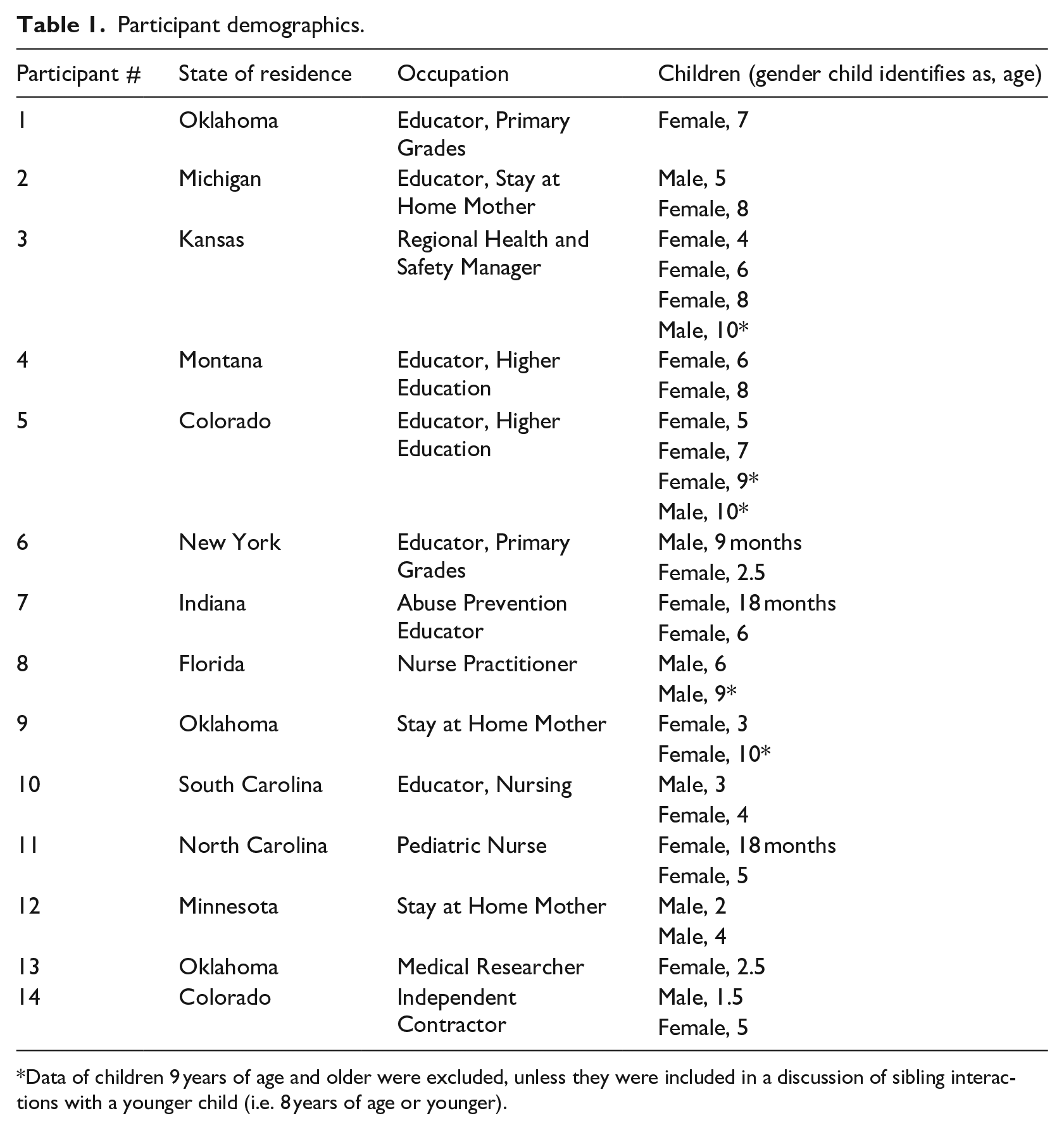
Data of children 9 years of age and older were excluded, unless they were included in a discussion of sibling interactions with a younger child (i.e. 8 years of age or younger).
Data collection and analysis
The study was ethically approved by the University’s Institutional Review Board. Semi-structured interviews were conducted through Zoom. The researchers used an interpretative phenomenological analysis as we attempted to understand the lived experiences of our participants and interpret their experiences and perspectives within the context of our research (Smith et al., 1999). Coding began in Dedoose, a cross platform-app. We reviewed the data set (Miles et al., 2014) and developed a coding frame to use with the raw data (O’Connor and Joffe, 2020). Codes were applied to provide meaning to the participants’ narratives (Sutton and Austin, 2015). A small segment of the data were used to initially compare code patterns, discuss misinterpretations, and refine codes as needed. Coding the same transcript, using line-by-line analysis, and discussing similarities and differences in codes helped establish credibility in our research findings (Sutton and Austin, 2015). We continued to double code the remaining data, engaging in reflective conversations throughout the entire coding process. During the second cycle of coding, codes were organized into categories and subcategories as patterns emerged. We noted, as we pulled the codes together, that there were themes running through the narratives. These themes give meaning to the participants’ experiences of the phenomenon and we, as the researchers, interpreted meaning from these themes.
We used a variety of ways to achieve trustworthiness in our interpretation and description of the participants’ narratives (Sutton and Austin, 2015). We sought out intercoder reliability, in which we checked for “stability of responses to multiple coders of data sets” (Creswell, 2013: 253). Some codes and categories were refined and examples were provided to define these codes and categories. The global themes were discussed and revised among the researchers during the data analysis process. The findings are reported in such a way that they are supported by the participants’ quotes so as to help us to tell their experiences (Merriam, 2009).
Findings
The purpose of this study was to describe common lived experiences, and specifically the perceived challenges, among mothers of young children during social distancing as they narrated their children’s play experiences in the home. We found the mothers’ overall common experience was that play efforts were disrupted or challenged at times because of factors related to social distancing and the COVID-19 pandemic. Four themes described these challenges. The mothers’ words are used to narrate their experiences with their young children.
Lack of parent resources and support
Categories under this theme speak to the parents’ perceptions of a lack of resources (both material and mental) and support to facilitate play.
Parent perceived obligation to stimulate play
Mothers believed they needed to support children’s play through stimulation and other means. They mentioned children getting “bored” and found it challenging to “entertain them all of the time.” One mother commented:
When I was a kid, you would just go outside and you would figure out something to do. . . My kids. . . they just couldn’t do that. . .They just didn’t know what to do unless you could direct them and tell them exactly what to do. They very much need some type of guidance on play.
In addition to providing ideas to children to stimulate play, mothers used schedules, bought materials and items, and sought to go outdoors. One said, “In the beginning, I was trying to be supermom. We had a color-coded schedule. I was in there with them playing a lot more. I was trying to. . . not control the play, but probably control the mess, honestly.” Supplies such as trampolines, bikes, playhouses, and even pets were brought into homes to facilitate play. Outdoor access (with good weather) was mentioned by almost all participants as a necessity for play as one mother explained:
March and April, I feel like it literally rained, almost every day, which made this whole situation so much harder. . .But the past month it’s been a lot easier because we’re able to go do outdoor play.
Social distancing challenged and changed mothers’ perceptions of what were beneficial play opportunities. They worried that not attending their usual extracurricular or community activities, such as visiting child-friendly museums, going to girl scouts, or taking part in library storytime, would affect their children’s well-being. They expressed the need to change their perspective in this area of parenting. One explained, “It’s been like a new mindset for me to be okay with being slow about the things we’re doing.”
Parent lack of enjoyment in play
Without access to other children, mothers felt the burden of being a playmate. Many acknowledged they often did not enjoy engaging in the type of play their children typically chose. One mother stated:
I don’t engage in imaginary play except to interject a thought. . . but I’m not a playmate. I just don’t have the time and I think even if I had the day ahead of me, that’s not how I fill my time (laughs).
Another mother, who attempted to engage in play, noted her lack of interest, stating:
I think part of it’s me getting bored too. I’m kind of Star Wars out. I can only come up with so many things for these Star Wars characters to do, and I’m kind of sick of the “pew pew pew,” and this is my blaster and this is my lightsaber. That’s not how I want to play, but I know that’s what you’re really into so I’m trying to go along with that, and I’m trying to weave whatever I want to in with it as well. But I’m like, “Can we please not have another blaster?”
To combat play fatigue, mothers often structured the play toward activities they enjoyed such as storytelling, games, and puzzles.
Parent need for downtime
Mothers discussed the need for personal time to rejuvenate their play support. Although interacting with their children was a priority, lack of access to pre-pandemic supports (i.e. school, family, extracurricular activities, etc.) lessened their alone time. They sometimes felt “tired” or “unmotivated” to provide their full attention to play and desired “to do an adult thing.” One mother described her children’s attention demands:
Both of my kids are a lot needier than they ever were before. It’s just constantly “mom, mom, mom,” and it wasn’t like that before. I think they were getting that attention and interaction from other places.
However, mothers had various avenues to find “adult time.” One mother described enforcing daily quiet time rules: “I need this quiet time. You are in your room. You’re reading books or playing with a toy, but you are not allowed to come talk to me. It’s my adult time.” Another mother noted she found a way to have alone time by engaging in a type of parallel play with her children:
It’s like I’m doing my own parallel independent play. . . because if I went and washed the dishes, or if I went and tried to read my book, they would be on top of me. . . but for some reason, if I’m playing, but I’m making a choice that’s my own choice, and you don’t have to do it, they’ll kind of leave you alone a little bit. It’s like they watch you play, and they’re like, I don’t want to do that, but I’m not gonna force you to stop playing. Like, play is what’s the important thing here.
Other mothers mentioned they changed their prior expectations of parenting to find adult time:
My husband was joking the other day, and he’s like, “I mean, when did your parenting start to suck?” Cuz, we’re usually very like old rules and very careful with risk. And now I just throw my children outside, and I lock them out there for half an hour, and they are expected to play on the swing set, and my two-year-old is a climber, and she has started climbing trees, and I’m like “Eh, whatever.”
Work and child care balance
Mothers felt conflicted between completing work, maintaining the perception of work availability, and wanting to meet their children’s play needs. The word stress was frequently used when discussing working from home conditions. The following comment reflects this internal conflict:
I teach year roud and so nothing slowed down for me in terms of work. And being a junior faculty member, I’m the only one with children this age. So while I have the accommodations and the flexibility to work from home, being the parent I want to be is not happening.
Mothers mentioned feeling stressed when children interrupted Zoom meetings and phone calls. Work demands and family time bled into each other. Some mothers reflected on their inability to be completely present with their children while trying to play and also think of work tasks. For example, a mother commented that while she is playing with her child, in the back of her mind, she is thinking about how she should be working. Another mother stated:
With me home, it’s not like if I were home without a job. I have a pretty all-consuming job. So, in some ways that’s given [the children] these limitless boundaries. They have some real independence. That comes with backlash for me sometimes. Like, oh, my gosh, I did not know they were running the hose in the backyard for an hour yesterday that has now created river patterns. So, I think that’s the challenge. I’m home, but I’m not home.
Some mothers tried “taking breaks to engage” with their children, setting the children up with an activity, putting their older children in charge of their younger siblings, and increasing their children’s time with televisions or computers.
Screen time was used for children’s schoolwork, alleviation of boredom, and as a way to provide parents time to accomplish work tasks. Mothers expressed regret for this change and worried about how it might impact their children, as they believed screen use could lessen the quality of play and other stimulating activities. One, who apologized for getting emotional about the topic, said,
We’re on screens now. It irks me as a healthcare provider and an educator, because we didn’t [used to] do it. And I grieve that because we were so intentional and sacrificial in that way. And now we’re having to resort to it.
Another mother explained that prior to social distancing, her daughter was only allowed up to an hour per day of screen use, but that routine quickly changed when social distancing began. She commented:
Now we have a TV in the playroom. I just don’t have the energy to fight about it all the time, or if I’m working I need them occupied. Like, I’m joking that she’s basically going to preschool on Sesame Street right now.
Children’s struggles with social isolation
Mothers perceived that play was sometimes difficult for their children because social distancing changed who children had contact with during the pandemic. For most of the mothers who were interviewed, interactions with others outside the household were limited. Mothers narrated the disadvantages of this new social isolation for their children and the play context.
Lack of access to peers
Children’s lack of access to same-aged peers was a common challenge. Children frequently expressed their desire to see friends, neighbors, and cousins. One mother stated her daughter would dramatically sigh and express she would never play with her friends again. Another mother shared that her daughter would discuss missing her friends before falling asleep at night. Several mothers discussed how their children began using virtual platforms to see peers, but noted it did not offer the same comfort as a face-to-face meeting. The following comment was from one participant, who had a two-and-a-half-year-old daughter:
We’ve also done a couple of virtual library classes where there’s been other kids in the storytime. But she gets bored of it quickly. She’s young. She’d much rather see them in person, and she said, “I miss you. I see you when virus over. My friends!”
Several mothers noted children’s disinterest with peers over virtual platforms. This participant discussed her 5-year-old daughter’s unease during a Zoom call:
That first Zoom call we had with the 10 kids. She got about halfway through it. She had to stop. It was too much. And she just crawled onto my lap and just had a quiet little meltdown. Not being able to actually play with them and not being able to actually touch them was really weird.
One participant mentioned her 7-year-old daughter did not play well by herself. The lack of access to other peers or siblings inspired her to build an imaginary playmate:
She watched some Styrofoam head [video], and they decorated it to be their friend during quarantine. She begged for this Styrofoam head you would keep a wig on because she wanted to decorate it and have someone to talk to. And so we got this Styrofoam head, and she drew eyes on it and like lips and decorated it. . . He’s just a white styrofoam head she’s named Jimmy that she talks to and kind of like wrestles around with a lot. . .And when she’s frustrated she’s stuck at home, she kind of will bang him around some and likes to see, since he’s Styrofoam, indentions on things when she pushes him on things. . .
For those children with siblings, the mothers described an increase in play engagement together. Sometimes, more time with siblings created challenges. They contended the children grew bored of each other or were frustrated as they struggled to play. One participant stated her children “weren’t the greatest playmates.”
Regression in social skills
Most of the mothers described their children as regressing in their play social skills or exhibiting new challenging behaviors. While the behaviors the mothers saw differed, they connected them to the social isolation context. One stated:
I think we’re missing out on the early socialization of [18-month-old] where she can be around her peers and starting to learn like sharing. We’re starting to get a lot of tantruming when she has to share. I think she’s missing out on just some of that social interaction.
Tantrums were mentioned by another mother, who saw her daughter’s frustration with the social distancing context when she was finally allowed to play with her best friend:
Sulking and tantruming when [she doesn’t] get [her] way. We’ve just hit the point where we’re just kind of letting them duke it out, not physically, but, you know, work it out and, you know, sometimes my husband’s like “you’re letting them yell at each other,” and I’m like “they gotta get this out, the pandemic sucks. We’re all tired and frustrated. Like, this is how it’s coming out.”
Other participants noticed an increase in separation anxiety affecting children’s behavior and play. Mothers mentioned children forgetting to ask for permission, not obeying directions, and having an inability to be alone. One mother stated her children were now desiring and playing with attachment objects they did not need prior to the start of social distancing:
They’re both starting to sort of have something they’ll attach to for a day or two and kind of carry around. So, [daughter/5 years olds] currently has a pet rock named Rockla. And it lives in a magnatile castle in her room and sleeps in a bow bed, and God help us all if we can’t find Rockla.
Children’s uncertainty of COVID-19
The mothers described how the feelings of uncertainty of the COVID-19 virus affected children’s play behaviors, and this was concerning to them. Children asked questions about the harms and duration of the virus and wondered when they would see people outside the household. Some children showed distress when their parents would leave the house, and their feelings of the unknown of COVID were projected in their play. One mother stated:
I’ve also seen some darker themes coming up, and we talked very openly about COVID, but there’s definitely been more death play. There’s been more play where the parents are dead. She is playing more that she’s in charge of things.
Another mother noted:
My six-year-old, she’s always been one to collect things on our walk, whether it’s little nature things like rocks, or if she sees something shiny that’s probably a piece of trash. She’ll pick things up now. . . she freaked out and said it might have coronavirus on it. So, she no longer collects things on her walks.
Other mothers noticed their children wearing masks and protective gear during play, pretending to use hand sanitizer, and dressing baby dolls up in masks. Battling COVID was mentioned several times, with examples including destroying the virus with a sword and playing a version of tag where the objective was to keep away from the child designated as “having COVID.”
Discussion
The aim of this study was to shed light on mothers’ experiences and perceptions of their children’s play practices during the early period of COVID-19 social distancing. We found the common experience for mothers was the disruption or changes to play as a result of factors related to social distancing and COVID-19. Some of the challenges were specific to the mothers’ experiences while others concerned their perceptions of their children’s challenges. Social distancing was perceived as difficult for the mothers because of a lack of access to social support and resources. With limited social contacts, mothers felt they needed to find ways to entertain their children or support their interests. Mothers discussed engaging their children in play, creating play schedules, acquiring supplies, and seeking to go outdoors to support play. They believed it was their responsibility to keep their children engaged in play and they worried when they could not.
Mothers struggled with work and child care balance and acknowledged changing their parenting practices as a result. These changes to parenting practices fed into the way they felt about their children’s play environments. They were conflicted between work obligations and wanting to meet their children’s needs. They also felt they could not be as present with their children either physically or mentally, which brought forth feelings of stress. Similarly, mothers found the need to engage their children in activities to be challenging, as they did not always enjoy playing with their children and also desired alone time to complete adult tasks. They grew weary of child-directed themes and repetitive play behaviors and felt exasperated by the lack of other play partners, outlets, and settings. For example, one mother commented how she was bored with Star Wars-themed play episodes. This strong desire to create a child-centered environment seems to fit with a parenting style that permeates Western cultures called intensive parenting (Forbes et al., 2020; Hays, 1996; Schiffrin et al., 2015). The term describes the pressure women can feel toward childcare tasks and toward ensuring “optimal intellectual, social, and emotional child outcomes” (Schiffrin et al., 2015: 2323). While more responsive parenting practices are linked to better child developmental outcomes, Schiffrin et al. (2015) state there is little evidence an intensive approach to parenting results in greater benefits. It has been linked to poorer maternal mental health (Rizzo et al., 2013) as well as deficits in children’s later social-emotional skills (Schiffrin et al., 2015).
Social distancing may have created an environment more conducive to intensive parenting and perceived pressure to play, as mothers attempted to maintain a sense of normalcy and routine and put schedules and parameters on play in order to fill a void. However, these actions may have actually contributed to burnout, stress, and guilt as they were unable to keep up with their own expectations. This opinion agrees with Gray’s (2014) statement that parents are “poorly equipped” to serve as adequate play partners, in comparison to children (para 14). Gray (2014) notes that adults do not always have the same energy levels, interests, or senses of humor as children. Our results also support Russell et al.’s (2020) findings that parents felt greater caregiver burdens during the early part of the pandemic, and in fact, were likely to compromise their own well-being in order to care for their children. Yet, mothers in our study also mentioned letting go of or re-evaluating their parenting values. They sometimes became emotional when narrating how they needed to reconcile their decisions during an uncertain and stressful time. For example, for many of the participants, screen time increased, which was contradictory to several of the mothers’ parenting philosophies prior to social distancing. Perhaps more intensive parenting philosophies are difficult to sustain when society does not operate as usual.
Other challenges mothers discussed were what they perceived to be their children’s struggles with play as a result of social isolation and the uncertainty of COVID-19. The children showed signs of or directly stated they missed their friends. Their play had underlying themes of COVID-19 with protective gear, battles with the virus, and death. Mothers noted a regression in social skills and an increase in what they believed to be more challenging behaviors because children lacked access to peers, had a break from usual routines, and had an increase in technology use. This is similar to other studies that found children felt increased loneliness during the pandemic (Ullah et al., 2022), which for some children led to a decrease in behavioral health (Patrick et al., 2020) and an increase in anxiety and distress (Rosen et al., 2020). We do not know if children were exhibiting more challenging behaviors or if mothers’ perceptions of these behaviors changed due to new routines or the mothers’ own stress.
Implications and conclusions
Mothers reported feeling stressed as they tried to balance taking care of their children’s needs while also meeting their own needs. Several worried about being the best versions of themselves. Literature on resilience shows that in order to promote children’s well-being, we need to nurture the most proximal processes in children’s lives, that is, supporting and caring for their caregivers (Luthar and Eisenberg, 2017). Based on our participants’ experiences and our findings, we offer suggestions on how to support parents. First, online parent support groups could help mothers connect with other parents in order to problem-solve areas of concern. Second, to nurture children’s play, opportunities for socialization in a safe environment with other children should be a high priority. Play could be advocated in the school setting and encouraged during social distancing in pre-designated play pods. Play could also be supported in the home and could include family members, as play allows for stress release for all ages (Wang and Aamodt, 2012) if it is a type of play that all parties agree is enjoyable (Gray, 2013). We believe the focus should be on positive parent-child play encounters so as to reduce parent burnout and stress (see Cohen, 2001). Finally, mothers can use children’s play scenarios as a means for discussing crises, like the COVID-19 virus, so children can process their feelings of uncertainty and build resilience in a safe space (Cohen and Gadassi, 2018).
Limitations and future research
This study consisted of 14 participants, and because of our small sample size, our study lacked diversity. Evidence suggests some families were more affected by the pandemic than others; particularly people of color and those who are economically marginalized (but see Gregus et al., 2022). Since our study looked at the experiences of a small sample of mothers, our findings are not generalizable to the overall population (Merriam, 2009). Eleven out of 14 participants were in a career in the medical or nursing field and therefore could have seen play as more important to health and well-being than other mothers. This study did not include fathers’ perspectives and this was certainly a limitation. Future research should further explore both mothers’ and fathers’ experiences during the pandemic from a diverse sample of participants. The researchers of this study also did not ask the mothers what types of support they felt they needed to overcome some of the challenges they faced. A future study could use a qualitative methodological approach to understand what mothers believe they need to support play in the home setting.
