



Abstract
According to the National Center for Educational Statistics, more than 85% of U.S. children under the age of five attend pre-Kindergarten programs. When COVID-19 quickly caused much of the nation to close preschool programs with very little notice, the structure of education changed dramatically. The purpose of the present study was to explore two specific aims: First, the study examines the role of self-efficacy in educational involvement during COVID-19; and second, the study examines the impact of perceived resources on parental efficacy and involvement during COVID-19. Parents of pre-K students reported on their perception of the educational program’s resources and their own involvement and feelings of self-efficacy toward their child’s education. Results indicate that resources, self-efficacy, and involvement were challenged by the pandemic. Taken together, these results strengthen existing research on educational efficacy, parental engagement, and perceptions of resources during times of adversity.
Introduction
According to the National Center for Educational Statistics (2020), more than 85% of U.S. children under the age of five attend pre-Kindergarten programs. It is lauded that pre-kindergarten (pre-K) programs offer the best possible results for children’s educational success, and some claim that it acts as an “equalizer” for children whose parents have less education or are less involved (Cebolla-Boado et al., 2017). However, childrens’ educational and developmental outcomes are impacted greatly by parental involvement (Watson et al., 2012). When COVID-19 quickly caused much of the United States to close schools with very little notice, the structure of education changed dramatically. In the present study, parent experiences and perceptions about their children’s pre-K programs at the start of COVID-19 were examined. Specifically, we examine parent’s efficacy and engagement surrounding their child’s education, a critical factor in children’s cognitive and social development.
Parent involvement and perceived resources
Parental involvement in education has numerous benefits to children. Parents are the main educators in a child’s life until they go to school, but even after children are in school, parents have a profound impact on a child’s learning and development. Some have suggested that parent engagement is the single biggest predictor of child academic success (Cotton and Wikelund, 1989; Dufur et al., 2011). Trotman (2001) claims that parent involvement allows for a partnership between home and school to more effectively meet the child’s needs. A wealth of research finds that parent involvement in education is beneficial for students across age groups and populations (Watson et al., 2012), beyond the impact of socioeconomic status (SES) and family dynamics (Jasso, 2007).
The focus of the current study was educational involvement from parents, which was defined as actively participating in educational activities, being present in a child’s learning, and attempting to construct an encouraging environment that facilitates the child’s growth and achievement. There are positive academic outcomes when parents are engaged with their children’s education including higher grade-point averages, increased achievement in reading, writing, and mathematics (Anderson and Minke, 2007), lower dropout rates, fewer absences, grade retention and special education placements (Brody et al., 1999; Watson et al., 2012), improved classroom behavior, more time spent on homework, and more optimistic expectations for their educational futures (Watson et al., 2012). Further, Watson et al. (2012) suggest that academically involved parents instill a love of learning that translates to a sense of pride in academic achievement.
In addition to educational benefits, parent involvement is related to socioemotional benefits. Parent interest in education is related to self-concept and socioemotional development including social adaptedness and positive school behaviors (Watson et al., 2012). According to Anderson and Minke (2007) parental involvement increases children’s abilities to self-regulate behavior and is associated with higher levels of social skills. Nguyen et al.’s (2020) study examined Chinese parents’ involvement in their childrens’ education and the impact on peer status and internal characteristics (Suzhi, an indigenous concept of China, similar to a positive psychological quality). Nguyen et al. (2020) found that at all levels of SES, parental involvement was associated with positive internal characteristics. As such, their results indicated that parental educational involvement had a direct impact on Chinese childrens’ acceptance from classroom peers, an effect moderated by SES. Interestingly, children from low SES homes did not benefit from parental involvement. In these cases, Nguyen et al. (2020) suggested that the quality of involvement may have been poorer due to parent education and family economic stress. Coupled with the fact that during COVID-19 many parents were also serving as their child’s primary educator, these factors may be further compounded. In fact, Westrupp et al. (2021) indeed found in studying Australian families, that compared to pre-pandemic measures, parents were more depressed, anxious, stressed, irritable, expressed less positivity in their families, and had reported increased alcohol consumption after the pandemic began, and that financial and health factors exacerbated these. To this end, the present study seeks to examine factors that may impact parent involvement during COVID-19, including perception of resources.
Extant literature suggests that barriers to educational involvement among teachers mostly stems from a lack of training (Davidson and Dell, 2003; Dixon-Elliott, 2019; Langbort, 2001). To the extent that COVID-19 incited new social distancing procedures that necessitated that many parents navigated providing childcare and educational assistance while working from home, it is reasonable to infer that a perceived lack of resources (e.g. training, educational materials, technology support, accessibility) may impact parents’ educational involvement. In research on teachers, training programs are found to boost preparedness (Davidson and Dell, 2003; Langbort, 2001). As parents navigated the many transitions that came with the initial stay-at-home orders and during the pandemic, preparedness for helping their child complete educational tasks at home was lacking.
Additionally, research shows that barriers to parental involvement in educational settings may involve negative attitudes from schools, poor communication between the school and family (Trotman, 2001), conflicting obligations—especially for low-income families (Weiss et al., 2003), differing parenting styles (Jasso, 2007), and lack of policies that support paid sick time (Bracey, 2001) continue to impact parental involvement. Stites et al. (2021) found that it was common that parents of preschool children were responsible for engaging in literacy-based distance learning activities during the pandemic, and that many parents pointed to time as a primary factor hindering their ability to provide educational activities for their child.
In a study of Turkish parents and preschool teachers during the pandemic, parents reported feeling a great deal of responsibility for their child’s education (Yıldırım, 2021), but also felt there were a lot of challenges to being involved in their child’s distance learning. Some of these challenges include lack of resources and low self-confidence. The researchers found that with quality parent-teacher communication, parents felt encouraged to be involved in their child’s distance learning activities.
A study of 764 households, conducted in Wuhan, China, found that caregivers were generally less involved in their child’s education at home than they were before the pandemic began, and parental involvement was lower for families with younger children, lower socioeconomic status, poorer physical health, and higher levels of household chaos (Zhang, 2021). However, there was a positive association between parental involvement and preschool children’s academic behaviors and emotional health.
While it is clear that parental involvement is beneficial, studies have discerned which types of involvement in typical circumstances are most beneficial. In a meta-analysis of 448 studies, Barger et al. (2019) found that home-based (discussions about and encouragement around schooling) and school-based (participation in conferences and events or PTA membership) parental involvement both have a small to moderate positive relation to child’s academic achievement, engagement and motivation. However, parental help with homework had a negative association with academic achievement and a positive effect for child’s engagement. Others have posited that home-based involvement such as having high expectations for how far the child will go in school is predictive of higher cumulative high school GPA and educational attainment, and parental provision of academic advice has been found to boost achievement for already advantaged youth (high-SES, high prior achievement; Benner et al., 2016). Literature often points to parental involvement as a means of closing outcome gaps among ethnically-racially diverse students (Cebolla-Boado et al., 2017). In fact, Day and Dotterer (2018) found that home-based involvement is particularly beneficial for educational attainment among African American and Latinx students. Further, school-based involvement such as parent participation in school functions and activities is a positive predictor of GPA, high school graduation, and postsecondary enrollment (Benner et al., 2016; Ross, 2016). Parent involvement in school activities was particularly beneficial for disadvantaged students (low-SES, poor prior achievement; Benner et al., 2016). However, the lines between home-based involvement and school-based involvement are quite blurred during the time of COVID-19. Similarly, boundaries between parent and teacher responsibilities have blurred. For this reason, the present study explores the relationship among these parental variables during the global pandemic.
Some research has examined reasons for varying levels of parental educational involvement. Various factors seem to boost parental involvement, including child disability factors, income, parent education, and teacher support (Rispoli et al., 2018). Parent social networks, on the other hand, predict parent involvement, perhaps due to boosting efficacy, knowledge, and skills around educational involvement (Sheldon, 2002). Research suggests that parents may need guidance on how to become involved, especially for early childhood education (Kurtulmusk, 2016).
Parent self-efficacy and educational involvement
One mechanism that may be a key motivational factor in parents’ educational involvement is self-efficacy (Hoover-Dempsey and Sandler, 1997). Self-efficacy refers to a person’s cognitive evaluations of one’s perceived competencies for themselves for learning or performing actions at designated levels (Bandura, 1977). Human achievement is significantly affected by one’s level of self-efficacy and is influenced by various personal, social, and contextual variables (Bandura, 1977). Parental self-efficacy is the parents’ confidence in the ability to raise their child (Jones and Prinz, 2005). Parental self-efficacy extends beyond the parents’ cognitions to impact their parenting behaviors and their child’s general development (Coleman and Karraker, 2003; Weber et al., 2019). Mouton et al. (2018) suggest that the more a parent feels competence, the more they engage in supportive parental behaviors with their child, which may suggest that self-efficacy is an important pathway to parental involvement.
Parent self-efficacy is related to favorable outcomes for children, such as self-esteem and self-efficacy for early adolescents (Whitbeck, 1987) and child adjustment (Jones and Prinz, 2005).
A study of Korean and Japanese primary school children found that Japanese mothers’ education and parenting self-efficacy predicted higher child school-related competence, and parent self-efficacy moderated the effect of parent education on school-related competence (Holloway et al., 2016). In the Korean sample, Holloway et al. (2016) found that household income had a direct effect on the child’s school related competence, as well as an indirect effect through parenting self-efficacy. Similarly, Tazouti and Jarlégan (2019) discovered that French mothers’ (but not fathers) self-efficacy and involvement mediated the relationship between family SES and child academic achievement. Taken together, these studies suggest that self-efficacy about parenting influences children’s educational outcomes. As such, the present study specifically examines parents’ self-efficacy about their child’s education.
There seems to be a modeling effect of self-efficacy, such that parents model self-efficacy and their child learns from the parent to be self-efficacious (Bandura, 2010). Parents and teachers should want to instill high levels of self-efficacy in children because it leads children to believe they have the skills to help them succeed in their goals in an academic setting. Research supports the idea that self-efficacy influences the instigation, direction, persistence, and outcomes of achievement-related actions (Schunk and Pajares, 2002). Jones and Prinz (2005) proposed that parent self-efficacy works as a “transactional” mechanism, such that higher parent self-efficacy makes parenting techniques more effective, whereas lower efficacy predicts frustration and struggle with parenting.
Again, here it is not difficult to imagine that parental self-efficacy was likely disrupted during the difficult circumstances at the start of COVID-19 spread in the United States. Thus, to gain an understanding of factors that may impact parental involvement during COVID-19, the following research questions are posed:
1: Is there a relationship between parental self-efficacy and involvement in their child’s education during COVID-19?
2: Do parental perceptions of institutional resources influence parental efficacy and parental educational involvement?
Method
Participants and recruitment
After obtaining IRB approval, 50 parents were recruited through social media and online listservs. To qualify for this study, participants were required to (a) be 18 years of age or older, and (b) be a parent of a student currently enrolled in a pre-kindergarten program. Parents interested in completing the study were directed to the online survey posted using Qualtrics. The participants in this study included 5 (10%) males and 43 (86%) females (two participants, 4% did not indicate their gender identity), ranging in age from from 29 to 44 years old ( M = 35.44, SD = 3.76). The majority of participants (85%, n = 42) identified as White/Caucasian, with 4% (n = 2) identifying as Black/African American, 2% (n = 1) identifying as American Indian, Alaska Native, or Indigenous American, 2% (n = 1) identifying as Hispanic or Latino/a/x American, 2% (n = 1) and identifying as Asian American. Approximately 6% (n = 3) preferred not to specify their ethnic-racial identity. Further, all participants resided in the United States, primarily in the midwest.
Measures
Participants responded using self-report measures via Qualtrics.
Institutional efficacy
Parent self-efficacy related to the child’s educational institution was measured using an adaptation from existing measures of self-efficacy (Armitage and Conner, 1999; Sherer et al., 1982). Parents were asked to respond to nine items using a Likert-type scale that ranged from (1) strongly disagree to (5) strongly agree. Sample items are: I believe I have the ability to take leadership positions in my child’s school. To what extent do you see yourself as capable of influencing your child’s education? If it were entirely up to me, I am confident that I would be able to have influence in my child’s education. Reliability for the current sample was sufficient (α = 0.79).
Instructional self-efficacy
Additionally, parents used a single item to rate to what extent they feel they have the skills and control to be influential in their child’s education using a scale from (1) not at all to (5) a great deal.
Active institutional engagement
To measure parents’ engagement in their child’s education, a subscale called “School-based involvement” from the Family Involvement Questionnaire (Fantuzzo et al., 2004) was selected. Parents were asked to respond using a Likert-type scale (1) rarely to (4) always regarding their school-based involvement (e.g. I participate in parent and family social activities with the teacher; I participate in planning school trips for my child). Reliability for the current sample was sufficient (α = 0.75).
Parent-teacher communication
Communication-based engagement was measured using the “home-school conferencing” subscale from the Family Involvement Questionnaire (Fantuzzo et al., 2004). Eleven items were rated on a four-point Likert-type scale (1 = rarely to 4 = always; e.g. I talk to the teacher about how my child gets along with his/her classmates at school; I talk to my child’s teacher about his/her daily routine). Reliability for the current sample was sufficient (α = 0.85).
Overall perceived involvement
Parents were asked to rate to what extent they feel involved in their child’s education using a scale from (1) not at all to (5) a great deal.
Perceived resources
Parents were asked to rate their perceived resources in their child’s school using the following scale: (1) My child’s school often lacks basic resources, (2) my child’s school sometimes lacks basic resources, (3) my child’s school has basic resources, but no extra, (4) my child’s school has both basic needs and many extras, (5) my child’s school has plenty of resources for both basic needs and all desires.
Results and discussion
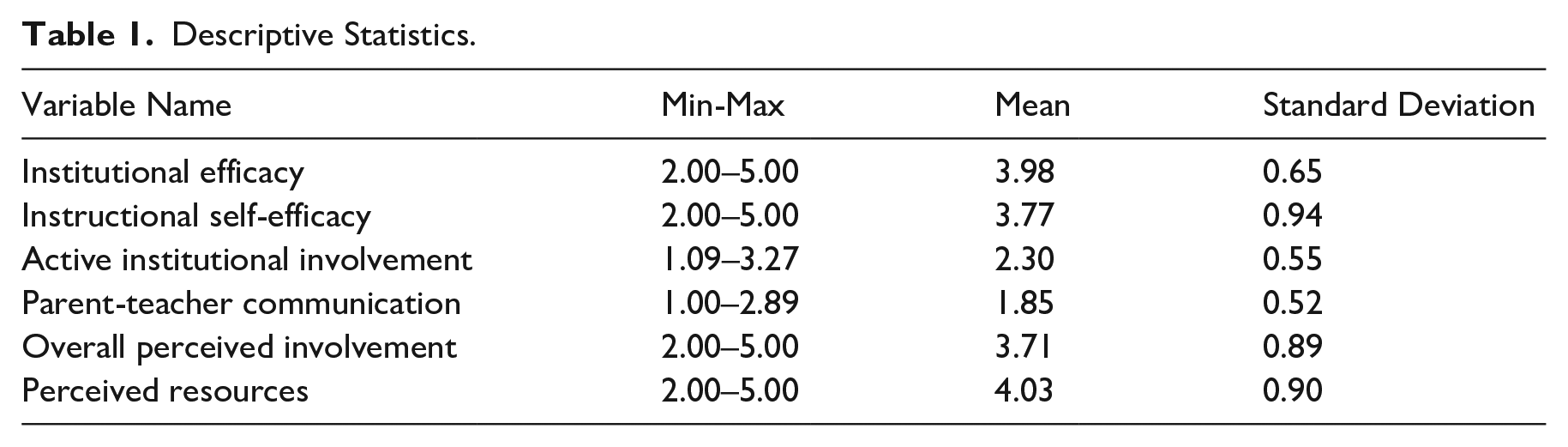
Descriptive statistics are displayed in Table 1. In order to investigate relationships among variables, bivariate correlations were performed. See Table 2.
Descriptive Statistics.
Correlations among variables.

p < 0.05. **p < 0.01.
The purpose of the current study was to explore two specific aims: First, the study examines the role of self-efficacy in educational involvement during COVID-19; and second, the study examines the impact of perceived resources on parental efficacy and involvement during COVID-19. Results from the study indicate that resources, self-efficacy, and involvement were all challenged by the pandemic. Taken together, these results strengthen existing research on educational efficacy, parental engagement, and perceptions of resources during times of adversity. In what follows, we discuss both of the study’s aims and their implications in turn.
The first aim of the study focused on the role of self-efficacy in educational involvement during COVID-19. Here, we first demonstrated that the non-significant correlation between institutional efficacy and instructional self-efficacy, and correlations revealed that the variables were related in differing ways to other variables of interest. This suggested that the two types of efficacy are in fact distinct. Similarly, we found stronger associations among the parent involvement variables, yet continue to observe different associations among the variables of interest. This again suggested that our variables were capturing distinct aspects of parental involvement. Prior work has specified differing impacts of types of involvement, conceptualizing home-based and school-based involvement (Benner et al., 2016) as well as academic socialization (Day and Dotterer, 2018). In light of stay-at-home orders and other pandemic-related restrictions, we conjecture that parents may have taken questions about instructional self-efficacy to reflect their own ability to teach their child through remote learning, whereas institutional efficacy represented confidence in their capabilities to be influential in the student’s institution or school.
Thus, we are able to move on to examination of the impact of each component of educational efficacy and their relations with each component of involvement. We see that institutional efficacy is not significantly related to active institutional involvement or parent-teacher communication, however, it is correlated with overall perceived involvement. This may suggest that parents were feeling overall quite involved with their child’s education, but not in a way that is specifically based in the school. The mean for overall perceived involvement is indeed higher than the means of the school-based involvement variables (active institutional involvement, parent-teacher communication). It is impossible to know whether this constellation of findings would hold true in circumstances normally, or whether they are an effect of COVID-19. It could be that parents who typically feel high self-efficacy related to the school are feeling overall more involved, but are unable to be involved specifically with the teacher or school. Outside of the pandemic, homeschooling parents report a motivation to be involved in their child’s education, taking an active role and feeling high self-efficacy for helping the child to learn (Ice and Hoover-Dempsey, 2011). Here, the parents were not actively choosing homeschooling, but contextual factors required that the parents provided care and/or education for their child while in many cases, working from home, which may have had a deleterious effect on self-efficacy toward schooling.
Further, in examination of the relationship among instructional self-efficacy and the involvement variables, we see that parents who are more involved with the institution actually feel more self-efficacy in being influential and controlling over their child’s education. This could mean that parents who, before COVID-19, were more involved in the classroom and school tended to feel more self efficacy in doing home-based instruction. However, instructional self-efficacy was not related to parent-teacher communication or overall perceived involvement. It is unclear why this expected relationship did not occur, but emerging research suggests that parents had generally negative beliefs about the structure of online learning during COVID-19 (Dong et al., 2020). A large study of Chinese parents reported that they resisted and rejected online learning for early childhood education for three main reasons: general shortcomings of online learning, young children are not adequate at self-regulation, and the parents’ lack of time and professional knowledge to support online learning. When Indonesian teachers were surveyed, they felt that the success of online learning primarily hinged on the readiness of instructional technology and collaborative support from the schools, teachers, parents, and the community (Rasmitadila et al., 2020).
The second aim of the study focused on examining the role of perceived resources on efficacy and involvement. Given that existing research has linked a lack of resources with a variety of negative academic, behavioral, and psychosocial outcomes (Davidson and Dell, 2003; Dixon-Elliott, 2019; Sofronoff and Farbotko, 2002), it was expected that parents of pre-K students who are enrolled in less resourced programs may tend to be less efficacious or involved. In contrast, however, perceived resources were unrelated to institutional efficacy, instructional efficacy, active institutional involvement, parent-teacher communication, and overall perceived involvement. These nonsignificant effects could be the result of our sample representing a population who perceived their schools to be well-resourced.
Although a lack of a significant relationship between perceived resources and efficacy or involvement was initially unexpected, existing literature offers some insight and possible explanations into results reflecting well-resourced pre-K programs. Specifically, Dixon-Elliott’s (2019) study shows that lack of time, knowledge, and resources are central tenets in causing low self-efficacy among parents. Dixon-Elliott (2019) argues that to better the levels of parent’s self-efficacy, extra resources to help parents support homework, resources to supplement children’s curriculum, and accommodations for working parents are necessary to help raise levels of self-efficacy in parents and their involvement with their children. Yet, scholars agree that one of the main barriers preventing parents from gaining the resources they need is an unawareness of the educational resources available and where to find them (Davidson and Dell, 2003; Dixon-Elliott, 2019; Sofronoff and Farbotko, 2002). Further, Dixon-Elliott (2019) explains that while there may be resources available, oftentimes they are limited and not easily accessible. This has particular implications for the present study in that perhaps the context surrounding COVID-19 provided parents with more direct or tangible avenues to access the resources they needed, without drawing specific attention to the resources themselves. In other words, because pre-K programs may have shifted the ways in which they made their resources accessible (e.g. online, real-time interaction) to aid in social distancing, the lack of a direct association between resources and efficacy or involvement during COVID-19 is reasonable.
Limitations and suggestions for future research
Several limitations should be considered when interpreting the results. First, our sample size was relatively small (50) and the majority of participants in the study identified as White (85%) which limits the extent to which these results can be generalized as representative of a larger population. Additionally, the sample included both mothers and fathers, but not enough fathers to examine parent gender differences. To this end, we hope that future researchers continue this work by purposely recruiting from a more diverse sample. The third, and perhaps the most significant, limitation of the current study involves the context during which data collection took place. Given that data collection coincided with the COVID-19 pandemic, limited data were available. Additionally, we are uncertain of how changes to participant’s household routines (having children at home, quarantining, social distancing) may have impacted responses.
These limitations aside, the present findings extend parent self-efficacy research by identifying communication-based engagement as significant in increasing feelings of parental influence and involvement in their children’s education. One future direction may include exploring characteristic (psychosocial, demographic) factors specific to parents with higher levels of self-efficacy. Researchers might also consider how parent gender differences may impact these factors. Additionally, because our sample did not reveal an effect related to lack of resources, future researchers should explore the experiences of under-resourced schools and families. Further, the examination of other variables will be necessary to provide a more nuanced picture of the processes and outcomes impacting parental self-efficacy and educational engagement. Through these types of investigations, researchers can expand existing knowledge on parental self-efficacy and educational engagement.
Overall, these results suggest several important conclusions and implications. First, these findings advance that maintaining and encouraging ongoing parental involvement can be a proactive way to prepare for unexpected disruptions. Results show that parents who were more involved in the classroom tended to feel more self efficacy while serving as their child’s primary educator during COVID-19 closures. Given that results show that parent-teacher communication rarely occurred, these findings also shed light on the reciprocal relationship between families and schools in supporting pre-K education. Moreover, these results have practical applications as well. Communication research has long evidenced parent-teacher dialog as significant in increasing parental involvement at the P-12 level (Mazer and Thompson, 2016; Pillet-Shore, 2015; Stafford, 1987; Thompson, 2008; Thompson and Mazer, 2012). Thus, an important implication of the current study involves drawing attention to maintaining strong parent-teacher communication during times of challenge.
