



Abstract
Parental self-efficacy (PSE) is an essential predictor of parenting practices and child development. The content-specificity of PSE is not well understood: Previous studies are based on either measure of general parental self-efficacy or task-specific parental self-efficacy but not measures of both constructs. Thus, we do not know how both constructs are related. With data from the “AQuaFam” study, we compared four-factor models to investigate the structure of PSE. It was a priority whether (1) task-specific and general PSE could be assessed separately or (2) be mapped in a hierarchical model with task-specific PSE factors and a superordinate factor of general PSE. A Chi-square test shows no significant model improvement, which indicates general and task-specific PSE being separate dimensions. US studies suggest that low-income parents, migrants, or parents with a lower educational status experience lower PSE. To adequately support these parents, we need to know whether differences according to families’ background characteristics occur in task-specific and general PSE beliefs. We tested general PSE and PSE in four parenting tasks for differences according to families’ background characteristics. Parents with a university degree they were self-efficacious in communicating responsible media use than parents without a university degree. Parents with a non-German family language they were self-efficacious in communicating a responsible media use, caring for a sick child, and in their general PSE compared to parents with German as a family language. The results of the group differences are discussed in the context of how to support different parent groups.
Parental self-efficacy is an essential predictor of parenting practices and child development (Albanese et al., 2019; Ardelt and Eccles, 2001; Bubic et al., 2021; Jones and Prinz, 2005; Wittkowski et al., 2017). Specifically, parents with higher parental self-efficacy engage more frequently in home learning activities and show more appreciation and warmth in parent-child interactions (Bojczyk et al., 2018; Glatz and Trifan, 2019; Jones and Prinz, 2005). However, the construct of parental self-efficacy and, in particular, its content-specificity is not well understood: Parental self-efficacy can either refer to parents’ general perception of how well they judge themselves in their role as parents (Gärtner et al., 2018), or it can refer to a specific parental task such as supporting healthy dietary and physical activity behaviors (Bohman et al., 2016). Previous studies are mostly based on either measure of general parental self-efficacy or task-specific parental self-efficacy but not measures of both constructs. These studies do not attempt to put the two constructs into relation to each other. Thus, we do not know how both constructs are related. Answering this question is essential for the construct validity of parental-self-efficacy. The comprehension of parental self-efficacy is not only important for research but also relevant for educational practice. Therefore, this information might also be relevant for family support programs, which often aim at improving parental self-efficacy (Freiberg et al., 2014; Mouton et al., 2018; Sanders, 1999; Sanders and Woolley, 2005). Low parental self-efficacy can be found among parents with a low educational level, low income, or a family language different from the national language (Ardelt and Eccles, 2001; Elder et al., 1995; Peacock-Chambers et al., 2017), which is also why many programs focus on these parents (Ardelt and Eccles, 2001; Wittkowski et al., 2016). To adequately support these parents, we need to know whether differences according to families’ background characteristics also occur in task-specific parental self-efficacy beliefs and—if so—in which of these parenting tasks background characteristics matter the most. Therefore, this article addresses these research gaps and focuses on two questions: (1) How can the structure of parental self-efficacy be mapped? (2) Do parents differ in their general and task-specific self-efficacy according to specific background characteristics of families?
We did secondary analyses using data from the study “AQuaFam” that followed the family support program “Chancenreich.” Thus, the given study design of “AQuaFam” limits the selection of the task-specific parental self-efficacy measures.
Literature review
Parental self-efficacy
Parental self-efficacy describes the parental belief of one’s efficaciousness to influence their child and its environment in such a way that it promotes child development (Ardelt and Eccles, 2001). The construct is based on Bandura’s (1977) understanding of self-efficacy, which describes it as the confidence in one’s ability to execute certain behaviors successfully. According to social cognitive learning theory, self-efficacy is decisive for human motivation and action (Bandura, 1994). With a high amount of self-efficacy, people tend to see difficult situations as challenges and show more stamina and less negative emotional arousal in the face of stress (Jerusalem and Mittag, 1995). Empirical findings also show positive relations of parental self-efficacy with parenting competence, children’s adaptation, and negative relationships with children’s problem behavior (Albanese et al., 2019; Bandura, 1997; Jones and Prinz, 2005; Stiévenart and Martinez Perez, 2021).
Parental self-efficacy is often referred to as parental self-regulation, parental competence, parental self-concept, self-confidence or self-esteem, or concepts are used synonymously (Coleman and Karraker, 1998; De Montigny and Lacharite, 2005; Hamilton et al., 2015; Hess et al., 2004; Wittkowski et al., 2017). However, a conceptual analysis of the literature from 1980 to 2000 showed that these concepts describe different constructs and have different precursors and effects (De Montigny and Lacharite, 2005). For example, parental competence is a precursor of parental self-efficacy (Coleman and Karraker, 2000; De Montigny and Lacharite, 2005). Self-confidence is compared to self-efficacy more stable over time and situation-independent (Glidewell and Livert, 1992). Self-efficacy is further distinguished from the more general construct of self-concept, which is more past-oriented and stable over time (Bong and Skaalvik, 2003).
Research on parental self-efficacy for parents of preschool children is mainly conducted in English-speaking countries (Coleman and Karraker, 1998), both for the development of measures and research on the relation to families’ background characteristics (Albanese et al., 2019; Ardelt and Eccles, 2001; De Montigny and Lacharite, 2005; Elder et al., 1995; Holloway et al., 2019; Jones and Prinz, 2005; Peacock-Chambers et al., 2017; Sanders, 1999; Sanders and Woolley, 2005; Wittkowski et al., 2017). In German-speaking countries, there have been few empirical studies specifically on parental self-efficacy. Examples for these few are the works of Kliem et al. (2014) and Gärtner et al. (2018). However, educational goals—and beliefs—differ from country to country and from culture to culture (Chao and Kanatsu, 2008; Gerhards and Hölscher, 2003; Herwartz-Emden, 2003). According to the eco-social model of development (Keller and Kärtner, 2013), parental perceptions of adequate child development, parenting behavior, and socialization goals vary according to cultural mindset, which depends on the eco-social context. For example, European American parents exhibited less behavioral control behavior than other groups, such as Latinos (Chao and Kanatsu, 2008). Within Germany, too, culture-specific differences in parenting beliefs are found, for example, for families with a Turkish immigration background and those without an immigration background (Döge, 2015). Since this study assesses family language, the aforementioned differences cannot be transferred but might hint to differences according to family language and families’ cultural background. Additionally, demands on children’s upbringing and education have increased, and parents face high expectations (Merkle and Wippermann, 2008). Due to the important role of parental self-efficacy with educational behavior and goals, which are context-dependent, further research on parental self-efficacy is also needed in Germany.
The structure of parental self-efficacy
Due to various theoretical approaches, some of which are inconsistent, the structure of parental self-efficacy has not been finally clarified (Coleman and Karraker, 2000; Jones and Prinz, 2005). Parental self-efficacy is seen here as self-efficacy in the domain of parenting. Theoretically, two specificity levels can be distinguished: (1) general parental self-efficacy and (2) task-specific parental self-efficacy. There are different approaches to the measurement of general parental self-efficacy and task-specific parent self-efficacy. General parental self-efficacy is assessed either through measuring parent’s global assessment of their efficacy expectations to parent children (e.g. “What I do has little influence on the behavior of my child,” Campis et al., 1986), whereby this can also be referred to as domain-general parental self-efficacy. Another approach to assessing general parental self-efficacy stems from the summary of task-specific measurements resulting in a multidimensional index (see Bandura et al., 1996). This is also referred to as domain-specific parental self-efficacy. Task-specific parental self-efficacy can be assessed either by using individual questions to a specific parenting task (e.g. “I feel comfortable with my ability to respond well when an emergency occurs in which my child’s physical well-being is at risk,” Coleman and Karraker, 2003) or through a set of questions on a parenting task, for example in caring for a sick child. The advantage of using task-specific items over generally formulated items is a higher informative value (Bandura, 1989), predictive validity (Črnčec et al., 2008; Wittkowski et al., 2017), and higher sensitivity to specific parental tasks and the children’s age (Marsh et al., 2002). Even when comparing domain-general with domain-specific parental self-efficacy, Coleman and Karraker (2003) found that only the domain-specific scale was related to several child behavior outcomes, such as affection for the mother. Furthermore, the results indicated that the domains of the domain-specific scale are empirically distinguishable. Concerning task-specific parental self-efficacy, there are also findings which indicate that efficacy beliefs in different parenting tasks are empirically distinguishable (e.g. Ardelt and Eccles, 2001; Bohman et al., 2013, 2014; Črnčec et al., 2008; Dennis and Faux, 1999). If parents are to be strengthened in their self-efficacy in specific parenting tasks, then these tasks should also be theoretically distinguishable from each other and general parental self-efficacy. It can be concluded that a distinction between parental self-efficacy on a general or task-specific level is essential for construct validity. So far, no study has tested (a) if the construct of general parental self-efficacy is empirically distinguishable from task-specific parental self-efficacy and (b) how the constructs of general and task-specific parental self-efficacy are related.
The present article intends to address this by comparing four different models: we examine (a) whether general and task-specific parental self-efficacy are distinguishable, (b) whether the factors of task-specific parental self-efficacy are empirically distinguishable, and (c) the relationship between general and task-specific parental self-efficacy. We also applied (d) a nested factor model for the latter: we assume that task-specific parental self-efficacy factors are nested within a higher-order factor of general parental self-efficacy. Thus, the higher-order factor covers both general and task-specific parental self-efficacy. This would allow conclusions drawn from general parental self-efficacy to task-specific parental self-efficacy since general parental self-efficacy would also represent task-specific parental self-efficacy.
Differences in parental self-efficacy according to family characteristics
Parental self-efficacy is one crucial aspect that several family support programs focus on (Freiberg et al., 2014; Mouton et al., 2018; Sanders, 1999; Sanders and Woolley, 2005). To strengthen parental self-efficacy, parenting support programs developed various concepts. To adapt these programs to families’ different needs, it is necessary to generate more knowledge about which family characteristics are related to parental self-efficacy to respond better to parents. Previous evidence suggests that parents’ educational level, parents’ income, family language, and the child’s gender are linked to parental self-efficacy. We will discuss this in more detail in the following.
Education
Coleman and Karraker (2000) reported that mothers with a higher education level feel more self-efficacious in raising their children than mothers with a lower educational level. More specifically, parents with at least a high school degree felt significantly more efficacious in parenting their child than parents without a high school degree (Peacock-Chambers et al., 2017).
Family language
In a study by Peacock-Chambers et al. (2017), English-speaking and US-born parents reported significantly higher self-efficacy than immigrants or Spanish-speaking parents in the US. In a study by Keels (2009), the parents’ primary language served as an indicator of families’ acculturation. Additionally, parents’ primary language served to generate the variable of families’ ethnic group category in this study. This points to a potential relationship between a family’s language use and the family’s ethnic background. Bandura (1989a) social cognitive theory and several studies (Boruszak-Kiziukiewicz and Kmita, 2020; Glatz and Trifan, 2019; Kiang et al., 2017; Mendez et al., 2013) suggest that the (cultural) context influences parents’ attitudes, self-efficacy, and parenting practices. A family’s language spoken at home or their ethnic background point to some part of their cultural heritage and influence the context they live in.
Income
In a study by Coleman and Karraker (2000), mothers with higher incomes reported higher parental self-efficacy than mothers with lower incomes. In a Japanese-Korean comparative study, Korean mothers’ and not Japanese mothers’ parental self-efficacy was significantly positively associated with household income (Holloway et al., 2016). Elder et al. (1995) found that economic burdens lead to perceived economic pressure, resulting in emotional stress and depressive feelings. This contributed to decreased parental self-efficacy and less beneficial parenting strategies (Elder et al., 1995).
Children’s gender: Studies from the US show various findings concerning the relationship between children’s gender and parental self-efficacy
Coleman and Karraker (2000) found no statistically significant relationship between children’s gender and parental self-efficacy. In contrast, Wilson et al. (2014) found that children’s gender is marginally associated with parental self-efficacy, suggesting that parents of girls have slightly higher self-efficacy than parents of boys.
In summary, the results show that parental self-efficacy differs according to families’ characteristics. Concerning the relationships between parental self-efficacy and parenting practices described at the beginning of this paper, it becomes clear that strengthening parental self-efficacy, for example, through family support programs, can mitigate direct effects of unfavorable family characteristics, such as low socioeconomic status, on parenting practices (Coleman and Karraker, 1998; Wittkowski et al., 2016). However, most of these studies were conducted in English-speaking countries (cf. Ardelt and Eccles, 2001; Elder et al., 1995; Peacock-Chambers et al., 2017). Families and their environment’s characteristics often differ from those of parents in Germany regarding income, family language and cultural background, and health care system. There is a lack of research on the relationships between family characteristics and parental self-efficacy for families in the German context. Therefore it is vital to assess parental self-efficacy on a country-or culture-specific basis. Also, these groups differ, for example, in their parenting style (Döge, 2015).
As presented above, families’ characteristics play a significant role in their parental self-efficacy and for the design of family support programs. For the further development of local family support programs, evidence from Germany regarding parental self-efficacy differences according to the families’ characteristics is required.
Method
Study design and sampling
This study draws on data from the study “AQuaFam” (Anders et al., 2017). “AQuaFam” followed families who participated in the family support program “Chancenreich” and compared attending families to families who did not participate in the support program. The program was established by the Carina Foundation and the city of Herford. Chancenreich is an still ongoing, regional program implemented in the German town Herford. Any family with a newborn child in Herford can participate in this program for free. The program aims to generally promote parenting skills and child development and offers, for example, parenting and parent-child courses. In the present study, we draw on the entire sample of families regardless of whether they attended the support program. We include group affiliation (whether families participated in the support program or not) as a control variable in the analyses to control group differences. The data collection for the study AQuaFam took place during the program from November 2013 to May 2014. The families’ data were collected by trained research assistants using a standardized family interview and a parent questionnaire. Participation was on a voluntary basis. Firstly, participating parents were informed about the content and procedure of the study via letter. The letter included the contact details of the study team (telephone number and e-mail address) where participants could obtain general information about the study. As the next step, trained research assistants called the parents to make an appointment for the home visit. A standardized guide was used for this call. Since most parents were female, the parents were asked if a male research assistant could also conduct the home visit. At the beginning of the home visit, the parents were presented with a privacy statement. The parents were informed about the confidentiality and anonymity of their data. Subsequently, they could sign the consent form for participation. With their signature, the survey started. The standardized family interview and family questionnaire were only available in German. All families were able to speak German at least on a low level. This was ascertained when the families were called to make an appointment for a visit by the trained research assistants. If a parent did not understand a question, it was repeated slowly and with emphasis. In some exceptions, the research assistants were allowed to repeat the question in their own words. Families were recruited through the Chancenreich program or leaflets in childcare facilities, family education centers, pediatricians, and newsletters. Families who did not participate in the program were recruited in a neighboring town through postings in day-care centers, family education centers, pediatricians offices, and newsletters. This group was recruited in another city because almost all families in Herford participated in the Chancenreich program. The sample consisted of 249 families. Only parents data was used who have signed an informed consent form.
Instruments
For the present study, four scales were applied to measure task-specific parental self-efficacy. Additionally, one scale measured general parental self-efficacy.
General parental self-efficacy
The items are based on the instruments “Parenting Sense of Competence Scale” (PSOC) by Gibaud-Wallston and Wandersman (1978) (cited in Johnston and Mash, 1989) and the “Self-Efficacy for Parenting Tasks Index-Toddler Scale” (SEPTI-TS) by Coleman and Karraker (2003). A sample item is: “I feel competent in dealing with conflicts with my child.” The scale consists of four items (Cronbach’s α = 0.74). The item’s response possibilities ranged from 0 (“does not apply at all”) to 5 (“applies completely”).
Task-specific parental self-efficacy
Parental self-efficacy in caring for a sick child
The items are self-developed. An item example for this scale is “I am confident that I know when my child is sick and should stay at home.” The scale consists of three items (Cronbach’s α = 0.57). The item’s response possibilities ranged from 0 (“not true at all”) to 5 (“completely true”).
Parental self-efficacy for a healthy diet and exercise
The “Parental Self-Efficacy for Promoting Healthy Physical Activity and Dietary Behaviors in Children Scale” by Bohman et al. (2013), which measures parents’ self-efficacy in establishing healthy physical activity and dietary habits for children, was adapted for the study. Specifically, we translated the items into German, two items were added that are very similar in content, and one item was slightly changed. The new scale consists of 10 items. An example item is: “I am sure that I can support my child to play physically active.” In line with Bohman et al. (2013), we differentiated two subscales, the first focusing on a healthy diet (four items, Cronbach’s α = 0.67) and the second on exercising (three items, Cronbach’s α = 0.74). The item’s response options ranged from 0 (“not applicable at all”) to 5 (“completely applicable”).
Parental self-efficacy for responsible use of media
This scale was developed for the AQuaFam Study. An item example is “I am confident that I can resist the requests of my child if he/she wants to watch television or play computer games.” The scale consists of two items (Cronbach’s α = 0.56) The item’s response options ranged from 0 (“not true at all”) to 5 (“completely true”).
Families’ background characteristics
In a standardized family interview and a parent questionnaire, the socioeconomic characteristics of the families were assessed. The following data were relevant for this article: gender and age of the child, gender and age of the parent, the family language spoken at home, the participants’ university degree, and whether families lived in poverty at the point of the assessment. The participants’ university degree was created based on the person’s educational qualification who answered the questionnaires. 88% of the participants who answered the questionnaires were mothers, 5.2% were fathers, and in 2.8% of the cases, both parents answered the questionnaires. In the latter case, missings were assigned for the educational qualification and parents’ age and gender because we could not assign them afterward. The family language background was assessed to determine whether the family language was German or not (0 = German, 1 = another language than German). The variable for assessing poverty (0 = not poor, 1 = poor) was derived from family income. The poverty line is given a basic value of 1033 euros per month for a one-person household in 2015 (Statistisches Bundesamt, 2019).
Analyses
The structure of parental self-efficacy
To investigate the structure of parental self-efficacy, we compared four different models using confirmatory factor analyses:
(a) a one-factor model on which all task-specific and general items map on a parental self-efficacy factor (see Figure 1);
(b) a two-factor model in which the items of general parental self-efficacy represent a factor and all items of the four tasks represent a common factor (see Figure 2);
(c) a second-order factor model in which the g-factor is derived from the four task-specific factors of parental self-efficacy (see Figure 3);
(d) a hierarchical model: a factor is represented by all items of task-specific and general parental self-efficacy, where the task-specific items, in turn, represent further four factors (see Figure 4).
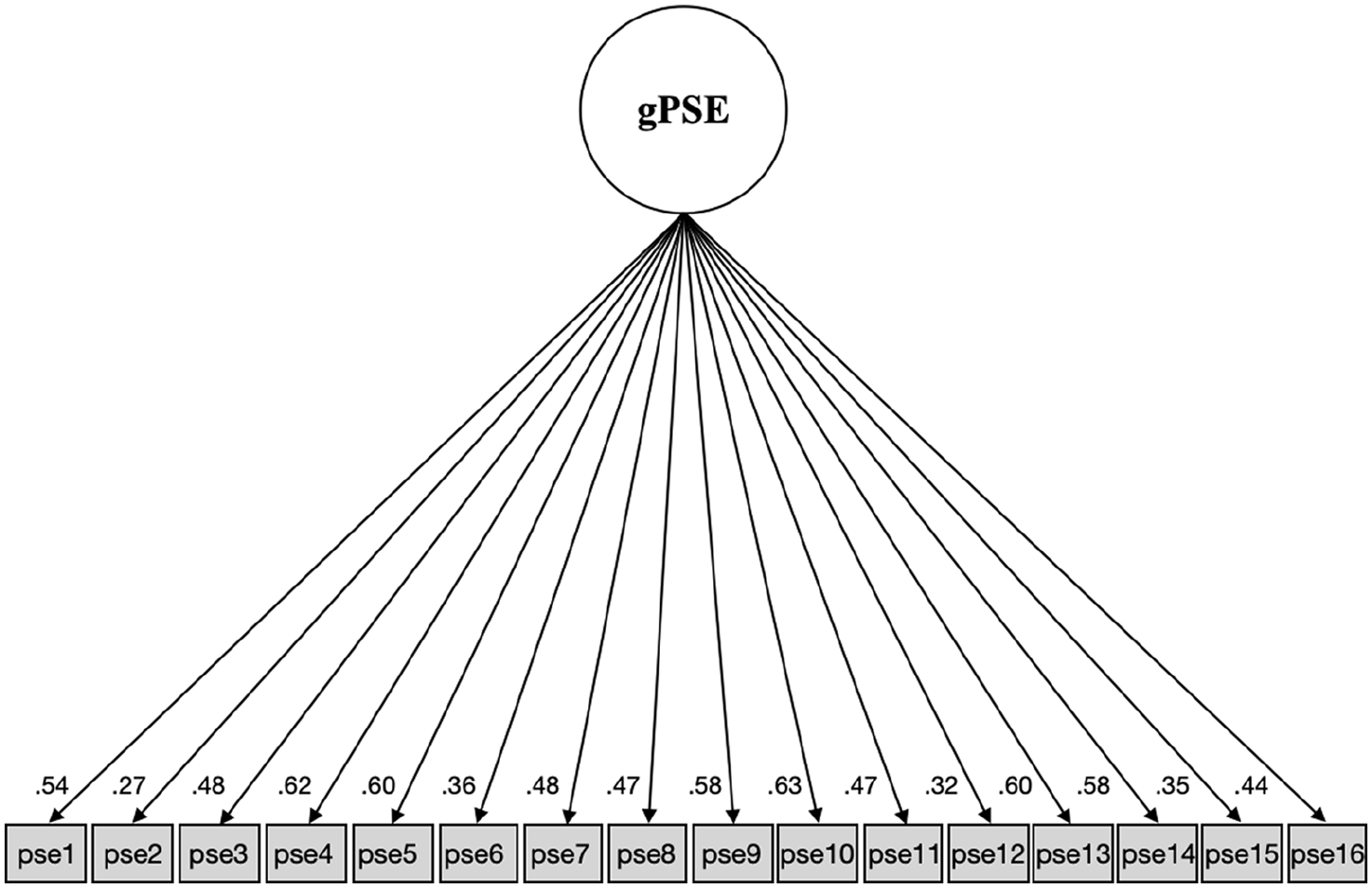
Model a of the structure of parental self-efficacy.

Model b of the structure of parental self-efficacy.
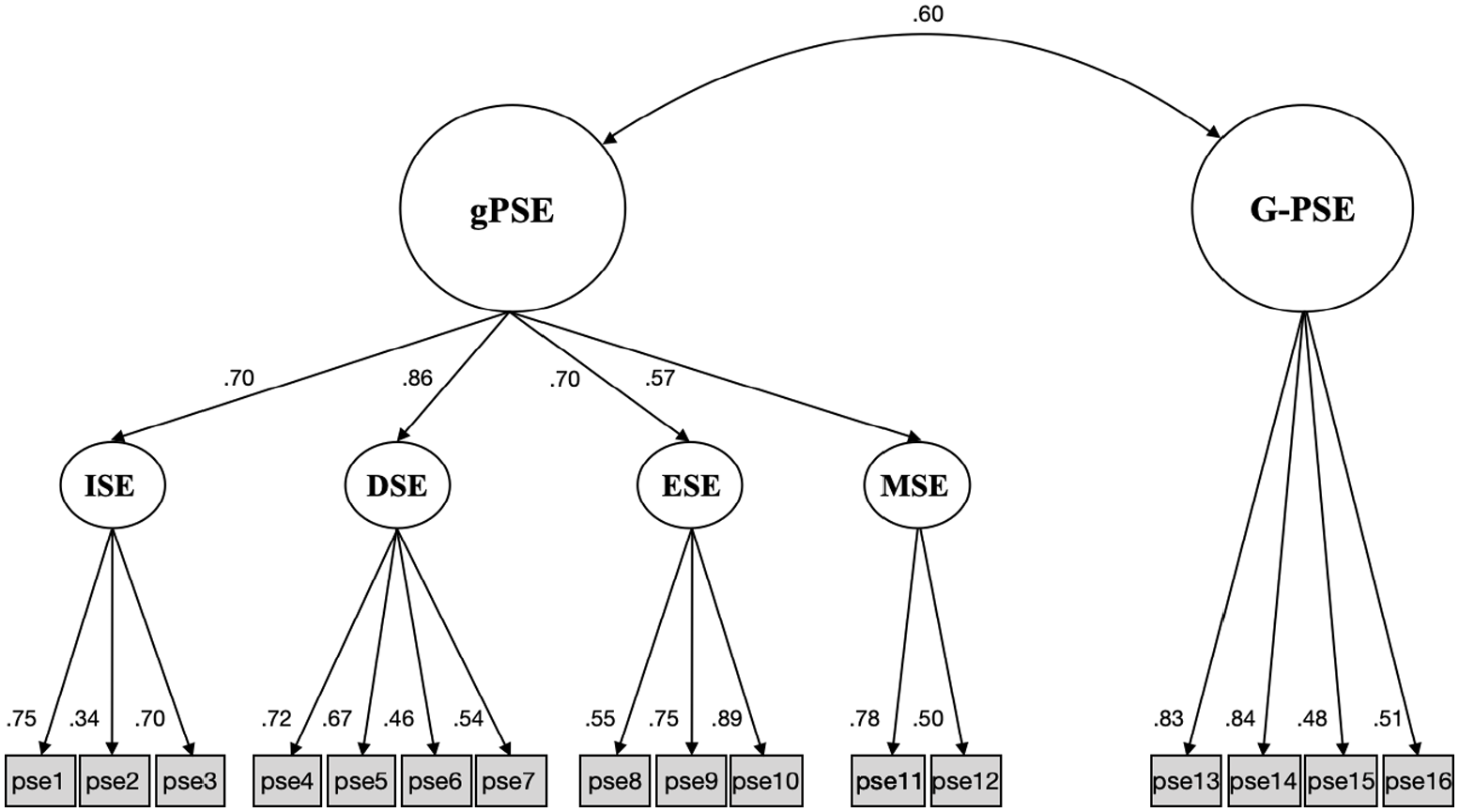
Model c of the structure of parental self-efficacy.
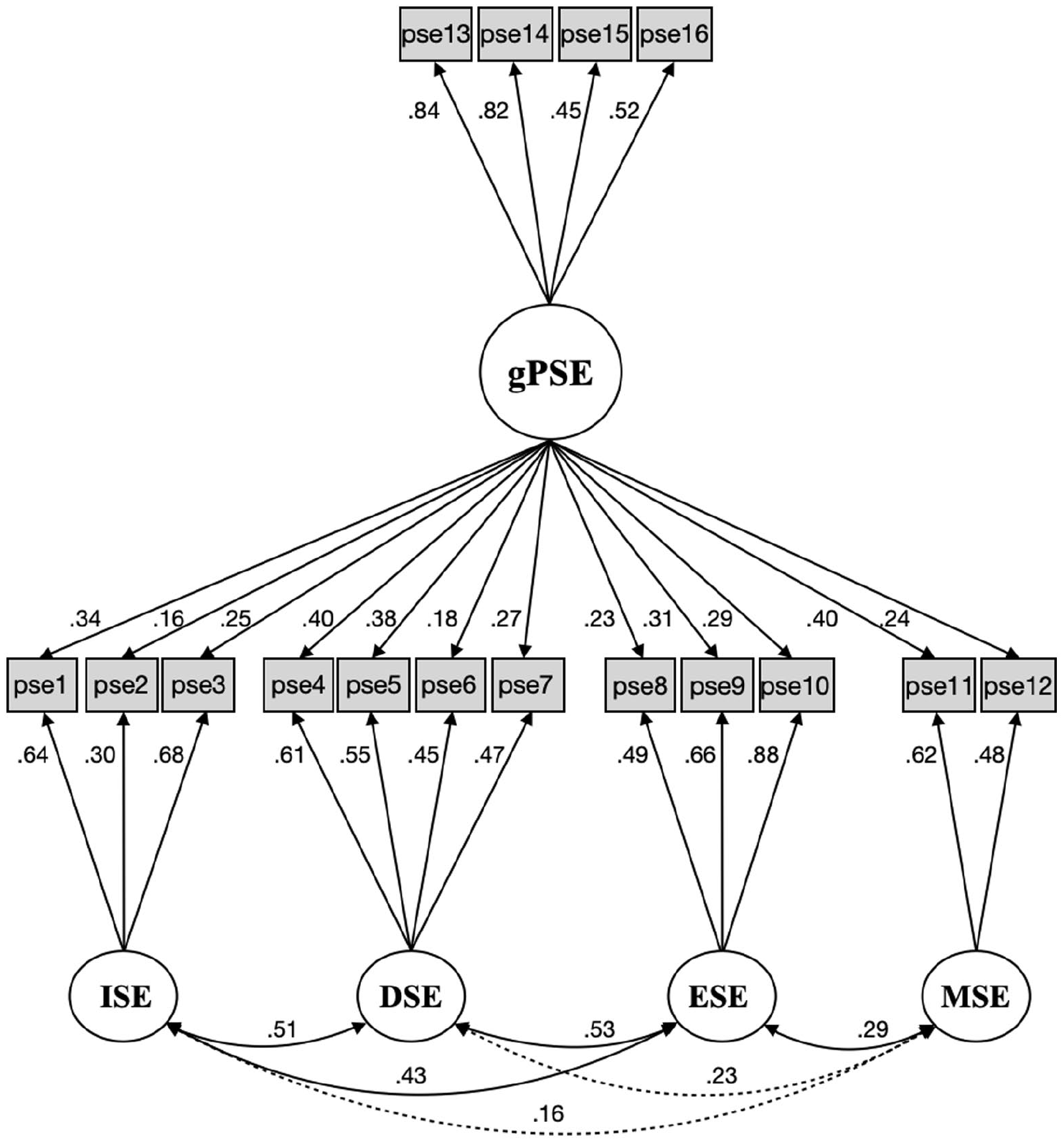
Model d of the structure of parental self-efficacy.
The figures show factors as circles and manifest variables as rectangles.
For comparing the model fit, the χ2-test, the RMSEA (Root mean square error of approximation, Brown and Cudeck, 1993), and the CFI (Comparative fit index; Bentler, 1990) were applied. CFI values close to 0.95 or higher, RMSEA values close to 0.06 or lower, and SRMR values close to 0.08 or lower are indicators for a good model fit (Hu and Bentler, 1999). We used the MLR estimator because it is robust to a violation of the normality assumption (Christ and Schlüter, 2012). All regression analyses and confirmatory factor analyses were performed with Mplus (Version 7.4, Muthén, L. K., & Muthén, B. O., 1998–2015). SPSS was used for descriptive analyses (Version 25.0, IBM SPSS Statistics for Windows, 2017).
Differences in parental self-efficacy according to family characteristics
According to the family characteristics, parental self-efficacy differences were analyzed for general parental self-efficacy measures and the four measures of task-specific parental self-efficacy. Multiple regression analyses were used to investigate group differences between families (1) who live below or above the poverty line, (2) whose child is a girl or a boy, (3) who do not speak German or speak German at home, or (4) whose parent that answered the questionnaire had a university degree. The three other background characteristics and the families’ group affiliation (Family support program participation: 0 = no, 1 = yes) were included as control variables in the separate regressions. Besides, children’s age and gender and parent’s age and gender were included as control variables in all regressions.
Results
Descriptive results
Table 1 shows the child’s and family’s characteristics of this sample. Table 2 provides an overview of descriptive statistics on the parental self-efficacy measures. On average, parents felt very self-efficacious in all tasks. Only in handling responsible media use, the parents felt less self-efficacious. Table 2 also depicts the correlations of the measures of parental self-efficacy. All correlations were positive and significant.
Descriptives of families’ background characteristics.

0 = German, 1 = not German.
0 = not graduated, 1 = graduated.
Income under <€1033.
Descriptives and intercorrelations of parental self-efficacy measures.

PSE: parental self-efficacy.
p < 0.01.
The structure of parental self-efficacy
Table 3 shows the fit indices of the four models compared using confirmatory factor analyses. The first two models do not fit the data well: the CFI values are far lower than the limit of 0.95, and the values for the RMSEA are higher than 0.06. The second-order factor model (model c) and the hierarchical model (d) seem to fit the data well. A model comparison using the Chi-square test shows no significant improvement of the models c to d (∆χ2 = 17.057, p = 0.197). Model c is favored because it is in line with the theoretical assumption that general and task-related parental self-efficacy are two separate dimensions.
Fit indices of confirmatory factor analyses for models a–d.

N = 240.
Differences in parental self-efficacy according to family characteristics
Parents with a non-German family language experienced a lower general parental self-efficacy (β = −0.19, SE = 0.07, p = 0.008) and also perceived themselves to be less self-efficacious in caring for a sick child (β = −0.17, SE = 0.07, p = 0.011). Participants with a university degree felt more efficacious in communicating a responsible media use (β = 0.15, SE = 0.06, p = 0.007) but less efficacious in caring for a sick child (β = −0.14, SE = 0.07, p = 0.040) than participants without a university degree. Parents with a family language other than German perceived themselves as less self-efficacious in communicating responsible media use (β = −0.29, SE = 0.07, p = 0.000). We found no differences according to the children’s sex or according to poverty.
Discussion
We pursued two objectives in this study: (1) we examined the structure of parental self-efficacy, (2) we tested for differences in parental self-efficacy depending on families’ background characteristics.
The structure of parental self-efficacy
We found that task-specific and general parental self-efficacy can be empirically distinguished. Additionally, we found that different parental self-efficacy tasks can be empirically distinguished from each other since the model fit improves between models b and c which is in line with previous findings (e.g. Ardelt and Eccles, 2001; Bohman et al., 2014; Črnčec et al., 2008). Furthermore, this study compared two models that relate general and task-specific parental self-efficacy in different ways: model c puts general parental self-efficacy on the same level as the g-factor of four tasks of parental self-efficacy. Model d places a factor at the head of the model, represented by general and task-specific parental self-efficacy items. We found no significant improvement from model c to model d which corresponds to previous approaches (e.g. Coleman and Karraker, 2000; Wittkowski et al., 2017). This is the first study to examine this empirically and to show the different dimensions. These results indicate that parental self-efficacy should continue to be assessed at a task-specific and a general level.
Differences in parental self-efficacy according to family characteristics
Results suggest that parents differ in their parental self-efficacy only according to their university degree and the family’s language. Since a family language different from the national language is often seen as a difficulty rather than a resource, this could contribute to a decreased parental self-efficacy (Cornelli et al., 2013; Jambunathan et al., 2000). Furthermore, the variety of educational beliefs and goals could be an explanation. The experience of having different educational styles and beliefs (Döge, 2015) and the expectations of oneself and the German majority population could lead to or be associated with lower parental self-efficacy. Further, parents with a university degree felt more efficacious in communicating a responsible media use than parents without a university degree. This could indicate that parents with a higher level of education have a different or stronger educational aspiration and feel they can enforce it. Previous research suggests differences for home media use by parental educational background (Levine et al., 2019). For example, toddlers were more likely to use mobile media alone, if their parent had comparatively lower level of education. Interestingly, parents with a higher level of education have lower self-efficacy to take care of a sick child, which suggests insecurity and possibly also high demands on their parenting skills and less hands-on experience in their family context. At least, women with a university degree are much more likely to have no children than women without a university degree (Statistisches Bundesamt, 2018). Also, women with a university degree have fewer children than women without a university degree (Bundesministerium für Familie, Senioren, F. und J, 2020). For supporting these parents, insight into how much hands-on experience they have in caring for a sick child and whether the extended family is available as support would be helpful.
Parents living in poverty did not differ significantly in parental self-efficacy from parents who do not live in poverty. This contradicts previous assumptions that material deprivation is negatively related to parental self-efficacy (Coleman and Karraker, 2000; Elder et al., 1995). First, we suspected multicollinearity and therefore tested the link between family language and poverty. Since the correlation was rather low (r(234) = 0.33, p = .000) we rejected this assumption. Elder et al. (1995) showed that emotional stress and depressive feelings are mediators between poverty and parental self-efficacy. Many families in the sample come from a rather rural area, in which, for example, social support from one’s family is more readily available. This might reduce the feeling of stress, which in turn reduces effects on parental self-efficacy. Comparing the circumstances of the families of our sample with families who live in poverty in other countries with different social systems may be difficult, as the support options and living conditions are too diverse for comparison.
We found no differences in parental self-efficacy according to the gender of the child. Here, too, the family’s living circumstances could play a role since it can be more difficult under certain circumstances to raise a girl or a boy. A previous study by Ardelt and Eccles (2001) showed that parental self-efficacy was positively associated with supportive parenting strategies that mothers used significantly more often for their sons than their daughters. These mothers were living in poor and criminal inner-city districts of a big American city marked by violence, drugs, and gangs. These circumstances probably made it particularly necessary for them to have high self-efficacy and support their sons while keeping them away from dangerous factors in their neighborhood, such as violence or drug use. The families in our sample do not live under these very severe conditions, so they do not have to be self-efficacious specifically toward their sons.
Limitations
We must first mention that this sample is not representative, which limits the generalization of the results. Since the interview and questionnaire were only available in German, only families with a basic level of German were interviewed. Accordingly, these families were at least bilingual. This approach might have excluded monolingual families with a non-German family language. This might underestimate the consequences the family language has on measures of central tendencies. However, we controlled for family language in the analyses, which is why a difference should not affect them. Furthermore, we cannot dismiss the possibility that some of the parents did not fully understand the questions in the interview or questionnaire and that the trained research assistants had to act as interpreters. In future studies, both multilingual assistants who conduct the interviews, and questionnaires in the participants’ native language should alleviate difficulties in understanding the questions.
Future studies should adjust the instruments more closely to the child’s age concerning the measure of task-specific parental self-efficacy. Specifically, the items used in the present study were task-related. However, their wording could be more specific; for example, instead of “I am confident that I know when my child is sick and should stay at home,” then it says, “I am confident that I know what to do when my baby has a high fever.” Coleman and Karraker (1998) pointed out that measures should contain questions on parental tasks that correspond to the children’s age at a more specific level. Since (parental) self-efficacy in Bandura’s sense is task-related and parental tasks change with the child’s age (Coleman and Karraker, 2003), it is evident that the assessment of task-specific parental self-efficacy also changes with the course of child development. Having more age-specific measures could improve the predictive power of the measurement. Additionally, the internal consistency of some measures of task-specific parental self-efficacy was rather low probably because of the limited number of items.
Implications
The present study provides important insights into the structure of parental self-efficacy. From our findings, we can conclude that general and task-specific parental self-efficacy reflect two different self-efficacy dimensions. The empirical confirmation of the distinction between these two dimensions is an essential step for construct validity. This could provide an impulse to consciously decide on a dimension in future studies, depending on the relationships one wants to investigate. For example, child development results in a change of parental tasks. Consequently, it is interesting to examine the relationships between task-specific PSE (e.g. doing potty training with children) and children’s development in those specific tasks. However, when choosing and formulating the items, attention should be paid to whether they are culturally specific and how the parents’ response behavior could vary accordingly. For example, potty training is still handled differently in Germany and the US.
The results further showed that parents who do not speak German as their family language or have a lower educational level need support concerning their self-efficacy in specific parenting tasks. This could be improved through family support programs. For example, Mouton et al. (2018) reported that mothers who received positive feedback for strengthening their self-efficacy showed more positive parenting behavior in parent-child interactions than mothers who did not. This indicates that family support programs can influence parental self-efficacy.
Footnotes
Acknowledgements
This research was made possible by the Carina Stiftung. Furthermore, we want to thank all the participating families and the staff of the Chancenreich program.
Funding
The author(s) disclosed receipt of the following financial support for the research, authorship, and/or publication of this article: This research was funded by the Carina Stiftung.
