




Abstract
The purpose of this study was to explore parents’ common experiences with healthy eating and physical activity-focused (HE-PA) programming in one Head Start (HS) program (two centers) in eastern North Carolina (NC). Researchers conducted 13 in-depth semi-structured telephone interviews November 2017–May 2018. Participants were parents of preschool children (4–5 years) enrolled in HS. Interviews were recorded and transcribed verbatim. Phenomenology was used to guide study design and analysis to identify themes. Researchers identified seven emergent themes within three categories: (1) strategies to facilitate engagement; (2) motivators for engagement; and (3) barriers to engagement. HS facilitated engagement through HE-PA focused programming. Parents reported they were motivated by self-interest and their children, but engagement was challenged by poor communication and socioeconomic barriers. HS programs may benefit from new strategies that help parents overcome barriers to making HE-PA a priority amongst competing priorities. Research is also needed to explore new methods of communication that align with parent-reported motivations.
Introduction
Approximately 13.9% of preschool children in the United States are overweight or obese (Hales et al., 2018). Obesity in young children has been linked to serious health conditions including metabolic syndrome and type 2 diabetes that can follow children into adulthood (Collins et al., 2013). Furthermore, children from low-income families have been shown to have a higher risk of obesity as well as lower dietary quality compared to children from higher income families (Ahrens et al., 2014; Larson and Story, 2015). Healthy eating and physical activity (HE-PA) choices have been shown to decrease children’s risk of obesity (Sisson et al., 2016). Due to the potential health complications related to children’s weight status, it is important to understand factors that influence children’s HE-PA choices (Copeland et al., 2012; Gagne and Harnois, 2014; Larsen et al., 2015).
Parents are important role models for their children’s health (Vaughn et al., 2018) and can have a significant impact on their children’s HE-PA behaviors (Gugusheff et al., 2015). However, to serve as effective role models for HE-PA behaviors among preschool-aged children, parents must first practice these behaviors themselves and have the knowledge and skills needed to promote HE-PA choices to their preschool children (Peters et al., 2014; Sisson et al., 2017; Zarnowiecki et al., 2012). Unfortunately, families from low-income backgrounds may face socioecological barriers that impact their ability to practice and promote positive HE-PA behaviors. Prior studies have cited barriers such as limited time and financial resources to purchase healthy foods (Agrawal et al., 2018; Dwyer et al., 2008; Peters et al., 2014); educational level of parents including HE-PA knowledge (Davis et al., 2012; Zarnowiecki et al., 2012) parents’ perceptions, attitudes, and beliefs related to HE-PA (Peters et al., 2014; Slusser et al., 2012; Zarnowiecki et al., 2012); and children’s existing unhealthy food preferences (Dwyer et al., 2008).
As a federally funded preschool program that serves more than 1 million preschool children and families from low-income backgrounds each year, (Gooze et al., 2010) Head Start (HS) plays an important role in shaping the health behaviors of young children most at increased risk for nutrition-related diseases (Foster et al., 2015; Gooze et al., 2010). HS programs often promote HE-PA behaviors among young children and their parents through school-based HE-PA programming such as obesity prevention interventions for children, workshops on shopping for healthy food for parents, and/or written information on healthy eating via flyers or newsletters (Gooze et al., 2010). Early education teachers also often recognize the importance of modeling healthy eating (Johnson et al., 2013; Lebron et al., 2020) and physical activity behaviors (Copeland et al., 2012; Gagne and Harnois, 2014). Prior research suggests that early childhood teachers reported intentionally eating healthier in front of children in their classroom because they were aware of the positive influence role modeling can have on children’s dietary behaviors (Lebron et al., 2020). There is a need for both teachers and parents to work together to promote HE-PA behaviors to children (Gooze et al., 2010; Lebron et al., 2020) but teachers often report parents are barriers to promoting nutrition and physical activity to children (Lebron et al., 2020; Lyn et al., 2014; Sisson et al., 2017; Stage et al., 2018). Teachers may perceive parents as complacent and uninterested in HE-PA related information, such as how to choose healthier food options for young children (Dev et al., 2017; Lebron et al., 2020; Stage et al., 2018). Alternatively, studies have reported parents do acknowledge the importance of teaching young children about HE-PA behaviors (Dev et al., 2017; Gooze et al., 2010). However, the previously described socioeconomic barriers, such as limited time and resources, may make it difficult for parents to engage in opportunities to learn about HE-PA (Agrawal et al., 2018; Mena et al., 2020; Zarnowiecki et al., 2012).
According to the HS Office of Administration for Children and Families, parent engagement is referred to as an interactive process that builds positive and goal-directed relationships between staff and families. HS programs are directed by the Parent, Family, and Community Engagement Framework (Family Engagement, 2021) and related federal performance standards. Within this framework, engagement is viewed as a shared responsibility between staff and families, which goes beyond simply involving families in program activities. HS staff are directed to work with families using inclusive, equitable, culturally, and linguistically responsive strategies that support positive family and child outcomes (Laff and Ruiz, 2021; Office of Head Start, 2016). One component of engagement is connecting families with comprehensive programming and resources that can support family goals. Unfortunately, engaging families can be a significant challenge for HS families, particularly for HE-PA focused programming (Dev et al., 2017; Garcia et al., 2018; Stage et al., 2018). Several studies have explored challenges with engaging families with HE-PA programming from the administrator and teacher perspectives (Dev et al., 2017; Garcia et al., 2018; Lebron et al., 2020; Sisson et al., 2017; Stage et al., 2018), but few studies have explored the challenge of engagement from the parents’ perspective. Therefore, the purpose of this study was to understand HS parents’ common experiences with HE-PA programming offered in one HS program (two centers) in Eastern North Carolina (ENC). Focusing on parent perspectives has significant implications for early childhood programs and educators serving communities with less resources who are interested in improving parent engagement with HE-PA programming.
Methods
This study used a qualitative phenomenological design to explore parents’ common experiences with HE-PA-focused programming in HS (known as the phenomenon) using in-depth, semi-structured interviews (Creswell, 2007). Purposive sampling was used to select the participating HS program and individual interview participants. The area partnering HS program was selected because they had recently participated in, HE-PA focused programming through the Expanded Food and Nutrition Education Program (EFNEP), a nutrition and physical activity education program designed for communities with less resources (Stage et al., 2021). Researchers developed an in-depth semi-structured interview guide designed to examine perceived barriers, motivators, and facilitators to engagement with offered HE-PA programming. The East Carolina University Institutional Review Board approved this study protocol.
Researchers recruited parents (n = 13) of HS children (4–5 years old) from two HS centers in ENC. Participants were recruited by sending flyers home to all families with a description of the study’s purpose, data collection method, and researchers’ contact information. Interested parents contacted the research team for more information and to schedule a time for conducting a telephone interview. At the time of recruitment, participants were informed of the study’s purpose, what types of questions would be asked, consenting process, incentive, and the timeline for completing the interview. At the scheduled interview time, participants were asked to find a quiet, secluded location with low distraction. Individuals were ineligible to participate if they were a primary caregiver or family member that was not the mother or father of the child, if the child enrolled in HS was less than 4 years of age or older than 5 years of age, or if the child had not been enrolled in HS the prior year. All participants were provided with a $25 gift card as compensation for their time.
Data collection
A trained early childhood graduate student (second author) conducted telephone interviews between November 2017 and May 2018. The graduate student was selected due to her prior experience working in the community where the partnering HS program was located. Prior to data collection, the interviewer was trained in human ethics and qualitative research methodology using Goodell’s five-phase training protocol for interviewers (Goodell et al., 2016). As part of the training protocol, the interviewer completed two pilot interviews, one with a fellow researcher and one with a member of the target population who was not included in the final sample. Finally, following the phenomenological approach, the primary interviewer bracketed their personal experiences and biases about the topic and study population to have an objective perspective of the phenomenon and increase awareness of potential biases (Creswell, 2007; Moustakas, 1994).
All interviews were conducted using an in-depth, semi-structured interview guide (Table 1). The guide featured six interview questions, four of which yielded the greatest insight into the research question (Table 1). Interview questions were open-ended and broad, and designed to encourage a natural, easy-flowing conversation between the interviewer and the participant. As warranted, researchers asked specific general probes (i.e. Can you tell me a story about that? Can you explain this more? Can you think of anything else?) to elicit additional insight into parents’ experiences. Guides were evaluated for clarity and content by two researchers with expertise in early childhood nutrition during the pilot interview process. Wording of questions within the guide was slightly modified to improve participant understanding of the questions being asked. No questions were added or removed during piloting process. Final interviews were approximately 20–45 minutes in duration and were recorded in digital audio format. Data collection continued until saturation was reached, defined as the point in which no new information is yielded (Bowen, 2008). Finally, techniques to ensure trustworthiness of the data (reliability and validity) were used including the use of a standardized qualitative approach (phenomenology), writing detailed field notes, audio recording interviews to ensure accuracy, and member checking with participants during the data collection process (Shenton, 2004).
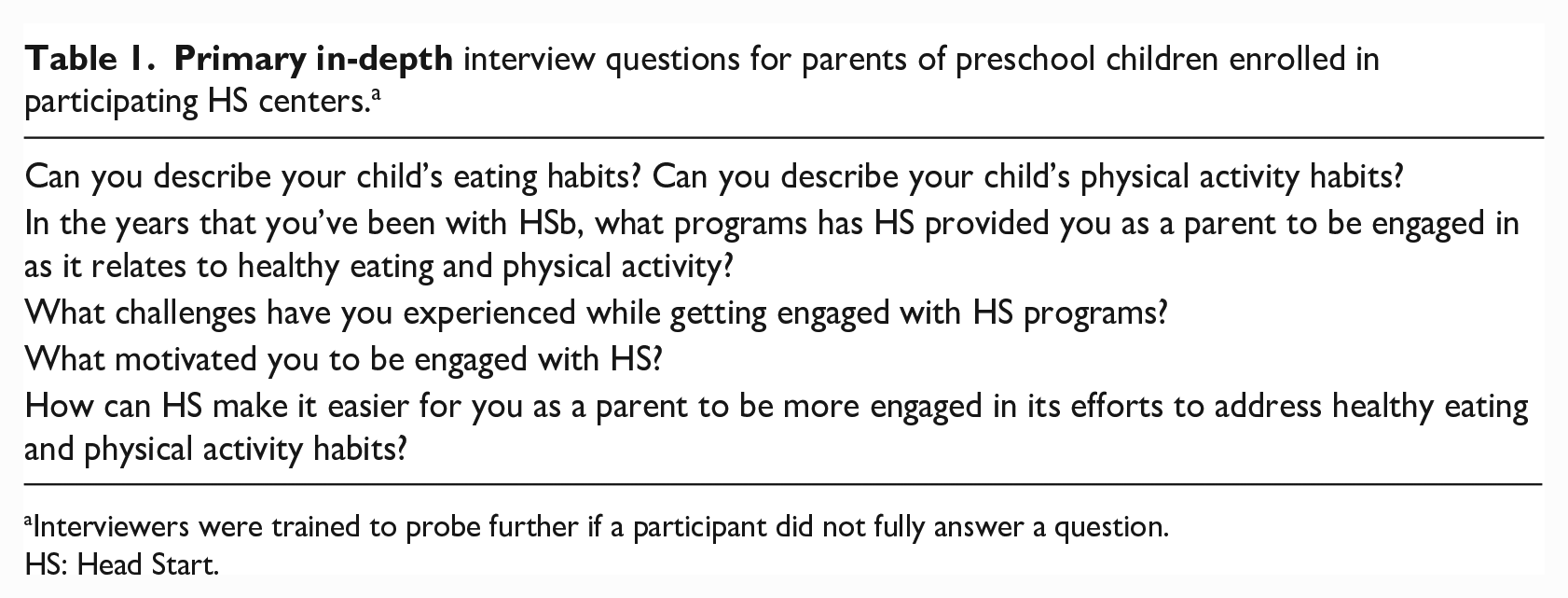
Interviewers were trained to probe further if a participant did not fully answer a question.
HS: Head Start.
Data analysis
Each interview was audio-recorded and transcribed verbatim. Coders were trained using Goodell’s five-phase training protocol for coders (Goodell et al., 2016). Analysis was conducted using a phenomenological approach (Creswell, 2007; Moustakas, 1994). First, coders engaged in the previously described bracketing process to document their personal experiences and biases about the topic and study population (Moustakas, 1994). Second, each transcript was reviewed independently by two trained coders (first and last author) to immerse themselves in the data. During this phase, coders simultaneously engaged in memoing and open coding to highlight key concepts related to the phenomenon. Third, coders created codes for specific relevant statements in the data. Coders then reduced and eliminated data that did not describe parents’ experiences with HE-PA programs in HS (Creswell, 2007; Moustakas, 1994). During this process, the coding team created a code book and reached 100% consensus as to how codes were applied to the data (Creswell, 2007). Fourth, coders created a list of nonrepetitive coded statements related to parents’ common experiences in a process called horizontalization of the data. In the fifth and final step, the coding team grouped significant statements together in larger units of information called “meaning units,” also known as themes. Themes were created based on common patterns observed within the data (e.g. barriers to engaging in HE-PA programming) and relevance to the primary research question (Braun and Clarke, 2006; Creswell, 2007; Moustakas, 1994). This process created three primary themes that succinctly describe the “what” and “how” of families’ experiences with HE-PA programming in HS.
Results
The final sample included 13 female participants who were an average age of 30.3 (SD = 9.56) years. Previous researchers have established a sample size of 10 participants as adequate for phenomenological studies (Creswell, 2007; Hall et al., 2016). Race or ethnicity was self-reported by participants from a list including non-Hispanic White, non-Hispanic Black, Hispanic, Asian or Pacific Islander, Native American (including Alaskan), biracial or multiracial (specify), or other (specify). Parents were asked to check all that applied. Most participants identified themselves as Black/African American (85%), single (69%), with an income of less than $25,000 per year (83%, percent excludes one participant who was unsure of her household income due to unemployment), a high school degree or higher (77%), and were either employed working part-time or were unemployed (62%; Table 2). Only two parents (15%) reported regularly attending parent meetings and/or serving as a volunteer with their HS program. Most parents reported they engaged their children in activities related to nutrition (62%) and physical activity (85%) “almost all of the time.” Table 2 presents demographic information for interview participants. Participating parents were representative of parents enrolled across HS programs in NC. In 2017, approximately 72% of HS parents in NC held a high school degree or higher, were unemployed (46%), and from single family homes (68%; Office of Head Start, 2017).
Demographic information for interview participants (n = 13).

Using a 4-point scale (1 = almost never, 2 = sometimes, 3 = frequently, 4 = almost all of the time) participants were asked to report their perceived level of engagement with nutrition education and physical activity programming offered by their child’s Head Start center.
Using At the time of the interview, this participant was unsure of her houseful income because she was unemployed, but others in her household were working.
Researchers identified seven emergent themes that were categorized into three categories: (1) Strategies to Facilitate Parent Engagement, (2) Motivators for Parent Engagement, and (3) Barriers to Parent Engagement. Table 3 presents representative themes, subthemes, and supporting quotes.
Supportive head start parent quotations for themes and subthemes regarding facilitators, motivators and barriers for engaging in healthy eating and physical activity-focused head start programming.

Head Start
Healthy eating and physical activity.
HS Facilitators to Parent Engagement
Researchers identified two primary themes within the category of “Strategies to Facilitate Parent Engagement” based on participant responses: (1) child and parent engagement with HE-PA at school; and (2) HE-PA-focused parent education and communication. Parents described various methods HS used to engage children in HE-PA behaviors at school. Some participants stated HS’s focus on promoting HE-PA at school made it easier for them to support healthy behaviors at home. For example, participants stated HS provided healthy food options at school which made it easier for them to practice the same eating habits at home. Participants also stated that HS provided opportunities for their children to be physically active during the day by letting children play outside. Participants further reported that HS provided parents with opportunities to engage in HE-PA with their child at school stating the program had a “welcoming” policy in which parents were invited to eat with their children during mealtime and play outside with them. Participants reported they were encouraged to volunteer at their child’s center by visiting during mealtimes, participate in field trips that encouraged parent and child physical activity (e.g. walking), and share ideas at parent meetings for how HS could improve programming for both parents and children (e.g. future field trips, timing of meetings).
Parents also reported that HS encouraged engagement with HE-PA through education and communication. HE-PA programming was reportedly featured during parent meetings, health fairs, and nutrition and cooking classes. For example, parent meetings discussed upcoming programs and/or HE-PA activities to try at home with their children. Additionally, health fairs were described as events participants were able to attend and gather information on, HE-PA activities to do with their children and other age-related health topics. Occasionally, nutrition and cooking classes were held at the center and led by a nutritionist. These classes provided participants with information on healthy eating, information on food safety and sanitation, cooking demos, food samples, and recipes to try at home.
Parents reported that HS also facilitated parent-child engagement with HE-PA by sending home information and/or providing opportunities for parents to engage in HE-PA activities with their children at the center. Interviewed parents stated HS often sent information about healthy eating home in the form of newsletters to encourage families to engage in healthy eating behaviors. Newsletters often included healthy eating tips, new recipes for parents to try, or healthy snack ideas.
Motivators to parent engagement
Researchers identified two primary themes within the category of “Motivators for Parent Engagement”: (1) personal interest in learning about nutrition and (2) child interaction. Participants reported their personal desire to learn more about healthy eating was a motivator to their engagement with HE-PA programming offered at HS. Some parents reported they were motivated to read the HS newsletters because they wanted to learn more about the HE-PA topics highlighted. Participants reported opportunities to interact with their child at school was also a key motivator for their engagement with HS programming. Many participants recounted that seeing their children and/or other children happy motivated them as parents to be engaged. Some participants highlighted the “good” feeling they received because of spending time with the children and/or serving as a role model.
Barriers to parent engagement
Three primary themes were identified within the category of “Barriers to Parent Engagement”: (1) HS-related barriers, (2) socioeconomic challenges, and (3) priority for HE-PA. Participants reported HS-related barriers including poor communication with parents and limited availability of HE-PA programming. Participants stated HS’s poor communication methods were not only a barrier to engaging HE-PA-focused activities, but all HS programming. Some parents reported receiving little communication regarding HE-PA activities and/or upcoming programing offered by their HS center. Participants further explained that they often received communication from HS about upcoming programs too late, limiting their ability to plan to attend.
Socioeconomic challenges such as parent’s educational background, time constraints, and childcare access were also described. Participants described a desire to learn more about HE and making healthy behavior changes but reported a lack of knowledge about HE, which may be a barrier to some parents’ engagement. Some participants acknowledged time constraints which impacted their ability to engage with HE-PA programming at HS. This was due to conflicts between HS programming and participants’ work, school, and personal schedules. Limited access to childcare was acknowledged as a critical barrier to parent engagement. Participants reported that they would be interested in attending more HS programs, but their children had no place to go or were dropped off at the center when the programs occurred. Multiple parents suggested HE-PA programming should provide childcare, emphasize hands-on learning activities, and/or provide opportunities for parents and children to learn side by side. Finally, participants stated HE-PA may not be a priority for their family time due to other socioeconomic concerns. Parents described being more concerned with meeting their family’s basic needs (e.g. rent, electric bill) and/or improving their current economic status. As a result, HE-PA was considered a low priority limiting parent engagement with related programming at HS.
Discussion
HS strives to create strong partnerships with families to promote parent engagement in the health and education of young children (Foster et al., 2015; Gooze et al., 2010). Creating strong partnerships includes teaching parents how to implement HE-PA behaviors in the home (Gooze et al., 2010); however, families may face unique barriers to engaging with HE-PA programming offered through HS (Ling et al., 2016). Therefore, the purpose of this study was to understand HS parents’ common experiences with HE-PA programming offered in one HS program (two centers) in ENC.
Personal interest and opportunities for parents to engage with children during HE-PA programming were cited as motivators for parent engagement. Facilitating their engagement, parents reported HS often invited parents to engage in HE-PA alongside their child during school hours at mealtime and/or outdoor playtime. These findings are consistent with other studies (Dev et al., 2017; Garcia et al., 2018; Zarnowiecki et al., 2012). Parents in the current study also reported that HS offered opportunities for parents and children to engage with HE-PA focused educational programming outside of the school day. HE-focused educational programming was most often described as occurring through parent meetings, nutrition classes, and written communication including newsletters and school menus sent home. Prior studies have reported similar findings demonstrating communication via newsletters or menus may be a common approach used by HS to provide parents with information on HE-PA (Dev et al., 2017; Gooze et al., 2010; Johnson et al., 2013; Stage et al., 2018). Finally, in contrast to prior studies exploring teacher perspectives (Dev et al., 2017; Sisson et al., 2017; Stage et al., 2018), findings from the current study indicate parents are interested in learning about HE-PA topics for their personal benefit and that of their children. However, parents may feel more motivated to engage with HE-PA programming when they are able to connect their own learning with the importance of their child’s learning of HE-PA behaviors (Dev et al., 2017; Garcia et al., 2018).
Parents also reported several barriers to engaging with HE-PA educational programming offered through HS. Communication challenges between HS and parents were most frequently described. While some parents were satisfied with HS communication via newsletters and school menus, other parents reported receiving little communication from HS. Some parents may not receive adequate communication; however, Dev et al. (2017) reported teachers suggested parents may not be reading materials sent home. While teachers share parents’ goal of promoting healthy choices to children (Garcia et al., 2018), prior literature has suggested that both teachers and parents may see each other as barriers to this goal (Dev et al., 2017; Garcia et al., 2018; Lebron et al., 2020; Lyn et al., 2014). Overall, there appears to be a disconnect between parents and teachers in which both parties believe the other is a barrier to health promotion (Johnson et al., 2013). This disconnect is further highlighted by parents who report limited programming was a barrier to their engagement. Despite the many programs that HS offers for parents, most parents spoke of only a few programs offered by HS and only two parents (15.4%) reported that they regularly attended parent meetings and/or served as a volunteer for the HS program. Mena et al. (2020) suggested consideration of parents’ daily routines, including their work schedules, to increase communication between parents and teachers. Parents commenting that they have limited time to engage with HE-PA is consistent with previous literature in which teachers have described parents as being “too busy to talk” about nutrition (Dev et al., 2017; Garcia et al., 2018), engage in nutrition-related activities (Stage et al., 2018), attend events, or respond to information sent home (Lyn et al., 2014).
Lyn et al. (2014) reported teachers described parents as infrequently attending events held at the center. While it is likely true that some parents may not be interested in engaging in, HE-PA programming offered by HS, other parents may not be receiving adequate communication which results in parents being unaware of the HE-PA opportunities available. It is important to address this disconnect as good communication between centers and parents is necessary to allow teachers to deliver essential information to parents (Sisson et al., 2017). A study by Johnson et al. (2013) found that staff reported parents were most interested in discussions about types of food and how much children eat at the center, which may be beneficial for providers to know when facilitating communication with parents. Parent engagement with HE-PA may also be essential for teachers to feel motivated to promote healthy behaviors to children (Sisson et al., 2017). Johnson et al. (2013) reported that teachers described several recommendations for how to engage parents in HE-PA including providing parents with recipes, newsletters, and inviting parents to participate in mealtimes during school hours. Many of these practices were described by some of the parents in this study. However, other parents appeared unaware of the offered HE-PA engagement opportunities while acknowledging a desire to receive more information. This finding highlights a disconnect between HS and some parents, as parent awareness of HS practices varied. In contrast to the previously provided definition for engagement, awareness refers to the acquisition of knowledge about various parenting programming and events to engage in or opportunities for parents to be engaged in the HS program by volunteering (Laff and Ruiz, 2021). For example, some parents described how HS used newsletters to communicate healthy eating and physical behaviors that can be done at home with the child. This would be considered a method of bringing awareness to engagement opportunities to families.
Limitations
Due to the qualitative nature of this study, results of this study should not be generalized beyond the sample. Among the sample interviewed, two parents (15.4%) reported that they regularly attended parent meetings and/or served as a volunteer for the HS program. It is unclear what percentage of parents engage regularly with HE-PA programming offered through HS. Future studies should use quota sampling to compare the experiences of engaged and non-engaged parents. Despite these limitations, this data demonstrates parents’ perspectives regarding their engagement with HE-PA focused programming at HS and provides some insight into helping parents engage with HE-PA programming.
Implications for future research
Parent engagement with HE-PA is necessary to promote healthy lifestyle choices to children and combat childhood obesity. HS programming focused on child and parent engagement appears to be an effective strategy to promote parent engagement. To increase parents’ motivation to engage in programming, HS may benefit from implementing more HE-PA programming that also includes children, such as a child-parent cooking program. Previous studies have demonstrated that cooking classes can have positive effects on parents, such as increased self-efficacy for meal preparation (Herbert et al., 2014; Morin et al., 2013). While there is a need for further examination of cooking classes that involve both parents and children, a few studies have examined such classes and reported positive outcomes including improvements in HE-PA behaviors (Anderson et al., 2015; Miller et al., 2017).
Unfortunately, participants in our study also reported their engagement with HE-PA was limited due to challenges that existed between administrators/staff and families including limited communication and parent awareness of available programming. Nutrition educators and HS administrators may benefit from reconsideration of current communication practices and use of alternative HE-PA interventions through online through social media (Sisson et al., 2017; Swindle et al., 2017) or texting (Snell et al., 2020) to address parent barriers. This approach has the potential to simultaneously improve communication and engagement with HE-PA programming. Snell et al. (2020) reported parents were open to the use of text messages as short and informative messages to encourage and/or remind parents to model a behavior and reinforce learning activities at home. Future research should further examine alternative interventions including social media and/or text messages to determine the best way to promote parent engagement among families from low-income backgrounds. While parent awareness of programming is different than parent engagement with programming, for parents to engage, they need to first be aware of opportunities. HS will likely benefit from further examination of their communication policies to better understand why this disconnect between parents and HS staff exists and how to overcome it. Finally, this study provided insights regarding parents’ barriers such as limited childcare, access, and educational background. HS programs and educators can also consider address these challenges to ensure adequate planning to accommodate both children and parents, offer incentives such as a dinner meal for parents to attend, as well as provide adequate time to parents to plan these events.
Footnotes
Acknowledgements
We would like to acknowledge the East Carolina University’s Undergraduate Research and Creativity Achievement Award for funding support. We also acknowledge our study participants who graciously gave of their time to participate in this study.
Funding
The authors received no financial support for the research, authorship, and/or publication of this article.
