




Abstract
Children’s conceptual knowledge of writing words and numbers is an important aspect of their cognitive development. Children use notations as representations that have a communicative value and begin to learn about formal differences between writing words and writing numbers at an early age before the onset of formal schooling. The aim of the present study was to examine preschool children’s conceptual knowledge of writing words and numbers in an ecologically valid task with communicative value. One hundred and twenty Greek-speaking preschool children between the ages of 3 and 6 years old were assessed on the identity card task, which examined their production of notations for words and numbers during their effort to communicate personal information to others. The results demonstrated a developmental trend in the type of notation children produced with the younger children providing more “ambiguous” notations, for both tasks implying writing words and numbers, while as they got older, they provided more “writing-like” notations for the tasks implying writing words and more “number-like” notations for the tasks implying writing numbers. Understanding when and how children differentiate their symbolic representations for words and numbers can inform both theory and practice by expanding our understanding of whether certain constraints characterize the developmental course of a specific notational system. The findings of the present study could be incorporated in educational practice and enhance children’s emerging literacy and numeracy skills.
Introduction
Using symbols is a distinguishing characteristic of human communication. The definition of a symbol as something that someone intends to stand for something else (DeLoache, 2002) is based on two psychological processes, namely intention and representation. In order for children to use symbols, they need to understand not only the communicative intent that led to the creation and use of the symbol but also how the symbol relates to its referent (Uttal and Yuan, 2014).
Notations, such as words and numbers, allow the expression of mental representations and can be conceived as permanent external symbols that refer to absent realities and establish a relationship between a referent and a sign (Donald, 1991). Notations are essential tools, influenced by biological, cognitive and cultural factors, which are frequently used in everyday tasks and facilitate communication and social interaction (Garcia-Mila et al., 2004).
Unlike what occurs with speaking or reading, writing is a symbolic system that leaves visible marks. The writing system can be segmented into discrete units (i.e. a word can be segmented into letters, a number into digits). Despite their intricate relationship, numbers and words are very different in the type of meaning they represent and in the syntactic rules that establish how they must be read or written. Words are symbols that convey meaning and represent objects, ideas, people, places, or concepts, while numbers are initially used as labels which identify familiar objects (i.e. telephone numbers, car number plates) or situations (i.e. birthday) and afterward they become symbols that represent certain quantities (Munn, 1994; Sinclair and Sinclair, 1986).
Literacy and numeracy are fundamental components of children’s emergent understanding of symbolic systems and have been found to be strong predictors of later achievement in formal literacy processes in both transparent (e.g. Italian, Japanense; Bigozzi et al., 2016; Yamagata, 2007) and opaque languages (e.g. English; Ouellette and Sénéchal, 2008). Long before formal schooling begins, children attempt to write and show some understanding about the symbolic nature of writing, and how words and numbers represent meaning in a different way than drawings do (Treiman et al., 2015). In their seminal study, Ferreiro and Teberosky (1979) found that even the children from lower-class backgrounds, with limited exposure to print had accumulated knowledge about print before going to school. In the same line, Goodman (1985) recognized the importance of social context and supported that children actively construct their notions concerning literacy through their participation in a literate society.
Conceptual knowledge of writing words and numbers
Although a number of studies has focused on children’s awareness of different symbolic systems for drawing and writing letters, less attention has been paid on how children differentiate the symbolic systems for writing words and writing numbers (Dockrell and Teubal, 2007).
Conceptual knowledge of the writing system includes two components. The first component is awareness of the existence of different symbolic systems to represent meanings (written and numeric language). The second component is represented by invented spelling, which is the systematic matching of sounds that are included in words with signs that are not necessarily conventional (Puranik et al., 2011; Read and Treiman, 2013). Children’s emergent conceptual knowledge of the writing system is progressive and reflects how they develop an early understanding of the functions of print (Bialystok and Martin, 2003; Leyva et al., 2012).
In their pioneering work, Tolchinsky-Landsmann and Karmiloff-Smith (1992) investigated preschool children’s (3.8–6.6 years old) understanding of notations by presenting them cards and asking to put the cards which were “not good for writing” on one side. Results showed that since the age of 4 years, most children categorized effectively cards depicting words and cards depicting numbers. By 5 and 6 years of age, children were able to understand that repeated symbols (i.e. “ppppp”) or a single letter (i.e. “P”) cannot represent an example of a correct representation of a word, whereas a string of numbers (i.e. 88888) or a single number (i.e. 8) can represent an example of a correct representation of a number. In another task, they investigated notational production by asking children to write their own name, as well as other names, words, letters and numbers that they knew. Then, the same children were asked to produce non-numbers, non-letters, and non-words (“Here you made a number, now make a number that doesn’t exist”). Although before the age of 6 children were not so capable of recognizing how the different systems are used to refer and communicate information, at the age of 6 children started to become sensitive to the function of notations as potentially meaningful referential-communicative tools.
Similarly, Bialystok (1992) supported that although children may mentally represent written letters and numbers as objects that have certain visual characteristics, they cannot yet represent them as symbols that stand for meanings. This comes gradually and becomes evident when children are around 6 years old. Beyond this age, letters and numbers can be understood as symbols whose function is to refer only to specific values.
However, there is another group of studies according to which children can differentiate words and numbers and they are aware of their communicative value earlier, that is before the age of 6 (Dockrell and Teubal, 2007; Yamagata, 2007). More specifically, Dockrell and Teubal (2007) investigated early production of writing words and numbers in an “identity card” task in English speaking preschoolers’ (3–5.5 years old). The children were asked to communicate information about themselves to others (i.e. “put down on paper your name”), that is to use notations as representations that have communicative value. Children as young as 3 years of age were able to discriminate between notational domains (“writing-like,” “numeric” and “iconic”) when they intended to communicate information. Also, a significant developmental trend was found with older children (5-year-olds) providing more writing-like notations for the tasks implying a writing response and more numeric notations for the tasks implying a number response.
In another study, Yamagata (2007) investigated the production of notational systems in Japanese-speaking preschool children (1.9–3.10 years old). Particularly, she asked the children to draw a human figure (“draw your mother or father”), to write their name in hiragana letters (“I would like to see how you write”), and to produce the number 1 (“write down the number 1 on this paper”). All the children of the youngest age (1.5–2-year-old) provided a drawing both for the number and the word task. Most 3 and 3.5-year-old children produced few pseudo-products (drawing-like or writing-like) and more conventional products in the number task, whereas in the word task the majority of children produced more pseudo-products and just one child provided a conventional response, implying that number production develops a little faster than word production.
In one of the first studies examining invented spelling in Greek language, Tantaros and Vamvoukas (1999) asked 5 and 6-year-olds to write (“as if you know how to write”) four words (rat, dog, butterfly, crocodile) and a sentence (“the dog eats bones”). According to the researchers “it seems that after a phase of drawing . . . the children create written signs that try to represent writing . . ., then they use only letters for their writings . . . to proceed finally to the creation of partially or totally correct writings” (Tantaros and Vamvoukas, 1999: 128). Their results demonstrated the developmental sequence of writing words, but they did not examine when children start to differentiate between writing words and numbers and which system develops first.
In another study, Stellakis and Kondyli (2004) asked Greek-speaking children (4–6 years old) to communicate information in two production tasks (“write down a list of toys”) and (“write down a message”) after listening to a story. In both tasks, 4–5-year-old children produced more drawings and scribblings, while most 5–6-year-old children produced letter-like forms and letter strings.
Aim of the present study
Research conducted so far regarding preschool children’s conceptual knowledge of writing words and numbers is very limited, mainly employing artificial tasks and with contradictory results (Bialystok, 1992; Dockrell and Teubal, 2007). As it was previously shown, most of the studies have mainly focused on children’s writing of a given word or number (Tantaros and Vamvoukas, 1999; Yamagata, 2007). The conflicting evidence may be attributed to different methodological procedures applied (communicative vs artificial tasks), the instructions provided to the children [directive (i.e. “write”) vs neutral (i.e. “put down on paper”) instructions] and the coding system employed in order to categorize children’s productions (Dockrell and Teubal, 2007; Stellakis and Kondyli, 2004; Tantaros and Vamvoukas, 1999; Tolchinsky-Landsmann and Karmiloff-Smith, 1992; Yamagata, 2007).
To our knowledge, only Dockrell and Teubal’s (2007) study investigated children’s conceptual knowledge of writing words and numbers in English language using a communicative production task, while only one study has been conducted in Greek language. The Greek language is characterized by a shallow orthography because there is consistency in grapheme-phoneme correspondences (Protopapas and Vlahou, 2009), whereas English is characterized by a deep orthography, with higher level morphological constraints (Porpodas, 2001). Investigating children’s conceptual knowledge of writing words and numbers in another language than English could provide us with more information about children’s conceptual knowledge of writing in different languages by possibly demonstrating similarities and differences.
Therefore, the aim of the present study was to investigate the conceptual knowledge of both writing words and numbers in Greek-speaking preschool children (3–6 years old) and extend previous research by (a) including a younger age group of children (3-year-olds), (b) eliciting different notational forms (words and numbers) (c) using neutral instructions (i.e. “put on paper” instead of “write”) and (d) administering an ecologically valid task with communicative value for the children. Ecological validity lies in the principle that the task resembles everyday situations rather than being artificial (Ashcraft and Radvansky, 2009).
The study had the following four research questions: (a) What type of notations did children 3–6 years of age produce for the items implying writing words in a communicative task? (b) What type of notations did children 3–6 years of age produce for the items implying writing numbers in a communicative task? (c) To what extent are there developmental differences in the types of notations that children produced for words and numbers? (d) To what extent do preschool children (3–6 years old) differentiate the productions of notations for words and numbers?
Method
Participants
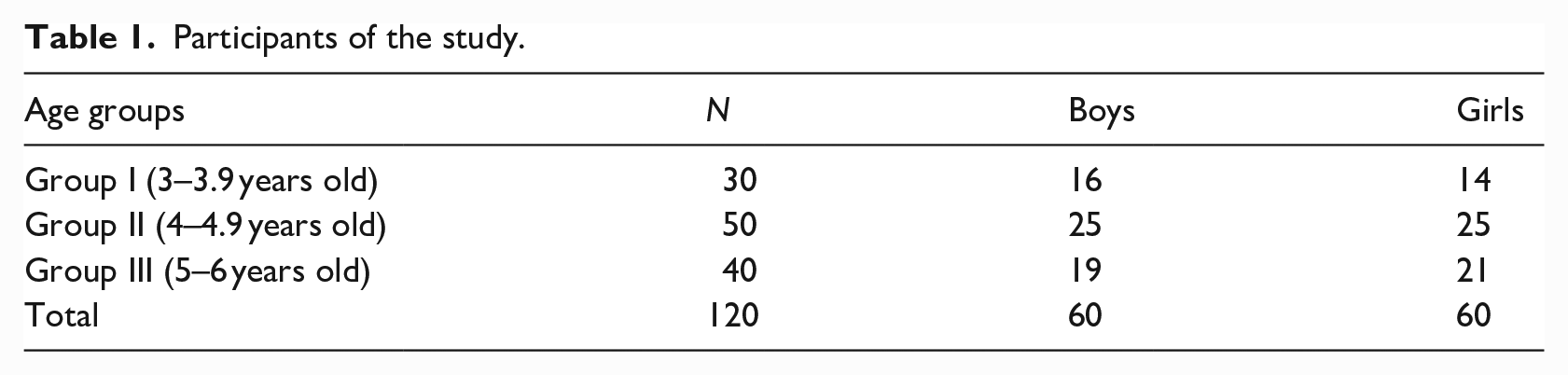
One hundred and twenty (120) 3-6-year-old Greek-speaking children, matched for gender, participated in the study (see Table 1). Children belonged to three different age groups: Group I (3–3.9 years old, N = 30, 16 boys), Group II (4–4.9 years old, N = 50, 25 boys) and Group III (5–6 years old, N = 40, 19 boys). Participants were recruited from public schools and came from middle class socioeconomic background. Children with special educational needs did not take part in the study. Parental consent was obtained in order for children to participate in the study.
Participants of the study.
Measures
The identity card task
The children were administered the identity card task, based on Dockrell and Teubal’s (2007) protocol. Each child was invited to play a game with a puppet. Prior to commencing the game, the child was asked to help the experimenter by completing an identity card, which would allow others who didn’t know the child “to learn more about him/her,” emphasizing this way the communicative value of the task. The task required the child to produce information that is conventionally presented either in notations for words or in notations for numbers. To allow each child to generate his/her own representations the instructions were open-ended, and no images or examples were provided.
Initially, children were given a piece of paper with enough space at the top in order to draw a picture of themselves and beneath a series of boxes to provide their responses. Children were invited to listen to the questions and then were asked to complete their answers. At the same time, the experimenter noted the child’s responses on his own protocol. The identity card task included two sets of 16 items, which required from the child to produce notations for words and numbers. Set A (eight items) required notations for words, such as the child’s name, their mother’s name, their father’s name, their best friend’s name, the name of the street they lived, their city, the color of their eyes, and the color of their hair. Set B (eight items) required notations involving numbers, such as the child’s age, their mother’s age, their father’s age, their best friend’s age, the number of friends they have, their telephone number, their weight, and their height. The order of Set A and Set B items was counterbalanced across children. The identity card task was administered individually in a quiet room without other stimuli that could distract children’s attention.
Coding of the responses
Children’s responses in the identity card task were categorized according to previous relevant research (Dockrell and Teubal, 2007). The detailed description of each one of the categories of notations as well as a relevant example is presented in Table 2 below. Children’s responses for each one of the eight items in each set of questions was coded only in one of the categories. For the last research question, the total number of responses for each set of items which fell into the same category was added. Two independent researchers coded 60 protocols of the children’s responses. The inter-rater agreement was found very high (95%) according to Fleiss et al. (2003) criteria.
Categories of notations: description and examples.
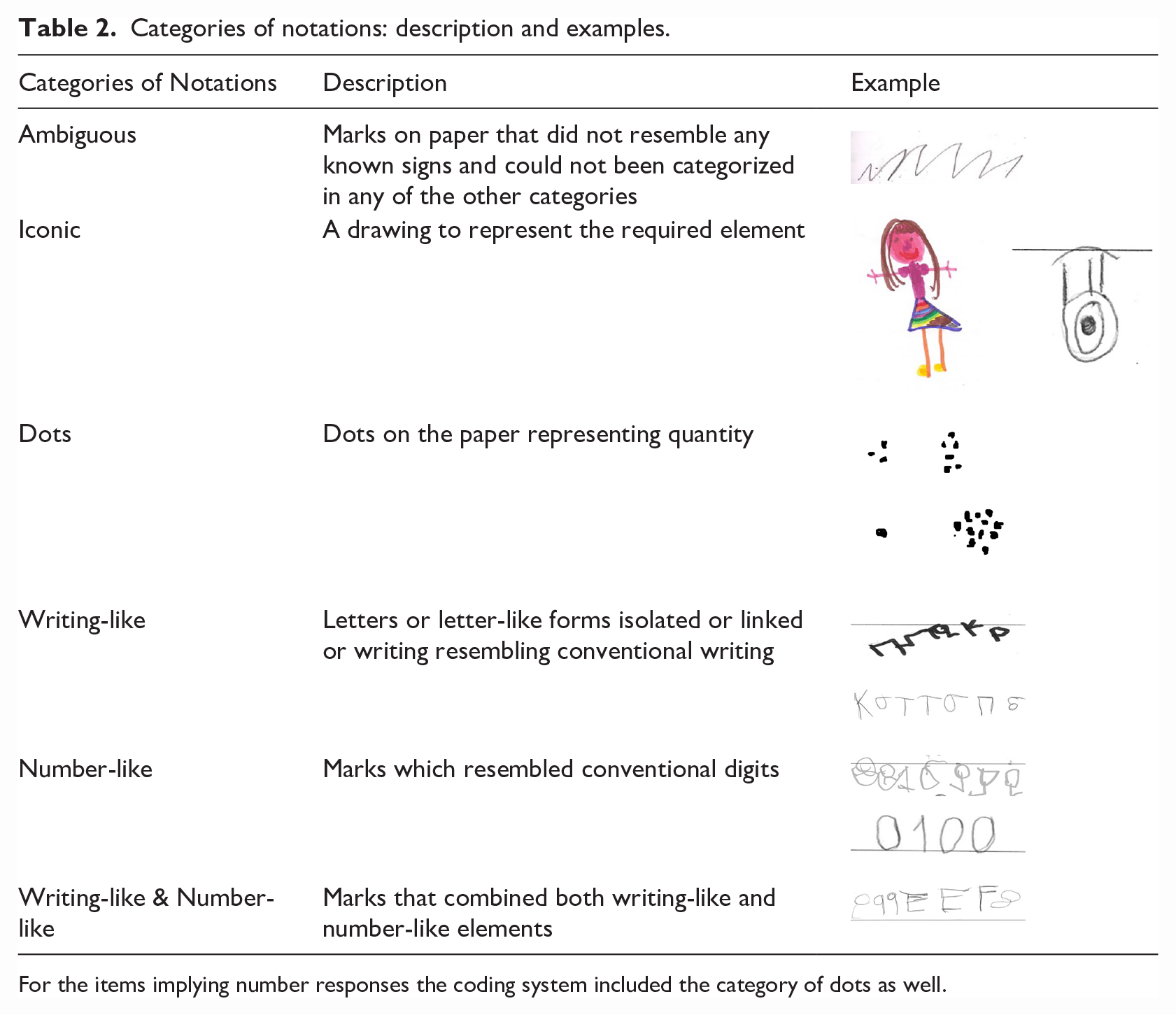
For the items implying number responses the coding system included the category of dots as well.
Results
The results are presented in three sections, according to the research questions. The first section presents the type of notations that children produced for the items implying writing words by age group. The second section presents the type of notations that children produced for the items implying writing numbers by age group. The third research question addresses to what extent there are developmental differences in the types of notations that children produced for words and numbers. The final section demonstrates the extent to which preschool children differentiate the productions of notations for words and numbers. For the first two questions, chi-square tests of independence were conducted in order to examine whether there were any statistically significant differences across the various types of notation responses for each age group. For the third question, a one-way ANOVA was performed in order to explore developmental differences in the types of notations children produced by age. For the last research question a paired samples t-test was applied in order to examine whether there were any differences in the use of each notational category between Set A and Set B for each one of the three age groups.
What type of notations did children 3-6 years of age produce for the items implying writing words?
Table 3 presents children’s production of different categories of notations for the items implying writing words by age group. Most of the children in Group I (3–3.9 years old) provided statistically significantly more “ambiguous” responses for all the items in comparison to the other types of responses.
Categories of notations for the items implying writing words by age.

On the other hand, Group II (4–4.9 years old) produced statistically significantly more “writing-like” responses for all the items in comparison to the other types of notations. None of the children produced an “iconic” response for the items requesting a person’s name, except for one child who used an iconic response to depict his/her friend’s name. However, it is worth mentioning that “iconic” responses were more frequent for both the items about color of eyes (20%) and color of hair (20%).
Group III (5–6 years old) provided statistically significantly more “writing-like” responses for all the items implying writing words, and almost no “ambiguous” notations, with the exception of one “ambiguous” response for father’s name and street name. “Iconic” responses were also very infrequent in this age group.
What type of notations did children 3-6 years of age produce for the items implying writing numbers
Table 4 presents children’s production of different categories of notations for the items implying writing numbers by age group. Most children in Group I (3–3.9 years old) provided statistically significantly more “ambiguous” notations for all the items implying writing a number in comparison to the other types of notations. Also, none of the children in Group I provided a “number-like” response and only a few used “dots” as their response, exclusively for the items about their own age (6.7%), friend’s age (3.3%), number of friends (13.3%) and height (3.3%).
Categories of notations for the items implying writing numbers by age.
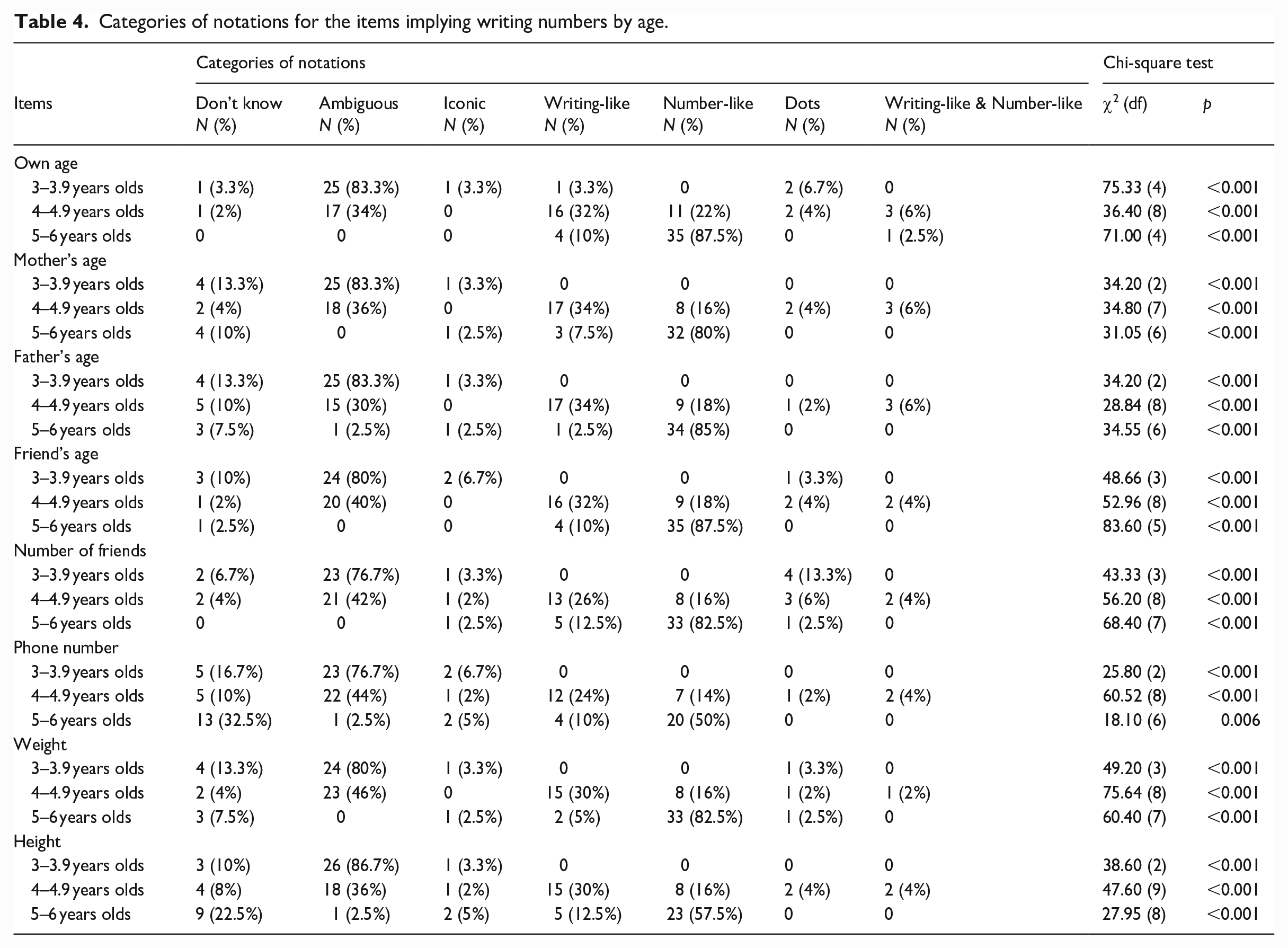
Group II (4–4.9 years old) provided statistically significantly more “writing-like” and “ambiguous” notations, despite the numeric nature of the task (all items implied a number response), in comparison to the other categories of notations.
On the contrary, in Group III (5–6 years old) the majority of children provided statistically significantly more “number-like” notations for all the items implying a number response.
To what extent are there developmental differences in the types of notations that children produced for words and numbers?
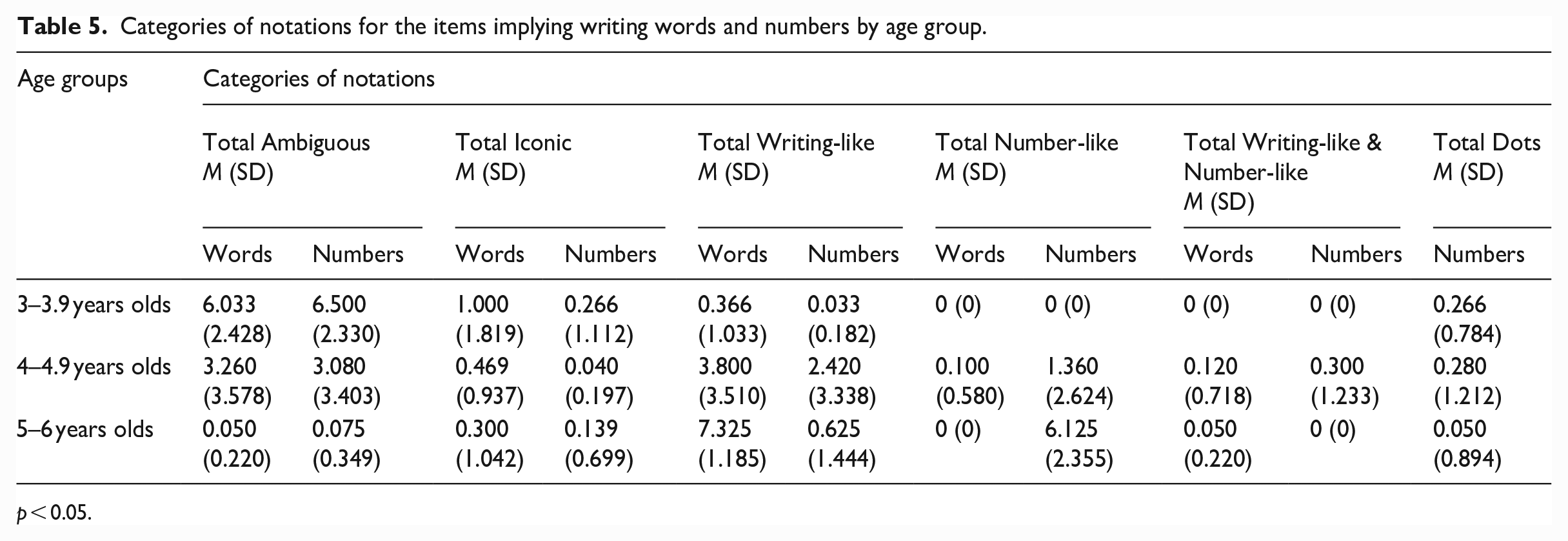
Looking at the items implying writing words, Group I (3–3.9 years old) provided statistically significantly more “ambiguous” responses (Table 5) than the other two groups of children aged 4–4.9 and 5–6 years old [F (2, 117) = 45.740, p < 0.001]. On the other hand, Group III (5–6 years old) provided statistically significantly more “writing-like” notations than Group II (4–4.9 years old) and Group I (3–3.9 years old) [F (2, 117) = 71.127, p < 0.001].
Categories of notations for the items implying writing words and numbers by age group.
p < 0.05.
In relation to the items implying number responses, Group I (3–3.9 years old) provided statistically significantly more “ambiguous” responses than Group II (4–4.9 years old) and Group III (5-6 years old) [F (2, 117) = 56.862, p < 0.001] (Table 5). Furthermore, Group II (4–4.9 years old) provided statistically significantly more “writing-like” notations for the items implying a number response than Group I (3–3.9 years old) and Group III (5-6 years old) [F (2, 117) = 11.951, p < 0.001]. Group III (5–6 years old) provided statistically significantly more “number-like” notations than Group II (4–4.9 years old) and Group I (3–3.9) who did not provide any “number-like” response for the items implying a number response [F (2, 117) = 82.031, p < 0.001].
To what extent do preschool children differentiate the productions of notations for words and numbers?
A comparison between children’s responses for words and numbers showed that Group I (3–3.9 years old) used statistically significantly more “iconic” responses for the items implying writing words than for the items implying writing numbers [t (29) = 3.003, p = 0.005]. The same pattern was evident for Group II (4–4.9 years old) [t (49) = 3.623, p < 0.001]. Furthermore, both Group II (4–4.9 years old), and Group III (5-6 years old) provided statistically significantly more “writing-like” responses for the items implying writing words than for the items implying writing numbers (Group II: t (49) = 3.478, p = 0.001, Group III: t (39) = 22.998, p < 0.001).
Last, both older age groups provided statistically significant more “number-like” responses for the items implying writing numbers than for the items implying writing words (Group II: t (49) = 3.591, p < 0.001, Group III: t (39) = 16.446, p < 0.001). In fact, none of the children in Group III used a “number-like” response for the items implying writing words.
Discussion
The aim of the present study was to investigate the conceptual knowledge of writing words and numbers in Greek-speaking preschool children (3–6 years old) using an ecologically valid task. The first research question was about the type of notations young children produce for a set of items implying writing words. It was found that 3–3.9-year-old children provided statistically significantly more “ambiguous” notations, while 4–4.9-year-old children produced mostly “writing-like” responses and less “ambiguous” responses. Similar findings were found in Stellakis and Kondyli’s (2004) study. Also, in the present study children 5–6 years old gave statistically significantly more “writing-like” responses for all the items implying writing words, and almost no “ambiguous” notations, which is in the same line with previous studies both with English (Dockrell and Teubal, 2007) and Greek speaking children (Stellakis and Kondyli, 2004).
In our study, it is worthwhile mentioning that despite that those younger children (3–3.9-year-olds) provided statistically significantly more “ambiguous” responses for all the items implying a word, the item in which even this age group provided the most “writing-like” responses was the one asking them to produce their own name. Levin et al. (2005) have also found that 2–5-year-old Israeli and Dutch children showed more writing-related qualities (i.e. linearity, segmentation) when asked to produce their names than when asked to produce other words, a finding which was also confirmed by Otake et al. (2017) in English language. Previous research has shown that the child’s name plays a critical role in the development of writing and writing his/her own name precedes writing of other words (Tolchinsky-Landsmann and Levin, 1985). Nevertheless, name writing should not be used as the only measure of conceptual knowledge of the letters, because sometimes there are disparities between children’s ability to write the letters in their names (mechanical knowledge) and their understanding of what those letters represent (conceptual knowledge) (Drouin and Harmon, 2009).
The second research question was about the types of notations children produce for a set of items implying writing numbers. Children aged 3–3.9 years old produced statistically significantly more “ambiguous” notations, while none of them provided a “number-like” response and only a few used “dots” as their response. Children of 4–4.9 years old provided statistically significantly more “writing-like” and “ambiguous” notations, despite the numeric nature of the task. The above pattern of responses was also observed in Dockrell and Teubal’s study (2007), but not in Yamagata’s study (2007) with Japanese-speaking children, who found that 3–3.5 years old provided more conventional number writing responses in the number writing task. Nevertheless, it should be noted that Yamagata (2007) examined only the production of the Arabic number 1, by asking children to “write down the number 1” on a sheet of paper, whereas in the present study children were asked to “put down on paper” many more numbers (age, telephone number etc.). The production of numbers in comparison to words seems to be of greater challenge for children, since “some uses of text involving numerical information can be inherently fuzzy” (Dockrell and Teubal, 2007: 122). Last, the majority of children between the ages of 5 and 6 years old provided statistically significantly more “number-like” notations for all the items implying a number response. This finding is in the same line with Teubal and Dockrell (2005) who asked 3–6-year-old children to record the result of a throw of a die in a game and found that children above the age of 4.5 provided a correct digit notation.
In relation to our third research question about developmental differences in notational production of words and numbers, the results indicated a developmental pattern in the type of notations produced by age. As children were getting older, they used less “ambiguous” and “iconic” responses and produced statistically significantly more “writing-like” responses in the items implying writing words, while they also produced statistically significantly more “number-like” responses in the items implying writing numbers. These results are in the same line with previous studies both with English and Japanese speaking children (Dockrell and Teubal, 2007; Yamagata, 2007).
Τhe fourth research question investigated the extent to which preschool children (3–6 years old) differentiate the productions of notations for words and numbers. Results showed that Group I, the youngest age group (3–3.9 years old), seemed more confused about what kind of notation to use, providing mainly “ambiguous” notations both for words and numbers (although more “ambiguous” responses for numbers), while Group II, the middle age group (4–4.9 years old) seemed to be in a phase of starting developing a better understanding of the different notations that they had to use in the two different tasks (words and numbers), since they used less “ambiguous” responses both for words and numbers in comparison to the previous age group and more “writing-like” notations for the items implying words as well as more “number-like” notations for the items implying numbers. Nevertheless, at this developmental phase they also used “writing like” notations for the items implying numbers. Group III, the oldest age group (5–6 years old), clearly showed that they had built in their repertoire a conceptual knowledge of the characteristics of the two notational systems since they produced different notations for words and numbers according to what was required by them. A similar pattern of responses has also been found in relevant previous research by Dockrell and Teubal (2007).
The results of our study come to reinforce the hypothesis that learning to distinguish between different notation systems emerges early in development (around the age of 4 years) (Dockrell and Teubal, 2007; Yamagata, 2007). The above findings contradict previous research according to which it is not until the age of 6 that children learn how the different systems are used to refer and communicate (Bialystok, 1992; Tolchinsky-Landsmann and Karmiloff-Smith, 1992). However, this differentiation in findings might be attributed to the nature of the tasks. Bialystok (1992) asked 3–6 years old children to “write down something to help them remember how many things are in a box” and Tolchinsky-Landsmann and Karmiloff-Smith (1992) required from children between the ages of 3.8 and 6.6 years to produce “nonletters,” “nonwords” and “non numbers.” These kinds of instructions probably confused the children about what they had to do or did not capture children’s interest in the task, while in the present study a communicative task was administered which was understandable by the children as to what was required by them and concerned themselves (provide information about themselves to someone else). As Tolchinsky-Landsmann (2003) has mentioned, children’s performance in notational production tasks highly depends on the meaning that the task has for the child. That is whether it engages the child in the task and reinforces his/her willingness to communicate. Asking a child to convey personal information involves a different degree of engagement than asking a child to write some “non-words” or some given words.
Future studies investigating children’s conceptual knowledge of writing could possibly design tasks with different items and levels of difficulty in order to achieve variability in cognitive demands and verify children’s performance through questions with escalating difficulty within the same task. Also, the child’s characteristics (e.g. short term memory, working memory, oral language, kindergarten attendance etc.) as well as parental education and home literacy environment should be taken into account in order to obtain a homogeneous sample, which will facilitate comparisons between the participants, and expand our undestanding about the influence of other factors on the development of children’s conceptual knowledge.
Footnotes
Funding
The author(s) received no financial support for the research, authorship, and/or publication of this article.
Ethics approval
All procedures performed in studies involving human participants were in accordance with the ethical standards of the institutional and/or national research committee and with the 1964 Helsinki declaration and its later amendments or comparable ethical standards.
Consent to participate
Informed consent was obtained from all individual participants included in the study.
