



Abstract
The central theme for this article arises from conversation on how agricultural scientists can move from technology transfer to complementing development. Researchers may be willing to embrace developmental concerns while lacking enabling skills and perspectives. Agricultural researchers often choose agendas based on cost, efficiency and appropriate controlled input use. This is problematic for small-scale commercial agriculture in traditionally managed rural situations because it does not include the issues of authority, power and complexity found in situated contexts. This article describes researcher learning arising from participatory farmer–researcher activity that determined a mutually beneficial research agenda. The participatory nature of the research was determined by how relationships were developed and managed. Researchers came to understand that attitude, environment and relevant issues, not specific tools, achieved participation.
Introduction
The central theme of participant learning in the context of agricultural science in this article arises from a growing concern for how agricultural scientists can move from technology transfer to complementing rural development. In the field of agronomy, we find ourselves willing to embrace developmental concerns but lack the social research skills and perspectives that will enable such research. In the transfer of technology, agricultural researchers often choose agendas based on cost, efficiency and appropriate controlled input use to ensure predictable results. This is problematic for small-scale commercial agriculture in traditionally managed rural situations because it does not include the issues of authority, power and complexity found in situated contexts. For a limited time between October 2005 and the end of 2009, student researchers loosely connected through a project leader (Modi 1 ) were offered the opportunity by a group of subsistence farmers from Umbumbulu, KwaZulu-Natal to challenge everyone's mental models of commercial production and focus on complementing local, social, cultural and knowledge priorities with science for successful ‘commercialization’ of traditional agriculture. The farmers were members of the Ezemvelo Farmers Organization (EFO), a community structure bringing together local small-scale farmers committed to making indigenous crops, specifically amadumbe, 2 available for the market.
This article describes learning arising from participatory farmer–researcher activity culminating in a pre-research workshop arranged by researchers. In this process, researchers asked farmers what real problems they faced, and whether their commercializing endeavors could be supported through research activities; effectively developing a research agenda. From the workshop dialogue, project activities for capacity development, farming support and individual research agendas for student researchers emerged.
This article reflects on why a group of agriculture related scientists and farmers would engage in a participatory research relationship, how we began the process of engaging in legitimate Discourse, 3 and what shifts in thinking would help us identify research questions that would be mutually beneficial. We saw ourselves as scientists involved in an action learning process conducted through a ‘collegial’ farmer–researcher–market relationship.
Shifting objectives: Why engage with participatory research?
Transformation
Historically, South Africa has developed a dual agricultural landscape. White farmers were supported by well-resourced extension services, and a highly efficient and productive commercial agriculture sector with ready access to factors of production and commercial markets. In contrast, black farmers were supported through the less-resourced, and less effective, apartheid homeland extension system. They were effectively excluded from the market and had only limited access to the factors of production needed for commercial agriculture, most notably land(Singini & van Rooyen, 1995; Worth, 2006). In the post-apartheid national agenda, academic institutions and agricultural researchers are being called upon toengage with farmers through research-led projects and programs to effectively engage disenfranchised farmers in the South African agricultural sector (NDA, 2001).
The South African national strategy for agriculture envisions an ‘equitable access and participation in a globally competitive, profitable and sustainable agricultural sector that contributes to a better life for all’ (NDA, 2001, p. vii). The Integrated and Sustainable Rural Development Strategy (ISRDS) aims to ‘transform rural South Africa into an economically viable, socially stable and harmonious sector’ (NDA, 2001, p. vii). This is an example of how developing countries are utilizing sector wide approaches to encourage innovation in the use of technology and information to establish sustainable agriculture in the mainstream economy. Sadly, for rural South Africans the ‘main impediment to successful implementation of a sector wide strategic vision for equitable access and participation in a profitable and sustainable agricultural sector… is the vast untapped potential that lies in its people and material resources, and the low profitability and competitiveness that constrain the participation of a full spectrum of people and economic entities' (NDA, 2001, p. viii). A further impediment to progress is the failure by post-apartheid (1994 to present) government structures to deliver and implement regulations, programs and support systems critical for redress and the enabling of sustainable rural development (NDA, 2001).
Just as policy has shifted to include the potential of people as an integral part of agricultural processes, agricultural scientists are similarly challenged. Researching the relationship between labor and agricultural practice amongst subsistence Xhosa farmers has shown that rural homesteads are ‘built’ through a combination of social, economic and moral-religious elements (McAllister, 2001). This ‘building’ suggests that the process is complex and does not necessarily follow Western logic, but it drives decision-making and must be accounted for when researching commercialization processes. Scientists are also challenged to re-consider that their role in technology development is through innovation and not just technical phenomena. They are challenged to understand it as a complex process involving a reorganization of social relationships (Jansen, 2004). However, in academic institutions where agricultural specialists are produced, there is still the notion that Western ‘rational’ decisions, driven by economic theory, are the most productive in an environment with scarce resources. Production efficiency is perceived as a linear process obtained through a quantitative modeling of optimum behavior (Bitsch, 2000). This logic reinforces resistance by academics in these institutions to accept that small-scale farming with its complexity and scale of production has anything to contribute to a viable agricultural economy (Hall, 2009; A. Modi, personal communication, March 2006). There is a need, to understand the role of small-scale agriculture and its economic and social roles in rural economies.
Problems facing small-scale market-oriented agriculture arise from social, technical and environmental spheres (Munyua, 2007). Problems include a lack of appropriate technical information and training (Düvel, 2004) shortages of labor, access to markets, the perception that farming is risky in an increasingly hostile and confusing natural environment, and the perception that youth are not interested in taking over farming activities (S. Mabida, EFO farmer, personal communications, 2006). There is a need then to challenge barriers that prevent creating a knowledge base which relates to small-scale commercial farmers. Whiteside (1998) advocated empowering small-scale farmers to take more effective roles in sustainable natural resource management by seeking new partnerships with government, the private sector and non-governmental organizations based on national policy that is influenced by community-level thinking and meanings about the shape and scale of sustainable agriculture. Such a process requires engaging people and institutions in networking relationships that self-determine the norms and agendas for all actors in the use of the farmers' resources (Maxey, 2006).
Learning in the context of uncertainty
The central issue for sustainability centers on learning in the context of uncertainty. Scientists and society perceive uncertainty from very different perspectives (Nowotny et al., 2001). The scientist relies on scientific uncertainty as a natural outcome of progressive science. Research begins with a problem demanding an answer. Each step in the scientific method resolves one question using a framework that recognizes ‘valid’ features from the old perspective or theory and incorporates the new evidence. Unaccounted for uncertainties are simply posed as new research questions to investigate. Society on the other hand perceives uncertainty as threatening because it cannot be resolved and may possibly spin out of control. The individual has to live with these consequences whereas scientists just absorb them into their research agendas (Nowotny et al., 2001). Research, when it is conducted as part of a development or empowerment process, has to deal with the production of knowledge that is a product of science engaging with society over uncertainties. Successful participatory knowledge production requires not only useful knowledge, but also knowledge produced through continuous negotiation within a specific context (Van Heck, 2003). This effectively describes a learning process.
Pretty (1995) defines sustainable agriculture as a process for learning which allows scientists and farmers alike to adapt as conditions and knowledge change. Peterson (2002) suggests that for such learning to occur in the agri-food system, learning would be dependent on effective broad knowledge-sharing and information management at all levels (i.e. from producer to consumer) which will result in faster responses to changing markets, shorter product realization cycles, and lower product development costs.
Agricultural research is in an especially unique position to pursue a learning framework rather than merely diffusing technology it has developed (Bitsch, 2000). Learning would address real-world problems based on co-operation from different knowledge areas (Johnson et al., 2003; Nowotny et al., 2001). Applying McNie (2006) to ensure mutual learning, all the role players – farmers, researchers, extension workers, the market – will need to shift from a paradigm which gives primacy to knowledge production in the laboratory to one where knowledge production also derives from active and genuine engagement of all the role players in scientific enquiry contextualized within real-world social concerns. This is more consistent with the notion that the reliability of knowledge is judged not only by a scientific peer group, but by the public as well (Nowotny et al., 2001). Such knowledge production, including agri-food research, becomes part of a social process, potentially sensitive to a range of social implications and occurs in public spaces where the researcher has less, if any, control.
Innovative approaches such as participatory rural appraisal and participatory action research have shown us that the farmers' own knowledge and ingenuity are a major resource for finding solutions to local problems (Scoones & Thompson, 1994). The philosophy of the participatory paradigm assumes that the natural and social worlds are part of the same complex whole. Self-determining humans are an integral part of this whole participating in its creation (Breu & Hemingway, 2005). When research practice gives priority to the realities and analysis of rural problems by the people themselves, a whole new range of experiences and way of working opens up (Jones & Garforth, 1997). For the farmers to engage significantly, the behavior, attitude and practice of professionals and scientists involved with agricultural research and extension must cultivate an understanding of small farmers involved in complex and diverse agriculture and support them accordingly (Chambers, 2005). Including farmers in setting the research agenda should move researchers towards new ways of working and thinking; producing researchable problems that include social priorities in the way that knowledge is produced.
Committing to mutual learning for development
The foregoing analysis suggests that to foster commitment to mutual learning will require a clear understanding and realignment of the power relations amongst the role players and their perceptions of authority of ‘knowledge’ while giving due consideration to the uniqueness of each situation. For this to happen, positive linkages between appropriate behavior and attitudes must be connected to sharing of power and methods when participating in rural environments (Hinrichs, 2008; MacMynowski, 2007). Positivist researchers claim to be ethically neutral while ignoring their own assumptions and values (Hinrichs, 2008). For them, knowledge is the result of logic and objectivity. The participatory approach however, allows participants to determine legitimacy as an added dimension to good science. Contextual credibility and authenticity can influence the knowledge making process as participants identify it as appropriate and proper for their situation, thereby providing a situated legitimacy (Kumar, 1996). Reflecting on the importance of attitude and behavior alongside methodology, Chambers (2005, p. 163) suggests five behaviors for researchers: ‘learning not to put forward one's own ideas, learning not to criticize, learning to keep quiet and not interrupt, relaxing and not rushing, developing rapport’. He further suggests that attitudes and behavior inherently have priority over method in participatory methodology and rest on three supportive pillars: power sharing, methods to doing research and behavior and attitudes of outsiders (Chambers, 2005). These pillars are crucial to changing the relationship between the participants; because the researchers can no longer claim to be the authority or the owner of the knowledge when the research is built on the assumptions of participation (Huizer, 1997; O'Brien, 2001). This would also apply to the other role players in the learning process.
When communities themselves are key actors in the process of following sustainable pathways, a shift in emphasis occurs, placing research priorities within farmer agendas. At field work level, researchers and practitioners involved in small-scale agriculture move from observers and implementers to development facilitators. The farmers shift from beneficiaries to participants (Korten, 1993). Success in this process is determined by entering into a temporary alliance (Korten, 1993) and within this identifying participant realities and mindsets (Chambers, 2005). While extension workers and researchers may find the shift overwhelming (Fulton et al., 2003) the EFO farmers in this participatory process seemed to embrace a mutual commitment to learning as logical and welcomed the student researchers into a ‘learning’ relationship as recorded in the author's notes:
When visiting an on farm crop trial, I asked a farmer why she was motivated to donate the energy and cost towards an experiment from which she could not eat or sell produce. She replied that when someone brings you something, you do not reject it. You match that person's effort with commitment. We also do this, she added, because we are always interested in learning and know that these experiments will benefit us in the future.
Getting involved
The research setting
There has been a long-term building of relationships between researchers at the University of KwaZulu-Natal (UKZN), and farmers who are members of the EFO. A critical personality in the development project was a crop scientist (Modi) who had been involved as consultant and catalyst with the Ezemvelo Farmers since 2001. He had journeyed with them from farming primarily for home consumption to farming with increasing confidence for the market. Modi challenged farmers with the question: ‘Are you going to market your indigenous vegetables or are you going to wait for the Dutch to do it?’ The challenge broadened the farmers' understanding of opportunities and stimulated research activities through a farmer-researcher approach to investigating organic commercial production of traditional crops (A. Modi, personal communication, 2006).
By February 2001, the EFO was established. The farmers' vision for market-oriented farming was embedded in the organizations' constitution objectives 4 encouraging ‘co-operation with the South African Department of Agriculture at all levels and any other institution or person in sustainable, productive, stable and equitable agriculture…’ and ‘… to commercialize their produce in a manner that improves economic development without compromising their cultural integrity’ (EFO, 2001).
By 2005, the members of the EFO, who to some extent farmed for the market, were now in the process of certifying their fields to capture a marketing niche for ‘organic indigenous vegetables', specifically amadumbe. The farmers were beginning to see the possibilities of market-oriented farming (one farmer had already purchased a light delivery vehicle from his profits). Specific participants in the agri-food chain were also key including a national food retailer and local pack house.
Building trust
In October 2005; interested parties embarked on a path which the farmers called Sifundela ukwenza; senzela ukuphila (‘Learning to do, doing to live’). Modi had successfully proposed the current phase in consultation with a Dutch rural sociologist and the members of the EFO to the South Africa Netherlands Partnership forAlternative Development (SANPAD) for funding. Inclusion of the student researchers in the current project was a result of the trusting relationship between Modi and the farmers. His relationship had developed over a long time and the hospitality offered by the farmers to students in the current project reflected an almost instant acceptance of them as ‘colleagues'. The farmers were already following a self-determined path. Students on their part were expected to approach the community from recommendations from literature and best practice enforcing that the farmers were in the best position to transform their own situations. Students understood that as outsiders they would observe and learn from the unfolding of farmers' responses to market demands. The farmers knew from their previous experiences that students had individual research projects and that publishing research was an expected requirement of UKZN researchers. They anticipated that experiments run by the students would also contribute to filling in the farmers' knowledge gaps – specifically knowledge relevant to market-oriented farming.
It is difficult to say exactly in what sequence the students came to understand their role. The students' attitudes were molded through planning, individual research supervision, individual interactions with Modi, post-graduate student meetings, and unpacking of visits to the field. Modi made it clear that students were specifically chosen for the project because of a commitment to development; were involved in something much bigger than themselves; and that they were being included because of the confidence farmers had in Modi's choice of students. Thus, trust in the students was built on the farmers' existing trust in Modi. Additionally, there were two events at the start up of the project that significantly influenced the student researchers' thinking and understanding of relationships. From the first instance, they understood that processes in the community would follow culturally acceptable formalities and courtesies. From the second, they began to understand their role as learners included in the priorities of the EFO.
The first learning took place during the stakeholder meeting on the 21 October. At this meeting, farmer representatives stated categorically to funders, the university staff, and government extension and research representatives that they had elected Modi as a Gatekeeper for the EFO. Modi was to be their ‘phatithlalo’ – someone appointed to facilitate productive discussion, and summarize it for consensus with farmers (stakeholder meeting notes, October 2005). All requests for external players to interact with the EFO, and more specifically, research activities were to be channeled through him to monthly farmers meetings for discussion. This demonstrated very clearly that leadership was decisive; that there would be a particular personality influencing decision-making and that the farmers were comfortable with this.
The second event was a visit to the ‘field’ for the project participants. One purpose was to see the context of individual farm systems and meet farmers: the other for Modi to open communicative space to introduce the project participants to the farmers and to formally place the request for a research partnership before the members of the EFO. This was significant to the students, because it emphasized the importance of having an interface (in this case Modi) chosen by the farmers. Following local norms and behaviors for engaging with the farmers, increased the consciousness of student researchers that they were extensions of Modi's work in this community and that they were being included within a circle of mutual respectfulness built on the farmers' existing trust in Modi.
On reflection, this was a very ‘African’ way of doing things, in that traditionally it is a representative who negotiates on behalf of someone else. In addition, the process respected the African world view of personal enhancement as a consolidation of socially responsible decisions and actions in submission to the community as the dominant entity of social order (Lassiter, 1999). For students, our inclusion in the community for personal enhancement could really only be legitimate, if we followed socially responsible decisions and actions that could be acknowledged as personal enhancement within the purposes of the EFO. Modi also asked the students to suspend their attitudes and beliefs about commercial farming and, instead to ‘listen’ to individual farmers. He wanted the students to look at ‘commercial farming’ as a system through a different lens. Four farms were visited that day and although having similar circumstances, each farmer was unique in terms of his or her farming capabilities and strategies. Through observation, listing and subsequent reflection key learning emerged as a product of the mutual trust being built:
Farming was a ‘way of life’ providing structure, sustenance and order within which to organize resources and expertise; These farmers were decisive with skills and knowledge that they had learned from their parents and from their own interaction with the environment although not all operating with the same level of knowledge; Confidence in their knowledge had to do with accumulation of experience with using or relying on that knowledge; and Understanding that farming had to do with seeing this ‘way of life’ as a network of applied values and beliefs in a context limited resources.
Barry (1993) describes this learning as representing a worldview that influences patterns of value and restraint, principle and expectation, memory, familiarity and understanding. Pretty (1995) and Maxey (2006) would challenge us to consider that we were raising our consciousness to the concept of sustainability not as a specific farming strategy or a model to describe or impose on the world, but rather, as an approach to learning about the world with the farmers.
The current project
The ethos of the project was expressed as an engaged form of scientific inquiry whereby the relationship of the researcher with the community and other stakeholders involved negotiation and collaboration to produce knowledge surrounding the transformation of homestead agriculture to small-scale commercial agriculture (Modi, 2005). The project investigated the use of homestead agriculture as a model for rural economic development in South Africa. It sought to identify social and agronomic lessons learned from transforming homestead agriculture through the production of organic, traditional and indigenous vegetables. The project goals had been previously negotiated between Modi and the farmers and centered on using local knowledge to develop appropriate technologies, examining the impact of the farmer-researcher approach on the rural values and culture and further developing a social-agronomy approach to understanding compound agriculture.
The project involved three key steps. Key decision-makers inside and outside the community needed to be drawn together for a strategic consultation, community members needed to engage and a research agenda needed to be established.
Step 1: A three-year commitment of individuals and organizations driven by conviction and a shared social vision
For this formation of a temporary alliance, representatives from the EFO, funding representatives, specific persons from the research community and government departments were invited to negotiate a commitment and plan of intention, from a core group interested to support commercial homestead agriculture with the EFO. This group met at the University of KwaZulu-Natal on 21 October 2005 to strategize and then travelled the next day into the community where informal discussions were held with individuals and small groups in the fields and at homesteads of the farmers. Over a meal of roasted chicken, sliced ujeque (watermelon sized rounds of steamed yeast dough) and utshwala (traditional Zulu beer) shared together at an EFO member's homestead, the participatory nature and objective of the research project was explained and a request for approval for a research relationship between the Project and the EFO farmers was formally presented.
Approximately 30 EFO members were present including the EFO executive committee, but all EFO farmers (even though not necessarily present on that day) were invited to participate. Farmers were asked if they would be willing to initiate research questions and allow the Research Team to jointly determine suitable researchable problems. It was explained that these questions could be explored together, allowing for positive ongoing negotiation, cooperation and learning that could occur between research institutions (specifically University of KwaZulu-Natal, Agriculture Research Council), farmers, and the Department ofAgriculture. On behalf of the researchers, Modi promised accountability to the community at all stages, starting with a workshop in March 2006, which would explore the questions raised by the farmers to identify suitable research projects.
Monthly farmer forum meetings allowed for follow up in a participatory process. At the November meeting, the EFO executive extended the invitation of the research relationship to the full membership. Farmers were given A5 exercise books and simply asked to record any questions, which they had about their farming that they felt, could be researched or were of interest or concern to the EFO as a community structure. These would be collected at the February 2006 meeting. Sixty-three farmers identified questions regarding problems they encountered within the context of their farming practices. They were presented in no particular order and without an indication of priorities. The farmers agreed that a feedback workshop would be held on 25 March to ensure there was mutual understanding about the issues, to clarify farmers' agenda and clarify the role of the researchers in the agenda.
Step 2: Dialoguing with farmers
Example of translation of a farmer's questions and problems (from A5 books) and grouping into themes to facilitate discussion
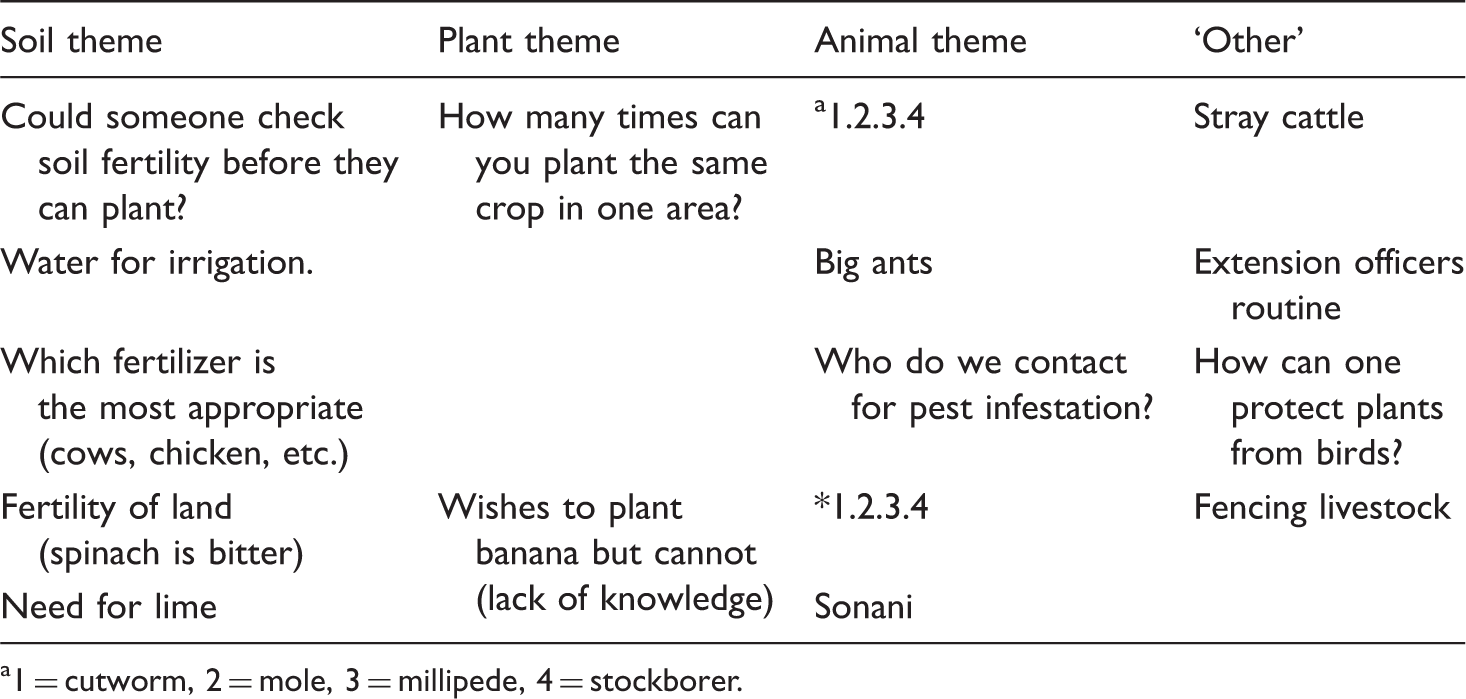
1 = cutworm, 2 = mole, 3 = millipede, 4 = stockborer.
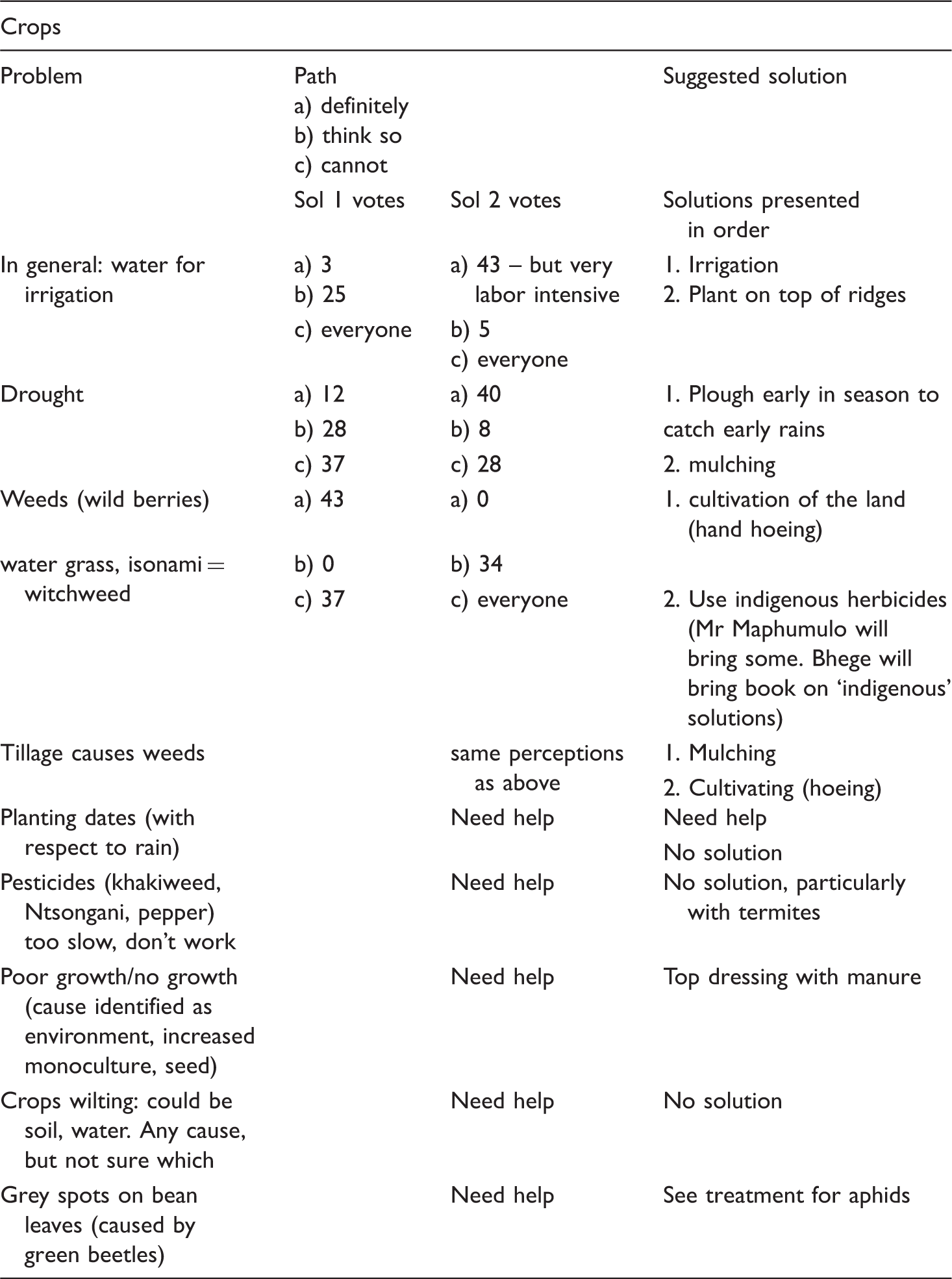
Through feedback from the farmers and discussion on the research questions, the meeting established clarity and consensus on the nature of the problems identified, which led to the farmers suggesting pathways for solving issues as well as their desired solutions. Key points were recorded on flip charts to create a permanent record (Figure 1).
Example of recorded discussion results (raw data) with EFO forum during pre-research workshop, 25 March 2006.
Each problem listed under the separate categories was addressed in the followingway:
Confirm that the researchers understood the problem – adjustments were recorded on the flip chart as required; Identify any solutions that the farmers could propose – proposed solutions were recorded and numbered sequentially as they were offered. Determine to what extent the farmers felt they could implement the proposed solutions – responses from the farmers (Figure 1) were captured as the number of farmers who voted:
I can definitely use the solution proposed I think I can do it I cannot do it
The farmers were particularly interested in determining whether they could resolve the problem themselves or if they would need external help in solving the problem and whether the proposed solutions fit with their ethos. It was readily observed that by creating space within the workshop for interchange and dialogue, the farmers became conscious of each other's problems and took collective ownership of many of the problems raised.
Digitized version of crops theme from Figure 1 to enable reading of content
In planning for this workshop, researchers originally had a second purpose for the meeting. This was to establish the research agenda through facilitating a general flow of ideas and information followed by individual activities and focus group interactions on specific issues. They had hoped to generate data that could be triangulated to ensure validity and authenticity of the researchable problems they had wanted to extract. However, as the workshop unfolded, the researchers discovered that when dealing with the need for inclusion and consensus, the planning merely contributed a framework of concepts to cover, rather than specific steps in collecting data. The researchers had to adjust their participation in the meeting to relieve the tension between the researchers' ‘scientific paradigm’ and the commitment to mutual learning and collaborative problem-solving. While specific participatory methods were not used, a high level of participation was achieved. From this, we learned that what is needed is to address relevant issues, in the correct environment with a conscious commitment (particularly on the part of the researchers) to collaboration and mutual learning. It is the attitude, the environment and the issues, not the particular tools that achieve participation.
Step 3: Establishing the research agenda
After the workshop, the student researchers and their supervisors met again. Conscious of the farmer's agenda and that the core issues were increasing productivity and expanding market opportunities, individual research activities were identified and linked to commercialization priorities. An emerging perspective was that the researchers would engage as facilitators and catalysts for capacity building and not solely as researchers. These activities would contribute to further relationship building between researchers andfarmers because they were timely, sought appropriate responses and created the opportunity for the farmers and researchers to benefit from practical mutual learning. The range of research activities included farmers' individual experiments, co-operative on-farm experiments by the farmers themselves with corresponding trial sites on the university research farm, on-farm farmer/researcher partnerships, focus group discussions and informal interactions.
Although not explicitly stated in the farmer questions, it became evident that to integrate knowledge and participant experiences into the over all learning, the social dynamics of the commercialization process itself needed to be researched. When presented with the research ideas at the next EFO meeting farmers representing households expressed their approval by volunteering to act as key informants, and provide, land, labor and expertise for the research. Although scientific measurements were being taken, the social interaction and sense of working together created shared experiences that could be discuss and reflected on together. This, coupled with regular visits to the field for monthly forum meetings, individual research activities and attendance at community celebrations established a rapport and credibility in terms of researcher commitment and interest in the farming activities.
Towards the end of the project in 2009, when asked what if any impact did the student researchers have, a farmer shared this with the author. For him the value lay in, ‘… you always wanted to know – you came and saw us, you visited us. It is nice for us to be able to share what we know. And you share our burdens by caring about them and you also share the same sentiments. This is important in terms of encouragement and inspiration for our thinking about our farming’ (Mr Miya, personal communication, 2009). This reflects that the farmers reaffirmed the research agenda with a sense of shared common purpose.
Another farmer shared: ‘… we need people like you because the group is too unwieldy. We need someone who can respond to us individually’ (L. Bhengu, personal communication, 2009). This reflects how the researchers were welcomed and able to work co-operatively with the farmers. When reflecting on these comments, it shows that student researchers had in fact travelled full circle in terms of inclusion and confirmed that student researchers had been able to genuinely engage within the expectations of socially approved behavior and decisions.
Summarizing the learning
This article shared situated discoveries and insights on how agricultural scientists can move towards complementing development. It explored what shifts in thinking would be required to identify mutually beneficial research questions. The experience described led to identifying research priorities with the full knowledge and approval of the farmers. The experience raised the researchers' consciousness of the complexity and multiple intertwining of social practices with technical farming activities. Thus, it was learned that, like the context itself, the relationship between farming and research would be complex with multiple layers of involvement and relationships opportunities making it to walk the journey with the farmers.
By focusing on complementing local, social, cultural and knowledge priorities the research priorities led to potential answers largely identified by the farmers themselves taking the researchers from the idealized vision of the project proposal to the realities of the framers and to realistic engagement with the complexity of small-scale commercial farming. Although the researchers were already committed to participatory interaction on entry, they were not sure how to be ‘participatory’ in their research. Actually carrying out that commitment moved them towards new ways of working and thinking. The idea of a research agenda from community engagement required them to see the farming context through the uncertainties and visions of the farmers in terms of their livelihood options rather than a throwing of resources and technology in an attempt to control uncertainties. Their ‘research’ expanded to a symbiosis of development through shaping a shared attitude of respect and cooperation. They learned that the participatory nature of research was determined largely by how relationships are developed and managed. What appeared most effective was creating the correct environment in a context of conscious commitment to collaboration and mutual learning. Attitude, environment and relevant issues, not specific tools, achieve participation.
Footnotes
Notes
Acknowledgment
We thank Hilary Bradbury-Huang for leading the review process for the author of this paper. Should you have comments/reactions you wish to share, please bring them to the interactive portion of our website: arj.sagepub.com.
Whether in the classroom, the field or the boardroom, Steve brings two things to the table: engaging creativity; and 30 years' experience as a practitioner, trainer and facilitator in development in Africa. For 13 years he worked in rural agricultural development amongst the Batswana of the now NorthWest province. There he was engaged in agricultural economics, agricultural extension and rural community development and rural enterprise development. For nearly a decade he has consulted with agencies like the CSIR, the FAO, the Institute of Natural Resources, the Farmer Support Group, the Spirit of Africa Institute, the South African Baha Office of Social and Economic Development, and National and Provincial Departments of Agriculture and Land Affairs on various aspects of human capacity development, wealth creation, rural development, agricultural extension, agricultural education and rural enterprise development. This work has taken him to Botswana, DR Congo, Kenya, Namibia, Swaziland, Namibia, Uganda, Zambia, Zimbabwe as well as all over South Africa.
Since 2001, he has been engaged fulltime as a lecturer in extension and resource management, community development, rural wealth creation and sustainable livelihoods. Using an experiential learning framework for his lectures and workshop, Steve, will tell his students two things up front: He does not believe in solving problems; and he will not take responsibility for your learning. The result: Classes that are hugely popular and highly transformative.
Over the years Steve has developed and presented numerous training programmes for agricultural, rural and community development and personal transformation. He has co-authored and edited training manuals and books with the FAO. He is an experienced facilitator, employing creative methods to engage participants, manage potential conflict and elicit practical outcomes from workshops.