




Abstract
As one of the oldest community–university partnership programs in the United States, the University of Illinois’s East St Louis Action Research Project (ESLARP) has evolved in an ongoing effort to balance stakeholders’ needs, broadly defined to include community partners as well as the university and its involved faculty, students, and staff. While ESLARP’s mission has remained consistent – briefly stated ‘matching needs and opportunities in the community with resources and opportunities on campus for teaching, research and service for social justice’ – what constitutes action research within this partnership has been broadly framed and has evolved due to circumstances on campus and in the community. Based on analysis of projects over the 23-year period and the personal reflections of two participants, this article seeks to reflect on the evolution through what we see as three phases – Neighborhoods First, Technical Assistance, and Engaged Research – in order to gain insights into the negotiations required to sustain a university–community partnership program. Refraining from judgment as to what model might be better, we reflect on the change in five core area: community organizing, direct assistance, popular education, mode of research, and the university’s core teaching mission. We acknowledge the different but important contributions of each phase.
Introduction
Twenty-three years is a long time to stay the same and in the context of university–community partnerships an exceptionally long life span all together. In 1987, the year that the University of Illinois first started working in East St Louis, the Cold War was still active, the world’s population had just reached 5 billion, and the first Simpsons cartoon was aired. Just three years later, in 1990, ESLARP’s model of engagement radically transformed from one based on professional assistance to action research that is best known through the writings of Ken Reardon, one of its key founders who left an indelible imprint on its work (Reardon, 1996, 1997, 1998, 1999, 2000). In East St Louis, the community was struggling due to population loss, corruption, and lack of services, and neighborhood residents were organizing in response to the overwhelming need. There was a clear need for outside assistance and during this time it arrived from university faculty and students. The model that developed involved action research, direct action organizing and popular education and the resulting institutionalized program became known as the East St Louis Action Research Project (Figure 1) (Reardon, 1999). However, it would be incorrect to suggest that these approaches remained consistent through its 23 years of different projects, changes in participants both in East St Louis and on campus, and unexpected opportunities and challenges arising from institutional and governmental support. While the general mission has stayed consistent, the project has experienced an almost complete change in faculty and staff from the university, and some of the earliest community partners either no longer need the university on a regular basis or their organizations have dissolved, and new partners have emerged.
Ideal approach to partnership that catalyzed ESLARP’s development (the authors developed this model summarizing Reardon’s expressed ideal for ESLARP) on the left in conversation with the powerful academic criteria of research, teaching and service on the right.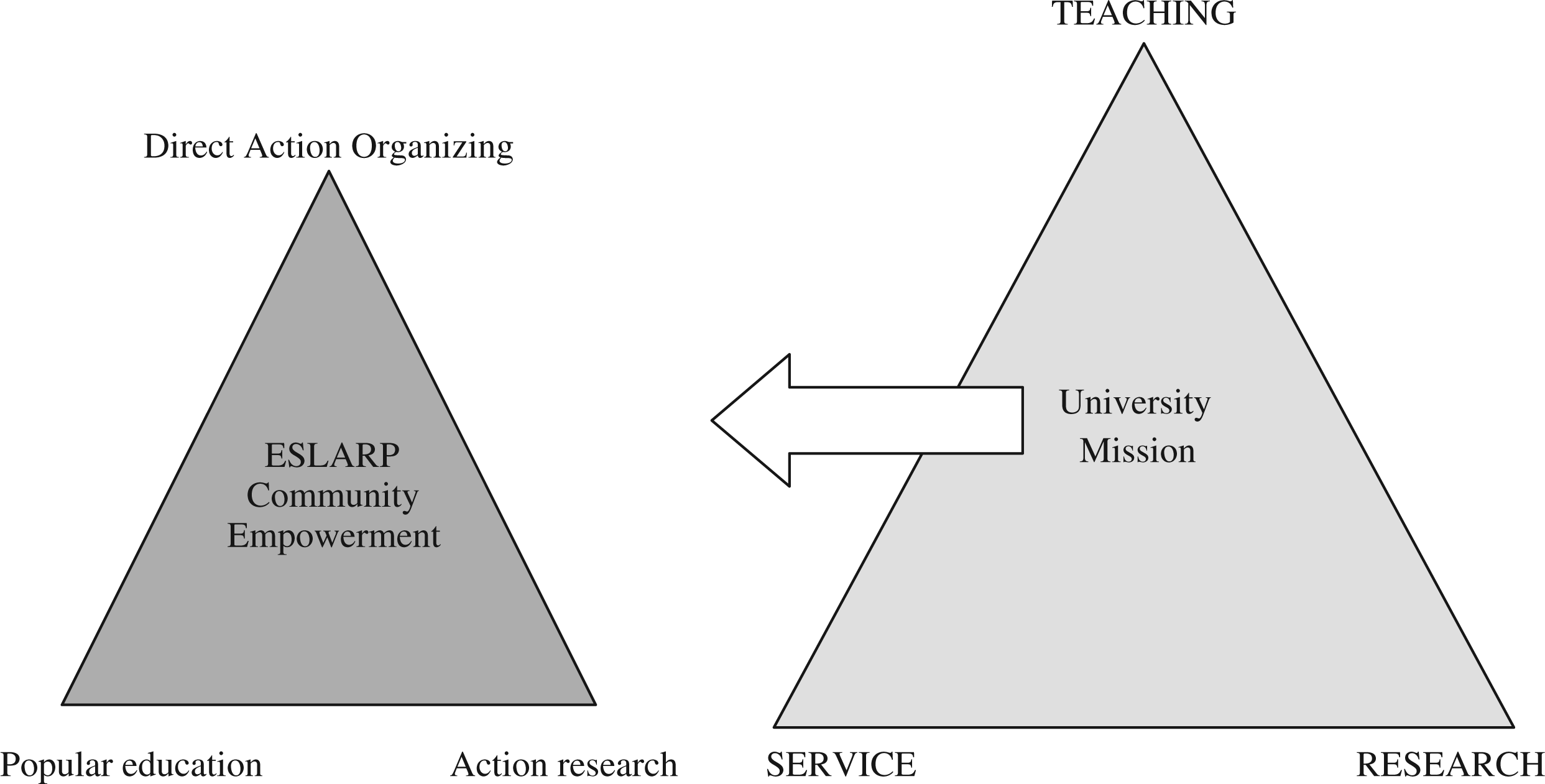
Twenty-three years after the beginning of the engagement efforts, by which time the world’s population had almost reached 6.8 billion, ESLARP is still active in East St Louis and other communities, but with many changes. Communication with partners has shifted from weekly meetings at churches to occasional meetings and more emails, phone calls, and file-sharing over the web. Emphasis on neighborhood plans has been usurped by engagement through establishing computer labs and assistance in acquiring corporate-sponsored playgrounds. And instead of fledgling community groups, partnerships tend to be with established non-profit organizations, service-providers, and the parks district. Twenty-three years is a long time to stay involved, and time necessitates change. The question is whether the intention behind action research, so prominent in the ESLARP name, is able to change or if the program has evolved into new models of engagement.
Based on analysis of projects over the 23-year period and the personal reflections of two participants, this article seeks to reflect on the evolution of ESLARP through what we see as three phases – Neighborhoods First, Technical Assistance, and Engaged Research – in order to gain insights into the negotiations required to sustain a university–community partnership program. 1 This evolution sheds light on the reality of participatory action research within academe and the ways the university’s core mission of research, teaching and service influence the partnership. This evolution is also deeply influenced by changing needs within the community and external challenges that call for new approaches and also tied to available types of funding that sustain the partnership at a given time. While it is clear to the authors that there is more than one model of partnership that works, we also acknowledge that reflection on the gains and losses experienced as a result of changing approaches is critical – understanding and reflecting on the choices made are opportunities for learning.
Given the complex navigation between action research intention and the reality of institutional contexts, ESLARP’s persistence and adaptation provides a useful point of study. In this article, we first set the stage by discussing some of the key criticisms and challenges to action research, primarily arising when the theory meets the reality of long-standing programs. Second, we outline the evolution of ESLARP, including its inception and phases of activity. To aid in analysis, we employ the action research cycle, illustrated in Figure 2. This figure helps visualize the parts of the research process that follow the flow of the cycle, where we have experienced ‘spin off’ and where we have stopped continuing the process. Our reflections on the different stages of ESLARP illustrate how completing the full cycle can be challenging in the academic setting. Specifically, we observe shifting priorities and varied ability in the core areas of community organizing, technical assistance, research, and finally integration of the university’s teaching mission.
Action research cycle (adapted from Kemmis & McTaggart, 1988; Maguire, 1987) illustrating the academic setting’s vulnerable points of departure before full turn and juxtaposed to the academic missions of research, teaching and service.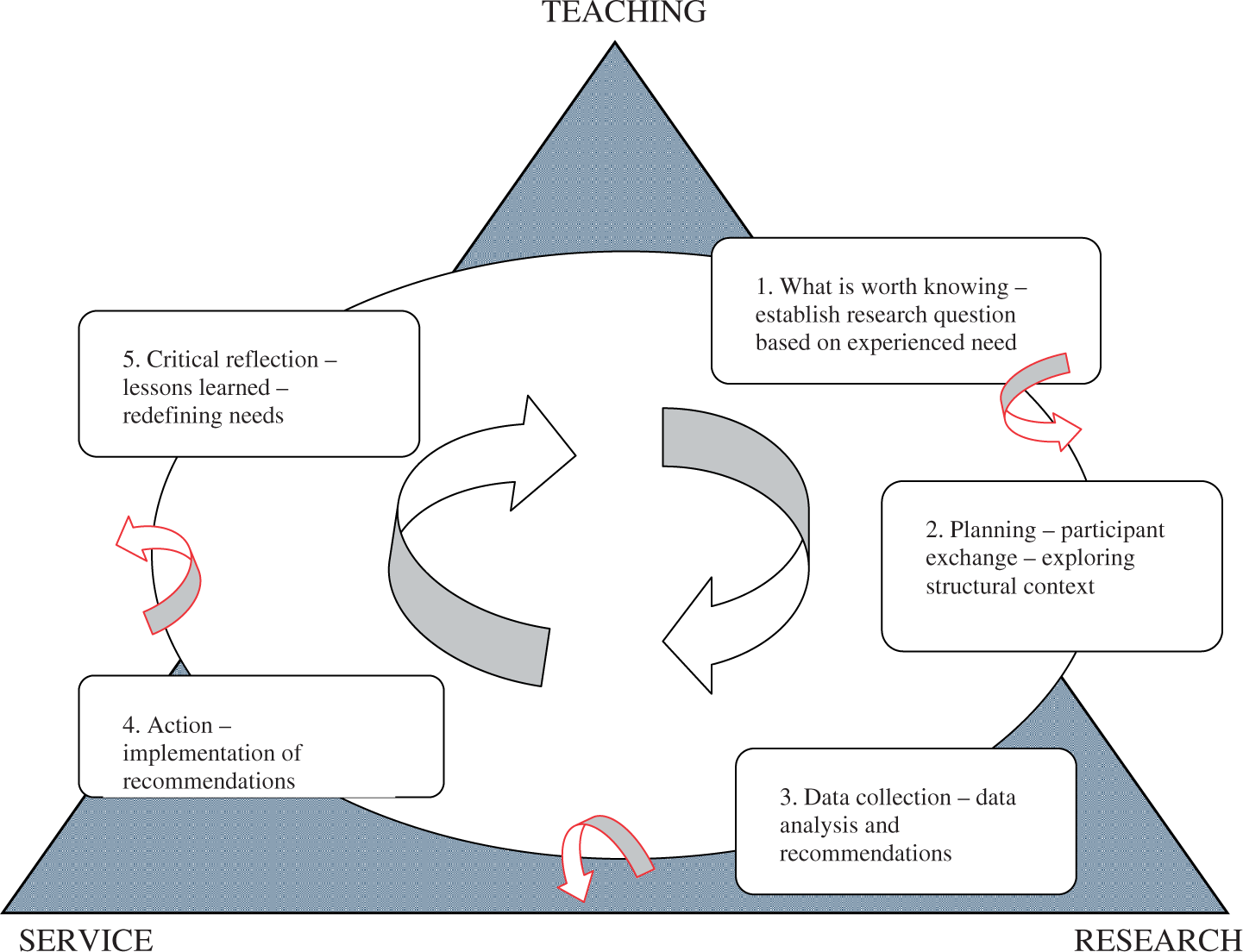
From community–university partnership to action research
Sustaining a ‘mutually beneficial’ community–university partnership necessarily requires evolution and change according to partnership needs as well as external forces acting on both partners (Vidal et al., 2002). The word partnership invokes a sense of intentional focus on balanced power and shared decision making. While a variety of justifications for partnerships exist, ranging from defensive responses (Benson & Harkavy, 2000) to commitment to social justice and ideals of the engaged university (Baum, 2000), from the university’s standpoint it is essential that the partnership aid in fulfilling part of the mission of the institution (Fleming, 1999). There is a wide variety of models of community–university relationships, ranging from the conflicts associated with ivory-tower and the towns-people (Rashdall, 1936; Reardon, 1996) to transformative social justice agenda’s with institutions playing critical roles as anchor institutions. A review of the current literature on university–community partnerships reveals a strong emphasis on participatory approaches (Feld, 1998; Keating & Sjoquist, 2000; Kellogg Commission, 1999; Mayfield & Lucas, 2000; Nye & Schramm, 1999; Ostrander, 2004; Rubin, 1998), but participation has varied definitions ranging from token participation to real power vested in local groups (Arnstein, 1969), and it is therefore important to reflect on the experience and challenges of working in a partnership.
There is a healthy cynicism and self-reflection in Randy Stoecker’s (1999) question: ‘are academics irrelevant in participatory research’, the title of an article in which he provides reflection on the often narrow set of skills academics are equipped with. As he reflects on the roles of academics in participatory research he writes (p. 840): Doing the research is not a goal in itself but only a means. Achieving these goals require that four functions be fulfilled: ‘animator’, community organizer, popular educator, and participatory researcher. Determining how the academic will fit in the project (as initiator, consultant, or collaborator) requires addressing three questions: What is the project trying to do? What are the academic’s skills? How much participation does the community need or want?
In this way academics can be relevant if we acknowledge our strengths and limitations and seek partnerships with others to fill the gaps – not all academics can be community organizers, popular educators, and researchers. Stocker’s reflections illustrate well the ways partnerships are shaped by individual faculty characteristics and by changing need in the partner community. This flexible notion of finding our place or establishing ways in which academics best contribute is a useful notion in considering and clarifying the evolution over the course of ESLARP’s history.
For community–university partnerships seeking to apply action research principles, commitment and duration is essential to success because long-term engagement is needed to produce positive outcomes for community partners as opposed to university researchers who can often get what they need from a one time survey or similar efforts (Barnes et al., 2009). Often universities seek out ‘partnership’ to engage in a specific research project in essence needing a laboratory in which to study impact of an intervention or phenomena. Other motivators might be requests for proposals for funding that require partnerships to be established. External challenges have also contributed to making decade-long partnerships the exception rather than the rule. Considering ESLARP’s history being situated in the midst of neo-liberal economics and higher education reform, the fact that ESLARP has survived is an important accomplishment that has required flexibility and innovation as illustrated in changing approaches when major sources of federal funding disappeared in the early to mid-2000s, after which ESLARP has relied almost exclusively on internal university funding.
While there is a wealth of useful theoretical and critical writing on community–university engagement, we found it relevant to focus our analysis on the challenges to our particular program by looking to similar models of applied university–community engagement. Most fruitful in this analysis is comparison to other programs, such as the University of Pennsylvania–West Philadelphia partnership that was founded at about the same time as ESLARP and on similar principles but with very different approaches and circumstances. 2 In particular, we identified three essentially different situations between the two programs that helped us understand some of the influences toward changes in ESLARP. First, whereas proximity between the University of Pennsylvania and residents of West Philadelphia enable physical emersion and direct dependence on shared conditions in the community, the University of Illinois and the residents of East St Louis are separated by roughly 175 miles, resulting in sporadic but intense direct engagements and strategies to bridge the distance. Second, given the importance of interdisciplinary efforts to address complex community concerns, it is eye-opening to compare Penn’s partnership – involving upwards of 150 courses and 60 faculty members in 2005 – with ESLARP’s approximate six to ten courses and eight to ten faculty. While Penn has been able to engage a much broader set of disciplines, ESLARP has relied largely on studio-based disciplines – Urban Planning, Landscape Architecture, and Architecture – that tend to work well with intensive overnight trips to East St Louis for fieldwork and meetings (outreach weekends). And lastly, how the university structure supports engagement is telling. ESLARP has established some sense of institutionalization evident through reoccurring funding from the university and its recent acknowledgement as a Carnegie classified engaged university. Yet in comparison, the story of Penn alludes to a much stronger institutional buy-in, in particular with establishing the central university-wide Center for Community Partnership as early as 1992 and the indicators in Penn’s 1994–95 annual report, entitled ‘The Unity of Theory and Practice’ (Benson, Harkavy, & Puckett, 1996, p. 35). In contrast to many urban campuses East St Louis was not in the university's back yard. Therefore it can be argued that motivation to support ESLARP had less of the self interest that in many places comes with the need for keeping campus safe and attractive. In the following we will discuss the way ESLARP has evolved adding detail to how ESLARP is situated in the world of university–community partnerships.
East St Louis and the university: Making the connection
Situated 175 miles apart, the sustained collaboration between University of Illinois and East St Louis does not immediately make sense and is in many ways what sets this project apart from the experience of other long-standing partnerships. The rationale for the partnership should therefore be explained. While many cities have neighborhoods with concentrated poverty and racial segregation, East St Louis has citywide concerns stemming from the combined effects of suburbanization, deindustrialization, and disinvestment (Reardon, 1997). A lack of tax base to support municipal services, including police and fire protection, code enforcement, infrastructure improvements, public education, and other essential services, is one of the city’s constant problems. In this strained city, residents have shown a tremendous will to address problems themselves, and many residents are actively involved in neighborhood revitalization (Edwards & Lawson, 2005). It was this unique setting that the university was pushed to engage with when in 1987 State Representative Wyvetter Young asked the university to step up and assist the most devastated city in the state. The roots of ESLARP begin with formation of the Urban Extension and Minority Access Project (UEMAP), a state-funded project seeking to respond to Young’s demand. Thus, beginning in the fall of 1987 Architecture Professor Carolyn Dry and her students began working with the City of East St Louis on large-scale riverfront development and downtown revitalization plans but also on smaller scale projects such as economic development plans for a factory that produced manufactured home components. In 1990 when the Department of Urban and Regional Planning hired Ken Reardon, a professor with a focus on community development, the project transitioned from Dry to Reardon. At the same time Landscape Architecture Professor Brian Orland and Architecture Professor Mike Andrejasich also became involved in the project (Lawson & Tigan, 2011). It was at this point that the project took on a new name, the East St Louis Action Research Project, and a mission clearly tied to core action research principles.
Over the years, through the rubric of teaching and service primarily, faculty from Urban Planning, Architecture, and Landscape Architecture worked on a range of community projects through courses, independent studies and theses, and service work. Overtime, key faculty, such as Reardon and Orland, left the university, while new faculty joined. Faculty from other disciplines also joined, adding new types of projects and expertise, including Recreation Sports and Tourism, Library and Information Sciences, and Law. In 2001, the three primary departments coordinated three hires to strengthen their commitments to the project. With each new faculty member came new energy and enthusiasm, new experiences and expectations, new skill sets, and new blends of course and research foci.
While including action research in the name of the project signaled the intention to work on an agenda set by the community, it is important to acknowledge the separate needs of the two sides of the partnership throughout the projects history. Figure 3 highlights the important fact that the partnership does not exist in a vacuum. East St Louis residents approached the partnership with both very specific needs and larger concerns that involved long-term commitment and multi-faceted approaches, such as economic development strategies, improved educational opportunities, and crime reduction. For faculty, staff, and students involved, the university’s focus on research, teaching, and service necessarily bounded the projects that they could be involved in, often with conflicts arising related to promotion and tenure expectations. Where the engagement thrived was where mutual benefit was easiest – work that faculty received credit for (i.e. courses), funded work that supported graduate students who provided more ongoing contact, and projects that involved students to produce tangible outcomes (plans, design-build projects, clean-ups, etc.).
Separate but overlapping priorities of community and campus.
While Figure 3 has been the given circumstance throughout the project’s life time there has been clear differences in how the overlap has been defined and that has lead us to describe the project in phases in the following.
Distinct phases in the history of ESLARP
Overview of phases in the evolution of ESLARP

The ‘Neighborhoods First’ phase
In some ways the realities of the partnership during this phase can be seen as a reaction to the more traditional design consultation that came before but also tied to the skills set and backgrounds of Reardon, Orland, and Andrejasich who were leading the community engaged aspects of ESLARP. In the time period 1992–1994, ESLARP began using direct action organizing techniques (Alinsky, 1971) to expand opportunities and ensure the implementation of projects. The partnership was experiencing the frustration that comes with the inability to secure municipal government support and funding for the implementation of projects (Reardon, 2000), and with Reardon’s strong background in the labor organizing movement, a natural reaction was to turn to direct action organizing strategies. One early example that was invaluable in terms of establishing trust between campus and the community was the shared experience of faculty and residents who came together to plan clean-up projects. These went far beyond the usual ‘band-aid’ solutions when direct action organizing was mixed in, such as when the press was invited to see bags of trash lined up along the county road and St Clair County was forced to acknowledge the problems in East St Louis.
When faculty introduced the tools of popular education in 1995, the purpose was to create a more balanced power structure after experienced leaders pointed out that ESLARP was failing to provide community residents with the kind of training that would enable them to collaborate on a more equal footing with students and faculty (Reardon, 2000). During 1995 ESLARP provided formal training sessions as a pilot project with the hope to institutionalize this part of the partnership. The project turned out to be short lived due to lack of funding, but some community members reflect on this particular endeavor as a critical intervention: We asked Ken to come down and teach the people how to empower themselves with the city. And he said yes and came down and we advertised it and the room was full … people from all over the city came and that was how all the different neighborhood organizations came about … It was 12 weeks of planning. It was the best thing we’d done with the university. (EPDC’s president, 2004 interview)
More widespread was the transfer of knowledge between the two sides that took place simply by working together. This was largely enabled through grants received that allowed a team of graduate students to work together and with resident groups. In 1995, ESLARP received a US Department of Housing and Urban Development Community Outreach Partnerships Centers Program (COPC) grant that awarded $500,000 to expand the ongoing work in neighborhood planning and organizational development. With this funding ESLARP employed as many as 12 graduate students representing the core disciplines. These students worked closely together and with faculty who mentored them. They spend significant time directly assisting residents, and during those hours together the learning on both sides was inevitable in particular because the work was done in partnership as opposed to distributing tasks between campus and residents. Examples included students spending hours rehearsing speaking roles with neighborhood residents before important meetings and time spent in neighborhood meetings reflecting on progress made and remaining challenges and tying challenges to structural inequality, both for the benefit of students to not reinforce negative stereotypes about low-income communities, and to support and motivate organizing efforts to confront injustices.
The ‘Neighborhoods First’ phase comes closest to research that completes a full cycle as illustrated in Figure 2. For example, the Emerson Park Neighborhood Improvement Plan was completed in 1991 in a process that emphasized the role of co-researchers and partnership between students and faculty and the Emerson Park Development Corporation. The plan addressed economic growth, public safety and other core community concerns, thus exemplifying step 1 in the cycle in Figure 2. And importantly, the Emerson Park Development Corporation (EPDC) went on to implement almost all of the programs outlined in the document. As part of the neighborhood planning process, Reardon emphasized negotiating a clear understanding of the roles and responsibilities in the planning process (see http://www.eslarp.uiuc.edu/durp/up378-s99/up378sc.html step 1), illustrating the second step on the cycle. Establishing the capacity to be prepared to participate was also critical; the neighborhood planning process therefore incorporated organizing and educating residents – Emerson Park residents ‘used the data’ to understand the need for programming – generating research that were relevant at the very local level.
Following the action research circle to step 3, the planning process consisted of significant data collection and analysis, both quantitative (such as census data) and qualitative (interviews with residents, political leadership and business community), all involving close cooperation between students and residents. When action (step 4) became difficult due to the inability to secure municipal government support and funding for implementation (Reardon, 2000), direct action organizing became critical and eventually successful. Step 5 can best be related through the fact that EPDC decided to implement a second and a third planning process in partnership with ESLARP.
The example of the planning process in Emerson Park stands out as close to the ideal including aspects of organizing popular education and action research with an emphasis on community control. It also exemplifies a case in which community needs overlapped with the university’s offering – in this case Reardon and others’ research foci, teaching goals, experience, and enthusiasm. Interestingly, the actual content of the plan extends the typical areas of planning far beyond concerns with land use, zoning, and projections of future needs – it illustrates a scenario where students were pushed to learn what the community needed them to learn as opposed to the community taking what the university offered.
The ‘Technical Assistance’ phase
As discussed by Stoecker (1999), while faculty become involved in action research projects – typically as a result of their discipline and areas of research and teaching interests, this does not necessarily mean they are equipped with community organizing skills. With Reardon’s departure in 2001 there was no longer a trained community organizer on faculty, the new faculty, hired at the assistant professor level, brought different skill sets to community-based planning and design and an urgent need to produce scholarship from their engagement. However, there was still a strong commitment to partners that had to evolve to new roles and responsibilities. At the same time, the constraints of ‘being in’ a community 180 miles away was causing stress on participants. In contrast to the faculty who initiated ESLARP in its Neighborhood First phase and who would travel the 350-mile round-trip drive weekly if not more, faculty who remained or became involved during this phase were less able to commit that time to travel, with several of the new faculty being women with young children making the constant travel increasingly complicated despite a strong commitment to the partnership. Fortunately, easing this faculty access transition was the existence of the Neighborhood Technical Assistance Center (NTAC) that had been established as a university representative and resource in the city.
Shifting COPC grant funding from the large group of graduate student research assistants ESLARP established this center in East St Louis in 1998, a move that would drastically change the face of the university in the city. NTAC, with a staff of four professional planners and architects, gradually came to replace faculty and graduate students as the primary contacts – a change that significantly pushed the project towards task-oriented technical assistance such as grant writing, non-profit services (i.e. assisting with 501c3 applications), and planning and design consultation. By having a physical office in East St Louis, residents had an easy place to go for internet access, copy machines, and strategy sessions with staff and others. NTAC was highly utilized by individuals and the non-profit community who came to the center with ideas that needed assistance and implementation strategies, such as the idea to establish a shelter for homeless veterans and the idea to develop a shelter for women and children escaping domestic violence, both of which were eventually realized. Projects such as these were originated by residents who connected with NTAC staff on core support functions and received supported for myriad phases of implementation through student volunteers and courses (e.g. Architecture studios developing schematic designs or Library and Information Science students setting up computer labs and networks).
During this phase, there was less focus on research and more on technical assistance. This may be partly explained by the distancing of faculty from day-to-day contact and from the process of defining projects. It also coincided with shifting definitions of ‘scholarship’ needed for promotion and tenure that began to discourage faculty from engaging in action research as their primary research outlet. Projects at this time often originated with suggestions from NTAC staff who clearly knew a lot about needs in the community from their day-to-day engagement but nevertheless were one step removed from the people who were expected to be co-researchers with the students. Neighborhood meetings became increasingly characterized by student presentation with the expectation of community feedback so students could continue work on campus.
Teaching engagement stayed strong and students were an important part of the partnership as courses responded to the needs NTAC identified. For instance, undergraduate classes participated in design-build projects in the Alta Sita neighborhood where the construction of new homes in partnership with a local developer was a significant achievement. Smaller scale projects such as students designing logos and T-shirts for neighborhood associations and building no-dumping signs for placement in locations that were vulnerable for the illegal dumping of outsiders, were examples of projects that tied the classroom experience to the work accomplished during outreach weekends. Neighborhood planning workshops also continued and were great learning opportunities for students. However, compared to the Neighborhoods First phase results in the community were less apparent. Without the previous attention to organizing and popular education the neighborhood plans produced had less success in terms of being implemented. Plans had elements that neighborhood groups could work on but as a whole they appeared daunting for the fragile neighborhood groups.
The small-scale projects (those that could be implemented without outside funding sources) were quite successful, including a ‘slow down and smell the flowers’ project where a speeding issue identified in the planning process was addressed through a low cost planting and sign installation. However, with little reflection on the process and no planning for maintenance and improvements the project, and other similar efforts, did not have a sustained impact.
During this time period ESLARP was strengthened by the significant contributions of the Graduate School of Library and Information Science (GSLIS). GSLIS graduate students and faculty have worked to narrow the ‘digital divide’ by providing computer workstations and training at more than 20 locations in and around East St Louis. To address the need for hardware repair and to engage local youth the ‘Team Tech’ program was established. It was designed to address the technology literacy needs of youth in East St Louis and the teens also learn about business as they sell the used and refurbished computers to the community at affordable prices (ESLARP website; Adams & Wolske, 2009).
One tract of research that increased during this time focused on pedagogy and student outcomes connected to the service-learning and applied design and planning workshops (Dearborn, forthcoming; Lawson, 2005; Lawson, Spanierman, Poteat, & Beer, 2011). Responding to multiple pressures, faculty increased evaluation of student learning, particularly self-reflection on the meaning of engagement and multicultural competency. While anecdotal evidence from years of involving students suggested powerful learning occurred through ESLARP-affiliated courses and participation in outreach weekends, faculty and staff felt an undercurrent of concern about what it meant to bring hundreds of students, often predominantly middle-class and white, to witness first-hand the poverty and lack of resources in East St Louis. From a disciplinary perspective, ESLARP architecture and landscape architecture studios and planning workshops had influenced some students toward careers in public service, even in some cases working for EPDC, NTAC, and other development agencies in and around East St Louis – but it was unclear how most students fit this experience into their overall professional education as designers and planners. In light of this concern, ESLARP faculty turned to scholarship in multicultural education for teaching models that explicitly address issues of race and class differences between students and community (Lawson et al., 2011). This focus led to significant changes to the Outreach Weekend structure by focusing on student orientation and creating opportunities through service-focused projects (clean-ups, events) and shared meals that enabled opportunities for students to listen and talk with residents about their lived experience and hopes for the community.
Returning to the action research cycle, the mechanisms for feedback begins to break down as the process shifts to service- and task-oriented engagement. While communication remained essential to all steps, the mechanisms to get work done became less fluid between residents and the university participants. The NTAC office enabled much closer engagement with residents on a daily basis but may have had the counter impact of allowing campus faculty and staff, admittedly distracted by other university roles and responsibilities, to take a more passive role in maintaining the relationships. Both the university and the involved resident organizations benefited from the ongoing partnership, however the mutuality began to disengage, with resident groups identifying service opportunities through courses and volunteer labor on outreach weekends and faculty seeking dialogue for student learning. Students engaged in studios or other courses did much of their work on campus and cross-fertilization of ideas throughout the process proved more and more difficult, limiting the opportunities for residents to participate in the development of concepts and for students to learn the nuances and complexities of community considerations from residents. Through courses, faculty were able to stay engaged with a residential organization on complex projects like neighborhood plans through multiple semesters of courses; this gave more time for discussion but meant that individual students rarely engaged in all facets of the project at hand. In some ways, action research became the model for the overall program – the collective effort and the sustained engagement – rather than individual projects, with discussions about how to develop a citizen advisory committee and retreats involving residents and campus community to determine direction. At the same time, the focus on the university’s mission to serve the public through research, teaching, and service seems to become a stronger influence and framing device for the program.
The ‘Engaged Research’ phase
Loss of funding to support NTAC and faculty taxed by campus and personal demands in the mid 2000s, led to more changes in ESLARP’s structure. A key change was the shift from originally being faculty-driven (Reardon and colleagues) to staff-driven (NTAC) to a third approach in which graduate assistants became the first point of contact. As NTAC downscaled to one position, graduate assistants became the new staff to serve as neighborhood liaisons, affiliated with one or more community organization and expected to attend neighborhood meetings, plan appropriate activities, help frame course projects to fit community priorities, and so on. While faculty and staff supervised, the learning curve remained steep for some students while others seemed to naturally fit the job demands. One consequence was that community partners had to acclimate to new faces frequently as students graduated or moved on to other projects. The structure worked best with community partners who knew exactly what they wanted to work on, such as shelters seeking assistance with grant writing for operating funds. More loosely defined assignments, such as assisting with organizational capacity building and community outreach, can with the right student turn out to be a very powerful experience but other students were intimidated and overwhelmed and these partnerships lost sight of any progress.
The loss of NTAC obviously limited the drop-ins of new partners and fairly quickly ESLARP experienced a shift from serving a broad pool of partners to a more narrow focus of core community partners that repeatedly worked with ESLARP (i.e. EPDC, park district, veterans and domestic violence shelter). Many of these partnering groups had increased capacity due to the long-term technical assistance received. Such groups easily accommodate courses but it limited the nurturing of new groups and projects. Recognizing that to work with fragile new organizations required skills and approaches not on hand anymore, this change in partnerships was a necessary evolution tied to the changing personalities and skills.
In 2006 ESLARP staff and faculty, frustrated by the dependence on departments’ course offerings that rarely included action research potential, began the process of developing ESLARP courses that could align with action research models of engagement and incorporate stronger reflective exercises for cross-cultural learning. One such course is an upper-level undergraduate action research seminar (FAA 291 – see Table 1) that is open to all majors and has had students from such varied backgrounds as aero-space engineering and history enroll. The strength of this course has been time for reflection and discussion as well as a research and action component. The first two years the class worked with the East St Louis Park district to develop a comprehensive plan for parks in the city, a project that led to several important park improvement projects and the adoption of the Illinois Avenue Playground by a local fraternity. Later the course has worked to address homelessness and supported the Joseph Center in East St Louis as they prepared to open their doors to homeless veterans. The second ESLARP class developed is a more general service-learning course (FAA 391 – see Table 1) that enables students to attend regularly scheduled outreach weekends and actively encourages critical preparation and reflection (O'Grady, 2000). This course has resulted in hundreds of students being introduced to East St Louis, talking with community partners, and assisting on very real projects that improve conditions for residents. The course also concretized a process at the outreach weekends that involved a resident-based tour of the city, service projects largely removed from research, and reflective exercises and conversations to aid student learning about the city and local activism.
Another big change during this phase has been the return to the significant contribution that research can make to the East St Louis community. For instance, Architecture Professor Lynne Dearborn has conducted independent research on predatory lending practices and has served as expert witness in several cases against lenders (Dearborn, 2009). While research projects such as this are informed by engagement, they are often framed within disciplinary interests for the sake of scholarly publication so not directly linked to the action research cycles steps. At the same time, however, they provide relevant material for the community. While data collection is not done by community members often the data consist of interviews with those most affected by the research, and the research is aimed at addressing policy change and change practices that directly impact East St Louis residents. This type of research is more respected in the academic setting than the experience of co-researchers in action research projects thus it tends to make sense for faculty – the ability to make a real contribution to a pressing issue in the community can be combined with the academic acknowledgement.
Evaluating this phase according to the action research cycle is in this way again complicated by the changed nature of engagement. Much of the research has provided clear benefit to the community, but missing from the action research cycle is the continuous reflection and reimplementation that was characteristic of the Neighborhood First phase. Interestingly, though at a 2008 Strategic Planning meeting involving more than 50 people – 30 from East St Louis and 20 from campus – residents voiced interest in more academic research. In particular, there was a need for research that would support the efforts of non-profit organizations and public agencies seeking grants for projects in the area of housing, economic development, job training, education, and community history. As some of the faculty noted, this desire for more traditional research might be due to increased capacity of the current partners, most of whom are staffed service agencies or well established neighborhood organizations, as well as to the urgent need to infuse years of good planning with necessary funds to implement improvements. The strategic planning meeting itself served as an overall reflective piece for the efforts underway. As revealed when everyone was together in one room, the wealth of particular personal relationships between members of the campus community and residents expressed the commitment to ongoing dialogue and work together.
Reflections on lessons learned and future prospects
The intention in describing ESLARP’s trajectory over 23 years in phases is not to favor one phase over others but to show the process of evolution. It is obvious that the earlier phase is more closely aligned with action research supported by the organizing component and strong connections at all phases of the cycle. However, the later phases also have merit and produced work that benefited both university and community participants. This said, the increasing distance building between partners causes pause and questions about the future of the project.
One question is whether a new model is on the horizon, and based on this article, are there lessons learned that can inform the current state of the partnership. One key revelation is the critical role of campus leadership in framing the partnership, and the impact of particular individuals’ skill sets on the work that is able to be done. Ken Reardon has left a long-standing impression on the ESLARP program; however, it is not possible to continue that model in the absence of his personality and skill set. To naively continue community organizing without the necessary experience and knowledge would probably cause more harm than good. When Reardon left the university, the departmental teaching needs plus changing expectations of scholarship through peer-review publications led to a candidate pool and ultimate selection that brought different skills and experiences to the ESLARP program, which in turned led to other alignments. Given that ESLARP does not hire faculty, it sets up the condition of having to adjust to new faculty and skill sets. The fact that core faculty leave and their skill sets are often not replaced is a critical lesson that helps explain the inevitability of evolution in long-standing projects such as ESLARP. And, as illustrated by the three phases these changes brings both opportunities and losses.
A second lesson relates to the way technical assistance is framed. NTAC played a pivotal role to residents and organizations in East St Louis: it was a clear and tangible resource and its staff provided ongoing day-to-day assistance. However, disengaged from research, NTAC struggled to stay relevant with the campus interests and individuals from campus found it hard to find an appropriate niche. When its external funding was spent, NTAC was vulnerable because it was only seen by campus administrators as service. In a different way, when technical assistance is provided through graduate students, who during the latest phase of the project worked mostly on direct assistance as opposed to the community organizing and action research earlier graduate students were engaged in, it is vulnerable to the constraints of the semester, to the other priorities of the students and to their short time as graduate students.
The shift to working with organizations with increased capacity rather than helping fragile organizations grow allowed the university to shift out of organizing and into applied technical assistance as necessitated by the available skills and interests amongst involved faculty at the time. Similarly, by focusing work through service-learning courses and complementary research by graduate students via masters’ theses and projects reflects a search for ‘fit’ within the university’s core missions. It does however also illustrate a partnership outcome where the university agenda is defining the projects. The core funding for the project at this time came from the university and was ‘just enough’ to keep the project from needing external funding which might help explain the natural evolution towards university priorities in contrast to when ESLARP was funded by external grants that had a community development focus, such as the HUD COPC grant, naturally pushing community needs to the forefront.
A final lesson is that we must recognize what we do well and how those particular contributions can supplement the work of community-based organizations in East St Louis. With the personalities and skill sets currently available, that means research (community based but most commonly not as co-researchers) and teaching that ties together the needs in the community with campus priorities. In particular, we see strength in the ESLARP-based courses that avoid disciplinary constraints. When speculating on the future of ESLARP, it is clear that much will be determined by its participants. Faculty, students, staff, and partners come and go, but with intentionality and reflection, such as attempted in this article, there is opportunity to maintain core values that has persisted through the 23 years’ history. In particular, a strong acknowledgement that all project must aim to be mutually beneficial and that action is central to continued strength and sustainability.
In the process of working together, relationships are forged that direct the projects, research, and teaching in certain ways. The overarching organization has to have the capacity to absorb new opportunities, resilience to adjust when certain relationships/partnerships end, and the ability to enable new participants.
