




Abstract
The philosophy of Deleuze, and his collaborative work with Guattari, has begun to appear in the field of action research. This article seeks to build on this scholarship through a discussion of the literature in which Deleuzoguattarian concepts are used to reconsider action research methodology. Framing action research as territory, I suggest that artmaking can facilitate the creation of new ideas, thus initiating the process of deterritorialization. For an examination of the concepts used and the implications for action research methodology, I draw from my experience creating art as an action researcher with a local Somali nonprofit organization.
Introduction
The philosophical concepts of French philosopher Gilles Deleuze and his collaborative work with psychoanalyst Felix Guattari offer a new vocabulary for thinking about and discussing action research. While Deleuzoguattarian philosophy has been put to use in a variety of academic fields such as education (Olsson, 2009; Semetsky, 2006; St Pierre, 2004), art and art history (O’Sullivan, 2006), qualitative research (Lather & St Pierre, 2013) and ethics (Braidotti, 2012), only sporadically has it begun to appear in action research scholarship (Amorim & Ryan, 2005; Drummond & Themessl-Huber, 2007; Henderson, 2010). This work has significance in light of the goals of action research, which include for Drummond and Themessl-Huber (2007) engaging with problems and learning in the act of creating change, and aligns with the primary purpose of Deleuzian thought: cultivating new ideas. These studies challenge a fixed methodology by putting action research to work with Deleuzoguattarian concepts, but I suggest that a means of having a Deleuzian action research is through the inclusion of artmaking as a deterritorializing method.
Deleuzian philosophy is primarily concerned with overcoming the dualistic nature of Western thought through experimentation and creation. Deleuze is concerned with what something does and how it works, rather than what it means, in order to cultivate new ways of doing and thinking. Subsequently, a Deleuzian action research does not require a Deleuzian methodology. O’Sullivan (2006) has indicated that such a use of Deleuze misses the point. As O’Sullivan (2006) argues, the extraction of a Deleuzian method or system would “render [it] inoperative, to freeze it in, and as, a particular image of thought, to capture its movement, precisely to represent it” (p. 3) making it an object of recognition rather than an object of encounter with the possibility of disrupting systematization. Rather, the intersection of art and action research creates the opportunity of what Beyes and Steyaert (2011) term intervention. Intervention for Beyes and Steyaert (2011) is an experimentation that “support[s] and make[s] possible social change through artistic forms and processes” (p. 108), an act of creation which both Deleuzian thought and action research espouse even if, and especially if, it means finding oneself in a completely new territory.
In this paper, I set out a review of literature putting Deleuzian concepts to work with action research, suggesting that both Deleuze and action research be read as territory. Following this conceptual exploration, I offer my own encounter with Deleuze and action research with the Somali Women and Children’s Alliance (SWCA) through artmaking as an example of stumbling onto new methodological territory. Artmaking is then offered as a process of deterritorialization with the illustration of action research as an accompanying territory in which Deleuze, artmaking, and action research become an object of encounter. Reconsidering action research as territory challenges action researchers to remain open to deterritorializing methods and encounters in order to destabilize and transform fixed meanings, understandings, and practices.
An encounter: The man at the café
I sat at a table close to the café entrance drawing on thick paper, not great quality—erasing rubs away the paper more than the lead. There were men sitting at the tables facing the TV and at the long table in the corner facing me. Quiet. Solemn. We made eye contact. Faadumo (2nd grade) came by, I gave her paper, she sat down, and we drew. She drew the men and then added to it out of her imagination. I drew the pop machine and the man sitting in front. Another man sat down beside him and caught my eye as I observed. He waved at me, gesturing no. Back and forth, side to side, with hand and head. I responded, or so I thought. He called out. I didn’t understand and didn’t respond. He got up and came over; he was not happy. He gestured to my drawing while saying something in Somali, a few English words slipped in. He was yelling. I told him I would erase it. He kept telling me, “Now.” I erased. “I still see me.” I erased. He demanded more. Faadumo chimed in, speaking Somali. I asked her what he was saying. According to Faadumo, he wanted me to throw away my drawing. I told him I would cut the end off, even though I had erased him. There was, and still is, only a hole. He turned and walked away. I asked Faadumo why he wasn’t happy. She said some Somalis are just mean. She wanted to chase after him and yell some more, but I told her no. If he didn’t want to be drawn, I wouldn’t draw him. It was ok. I wonder what he said. I wonder what Faadumo responded. Why was it such a big deal? Was it because of me? Because of Islam? Because of Somali traditions? Because I was an outsider? I haven’t gone back to that space. I left the café because it was not where I belonged, but does this encounter indicate something else? (19 May 2011) Man in the café (2011).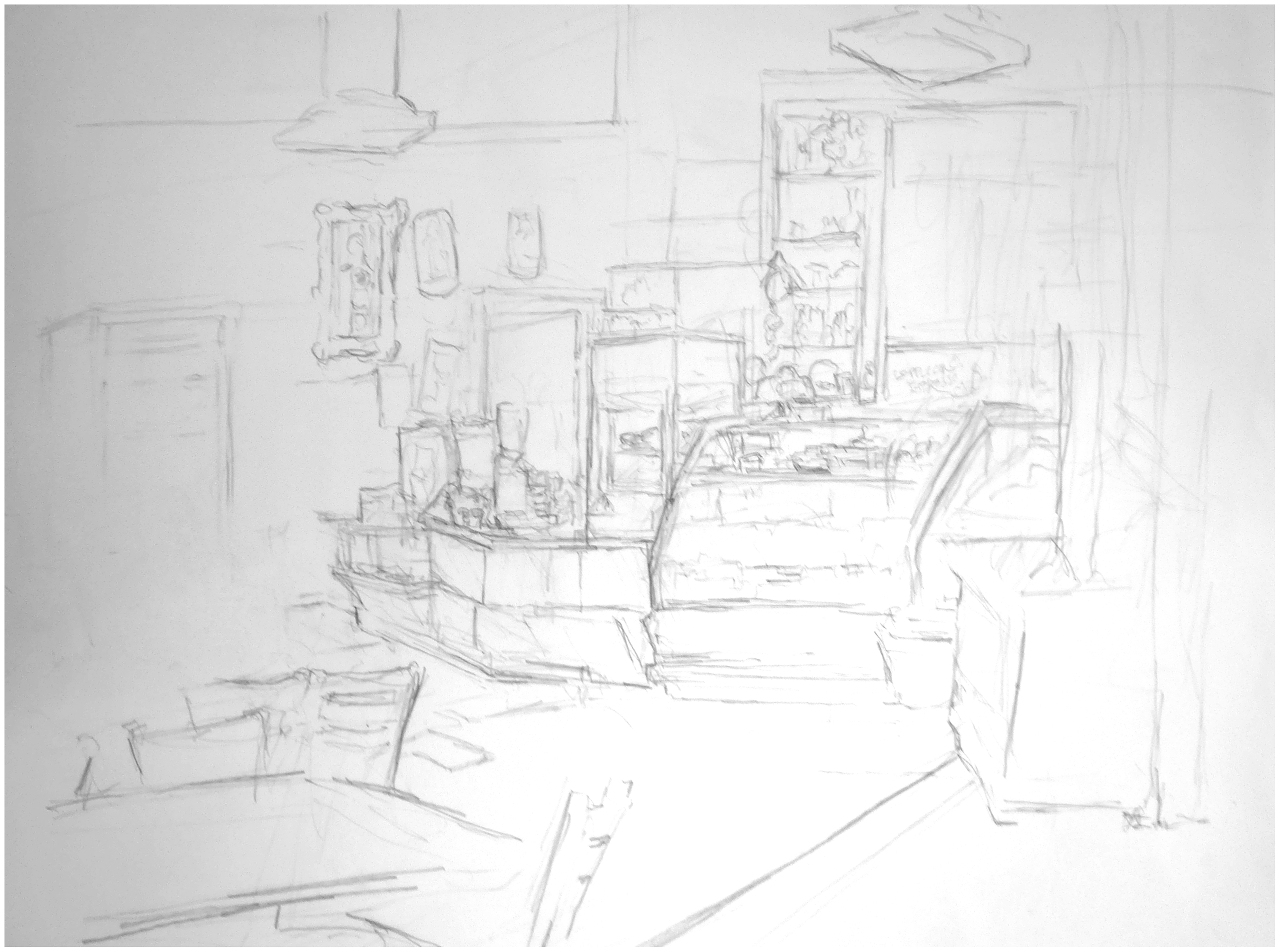
Surveying the Territory: Deleuze and action research literature review
While other scholars have put Deleuze to work with methodology (Drummond & Themessl-Huber, 2007; Henderson, 2010) and writing as a method (Amorim & Ryan, 2005; St Pierre, 1997), the concept of territory, its implications for both methodology and methods, and the role of artmaking as deterritorialization have not yet been considered. For Deleuze, territory is not a static, stable entity. Territory is a grouping of objects, bodies, expressions, and qualities localizable at a specific point in space and time, what Deleuze and Guattari (1980/1987) describe as assemblage. For an action researcher, the form of research changes with and is dependent on the specific community, place, and time that the research takes place. Although such an assemblage exists in a “state of process” (Message, 2010, p. 280), there is an internal organization. Within action research, this organization includes the foundational values, principles, and histories of its theory and practice. Territory is an experiential and experimental concept that accompanies and facilitates deterritorialization, a process of forming new ideas and ways of thinking (what Deleuze and Guattari call lines of flight) that changes the territories from which they originate. Considering Deleuzian thought and action research as territories rather than disciplines focuses on the ways that each works in particular instances, establishes deterritorialization as a goal, and uses alternative methods such as artmaking to put its values and ideas into practice in a particular place and time.
Deleuzian cartography: Mapping the unknown
I drew many maps of SWCA in my first few months volunteering in the afterschool program, trying to visualize the connections between the physical location and the things I observed (Figure 2). I also had my students work on maps together to explore their relationship to the spaces they inhabit (Figure 3). These maps are examples of the rhizome (Figure 4), which are “unregulated networks in which any element may be connected with any other element” (Bogue, 1989, p. 17) so as to generate multiplicity and heterogeneity (Deleuze & Guattari, 1980/1987). Amorim and Ryan (2005) explore the potential of writing action research to enact rhizomatic thinking, in which both process and product allow for encounters by taking into consideration the differences between what is planned and what actually happens (p. 585). Reconsidering research and writing as mapping, Amorim and Ryan (2005) challenge the tendency to striate, delineate, and fix practices by valuing that not done as much as that done for future rhizomatic connections.
Map of classroom in Global Mall (2011). Map of Columbus (2011). Rhizome.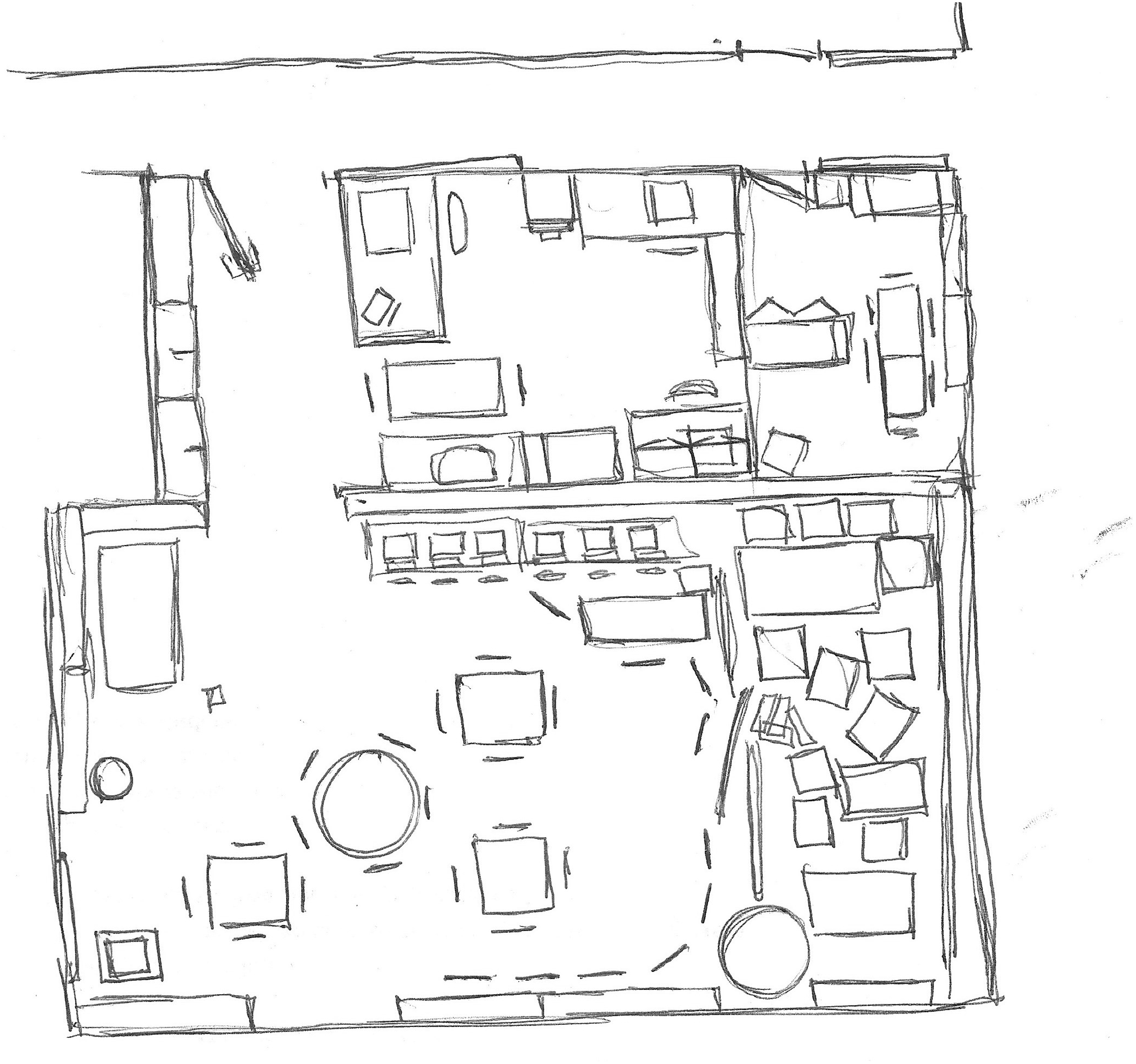


Mapping is an important action for Deleuze and Guattari (1980/1987), a form of experimentation (the exploration of possibilities) in contact with the real. The full potential of cartography is realized through experimentation as well as creation, what Colombat (1999) defines as forging new connections between ideas (p. 206). Amorim and Ryan (2005) suggest that it is through both participant and researcher writing (analytical and presentational) that these new connections, becomings, and unfoldings occur. I propose that artmaking serves complementary purposes, offering another option for working towards a rhizomatic and creative action research that affords reflection, sense making, and opens new connections. I used different art forms to collect and analyze data as an individual researcher (Figure 2) and with my participants (Figure 3). Through experimental methods such as artmaking and writing, I began to understand the space in which I was working in a new way, and subsequently transform my research and work.
A Deleuzian framework for action research
Drummond and Themessl-Huber (2007) offer a foundational text that connects Deleuzian concepts to the action research process through a series of enrichments. In their model, “[t]he central circle represents the contingency of the cyclical process of action research…. The outer items are the Deleuzian enrichers of this process, inviting us to look at it differently, but without compromising it” (Drummond & Themessl-Huber, 2007, p. 444). One of these enrichments includes “necessary encounters” (Deleuze, 1964/2000), which undergird experimental learning. Necessary encounters are not based in previous knowledge, but rather cultivate an apprenticeship with others while engaging in a project that begins with a sense of a problem rather than a defined question necessitating a clear answer.
Drummond and Themessl-Huber (2007) present an aerial view of the linear spiral of action research, deemphasizing the temporality of what is often construed as a clear beginning, middle, and end despite its iterative and cyclical nature. Looking at the process differently by circling around action research without altering it, Drummond and Themessl-Huber (2007) offered a way to reconsider my own practice. I reworked images and stories in different forms and media, collapsing time as I reflected back and looked forward while still grounded in my desire to understand what was happening in the present. One example includes writing about the man in the café. Subsequent iterations of an event that occurred months prior offered an opportunity to look, think, and act again. At first, it was a cultural conflict rooted in my mistaken assumptions about the space. However, as I continued to work with SWCA and think about what was happening, the story layered issues of belonging, credibility, gender roles, and power relationships (Figure 5). The images in Figure 5 offer another example, exploring spatial and interpersonal relationships. Sketching enabled a depiction of the transitory nature of the space, an extension of my frustration with students coming, and going within the afterschool and summer arts programs. However, the transition to collage, which layered impressions rather than belabored them, marked a transformation in my thinking: no longer was I trying to understand the whole Somali community, but rather one particular aspect of the community in this particular place and time.
Drawing and collage of Global Mall (2011).
Drummond and Themessl-Huber (2007) proffer an invitation for further experimentation, which Henderson (2010) accepts and extends through the presentation of a participatory action research (PAR) project. Henderson (2010) found that Deleuze’s concept of desire was the driving factor behind the cyclical processes “producing connections and intense states within and between bodies” (p. 5). Deleuzian concepts in this case form an analytical framework, a method for understanding the thought processes at work. Like Henderson (2010), I responded to Drummond and Themessl-Huber’s (2007) invitation for experimentation. Territory and the process of deterritorialization provide my starting point for considering artmaking, Deleuze, and action research together. I challenge researchers to consider action research and Deleuzian theory as accompanying territory rather than enhancing theories or driving concepts in order to develop new, previously unknown and unrecognized ways of doing things. Furthermore, as I found with my encounter in the café, artmaking offers the potential to create a new line of flight, initiate the process of deterritorialization, and change the territory of action research.
Mapping a Territory: A discussion of practice and theory
As each of the authors (Amorim & Ryan, 2005; Drummond & Themessl-Huber, 2007; Henderson, 2010) point out, the primary use of Deleuze in action research is to reconceptualize the cycle of action research, loosen fixed stages and protocols, and to reconsider the process of learning occurring in action research. However, the pairing of practice and theory and its subsequent lines of flight also offers the potential for new methods of working toward the principles of action research. Action research in this sense acts as a territory, one that is neither bounded, nor oppositional. As such, action research is defined not by its borders but by its codes of expression. These codes of expressions, or guiding principles, include the development of nonexploitative and life enhancing relationships, building community, strengthening democratic ways of life, building people’s capacity to collaboratively learn and grow (Stringer, 2007), and a political commitment to collaborative learning and research as a means for increasing voice and enacting social change (Kindon, Pain, & Kesby, 2007). If methodology is a territory, then methods can be understood as processes of deterritorialization accompanying it. The way a methodology is enacted necessarily changes the territory in which it began, though the territory continues to accompany it. Remaining open to new methods avoids the fixed nature of many traditional forms of research and posits the potential for new ways of acting and thinking especially through artmaking.
Stumbling into Territory: Artmaking as an action researcher at SWCA
I began working with SWCA as a volunteer tutor in the afterschool program and started teaching art classes soon after. Discussions began about the upcoming summer camp, and I offered to help plan and teach as part of an action research study for my master’s thesis. I worked with SWCA staff to plan a one-week summer arts camp for Somali youth ages 5–12 that included Somali dance and storytelling, puppetry, and visual arts. While we collaboratively embarked on this project, the philosophy of Deleuze and Guattari and the encounter with the man at the café pushed me to think further about these experiences in terms of relationship, education, and political action—guiding principles of PAR. The concept of the rhizome in particular helped to describe the fluid and often confusing processes of planning. I experienced a simultaneous breakdown of dominant structures—the assumed ways of doing things defined by best practices and cultural norms—and the reestablishment of new practices developed out of necessity for bringing together different beliefs about education, childcare, the value and use of art, and planning. For example, I wanted to design the entire curriculum prior to camp. However, the teachers (who were Somali young adults) did not see the value in planning ahead, preferring to take the camp day by day. In the end, we formed a new way of working which brought together my proclivity for planning and the flexibility of the Somali staff members. One of the teachers remarked afterwards that although the number of planning meetings seemed excessive, at the end of the day, it was worth it. In the beginning, it seemed like a lot because I’ve never done that. But we got to know each other more, what to follow, and what the rules are. Things that you plan work out more, even if things don’t go according to plan. So you plan, plan, plan and then the week goes according to plan. Like the dance. We planned that we were going to learn a little bit each day with different groups. But we didn’t have enough kids to have three different groups. So we tried a big group, but it was too much. Then the older kids did the dance and the little ones clapped. We changed as we went, according to the kids and how much time we had. (personal communication, 19 August 2011)
I found that artmaking provides an opportunity to communicate with others, particularly across cultures, which may not happen otherwise. Seeley (2011) describes this as “c/overtly creating transformational spaces for ourselves and others” (p. 96). For me, this meant that the oddity of a white woman making art in a public space occupied primarily by Somalis often caused people to stop and ask me why I was there. Many times, this led to prolonged conversations with people who would not otherwise have talked to me, especially apparent when men or young women wearing headscarves stopped to ask me what I was doing.
Not only does artmaking provide a conversation piece and something that communicates beyond language, it is also an opportunity to observe with focus and to think about the relationships in and to the space. Cole and Knowles (2008) describe this as arts-informed research, in which the mode and form of research are influenced by the arts. Arts-informed research, which is committed to alternative processes and is a potential space of encounter where new lines of flight can emerge, breaking away from the territory already defined, and creating new expressions. Artmaking in this case was not used as a technique for action research undertakings—as a method of observation, analysis, or representation—but as an intervention in its own right, “exploring the reverberations for understanding, conceptualizing and performing action research” (Beyes & Steyaert, 2011, p. 101). I used artmaking to intervene into my own assumptions about the Somali community regarding cultural norms and practices, and used collaborative artmaking throughout the course of the summer camp to explore what Somali culture means to the participants, how it informs the way they make art, and their relationship to the spaces they inhabit.
The example offered in the beginning of this paper was the first time that my thoughts about Deleuze, the community in which I was working, and the methodologies I was attempting to employ came together productively through artmaking. It was not simply the drawing itself that became an encounter, but what O’Sullivan (2006) describes as pragmatic processes of connectivity and interpenetration moving sideways between objects, spaces, and people and fostering transversal connections that are engaged and creative rather than typical and habitual. The movement O’Sullivan (2006) describes is similar to how Deleuze and Guattari (1980/1987) describe deterritorialization as not a movement of one thing to another, but rather a process of becoming or “a transversal movement that sweeps one and the other away” (p. 25). While the confrontation could be framed as a conflict of culture, for me, there are more complexities. It was about my role in the community, about belonging, and about challenging assumptions. It affirmed the need to understand the territory in which I was working in order to establish a new way of working reflective of all involved. That territory was not just the place in which I was working (including the people who occupied it), but also the methodological and conceptual space I occupied. In order to understand this territory, methods that permitted me to move between these spaces were necessary to confront my assumptions and affirm deterritorializing encounters.
Deterritorializing my practice
Deterritorializing encounters, like my encounter with the man in the café, confront and affirm the territory that accompanies it. I could not bring myself to go back to the café; my position in and understanding of the community was confronted and I was uncomfortable with the resulting tension. Nevertheless, I became less of an anomaly as I continued to work with SWCA. My students’ artwork began to fill the walls of the hallways between stores, evidence of the affirmation of a new way of working.
Artmaking provided an opportunity to express relationships and events with rhythms, colors, and shapes, and in doing so establish new territory. My background as a painter provided the methods: I observed, worked, read, and wrote. The days that I volunteered at SWCA, I spent an hour before drawing, painting, collaging, or taking photographs. Then, reflecting on the experience, I described the artmaking process as well as transcribed interactions with others in a research journal. In these reflections, evidence of deterritorialization through artmaking is apparent, whether it is drawing attention from shoppers and storeowners, disrupting assumptions and patterns of use (the striations), or changes in art practice. There is a particular aesthetic to the colors and patterns that all the clothes create when they are packed together like that on racks or overlapping hanging from the top of the wall on hangers. I have been trying to access that aesthetic using colored paper and collage, but I have not achieved it yet. Maybe I have the wrong colors (21 April 2011).
As I made marks, arranged forms, and defined relationships these works became my field notes, points of encounter and recognition, and an effort to organize my experience as a practitioner and a researcher. The “expressive qualities” of my work entered into “shifting relations with one another that ‘express’ the relation of the territory they draw to the interior milieu of impulses and exterior milieu of circumstances” (Deleuze & Guattari, 1980/1987, p. 317). Or, in other words, “dwelling in and responding to the present moment through drawing [to] reflect back and make sense of what’s around them as well as what’s in them” (Seeley, 2011, p. 91). For me, it was not only artmaking that afforded this reflection and sense making, but also the writing about my experiences making art that helped me to establish a framework of understanding this new territory for myself. These field notes helped document the changes in my understanding and practice.
One such example is the role that form played in the transformation of my practice. Deleuze and Guattari (1980/1987) affirm the importance of “proper qualities” (p. 316) such as form, and the form of making emerged from various elements of research including data, researcher identity, intended audience, site, and participant (Cole & Knowles, 2008). After the encounter with the man in the café, I began to collage; the method and material were the better fit than drawing for my surroundings (Figure 6). Drawing at the classroom on a large piece of grey tone paper left over from a previous project, the going home series. I drew in pencil, layering in color—looking from the back of the room through the doorway to the closed door across the hall. The blue of the office juxtaposes nicely with the strip of orange hallway visible through the front door. The piles of books on the coffee table to the left and the rows of computers to the right. Three tables visible in the foreground. This is a typical view of the room. Lots of patterns—the color blocks of rows of textbooks, the baskets on top of the bookcases, the rows of computers and orange chairs, shelving identical side by side. It sets up an interesting if slightly chaotic composition.
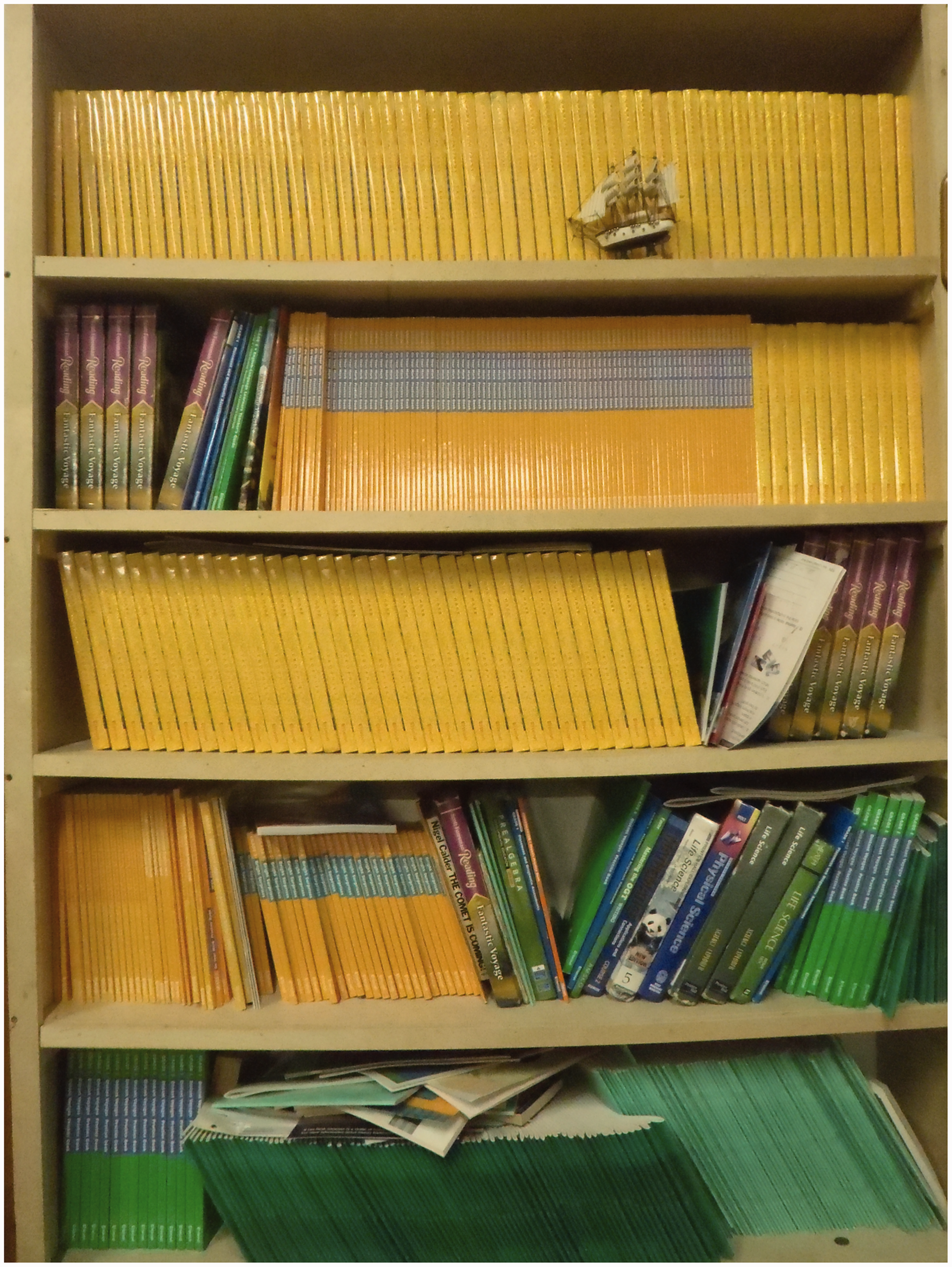
Collage of classroom in Global Mall (2011). I seem to deal with organized chaos a lot in my work as an artist and researcher. Finding patterns, structure, order in something that can seem somewhat senseless, or simple, or dismissed at first glance. Reconsidering spaces that don’t make sense. I laid in newspaper grids and blocked in color. As I sorted through the colored scraps, the piles made sense thinking about how things are stacked against the walls. I’m thinking about composing in a different way—letting go. So I dropped piles and attempted to glue them. I will have to put a layer of something on top to keep everything together, but it’s all temporary anyway—newspaper yellows and disintegrates quickly. That is appropriate here—thinking about the structural issues. For example, I spent three hours on the bus to come here to find paperwork, get it signed, and submit it in person the day the grant was due in order to receive what little funds we have for the summer camp. It is stressful. Not because of the people, but sometimes the underlying framework is hard for me to find. Is it cultural? Is it organizational? Does it matter? (28 May 2011). Exploring the space with a camera forces me to pay attention to different details … It is a different space than drawing to operate in [where] I put myself at a distance and then build up the space between me and the furthest point … But with a camera, I am separating myself with a lens … I think about what I choose to portray—how do I frame this picture? What is my focus? What I want to eliminate? Drawing and painting, I work with the space. Cameras I work with the details (11 May 2011). Bookshelves in classroom (2011).
The selection of different forms of artmaking—drawing, collage, and photography—marked a transformation in my consideration of the territory in which I found myself. No longer was I considering the Somali community as an entity, but understanding the temporal and fluid nature of the small group of participants with whom I worked. From this shift in my understanding, I was able to consider the differences in planning and implementation of programming specific to my individual partners. The same questions I asked of myself—How am I framing this picture? What is my focus? What did I eliminate?—helped to form the framework for planning the summer camp.
While artmaking proved an important element of my research process, it is not inherently disruptive, just as action research for Drummond and Themessl-Huber (2007) is only potentially minoritarian. It is easy to fall into familiar methods and practices. As I wrote, “I’ve been collaging [but] I feel like I need a rupture, an encounter, to think about the space in new ways and challenge my preconceptions” (20 April 2011). The purpose of artmaking is to create ideas that would not be thought otherwise, echoing Richardson and St Pierre’s (2005) assertion that writing allows us gather data that would not appear otherwise, allowing movement “into your own impossibility, where anything might happen—and will” (p. 973). Artmaking helped me to understand my partners differently, consider unfamiliar modes of planning and organization, and experiment with different methods of collaboratively planning and teaching a summer arts camp.
Artmaking as an object of encounter, similar to Beyes and Steyaert’s (2011) intervention, creates a shifting space typified by disruption that Deleuze marks as potentially productive and transformative. I believe that action research also seeks to create this type of space. While I frame my research as PAR and identify as an action researcher, I draw from artmaking to materialize the guiding principles marking the territory of action research. If artmaking is able to facilitate these goals, how might we follow it as a line of flight? Following such a line of flight is not an abandonment of territory, as Message (2010) reminds us. Rather, territory accompanies new ideas throughout this process of deterritorialization.
Action research as Territory, artmaking as Deterritorialization
There are consequences of using Deleuze—benefits and drawbacks—methodologically, theoretically, practically, and ethically. While Friedman and Rogers (2009) identify terminology as a mark of a ‘good theory,’ it is important to consider also the effects of such language on community partners. While the use of new terminology opens up possibilities, there are potential harms in using terms like territory, minoritarian, and disruption and thus important to weigh ethical concerns against productive creative potentialities. However, this tension has been productive. Deleuzoguattarian concepts provided direction in my approach to arts programming that was my work as an action researcher with SWCA. Yet, I often felt as if I was stepping in too much in the planning process. I need to provide some structure…but I also do not want to inhibit their creativity and ideas. It makes me consider Deleuze and Guattari’s (1980/1987) smooth and striated space. Both are necessary. Structure, striated space, provides a framework in which to work, guiding the type of learning that is happening … .but within that framework, we can explore all sorts of possibilities … We don’t know what is going to happen in the camp. The goal is to leave enough choice for the kids that they are able to determine the focus, the content. The smooth. This is where we must allow some chaos. Exploration. Discovery. Creativity. Making something new—understandings, knowledge, experiences. We are providing the framework for possible encounters, and the kids are determining what those encounters will be, whether they will respond, whether they will recognize (18 July 2011).
Such a bursting free is exactly what Deleuze means by the concept of deterritorialization. This “coming undone” (Deleuze & Guattari, 1977/1983, p. 322), the cutting edge of an assemblage (Deleuze & Guattari, 1980/1987, p. 88), a transformative vector (Parr, 2010, p. 69) is illustrative of the potential impact of action research. Action research and Deleuze do not simply produce a research methodology, but an approach for living a creative life. Rather than fixing a Deleuzian methodology, we must make action research an object of encounter that both ruptures fixed practices and affirms new ways of doing and thinking. This encounter is “the creative moment… that obliges us to think otherwise” (O’Sullivan, 2006, p. 1). Such lines of flight like those which sprung from my encounter with the man at the café (launched by artmaking and accompanied by action research and Deleuze) have potential to be creatively productive and world-making (Beyes & Steyaert, 2011), changing the territory in which we live and work. This approach to research and practice rests on experimentation. Deleuze and Guattari (1991/1994) write, “To think is to experiment, but experimentation is always that which is in the process of coming about—the new, remarkable, and interesting that replace the appearance of truth and are more demanding than it is” (p. 111). To consider action research as territory is to be guided by principles while remaining open to encounters that work to destabilize fixed ideas, striated spaces, and normalized practices. Such a territory is always in the process of coming about, localized, and through artmaking seeks to create in order to change.
Conclusion
A Deleuzian encounter with action research is not an approach, nor an application. It is the potential of theory and practice coming together to initiate a line of flight. When viewed as a territory, action research remains open to potentialities. I have argued that artmaking in particular facilitates the creation of new ideas, thus initiating a process of deterritorialization. Anticipating this experimentation leaves arts-informed action research open to new methods of creation and cultivates a methodology of deterritorialization. Supplementing action research with the accompanying territory of Deleuzian thought forefronts practice in an open and localizable system, which presents challenging implications for action research. While action research provides important guiding principles, they are just that—a territory to accompany a line of flight, and new ways of doing and thinking. Writing, for Amorim and Ryan (2005), and artmaking, as I suggest, offer experimental and creative methods for forming new connections, creating spaces of encounter, and potential lines of flight. Incorporating artmaking and writing methods in order to disrupt fixed perceptions, processes, and concepts is an important consideration for action researchers. While certainly action research is considered a methodology and a theory in and of itself, working with Deleuze demands a letting go of defined methods and methodology and seeks “to actualize something that was not there before” (Drummond & Themessl-Huber, 2007, p. 437) in order for something new to emerge. And isn’t that the whole point of action research—to work with communities in collaborative and engaged ways in order to create something new?
Footnotes
Acknowledgement

Declaration of Conflicting Interests
The author(s) declared no potential conflicts of interest with respect to the research, authorship, and/or publication of this article.
Funding
The author(s) received no financial support for the research, authorship, and/or publication of this article.