



Abstract
This article discusses and reflects on the action research process used during an investigation in which social and participatory media were integrated into the face-to-face classroom. The action research project concerned pedagogical and curricular changes created, negotiated, reflected upon and documented as new media were incorporated into 13 classes, over an 18-month period, in an Australian public high school. The action research process and its continual cycles of improvement were used to redesign projects that incorporated new media within a contemporary pedagogical approach to schooling young people. The article discusses the change in thinking and mindset for the teacher that came about from this new learning milieu and was undertaken with a view to meet the school demands of a one electronic device per student program. This study supports educators and learning designers in developing curriculum and pedagogy that is more in line with the demands and skills of young people using social and participatory media to engage, interpret and understand their social worlds.
Introduction
In exploring the learning potential that new media hold for education, the foci of this article highlights the pedagogical and curricular changes that were created, negotiated, reflected upon and documented through classroom action research cycles of improvement. At the commencement of this study, the research site was in its initial stage of implementing a one-to-one laptop program and all teachers were asked to integrate these laptops into their curriculum and consider developing a more student active and engaging learning program. Many questions arose as to the pedagogy that should drive the redesign of curriculum and in considering approaches for student engagement and active participation, the authors saw potential in the ways in which young people were using online social media outside the classroom and wanted to explore the concept of social media as an enabler for active learning.
The study was conducted by the first author for her doctorate supervised by the second author and was based in the public high school in which first author worked in Victoria, Australia; in this sense, she was the practitioner-researcher. The authors aimed to construct a social learning framework to support students as active and engaged participants in the learning process.
Action research and a social learning framework
Action research embraces any useful research methods – especially qualitative methods – that can be deployed by the researchers in order to enable evidence-based action to solve a particular practical problem or problems in the researchers’ practice. It is typically used collectively by practitioner-researchers – as distinct from being researched by others – through a cycle of activity such as: problem identification, proposed solution or action, trial of the proposed solution, analysis of the findings, reflection on the worthiness of the solution or action, and then further cycles until the appropriate solution or action is fulfilled. Kemmis and McTaggart (1998) were amongst the first to codify the process for practitioners and provide a guide to its implementation.
Historically, there is a complex interplay between action research, curriculum and teachers’ professional learning. Nearly 60 years ago, Corey (1954) saw that practitioners could identify their own researchable problems and undertake their own local research activities to formulate solutions. Brydon-Miller, Greenwood, and Maguire (2003) argue that the history of action research is complicated by its various disciplinary influences that produced research approaches deployed in various fields of practice. Education is arguably the most common locale of action or participatory research, but it is also popular, for example, in agriculture and rural development (Chambers, 1994, 2008). The contexts of schools are changing rapidly in the contemporary world. Babione (2015) argues that school settings today are multifaceted and unpredictable real-world environments and research is difficult because of numerous economic and social factors, including teacher dispositions towards research. She suggests that the social and cultural factors that surround and permeate schooling need to be incorporated in educational action research. She goes on to explain that educators can engage in action research to support the active experimentation of new curriculum to develop new strategies and keep abreast of the changing world.
The search for continuous improvement to practice through critical reflection is foundational to critical educational and social research (Smyth & Shacklock, 1998). Action research is an important form of such research (Kemmis & McTaggart, 2005; McNiff, Lomax, & Whitehead, 1996; Noffke & Somekh, 2005) and, in educational contexts in particular, is seen as a sustainable form of professional learning (King & Newmann, 2001). Action research is used by educational practitioners to improve their practices and, sometimes, to inform their institutional policies more broadly (Nolen & Putten, 2007). Armstrong and Moore (2004) offer a flexible action research framework that provides a variation of the traditional process. Their framework encourages a move forwards or backwards within cycles or even the option to skip a particular stage within a cycle. They point out that the intended achievements do not always occur, but the process of trying, and even failing, yield many insights into issues relating to possibilities and barriers. Armstrong and Moore’s (2004) framework encourages deep thinking as each stage occurs and this includes thinking:
about democracy, creatively, reflectively, about power relations, about context(s), about barriers to inclusion (and is the research process creating them?), about the language used in the research discussion and process, and about (auto)biography.
In exploring how social media can enhance the teaching of action research, Carroll, Jenkins, Woodward, Kop, and Jenkins (2011, p. 185) explain that the learning and teaching processes afforded by the social media they used “provided new dimensions to online teaching and learning that would have been much harder to achieve without the use of these technologies, and they related well to action research, particularly aspects of reflection, dialogue, change, and feedback”.
Action research and its ability to provide continuous improvement to practice was welcomed by the authors as they considered the challenges that new open, social and participatory media could bring. Conole and Koskinen (2011) argue that such new media have the potential to transform learning and teaching. They argue that new media offer learners and teachers multiple ways to communicate and collaborate, to connect with a distributed network of peers, and to find and manipulate information.
Learning, students and the growing connections to social worlds
In the developed world, and increasingly in the developing world, people are using communications technology in everyday life. Organisations, such as local councils and private industry often include, as part of their contact information, links to new media, such as, Twitter and Facebook. The advantage of this type of social media is now also appearing in educational areas. Thomas and Brown (2011) suggest that mediated learning with such media is different from the learning described in traditional educational theory. They note that this mediated learning can occur without books, teachers and classrooms, and requires environments that are virtually bounded yet provide freedom of action within those boundaries. Thomas and Brown (2011) argue that this new learning requires a different educational thinking and practice. This is congruent with the direction of the social learning framework sort by the authors.
Evans and Haughey (2014) discuss the relationships between online learners, content, designated instructors, the computer and other digital objects. They argue that in fluid environments where information may be in human and non-human sources, the learner needs to be able to facilitate and nurture connections that will encourage further learning. They go on to explain that the learner needs to be able to recognize the connections between others’ contributions and the dissonance or resonance with the learner’s own knowledge. In designing this study, one could say that it was also important for the teacher to recognize these connections and, hence, become part of the complex social interplay between action research, curriculum and teachers’ professional learning
Social media, as explained by Benson (2011), are becoming more common and pervasive, but with considerable uncertainty about their future forms in everyday life. He argues that interaction with pre-teens and teens – the first generation to grow up with Web 2.0 – suggests that the ways social media are changing social life is compelling. Similarly, Fei-Ching and Wang (2009) argue that social talk is a ladder to more comfortable participation; for proactive members, social talk is a powerful way to influence teammates. Although Doll (2012) in his discussion on learning does not distinguish between online learning, social media and face-to-face teaching, his words on learning are apposite when considering the increase of social media within student’s out-of-school lives: Learning now occurs, not through direct transmission from expert to novice or from teacher to student, but in a non-linear manner through all in a class exploring a situation/problem/issue together (and indeed from multiple perspectives). (p. 25) Thus, what happens in my classroom in one lesson influences and is influenced by what happens in other classrooms during other lessons. A helpful image of teaching is not the swimming lesson, in which teachers conduct lessons from the edge of the pool, but the canoeing lesson: teachers’ and students’ canoes are in the sea, already moving, the wave from one canoe affecting the movement of the others, all moved by the sea’s currents, and there are no edges to cling to. This ontological viewpoint is more complex than a tidy world of definite divisions, but to me it rings truer and I think it is coherent (p. 8).
Research design
The research design was principally qualitative action research used to implement a flexible cycle of continual improvement through planning, acting, observing and reflecting. Action research was chosen for this study because it enabled action to transform the practitioner–researcher’s practices as well as understand practice and the conditions under which practices occur (Kemmis, 2010). In considering the dynamic nature of online social and participatory environments, Armstrong and Moore’s (2004) action research framework was chosen because of its suitability in supporting teachers to investigate new models for teaching and learning. It supports a dynamic and complex action research process while providing the flexibility to support multiple cycles to occur simultaneously (as multiple classes were being taught). This cyclic process included improvement through planning, acting, observing and reflecting while being supported by critical friends. One action research cycle was, generally, one class topic and each cycle informed other cycles regardless of the topic or class for which the cycle originated.
In constructing such a social learning framework the three main areas involved: Students, Learning and the Teacher; these were established as the research themes and a graphic representation of the foci for each theme is shown in Figure 1. Within each of these themes, key elements were identified to support the research direction and these are described in the following points.
Students: integrating prior knowledge and the experiences that they bring into the classroom. Teacher: developing approaches and practices that will support a social framework while meeting the curriculum and assessment requirements of the school. Learning: incorporating peer-to-peer interaction where students are engaged and learning occurs within a wide range of interaction types. The research direction for each of the three themes.
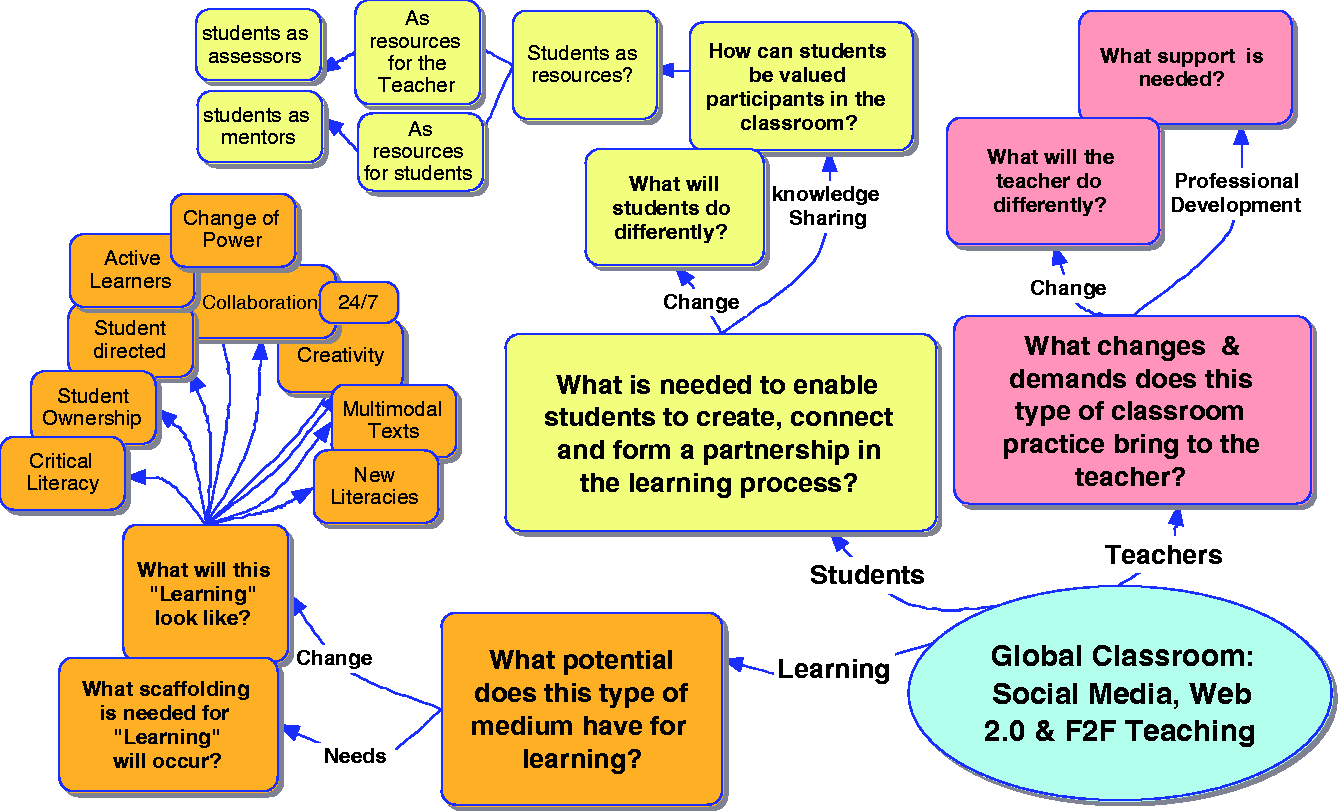
It should be noted that the Student, Teacher, and Learning themes were entwined and interrelated, and the key elements within each theme developed from the struggles the practitioner-researcher experienced over a number of years in getting students to complete and submit project work. They were also influenced by the increasing appearance of mobile devices in the classroom; although, at the time, the school banned these. Note that the Learning theme explores what learning might look like once embedded with online social interaction, while the Student and Teacher themes focus on what will be done differently. The Learning theme was directed towards newer forms of social learning, informal learning and potential experts and students were encouraged to bring their day-to-day ideas into the online social classroom. It was hoped that this would encourage active, timely and engaged learning and also bring aspects of authenticity. The Student theme, while integrating students’ prior knowledge and skills into the curriculum, aimed to create opportunities for students to be valued by their peers. The Teacher theme, while investigating ways that can support students to be active and engaged, aimed to identify the needs of teachers through the progression of doing things differently.
The practitioner-researcher was well experienced, both personally and professionally, in the use of social media. She had been using social media, such as Facebook (http://facebook.com) and flickr (http://flickr.com), to interact with her two young adult children. She had also been sharing educational ideas and websites with other educators around the world through social sites such as Twitter (http://twitter.com) and Ning. In particular, she enjoyed taking part in online conferences at http://www.globaleducationconference.com. She had also used the Ning in some of her classes during the previous two years. Within the dynamic social interaction of sites such as Facebook, she valued many aspects of informal learning that she had witnessed online and continued to be impressed by the timeliness of responses to questions posted. Such online social sites also held an exceptional ability to link to an extensive range of potential experts in a seemingly endless range of fields and provided real world data and knowledge (for example, natural disasters and earthquakes http://www.visualisingdata.com/2011/03/japan-earthquake-real-time-visualisation/) and NASA (https://www.nasa.gov/audience/forstudents/).
During the research, four ‘critical friends’ (Dunne, Nave, & Lewis, 2000), who were colleagues at the school, regularly (weekly) provided the practitioner-researcher with feedback. She also sought feedback from others at the school through staff meetings as well as curriculum and learning area meetings. The practitioner-researcher also presented the research at local and international conferences as well as online educational webinars (such as https://www.youtube.com/user/ICTEV). In these presentations, many educators engaged in discussion around the research and some implemented ideas from the research social sites and provided further critical feedback. The practitioner-researcher reflected on the opinion of others and this informed the action research cycle. The authors met at monthly intervals and engaged in frequent email communication to discuss progress and issues surrounding the research.
The students in the study were 13 to 16 years of age and, generally, were from middle socio-economic circumstances. The practitioner-researcher taught Mathematics, and Information Technology; some of the Information Technology (IT) classes were integrated units where the curriculum also supported most of the students’ other subjects. Classes usually included 25 students and data collection included three Phases.
Phase A – Semester 2, 2010 included seven classes. Phase B – Semester 1, 2011 included five classes. Phase C – Semester 2, 2011 included 1 class.
One online social networking site was developed during each of the three phases (one for each of the three semesters). A Ning social network was used and this was similar to the popular Facebook social networking site except that the practitioner-researcher owned the three Ning sites and moderated all membership. Similar to Facebook, students could (and were encouraged to) create their own avatar and profile within the social site. Generally, through their out-of-school learning, students understood the use of avatars and profiles within social media. The challenge for the practitioner-researcher was to ensure that students appreciated the privacy of all online members and, hence, used appropriate pseudonyms when communicating online. An important ethical consideration was that students remain anonymous when online and, for privacy reasons, all students used pseudonyms when online; they could change these pseudonyms when and as often as they desired.
As is formally required of both staff and doctoral candidates undertaking human research, prior to commencement an application for ethics clearance was made and obtained from the authors’ university, The Principal of the school research site was approached first for approval for the research to be conducted. Once this was agreed, through the Principal, the regional school administration was also approached and gave approval. The procedures included a process whereby students and their parents or guardians were provided with a ‘plain language statement’ explaining the research and its potential risks and benefits, and requesting their consent to participate. Approximately one-third of the students in each class with their respective parent or guardian agreed to participate. Those who agreed were free to withdraw at any time: no student withdrew. Students who declined to participate were involved in the same classes, activities and assessment, but the data from these students were not collected.
In considering the extent to which students were stakeholders in this study, they were not invited to take part in the ongoing discussion of the action research. However, their actions and reactions were carefully considered within the teacher reflections. Also, their judgements on both self-assessment and peer-assessment were key to building an active element into the assessment process. Teacher reflections on student interaction, discussion, reactions and work output were key elements in driving change within the action research cycle of improvement.
During the first phase, Phase A, the practitioner-researcher taught a full teaching load. She chose to work full-time to ensure that her first phase represented the issues relating to a ‘real’ full-time teacher. This allowed both the time constraints of a full-time teacher, and the day-to-day pressures and accountability, such as, student assessment, student reporting, parent–teacher communications, staff meetings and even yard duty to be included in the first phase of data collection.
At the time of the research, there had been a number of negative reports in local newspapers and media in regard to the use of social media. The practitioner-researcher, therefore, regularly informed parents and the school community about the research. This included the potentially positive aspects of social media and how these were being deployed in a safe and controlled educational environment. It was emphasised that students were being educated on appropriate use of such online sites and parents were encouraged to seek further information if required. At parent–teacher interviews, during each phase, parents/guardians of each child attending were shown the social site. In particular, parents were shown how students could leave comments for the teacher or peers at any time of the day as well as during school holidays. The practitioner-researcher encouraged the parents to ask their child to also show them this site, their profile and their posted content as the semester progressed. Parents were asked to remind their child to leave comments for the teacher or peers if they needed help in any way; parents of mathematics students were particularly impressed with such flexible options as well as the range of learning materials.
During the second phase, Phase B, the practitioner-researcher reduced her teacher and classroom responsibilities and worked part-time (four days per week). This also allowed for more time to reflect and analyse data with second author. During the final phase, Phase C, the practitioner-researcher taught one class and devoted more time to analysis and the writing of her doctoral thesis (dissertation). This class, among other things, worked on collaborative projects with schools from Russia and Romania. Partly due to research ethics and integrity concerns, data were not collected from the overseas students. The work of the students from these overseas schools did, however, influence the work of the students from the researcher’s class by engaging them in online conversation and sharing ideas.
Data collection and analysis
Data collected included the practitioner-researcher’s planning documents, classroom reflection, and field notes, students’ online activities, students’ tasks, weekly reflections, mid-term reflections and end-of-term reflections, as well as critical friend and peer feedback. Teacher reflection was used at the end of classes, to improve immediate practices, at the end of each week to help inform curriculum content and at the end of each five-week period to help inform broader curriculum development and assessment processes. The latter was also used to evaluate research progress. The practitioner-researcher also took screen clips on student online conversations and work after most classes.
Each research theme were broken down into categories with data tags.

The data were grouped into categories that, consequently, could be organised into each of the three themes. Summaries and samples were then created for each topic within each class and compared and reflected upon as the research progressed. These, in turn, helped to inform the next cycle of action research.
When considering the tagged data, a number of complexities existed that were challenging. These were, however, a normal part of action research, such as, in this case, the practitioner-researcher’s evolving understandings, new learning experiences, and professional risk-taking in curriculum design. These were documented through written reflections as part of the cycles of development and improvement, within the action research. One particular complexity involved the development of the thinking behind a teacher’s behaviour and their curriculum development: this is discussed later as evolving ‘teacher mindsets’.
When considering the focus of this article, Figure 2 provides a summary of many active elements implemented in the study. The practitioner-researcher had used these previously and valued them as part of her approach to multimodal and interdisciplinary literacy in the classroom. As can be seen in Figure 2, many of these activities involve students as active designers and creators of content such as animations and vodcasts; a move away from the passive learning context often seen in traditional methods of learning. Figure 2 also identifies the wide variety of the student interaction that was available on the social learning site and includes comments, discussion forums, ‘Likes’ and online ‘Friends’.
A summary of the elements used within the redesigning of class projects using social media.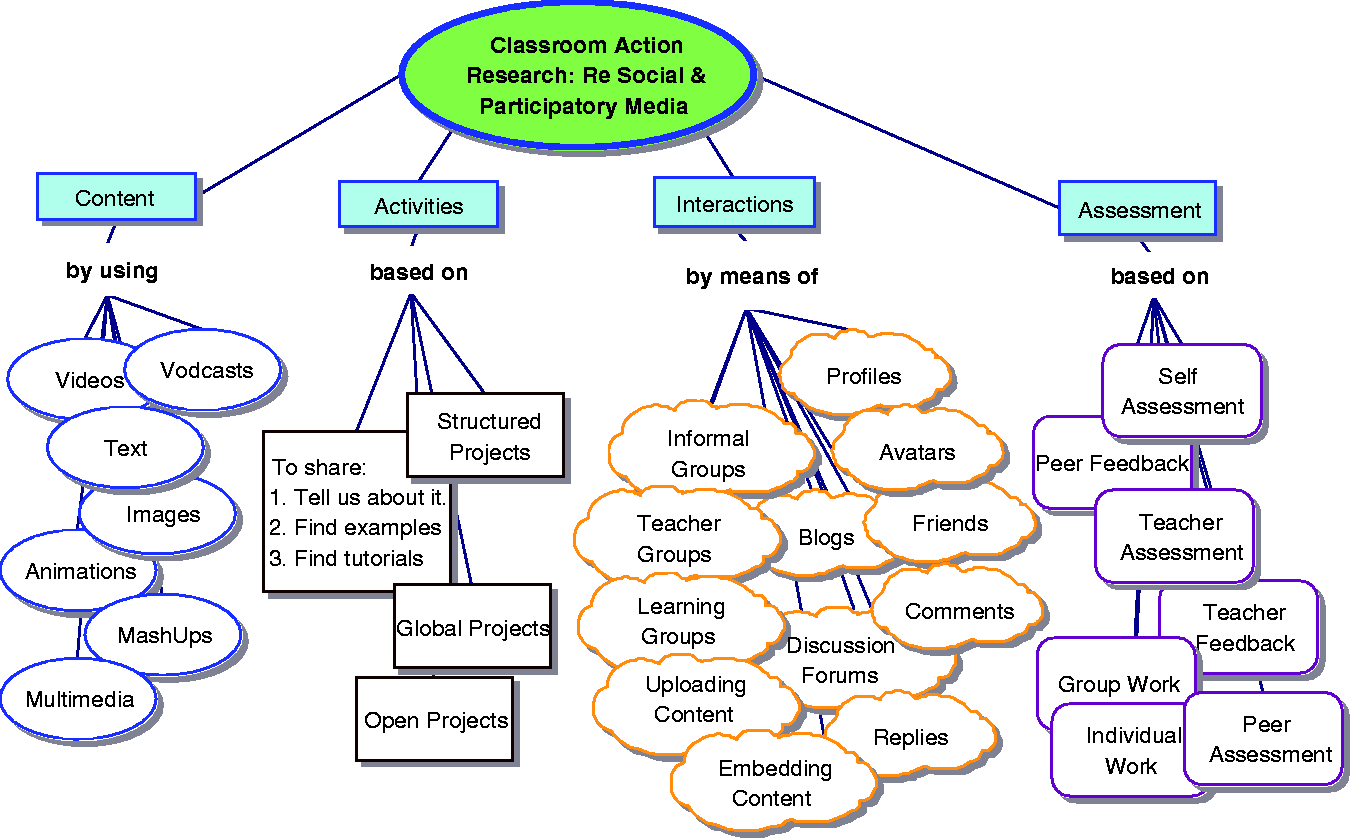
The main source of data for the student theme came from screen clips taken from the student online activitiy. Taking screen clips was an efficient method of capturing the students’ online activities. These screen clips were taken as the practioner-researcher checked her students’ online activity. The clips were taken using Microsoft OneNote which enabled automatic filing into the OneNote software. Screen clips were taken using keyboard shortcuts and then dragging the mouse over an appropriate part of the screen. These were tagged and searchable within the software to enable the sorting of tags, categories and themes for analysis.
The screen clips included formal discussion within project work as well as informal discussion and social chat. The main souce of data for the teacher theme came from teacher planning and field notes as well as reflections. Data for the Learning theme generally came from a combination of all areas of the data collection types. As part of the action research cycles of improvement, by default, analysis of the data occurred as it was collected through the on going reflection processes. Teacher reflections at the end of each topic involved the creation of summary tables from the data collected within that topic and helped to link the content taught with the tagged data. This helped to ensure that the curriculum data could be organised into the categories and, hence the research themes.
Part of the tag summaries for one topic for one mathematics class.

Cycles of learning and action
Each student could be identified by the practitioner-researcher from their school email address, which they used to join the Ning social site. However, this email address was not publically visible to anyone except the teacher. This site provided each student with a ‘My Page’ where they could choose or design their own theme. A student’s ‘My Page’ also provided fast and convenient links to important online elements, such as, members’ blogs, discussion forums, friends, ‘Likes’, photos and videos. These and many other aspects of the social site allowed students to take ownership of the look and feel of their presence when online. Occasionally this was difficult for the practitioner-researcher as some students wanted to post inappropriate avatars, such as, violent images. Enforcing simple rules, such as, all content must be rated for ‘general exhibition’ (in the Australian film and TV classification sense) helped to ensure students met school expectations and appreciated the difference between social media usage in school compared to their out-of-school lives. In the more traditional classroom, the teacher is often at the front of the classroom controlling discussion and learning, such control can be difficult within a social online environment and the practitioner-researcher valued the development of an important balance between authority and freedom for students as their posts and communication evolved over the three phases.
An unexpected challenge experienced by the practitioner-researcher was that of being a good role model for online educational practice. Short comments on students’ work, such as, ‘good job’ or ‘well done’ provided little explanation of what was actually good or well done. The practitioner-researcher aimed to provide constructive comments that aligned with more critical and higher order thinking, and that would also model how students should provide constructive comments to each other. A further contrast with normal classroom oral practice is that the teacher’s and the students’ online comments remained on the Ning to be viewed and used later; whereas normal classroom discussion instantly ‘evaporates’ except to the extent to which it is ‘condensed’ into notes and memories.
The Ning sites were viewable from anywhere in the world, although only members could login to post or upload content. All classes taught during a particular phase shared the one Ning site; hence, students from Year 7, 8, 9 and 10 could share groups and discussion forums, post comments on each other’s blogs and generally interact together; this was encouraged. Initially, the practitioner-researcher posted class projects on her ‘My Page’, but she soon found that these needed to be more easily accessible to students. Designing a social online site is complex and consideration needed to be given to the number of clicks required to access the projects and presentations. From the knowledge gained through the reflection data, from the action research, important information such as project work was presented and linked onto the main online page and this can be seen down the left hand side of Figure 3. This figure displays the main page of the Ning used during ‘Phase A’. Important notices such as reminders not to post identifiable photos or materials can be seen in the middle section of the Figure 3. Links to the latest activity that occurred on the Ning also appeared on the main page and this helped the practitioner-researcher easily monitor the latest interaction. For the Teacher Theme, this main page is an example of the learning delivery and design. This continued to evolve over the three phases and the page shows some of the ways in which materials were presented differently.
The main page of the Ning social media site used during the first phase.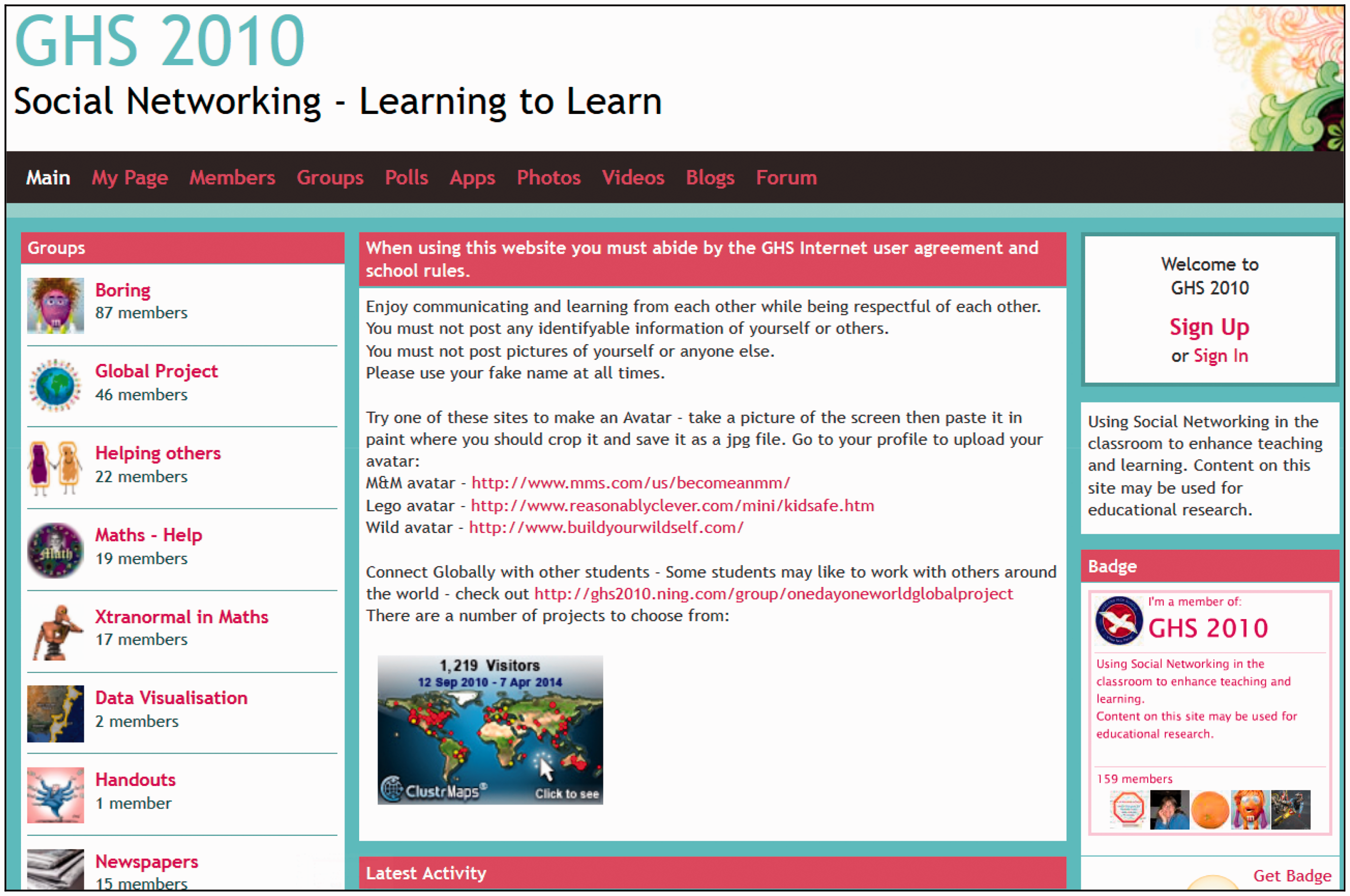
Figure 4 shows the ‘My Page’ of a student with pseudonym ‘Betty-Boo’. This page highlights a student’s use of the social site including avatars and interaction. It also highlights the ease, for the practitioner-researcher, to identify how much work students have done at any point in time. For Betty-Boo, one can see seven Blog Posts, 12 Groups and three Photos. The screen clip also shows peer comments those with pseudonyms ‘Leda Moore’ and ‘Tam’. This figure provides common examples of student responses to peer-assessment during major projects; this included ‘H’ for high, ‘M’ for medium and ‘L’ for a low standard. Further comments, in Figure 4, show ‘Betty-Boo’ giving feedback and providing peer-assessment. When considering the comments related to peer-assessment, the screen clip also identifies the struggle the practitioner-researcher had in scaffolding in-depth constructive feedback from students.
A typical student’s ‘My Page’ from the Ning showing many links and peer-to-peer communication.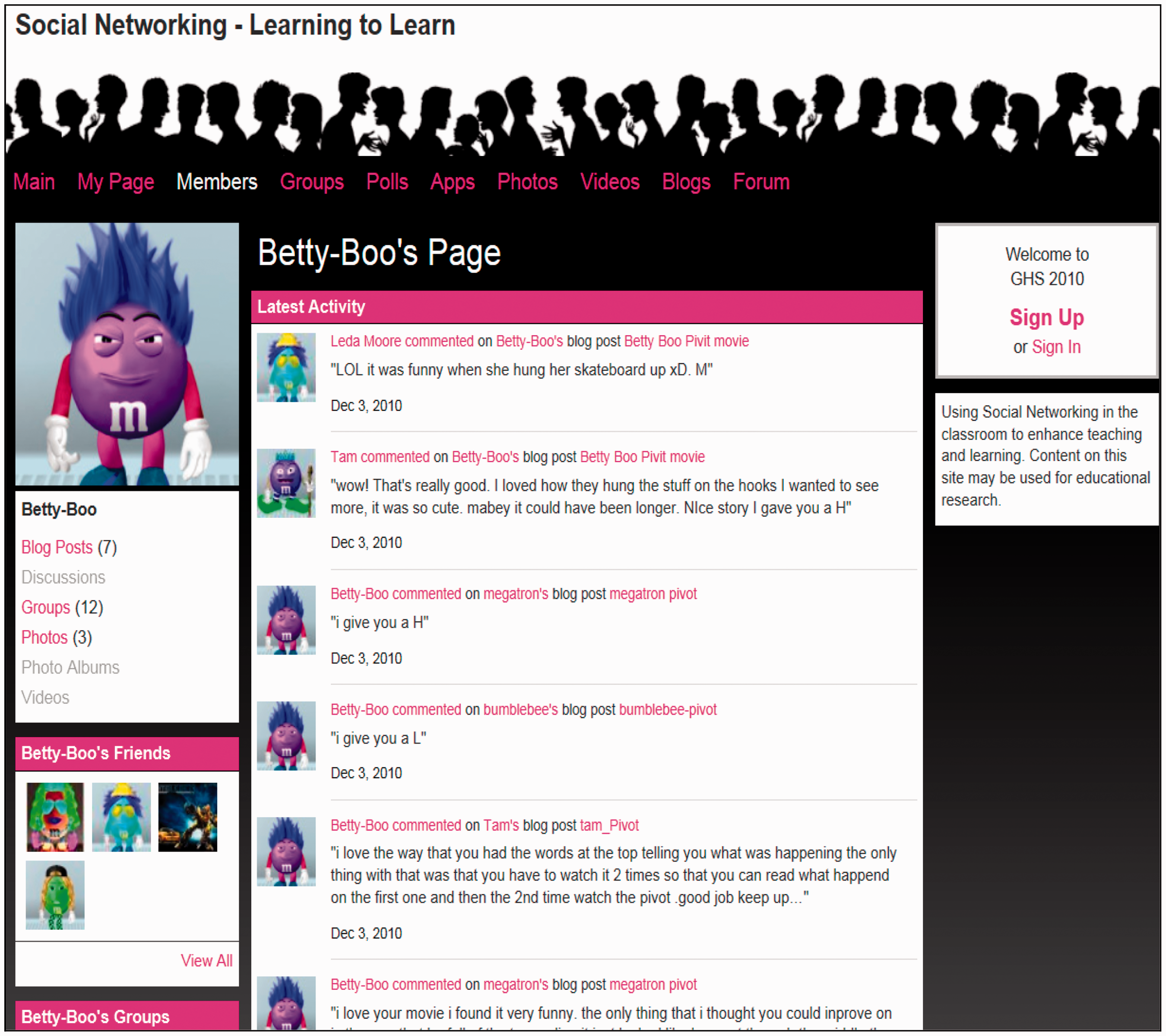
For formative and summative assessment purposes, a student’s My Page was used as a form of ‘learning portfolio’. In particular, Blog posts documented students’ progress in projects, whilst also including interactions with peers. Before final assessment, students had time to improve their work, given their peer-feedback. It should be noted that, although students gave online feedback, they also had many opportunities to discuss this in the classroom. Self-assessment was used as part of the learning process which helped to identify students’ achievements against set criteria. This also helped to form a detailed triangulation of assessment data when combined with the teacher’s observation (this is discussed further in Casey, 2015). As shown in Figure 1, students as mentors and assessors were planned as part of the research. However, the development of the triangulation of assessment data evolved over time and this became more explicit as a student’s work content and interactions increased and were automatically documented on a students’ My Page.
In returning to the article’s focus, Figure 3 and Figure 4 help to picture the Ning online site. These figures help to provide snapshots of how the social site was used to structure student interaction around set projects while still encouraging informal interaction in support of just-in-time learning in the areas of student choice. Students were encouraged to establish their online personas and combine this with the freedom to create interest groups. The authors saw these opportunities for informal learning as scaffolding for building relationships within the class and across subjects and classes. The following pages discuss more closely the priorities within the action research during each of the three phases.
Action Research and the Phase A priorities and challenges
During this first phase, membership to the Ning site comprised solely of the practitioner-researcher’s four Year 7 IT classes, one Year 8/9 IT class, one Year 9/10 Multimedia class and her one Year 9 Maths class. At this early point in time and being in an educational setting with students under the age of 18, the practitioner-researcher felt the need to maintain a consistent approach within her class and take a firm handling of any misconduct on the online. This, she felt, helped to gain the support of her principal and teaching colleagues, hence, all students were expected to become members of the Phase A social site (this changed during the further phases). During Phase A the student online activity was closely monitored and the action research cycle was used to overcome four main challenges.
Teacher Time. The data included many teacher reflections concerned with the time taken to monitor students’ online activities. Professionally, and ethically in terms of the research, the practitioner-researcher was responsible for ensuring that activity within the online site was appropriate and aligned with school policy and guidelines. Initially, this responsibility was stressful as students wanted to invite people outside the classroom to join the Ning site. An example of this is shown in Figure 5 where 103 is shown as ‘Invited’. However, the students sent out these invitations from the Ning and those invited were not part of the practitioner-researcher’s classes; hence, were not accepted as members. Figure 5 also draws attention to challenges, such as, identifying students involved in misdemeanours. In Figure 5, a student is requesting membership using the pseudonym ‘mr farts a lot’. Students consider this type of behaviour humorous. As noted previously, the practitioner-researcher could identify students by their school email addresses. In this case she spoke to the student to explain the appropriate online behaviour. The student was part of the teacher-researcher’s classes and changed the pseudonym before being accepted. Figure 5 indicates that there were 134 members plus 12 students who were banned for misdemeanours. Students did not stay banned for long; they usually sought the teacher to rectify any issues. This seeking out demonstrated engagement with the Ning and the association it held with peers. Although Figure 5 highlights some of the issues relating to teacher time, it also shows that students invited their out-of-class friends to become members of the site indicating engagement with the social site. The teacher explained to the students that, as with normal school practice in classes, she could not accept membership from outside of the class. This large number of invitations, by students to external people, was unexpected. It helped both the teacher and the students to understand one of the important differences between students’ private online social sites and class sites. Structure. It was essential that the social media site provided quick and easy access to materials and interaction, as explained earlier in the discussion regarding Figure 3. Early in Phase A the teacher-researcher explored a number of options for posting project work and instructions and she spent time exploring the suitability of discussion forums and blogs for project work. Each of these provided for different approaches to social interaction and publication of user-generated content. Teacher mindset. The teacher reflection data showed that, as part of the action research cycle and the pressure on teacher time, there existed a continuous re-evaluation of what was import in the daily life of ‘the teacher’. The following identify some of the questions that arose in the reflection data and they highlight the thinking that was occurring as the pressure on teacher time continued.
How important was it for the teacher to know the identity of students at all times? There was never enough teacher time to do everything; therefore decisions had to be made regarding priorities in monitoring aspects that would not have been considered in the more traditional classroom. For example, students frequently changed their pseudonyms and it was time consuming to look up new identities. How important was it for the teacher to always know the class in which the student resides? Again, this was time consuming to look up and as peer-to-peer feedback and support began to evolve students, in many ways, became monitors of their peers. How important was it to know how much work each student completed in any class or in any given week? When considering this question, one should also note that, at the end of project work, detailed student self-reflections were introduced and teacher observations also formed part of daily reflections. Peer-feedback before projects were due also developed and provided students with opportunities for feedback as projects progressed. How important is it to for the teacher to tell the students what to do, when to do it and how to do it? How much teacher instruction, or how little, is acceptable or optimum? This is a question that continued to arise once careful consideration is given to the prior a, b and c. It is also one that involves value judgements and ethical considerations. It continued to be a point of contention when discussed with other teachers at the research site and educators at conferences. Critical thinking and students expressing themselves. Figure 6 shows a screen clip from a Year 7 project where students were expected to choose one task from a range created by the teacher. These tasks were designed to encourage students to think about how what they do in their daily lives might be different to that of others around the world. This can be a difficult concept for 13 year olds. The students in Figure 6 used the pseudonym ‘Pip’ and chose the third task from a list of 11 global classroom projects. In this project, students published content such as pictures, multimedia and detailed information on the Ning for classes outside of Australia to read, comment and make comparisons of their country. To help with assessment, a number of questions were posed to scaffold their learning and students’ thinking. In Pip’s answers to these questions, shown in Figure 6, in particular question 4, Pip explains why work was not complete and the practitioner-researcher valued this input from students. It helped her clarify some aspects surrounding the progress of learning and to some extent the reasons behind why learning may not be progressing as expected. Such questions also proved the student with a voice and provided a mechanism for the student analyse their approach to work. The authors considered that this approach helped students to take responsibility for their work and helped to identify the learning that occurred.
Moderation of a large number of members was initially time consuming. A student post explaining what the project work completed with the uploaded project for assessment.


On many occasions, the teacher reflection data showed that students were becoming less dependent on the teacher for directions and approval and as students became more accustomed to peer-feedback, they actively sought it from their peers; it appeared that they were genuinely interested in their peers’ reactions and opinions of project work. This created a shift in the student to teacher relationship as students continued to express positive comments in regard to the feedback they obtained from their peers. On reflection, in many cases, peer-feedback was more immediate and more conversational than teacher-feedback.
Action Research and the Phase B priorities and challenges
The action research cycles during the first phase were very successful in dealing with teacher time and these cycles helped the practitioner-researcher to become aware of her values changing and continuing to move away from the more traditional teaching hierarchy and strict control within student learning. Although teacher time remained important, there was little need to continue teacher time as a major focus for subsequent phases as the techniques put in place from Phase A were working.
Membership to the second phase Ning site included two Year 7 IT classes, two Year 8 Maths classes and one Year 8/9 IT class. Having the experience of Phase A, the practitioner-researcher wanted to increase the choices and flexibility for students and this included letting students join the Ning when they felt they were ready and had the desire. In this sense, she wanted to ‘stand back’ and watch when students joined and, from this, reflect on the reasons why they made this decision. The practitioner-researcher felt comfortable allowing students to decide when/if they wanted to join, believing that they would choose to join when they felt that the site had something to offer them.
It was noted that many students who joined the Ning on the first day were those experienced in using online social networks. These students were able to use their previous understanding of social media to establish avatars and pseudonyms. These students particularly displayed a depth of knowledge and understanding of their ‘My Page’ and were able to ascertain how to change the theme of the page and leave comments for peers. The teacher reflection data identified that some students ‘lurked’ for a few days before joining. Some students joined the Ning after the practitioner-researcher encouraged them to share their work and gain feedback from their peers.
It should be noted that students from the first day of the semester all classes were directed to view the site and retrieve teacher content. This was not optional; hence, they only needed to join the site if they wanted to interact or upload content. Students were encouraged, however, to join and leave comments for their peers when they felt comfortable so doing. Seventy-three students joined the Ning in Phase B. When considering the research priority of students being active and engaged, the following were the key challenges for the action research during this second phase.
Structure. In order to continue to improve the active nature and engagement of class projects, it was important that the projects were designed in ways that took advantage of the unique qualities that the social media offered. Further exploration was also carried out involving structural elements such as how blogs and discussion forums could be used and when one was more suitable and/or engaging than the other. To support active learning, careful consideration was given to the presentation and content of online projects. Attention was given to selecting appropriate sites for their graphics and associated interesting websites that provided variety while being relevant, authentic and multimedia rich. Student-centred activities. Strategies for peer-to-peer teaching, including student made video help tutorials. Processes of effective ways to create these with appropriate software still needed further development. The main purpose for these was to identify key areas of learning and share these with peers, while also providing students with a means to see and hear themselves express their learning. Informing the face-to-face classrooms. In classes that expected more direct content learning, such as in mathematics, the practitioner-researcher wanted to incorporate some of the Phase 1 approaches used to address teacher time issues in her face-to-face mathematics classes. This included incorporating student-made help videos and providing peer feedback, but also building more timely feedback through peer-assessment of simple quizzes and problem solving tasks that were scaffolding activities to larger projects.
Action Research and the Phase C priorities and challenges
During the final phase, the practitioner-researcher taught only one Year 7 IT class. The curriculum for this class was part of an integrated program with other Year 7 teachers. As well as using the Ning site for general interaction and class projects, it was also used to work collaboratively with schools from Russia and Romania. Part of student learning during this phase was to gain cultural understanding of others and this included the need to a deeper level of empathy and support for those from outside Australia. During this final phase, the focus was on identifying what learning looked like across cultural groups of students. The challenges included:
Web 2.0 tools. Incorporating options for students to integrate these more fully into their non-IT subjects so that they could create multimedia that provided visual clues to the learning that occurred. This included students becoming designers, creators and publishers online while producing content for other teachers. Peer-to-peer teaching. The authors wanted students to identify their previous knowledge and share this with peers. This included knowledge gained from primary school and that gained from their out-of-school activities. It was hoped that this would build student confidence while encouraging them to publish and share so that others could learn; this included those from other countries. International collaboration. This included exploring how social media could contribute to more global classroom learning. Identifying how discussion forums, blogs and online groups could be used to more formally document and discuss concepts such as how students spend their time, the clothes they wear, and the food they eat. It was important that ethical and privacy issues continued to be discussed in the face-to-face classroom as well as online. As students became more enthused in such projects, they need reminding, both not to use the real names of their peers in their descriptions and that some phrases in one culture can be offensive in others. Redesigning learning. Continuing to design projects and encourage interaction that was student-centred and encouraged students to take more responsibility for their learning and the learning of their peers.
This phase involved the greatest risk-taking for the practitioner-researcher because it held the unpredictability of working with overseas schools. Projects were very flexible and fluid to cater for possible constraints of the schools outside Australia.
Discussion of findings
This study found that social media offer new approaches for the face-to-face classroom. It found that learning can look and feel different through the range of technologies that can be embedded through social sites. Initially such approaches were more time consuming and involved a range of challenges. As the authors explored the potential for a more social approach to learning, student interactions became recognisably distinct from the more traditional classroom teaching approach; students became more active.
Initially students came into the classroom expecting that learning would occur in the more traditional way and that the teacher would be responsible for creating the learning content and providing the feedback. Some students required up to four weeks to become accustomed to a more social approach to learning where they had more choices in how they completed projects and the way in which their project could look. In considering how social media can be deployed to enable students to become actively engaged in project work, students were expected to take some ownership and responsibility within the learning process. They provided comments and feedback for peers to help them improve their work. When providing feedback students needed to understand the task at hand and this provided them with further incentive to more fully understand the requirements of project work.
On many occasions, the teacher reflection data noted that comments made by students in the face-to-face classroom indicated that students’ ‘lurking’ or watching how their peers reacted in different situations resulted in them learning different ways to behave as well as learning how to create content and learn new concepts. As students posted their work online, the teacher reflection data continued to indicate that students were using their peer’s work to gain ideas of ‘what to do’; in this way, students became models for their peers. Hamilton (1990) discusses the concept of learning before formal education and explains how the learner continued to seek out experts in a particular field. Aspects of this could be seen in this study as students sort information from more knowledgeable peers. This concept is a complex one within a social learning framework and opens up many avenues for further study. Casey and Wells (2015) discuss this further in a higher education context.
This study helps to address the argument that there is a lack of evidence to show that education has changed fundamentally in light of the introduction of new technologies into the classroom (Conole & Koskinen, 2011; Lindstrom, 2012). It supports Bonk’s concept (2009, p. 357) of Web 2.0, and its associated technology, being among the latest ‘fighting tools’ for change in education. Chun-Wang, Nian-Shing, and Kinshuk (2012) argue that social presence has significant effects on learning interaction that, in turn, can have significant effects on learning performance. The redesigning of classroom learning using social media required both the teacher and the students to be learners, working together in non-linear ways (Casey & Evans, 2011).
Conclusion
This article highlights the possibilities of social media being the enabler for active student interaction in the face-to-face classroom. It was found that such new media opened up opportunities for students to design, create and publish their work for all to see. In understanding how social media can be deployed to enable students to become actively engaged participants in the learning process, this study found that the continual improvement cycle of action research supported the integration of social and participatory media into the face-to-face classroom and helped to develop a social approach to learning that resulted in the look and feel of teaching, as well as learning, being very different to the traditional classroom.
The implementation of action research set the scene for cycles of improvement to occur and these included changes in the way projects were developed, presented and enacted by student. The social site time-stamped all online activity and this enabled snapshots of learning to be seen through the growth of online interaction and the posting of user-generated content. This also enabled the progress of learning to be easily seen and evidenced through a students’ My Page. The integration of a wide range of Web 2.0 tools, along with embedding social interaction into the curriculum projects were key aspects in developing dynamic and engaging learning experiences.
It was vital to meet school assessment and learning expectations and this also included building and embedding a safe and supportive online culture that was appreciative of cultural diversity. In maintaining an active environment, it was essential that students developed ownership of, and responsibility for, their online sites. This required that students – and the teacher – understood their ethical responsibilities and the importance of privacy online.
In supporting the schools desire to explore new ways of learning for its one electronic device per student program, this study highlights the change in thinking and mindset for the teacher as she sort a more social learning approach. This study contributes to knowledge that may help educators and course designers integrate an active and engaging digital learning approach. Measuring learning performance was not within the boundaries of this study and is an area for further investigation. While this study challenges the instructional status quo in education, action research is shown as a supportive mechanism for implementing such challenges.
Footnotes
Declaration of Conflicting Interests
The author(s) declared no potential conflicts of interest with respect to the research, authorship, and/or publication of this article.
Funding
The author(s) received no financial support for the research, authorship, and/or publication of this article.