



Abstract
This paper outlines an action research methodology used to create a practice-informed resource for social care in Australia. Practitioners and researchers worked together to develop, test and refine a process to engage people with cognitive disability and complex support needs in person-centred planning. The planning approach, which calls for planners to reflect on their own skills and attitudes as well as the unique needs of an individual, has helped to improve practice in a number of fields and locations in Australia. The process marks a substantive practice shift towards recognition of planning as fundamentally relational in nature. This paper reflects on the process of action research which we describe as similarly relational and potentially transformative of the relations between researchers and practitioners. Working within a knowledge translation paradigm we show how reflexivity within the researcher/practitioner relationship in action research calls for a substantive shift in perspective by researchers to effectively work within the complex contexts of practitioners themselves. In taking this opportunity in our research practice, we identify the potential for a fundamentally different praxis to emerge, one more deeply grounded in the conceptual, political and practical relations between researchers, practitioners and those whose lives they seek to enhance.
Introduction
Social researchers are increasingly focused on the need to apply conceptual and empirical learnings to enhance professional practice. This paper contributes to knowledge by reflecting on lessons from a qualitative study which applied a conceptual model of complex intersectional disadvantage to the development of a practice guide for person-centred planning with people with cognitive disability. Underpinned by the principles of knowledge translation, and operationalised in action research, the approach develops a methodology that is both empirically rigorous and responsive to a rapidly transforming policy and practice context. Acknowledging the challenges to effectively working with people with disability who experience complex social disadvantage, the approach foregrounds considerations of praxis (Freire, 1970), integrating theory and practice via a cycle of critically reflective action research to maximise the applicability and usability of resources to support person-centred social care practice.
Person-centred planning has emerged in recent decades as a central process in the move to individualised models of social care funding in many western neoliberal economies (O’Brien & O’Brien, 2000; Sanderson, 2000). In Australia, planning is the key mechanism for the engagement of participants in the recently implemented National Disability Insurance Scheme (NDIS) (Dickinson, Needham, & Sullivan, 2015). Depending on the nature and extent of disability and the presence of informal supports, planning can be a relatively straightforward process of identifying an individual’s needs and goals and matching those to available modes of support. However, we and others have argued that for social care recipients whose needs are complex due to the presence of interlocking issues across multiple domains or severity of need in one area and few informal supports, planning poses a significantly more challenging undertaking (Bigby, 2014; Clift, 2014; Collings, Dew & Dowse, 2016a; Robertson et al., 2007). Australian researchers have undertaken action research to understand the experience of people with intellectual disability of transitioning to the NDIS (Purcal, Fisher, & Meltzer, 2016). The following reports on action research to develop a practice guide for planners working with people with disability who have complex support needs (CSN) in Australia. The approach draws on a conceptual model of CSN and applies this to planning practice using an action research process. Focus groups were held with practitioners (N = 100) to inform the development of a planning approach to engage people with cognitive disability and CSN. A small group (N = 4) of experienced practitioners were engaged to work alongside the research team (first and second authors) to create an evidence-informed resource to guide planners and enhance their practice with people with CSN. The practitioners tested elements of the resource in their workplace and sought feedback from colleagues (N= 40) on the utility of the resource.
Foundations of research to practice
The methodological approach outlined in this paper is underpinned by three interlinked conceptual foundations, which inform a framework for research to practice in social care planning. The first component, knowledge translation, provides the impetus and rationale for the need to increase the integrity, uptake and applicability of research for end users. The second component identifies principles of praxis as a critically reflective application of theory to practice, and the third identifies action research as a key participatory method providing a model to structure engagement between researchers and practitioners and enable the production of empirically informed practice resources.
Knowledge translation has been defined by the Canadian Institutes of Health Research (CIHR, 2012) as ‘a dynamic and iterative process that includes the synthesis, dissemination, exchange and ethically sound application of knowledge to improve [health] status, provide more effective services and products, and strengthen the [healthcare] system’ (brackets added). It is considered best practice in knowledge translation to include end users such as practitioners, throughout the research process. This practice is known as integrated knowledge translation (Kothari & Wathen, 2013) and, in addition to ensuring the integrity of the research, end user input enhances the likelihood of the research being applied in practice, and also rebalances the notion of expertise and who holds it (Davies, Nutley, & Walter, 2008).
The concept of ‘praxis’ comes from educational philosophy and describes the integration of theory and practice (Freire, 1970). Praxis means that actions are informed by critical reflection and is a fundamental tenet in human service practice, where practitioners can become complacent as their work becomes routine or, conversely, be resistant when they encounter new systems (McCormack & Dewing, 2012). Reflexivity is also central to participatory research approaches that promote the importance of knowledge gained through a reciprocal exchange between researchers and participants. The term ‘action research’ has its origins in the work of organisational psychologist, Kurt Lewin (Bargal, 2008) and in the multidisciplinary international development movement of the 1970s that was influenced by Freire (1970) and coalesced as participatory action research (PAR). The PAR approach sought to emancipate and democratise knowledge by involving those outside traditional research institutions as co-researchers in a process of planning, action, observation and reflection (Hall, 2005). Today, action research refers to a broad family of participatory approaches used to build evidence in areas that lack an empirical research base, find practical solutions to areas of urgent concern to people (Reason & Bradbury, 2008) and understand complex situations (Hughes, 2008). Action research promotes collaboration between researchers and practitioners by valuing ‘different ways of knowing and intelligences’ (McCormack & Dewing, 2012, p. 7). Our purpose in using action research was to translate our findings about CSN planning practices to foster reflective practice among a diverse audience of practitioners.
Using action research to undertake a critical process of reflection on how to convey an approach to CSN planning led to the creation of a product that has achieved widespread attention and application in Australia and parts of North America and Europe. As researchers, we gained much from entering a reflexive process with practitioners that often challenged our views and assumptions about what was needed to make positive and lasting practice improvements.
The need for research-informed resources for social care planners
The research reported in this paper addressed a gap in knowledge about how to undertake social care planning with people with CSN through the development of an evidence-informed resource. In the first stage of this study (reported elsewhere; Collings, Dew & Dowse, 2017), the first two authors conducted focus groups across New South Wales (NSW) with 100 practitioners working with people with disability and CSN and identified common themes about facilitators and barriers to effective planning and the multiphase nature of the planning process with this group. The research findings were used to formulate the concept and structure of the planning resource kit as the basis to the action research phase. Figure 1 describes the relationship between the two studies conducted to develop the planning resource.
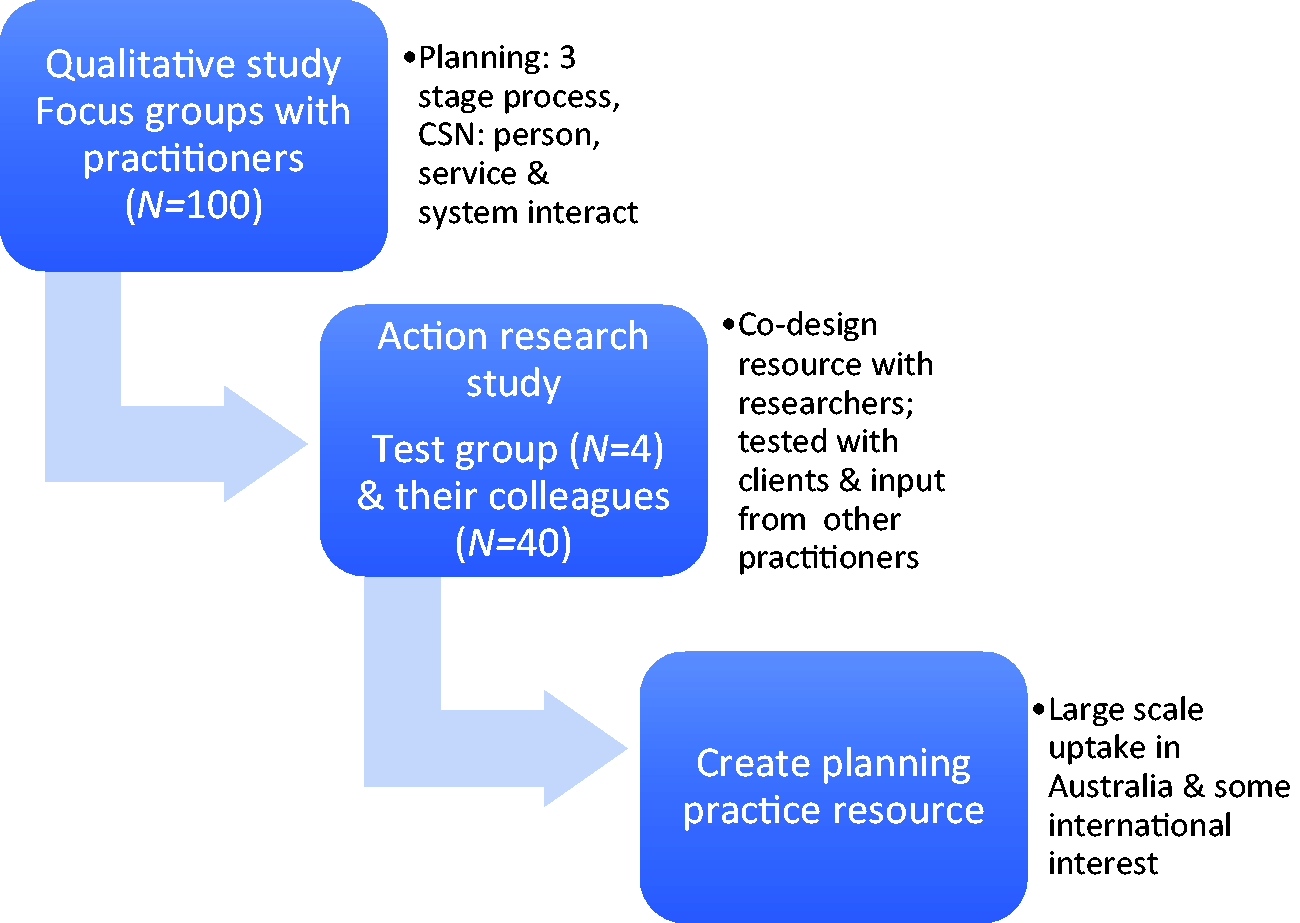
Research process used to create practice-informed resource.CSN: complex support need.
The study
Design
Action research was used to test the planning approach developed based on results of the qualitative study (described above) and to confirm it could be applied to practice. The approach was founded on planning as a three-staged process and underpinned by the conceptual framework of social ecological theory (Bronfenbrenner, 1979). The action research design used three review/reflect/adapt cycles to test and revise the materials. This rigorous process meant that the planning approach described in the resource was not only user friendly and visually appealing but relevant to contemporary disability practice. Each of the three planning stages detailed in the resource was sequentially tested and then retrospectively revisited to allow for uptake of emergent insights. The action research study took place over five months between July and November 2015 during which time the researchers and test group met monthly and maintained email and telephone contact between meetings. Ethical approval for the study was gained from the (UNSW Australia Human Research Ethics Advisory Panel: 09_14_054).
Recruitment
In the context of NDIS implementation, the priority was to build the capacity of disability practitioners and so only practitioners with expertise in facilitating planning conversations with people with cognitive disability and CSN were recruited. In order to gain a novel perspective on the resource, we recruited individuals who had not participated in the earlier study. Recruitment was facilitated through an existing agreement between a district office of the NSW Government disability department that commissioned the research, located in a large metropolitan city, and the tertiary institution that undertook it. The researchers met with senior personnel from the district and asked them to each identify an experienced practitioner from their client service teams who could form a working group to field test, review and refine a planning resource in close consultation with their respective teams of up to 10 practitioners each, and in partnership with two researchers (first and second authors). Five individuals attended a preliminary meeting to learn more about the study. All five gave written consent to take part in the test group; however, one participant subsequently withdrew due to work commitments.
Participants
The test group participants (N = 4) were all female and comprised two allied health professionals working in behaviour support and early childhood intervention teams, respectively, and two social workers employed as support planners in generalist casework teams whose work focused on people with CSN. Participants ranged in age from late 20s to mid-50s. All participants held tertiary qualifications and their experience working in the disability sector ranged from four to 29 years. No demographic details were collected about the colleagues with whom they consulted. However, as client service teams comprised around 10 staff, the resource was informed by feedback from approximately 40 practitioners in addition to the four test group members.
Preliminary concept and design work
Prior to the first action research meeting, the researchers sketched a three-staged planning process (pre-planning, planning conversations and plan to action) and commissioned a commercial graphic design company to develop visual representations of these steps and to translate the conceptual framework for CSN into graphic form – the CSN flag. Figure 2 shows the CSN flag, which used social ecology theory as a framework to depict the interaction between a range of support need domains across person, services and system levels. The concept of needs spanning multiple domains and levels was used to guide a structured process for gathering information about a person’s circumstances prior to undertaking the planning conversation (Collings, Dew, & Dowse, 2016b).
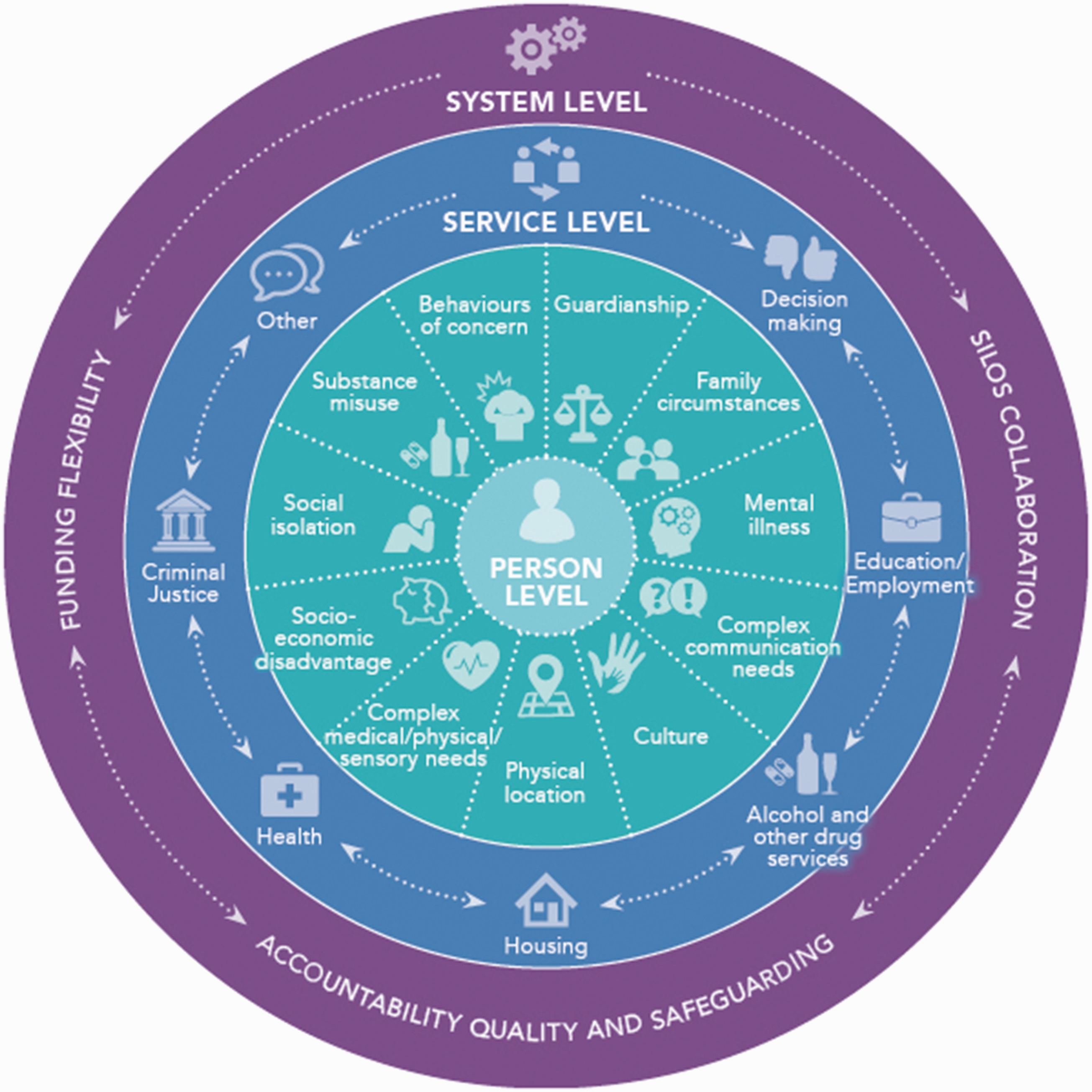
CSNs flag.
Establishing the test group
At the first meeting, the researchers and test group discussed the role of action researchers as equal partners with specific knowledge which, in this case, was clinical and planning expertise. The researchers shared their own practice backgrounds (casework and disability service provision) to reassure the test group that they understood the systemic issues that can impact on practice. The test group agreed to actively participate in discussions, involve colleagues in materials’ review, test materials with clients (people with disability and CSN) and provide timely written feedback to the researchers. The researchers agreed to present the cumulative feedback for test group discussion and accurately convey the agreed changes to the designers. With only four test team members, the contribution of each individual was critical and, had one person not demonstrated this commitment, the outcome of creating a user-friendly practice improvement may have not been realised. It is also worth noting that an advantage of a small group was that camaraderie and a shared goal could be quickly fostered. Each member was heavily invested in the process of creating an enduring practice improvement in the form of a high-quality resource and this was reflected in the final product.
Overview of the research process
Three action research cycles were undertaken, one for each of the three planning stages in the resource. Test group members presented each stage of the resource to workplace colleagues and both they and their colleagues trialled the materials with clients. The test team collected written feedback on this process using a custom-designed questionnaire. Cumulative feedback was analysed by the researchers and presented to the group for discussion of issues and solutions. The researchers relayed these to the graphic designers who amended the materials accordingly. At the conclusion of all three cycles of action research, the test group met and reviewed the full penultimate version of the resource. This led to further refinements to the overall structure, content and design. Suggestions were discussed and changes made before the designers produced the final version, which was reviewed and approved by the funding body.
An account of the action research process that was used to create the resource kit is now described with a focus on reflexivity, significance and translation to practice.
Results and discussion
Reflexivity
The action research process was conducted in resonance with the reflective practice principles at the heart of the resource under development. Each test group meeting was approximately 3 hour duration, which allowed this small group to build trust and mutual respect so that everyone’s views could be expressed and sense of a shared goal created. Consensus was an important principle of group decision-making and this meant that some decisions were postponed until group members could reflect on a proposal or seek further input or clarification from their teams. The two researchers provided a sounding board for one another when the position taken by the test group challenged their own views of what was needed for the resource. For example, not everyone agreed with a group member’s proposal to include ‘family’ in the service level of the CSN flag in recognition that family members were an unpaid service. Some test group members felt family were commonly viewed as informal support, while others felt family could be a barrier for a person. The researchers were concerned that this inclusion may align the resource with a particular view on the status of families in (in)formal spaces of social care where there is a range of contesting views. The group settled on a compromise to rename the category ‘family circumstances’ to encompass family as potentially either a resource or a challenge for the person.
The group discussed the CSN flag as the key visual guiding the planning process and agreed it worked well on a conceptual level to assist them to identify areas in a person’s life that were important or might impact on goal attainment. However, the group expressed uncertainty about how to use the flag in practice. Some people felt that it was unclear whether the purpose was to assess each domain, ascertain the breadth and depth of needs across domains, or to map the interaction of needs in different domains. In addition to these issues of conceptual coherence and clarity, others identified a concern that the flag risked the use of a deficit approach on the part of the planner, that is it encouraged potentially negative assumptions about a person prior to meeting them. The researchers reflected on this feedback and grappled with the competing requirements of achieving the intended purpose of the guide without losing the coherence of the visual image in identifying domains of potential support need. The solution proposed, which was endorsed by the test team, was to add a detailed explanation of the purpose and use of the flag; a definition of the person, service and system levels; and some changes to the flag itself. For example, a domain of ‘culture’ was added and ‘rural and regional’ became ‘physical location’ to incorporate not only geographical disadvantage but also aspects of the physical environment such as squalor or safety concerns.
Reflexivity was not only applied to the part of the resource then under development but the content of earlier stages was reconsidered in light of subsequent decisions. For example, when, following field testing, the group met to discuss changes to Stage 2, some test group members expressed concern that the fundamental principle of the social ecology model – that an individual must be understood in terms of her/his environment – was not yet sufficiently clear. The CSN flag encouraged the planner to take into account the interaction of CSN at person, service and systems levels; however, the group felt that the resource needed to do more to ensure the planner did not view the person, but rather the services and systems with which they interacted, as complex. The group worried that in failing to appreciate this distinction, planners would approach the person as a problem to be solved, which could undermine their ability to engage the person in a planning partnership.
As these examples show, the conceptual framework devised by researchers following extensive consultation with social care practitioners was transformed by the insights gained from action research with a small group of practitioners. The practice-based knowledge of the test group and the reflective process and dialogue between researchers and practitioners ensured that the CSN flag moved beyond negative stereotypes about people with CSN and yet was able to retain the simplicity and coherence of the original graphic design. This enabled us to fashion a fundamentally different style of practice engagement with people with CSN.
Importantly, reflexivity also changed the way we as researchers approached our research practice. The project commenced with an awareness that improving planning practice would involve learning from those with practical knowledge. However, during the action research process our own research practice was transformed under the influence of the different and deeper engagement developed with the test group. This transformation centred on a substantive shift in our own perspective as researchers – from a one-way process of knowledge gathering from ‘experts’ to an interactive process of co-design, interweaving the subject matter knowledge of our expert practitioners with our own analytic and conceptual research knowledge and expertise in new ways. This bidirectional reflexivity enabled the development of an evidence-informed resource grounded in and shaped by real-world application.
Significance
As described earlier, action research was the second (and final) phase of a larger study undertaken to build the capacity of professionals to undertake social care planning with people with CSN. The authors recognised that action research was essential if we were to create a resource that was both informed by practitioner wisdom and led to practice development. Nonetheless, the frank and illuminating dialogue between the researchers and the test team about the nature of CSN and the challenges it presented in practice enriched our understanding of what was needed in unexpected ways. The following examples explore how the action research process made possible a deeper engagement with the conceptual, political and practical dimensions of CSN and contributed to improving good practice.
During one discussion, several group members reflected that, although the materials had assisted the planners to think about a person’s circumstances more holistically, the approach needed to be more person-centred. In particular, group member suggested that a graphic headed ‘Building the Capacity of a Person’, held a negative connotation that support planning is done to a person. To address this, the group suggested that the graphics be renamed ‘Building capacity with the person’ to clarify that person-centred planning is a collaborative approach. This language was then applied throughout the resource, including in the title itself.
This discussion led the researchers to reflect on learnings from the earlier qualitative study about the need to recognise that planning was primarily relational. In response to this fundamental underpinning to the planning process, as articulated by practitioners, the researchers conceptualised a companion graphic to the CSN flag and worked with the graphic designers to develop a visual prototype using the same concentric circles as the CSN flag to highlight the other person in the planning relationship whose experience was influenced by environmental factors – the planner. The aim of the Planner Flag is to enable the practitioner to examine his or her values, attitudes and beliefs about CSN, the skills needed to work effectively with a person with CSN and the systemic factors that help or hinder them in this work. Figure 3 depicts the Planner Flag.
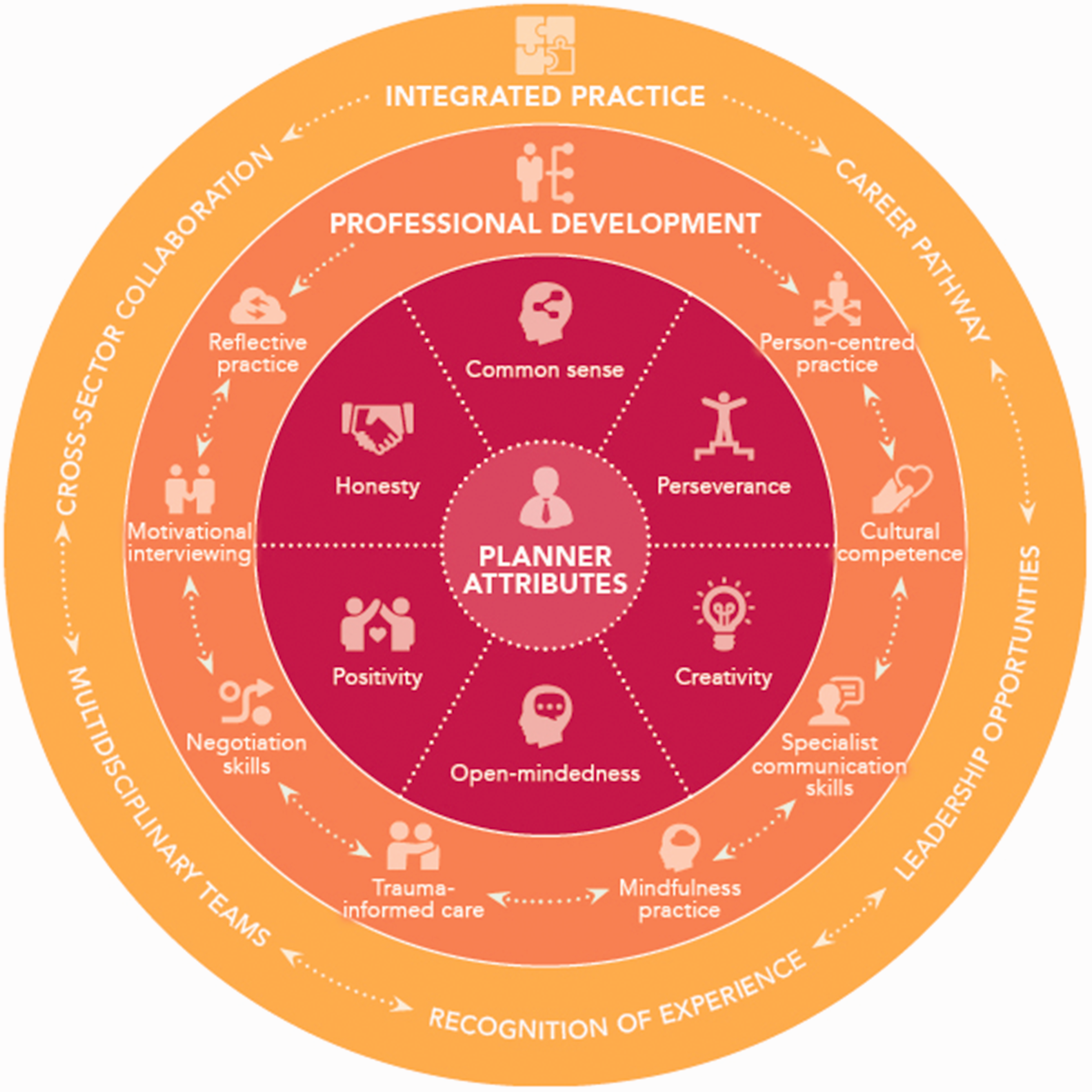
Planner Flag.
The Planner Flag was presented to the test group, who saw it as a useful addition to the kit that encouraged reflective practice and provided a guide to identify professional development needs. Group members suggested additional professional development level domains, such as ‘human rights framework’ and ‘social justice framework’. The consensus was that the Planner Flag depicts the core values that practitioners need to be able to engage with a person with CSN. The group suggested that a glossary of skill definitions be added alongside this graphic, similar to that which accompanied the person-level domains of the CSN flag.
The development of the twin visuals represents a significant turning point in the evolution of the resource. At this point, the researchers and test group recognised that these visuals would be key to guiding a practitioner through the planning approach. Their contribution to good practice was to encourage practitioners to remain mindful of the role their own values, skills and personal attributes play in successfully engaging a person in a constructive relationship.
Translation to practice
In this study, action research was used to extend knowledge on good practice in engaging with people whose CSN are, by their very nature, multiple, interlocking and entrenched. Applying an integrated knowledge translation approach by involving practitioners in developing the planning resource kit, the study harnessed feedback of a wide range of individuals, not only those in the test group but their workplace colleagues.
The insights of the test group positively influenced the quality and usability of the final product. Working closely with the group, the researchers were able to workshop ideas for creating graphics that would provide a visual ‘snapshot’ of each stage of the planning process. Discussions with the group and the results of field testing confirmed that the graphics were a key to the likely application of the planning approach to practice because they were both visually appealing and accessible, making it immediately clear how a practitioner should follow each step in the planning process. The action research process identified the need for a companion flag which addressed the ‘planner’ side of the relationship which the researchers subsequently developed. By using two flags, practitioners have a visual prompt for the inherently relational nature of planning and are invited to think about an individual in their context and critically reflect on the skills and training they may need to respond most effectively to them. This dual approach fundamentally changed the nature of the guide and oriented it away from the danger of it contributing to a ‘deficit-based’ approach towards a recognition of the relational nature of the planning process itself.
Drawing on feedback from approximately 40 practitioners, the test group’s workplace colleagues, meant that input from a wide range of practitioners was gained, enhancing confidence in the utility of the final product for use in practice. This confidence is supported by unsolicited feedback and solicited testimonials, and analysis of website downloads. A comprehensive knowledge translation plan was developed to ensure that the resource was available to practitioners across diverse practice and geographical settings. Hard copies were produced and electronic versions were made available for free download on the hosted websites of the funding body and the research teams, links to which were shared via electronic mail lists and at national and international conferences. The government department that commissioned the study reported 334 copies of the resource were downloaded from its website in the first month.
Drawing on this range of evidence, the kit has been well received and is being used in a variety of locations, sectors and with different client groups including people with CSN living in residential accommodation and those in contact with the criminal justice system. The resource is being utilised to inform practice in at least three Australian states via inclusion in two undergraduate disability courses in Victoria, use in a post-graduate disability course in NSW and through training delivered to practitioners across NSW and Western Australia. Internationally, service providers in Canada and Eastern Europe are utilising the planning resource in their work. A recent review in a peer-reviewed disability journal commended the kit as ‘a sophisticated resource that effectively supports the translation of research and policy into practice’ (Hamilton, 2016, p.196).
Limitations
This paper reports on a small action research study that involved disability practitioners working with people with CSN in one metropolitan area of NSW. It may not therefore be applicable to practitioners from other locations and sectors, although uptake of the resource has occurred across Australia and internationally and in a variety of settings. The authors acknowledge that the relatively small number of practitioners in the action research, all of whom worked in the disability sector, may have limited the diversity of perspectives available. For example, not engaging practitioners working exclusively with specific groups with CSN, for example Aboriginal Australians or people living with substance misuse issues and, being located in a large city, did not address the complexity of living in rural or remote areas. This was addressed by seeking input from the workplace teams of the four test group members at each stage, which meant accessing the views of around 40 practitioners.
In general, practice resources are produced by those with frontline knowledge and are not subject to scrutiny for their scholarly rigour, coherence and useability. The limitation of this study is, to date, the lack of a rigorous evaluation of how the planning approach outlined in this resource works in practice. Funding to produce commissioned resources such as this one consistently fails to permit rigorous evaluation and yet it is precisely this evaluative criterion that is increasingly expected to guide practice-informed research. While we acknowledge this limitation, we argue that by grounding findings from a large-scale qualitative study in the current planning experience of our test group and harnessing the views of a large group of practitioners, via a small test group, we maximised the applicability and usability of a resource to facilitate person-centred social care practice.
Conclusion
The Planning Resource Kit produced using an action research approach was officially launched in early 2016 and has since been distributed widely throughout Australia, particularly within the disability sector. Larger scale evaluation is currently underway to assess its use in multiple settings with different groups of individuals with cognitive disability and CSN. It has received a favourable reception with end users noting its visual appeal, ease of use, flexibility to multiple sectors and with diverse service users. The kit marks a substantive practice shift by focusing on the relationship between the planner and an individual whose support needs must be understood in the context of their unique circumstances and the systems within which they live.
The reflexive PAR approach that evolved in the development of the kit marks a similarly substantive shift in our own practice as researchers concerned with knowledge translation. In our reflection on this process we find resonance with the notion of ‘first-person’ research (Reason & Torbert, 2001, p. 17) which entails ‘skills and methods that address the ability of the researcher to foster an inquiring approach to his or her own life’. In our process of first-person research, we observe that our own internal transformation was shaped by the emergent bidirectional and relational engagement between ourselves as researchers and our test group of practice experts. Mirroring the shift of focus in the content of the kit itself towards a relational understanding of the context of planning for social care, our own shift as researchers required us to reflect on our understanding of the context and unique circumstances and systems which inform the perspectives of practitioners themselves. In this process a fundamentally different form of praxis emerged, which we have argued has significant potential to transform knowledge translation at the nexus of research to practice.
Footnotes
Acknowledgement

Declaration of conflicting interests
The author(s) declared no potential conflicts of interest with respect to the research, authorship, and/or publication of this article.
Funding
The author(s) disclosed receipt of the following financial support for the research, authorship, and/or publication of this article: This work was supported by funding from NSW Family and Community Services, Ageing, Disability & Home Care. The views expressed are those of the authors and not necessarily those of the funder.