



Abstract
Amid research into the mounting social and environmental threats presented by climate change, young people’s everyday experiences and knowledges are often overlooked, despite being the generation that will be most affected by climate change. We present a ‘looping’ methodology, developed through collaborative work between two distinct but complementary research projects wherein young people in the Paraíba do Sul watershed, São Paulo state, Brazil shared their perspectives on (respectively) climate-related disasters and the food–water–energy nexus. The approach brings together the theoretical framings of citizen science and nexus thinking under the aegis of participatory action research, to identify points of mutual learning in relation to the knowledge, action and critique co-produced with young people. This ‘looping methodology’ enables meta-analytic insights into how participatory action research, looped with other forms of action-oriented research, can enable young people and other protagonists to articulate and act upon the complex, multi-scalar processes that characterise what it means to live in uncertain social, political and environmental times.
Keywords
Introduction
Climate change exacerbates vulnerabilities for marginalised populations, resulting in manifold, interrelated socio-environmental crises (Intergovernmental Panel on Climate Change [IPCC], 2014). As well as being the generational group expected to live longest with the effects of climate change, children and young people are recognised as amongst the most vulnerable to these effects (United Nations Children’s Fund [UNICEF] UK, 2013). It is estimated that almost 90 per cent of the 150,000 deaths linked to climate change are children (Plan International, Australian Youth Climate Coalition [AYCC] & Oaktree, 2015). Children’s biological vulnerabilities can also intersect with structural vulnerabilities, including generation, gender and socio-economic status, to further disadvantage them during disasters (Plan International, 2011; Plan International et al., 2015).
Young people should not be regarded solely as victims of climate change, however: they hold unique perspectives on its manifestations and potential responses (Corner et al., 2015; Haynes & Tanner, 2015; Tanner, 2010). Indeed, the case studies we reflect upon in this paper show that young people can contribute to community efforts to better prepare for climate-related events, and entangled issues of social justice and resource equity.
In writing this paper, we have reflected on our experience with two research projects with young people and their communities, both carried out between 2014 and 2017 in the Paraíba do Sul watershed, São Paulo state, Brazil, where extreme weather events and issues of resource security (especially in terms of food, water and energy) have become prevalent in recent years. The two research projects were undertaken separately, with different funders, research teams and participants, as further outlined below.
Despite the differences between the two projects, the research teams shared a commitment to use research to effect social change and ‘an orientation to knowledge creation that arises in a context of practice [and] requires researchers to work with practitioners’ (Bradbury Huang, 2010, p. 91). Dialogue between the teams generated complementary ideas (Bakhtin, 1984), and has enabled our main contribution of an emerging ‘looping’ methodology to come to life.
Through our reflection across two projects, we produce two interrelated contributions to action research with young people on climate change. Firstly, we provide empirical insights from within the two projects about young people’s (often overlooked) subjective knowledges on climate change and resource security, and show that young people’s perspectives can usefully inform responses to the complex and multi-scalar challenges of climate change, disaster risk reduction and resource security. Secondly, reflecting on and across the empirical findings from the two projects, we show how complementary methodologies can be ‘looped’ to generate meta-analytic insights and action-oriented agendas that are greater than the sum of their original parts. We contend that this process of looping methodologies can advance action research in relation to complex transformative change.
Climate change policy, action research and the marginalisation of youth knowledge
Scholars have drawn attention to the marginalisation of subjective, everyday knowledges in favour of ‘putatively universal’ scientific knowledge in climate policy making (Jasanoff & Martello, 2004). For Jasanoff (2010, p. 233), ‘global’ framings of environment ‘detach knowledge from meaning’, contributing to a sense of public alienation from climate change policy agendas. This resonates with a caution in an earlier editorial of this journal that environmental governance is too often characterised by ‘a technical-rational logic that […effaces…] more complicated behavioural and cultural aspects of creating a sustainable society’ (Bradbury & Waage, 2005, p. 131). Paradoxically, this is at a time when environmental governance relies on the active participation of individuals (Middlemiss, 2014; Walker, 2017).
In climate change policy, as in many domains, young people’s needs, experiences and knowledges are frequently neglected because of their legal and social positioning (Cumiskey, Hoang, Suzuki, Pettigrew, & Herrgard, 2015; Horton, Hadfield-Hill, & Kraftl, 2015; Marchezini, Trajber, Olivato, Pereira, & Luz, 2017). Although youth summits have taken place alongside UN climate change summits, they are often rendered tokenistic by insufficient formal mechanisms to incorporate young people’s perspectives into policy (Cumiskey et al., 2015). This fits with the prevailing perception that youth are vulnerable recipients, not proactive protagonists (Marchezini & Trajber, 2016; Tanner, 2010). Thus, their environmental knowledges and agency are frequently overlooked in environmental education, urban planning and climate change adaptation.
Action research, education and sustainable transitions
Action research approaches create real and concrete opportunities for youth participation, allowing them to make collective decisions throughout the process, based on Freirian pedagogy (Freire 1996, 1999), whose inspiration emerges in some of this paper’s findings. Action research has been taken up by environmental educators who seek to engender co-learning, responsive action and critical dialogues on (un)sustainability (Kemmis, McTaggart, & Nixon, 2014; Quijada Cerecer, Cahill, & Bradley, 2013; Stevenson & Robottom, 2013). Many forms of classroom-based environmental education have been critiqued for teaching learners to adapt to rather than challenge the root causes of unsustainability (Huckle & Wals, 2015). In this context, action research carried out by educators, learners and researchers (e.g. Greenhall-Gough & Robottom, 1993; Kemmis et al., 2014; Schindel & Tolbert, 2017) exemplifies productive synergies between critical environmental education and action research.
Amid attempts to involve a broader range of stakeholders in climate change adaptation, some community programmes are incorporating participatory action research through activities such as community mapping, scenario planning and ‘pathways to change’ (Pelling, 2011; Wise et al., 2014). In this way, climate change adaptation becomes not only about reducing the material risks and impacts of climate change, but also a means to address social inequities as drivers of vulnerability and poverty, particularly in terms of gender (Rasul & Sharma, 2015) or youth (Haynes & Tanner, 2015; Marchezini & Trajber, 2016; Tanner, 2010).
Pelling (2011, p. 33, our emphases), notes that ‘Freire warns us that without a critical awareness, adaptation is […] limited to efforts that promote action to survive better with, rather than seek change to, the social and political structures that shape life chances’. Thus, genuinely sustainable climate change adaptation is a political process that involves generations working together to overcome feelings of alienation, apathy or powerlessness in order to articulate knowledge and action for the transformation of complex and unsustainable socio-environmental arrangements.
Introducing the looping methodology
As we show in the paper, the looping methodology emerged from the dialogue between two different research projects and teams. The first project was a participatory action research project carried out between a team led by co-author Rachel Trajber for the Brazilian Government’s National Centre for Monitoring and Early the Brazilian Government's National Early Warning and Monitoring Center of Natural Disasters (henceforth Cemaden) and local schools. Cemaden, a research institute established in 2011 by the Brazilian Ministry of Science, Technology and Innovations includes an education program to engage with local communities. In the participatory action research outlined in this paper, young people (aged 14–18), teachers and community members participated in a high school-based ‘micro-centre’ aiming to improve perceptions, prevention, protection and resilience for water and climate-related disasters. Research activities outlined below were co-designed by Shirley Monteiro, a teacher at a participating school. Victor Marchezini and Débora Olivato, part of the research co-authoring team, co-created the Cemaden Education project and extracted relevant information to enable the collaborative reflections that underpin this paper.
The second project, entitled (Re)Connect the Nexus (RCTN), was an academic research collaboration between social scientists and engineers from four universities in the UK and Brazil. Comprising three strands of i) in-depth qualitative research with 10–24 year olds, ii) a large-scale survey with the same age group and iii) key informant interviews with individuals working in food, water, energy or education sectors in the Paraíba do Sul watershed and surrounding region, the research was designed to enable participants and researchers to co-construct ‘theorisations’ of food, energy and water as a nexus of essential resources constituting their everyday lives. Peter Kraftl, Sophie Hadfield-Hill and Cristiana Zara, all co-authors, were part of the team of researchers who designed, co-generated and analysed the nexus theorisations emerging from the qualitative research. Catherine Walker, also a co-author, carried out interviews with key informants for the third strand of RCTN, one of whom was Rachel Trajber.
Building on our existing research connections, we came together in second-person action research modality (Reason & Torbert, 2001) to dialogue about our distinct yet complementary methodologies for working with young people in the Paraba do Sul watershed. Through discussions about theoretical, methodological and practice approaches to promote climate change transformations with young people, we developed what we have termed a ‘looping methodology’ to generate meta-analytic insights. This emergent methodology reflects the research teams’ shared belief that the co-production of knowledge breeds critical and collaborative knowledges, attitudes and values for transformation (Santos, 1999).
The emergent looping methodology is depicted in Figure 1. A dictionary definition of a loop (www.dictionary.com/browse/looping) describes this as ‘a portion of a cord, ribbon, etc., folded or doubled upon itself so as to leave an opening between the parts’. This definition is useful in understanding the transfers of knowledges within and between the projects. Figure 1 depicts the dynamic forms shaped as loops where the two project methodologies and the focus of our dialogue across them meet and circulate: an internal loop, showing the learning fields included in the original project designs, disaster risk reduction and environmental education for the Cemaden project, and climate change and resource scarcity for the RCTN project and an external loop, encompassing the different participatory methods used by the research teams that were the subjects of our meta-reflection. Participation can range from passive to active participation (Dyball et al., 2009, apud Marchezini et al., 2018), for the Cemaden project there is co-production, dialogue and sharing with citizen science and youth participation, and for RCTN, a multiscalar building of knowledge and critical theory between participants and young researchers. The loops depicted here illustrate that the two spheres work together to generate and learn from young people’s critical thinking and dispositions to action, as detailed in narrative form across this paper.
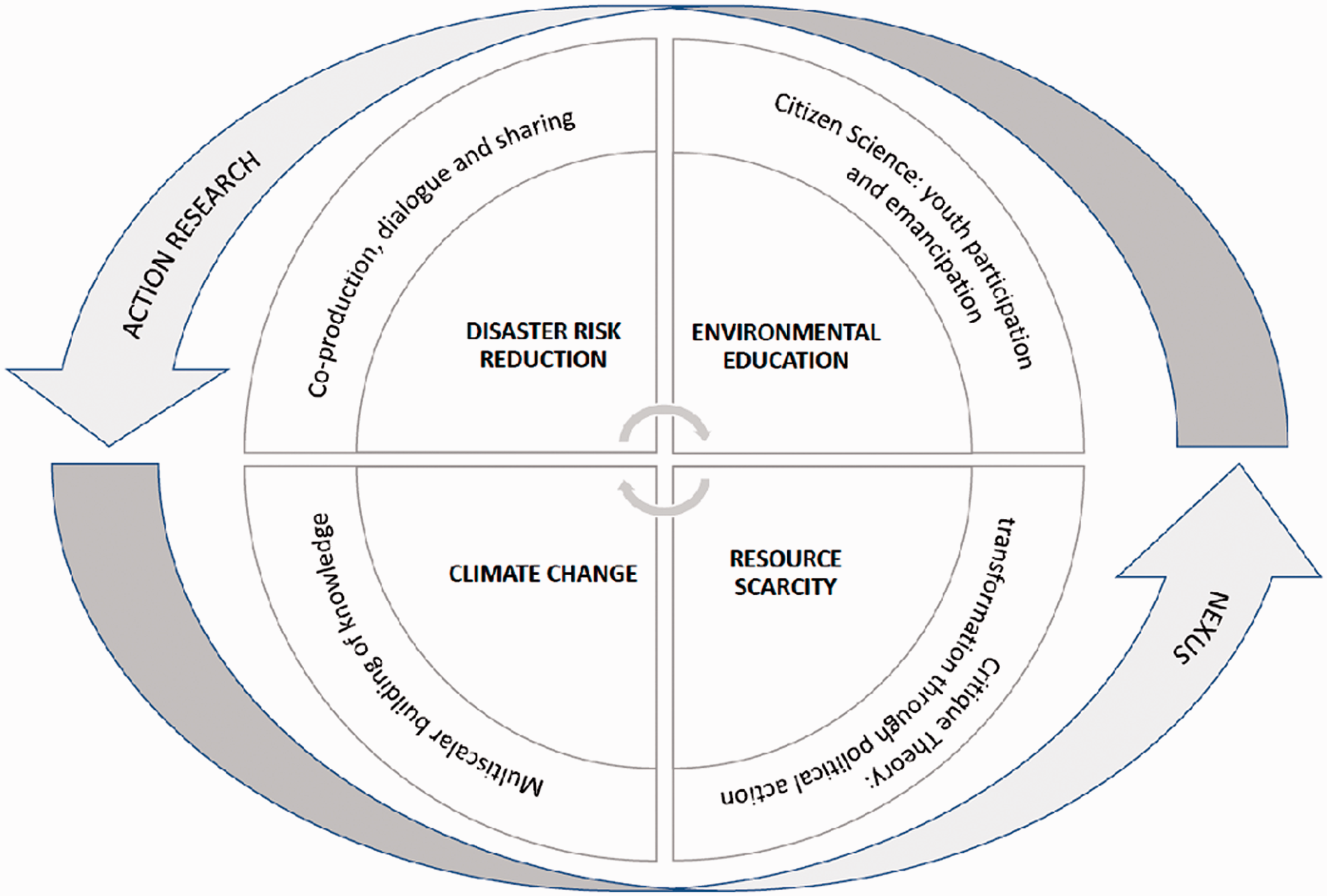
Looping methodology.
In the research accounts that follow, we engage specifically with the internal loops of Figure 1, by detailing the methods employed in the two projects and providing insights into the subjective knowledges and perspectives that were co-constructed between young people and those working with them. This leads into a discussion of how our emerging looping methodology may advance action research and contribute to urgently needed transformative change processes to the complex challenges linked to climate change.
Territory and context: The Paraíba do Sul watershed
The Paraíba do Sul river, which runs through São Paulo state, supports approximately 13 million inhabitants. The watershed produces 13% of Brazil’s gross domestic product (GDP), covers a drainage area close to 62100 km2, and supplies water – via a complex diversion and water transfer system – to nearly 8 million residents of the Rio de Janeiro metropolitan area, located outside the watershed (Kumler & Lemos, 2008). The profound spatial and temporal effects of land use change and water extraction (for agriculture and industry) in the region have led to much academic and political attention (Ovalle et al., 2013).
In 2010, several major floods were registered in the Paraíba do Sul watershed. Eighty percent of São Luiz do Paraitinga city (a cultural heritage site) was flooded, affecting 5,000 people. The town of Cunha was badly affected, with six dying in subsequent landslides (Marchezini et al., 2017). In subsequent years (2013–2015) rainfall reduced substantially and the region suffered the greatest drought in 55 years. The Paraibuna reservoir, the largest water body in the region, reached its lowest level in 2015 with only 1.09% of effective volume (Agência Nacional de Águas/National Water Agency [ANA], 2015). This reduced capacity impacted on the production of electricity at the Paraibuna hydroelectric plant.
Cemaden’s disaster risk reduction education
Disaster risk reduction is an important part of climate change adaptation and is urgently required to build resilience against extreme weather events, particularly in vulnerable countries (IPCC, 2014). However, in international frameworks, specific guidance on involving vulnerable groups – especially youth – is limited (Cumiskey et al., 2015; Marchezini et al., 2017; Mitchell, Haynes, Hall, Choong, & Oven, 2008).
Selby and Kagawa (2012) highlight the potential for schools to become centres for disaster risk reduction in vulnerable areas. Nevertheless, where disaster risk reduction is integrated into curricula, this is often in a unidirectional way that normalises scientific knowledge and forecloses dialogic processes (Marchezini et al., 2017). Where young people’s involvement in developing disaster risk reduction has been documented, reports showcase their valuable perspectives and ‘change the narrative’ from young people as victims to protagonists in climate change adaptation (Tanner, 2010).
The Cemaden Education project, launched in 2014, aimed to do just this, going beyond existing approaches to disaster risk reduction and climate change education in order to understand how young people can be better engaged in these actions. The project team conducted participatory action research to develop curriculum skills and research competencies and encouraged schools to become producers of knowledge rather than reproducers of centrally disseminated information. As a federal science institution, the aim of the Cemaden Education project is to scale up this work to reach vulnerable schools across the country, however, the process began with intensive work with two schools in São Luiz do Paraitinga and Cunha, small cities with a history of flooding and landslides in the Paraíba Valley, where Cemaden is based.
Between October 2014 and November 2017, the team facilitated the co-creation of a series of hands-on participatory learning activities in the two schools. The team advocated an ‘open methodology’ whereby each school was free to devise their own ways of implementing activities. All activities were underpinned by a participatory action research approach, designed to prompt local and external stakeholders to collectively reflect on disasters and the underlying problem of human induced climate changes. Through building critical knowledge and empowering community members, participants and researchers could develop transformational actions oriented towards engendering action–interventions (Kemmis et al., 2014). These ‘dialogue-oriented’ approaches are essential tools for community-led disaster risk reduction, encouraging an ethos of coping, self-protection and self-management, and providing the skills necessary for participation in adaptation strategies (Selby & Kagawa, 2012).
The participatory action research approach involved two dimensions related to the aims of the Cemaden Education project (for more details, see Marchezini et al., 2017; Trajber & Olivato, 2017):
The following analysis draws on the experience of one of two schools, Escola Estadual Paulo Virgínio, in Cunha. The school’s involvement in the participatory action research activities was facilitated by the enthusiasm of the pedagogical coordinator, Shirley Monteiro, who became a co-author for this paper. She included the whole high school in the project, looked for funds for field trips and organised seminars to discuss all the presentations. From the outset, young people were divided into four thematic research groups and teachers equipped students with methodological tools and organised field trips. Table 1 summarises the transdisciplinary activities that students’ research groups developed in collaboration with other community members, promoting intergenerational dialogue and action:
Summary of activities.
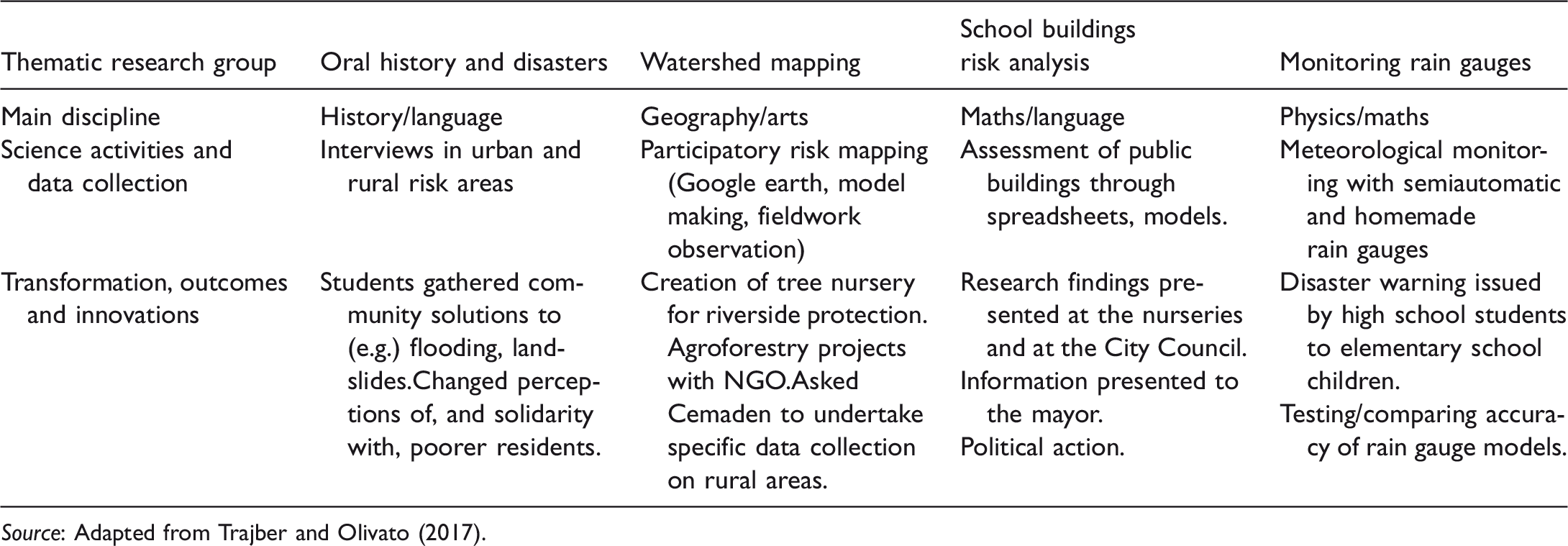
Source: Adapted from Trajber and Olivato (2017).
Among the outcomes of these activities was the development of a methodology for science initiation activities with high school teachers, students, the local community and other local stakeholders. The development of this methodology meant that disaster risk reduction activities ran for two subsequent years, involving more than 1,200 students (670 each academic year). Both academic years culminated in a seminar ‘Dialogues: citizenship in socioenvironmental disaster risk reduction’. At these seminars, students presented their research to teachers and interdisciplinary researchers from Cemaden. Students also participated in peer-to-peer dialogue between novice ‘student–researchers’, the school community and researchers from Cemaden. The process was based on the ‘dialogue-oriented’ learning approach and participatory action research outlined above, through which attitudes and values were challenged, tested and rethought through debate (Selby & Kagawa, 2012). Seminar outputs are publicly available at the Cemaden Education online platform (educacao.cemaden.gov.br/).
This approach showed how knowledge building can take place on the ground, promoting innovations, awareness and transformation. The groups dedicated to oral history interviewed residents in vulnerable areas impacted by floods and landslides. Crucially, dialogue with older residents about disasters due to changes in river structure and flow initiated a strong sense of solidarity amongst students, and encouraged them to consider urgent action for environmental, social and economic transformation.
Others, working in the watershed risk mapping, devised road map surveys and questioned residents about solutions to minimising risk, including the participation of the community in disaster risk reduction policies. One group was proud that the community praised this educational project. A further intervention initiated by the project was the psychological and financial support given by the students to a family prone to landslide disturbances who had to move out of their house during a period of heavy rainfall. The students, together with the pedagogical coordinator, organised a community and radio campaign to help the family through this traumatic event.
Students also helped to organise a series of events with local farmers – including a native seeds fair and agroforestry training workshops (supported by the NGO Serra Acima). Other students investigated the susceptibility of schools, nurseries and public buildings to diverse socio-environmental hazards, generating political discourse, action and transformations. One group observed and photographed several risky items at a newly built nursery that had been central to a local political campaign. They presented these findings to the nursery teachers and publicised them in the neighbourhood, arguing for community members not to vote for the political candidate who used the nursery as electoral propaganda. This direct political engagement led to the City Council of Cunha inviting students to present the work in a public hearing attended by the mayor.
Students demonstrated a capacity to integrate their existing knowledge with more recently acquired understandings on climate changes and disasters. Research activities led students to raise important questions that produced new research and further actions: what are the underlying causes of unsustainability that are generating vulnerability and producing disasters? What should change in order to be sustainable and prevent disasters?
The students, the pedagogical coordinator and teachers built a tree nursery in the school as a legacy of the project. The ongoing effects of this action research have also been witnessed recently through the actions of one graduate of Escola Estadual Paulo Virgínio. Now studying at a university in Campos do Jordão, a city also vulnerable to disasters, he convinced the Mayor to bring the Cemaden Education project to all the schools in the township.
(Re)Connect the Nexus
Policy interests in nexus approaches to resource management have surged in recent years, in tandem with concerns over the long-term sustainability of resources: most prominently food, water and energy (Hoff, 2011; United Nations Economic Council for Europe [UNECE], 2015). Although the grouping of food–water–energy is just one iteration of a nexus, it has become prominent in sustainability policy (including in Brazil) as these resources sustain life and interact to reduce or aggravate threats to human survival – hence the overlap with disaster risk reduction.
Nexus thinking has progressed largely through top–down recommendations for national governments and large industries (Leck et al., 2015). However, there is much to be learned from household and community contexts, where ‘the relationship between water, food and energy has often not become fragmented in the same way that experts have “siloed” the sectors’ (Allouche et al., 2015, p. 611). The RCTN project was designed in response to this research lacuna, and in addition sought to foreground the perspectives of young people, which are often overlooked in research (Kraftl et al., 2018). The project sought to understand how diverse young people in the Paraíba do Sul watershed and surrounding region engage with the nexus in embodied, everyday and, even, emotional senses.
The multi-method approach included in-depth interviews with 64 professionals from a range of disciplines and a large-scale survey of young people in the case study region (for details, see Kraftl et al., 2018). The research comprised three research strands: participant-led qualitative research with 54 10–24 year olds in the Paraíba do Sul watershed and surrounding region, a survey with over 4,000 10–24 year olds and key informant interviews with 64 individuals working in the food, water, energy or education sectors in our case region and beyond. We focus here, however, on in-depth, qualitative research with 44 young people. Most of these young people participated in a multistage process: (i) an interview about their everyday experiences of food/water/energy; (ii) use of a bespoke mobile/cell phone ‘app’ which enabled them to photograph and record notable interactions with food/water/energy and (iii) follow-up interviews where young people created a detailed ‘visual web’ based on the photographs and prompts from the app activity.
For the purposes of this paper, it is the visual web process and outputs that are most significant. The ‘data’ collected through this method constituted forms of co-learning and, especially, critical theorisations of the nexus that resonate with the enabling, horizontal approaches of action research (Bradbury Huang, 2010; Stevenson & Robottom, 2013). This was made possible through a process of participation where the young people were actively involved in: (i) co-analysing their own data produced through various research activities, particularly through use of an app, but also through the initial in-depth interview and a mapping exercise using Google My Maps aimed at locating participants’ mobilities and routines in relation to water, energy and food; (ii) reflecting back to own everyday food/water/energy experiences and knowledges, connecting and visualising them into meaningful networks made of connections, disconnections and gaps, enriched with their own views and suggestions for improvement; (iii) reflexively discussing with the researcher the visual web they had created, which ultimately led to (iv) extending bottom-up, multi-scale theorisations of nexus from young people’s perspectives.
It is evident from the three visual webs presented here that each output was unique. The process was enabling and creative as most young participants had never had the opportunity to reflect on their own experiences and feelings, as distinct from being asked to acquire/adapt to pre-existing environmental expertise (Huckle & Wals, 2015). Critically, rather than ask young people to simply tell researchers about how ‘the’ food–water–energy nexus looked from their perspective, researchers adopted an open, dialogical approach based on forms of nexus thinking. As seen in the examples below, rather than confining the discussion to particular elements of the nexus, young people used nexus thinking to demonstrate how a vast range of processes, people and material ‘stuff’ constituted their nexus – well beyond the apparently stable categories of ‘food’, ‘water’ and ‘energy’ and the usual terms of resource efficiency and ‘trade-offs’ deployed in previous work on ‘the’ nexus (Leck et al., 2015).
Isabelle’s visual web (Figure 2) is an example of these kinds of (dis)connections. Isabelle is an 18-year-old, middle-class University student from a small town in the Paraíba Valley (Guaratinguetá). Her visual web affords a sense of complexity and nuance. The web effortlessly leaps between and connects spatial scales and multiple social–political issues, as micro-scale images of particular meals are connected to wider socio-economic articulations of: ‘population’, ‘government’, ‘rich’ and ‘poor’. Indeed, it emerged from Isabelle’s narrative that her differentiations of ‘rich’ and ‘poor’ were both local and national.

Isabelle’s visual web (all names in the examples are pseudonyms).
In the context of working with young people – where the emphasis is often on local scales of knowledge and action (Ansell, 2009) – the ease with which participants connected different scales was noteworthy. A key feature of Isabelle’s web – and many others – was that these connections enabled a form of critical, politicised thinking.
Thiago’s visual web (Figure 3) is exemplary of young people’s heightened consciousness about the connectedness of (in this case environmental, political and fiscal) issues that are usually considered separately. Thiago is a 16-year-old boy from a lower middle-class family, who lives in Taubaté, a medium-sized town. We focus on the drawings on the top and middle right-hand side of the web, which relate to flooding hazards, solutions and responsibilities. Significant here is the juxtaposition of the two storyboards: the ‘blue’ one representing flooding and its associated risks, causes and actors; the ‘green’ one representing Brazil’s general problems, with a focus on food and energy issues related to various forms of political accountability. Visually, this juxtaposition suggests a correlation between food/water/energy issues and political responsibility, both at the local (‘prefeitura’ = city council) and corruption at the national (‘governo’ = government) level. The scale of the ‘problems’ here is represented by a map of Brazil with a thumb down and a sad, crying face next to the writing ‘Brasil’. This is a powerful narration, which suggests that, in young people’s minds, the issue is not with resource lack but the need for transparent and just governance, enhanced social justice and political responsibility.

Thiago’s visual web.
If Thiago’s visual web offers hints at the kinds of political action young people wished to see, then Mariana’s web (Figure 4) draws out the kinds of action and dispositions-to-act that could address inequitable access to resources. Mariana is 21, female, and whilst she now lives in Guaratinguetá, grew up in a more rural context. Resonating with the Cemaden case study, she emphasises the embeddedness of education (‘educaҫão’) – in this case within questions of access to resources, and especially food. Mariana was passionate about how education should be embedded in a social network of care, including the ‘FAMÍLIA’ (family), ‘#Comunidade’ (community – represented with the icon of a church), Bairro → Vizinhanҫa (neighbourhood → neighbourhood/vicinity – encompassing the physical environs and the connection/care among neighbours) in order to help with the provision of food (‘Ajuda com alimentos’ = help with food items). In this way Mariana emphasised that the responsibility for acquiring and implementing knowledges about the environment should not rest with individual young people, but is shared within families, communities and (as in Thiago’s web) politicians.

Mariana’s visual web.
Like many young people, Mariana used the visual web exercise to articulate forms of nexus-thinking that were characterised less by the language of resource efficiencies and more by shared emotions, dispositions and forms of practical action amongst families and communities. She pointed to actually existing ways in which they deal with nexus challenges, ways often overlooked in scholarship on the nexus. Moreover, she explained how the visual web exercise had made her think differently about these kinds of connections and to see the significance of care. As she commented during the discussion: It’s very nice this link of food, energy and water, because nothing is done alone. Water, you don’t have water on your own, you need other people, the work of other people. Food too, you can take care of this, but you can help others with this too; and energy is the same. (Translated from original Portuguese)
Discussion: Looping methodologies as a tool for transformative learning
In the previous section, we have presented two projects that operated in the same region in Brazil. Both projects enabled transformative learning and it is in thinking about these two projects together that we now step back to consider the value of a ‘looping’ action research methodology; a way of identifying and building upon the transfers of knowledge that were engendered in the individual research projects, and continuing the knowledge generation through dialogic learning across researchers working in different projects.
We have come to see the extent to which the knowledges co-constructed between researchers and participants in both projects lend support for young people’s perspectives to be included in transformative responses to the entanglements of climate change, disaster risk reduction and the food–water–energy nexus. We present three meta-analytic insights that show the value of looping between projects.
First, the two projects engendered forms of subjective knowledges about disaster risk reduction and the nexus that are often effaced in scholarship and policy making on climate change (Jasanoff, 2010). Moreover, both projects provided mechanisms through which such knowledges could be valued – whether through meteorological monitoring in schools, or through the value that young people themselves ascribed to their participation in the visual web exercise. In both projects, social justice, equality and political accountability came to the fore. Therefore, by reflecting on the emerging characteristics that appeared through dialogue and mutual learning, this paper has begun to explicate some of the hidden politics of traditional (and unsustainable) policy making around the food–water–energy (and-more) nexus (Allouche et al., 2015) and climate change adaptation (Klein, 2014).
Second, both projects make young people central to processes of knowledge generation. However, they move further than a simple elucidation of children’s ‘voice’ or ‘agency’ (Kraftl, 2013) to cohere around a commitment to forms of solidarity, care and community that cross-cut generations, scales and organisations. Whereas many approaches to environmental education emphasise the responsibility of youth for the planet’s future, young people were clear that, despite their generational positioning, they are not the only stakeholders and should not carry sole responsibility for disseminating and acting on knowledge. Young people, together with a range of adults, were central to the articulated narratives of environmental and climate justice.
Third, the two projects enable a comparison of where transformative political thinking and ‘action’ emerges in the course of research processes. Leading from what Horton and Kraftl (2009) term ‘implicit’ forms of action, this emerged in three senses: through consciousness raising about the connectedness not only of different scales (from the body to the globe) but issues that are generally ‘siloed’ in contemporary policy-making and educational spheres; by highlighting actually existing actions in which young people are embedded, and through which they broach nexus challenges; and by hinting – however tentatively – at dispositions-to-act prompted by the research process. One example of this can be seen through the politicised thinking that emerged through young people’s mapping activities in the RCTN project. A further political action was also witnessed in the Cemaden project in the students’ resistance (outlined above) to the local political campaign to build a nursery. Whilst it is impossible to know how many of the dispositions-to-act will result in concrete action, these examples show the transformative potential of the action research process, which is imperative in societies marked by injustices and inequalities, including Brazil.
These meta-analytic insights underpin our first contribution to this special issue, showing how young people’s (often overlooked) subjective knowledges can usefully inform responses to the complex and multi-scalar challenges of climate change, disaster risk reduction and resource security. However, it is important to note that, just as the complementary knowledges arising from the internal spheres of activity in what we have come to conceptualise as a ‘looping methodology’ supported the emergence of this methodology, the elaboration of meta-analytic insights and dispositions to action materialise the metaphor of looping, enabling it to become productive and not merely symbolic. This enables the second contribution to this special issue – the elaboration of how complementary methodologies can be ‘looped’ to generate meta-analytic insights and critical, action-oriented agendas that are greater than the sum of their original parts.
In the case of our projects, the looping methodology was emergent as the dialogue between projects enabled deeper understandings of the multi-scalar complexities and concerns articulated by young people. This has generated opportunities for members of the research teams to continue to work together, building on the achievements of the two projects. Recently, Rachel and Catherine have formed a partnership with the Manchester Environmental Education Network (MEEN) which will allow schools in Manchester, Paraíba Valley (São Paulo state) and Santarém (Pará state, Amazon region) to participate concurrently in social cartography activities that hold similarities with nexus thinking and young people’s constructions of visual webs. This is an example of how looping between different but complementary research activities can be built purposively into research. This kind of purposive looping design may be of use for other action researchers who are engaged in work on climate change in context, helping them to see that by looking across specific siloes or specific subject areas with particular methods, we visualise spaces for youth to engage, act, and be heard.
In closing the paper, we pose an urgent question that action (and other) researchers might seek to address through future research that employs a looping methodology to learn across or within contexts. How do we create the conditions for public educational policies – and educators – to become part of strategies for realising transformations for sustainability and resilience in the face of climate change, disaster risk reduction and resource insecurity? It is our contention that the approaches in this paper – as well as the knowledges co-produced with young people through intergenerational dialogues – offer some starting points for grappling with these wicked challenges.
Footnotes
Declaration of conflicting interests
The author(s) declared no potential conflicts of interest with respect to the research, authorship, and/or publication of this article.
Funding
The author(s) disclosed receipt of the following financial support for the research, authorship, and/or publication of this article: The (Re)Connect the Nexus project was funded by the UK Economic & Social Research Council (ESRC grant reference: ES/K00932X/1) and the São Paulo Research Foundation (FAPESP process 15/50226–0). Rachel Trajber and Débora Olivato acknowledge the Brazilian Council for Scientific and Technological Development (CNPq) for their research scholarships for the Cemaden Education project.