



Abstract
This paper documents a collaborative, multi-site participatory action research project in collaboration with children to act on climate change within local community settings. The project was an after-school program that combined hands-on climate change educational activities with photovoice, a participatory action research method that uses digital photography as the basis for problem identification, group dialogue, and social change action. Grounded in transformative sustainability learning theory and integrated with an arts-based participatory action research methodology, the program was designed to strengthen children’s climate change awareness and sense of agency through youth-led action projects. After describing the program, this article details the collaborative action projects designed and carried out by 10- to 12-year-olds in each community (e.g., policy advocacy, tree-planting, community garden) as well as how the program facilitated children’s constructive climate change engagement through children’s enjoyment and agentic action. The critical importance of participatory process and collaborative action in strengthening children’s sense of agency is discussed.
Climate change is often said to be the defining issue of our time (Dimitrov, 2010). Indeed, climate change threatens the stability of socioecological systems around the globe and requires unprecedented societal transformation now. The urgency of the issue is apparent when considering the latest Special Report by the Intergovernmental Panel on Climate Change (IPCC, 2018), which warns that by 2040 global atmospheric warming could exceed 1.5°C beyond preindustrial levels. Crossing this critical threshold is now associated with the changing climate’s most catastrophic social and environmental effects, meaning that the lives of today’s children will increasingly be marked by climate change disruption before they reach middle age. Evidently, climate change will exceedingly be the defining issue of their time.
In this light, empowering today’s children to understand and take action on climate change should be an important goal, both to support children’s agency and to promote present and future community resilience in the face of climate change impacts (Schreiner, Henriksen, & Hansen, 2005). However, children are often under-engaged in climate change dialogue and action and overlooked as agents of change within their families and communities. Despite the increasingly integrated and inclusive methods employed by social scientists in the climate arena, attending to children’s agentic capabilities, rather than their vulnerabilities, remains rare (Tanner & Seballos, 2012).
In the U.S., a number of critical barriers impede children’s active engagement with climate change. For example, climate change education in the formal classroom is often neglected, misrepresented, or underemphasized (Plutzer et al., 2016), and few opportunities exist for children to engage meaningfully in action related to their education (Jensen & Schnack, 2006). In a U.S. climate change context, this is due to interrelated and mutually reinforcing barriers—most notably, the controversial nature of climate change as a politicized issue, combined with the widespread perception of politics as an “adult-only” sphere (Wyness, Harrison, & Buchanan, 2004). In order to encourage children’s constructive climate change engagement, methods are needed that empower children’s agency and facilitate their active participation.
To date, few studies have examined children’s climate change engagement beyond the formal science classroom and among pre-teen youth, and far fewer have sought to facilitate children’s collaborative climate change action. This article is the first in a series of manuscripts dealing with what it would look like to invite children’s substantive engagement with climate change through action research methods that endeavor to empower their agency—and encourage their action—towards building a sustainable future. Specifically, this study documents an after-school program designed for 10- to 12-year-olds that combined transformative educational techniques with arts-based and participatory methodologies to simultaneously explore and expand children’s role as agents of sustainable change within their families and communities through youth-led projects.
Identifying avenues for children’s constructive climate change engagement
In the following sections, I introduce transformative, arts-based, and participatory approaches as potential avenues for facilitating children’s constructive climate change engagement. In doing so, I articulate key strengths of each approach and identify relevant methodologies for use with children.
Educational approaches: Towards transformation
By far the most extensive literature concerning children’s climate change engagement is the education literature, which centers on effective pedagogical strategies to strengthen student learning. If climate change appears in the curriculum, it is most commonly taught in the science classroom. It is here that children may learn about the existence—and perhaps urgency—of environmental problems, but very rarely are children given opportunities to act on this information (Jensen & Schnack, 2006). Consequently, children’s anxieties may be exacerbated by hearing about climate change threats without more constructive ways to engage (Chawla & Cushing, 2007).
To go beyond teaching climate change merely as a collection of scientific facts, alternative educational paradigms have arisen that move “from transmissive towards transformative learning” (Sterling, 2001, p. 11)—those which seek not only to prepare children for their futures but encourage their active citizenship today. These transformative frameworks (e.g., climate education for empowerment; education for sustainability) transcend the canonical view of “scientific literacy” and emphasize the social, ethical, and political dimensions of climate change, while encouraging diverse participation and social change action (Schreiner et al., 2005). For example, the “Head, Hands, and Heart” model of transformative sustainability learning urges simultaneous attention to children’s cognitive engagement (“Head”), affective enablement (“Heart”), and behavioral enactment (“Hands”) consistent with sustainability principles (Sipos, Battisti, & Grimm, 2008). Transformative sustainability pedagogy emphasizes collaborative, experiential, and action-based learning, for example, through local partnerships (e.g., with non-profits, farmers) and projects (e.g., community gardens; Burns, 2015; Sipos et al., 2008).
Arts-based methods: Facilitating meaning-making
Given its disproportionate consequences for those who have historically contributed the least to the problem (e.g., low-income families and countries; children), climate change is increasingly understood as an issue of social and intergenerational justice (Stapleton, 2018). Art has a long history as a means adopted by subordinated groups to raise awareness of social issues, resist and rewrite dominant cultural narratives, and facilitate critical group dialogue and social change action. Moreover, arts-based programming has been used as a medium through which to foster the civic participation of young people in their communities (Dewhurst, 2011).
Empirical studies of children’s climate change engagement through arts-based methodologies are limited. However, findings within this small literature suggest that engaging young people in creative, participatory processes (e.g., visual art; video production; performance) can serve to empower their agency to raise awareness of climate change with decision-makers and advocate change on behalf of their communities (Haynes & Tanner, 2015; Osnes, 2017; Rooney-Varga, Brisk, Adams, Shuldman, & Rath, 2014; Stratford & Low, 2013). Moreover, by encouraging meaning-making and self-expression around issues of identity, community, and place, art can offer a medium through which to identify place-based sustainable solutions meaningful to children and their local communities (Haynes & Tanner, 2015; Osnes, 2017).
An underemployed action research method with the potential to facilitate children’s constructive climate change engagement is photovoice. Photovoice is an arts-based and participatory methodology, which has been used in collaboration with community members towards addressing environmental problems (Keremane & McKay, 2011; Q. Wang, Coemans, Siegesmund, & Hannes, 2017). The main goals of photovoice methodology are to enable people to record and reflect upon community strengths and concerns, promote critical and reflexive group dialogue on important issues using photographs, and promote social change. As an arts-based methodology, photovoice is a creative process that allows participants to represent and enhance their community through images, storytelling, and advocacy (Q. Wang et al., 2017). As a participatory approach, photovoice “expands the forms of representation and the diversity of voices who help define, and improve, our social, political, and health realities” (C. C. Wang, Morrel-Samuels, Hutchison, Bell, & Pestronk, 2004, p. 911).
Action-based methods: Empowering agency
Research suggests that young people feel more hopeful about climate change when they know there are things that they can do personally to address the issue (Ojala, 2012), and the simple act of imagining preferable futures for their community can itself be an empowering experience for children (Hicks & Holden, 2007; Kelsey & Armstrong, 2012). Taking action on learned concepts, however, is key to cultivating agency in the context of climate change (Riemer, Lynes, & Hickman, 2014). Researchers have recommended supplementing classroom-based climate change education with action-based opportunities to mitigate students’ sense of paralysis and promote their empowerment (Chawla & Cushing, 2007). For children in particular, Ojala (2016) recommends place-based programming with an action component, “in which children engage with the community” to address a local issue (p. 216).
To facilitate children’s constructive climate change engagement, participatory methods stand out for their potential to empower agency (Hart, 1997). Participatory action research (PAR) brings researchers and participants together to collaboratively investigate a problematic situation in order to improve conditions (Brydon-Miller, 1997; Weinberg, Trott, & Sample-McMeeking, 2018). However, compared to adults and older youth, few—particularly U.S.—PAR-based studies have involved children as social actors, change agents, collaborators, or co-researchers (Langhout & Thomas, 2010). PAR with young people (yPAR) seeks to shift power relations and give children—as key stakeholders—voice and control over decisions that will ultimately impact them (Kohfeldt, Chhun, Grace, & Langhout, 2011). Using participatory methods can inspire children’s “democratic imaginations” while strengthening their agency through ownership of the process (Haynes & Tanner, 2015; Hayward, 2012). PAR has been characterized as a prefigurative methodology—or one that simultaneously enacts and advances the conditions of a more socially just and sustainable world—by disseminating “images of possibility” for an alternative way of organizing social life (Kagan & Burton, 2000, p. 73; Trott, 2016; Trott, Weinberg, & Sample-McMeeking, 2018).
Science, Camera, Action! Program overview
The present study integrated transformative, arts-based, and participatory methods in a 15-week after-school program, Science, Camera, Action! (SCA), which aimed to facilitate children’s constructive climate change engagement (see Figure 1). Program components were grounded in the “Head, Hands, and Heart” model for transformative sustainability learning (TSL), which emphasizes cognitive, affective, and behavioral engagement for “learning that facilitates personal experience for participants,” and “result[s] in profound changes in knowledge, skills and attitudes related to enhancing ecological, social and economic justice” (Sipos et al., 2008, p. 74). SCA combined climate change educational activities (Science or “Head”) with photovoice, an arts-based PAR method (Camera or “Heart”), to empower children as agents of sustainable change within their families and communities through youth-led action (Action or “Hands”).
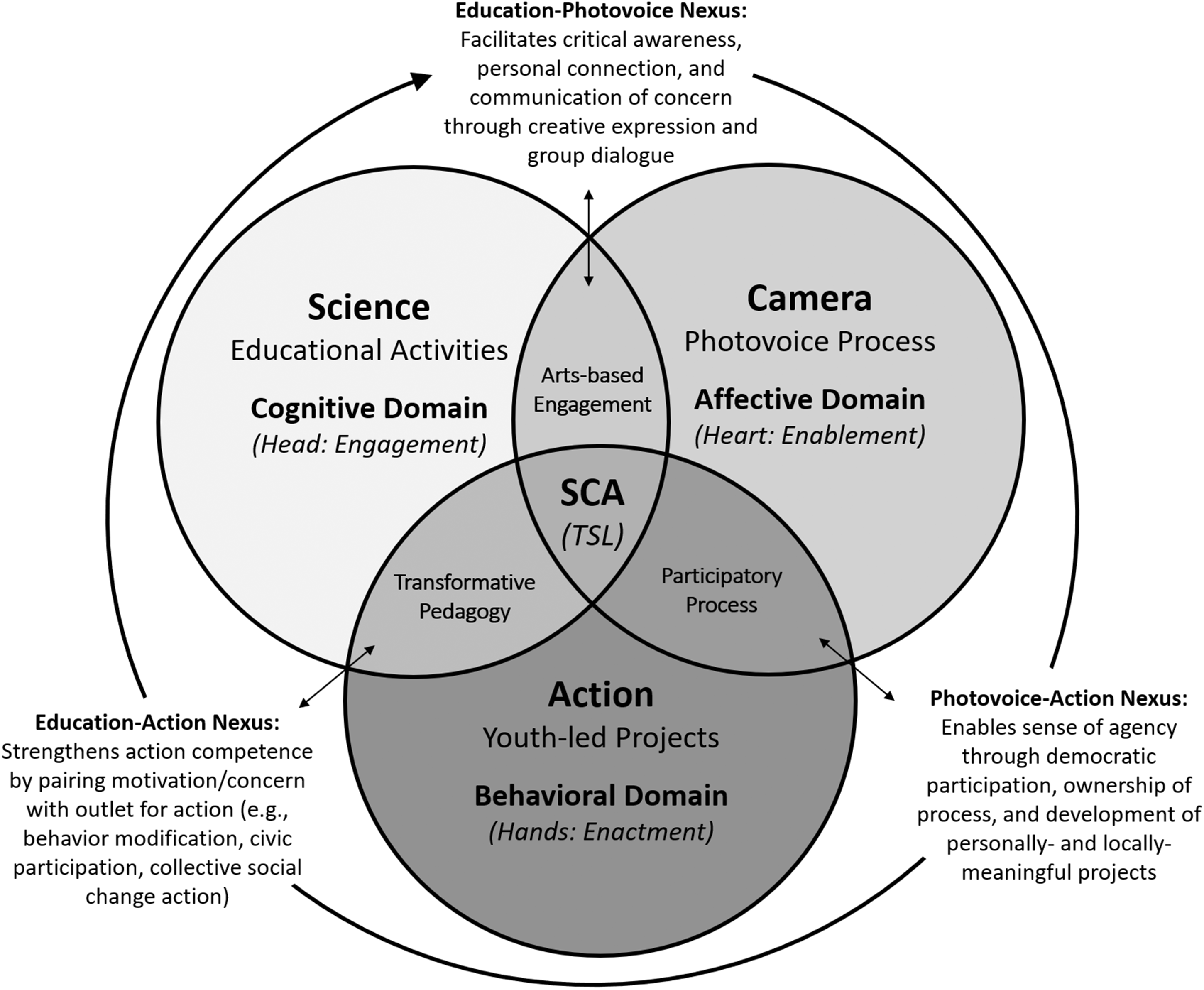
Towards facilitating children’s constructive climate change engagement, the primary components of the Science, Camera, Action! (SCA) program integrated transformative pedagogy with arts-based and participatory methodologies, grounded in the Head, Hands, and Heart Model for Transformative Sustainability Learning (TSL; Sipos et al., 2008).
Science: Educational activities
SCA’s educational activities emphasized the connections between climate change, local ecosystems, and sustainable actions within communities. Activities provided children opportunities to make personal and place-based connections to the issue while building a foundation for informed action through individual and collaborative projects. Rather than presenting climate change as a set of scientific facts, SCA’s educational programming—consisting of six hour-long, hands-on activities—introduced children to both the scientific and social dimensions of climate change, as grounded in local settings and personal experiences.
The first four activities (i.e., introducing ecosystems, climate vs. weather, and climate change) were problem-focused, while the final two activities (i.e., personal and collaborative action) were action-focused. Activities were freely available online and compiled for their alignment with program format (e.g., target age, length) and goals (e.g., children’s enjoyment, action). Weather-permitting, several activities took place outdoors, and some activities mirrored common children’s games (e.g., energy bingo; greenhouse gas tag) (Note: See Trott (2017) for full-text program activity descriptions). In the TSL framework, the Science component of SCA engaged the cognitive domain (i.e., “Head”) through interactive activities designed to enhance critical awareness through active and experiential learning.
Camera: Photovoice process
In SCA, photovoice methodology served to bridge educational program content with youth-led action through art (Q. Wang et al., 2017). Specifically, children were given digital cameras to capture and express their personal connections with program topics. During monthly photovoice discussions, participants, in small groups, told stories of their photographs’ content and meaning. Following photovoice sessions, children translated their collective commitments and visions into action plans.
As a PAR methodology, photovoice engages children as “experts in their own lives” who can explore and identify challenges and solutions related to complex problems in local settings. As such, photovoice was applied to advance children’s role as agents of change who can be active participants in political and civic life in their communities (Qvortrup, 2009). In the TSL framework, the Camera component of SCA engaged the affective domain (i.e., “Heart”) by encouraging children to make connections between program content and their everyday lives, simultaneously making abstract climate change concepts more concrete and personally relevant. Photovoice also encouraged children to express their hopes and concerns through creative expression and group dialogue.
Action: Youth-led projects
A central aim of SCA was to empower children’s sense of agency through youth-led action. SCA’s action component included: (1) the development of “family action plans” to promote small-scale, everyday sustainable behaviors (e.g., reducing energy use and waste) and (2) the design and implementation of “community action projects,” through which children were supported in realizing their visions for a collaborative project to advance sustainability in the wider community. In the TSL framework, SCA’s Action component promoted children’s active engagement (i.e., “Hands”) with learned concepts through everyday practices and innovative projects.
Methods
Community partner and research context
This collaborative, multi-site project was carried out in partnership with three Boys and Girls Clubs (BGC) in Northern Colorado. The BGC is one of the oldest and largest community-based youth development organizations in the U.S. (Boys and Girls Clubs of America, 2014). Most BGC members (60%) receive free or reduced-price school lunches, for which eligibility is based on federal poverty guidelines. The mission of the BGC is “to enable all young people, especially those who need us most, to reach their full potential as productive, caring, responsible citizens” (Boys and Girls Clubs of America, 2014). The present project aimed to contribute to the BGC mission by engaging its members in the SCA program. Recruitment took place through BGC site visits, and participation was voluntary. Parental consent and youth assent were obtained for all participants.
BGC partners were located in three municipalities in Northern Colorado. The pseudonyms Town, Suburb, and City are used in place of city names. Together, these sites comprised a regional division of the BGC, though individual localities varied in population size, economy, and political character—from rural, agricultural, and conservative (i.e., Town), to residential and moderate (i.e., Suburb), to urban, academic, and liberal (i.e., City). BGC units also fell along a spectrum of size, programming, and organizational culture—from a small, laid-back, and familial (i.e., Town), to large, coordinated, and formal (i.e., City and Suburb).
Participants and program implementation
Participants were 55 children (ages 10 to 12; M = 11.1), approximately half girls (52.7%) and boys. BGC group sizes varied, with 9 participants in Town, 19 in City, and 27 in Suburb. Participants were in grades four through seven and attended 18 different primary (61.8%) and middle schools (38.2%) in the region. Most participants were white (56.4%), followed by Hispanic/Latinx (25.4%), multi-ethnic (14.6%), and Asian/Pacific Islander (3.6%). Participants were more ethnically and racially diverse compared to the local region, which in 2015 was 83.2% white, 11.2% Hispanic/Latinx, and 5.6% other (including multiple ethnicities; U. S. Census Bureau, 2017). Most participants (61.8%) were eligible for free or reduced-price school lunches—slightly more than the BGC national average (Boys and Girls Clubs of America, 2014). For socio-demographic characteristics by research site, see Table 1.
Summary of socio-demographic characteristics, action projects, and key outcomes by research site.

aLow-income status indicated by receiving free or reduced-price school lunches, for which eligibility is based on federal poverty guidelines.
SCA was developed by the author and carried out alongside five undergraduate research assistants. The program took place after school for one hour weekly (per site) between January and May 2016, though the logged BGC volunteer hours, aggregated over the six-month period for the six-person research team, were much higher—totaling 345.7 hours. Participation in SCA varied from week to week, and the total number of participating children during a given week ranged from 30 to 48 (M = 40.5; 73.6%) of 55 participants. On average, participants attended between 11 and 12 (of 15) sessions (M = 11.3). Reasons for non-attendance included illness, doctor and dentist appointments, family plans (e.g., travel), custody arrangements, and competing activities (e.g., sports).
Data collection and analysis
The present analyses draw from 11 post-program focus group discussions—averaging 4–5 children each and lasting approximately 38 minutes—that explored: (1) Children’s views and experiences of the SCA program, and (2) Whether and how SCA affected how children felt about themselves, their capabilities, and their influence on others and the world. Focus group discussions followed a semi-structured format, and were audio-recorded, transcribed verbatim, and edited prior to analysis using NVivo 10 software. Thematic analysis was used to classify, organize, and describe children’s responses according to their shared thematic properties (Braun & Clarke, 2006).
Findings
Findings are organized by children’s reflections on each program component: (1) Educational activities, (2) photovoice process, and (3) youth-led action. Pseudonyms are used throughout.
Children’s reflections: Educational activities
According to the BGC Activities Director charged with overseeing all programmatic activities across the three Clubs, SCA was, by his estimation, the most popular non-sport program he had ever seen implemented. Children’s enthusiasm for the program was clearly observable on a weekly basis, and their resounding approval was further reflected in focus group discussions. When children were asked how they felt about SCA, many emphasized their enjoyment of program activities, which they said were simultaneously fun and informative. For example, 10-year-old Peyton said, “I enjoyed that we went outside and played games that actually taught us things.” Kids also appreciated the place-based nature of the program. As Cecelia, age 10, explained, “I liked learning about our community.” Both Gabe and Scarlett appreciated the interactive quality of the problem-focused activities, which they said helped them learn about environmental problems in a memorable way. I liked the games mostly, because they were really hands-on, and really helped you understand what’s going on with climate change and the ecosystem.—Gabe, age 12 I liked how things were taught—and how we learned about the environment and everything going on—because I thought it was a good, eye-opening way to realize it, especially for younger people, because then it’s more interactive and it’s a better way for it to stick in your memory.—Scarlett, age 12
Children’s reflections: Photovoice process
Following each educational activity, children were asked to photograph images conveying their views and feelings about program topics. This process yielded hundreds of digital photographs depicting, for example, children’s younger siblings and cousins (representing future generations in City) to cows grazing in a pasture (representing methane emissions in Town) to stunning ice formations on a chain-linked fence (representing shorter winters and barriers to climate action in Suburb).
In focus groups, several children recalled that the digital photography component of the program was what initially sparked their interest to participate. They joined the program excited to take photographs, then the program became much more—often transforming their views of the interconnectedness of science, nature, and society. When we were first coming here, I think it was going to be cool because of the pictures, and then we got into a new conversation of the planet, the plants, and how to save the world.—Dominic, age 10
Across research sites, children found photovoice a fun and engaging experience. Along with many others, “tak[ing] pictures of our perspectives of things” was 10-year-old Melanie’s favorite part of the program. During monthly photovoice sessions, kids were able to print a few of their favorite photographs using portable photo printers and were then asked to give each photograph a title and caption in preparation for discussion. Several kids said they enjoyed the exchange of ideas that took place during discussions. I like it because you could see what other people thought about the activities … and how people interacted … sharing what they thought about [climate change]. —Katherine, age 12 It was fun to listen to everyone’s ideas. It helped me make some of my own ideas. —Arie, age 10
Children’s reflections: Youth-led action
Family action plans
Halfway through SCA (Week 8), children estimated their carbon footprints using a 20-item inventory, which provided personalized feedback on how to reduce their environmental impact. Children were then encouraged to develop and implement “family action plans” to engage in—and promote—active climate change mitigation at the household level. Five weeks later (Week 13), participants again estimated their carbon footprints associated with their updated routines. During this five-week period, children assumed a leadership role within their families, sharing knowledge and promoting sustainable actions in the areas of energy and waste. Like 11-year-old Luke, children across research sites reported that modifying their everyday behaviors gave them greater confidence in their capabilities to have a positive impact. “I thought I was doing badly [with my carbon footprint] and that I needed … to recycle more and … that I eat too much meat or I waste too much water. The [family action plan] helped me find out that I can make a difference” (Luke, age 11).
Beyond gaining an improved sense of action competence, during this phase, children collectively saved from the atmosphere the carbon-emissions equivalent (CO2e) of approximately 2,500 miles of road travel (i.e., 1.1 metric tons CO2e).
Community action projects
In the final six weeks of SCA (Weeks 10 to 15), children were encouraged to translate their climate change awareness into collaborative action. After reflecting on themes derived from photovoice sessions, children at each research site formulated community-focused action projects specific to their interests and goals. The scope of each group’s project was chosen via a consensus process, and two of three groups pursued a combination of related project goals. For an overview of children’s collaborative action projects and key outcomes by research site, see Table 1.
Town: Policy advocacy and tree-planting campaign
The group in rural Town wrote and delivered a public speech—entitled “Climate Change: Operation Do Something!”—to local policymakers and community members during a city council meeting. After presenting on global to local impacts of climate change using images from photovoice, they requested permission to move forward with a tree-planting campaign in their community. Despite the politically conservative character of the region, children were given approval for their requests, recognition for their efforts, and a warm applause by the 60-member audience of parents, neighbors, and BGC staff. They later planted 12 trees, including two large Cottonwoods in a newly opened public park, which were to be honored with a personalized plaque from town administrators to commemorate their efforts.
During focus groups, the collaborative action project was viewed by many as the most influential aspect of the program. For 10-year-old Jimmy, the experience of presenting to local policymakers was seen as a rare opportunity. As he explained, “the presentation [at the town hall] … was smart and cool because I wouldn’t have been able to do that in any other group.” For some, the process of working collaboratively was enjoyable. Sydney, who took on a leadership role in drafting and delivering the presentation, said: “The program … it’s amazing. I don’t know, there’s something about it … Towards the end, [the action project was] so much fun—Getting together, creating projects, knowing each other, working together" (Sydney, age 12).
Others reflected on how the action project gave them greater confidence in their agentic capabilities. Ten-year-old Lexi added that “[the program] makes you feel like you can actually do something instead of ignoring the stuff around us.”
City: Photo gallery and program website
Children in City designed a website intended to inspire advocacy and action on climate change. The website features information about SCA, the problem of climate change, and how to “Get Involved.” Not far from City’s downtown art and music district, this group also held a photovoice gallery opening to unveil the website. The event was attended by more than one hundred visitors as part of a BGC-initiated, family-oriented, after-hours event to showcase children’s accomplishments. During the event, children discussed the content and meaning of their photographs with visitors while directing them to the website for more information.
For participants in City, making a difference in their community meant raising awareness about climate change and inspiring action by family and community members. Twelve-year-old Katherine explained that “the website’s helping [to inspire change] because people just can get on it, read about stuff we’ve done and try and make a difference.” To make sure it had an impact, Carlos, age 10, said, “I started to talk [about the website] to my friends, my teacher, and kids at my school.” By talking about climate change with family and community members, many City kids expressed greater confidence that their voices and actions mattered. As Tim explained: “[The program] helped me be more confident of what I can do… [I can] do stuff instead of just holding back and just standing there, not doing anything" (Tim, age 11).
Suburb: BGC community garden and summer garden club
Children in Suburb restored a disused garden and outdoor learning space on the property of their BGC unit. Growing plants was understood as a carbon sink, while eating local food was seen as a way to reduce “food miles” (i.e., emissions associated with the global food system). In the vacant lot, children turned the soil, spread compost, and planted more than one hundred fruit and vegetable plants. They also organized a garden club, inviting younger children to assist in tending the garden. By late summer, the large garden provided fresh local produce to the children, their families, and the BGC community. Using the garden harvest, older kids at the BGC taught younger kids about cooking and healthy eating. Inspired by their BGC garden, several participants reported initiating at-home gardens with their families.
Reflecting on their participation in SCA, many children in Suburb viewed the action project as the program’s most fun and influential component. For some, simply working in the garden was enjoyable. Maria, age 10, said, “I liked how I actually got to work on something,” while 11-year-old Jack said, “I enjoyed that we could go outside and play, dig, and do work out in the community.” Other children reflected on the participatory process, expressing that they enjoyed taking on responsibility during the garden project. Peyton, age 10, appreciated that SCA “actually let [kids] be like grown-ups in a way.” As she and others put it: I like [that] … the kids actually get to go help instead of the kids just being inside and doing things.—Peyton, age 10 My favorite was the action project, because we got to say our own opinion about what we wanted to do … Then, after we got done with that process, we got to actually do it and have fun with it.—Charlotte, age 10
Across research sites, participants expressed that action-taking helped them to feel a general sense of self-efficacy to accomplish goals in life, beyond environmental protection. Children’s collaborative action projects strengthened their sense of agency to have an impact on their communities and the world. Participants within and beyond Suburb expressed views similar to 10-year-old Arie, who said, “In the program, the action part was very exciting. It helped me realize that I could take action to help save the world.”
Discussion
By integrating transformative pedagogy with art-based and participatory methods to simultaneously explore and expand children’s role as agents of sustainable transformation, the present research responds to invitations—by interdisciplinary childhood studies scholars—to view children not as “human becomings” (i.e., future citizens), but as “human beings” (i.e., citizens of today) who can be critical actors in their communities (Qvortrup, 2009; Wyness et al., 2004). In this study, children enjoyed learning about and taking action on climate change, and left SCA with stronger beliefs that they could be agents of change in their families, communities, and the world. This study’s methods and findings add emphasis to calls to advance children’s participation in research and action to address climate change in local settings and lend insight into constructive methods for doing so.
Constructive engagement as children’s enjoyment
Throughout SCA, children maintained an overall positive outlook despite their increasing awareness of global climate change risks and harmful local impacts (Trott, 2017). As previous studies have documented, it is possible to strengthen children’s climate change awareness (and concern), while simultaneously preserving a sense of hope and optimism that “change is possible” (Ojala, 2012, 2016; Taber & Taylor, 2009, p. 110). Throughout SCA, children’s sustained sense of enthusiasm for the program seemed to coexist alongside their growing climate change awareness and motivation for action. Children’s improved knowledge and enduring positivity, in this study and in others, lend legitimacy to calls for increased climate change education with younger groups (Taber & Taylor, 2009).
In this study, a critical dimension of children’s constructive climate change engagement was children’s enjoyment of the program, which was fueled by a series of playful and creative activities (i.e., Science and Camera components) culminating in youth-led projects (i.e., Action component). To date, most emotion-focused research on children’s climate change engagement emphasizes avoiding the “worry factor” or facilitating constructive forms of coping (e.g., building hope), rather than advocating children’s active enjoyment (e.g., Ojala, 2012, 2016; Taber & Taylor, 2009, p. 110). In the TSL framework, “fun” is described as “equally important” to cognitive engagement for the process of learning (Sipos et al., 2008, p. 77); however, this criterion is not further developed. Findings from the present study lend support to the simple but critical notion that, in order to facilitate children’s constructive climate change engagement, activities must be enjoyable.
A key contributor to children's enjoyment of the SCA program — and which undergirds its transformative, arts-based, and participatory dimensions — was the interactive (i.e., hands-on, experiential, action-oriented) nature of program activities. Children enjoyed playing an active role throughout the program, rather than being passive recipients of knowledge or mere “implementers” of pre-determined forms of action. This finding echoes previous research emphasizing the empowering impact of learners’ active engagement (Jensen & Schnack, 2006; Kelsey & Armstrong, 2012). In this study, children’s enthusiasm for program activities made learning, connection, and action possible through their sustained participation (see Figure 2).
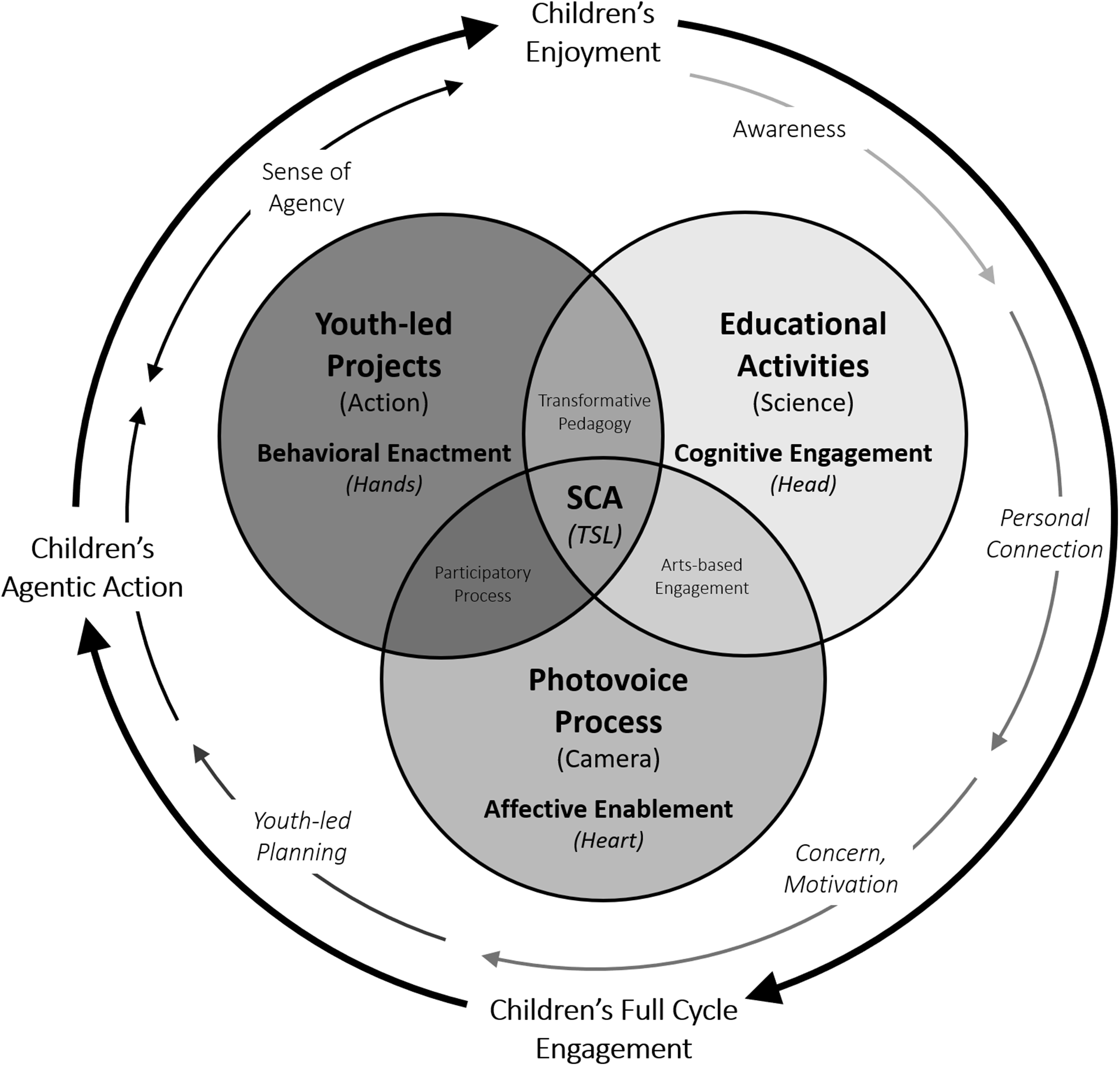
Conceptual model of children’s constructive climate change engagement through SCA. Critical dimensions include: (1) Children’s Enjoyment, which promoted children’s active participation and sustained engagement and (2) Children’s Agentic Action through youth-led projects in both household and community contexts, which served to strengthen children’s sense of agency.
Constructive engagement as agentic action
An additional indicator of children’s constructive climate change engagement was their enhanced sense of agency. In this study, sense of agency is conceptualized as children’s belief in their own capacity to take informed action on climate change through a sense of ownership of the issue (Marcel, 2003). In SCA, encouraging children to apply their climate change knowledge to ameliorative action gave them a sense of accomplishment and a stronger belief in their capabilities to remedy environmental problems through their own behaviors and decisions. In this way, children’s sense of agency is closely related to their perceived self-efficacy, or their belief in their own power to affect situations, complete tasks, or reach goals (Bandura, 1977). In SCA, children’s enhanced sense of agency had cognitive, affective, and behavioral dimensions. Specifically, children’s sense of agency was a confluence of hope, confidence, and motivation to affect change, and its source was children’s climate change awareness and action.
Despite the well-documented link between pro-environmental action and sense of agency, research and programming with young people has tended to focus on a limited range of potential actions (Kenis & Mathijs, 2012). Specifically, the behaviors advocated by most environmental education programs—and examined in most studies—are “highly individualized” and consist of “small things that young people can do in their everyday life, more or less in isolation” (Ojala, 2017, p. 80). This arises from the ways that schools and society have internalized neoliberal values, with a constant emphasis on competition, consumerism, and individualism (Hayward, 2012; Hicks, 2014).
Empowering children’s collaborative climate change action is critical because focusing exclusively on lifestyles and behavioral choices can serve to misrepresent the primary sources of climate change (i.e., as rooted in energy sources and infrastructure, which are in turn embedded within global economic and political systems that hinder transformation) and obscure accurate visions for alternative, sustainable futures, and what actions are necessary to realize them (i.e., structural, institutional, and policy change; Kenis & Mathijs, 2012). Moreover, collective engagement can promote children’s hope and well-being—by creating conditions that allow children to feel part of a collaborative effort rather than acting in isolation (Kelsey & Armstrong, 2012). SCA provided individual (i.e., household) and collaborative (i.e., community-focused) action opportunities as a means to provide children with multiple avenues towards expanded agency.
In this study, learning about climate change strengthened children’s motivation for action, and their participation in youth-led action projects empowered their sense of agency (see Figure 2). In this sense, a second critical dimension of children’s constructive climate change engagement was agentic action. In particular, children’s sense of agency was supported by the “adult-like” responsibilities undertaken during their collaborative action projects. These findings reflect those of previous studies concluding that action-taking on climate change is essential to building young people’s sense of agency (e.g., Riemer et al., 2014; Rooney-Varga et al., 2014).
Limitations and future directions
The present study is not without limitations. First, focus groups took place immediately following the program’s final week, which coincided with the height of children’s active engagement in collaborative projects. A question for future research is whether the children retained climate change knowledge, maintained a sense of agency, or sustained their active engagement in the months and years following the program. Investigating the long-term impacts of programs such as SCA is critical to understanding their transformative potential.
Additionally, the present analyses offer initial evidence that children acquired a deeper sense of agency and transformed views of science through their program participation. However, given the focus of the present article on methodologies for children’s constructive climate change engagement, and due to space limitations, it is not possible to delve deeper into how children made sense of their acquired agency or how children articulated their expanded perspectives on science. These are the subjects of forthcoming manuscripts in this series.
Conclusion
Towards identifying avenues for children’s constructive climate change engagement, this study integrated transformative pedagogy with arts-based and participatory methodology to empower children’s agency through personally relevant and locally meaningful action projects addressing climate change. Following the program, children had acquired new knowledge about climate change and its local impacts, which gave them a sense of ownership of the problem and its solutions. Most significantly, the children in this study genuinely enjoyed themselves and developed stronger beliefs in their agentic capabilities, while taking tangible steps towards the sustainable transformation of their communities.
Within the interdisciplinary climate change literature, children are most often characterized as potential victims of policy inaction and climate change impacts. Emphases on children’s psychosocial and health vulnerabilities tend to undermine a view of children as agents of change (Tanner & Seballos, 2012). As a result, children’s views are seldom considered in U.S. climate-related policies and programs. Rather, the protection of children’s present livelihoods and future well-being become the rhetoric of policy decisions made on their behalf.
With or without a coordinated global policy response to avert its catastrophic consequences, climate change is sure to reshape our world (Dimitrov, 2010). Without action, profound socioecological systems disruption threatens the well-being, even survival, of human populations around the globe (IPCC, 2018). To avoid grave consequences, nothing less than fundamental transformation in the functioning of human societies is now required. Children’s agentic participation is both a crucial feature of—and pathway towards—a sustainable future.
Footnotes
Acknowledgements
The author would like to thank the editors of this special issue, Dr. Laura Sample McMeeking and the STEM Center at Colorado State University, the Boys and Girls Clubs, and the research assistants who made this research possible: Anna Hoover, Christine Zirbel, Jade Croghan, Jimmy McCulloch, and Pauline Freud.We welcome and invite your comments and reactions at our action research community’s interactive ARJ blog housed at AR+ 
Declaration of conflicting interests
The author(s) declared no potential conflicts of interest with respect to the research, authorship, and/or publication of this article.
Funding
The author(s) disclosed receipt of the following financial support for the research, authorship, and/or publication of this article: This work was supported through small grants by the National Oceanic and Atmospheric Administration (NOAA); the Society for the Psychological Study of Social Issues (American Psychological Association [APA] Division 9); and the Society for Community Research and Action (APA Division 27).