



Abstract
This article explores how middle school youth view bilingualism and act on these views to transform their school and their communities. Following a post-structuralist perspective on language and society, a lens from raciolinguistic ideologies, and a creative justice approach, we developed a Participatory Action Research project in which seventh and eighth grade students became co-researchers as we explored how to make bilingualism more welcome in their school. In this paper, we reveal how bilingualism became a way to unite students and to fight deficit views of language minoritized communities. We show the students’ potential to engage in critical thinking about bilingualism and to become agents in their schools and communities. Our findings informed the school on how to acknowledge and leverage the students’ language practices and lived experiences based on a framework of armed and bilingual love.
Introduction
In educational contexts, language has frequently been regimented to exclude the linguistic practices of minoritized communities of color, racializing the children and stigmatizing their bilingualism and bidialectism (García & Otheguy, 2016). Such ideologies continue to reproduce deficit views of these communities. In most cases, languages and cultures of children and families of color are considered deficient and inferior to the norms of middle-class monolingual white Americans (Avineri et al., 2015). Nevertheless, children from minoritized communities have complex and dynamic linguistic repertoires that schools refuse to acknowledge (Otheguy et al., 2015, 2018). What children from minoritized communities do not have is power, thus their language practices are widely seen as inferior or non-existent.
In order to fight against these pernicious raciolinguistic ideologies, disrupt these power relations, and shift production of knowledge, scholars would have to adopt a decolonizing epistemology to conduct their investigations and work with minoritized youth. In this article, we explore how we engaged in a Participatory Action Research (PAR) to learn more about how youth at a middle school view bilingualism and act on these views to transform their own views and that of others in their middle school. Through our collective enactment of a PAR project, arts became a vehicle to transform how bilingualism and diverse language practices were viewed by the students themselves. In doing so, it also informed how the school was to act in order to acknowledge and leverage the students’ varied multilingual lives. In what follows, we first address our positions as scholars, activists, and educators. Next, we explore the theoretical framework which informs our work with the youth at the middle school. Then we discuss the importance of critical PAR as an epistemology for decolonization when working with minoritized youth. Further, we present the PAR project we developed at a middle school and discuss how it transformed the participants, their school, but also ourselves as scholars of multilingualism.
Our positionalities: Khanh Le and Lara Alonso
Although we are both scholars interested in multilingual education, our lived experiences differ greatly. Khanh Le is a Vietnamese American, a refugee who now specializes in the education of bilingual students and especially of Southeast Asian communities. Khanh grew up in South Philadelphia in a marginalized neighborhood that housed African Americans and Southeast Asian refugees. He has had previous experience with the arts and community engagement. As a youth activist, he used spoken word as a medium to speak out against injustices that happened in the Asian American community such as the privatization of the Philadelphia School District and the building of a stadium in Philadelphia’s Chinatown.
Lara Alonso grew up in Madrid where she studied anthropology and linguistics and moved to New York to work on critical sociolinguistics, specifically on the Latin American tradition of the politics of language known as glotopolítica (Del Valle, 2017). Soon, she started to identify with the US Latinx community and centered her research on the creation of a Latinx political subject and the defense and representation of their linguistic practices. As a researcher and an activist, Lara has previously used the arts for social purposes in different projects, among them, the realization of a documentary short film about the informal sellers in the subway of Mexico City, and the development of social photography diaries by youth at a shelter in Mexico.
Theoretical frameworks and our PAR project
For this project we relied first on an approach to sociolinguistics, multilingualism, and language education based on the critical post-structuralist approach to language and society posited by García et al. (2017), as well as on the work on raciolinguistic ideologies by Flores and Rosa (2015) and Rosa and Flores (2017). Second, because we framed our project as PAR, we draw from the theoretical positions of scholars whose work relies on a creative social justice approach (Rivera et al., 2018) and on theories of creativity and feeling (Greene, 1995; Million, 2009).
1. Critical post-structuralist approaches to language
Adopting a critical post-structuralist approach to language (García, Flores, et al., 2017) we distance ourselves from positivist modernist perspectives that see language as a monolithic entity connected to a certain territory and we defend more fluid and complex notions of languaging as a social action. We also incorporate post-structuralist framings of power (Foucault, 1978) in order to better understand the role of language in producing subject positions and to explore the relationship between language inequalities and other forms of social inequalities. Our approach to the study of multilingualism starts not from what nation-states and its schools define as language and bilingualism, but from the language practices of communities of speakers (García & Wei, 2014; Makoni & Pennycook, 2007). That is, our focus is to acknowledge and make visible the variety of language practices that exist among minoritized students and to work-out, with the students, how these might be represented and leveraged in an educational program.
We started our exploration with students as a result of their middle school administration’s concern that there was no bilingual education program in the school and that something had to change. Of course, we supported the middle school’s concern that a bilingual education program that would develop the students’ bilingualism was needed. But we wanted to explore whether indeed it was a “dual language” program (a two-way immersion program that in New York City requires balanced numbers of students labeled “English language learners” and English-dominant students) that needed to be put into place. In fact, dual language programs were being implemented in New York City—and in other places—in ways that favored White middle-class communities and that put aside the pursuit of equitable education for minoritized students (Flores & García, 2017; García, Menken, et al., 2018; Palmer et al., 2015). We wanted to design with the students an educational program that would leverage their linguistic and cultural practices and not just strive for white cultural and linguistic norms or focus on achieving white status (Flores & Rosa, 2015; Rosa & Flores, 2017).
That is, we went into the project understanding how raciolinguistic ideologies have worked to benefit white monolingual speakers. Raciolinguistic ideologies examine the co-construction of racial, ethnic, and linguistic categories and their interactions with minoritized communities. This involves looking carefully at how the language practices of minoritized communities are racialized, and changing the focus from the modification of linguistic behaviors of racialized populations to the dismantling of the white supremacy that permeates mainstream institutions (such as schools) (Rosa & Flores, 2017). With this, our contribution is dual-pronged: to the struggle against linguistic racialization—the sociocultural process through which race comes to be imagined, produced, and reified through language practices (Chun & Lo, 2016)—and to present an alternative in language education which acknowledges that racialized subjects’ linguistic practices are not evaluated based on their actual performance but are rather judged in relation to the racial position assigned to the speaker (Flores & Rosa, 2015). We committed to developing with the students an educational program that would work against these raciolinguistic ideologies by adopting a “culturally sustaining pedagogy” (CSP) (Paris & Alim, 2014). As CSP suggests, we wanted to honor, and at times problematize, community practices of youth of color, and to acknowledge that minoritized youth linguistic and cultural practices are not static, but dynamic and evolving. It was important for us then to center students’ knowledges, histories, feelings, lived experience, and voices—the focus of PAR.
2. The creative social justice approach
The critical PAR project that we document here takes on a “creative social justice approach” (Rivera et al., 2018) and shares a commitment to sociolinguistic justice (Bucholtz et al., 2016). On the one hand, this refers to a theoretical and methodological perspective that examines learning through the lenses of social justice, following the work of Gloria Anzaldúa (1987, 1990, 2002), Orlando Fals-Borda (1996), and Paulo Freire (1970, 1998). On the other, we rely on theories of creativity and feeling, following the work of Maxine Greene and Dian Million.
Regarding the social justice lens on education, we focus on Anzaldúa’s conceptualization of “nos-otras” as a mestiza-consciousness that recognizes that individuals have multiple and conflicting identities. “There is not a pure other; there is not a pure subject and not a pure object. We are implicated in each other’s lives” says Anzaldúa (1999, p. 243). Anzaldúa suggests that to theorize from the flesh, we involve ourselves and the students in reflection and action. On this matter, the Colombian sociologist Orlando Fals-Borda (1996) proposes the concept of “vivencia,” in which “the researcher shares his or her commitment with the peoples involved in transforming conflictive realities” (p. 81) and suggests that researchers must search the “silenced knowledges.” This transformation involves Freire’s (1970) concept of “conscientization,” through which educators guide students in the process of developing critical awareness of the conditions that lead to their oppression, expecting that this awareness would empower students to generate changes in their life conditions.
Concerning creativity and feeling, and in order to further the dialogue on decolonization of knowledge, our project takes into consideration two aspects frequently omitted from research: imagination and emotions. Maxine Greene’s (1995) pedagogy stance enabled us to release the youth’s imagination and creativity through self-reflection and critical thinking, placing their lived experiences at the center. In addition, we drew from Dian Million’s (2009) Felt Theory, which states that the lived experience of marginalized communities is rich and filled with pain, grief, and hope from pasts and futures. Million argues that these feelings are usually not acknowledged as an asset, but that they in truth are emotional knowledges and must be valued. For instance, Takaki (1998) has analyzed the case of Vietnamese refugees, who carried with them the trauma of living through wars and escaping Vietnam, the pain and grief of losing loved ones at sea, but also the hope for a better future. Their stories, memories, and voices are assets for marginalized communities because they are so powerful that they may shatter the world. They are dangerous to the oppressors because they speak truth to power and intervene in a constantly changing reality.
PAR: A decolonizing epistemology
A PAR approach “challenges traditionally hierarchical closed models of research and knowledge production through its commitment to participation” (Torre, 2009, p. 112). It seeks to include the participants and make them co-researchers and to think of a study object that can be addressed through a research collective. More than a methodology, “PAR is a philosophy about knowledge creation, a radical social movement, and a practice of collective questioning, looking, doing, being, knowing” (Rivera et al., 2018). The primary objective of PAR is not to do research on the participants, but with the participants. Hence, in PAR, researchers do not come in with a research question but collaborate with “local participants to define the research questions, describe their experiences in their own terms, and use the research results to effect change” (Chataway, 1997, p. 750). This allows for dialogical interactions between the participants and researchers, thus creating a more democratic experience regarding the methods, research question(s), and results of the project.
The PAR epistemic and methodological perspective we adopt here takes on a critical lens and draws on the following ideas of Fals-Borda and Rahman (1991), Martin-Baro (1994), and Freire (1998): To disrupt the hierarchy of the relationships between the researchers and participants, To empower marginalized groups to be knowledge producers, To help individuals develop an understanding of their plights and how to take actions to change them, To instill the knowledge of being action researchers (Chataway, 1997).
Additionally, this approach argues that PAR is not a research method, but an epistemological stance, which calls for research as a tool to liberate minoritized communities. PAR collectives “create new spaces whereby co-researchers enjoy new parts of themselves, and new forms of relationships with each other, experiences that often run counter to traditional social hierarchies” (Torre & Ayala, 2009, p. 389). In the next section, we will look at how we developed and implemented a PAR project with youth at the middle school.
Methodology transformed
The primary objective of our PAR project was to explore students’ perspectives in regards to bilingualism at a middle school. The school then planned to incorporate these findings in its design of a bilingual program that would respond to the students’ language practices and lived experiences. We decided not to follow the traditional social sciences quantitative or qualitative methodology in conducting this research project because we recognized that sometimes these research methods might be used as a tool to justify oppression and to reproduce oppressive ideologies of minoritized communities (Ayala et al., 2018). By not going the traditional route for this project, we also sought to empower the youth at the school, taking a position as activists in academia, incorporating a social justice lens, and working together in creative ways to disrupt the oppressive narratives that contribute to the marginalization of black and brown youth in the U.S.
Critical Participatory Research goes beyond grounded theory (Corbin & Strauss, 1990) in that the project takes shape in interaction among the entire research collaborative. Thus, although we guided the inquiry, and we presented our PAR stance, we became, through the process, equal participants in the research. This means that we participated in all the activities, discussions, and actions that took place during the process. For instance, we answered the same prompts the students answered, shared our personal history, and participated in the design and development of the actions that took place. Nevertheless, we privileged students’ ideas over ours and avoided imposing our thinking on them. Thus, we always centered students’ decisions and feedback.
The nature of the data collected, as well as its meaning, was also collaboratively arrived at by all the participants. However, even if the research was done in collaboration, we acknowledge the power relations that situated us as authoritative figures in the eyes of the students (who regarded us as adults connected to the school administration). We also recognize that our positions in academia allow us to write this article. We tried to take this into consideration when working with the participants as well as other ethical dimensions that are implicit when working with youth. 1
Conventional research often reports on quantitative data that consist of numbers or qualitative data that consist of words. However, it was very obvious to the entire research collaborative that for the youth, language was much more than words. Language was in the body and in their lived ecologies—in how the youth made meaning not only of words emitted, but also of signs and art, of gestures and actions, of dance and movement, of role play, and other types of artistic performances. Thus, the data that were gathered were richly multimodal.
The data that we present here thus come from students’ dialogical discussions and our field notes and observations, but also from their writing, their art, and especially the students’ final performance as they performed their multilingualism. Over the course of the 17 sessions we conducted during the fall of 2017, we collected not only students’ words, but also posters and chart papers in which students wrote messages often accompanied with art, 10 multilingual signs that they posted around the school, 20 pieces of students’ writings, and the recordings of the rehearsals for the final performance, as well as the final performance itself.
The analysis of the data that we present here was also collaboratively analyzed by the research collaborative. From the first session, students participated in coding the concerns they had about bilingualism in their school into themes and developing next steps. To do this, we started guiding the students in recognizing the topics that emerged from their comments. As the students further analyzed the school linguistic dynamics and linguistic landscapes, more ideas were identified along the sessions and the students also analyzed more critically the ones they had already suggested.
Designing the PAR project: Constructing a research question with a research collaborative
Our process began with a meeting with members from El Puente, a community-based organization for social justice founded in 1982 by Luis Garden Acosta and Frances Lucerna at the time when violence plagued the Southside community of Williamsburg, Brooklyn. The founders called on community activists, church leaders, and artists to stop the violence and crack epidemic that was unleashing in the neighborhood. A community-based arts program was developed to stop the violence that cost countless young lives in the neighborhood. In 1993, El Puente took up the challenge of founding a high school known as El Puente Academy for Peace and Justice, based on social justice education through the arts, science, and environmental actions. The school’s mission was to develop leadership skills for youth and their families through a holistic approach that centers on human rights. But although peace and justice worked within the walls of the high school, the El Puente collective wanted to take up the challenge of collaborating with a traditional public middle school that was across the street. This became possible in 2014, when El Puente and the middle school started a partnership through The New York City Community Schools Initiative, a measure which aimed to create Community Schools with high-quality academic instruction and where communities could share resources and address their common challenges. 2
We first got in contact with El Puente as part of a university project which aimed to collaborate with educational activist organizations. 3 El Puente was one of the organizations working in the collaboration project. Doing PAR means choosing to study an issue already highlighted by the community with whom the researcher will be working. In this sense, El Puente facilitators transmitted to us their desire to explore the issue of multilingualism in the middle school in order to design a new dual-language bilingual education program to implement the following academic year.
We first began our project with meetings with 10 students from Grades 7 to 8 at the school. Table 1 includes the characteristics of the students (all names are pseudonyms).
Students who participated in this PAR project.
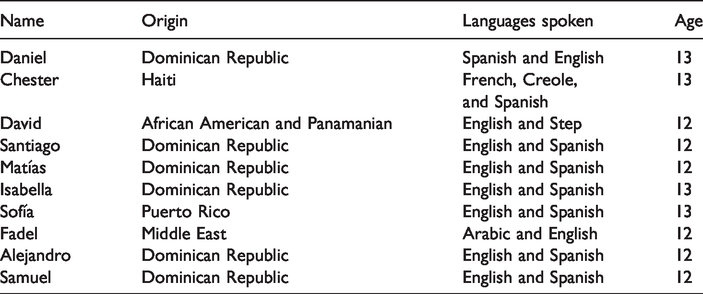
As the table shows, some of the students in what became our research collective were Latinx, and others were not, but all were brown or black. Some were considered bilingual, most in Spanish-English, and some were considered monolingual. This was an important asset of this research because it helped us to foster the idea that bilingualism matters to everybody, and not just to bilingual people. When we started, some of the students did not even know that a transitional bilingual class already existed in the middle school. However, all students were bilingual or knew friends who were bilingual, and wanted to have a bilingual program at the school, as one student said in the first meeting: “Why can’t there be a bilingual class for every grade in every school?”.
During our meetings the youth started opening up about their experiences with bilingualism in the school. They agreed that many bilingual students experienced bullying and marginalizing practices in the school: “Why do we speak English in front of people who don’t understand it, that’s bullying!”—said one student. “We need to focus a little more on bilinguals because they are the ones who get less learning time and less attention from teachers”—said another one. Each of them brought with them their rich experiences and talents into the team. Three youth were interested in music and could beatbox with their hands, rap and do step dance. One youth was very good at expressing himself with poetry. Others were good with visual arts and drawings.
We started by explaining to the students that we were going to develop a research study together in which the questions about bilingualism were to come from them. The objective would then be to answer the questions in action. Positioning students as producers rather than consumers of knowledge (Bucholtz et al., 2016), we established the understanding that each of us was bringing valuable (and necessary) knowledge and history to the “research table” (Torre, 2009, p. 109). We also explained that our aim was to directly engage them in the process of identifying problems and creating and implementing solutions to address the issue (Nieto et al., 2012, p. 9). Within this framework of identifying problems and creating and implementing solutions, we also wanted the group to collectively develop a critical and creative lens to address these problems.
We usually started our sessions with an icebreaker that served as a first step to relax and build confidence. After that first activity, we would start working on the project by giving prompts to students for them to discuss together and write about. These prompts were usually presented in a positive manner that encouraged students not only to critically reflect on the problems the school had concerning bilingualism, but also to think about the strengths that both the school and themselves already possessed. We encouraged students to use the power of imagination (Greene, 1995), imagining possibilities for multilingualism in the school. And we also encouraged them to unleash their feelings and emotions about language and multilingualism.
These sessions were conceived to promote the students’ conscientization (Freire, 1970) about their lived and linguistic practices in order to become critically aware of their condition as students with very diverse language practices. We also wanted them to reflect on the place that bilingualism had in their school. As Daniel said: “Aunque somos pocos bilingües en esta escuela, cada uno tenemos una historia, y nos ayudamos unos a los otros y yo veo el esfuerzo de cada bilingüe por aprender inglés” [Even if we are only a few bilinguals in the school, each of us has a story, and we help each other, and I see the effort in every bilingual to learn English]. When students delve into critical analysis of their own educational, social, and economic contexts, they begin to develop their critical consciousness (Cammarota, 2018). We believe that valid knowledge is produced only in collaboration and in action and those “studied” must be repositioned as subjects and architects of research.
As facilitators, we reflected on how to create spaces of collaboration, and we tried to guide the students while providing enough space—more to accompany than to lead (Bucholtz et al., 2016), so they could decide what to do (Cammarota, personal communication, 2017). Thus, the work of facilitators is “to make possible” (Rivera et al., 2018, p. 9). In order to create this space of collaboration, our research took seriously the idea of “mutual implication” (Torre, 2009), what Anzaldúa calls nos-otras (Anzaldúa, 1987), meaning that we accepted the “choques” that emerged during our collaborative research. There were different and sometimes contrary understandings about multilingual practices and their place in the school. For instance, at the beginning some students had only deficit views of the new arrivals’ English knowledge and the difficulties they encountered, whereas others focused on reclaiming a larger space for bilingualism in the school. We took these “choques” as enriching points of departure to think together and build consensus about what we wanted to accomplish. Following Fals-Borda’s (1996) concept of “vivencia,” we also participated in all the activities, sharing our experiences. An example of this was when Khanh read a poem he had written about his father when he was 16. This helped to create a space of confidence and trust.
After these sessions of exploration, dialogue, and collaboration, we suggested a more focused research question based on our previous discussions with the students: “How can we make bilingualism more celebrated at our school?”. However, the students were not convinced with the word celebrated, as they believed it was very far from the reality of what was happening in the school, so they decided to change it. Feeling empowered, the students came up with what became our research question: “How can we make bilingualism more welcome at our school?”. The students felt that bilingualism was not celebrated in the school, and that at any rate, they were not interested in just celebration. They suggested that “celebrated” be changed to “welcome.” In so doing, they wanted to open the door to the possibilities that their multilingualism would finally be acknowledged within the school, and hopefully leveraged in serious ways.
During the first few meetings the themes that emerged were language equity, bullying at their school, and identity development. From these themes, we then developed writing prompts that engaged students in critically reflecting on their lived reality. These prompts included: Describe one moment or experience when you felt proud of being able to communicate in a language. “I come from a place where…” Share a multilingual experience you had at the school.
One day the prompt was to reflect about a positive experience the students ever had communicating in any language.
Figure 1 presents Daniel's text, an eighth-grade student born in the Dominican Republic who had recently arrived to the US. He was a very bright youth who was still developing his English language repertoire. In the text, he talks about a debate that took place in NY in which he participated in Spanish and won, while representing his school. He explains how he felt prouder than ever of being bilingual.
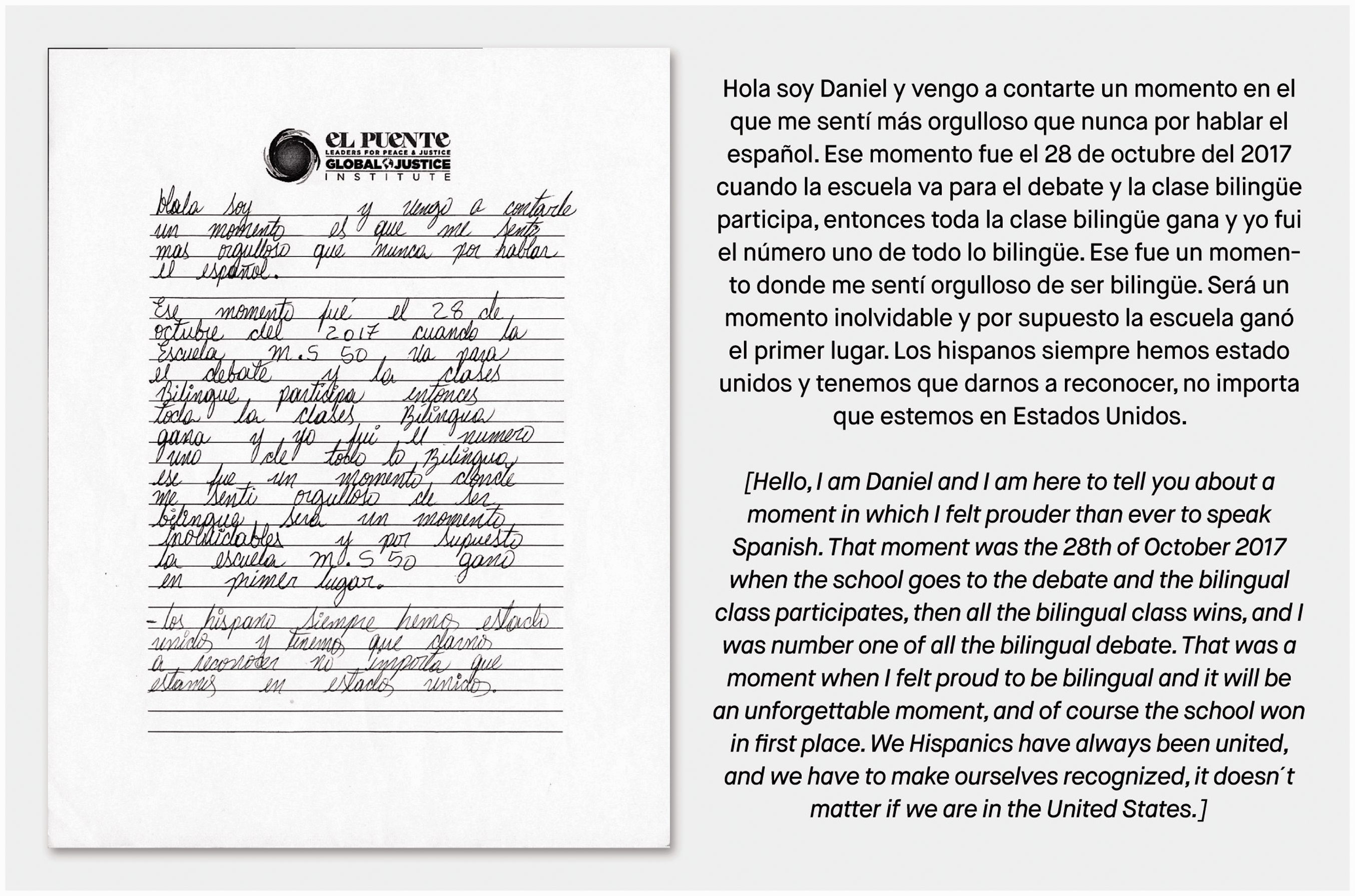
Daniel’s response to the prompt about a positive experience communicating in any language.
Figure 2 presents David’s text, an African-American eighth grader, in it he explains that he is proud to be in step class because it came from Africa. For him, step is much more than stomping and clapping the hands, it is a “language of dance” and “a form of communication,” and because he can do step he feels multilingual too.
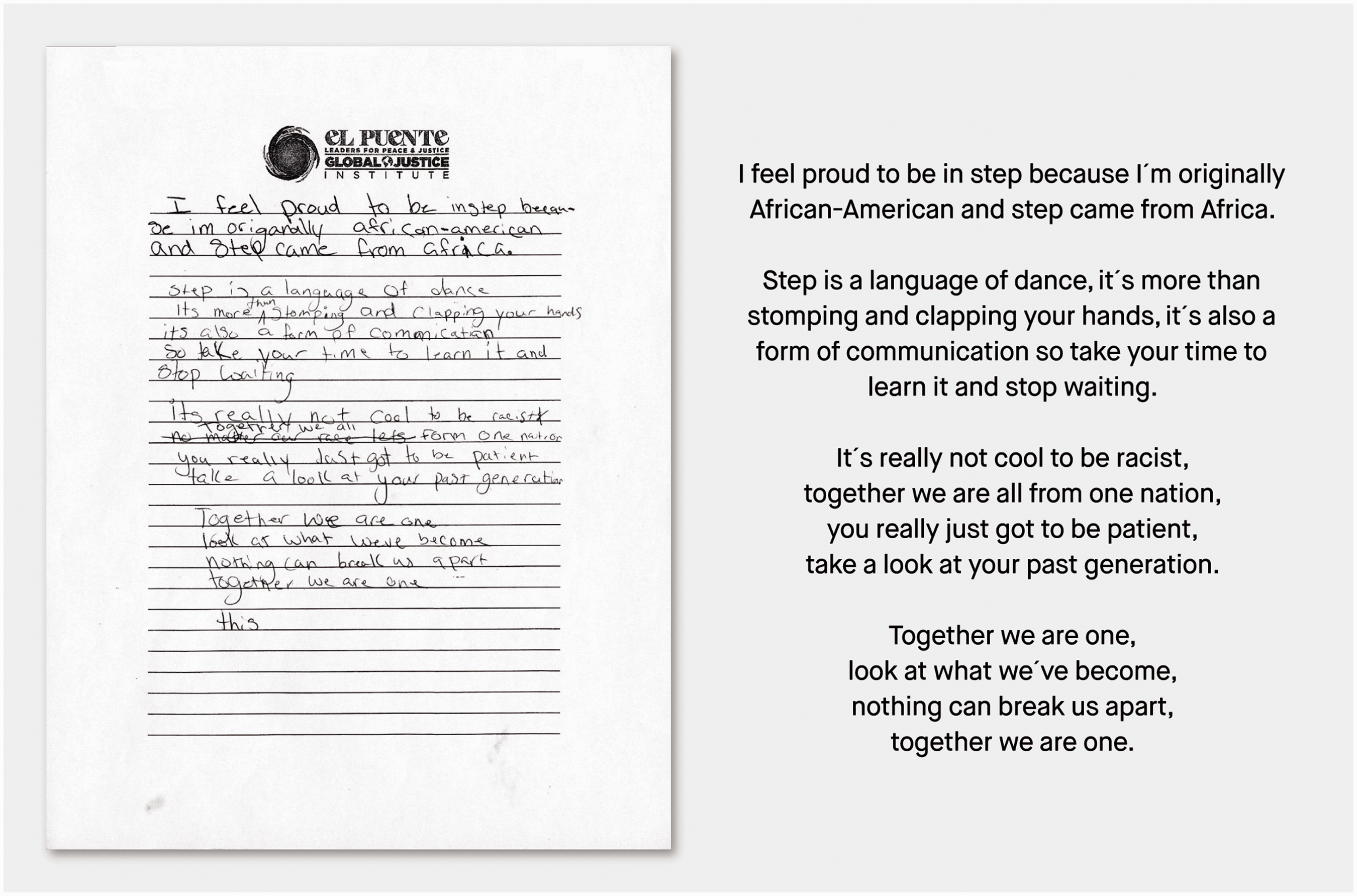
David’s response to the prompt about a positive experience communicating in any language.

Multilingual signs developed by the students and displayed in the school corridors.
The Language Warriors: Turning knowledge into action
In PAR, after the process of conscientization and the acquisition of intellectual resources, students “initiate revolutionary projects to transform themselves and the worlds which they inhabit” (Cammarota & Fine, 2008, p. 10). We called ourselves “The Language Warriors” and decided that our first collective action would be a performance about bilingualism at the school. This was suggested by Sofia, a 13-year-old girl from Brooklyn with Puerto Rican origins, who said: One of my nice experiences with being bilingual in the school is that having people focus more on bilingual students makes them feel accepted because this school speaks mainly English. So if we make something up like a production or show focusing on bilingual people it will make them a lot more interested.
The students’ choice of doing a performance fits in with El Puente’s long experience in using the transformative power of the arts, considering creative processes as an integral part of its pedagogical approach in both practice and theory (Rivera et al., 2018). The performance was carried out in front of the whole school. For the first part, the students introduced themselves: “Soy dominicano, de dónde vengo somos humildes y respetuosos” [I am Dominican, where I come from we are humble and respectful] said Daniel; “I am African American and Panamanian,” said David; and “I don’t come from a place where people disrespect each other. I come from a place where we can understand each other,” said Matías.
For the second part of the performance, the students developed spoken word pieces in which poetry became a way of generating data. Daniel wrote about the debate in which he participated in Spanish and won, and he described “el orgullo que yo llevo dentro al ver tantas personas debatiendo de un tema en mi idioma” [The pride that I carry inside seeing so many people discussing a topic in my language]. Fadel, a student from the Middle East, said in Arabic that he can speak Arabic, English, and a little bit of Spanish. Chester, a student born in Haiti, explained through poetry that he can communicate with a lot of different people because he speaks four languages. He expressed this through translanguaging, creatively using features that are part of his linguistic repertoire, but that socially are seen as different languages: My name is Chester, je parle kat lang: French, English, Creole and a little bit of Spanish; certain je suis happy to speak kat lang parce que I can make money and I can parler avec des persons, mwen pale French, Creole, English and Spanish and I can do translation. I made a song to show racism is wrong we have to all get along no matter what we are called we are from the same planet and not a different universe we respect all different languages because they are beautiful.
Findings and implications of the PAR project
The performance and poster project were an example of a transformative art project (Rivera et al., 2018) which used the research results to effect change (Chataway, 1997). In this sense, we understand transformation not necessarily as big changes in an entire community but as shifts in individual and group consciousness and practices which can lead to changes in norms, values, and hierarchies in a social context. After reflecting critically about the role multilingualism had in the school, doing research through linguistic landscape analysis, through critical linguistic awareness, and generating data through arts and analyzing it afterwards, the students tried to generate changes in the school by developing actions designed by them. As proposed by critical youth studies (Cammarota & Fine, 2008), this project showed that “young people have the capacity and agency to analyze their social context, to engage critical research collectively, and to challenge and resist the forces impeding their possibilities for liberation” (p. 4).
This project encouraged students who participated to develop critical multilingual awareness and to think about bilingualism, multiculturalism, and how these categories coexist in their school and their communities. We reflected together on the relationship between linguistic practices and identity, linguistic inequality, and language and education. The students’ perceptions about bilingualism in the school evolved during the months that this project lasted. Through our sessions, their understanding about language became deeper and opened up new possibilities for their school. After discovering through their research and critical thinking that bilingualism and bilingual people were sometimes erased and discriminated in the school, the students who were considered monolingual, as well as those considered bilingual, decided together that bilingualism should be a way to unite students. They also extended their understanding about language, perceiving it beyond linguistic codes and reflecting on music and dance as part of their linguistic repertoire. For example, David considered himself multilingual because of his ability to dance step music. And all students, including monolingual students, saw bilingualism as something that implicated them and that needed to be acknowledged and leveraged in the school. “I am a person that will make all bilingual people feel at home at our school,” said one of the students in one of our last meetings.
This experience also invited us to rethink theoretically about language and multilingualism. It challenged us to go further than traditional theories of language and language education and to imagine the possibilities of the students’ conceptions about language as something broader than simply standardized named languages. In many ways, the perspective of the students about their own multilingual and multimodal practices fits very well with the critical post-structuralist language lens in which we relied. Interestingly enough, hearing youth discuss their multilingual practices gave credence to theories about language and bilingualism that were presented by scholars as revolutionary and innovative as the lived experience of the students’ multilingual lives disrupted traditional assumptions about language and bilingualism. As researchers, we were humbled to discover that they viewed language as just an instrument with which to communicate and acquire knowledge, and that they viewed their language practices as dynamic and adaptive to the communicative and community context.
This project also showed us the importance of educational models that believe in the students’ potential to engage in critical thinking and to become decision-makers and agents in their schools and communities. On one occasion during the project, a school teacher who had been observing our session because he was working in the same space told us how surprised he was to see some of the “most difficult students of the school” participating and having such good ideas. We recognize the challenging working environment and insufficient living wages of teachers, with large size classrooms, pressure from administrators, and standardized testing. However, this project shows us how, under conditions of “armed love” (Freire, 1998), equity, and critical thinking, all students have something valuable to contribute.
“Armed love,” equity, and critical thinking are linked together and cannot be separated. “Armed love” is more than just providing minoritized youth with care and nurture; it is providing them with love that is based on liberatory education and affirming of one’s humanity (Bartolomé, 2008). Thus, when relations of equity, “armed love,” and respect are constructed, when practices are designed to share and work together in a context of trust, and when students are confronted with important issues that affect their school and community life, students tend to collaborate and have great ideas. This armed love is linked to the ideas of Mignolo (2000) about “bilingual love,” according to which, when students’ entire linguistic repertoire is considered and lovingly related, education can pay attention to what all students know, instead of focusing on simply developing command of linguistic norms and conventions that have been imposed by school bureaucrats and social elites.
Because the PAR performance was watched by the whole school and the multilingual signs were displayed around the school for months, we hypothesize that this project also had an effect in the other students of the school. By transmitting their ideas about bilingualism, the youth that participated in the project generated a topic of reflection for the rest of the students and helped to create a more open and respectful space for bilingualism in the school and thus to confront language discrimination in the students’ community (Alim, 2005). Because not all the students who participated were bilingual, this project also helped to raise awareness of bilingualism as a topic that should be important for all the students in the school (not only for bilingual youth).
Moreover, the students did the performance a second time, at The Futures Initiative’s Symposium, which took place in a public institution of higher education (The Graduate Center, CUNY) in an event attended by doctoral students, professors, provosts, and other public positions. On the one hand, doing the performance in front of stakeholders gave the students’ ideas the possibility to reach education public figures who might apply the students’ knowledge to future decisions, as well as professors and researchers, who might be interested in pursuing similar PAR projects. Besides, having this audience also encouraged the students to further believe in the value of their ideas as well as in their ability to do research and to propose changes.
This PAR project had an effect in the implementation of a dual language program in the middle school. We are confident that the project changed the educators’ perspectives on language and helped them to appreciate their students’ linguistic capabilities and practices (Bucholtz et al., 2016)—as in the example mentioned above of the surprised teacher after hearing the students’ ideas during one of our meetings. Instead of following bureaucratic requirements for implementation of a generic bilingual program, educators in the school decided to develop a dual language program that would include ALL students in the school, not just those who are “English language learners,” or those who want to learn “Spanish as a second language.” The students and their communities are now in the driver’s seat with respect as to how a multilingual education program ought to be implemented.
For us as researchers, this experience changed us too, making us question traditional research methodologies and furthering our understanding about power dynamics in research. Through this process, we learned that the participants in a research study should not only be heard but should also be considered part of the research itself, collaborating with their ideas as co-creators of the final project. Working this way gave us the opportunity to learn from each other and to learn to be patient and open to messiness and change of plans. We also learned that the youth have the ability to reflect on their community problems and to design actions to try to improve their own situation as a group. The students showed us that their notions about language and ours as critical sociolinguistics and applied linguists might be closer than what we thought. In turn, students guided us in the process of further opening our conceptions of language and of its role in a community.
Conclusion
This PAR project has changed us and the students who were involved in it. All of us feel proud of who we are as immigrants, women, bilinguals, refugees. One of the students declared in the introduction of her performance: “I’m so proud to call myself a Latina.” Thus, this project has instilled a sense of pride in us that was not visible before. Also, the PAR project debunked some of the stereotypes and ideologies surrounding minoritized youth, showing that they are critical thinkers and leaders willing to challenge the status quos and norms.
The epistemological stance of PAR allowed us to challenge hierarchical modes of knowledge production through its commitment to participation (Torre, 2009). Including community participants in the research process of collective questioning, researchers also become activists in academia, asking themselves about the purpose of the knowledge they produce (Fals-Borda, 1996). The production of knowledge is not only a socio-political process (Torre, 2009, p. 117), but, as Anzaldúa suggests, it has the power to subvert social conditions, because “if we have been disempowered by theories, we can also be empowered by them” (Anzaldúa, 1990, p. xxvi).
Through the potential of arts and critical thinking, we followed together a creative justice approach that allowed us to carry out action after a process of collective inquiry. In a continuous renewed process of doing, defining what we were doing, and thinking about it, we developed and answered in action a research question designed by the youth, the answer of which aimed to generate changes in their school.
Our study gave us some answers about the students’ and their families’ bilingualism and how to welcome it and leverage it in schools. We tried to reimagine and reorganize principles and pedagogies in educational spaces. But we were left with many why questions: Why is it that opening up a space for the bilingualism of students in schools necessitates action? Why is it so difficult to get schools to leverage what bilingual children bring? Why do so many educators see the children’s bilingualism as a problem, and not as their strength?
We realize that many of the answers to these questions have to do with the ways in which schools have been structured to benefit white monolingual middle-class children and the racialization processes to which many poor bilingual children have been subjected. And yet, our study has made us realize how the arts and aesthetics can give students not only a voice, but also a way of re-existing as dignified bilinguals. The creative process in which we engaged the students opened up for them, for their parents, and for the educators in the school a space to be themselves, to recognize their potential and their bilingualism as a strength. For us the essential question would be: How can we incorporate arts into the classroom in ways that validate and leverage students’ entire linguistic repertoires? What would educators see in their racialized bilingual students through arts performances that they cannot appreciate through scores in standardized tests?
Through PAR and the students’ arts performances we as researchers, as well as the school community, were able to view and theorize bilingual practices differently. And as Anzaldúa (1990) has said, imagine theories of language and education that can empower minoritized bilingual students. We hope this project will inspire researchers, community activists, and educators to take up PAR to disrupt the harmful theories that are being produced by academics surrounding minoritized communities. We also wish that educators interested in replicating this PAR project in their respective school’s contexts are able to find tools and resources in this article that they can adapt to their school’s own pedagogical, political, and logistical circumstances.
The youth in this PAR study found spaces to see themselves as bilinguals with strengths, as they reflected about language, identity, and power. And they generated actions through the arts that made their bilingualism visible to the school community. By co-creating knowledge and empowering the community, this PAR project opened up a small space to transform the youth and their school.
Footnotes
Acknowledgement
We are very grateful to Ofelia García, for her guidance during the project and for her comments on the draft version of this paper. We also wish to thank Maryann Polesinelli, Eugenia Sergeeva, and Clara Parker for undertaking this project with us; Fiorella Guevara and the staff from El Puente for their helpful assistance and their collaboration; and the reviewers for their rich suggestions. Finally, and very especially, we thank Daniel, David, Sofía, Chester, Fadel, and the rest of the students who went with us on this journey of resistance, armed love, and multilingual action. We welcome and invite your comments and reactions at our action research community’s interactive ARJ blog housed at AR+  .
.
Declaration of conflicting interests
The author(s) declared no potential conflicts of interest with respect to the research, authorship, and/or publication of this article.
Funding
The author(s) received no financial support for the research, authorship, and/or publication of this article.