



Abstract
In this paper, we present insights about the process and outcomes of an initiative designed to engage municipal staff with Black and Indigenous community members to develop a decolonial framework for community engagement within a mid-sized municipality in Southern Ontario, Canada. Grounded in the framework of Etuaptmumk (Two-Eyed Seeing) the project aimed to disrupt dominant Western mental models, envision improved power-sharing in municipal urban planning and decision-making, and start the process of decolonization instead of the dominant municipal engagement practices. A first workshop was conducted by an Indigenous Elder who shared their wisdom about Etuaptmumk. A second workshop invited the participants to apply that approach to the local municipal context and discuss its implication for a decolonial municipal engagement framework. The mixed-racial, mixed-disciplinary research team kept reflective notes throughout the process. The researchers used the powercube by Gaventa to analyse the power dynamics that affected the project negatively. Power dynamics included lack of visible power to influence major decisions, a shift from claimed spaces to invited spaces, hidden power in shaping the agenda, the use of invisible power in shaping the narrative, and a lack of readiness of the municipal leadership to engage meaningfully.
Introduction
Municipalities and other local authorities in North America are stakeholders that function as settlers on Indigenous land. Colonial forms of knowledge are part of the underlying mental models, ideologies, and worldviews that shape municipal planning and decision-making (Dobai & Riemer, 2024; Gillis, 2023). As a result, municipalities’ organizational structures and processes are limited regarding their relational governance and decision-making approaches (Posselt et al., 2022). This presents barriers to equitable and inclusive engagement with Indigenous and Black Peoples. A review of the research revealed a lack of consideration of decolonization and settler colonial relations with marginalized and racialized peoples in the organizational structures of municipalities (Barry & Agyeman, 2020; Hildebrand, 2012; Porter et al., 2017). Barriers to collaboration and co-creation with Indigenous and Black groups are partly due to knowledge gaps about options for decolonization processes and engagement at the organizational level of municipal planning (Porter et al., 2017). This paper shares our team’s efforts to address these municipal planning and engagement knowledge gaps by attempting to change the colonial worldview that informs Indigenous and Black communities’ relationship with municipal government.
“Decolonizing and Transforming the Engagement of Indigenous and Black Peoples within Municipal Planning” was a funded exploratory knowledge exchange project designed to improve municipal planning community engagement through a multiple stakeholders (academics, municipal actors, Indigenous and Black community organizations, and innovation actors) process. Using a mid-sized municipality in South-Western Ontario, Canada (“the City”), the project had two main aims. The first was to disrupt dominant Western mental models and envision improved power-sharing in municipal urban planning and decision-making. The underrepresentation and lack of meaningful engagement of Indigenous and Black Peoples in municipal planning have been identified as barriers to community-wide collaboration and co-creation in planning practices (Champagne, 2020; Russo & Pattison, 2016). As a means and a goal, co-creation is a facilitated process of engaging multiple stakeholders based on shared objectives, power-sharing and valuing of stakeholder experiences, and assessment to create new practices (Gouillart & Hallett, 2015).
Second, the project sought to start the process of decolonization in place of the dominant municipal engagement practices. Decolonization, as envisioned, is part of broader systems change and is key to introducing new knowledge and innovations into municipalities’ organizational structures and practices (Cole & Low, 2023).
Consistent with an action research approach, we employed an iterative process of valuing collaboration and co-creation with Indigenous and Black communities while working toward transformative change (Carr & Kemmis, 1986). As academic leads, reflexivity was core to the project. We continuously examined our roles with the communities, the municipality, and the project goals (Cameron et al., 2000). This paper is an outcome of our critical role as researchers with community ties in the process of social change and decolonization.
When we started this project, we had hoped that in the end, we would share a success story of developing an innovative way of engaging with Indigenous and Black Peoples in municipal planning grounded in principles of decoloniality and the Indigenous concept of two-eyed seeing, which we outline below. What we are sharing here instead is an experience of failure, a cautionary tale, despite the application of best practices. Innovation, however, requires testing with new approaches and ideas, and experimentation, which implies the potential for failed attempts (Cole & Hagen, 2024). The key to the innovation process is to critically reflect upon and learn from those failures. This article shares our critical reflection, lessons learned, and efforts to apply an action research approach to change municipal government engagement practices. For this analysis, we draw on the powercube framework developed by John Gaventa and colleagues (Gaventa, 2011).
The Project Team: Decolonization and Action Research
We are academics, social innovators, and community members committed to social justice and reconciliation. Our team reflects the diversity of groups we are attempting to engage. The project approach and our critical reflection on the project’s shortcomings are tied to who we are as individuals, our identities, and our collective team experience. Our approach to decision-making and co-creation between the academic leads and others in the team was also oriented toward questioning dominant colonial models of how scholarly research is usually conducted, such as the assumed researcher objectivity and the extractive nature of research (Tuck & Yang, 2014). Instead, collectively, the project team members shared commitments to decolonization, social change and action-oriented research in part because of team efforts to value team members’ community connections.
Being reflexive (Cameron et al., 2000) was a significant strategy that informed our critical approach to our own experiences, our relationships with our respective communities, and the overall goal to co-create a better relationship between communities and municipal government actors. In addition to considering our own positionality and identities, as project leads working with communities and the City, we used reflexivity as a way to value our subjectivity, beliefs and judgements as part of the research process (Ho & Limpaecher, 2022; Olmos-Vega et al., 2023). This included questioning our own assumptions tied to our own histories of Indigeneity or racism in relationship to state actors. Reflexivity was a strength for generating new knowledge and building community relationships (Ho & Limpaecher, 2022).
As a collaborative process, the emphasis was on generating new knowledge and taking action. The different identities of Indigenous, Black, and white team members were acknowledged, respected, and informed how we originally envisioned the project, implemented various iterations of the project plan, and finally, our reflections on the failings of the project’s outcomes. Our approach valued the Indigenous and Black communities’ strengths, shifting away from a dominant needs-based approach to viewing communities (Caiels et al., 2021). Communities were valued for their resiliency and capacity to develop and be sustainable at individual and community levels.
CT is a Professor of Sociology and an expert in racialization, anti-Black racism, community-based research and environmental justice/energy justice. This project was significant to CT as she shared the first-hand experiences of structural barriers and the systemic consequences of anti-Black racism that African and Caribbean community members in this city encountered. An intersectional understanding of racialization is central to her work appreciating how processes such as race, class, gender, sexual orientation, and country of origin create differential experiences of blackness by municipal governments and within the Black community, itself. CT is a racialized settler committed to social change with Indigenous peoples in Canada.
MS is an Associate Professor of Geography and Environmental Studies and a member of the Huron-Wendat First Nation. His research focuses on Indigenous land-based knowledges and environmental stewardship, with projects in regions such as the Yucatán (Mexico), the Northwest Territories (Canada), and Sápmi (Finland). He is committed to fostering meaningful intercultural dialogue and collaboration through research approaches rooted in Indigenous values of respect, relationality, and responsibility. Since relocating to this city for a tenure-track position, he has sought to meaningfully engage with local Indigenous advocacy organizations and groups. Prior to this project, he co-led an initiative focused on Indigenizing municipal park planning. His motivation for this project stemmed from a desire to support local Indigenous organizations and activists working to challenge colonial municipal planning systems and to apply his research commitments to the place where he now lives and works. His scholarship emphasizes the importance of learning to ‘be part of the land’ (see Sioui, 2021).
MR is a Professor of Community Psychology and Sustainability Science and the Director of the Viessmann Centre for Engagement and Research in Sustainability (VERiS). His research focuses on cultures of sustainability, youth climate activism, and climate/sustainability justice. As a white settler co-lead on this project he leveraged his pre-existing working relationship with this municipality. MR took on to be the main liaison to the municipality in this project together with another non-academic team member. Even though his preference is to work with grassroots groups, he believes that it is important to work with both the grassroots and the leadership based on what he has learned about the history of successful social movements. MR works with communities on social, environmental, and climate justice, believing that his privileges make him responsibility to fight unjust systems. This project emerged from his municipal climate action partnership focused on equity and accessibility. His theory of change assumes transformative change requires shifting mental models, such as a move toward decoloniality among leaders. He chose this innovative municipality despite knowing community members were frustrated with city engagement practices.
Other team members included Randy Sa'd, the founder of Enterprise Evolution, whose approach provided insights into how the project’s community engagement could be effectively applied and adapted in municipal practices. Randolph Haluza DeLay was the project coordinator, along with assistance from two graduate students, Jennifer Dobai and Eden Mekonen.
Theoretical Framework: Using ‘Two-Eyed Seeing’ and ‘Braided Knowledge’ in Municipal Planning
We engaged with postcolonial theory, Indigenous (Tuck & Yang, 2014) and Black geographies (McKittrick, 2002; McKittrick & Woods, 2007) and Indigenous Knowledge (Simpson, 2017) to redress the invisibility of Indigenous and Black legacies within urban and municipal spaces. As racialized settlers, Black Canadian communities are diverse but share a history of colonial exploitation in ways that are distinct but overlapping with Indigenous Peoples’ oppression (Amadahy & Lawrence, 2009; King, 2019). The colonial narrative of Canadian nation-building involves the exploitation of Indigenous land and genocide of Indigenous peoples, as well as the undervaluing of the labour and lives of Black communities.
To better support relationships and engagement between the community and the municipality, workshops with members of the Indigenous and Black communities drew on Etuaptmumk (Two-Eyed Seeing) approaches that braid together different knowledge systems and ways of knowing for the benefit of all. Mi’kmaw Elder Albert Marshall developed the ‘Two-Eyed Seeing’ approach to integrate Western and Indigenous perspectives into a shared vision in a culturally respectful way (Bartlett et al., 2012). Two-Eyed Seeing is a conceptual tool to facilitate cross-cultural collaboration, co-learning, and co-creation between Indigenous and Western knowledge holders. This framework requires building respectful and healthy relationships and applies to any context where diverse worldviews and knowledge systems intersect.
In practice, the Two-Eyed Seeing approach encourages seeing the world through both an Indigenous “eye” and a Western “eye”. It recognizes all elements of nature (or ‘the land’, in a more Indigenous terminology)—including animals, plants and other elements of ecosystems—as teachers and guides of humans. In contrast, Western perspectives often prioritize more ‘linear’, instrumentalist understandings of space and place. This integration of perspectives can enhance understanding and foster stronger relationships when approached with cultural respect and ethical considerations. The Two-Eyed Seeing approach aligns with a ‘braided knowledge’ framework, as presented by Kimmerer (2013). Workshop participants were encouraged to consider their ‘gifts’—attributes, abilities, and strengths—and how these can contribute to the collective good. Reciprocity, fairness, equity, collaboration, compassion, and patience are fundamental to creating and maintaining a shared ethical space.
Our project aimed to combine diverse forms of knowledge to generate new insights into developing a roadmap for decolonizing municipal policies and practices in the City; indeed, another goal of the project was to explore how collaborations among urban Indigenous and Black communities, academics, neighbourhood organizations, municipal planners, and innovation actors can influence other municipal policies. Integrating Indigenous epistemologies and land-based knowledges into municipal planning helps planners understand how these perspectives shape relationships with urban environments. In this vein, (re)building healthy relationships is seen as an ongoing learning journey rather than a finite goal. It requires shared responsibilities, commitments, and an acknowledgment that obstacles and mistakes are part of the growth process.
The Planning and Outcomes of the Project
Conversations Within Indigenous Communities, Black Communities, and the Municipal Government
Before applying for funding and throughout the project, as the three academic leads, we each took responsibility for consultation and ongoing interactions with one of the project groups. This took the form of regular meetings starting in 2021 with community groups, and becoming aware of the important urban issues for the communities. For the Indigenous communities and the Black communities, in particular, it was essential to have conversations within their communities first to identify and label their communities’ own needs, priorities, and willingness as well as their strengths in relationship to the municipal government before participating in forums with other groups that would have different histories, identities and power dynamics. Sharing narratives is inherent to the decolonial process for Indigenous and Black communities to ensure that their knowledge and voices are heard and valued in contrast to more dominant Eurocentric forms of knowledge (Gill et al., 2012).
For our initial engagement, we started by creating a stakeholder map of relevant community groups informed by the original Indigenous and Black community organizations in the city who agreed to be partners in the funding application, the existing community connections of our team members and their networks, connections of the City, and an online search of Indigenous and Black identified organization. The Indigenous community partners had an existing relationship with our team and they were active in the questioning of municipal practices in the city such as the ongoing presence of colonial monuments in park spaces. Similar, the Black community partners advocated in public conversations about the unique religious and cultural needs of new African, Caribbean, and Black immigrants and refugees in the city. We then contacted leaders or other representatives of each group by email and followed up by phone or in person if they expressed an initial interest.
The stakeholder mapping and meetings revealed to us that the Indigenous communities and Black communities were diverse communities within themselves. Both communities needed to heal from different histories of exclusion, racism and disenfranchisement. Thus, it was necessary not to homogenize or essentialize the Indigenous communities and Black communities. As Indigenous and Black research leads, we were sensitive to navigating intersectional differences within our communities and to critically question which voices in these communities were being heard and which voices were not being heard. The Indigenous communities concerns were connected to land and the ongoing impact of settler colonialism. While the Black communities had various perceptions about how the municipal government was allocating resources to city institutions, such as local police services, school trustees, and community planning. For the Indigenous and Black communities that who shared their experiences with us, their everyday challenges of exclusion in the city were deeply embedded in the municipal government’s ability to exercise power and control over possible municipal changes. For ethical reasons, more in depth specificities of these communities are limited to maintain their anonymity.
Likewise, in conversations with actors and decision-makers at the City, it became clear to us that they had their own motivations for participating in the project and being open to changing community engagement practices. In 2021, in part in response to Black Lives Matter and Indigenous communities’ land-back advocacy, the City established and resourced a new team to address equity, diversity, inclusion, antiracism, and reconciliation: the Office of Equity, Diversity and Inclusion. In addition, City actors were open to adapting their strategic management practices to better deal with emerging complex challenges.
Objectives and Structure of the Two Workshops
The two workshops were planned to bring together the Indigenous and Black communities and the City’s municipal government representatives for collaborative in person knowledge exchanges. For this purpose, we defined the following workshop objectives: 1. Developing strong relationships between Indigenous and Black communities and the City staff through dialogue, exchange, and shared learning. 2. Introducing the participants to the Indigenous approach of Two-Eyed Seeing and Braided Knowledge as a way of collaboratively leveraging two or more perspectives and/or types of knowledge (e.g., Indigenous, Black, and Western knowledge). 3. Examining the criteria for a new relationship between the Indigenous and Black communities and the City that differed from the past 4. Applying learnings from the Two-Eyed Seeing and Braided Knowledge approach and other knowledge to be shared at the workshops to create new frameworks for engagement.
The hope was that the City would listen, learn, and make space for Indigenous and Black knowledge and representation. Thus, the expected outcomes were stronger relationships between the City and local Indigenous and Black groups, which would lead to the establishment of a framework for engagement co-developed by community members and City staff that can become the base for a long-term co-productive process of decolonization.
We aimed to secure about 25 participants with equal representation from the Indigenous and Black communities and the City as a way to be sensitive to power dynamics. Participants for the in-person workshop were recruited among those we identified in our original stakeholder map, people they forwarded the invitation to, plus additional people who were recommended to us either by City staff or our own research team members who are engaged in the local community. For these workshops, the team used facilitation that aimed to disrupt power imbalances and to allow for equitable participation.
The project involved two workshops with preparatory engagement with Indigenous, Black community representatives and municipal staff. We held several meetings over six months with our respective communities to identify specific concerns about the community’s relationship with the municipal government and what was needed to address them. For example, we identified urban issues such as what to do with abandoned land in the city, how park spaces should be used and the city’s homeless population, where the communities held different needs and perspectives. It became clear to the communities in our pre-workshop meetings and us that the specific urban issues could not be addressed until their relationship with the City was improved, so the City staff would value community members’ knowledge and perspectives, which differed from the dominant Western knowledge of the City.
Together with the Indigenous and Black communities, we designed the workshops as foundational relationship-building steps to catalyze reflection, introduce Two-Eyed Seeing, and surface community narratives—not “solve” structural injustices. The Indigenous and Black communities and City staff all agreed using the Two-Eyed Seeing Approach. The 6-month process of preparatory meetings before the workshop modelled relational engagement between the communities and us to seed longer-term transformation.
All involved agreed that each workshop would be 2 h long, scheduled a month apart at the beginning of 2023. The first workshop attended by twenty-three participants featured an Indigenous Elder, academic, and facilitator who is an Anishnaabe Elder and veteran water walker. She shared her knowledge of and experience with the Two-Eyed Seeing approach. Then, she actively engaged the twenty-three participants in leveraging the approach to support building new and stronger relationships between participants.
The first Workshop was intentionally grounded in Two-Eyed Seeing and Indigenous research principles of respect, reciprocity, and relational accountability. Storytelling was central: participants shared lived experiences that shaped our understanding of municipal dynamics. These insights directly informed the second Workshop, illustrating an iterative, relational, and community-guided process.
The second workshop allowed the seventeen participants to apply the insights from the first workshop. We used in-person participant break out groups for small group discussion about the Two-Eyed Seeing and Braided Knowledge approach and then co-create an ethical space, which is a collaborative framework for transforming the relationship between communities and the municipal government. Ethical space is a negotiated space that brings together Indigenous, Black, and Western worldviews (Ermine, 2007; Sinclaire et al., 2021). Ethical space principles to foster a safe and inclusive space guided the workshop discussions, which allowed all participants to start from a position of mutual understanding and engage in meaningful conversation. The workshop included a facilitated conversation relating to the Black communities regarding what matters to the community and identifying existing strategies that have worked well regarding the Black communities’ engagement with the municipality.
Indigenous, Black, and Western knowledge were integrated together as a way to consider different worldviews and knowledge systems through facilitated reflective exercises in keeping with the concept of ethical space (Littlechild & Sutherland, 2021). During the workshop participants were given the following instructions as outlined in Figure 1. How to create community-centered safe & brave ethical spaces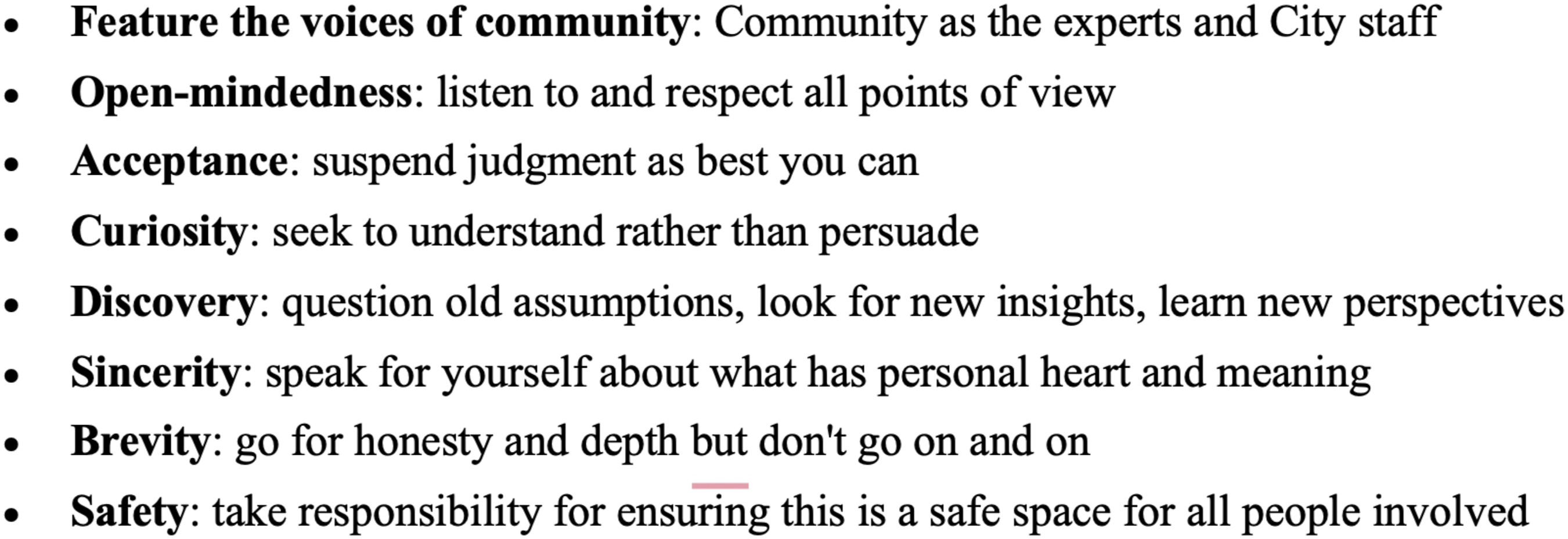
Knowledge dissemination following the workshops included two videos summarizing the workshop findings, which were shared with all participants. Survey questionnaires were circulated to all workshop participants to gather their post-workshop perspectives to inform the work going forward. In the few surveys we received, workshop participants noted that they valued the Two-Eyed Seeing approach, the need for further consideration of Black communities’ knowledges, and their interest in participating in small-group discussions in the second workshop (Figure 2). Diagram of the project’s action research process, in which action, research, and reflection are iterative, in keeping with our attempt to understand and apply the Two-Eyed Seeing approach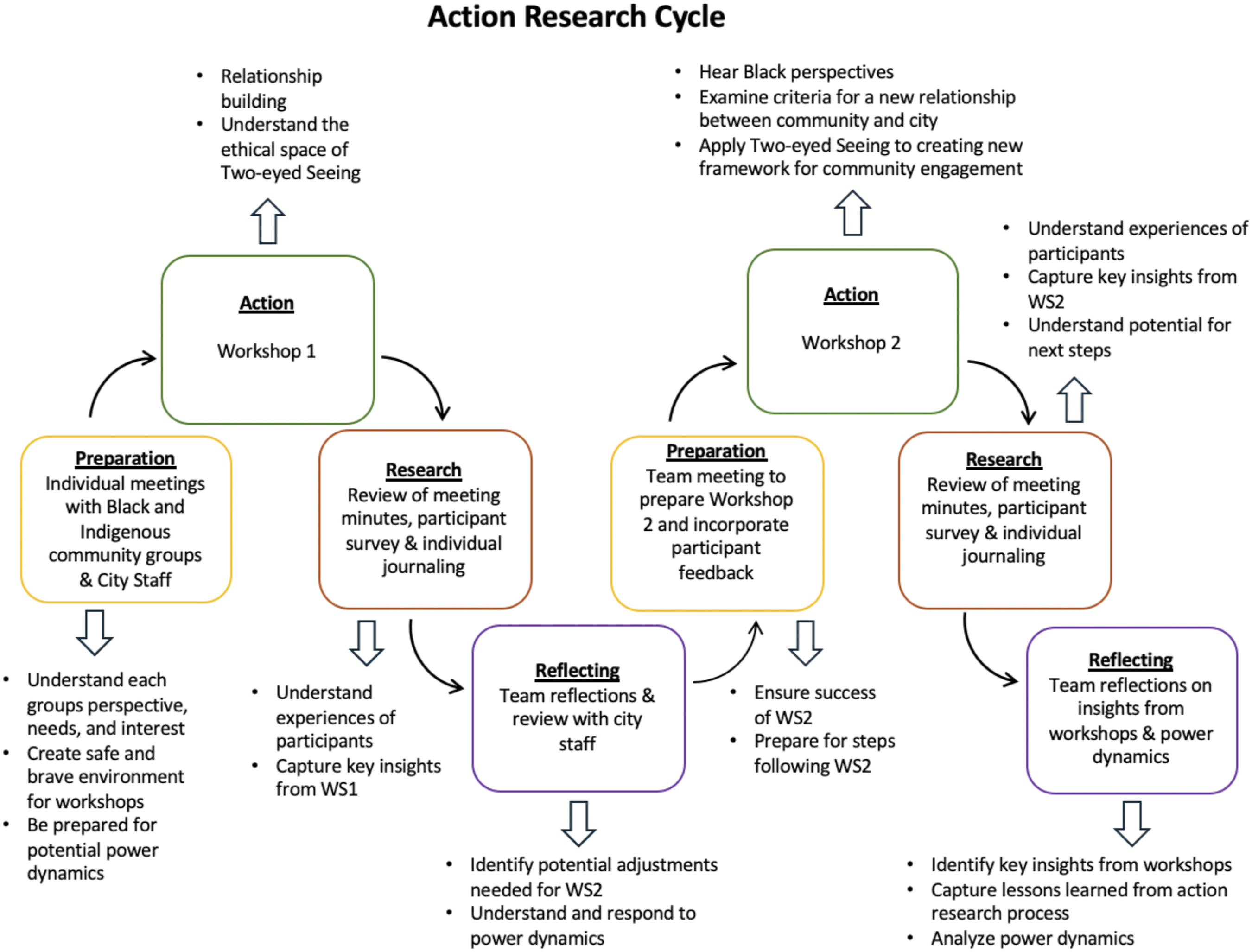
Findings From the First Workshop
In Indigenous cultures, there is a deep respect for Elders, who serve as guides and mentors, reminding us of the importance of approaching each other and our environment with a good heart and sound mind. The Elder’s discussion highlighted that relationship-building should be understood as a continuous learning journey rather than a finite process. This perspective challenges the conventional Western municipal planning approaches, which often adhere to a rigid, top-down model with predetermined budgets and timelines.
While our workshops focused on fostering connections between Indigenous and Black communities, the Indigenous Two-Eyed Seeing approach is also broadly applicable. It is relevant to all equity-seeking, racialized groups and non-racialized communities. This approach emphasizes our interconnectedness within the Great Circle of relationships and our collective dependence on the land, which we regard as our common Mother. The Elder’s insights underscore a cultural philosophy of unity and interdependence, offering a framework for building and maintaining healthy relationships in an ethical space.
Findings From the Second Workshop
Black and Indigenous participants who attended the second workshop raised several issues. They noted a lack of trust based on past experiences of being excluded or involved and mistreated by municipal processes and in their city. Community members felt that engagement with the municipal government was often transactional; for example, as some participants noted, the community is invited to contribute when input is needed for a specific purpose. Municipal government engagement was more about making the opportunity to be involved, so the City can say that engagement and consultation with communities has occurred rather than the intent to involve the community meaningfully.
As a result, specific communities’ viewpoints and cultural norms are not well-understood, making it challenging to strengthen relationships. As stated by some participants, Indigenous people want to be respected for just being and respecting the uniqueness of all relationships. Similarly, community members who attended the second workshop noted that engagement is designed too much in a one-size-fits-all manner rather than being tailored to the needs and expectations of different groups, especially equity-seeking groups, who experience barriers related, for example, to language, writing skills, time, money and access to technology.
Community members at the workshop also stated that city actors should treat the English language with more intention. Indigenous worldviews are not reflected in English words such as “owned”, “engagement”, “managed”, or “trade”. Language is not neutral; it shapes how we see the world. For example, in some Indigenous languages, the focus is on verbs/actions, while the English language focuses on nouns.
Member of the Black communities who attended the workshops originated from diverse countries of origin, immigration paths, and histories of colonialism. For instance, the workshop conversations revealed that those originally from East Africa and the Caribbean had different religious and ethnic backgrounds that were simply homogenized into the category of Black by government processes.
There was a feeling among Black youths that they were being called upon by the City merely due to tokenism. There is a fetishization of trauma when community members share their experiences, but no further support is offered in follow-up. The municipal government lacks transparency and accountability; community members at the workshops argued that it is important to be upfront and honest.
Indigenous and Black participants at the second workshop also raised perspectives on how the municipal government can develop healthier, non-colonial relationships with communities. First, when members of communities share input/feedback, it should be seen as an act of generosity. Second, the City can play different roles with equity-seeking communities, for example, by advocating on behalf of these communities and giving the communities a stake in what the City is doing. There is a need for some City actors to step back and begin by building a new foundation with communities rather than simply focusing on improving how the City approaches the community the next time there is a need for input. Workshop participants noted that the Two-Eyed Seeing approach was more than a simple exercise in considering and understanding the perspective of others. It requires applying/living the other perspective(s), which takes time and commitment.
Participants also noted that communities must be enabled to present their voices in their own way and feel that their narratives are valued. The municipal government actors must appreciate how immense the investment of time and resources in this process will take from communities and co-design a workable path forward. Participants shared with us that Municipal government staff need to be dedicated to relationship-building with communities, and this should not only apply to racialized staff who are already often overwhelmed and commodified by the City.
Reflections and Lessons Learned Using the Powercube Framework
In reflecting on our experience in planning and executing the workshops, we found it useful to frame it within a power analysis. After all, this project was about shifting power from the municipality to the two community groups in the way they engaged with each other. In this shift, our team was also affected by this power dynamic. For this analysis, we are drawing from the notion of the powercube developed by the Participation, Power and Social Change team at the Institute of Development Studies, University of Sussex, UK, building upon the work of John Gaventa and colleagues (Gaventa, 2011). The powercube is a framework for analyzing the forms, space, and levels of social power and their interrelationships.
The first dimension of this framework, “forms of power”, captures the way power manifests itself. Visible power refers to formal and observable power within relatively public spaces and formal decision-making bodies with clear rules of engagement, such as an election and public meetings of a city council. Hidden forms of power “are used by vested interests to maintain their power and privilege by creating barriers to participation, excluding key issues from the public arena, or controlling politics ‘backstage’” (Gaventa, 2011). Invisible power is present when dominating ideologies, values and forms of behaviour are adopted by relatively powerless groups, which affects their awareness and consciousness of specific issues and their own systemic oppression.
The second dimension, “spaces”, refers to “the potential arenas for participation and action” (Gaventa, 2011), including closed, invited, and claimed spaces. In closed spaces, the relatively powerful make decisions in relative secrecy without meaningful consultation or involvement of the public. Invited spaces provide some opportunities for involvement and consultation, but usually through an invitation by an authority, such as resident surveys or an advisory group for municipal strategic planning. Finally, claimed spaces are those spaces that are initiated and created by those who lack visible power and access to formal decision-making spaces, such as youth-led climate justice organizations.
Lack of Visible Power
The lack of visible power affected our project negatively in a couple of ways. First, a city is a very hierarchically structured institution. That is, the power is concentrated in a few hands of powerful managers at the top of the hierarchy (Denhardt & Denhardt, 2000). Our interaction with the city throughout the project was primarily with the Office of Equity, Diversity and Inclusion (EDI), which is located at the periphery of the organization with almost no power and resources. When we first engaged with the Office on this project, the director of the EDI office, while supportive, needed to get the buy-in and written permission for our project from the top-level management of the City.
This created challenges when the original director of the Office left the position soon after we received funding and started the project. In the staff transition, our project was considered a low priority and needed to wait until a new director of the EDI was in place, which significantly delayed the project’s start and put our community partners on hold. Fortunately, the new director was very supportive of the project. However, when things finally became more concrete for the workshops, and the plans were finally shared with the top manager, the Director of the EDI office reported that the top manager wanted to shut down the project as they perceived it as too high risk for the City. Without the City’s involvement, the chance to create meaningful change after the workshops would have been significantly reduced due to their visible and hidden forms of power.
After some negotiations with the City and the community members, we were able to continue, but only with lowered expectations of what the role of the City in this would be. That is, the City was no longer positioned as an active partner who would continue to work with the community groups after the workshops to co-create a new decolonized engagement framework based on the insights from the workshops. Instead, the City now saw itself as providing only input on the planning process and having staff attend the workshops as a learning opportunity. These actions left us in a bad spot regarding our expectations for these workshops, which we also communicated with the community participants to generate interest.
Visible power manifested through lack of Black and Indigenous people in City leadership positions. While the EDI director was Black with Indigenous staff, they held little power, caught between community identification and responsibility to white power players. More Black and Indigenous people in key decision-making positions would have changed project outcomes significantly.
From Claimed Spaces to Invited Spaces and the Workings of Hidden Power
Most municipalities’ engagement with community partners and members occurs through invited spaces. That is, the municipality creates opportunities for residents to provide input on various municipal plans and strategies. In most cases, this is relatively conscribed consultative input (Schafer, 2019). A municipality rarely engages in newly created neutral spaces that engage them on equal terms with the community and even more rarely engages with the community in spaces created by the community itself.
As described above, we had plans to co-creatively plan the workshops with the municipality and Black and Indigenous representatives from the community to ensure it is a safe space for all parties and the workshop content is relevant to all participants. However, before we engaged members from the Black and Indigenous communities, we wanted to make sure we had the buy-in from the City for the reasons explained in the previous section. Through the delays and power dynamics described above, in reality, we primarily engaged with the municipality members, and the community had little input into the planning process. This came at the expense of our engagement with the community partners and resulted in a form of unintended hidden power because now the members of the City had a lot more influence over the timing and agenda of the workshops than the community did. Yet, the City, through the EDI office, gave the impression that the City was interested in shifting to creating a new claimed space.
As such, we were caught in the colonial power dynamics that privileges the City that we were trying to change with our project. As community-based researchers, we were personally connected to these communities through our own identities and our desire to bring about meaningful social change. Our preference as researchers is to work directly with and alongside equity-deserving groups.
Invisible power at Play
Invisible power is executed by controlling key discourses and predominant narratives. Cities are notoriously known for wanting to control the narrative about themselves as institutions. This is generally called organizational impression management, which is quite common among cities (Bevan, 2022). This is understandable, given that they are institutions accountable to the public and that key decision-makers need to be re-elected every four to five years. However, it provides a challenge when creating change and innovation, which requires taking risks and being open to failure.
Some municipality members within this project were worried that they could lose control over the narrative about the City if they did not control the engagement process with community members. This fear was heightened by relatively recent open criticisms of the municipality by community activists, and the perception that community-oriented social change is a risky form of engagement.
Lack of Readiness
An important lesson learned for us is that we should have paid more attention to the municipality’s lack of readiness to engage in this project. We wrongfully believed that the public pressure from the Black Lives Matter and the Indigenous Landback movements, the public recognition of the systemic inequality in the impact of the COVID-19 pandemic, and the recently established EDI office in the municipality were sufficient factors to motivate the City to engage fully.
In hindsight, we realized that the EDI office was not established enough and that a lot more work was needed internally, including positioning Indigenous and Black staff in roles with higher power and authority in the City, before the municipality could meaningfully engage in the type of decolonization project we had planned. Maybe this project would have had a better chance of succeeding if the internal work had been further along and the EDI office had been more established and had a clearer direction.
Linking Powercube Analysis to the Theoretical Framework (Two Eyes-Seeing and Decoloniality)
In their seminal paper on relational systems theory, Indigenous scholar (Goodchild, 2021, p. 66) quotes Dan Longboat with the following powerful insight: Now looking at prophecy, we talk about this idea of the two-row wampum belt, the Europeans and Indigenous peoples, or how any people that come to North America, and our relationship together exists in the space in between. It is the sacred space, those principles of peace, friendship, and respect, that becomes the sacred way that we work towards one another, but the idea behind it is that we are both sailing down the river of life together. And our responsibility is to help one another, but more specifically, the river of life is in danger right now and there will be no more river of life. So, it behooves us now to utilize our knowledge together to work to sustain, to perpetuate, to strengthen the river of life.
It is this sacred space in between that the speaker of our first workshop emphasized as central to the Two-Eyed Seeing approach, which she referred to as the “ethical space” (see also above) In reference to the powercube framework (Gaventa, 2011), this clearly relates to the second dimension of spaces. However, it is neither an invited space, which is still dominated by those in positions of relative power, nor just a claimed space created by those with relatively little power. Instead, it is a shared space where two groups with different worldviews and knowledges meet with mutual respect and reciprocity to solve societal challenges together. It is not just a shift of power from one group to another but a complete revolution in mindsets of how we relate to and work with each other. This may be easier to grasp from an Indigenous worldview than from a Western one. But, it is also what we had hoped to broker for this municipality and local communities and, unfortunately, failed. We hope, however, that at least we have planted some seeds among the municipal participants and moved them along in shifting (or decolonizing) their mindsets. It may be that the groups we engaged still need to travel for a while individually on their own streams before they are ready to travel together on the river of life.
Three Different Perspectives on the Outcome of the Action Research
CT
As the Black co-lead working with Black African and Caribbean communities, I was initially excited about using the Two-Eyed Seeing and Braided Knowledge approaches to improve municipal engagement and responsiveness to community needs and strengths.
Through conversations with Black organizations, meaningful representation and resource access emerged as core issues. I appreciated the community’s diversity. Black voices wanted to be heard, valued, and see actual implementation creating foundations for future municipal engagement.
Despite community trust in the decolonial process and active workshop participation in co-producing new engagement frameworks, the project’s failures betrayed this trust. Senior municipal decision-makers maintained colonial power relations by controlling timelines and implementation—exactly what the project aimed to disrupt.
Moving forward, I’ll prioritize Black communities’ inherent strengths as agents of change, working with academic and non-academic teams genuinely committed to transformation.
MS
As an Indigenous environmental scholar with relevant research experience, I considered that this project presented a stimulating and new opportunity and challenge. I have long had a personal and academic interest in how Indigenous People experience municipal planning, which is still mired in colonial legacies and logics. I believe that solutions are most likely to originate from the colonized and racialized people themselves, rather than from city planners and officials. Given this, I was mostly interested in witnessing firsthand how a grassroots, bottom-up framework for decolonizing municipal practices could be built by advancing Indigenous and Black community members and activists and their interests.
Through this project, I discovered that change couldn’t happen as rapidly as hoped in this City context for reasons outlined throughout this paper. I remain deeply grateful to academic collaborators (MR and CT), the Elder who led the first workshop, and all participating community members and city officials. Although cities remain modern products of colonial spatial organization—the very concept of ‘city’ as economic production sites serving linear ‘progress’ being foreign to most Indigenous cultures—this project reinforced my belief that meaningful progress occurs most effectively on the human level, between individuals and grassroots organizations. I was delighted witnessing true Two-Eyed Seeing and Braided Knowledge throughout our work, characterized by humility, respect, and understanding as key pillars, despite institutional colonial structures.
MR
What I realized through this project, however, is how important it is that the municipality itself is ready and has moved far enough along with the necessary internal work before engaging the community. Leverage theory suggests that transformative change requires a shift in mental models and culture or otherwise change will remain incremental (Kania et al., 2018; Murphy & Jones, 2020). If I would do this project again, I would probably first work with the key leaders of the municipality on shifting their mental models to ensure that engaging with Indigenous and Black communities is not considered simply an obligation and a potential risk but be seen as a real strength in developing outstanding municipal processes and services.
Too often members of these communities have been consulted with no changes resulting from their input. While our team was very conscious of this and put measures in place to avoid this issue, we still fell into this trap. As a result, I feel very guilty of having raised hope among the community members we engaged that their engagement with the municipality could change and be more aligned with how they would like to be engaged.
Conclusion
Our project’s desired objectives were to set the foundation for a long-term collaborative process designed to reconcile the City’s colonial past and histories of racism, establish a foundation of trust between the City and community, and create the possibility of an equitable and inclusive future. Reconciling the past and developing better approaches to building the future represented a complex challenge that required innovative collaboration and drawing on the diverse knowledges that exist within our communities.
The knowledge exchanges in this project explored potential decolonization processes, new forms of knowledge creation and the goal of transforming colonial municipal organizational systems. However, in this paper, we consider the problems we encountered in our aim to disrupt dominant colonial mental models and envision improved power-sharing in urban planning. Decolonization as part of broader systems change is key to introducing new knowledge and innovations into municipalities’ organizational structure and practices.
This project allowed us, as academic leads, to learn at both structural and micro levels. At the structural level, shifting power from municipalities to Indigenous and Black communities requires sensitivity to how municipalities can use hidden and visible forms of power to maintain dominant worldviews. Transformative change requires more powerful actors to give up some of their power and privilege so marginalized voices can access agency and authority, for instance, by having Indigenous and Black people in positions of power at the City.
In future research, it would be useful to also collect the perspectives of the community and municipal participants as a final reflection on the process and the project’s outcomes. It is a limitation of this action research project that, for a variety of reasons, we did not have an opportunity to engage further with the participants after the conclusion of the workshops to capture their perspectives.
As individual academics, we have learned the value of doing research that benefits from our identities and community connections. Particularly for Indigenous, Black, and racialized academics, doing research with and about our communities comes with greater expectations from our communities to represent and organize projects in ways that do not reproduce dominant processes of power and knowledge. In this regard, Indigenous, Black, and racialized academics are expected to treat their communities better than colonial systems of extractive research.
While our work was guided by considerations of Two-Eyed Seeing and decoloniality, a second noteworthy limitation of our analysis is that we used a Western theoretical framework (the powercube) to reflect on the power dynamics within our action research process. To stay true to the Two-Eyed Seeing approach, it would have been interesting to supplement this by drawing on relevant Indigenous and Decolonial literature (in addition to Goodchild’s article on relational systems thinking) such as Simpson (2017) and Tuck & Yang (2012). For example, Tuck and Yang’s notion of settler colonialism as “the code beneath the code” as an invisible structure that normalizes the invasion of Indigenous lives through research is an interesting parallel to the invisible power experienced by Black and Indigenous communities in the engagement with municipal actors and the power dynamics we reflected on above. Simpson’s advocacy for “radical resistance” addresses the need for claimed spaces that exist outside the settler-colonial invited structures that are common in the engagement of Indigenous and Black community groups. A deeper engagement with these theoretical texts, however, is beyond the scope of this current paper.
We end with three recommendations for future decolonization projects with municipalities and the broader implications for municipal planning and community collaboration. First, the importance of readiness and support within municipal structures to engage in meaningful transformational change. This is crucial to overcoming hidden power dynamics and making space for new forms of Indigenous and Black knowledge. Ideally, this readiness exists at the highest levels of the municipal management systems. Second, as a related issue, researchers committed to action research, regardless of their identities and positionalities, must be cautious not to get caught in the power dynamics they seek to change. Co-production and co-creation with communities requires clear agreement on governance and decision making to manage power differences and to ensure that decolonization and the goals of the community are the priority. Third, in alignment with other scholars (e.g., Beausoleil, 2025; Gillis, 2023) and our original intention with this project, we emphasize the importance of meaningfully centering the knowledges, agency, and power of Indigenous and Black communities in local governance and go beyond approaches of inclusion that are grounded in colonial ways of thinking and that tend to be performative. While we failed to accomplish the development of such a framework in the context of this local city, we hope that we have planted some seeds that will eventually grow and enable a Two-Eyed Seeing approach to municipal engagement.
Footnotes
Acknowledgement
The three academic leads gratefully acknowledge the collaboration and commitment of Randy Sa’d, the founder of Enterprise Evolution. Dr. Randy Haluza-Delay was the project coordinator, and two graduate students, Jennifer Dobai and Eden Mekonen, were valued project team members.
Ethical Considerations
This study was approved by the Ethics Committee of Toronto Metropolitan University (REB, 2022-039) on January 2022 and Wilfrid Laurier University in February 2022 (REB 7239).
Consent to Participate
All participants provided written informed consent prior to enrolment in the study.
Funding
The authors disclosed receipt of the following financial support for the research, authorship, and/or publication of this article: This work was supported financial support from a Social Sciences and Humanities Research Council (SSHRC) Connection Grant [Grant Number 611-2021-0173].
Declaration of Conflicting Interests
The authors declared no potential conflicts of interest with respect to the research, authorship, and/or publication of this article.
Author Biographies
