



Abstract
This article surveys post-1945 scholarly attempts to interpret Jesus’ command to ‘render to Caesar the things of Caesar and to God the things of God’ (Mk 12.17; Mt. 22.21; Lk. 20.25). It suggests that part of the confusion surrounding the interpretation of this phrase lies not only in the disputed nature of the data, but also in the failure to clearly define the interpretive categories. This has resulted in contradictory interpretations being described with the same label, as well as scholars failing to notice similarities between the different readings. To this end, the following article attempts to more precisely outline the four major approaches to the command which have emerged since the Second World War (while also noting the various connections between some of these views): (1) exclusivist interpretations in which ‘the things of God’ nullify the ‘the things of Caesar’; (2) complementarian readings in which the two elements are held to be parallel; (3) ambivalent readings that stress the ambiguity and open-ended nature of the utterance; and (4) subordinationist readings that seek to uphold both elements of the command while prioritizing the second element (‘the things of God’) over the first (‘the things of Caesar’). The discussion then turns to considering four areas that might prove fruitful in future analysis of this command.
Keywords
Introduction
The famous tribute pericope in the Synoptic Gospels ends on a note of marvel, amazement, even confoundment. Hearing Jesus’ climactic response (‘render to Caesar the things of Caesar and to God the things of God’, hereafter referred to as the ‘render command’), the Jewish interlocutors leave in silent defeat (Mt. 22.22; Mk 12.17b; Lk. 20.26). The astonishment of the various Jewish authority figures is one, no doubt, in which contemporary scholars and readers have shared. This can, in part, be explained by the fact that scholars have come up with such a variety of interpretations for this command. The last seventy years or so have witnessed commentators confidently asserting radically contradictory conclusions for both the referents and relationship of ‘the things of Caesar’ (τὰ Καίσαρος) and ‘the things of God’ (τὰ τοῦ θεοῦ). Interpreters have referred to Caesar’s property as his ‘coin’ (Lane 1974; France 2002: 446), ‘the Pharisees and Herodians’ (Bünker 1986), ‘taxes, commerce, the imperial cult and military service’ (Carter 2014: 6), while others contend that Jesus’ statement means that ‘nothing’ in fact belongs to Caesar (Brandon 1967: 346; Horsley 2003: 99). Scholarly definitions of ‘the things of God’ have been much more numerous, ranging from ‘everything’ (Myers 1988: 312), to ‘the land of Israel’ (Horsley 2001: 113), ‘the human person’ (Giblin 1971: 510-27), ‘divine honours’ (Wright 1996: 505-6) and ‘the temple tax’ (Stauffer 1955: 133; Tagawa 1971: 117-25), among others. It appears that at present, the significance of the ‘render’ command—and the relation of ‘the things of God’ and ‘the things of Caesar’—remain as contested as ever. The goal of this article is to examine the post-1945 attempts of New Testament scholars to relate the two Synoptic referents (‘the things of God’ and ‘the things of Caesar’). Its aim is to guide those seeking to understand this phrase within its historical context.
Focusing on the period following the Second World War is justified on at least two grounds. First, as Luz has noted, the post-1945 period in many ways marks a series of water-shed moments in the understanding of the ‘render’ command (Luz 2005: 64). To begin with, there has been a marked tendency to argue that the Historical Jesus and/or the Synoptic Evangelists devalued and even rejected ‘the things of Caesar’ (Luz 2005: 64). Even when scholars maintain that the tax was to be paid, interpreters provide a variety of factors (e.g. the impending arrival of the kingdom of God), which severely limit Caesar’s demands. In general, the deep suspicion with which many scholars have come to look upon readings of the command that deal with church–state relations can be attributed to the growing suspicion, at least in certain quarters, towards the misuse of power by both state and church (Luz 2005: 64). There are, for instance, the rather worrying examples of New Testament scholars with affinities to German National Socialism attempting to shore up the authority of the state through the ‘render’ command and Romans 13.1 (see Kittel 1937, 1939; Stauffer 1955: 131; for a discussion which notes the varied approaches of German theologians under the Third Reich, see Rizzi 2009: 7-23). A further influencing factor which has arisen in the period after the Second World War is the emergence of readings that attend to the circumstances of those living in post-colonial situations (Moore-Gilbert, Stanton and Maley 1997: 12). Post-colonial readings of the command assume a high degree of correspondence between the context of those living in a post-colonial world, and the Gospels as texts that present Jesus living in a space between the Roman dominators and the Jewish revolutionary groups seeking to overthrow it (see further below). Thus, geopolitical events continue to shape the history of interpretation of this command (as with a good many biblical texts), despite protestations to the contrary.
A second impetus for providing the following analysis is the perceived inadequacy of several of the labels employed to describe the interpretive categories. Förster, to take one recent example, lists four categories of interpretation for the ‘render’ command (2012: 3-6). First, there are anti-Zealot readings that present Jesus in opposition to the Jewish revolutionary group that resisted Roman rule and taxation. Second, there are pro-Zealot readings which take the opposite view, so that Jesus’ response was anti-Roman in nature (on the existence and influence of the ‘Zealot’ party in the first century, see Hengel 1967; see also the sober assessments in Deines 2004: 626-30; 2011: 403-48; Horsley and Hanson 1999; Förster 2012: 1; Lichtenberger 2013). Third, Förster lists eschatological readings that interpret Jesus’ command squarely within the context of Jewish ‘eschatologischen Enwartungen’ (eschatological expectation) and Jesus’ own proclamation of the nearness of God’s kingdom, which relativized all human and earthly rule (2012: 6). Fourth and finally, there are the two-kingdoms interpretations in which the political ‘is distinguished from religious matters, and the earthly states were given their legitimacy solely by God, to whom man owed obedience’ (2012: 6, my translation). Bonnard’s earlier list provides three of these options, omitting the pro-Zealot interpretation but otherwise keeping the others (1970: 322-23; cf. Giblin 1971: 510-13 who follows Bonnard’s scheme; cf. for a different list of options, Ukpong 1999: 434-36).
Two examples demonstrate the deficiency of current interpretive categories. First, scholars use the label ‘ironic interpretation’ to refer both to readings in which the command amounts to meaningless ‘nonsense’ (Fitzmyer 1985: 1292: ‘a flash of wit, devoid of any serious import’), or alternatively, to describe a subversive reading of the command in which giving Caesar back his coin comes to signify an underhanded remark about the uncleanness of the imperial denarius. One throws the coin back at Caesar simply to avoid the taint of impurity (Wright 1996: 505). The label ‘ironic interpretation’ can thus be used to describe the view that the command is devoid of all meaning, as well as the position that the statement constitutes a subversive piece of teaching (for yet another ‘ironic’ reading, see Patte 1987: 309). Such diversity of interpretation is not limited to those readings labelled ‘ironic’. Förster’s ‘eschatological’ interpretation also requires unpacking. It has been possible for scholars to use Jesus, or the Evangelists’ eschatological expectation, as evidence of a desire to undermine Caesar’s claims altogether (Horsley 2003: 98-99). Alternatively, scholars have claimed that the context of his eschatological preaching supports a reading in which Jesus both acknowledges Caesar’s right to the coin, while relativizing the importance of this act given the imminently emerging kingdom of God (Förster 2012: 220; Wright 1996: 505). Just as with the term ‘ironic’, so also has the use of the ‘eschatological horizon’ of Jesus’ teaching resulted in numerous, seemingly contradictory interpretations of the ‘render’ command.
Given the lack of clarity surrounding some of the previously employed interpretive labels, I would suggest that a better way forward is to recognize that these groupings do not constitute watertight compartments in which there is no similarity between different exegetical options. That is, differences and similarities between the views of scholars within, and beyond, a single category should be noted. Thus, part of the purpose of this article is to more clearly define the set of interpretive categories used, while also noting that most of the readings fit together on a spectrum. The four interpretive options, which I will explore below, can be summarized as follows:
Exclusivist readings hold that ‘the things of God’ nullify the ‘the things of Caesar’. The two elements of the phrase operate in a relationship of mutual exclusivity.
Complementarian readings can be defined as interpretations in which the two elements are held to be parallel by the Historical Jesus and/or the authors of the Synoptics. Interpreters of this kind generally see no need for excluding either element, and hold that both can be upheld simultaneously as comparable and non-conflicting demands.
Ambivalent readings stress the ambiguity and open-ended nature of the utterance. Interpreters who stress the uncertain quality of the command have done so either through applying the insights of post-colonial and reader-centred approaches, or through attending to ancient rhetoric and the genres of the pronouncement story and the maxim.
Subordinationist readings seek to uphold both elements of the command while prioritizing the second element (‘the things of God’) over the first (‘the things of Caesar’).
It should be stated that these categories operate at the etic level as useful heuristic devices to organize the recent history of interpretation, rather than as strict categories which authors would use to describe their own points of view. Having discussed these major options, I turn to assessing the approaches of commentaries in the post-war period, before, finally, outlining four fruitful avenues for future research.
Preliminary Issues
Before beginning the analysis, however, two points about the scope of this article are in order, the first relating to source-critical concerns and the second to audience and authenticity. First, the tribute passage and the ‘render’ command with which it climactically concludes were extremely popular in early Christianity. At least five early textual versions of the command circulated between the second half of the first century and the mid-second century: Mark 12.17, Matthew 22.21, Luke 20.25, Thomas, 100.2-4 and possibly Romans 13.7 (for a literary relationship between Rom. 13.7 and an oral version of the Synoptic versions, see Thompson 1991: 111-20; Dunn 1988: 768; for the view that Paul’s version is independent see Neirynck 1986: 291). The relevant source-critical issues related to these versions have received ample treatment in the voluminous work of Förster (2012: 226-81; see also Cuvillier 1992: 329-44. Papyrus Egerton 2r contains a similar version of the tribute pronouncement story, although the ‘render’ command itself is absent, perhaps contained within the question asked of Jesus). Among the early Gospel versions, the best case for inclusion is, arguably, Thomas 100. Although some kind of literary relationship almost certainly exists between the three Synoptic versions, the case for Thomas’ connection with the Synoptics is far more debated, with some arguing for its secondary dependence on the Synoptics (tentatively, Gathercole 2011: 134-35; 2012: 154; Goodacre 2012: 112-15; Davies and Allison 2004: 218), and others positing its independence (Crossan 1983: 399-400; Gibson 2004: 296–97, 314, 314 n. 110; for a general discussion of the relationship between Thomas and the Synoptics, see Kloppenborg 2014; Gathercole 2014b; Denzey Lewis 2014; Patterson 2014; Goodacre 2014). For the sake of simplicity, then, this article does not consider the Thomasine version in the analysis below (for an assessment of the options for the Thomasine referents, see Gathercole 2014a: 561-65). This is not to deny, of course, that widening the focus of investigation to include additional early Christian versions, as well as patristic reuse, opens up new directions in the study of this text (on which see Bori 1986: 451-64; Luz 2005: 63-65; Rizzi 2009; 2010: 227-34; Förster 2012: 226-81; Burke forthcoming).
Second, it is worth noting that scholars have differed on what is meant by ‘historical context’, with some attributing their interpretations to the Historical Jesus and others to the Synoptic authors. This raises the question of the ‘authenticity’ of the phrase. In his 1922 published Die Geschichte der synoptischen Tradition, Bultmann commented that there were no reasons to doubt either that the command travelled within its current setting or that it could be traced back to the Historical Jesus (Bultmann 1922: 33; so also Collins 2007: 552-55; Bruce 1984: 250. Brandon 1967: 271, 346 thinks that while vv. 14-17 are original, v. 13 is a product of the author(s) of Mark). The Jesus Seminar attributed Mk 12.17 to the Historical Jesus, the only saying in Mark to receive their ‘red letter’ rating (Funk and Hoover 1993: 549). Yet the authenticity of the phrase has not achieved global affirmation. Those who question the command’s authenticity in the life of the Historical Jesus do so on several grounds. Petzke, for instance, thinks that ‘the things of God’ is a pious addition to the original version (1975: 232-35). More commonly, scholars have had cause to doubt that the command goes back to the Historical Jesus on numismatic grounds (Mell 1994: 222-27). Since there appears to be little to no evidence for a poll tax (tributum capitis) in Judea or the use of denarii in the pre-70 period, others posit that the scene cannot be authentic to the Historical Jesus (Udoh 2005: 207-38; Carter 2014: 2). There is some numismatic evidence to the contrary, however (Collins 2007: 555; Hart 1984: 242-48). Moreover, the recent work of Eck on Roman taxation suggests that the form of taxation, and the coins in use, in Roman Judea remain open questions (Eck 2007: 210; see the recent discussion of Zeichmann 2017: 422-37). In the discussion below, therefore, I attempt to note where scholars attribute the command to either the Historical Jesus or the Synoptic Evangelists, or to both.
1. Exclusivist Readings
First, there has arisen an array of interpretations which have often resulted in a seditious image of Jesus in relation to the Roman empire. The central feature of these readings is that the Historical Jesus and/or the authors of the Synoptics define ‘the things of God’ in such a way as to exclude, or nullify ‘the things of Caesar’ altogether. These readings, which I label ‘exclusivist interpretations’, boast a long history in the modern period, dating back as far as Reimarus in his 1778 essay ‘Vom dem Zweke Jesu und seiner Jünger’ (‘On the Aims of Jesus and his Disciples’, Reimarus 1970: 59-269; see also Leander 2013: 18). The following analysis starts with Brandon, who was its first major proponent in the post-war period (Brandon 1967: 346; cf. for an important pre-1945 forerunner, Eisler 1929; cf. Bammel 1984: 11-68 for a slightly dated but highly useful historical overview of revolutionary portrayals of the Historical Jesus).
In his famous work, Jesus and the Zealots, Brandon seeks to re-examine the reasons for Jesus’ suffering and death (Brandon 1967: xi-xii). Brandon contends that despite noting Jesus’ trial by Pilate as ‘revolutionary’ or ‘brigand’ (Mt. 27.38; Mk 15.27), the Synoptic Gospels present Jesus as a loyal subject of Rome (cf. also Brandon 1968: 30-31). The reason for Mark’s perceivably more irenic account, Brandon argues, is because the Markan community was writing in the aftermath of the dreadful Jewish War of 66–70 CE, in which Christians were suspected of participation in insurrectionist activities against Rome. Within this context, Mark writes an Apologia ad Christianos Romanos (Apology for Roman Christians) in which he presents Christ, and his followers, as obedient and compliant subordinates of Caesar who, among other things, pay their taxes (Brandon 1967: 221-82). And yet Mark, Brandon claims, does not entirely succeed in this aim. Mark’s inclusion of various narrative details (including Jesus’ selection of a Zealot among his twelve disciples, his call for his disciples to ‘take up their crosses’ and his crucifixion between two brigands) suggested to Brandon that the narrative should be read more critically as an apologetic cover-up of Jesus’ seditious aims (1967: xii). Each of these passages drove Brandon to re-consider Jesus’ relationship to the Zealots and to conclude that Jesus, while not a Zealot himself, held much in common with the beliefs and aims of these revolutionary groups.
Turning to Brandon’s exegesis of the ‘render’ command, the author clearly states his position that ‘the very essence of the Zealot case against the payment of tribute was that it meant giving to Caesar what belonged to God’ (1967: 346). The ‘things of God’, for Brandon, should be understood as the land of Israel which is currently possessed by Caesar and belongs to him. While Brandon does not explicitly define the ‘things of Caesar’, the implication of all things belonging to God is that ‘devout Jews’ owed nothing to Caesar since the land was not rightfully his but God’s. According to Brandon, the relationship between these two elements is one of mutual exclusivity. That is, the ‘things of God’ include the land of Israel which belongs exclusively to God and not to Caesar. Taken together, the command was ‘doubtless…intended, to rule that the payment of tribute to Caesar was an act of disloyalty to Yahweh’ (1967: 348). As a consequence, the command to ‘render to Caesar’ signifies that one should not pay the tax to Caesar. The ‘render’ command was therefore ‘a saying of which any Zealot would have approved’ (1967: 347).
Turning to more recent proponents of the exclusivist reading, one of the most influential is Horsley who comments on the ‘render’ command in at least three of his works (1987, 2001, 2003). Horsley’s concern is with those who simplify the complexity of ‘political conflict’ in first-century Palestine by conflating it with a ‘unitary’ account of Judaism, which smooths over the revolutionary qualities of certain groups. To counter this perceived trend, Horsley re-constructs a narrative of the political dimension of first-century Palestinian experience, particularly among those seeking to overthrow the Roman empire and create an alternative and theocratic society (2003: 35; cf. Horsley and Hanson 1999: 190-200). The protests and revolts of ‘the Galilean and Judean people’ becomes what one might call a controlling narrative or central lens through which Horsley reads the Gospel narratives (2001: 34; 2003: 35). Crucial to Horsley’s definition of ‘the things of Caesar’, and his interpretation of this pericope, is the assumption that Jesus operated with a similar religious-political ideology as the ‘Fourth Philosophy’, commonly equated with the Zealots (Horsley 2003: 99, 104; cf. 2001: 113). Josephus describes the origins of this philosophy as starting with Judas the Galilean, or Gaulanite, who along with a certain Pharisee called Saddok led a revolt against the census in 6 CE, during the governorship of Quirinius (Ant. 18.26). In line with the earlier Fourth Philosophy, Horsley’s Jesus preaches ‘the kingdom of God’ which judges rulers and which establishes the ‘renewal of Israel’ (2003: 98-99). When turning to the ‘render’ command itself, Horsley champions the view that since ‘Israelite covenantal theology’ operated with the assumption that all things belonged to God, then nothing was due to Caesar (2003: 98-99; 2010: 142-43). Thus, Jesus holds that ‘if God is the exclusive Lord and Master, if the people live under the exclusive kingship of God, then all things belong to God, the implications for Caesar being fairly obvious’ (2003: 99).
The exclusivist position has found support in numerous other monographs and treatments (Kennard 1950; Maccoby 1973: 132-33; Myers 1988: 312; tentatively, Ukpong 1999: 442; Herzog 2000: 219-32; Oakman 2012: 12). More recently still, Bermejo-Rubio in a string of articles has led the clarion call for an ‘open-minded’ and unblinkered analysis of the evidence for Jesus’ relationship to Rome (2013: 19-57; 2014: 1-105; 2015a: 232-43; 2015b: 131-65; 2017: 41-67). Bermejo-Rubio considers Jesus’ response as ‘crafty’, entailing ‘frontal opposition to the taxes whilst not openly recognizing it’ (2013: 41). Like several interpreters, Bermejo-Rubio borrows from Scott’s theory of hidden and public transcripts. In Scott’s theory, colonized subordinates employ a public transcript to appear loyal to the colonial power, while simultaneously presenting an implicit transcript that allows the individual to remain faithful to the commitments of the native community (see Scott 1990: 3; Herzog 1994: 342; see for wider methodological issues, Herzog 2004: 41-60). For Bermejo-Rubio, Jesus in his public transcript seemingly presents the duties to God and Caesar as two reconcilable demands so that he might avoid the danger of being arrested by pro-Roman forces (Lk. 20.19-20 presents the political danger most vividly; Bermejo-Rubio 2017: 60). At the same time, Jesus’ true hidden transcript, contained in the implicit message of his words, makes it clear that he stands with the revolutionary groups and against the Roman taxation. ‘Thus, what appear to be two parallel spheres are in fact two mutually exclusive domains, in which no compromise is possible’ (Bermejo Rubio 2017: 60, my translation).
In offering this renewed and nuanced case for Jesus’ anti-Roman stance, Bermejo-Rubio has also provided a useful survey and rebuttal of a vast array of counter-arguments against it (2013: 19-57; see also 2015b: 131-65). Among the many positive arguments he puts forward, the most crucial include the allegations made against Jesus in Lk. 23.2 (2014: 13; 2017: 61. Yet see for a different interpretation of these accusations, Derrett 1970:313-38; Schneider 1984b: 403-14), as well as the existence of roughly contemporaneous tax revolts both in Judea and Galilee which, for Bermejo-Rubio, increase the likelihood that Jesus’ position towards the Roman tribute was also revolutionary (Bermejo-Rubio 2014: 28-34; Bermejo-Rubio 2015b: 131-65). Finally, Bermejo-Rubio contends that the exclusivist reading makes best sense of various complex conundrums within the tribute anecdote (see Bermejo-Rubio 2013: 41 n.104). For instance, it appears to explain the fact that Jesus’ opponents knew his position was one of opposition and that they could trap him in his talk (Mk 12.13, 15; Lk. 20.20; although for different readings of the Pharisaic and Herodian views on tax, see Hooker 2001: 280, Taylor 2000: 299-310. On the difficulty of knowing the position of the Herodians on the tax problem, see the wise judgment of France 2007: 832: ‘We simply do not know’).
In sum, the exclusivist reading has grown out of a renewed desire to attend to the political situation of Jesus’ day. Although it currently remains a minority position, the number of scholars espousing these readings has greatly increased since the end of the Second World War. Such a meteoric rise can be attributed, in part, to the emergence of post-colonial criticism, and the proliferation of scholarly interest in both the Roman imperial order and the variety of first century Jewish responses to it.
2. Complementarian Readings
The second trend, which I refer to as complementarian in nature, holds that Jesus’ statement offers a harmonious analogy between the things of Caesar and the things of God. Here, the two demands constitute parallel duties that can be carried out simultaneously. As such, complementarian readings are the opposite of the exclusivist interpretations outlined above. Yet it should be noted that complementarian readings represent something of a spectrum within which numerous positions can reasonably be held. The most obvious complementarian reading holds that the Evangelists, and/or the Historical Jesus, never intended to place the two elements in conflict. Alternatively, other complementarian readings contend that conflict was a potential, and perhaps even inevitable, outcome of living in Caesar’s domain. On this view, it is down to the discernment of the reader who is obliged to decide when this might be the case (France 2002: 489). That is, conflict between God and Caesar is not yet envisaged by the authors of the Gospels but will at some indefinite point become clearer. Until then, the Evangelists and/or the Historical Jesus teach that one must submit to the ‘sober reality’ of the times and commit to faithfulness to God and the world (Ernst 1981: 346-47, my translation). I will note further below the overlap between this looser version of the complementarian position and some of the ambivalent and subordinationist readings.
A significant proponent of the classic complementarian reading of the ‘render’ command is Stauffer, a mid-twentieth-century German scholar who maintained an ambivalent relationship towards the German National Socialist Movement (on which see Nicklas 2014: 276). In his Christus und die Caesaren, Stauffer provides a series of diverse and wide-ranging ‘Historische Skizzen’ (historical sketches) which touch on the Roman empire and the ministry of Jesus, as well as early Christian encounters with imperial power (1948; 1955). Among these episodes is the encounter recorded in the tribute passage. Stauffer defines the first part of the sentence, τὰ Καίσαρος, as the ‘poll-tax’ which one should pay as a loyal citizen (1955: 131, 133) and the ‘things of God’ as ‘the temple tax’ (1955: 134). Stauffer arrives at this conclusion through a combination of linguistic observations and historical reconstruction. The verb ἀποδιδόναι refers to giving back, or paying tribute, which entails not only an obligation that must be fulfilled but ‘a moral duty’ (1955: 129). He furnishes a variety of Old Testament (Jer. 27.5), early Jewish (Baruch 1.10-11; Josephus, Ant. 12) and early Christian texts (Shepherd of Hermas 3.1; Origen; Hilary; Vulgate—the latter three all lack specific textual references however) to support his conclusion that for the Evangelists, there were no grounds to refuse the payment of the tax. He observes that in the Septuagint, when the verb ‘render’ (ἀποδιδόναι) is used in conjunction with the dative ‘to God’, ‘it is a common technical usage for the ceremonial discharge of obligations in the cult’ (1955: 132 in reference to Num. 8.13; 1 Chron. 29.9; Ps. 76.11). In Jesus’ day, Stauffer avers, these cultic obligations refer to paying the temple tax. Combined with this lexical point is Stauffer’s brief discussion of the situation of Roman tax revolts. He maintains that while tax rebellion was an existing phenomenon within Roman Judea, it was equally possible that a zealous Jew could fulfil both the temple and the imperial tax (1955: 130). Moreover, since the two clauses are strictly parallel, with the ‘and’ (καὶ) functioning as a simple conjoining of two equal halves, the command should be taken to mean ‘payment’ of both taxes (1955: 133). Hence, the overall interpretation of the command for Stauffer is that the two clauses refer to parallel expressions of obedience to both the empire and to the kingdom of God (1955: 133).
Stauffer hints towards a subordinationist reading when noting the tendency of the world to glorify Caesar in contrast to Jesus who ‘affirmed the symbolism of power’ but ‘rejected the symbolism of worship’ (1955: 132). Even still, Stauffer does not develop this point and maintains that the two duties can be upheld simultaneously. Moreover, he concludes on a highly controversial note by remarking that the payment of the tribute to Caesar is ‘the contribution of the people of God to the maintenance of the empire’ and is ‘to fulfil God’s will for history’ (1955: 131). In Stauffer’s account, the two duties appear not only to be complementary, but equivalent, even coterminous—to obey Caesar is to obey God, since the power of the former flows naturally from the latter.
A second and rather different complementarian reading of the tribute passage is put forth by Derrett (1970: 313-38; 1983: 38-48). The impetus for Derrett’s approach to this pericope is the perceivably troublesome doctrine of two kingdoms. Derrett argues that some used the ‘render’ command to distinguish between ecclesiastical and civil spheres. The author then questions whether Jesus invoked such a distinction and, more generally, whether ‘first-century Jews were capable’ of understanding, or even producing, a contrast of this type (1970: 313). In challenging such a view, Derrett defines ‘the things of God’ in terms of obedience to the commandments of God and those of Caesar. His words are worth quoting in full: ‘The original meaning is therefore not an evasion, nor an equivocation, but simply “Obey the commands of the king and obey (thereby) the commandments of God.” There is no dichotomy between God and Caesar, nor between the “world” and the kingdom of God, but a straightforward application of the biblical verse’ (1970: 335). The general rule which the Jesus of the Synoptic Gospel invokes is that of two duties which one can ‘straightforwardly’ undertake. Derrett invokes Eccl. 8.2 (‘I say: Keep the king’s command, because of God’s oath to him’) as the key text for understanding the ‘render’ command (1970: 323). Based on this verse, ‘obedience even to non-Jewish rulers is within one’s comprehensive obedience to God’ (1970: 335). Yet Derrett is more explicit than Stauffer concerning the conditionality of obedience to Caesar. He notes that the historical Jesus had in mind occasions when ‘Caesar’s orders implied disobedience to any one of the divine commands’ which would imply a division of loyalties and a prioritization of ‘the things of God’ over ‘the things of Caesar’ (Derrett 1970: 336; see also Klemm 1982: 254). Moreover, he notes that the reader must consider whether by paying taxes, one was contributing to morally dubious projects (military campaigns, for instance; Derrett 1983: 48). ‘Where a conflict might arise between’ one’s duties to God and Caesar, then ‘Caesar’s right must take second place’ (1970: 338).
In summary, the harmonious view as represented by Stauffer, Derrett (and others) rests on the parallel structure of the clauses in Mk 12.17, which suggests that the interpretation must also be taken in a parallel way (see also Bonnard 1970: 323). The interpretation also rests on a straightforward reading of the command of Jesus to give back (ἀποδιδόναι) to the ruling authorities that which belongs to it. It therefore resists the attempt to read the command in an ironic fashion. Moreover, scholars of this interpretation offer textual data in support of these readings and point to the apparent strain within the Hebrew Bible, especially in the prophets, in which one is commanded to pray for and faithfully serve the ruler (cf. Jer. 27.5; Baruch 1.10-12; Eccl. 8.2; Dan. 2.21; Prov. 8.15). This evidence offers a very different picture compared with the texts offered in the exclusivist readings of Bermejo-Rubio and Horsley, both of whom invoked the shema of Deut. 6.4 as evidence for the exclusivity of divine honours (Horsley 2001: 199; Bermejo-Rubio 2017: 60-1). Moreover, and as will be seen below, among subordinationists, Wright refers to Jesus’ hearers’ minds being ‘stocked, kitted out one might say, with stories and symbols about kingdom, slavery, battle, and freedom’ (1996: 502). Wright includes the exodus and the liberation from Pharaoh’s unjust rule, the Maccabean revolt (1 Macc. 2.66-68), and the revolt of Judas the Galilean as significant texts and historical traditions that inform his reading of the command. These three examples raise an important question for future investigation: What texts, traditions and historical events, to the extent that it is possible to determine, might have shaped the political viewpoint of the Synoptic Evangelists and the Historical Jesus?
3. Ambivalent Readings
The third interpretive tendency in the post-war approach to the tribute pericope has been to lay stress on the ambiguity of the phrase. Scholars espousing this view often distance the ‘historical setting’ of the command and the tribute pericope from perceivably worrisome applications to ‘church and state’ discussions in the present. One notes a tendency among those adopting ‘ambivalent’ readings to label such applications as anachronistic since the notion of a nation-state with a conscious relationship to political power was not yet born in the history of ideas and politics (see Collins 2007: 550-57). According to ambivalent readings of the command, the referents of τὰ τοῦ θεοῦ and τὰ Καίσαρος remain purposefully ambiguous, and thus the teaching of Jesus as represented in the Synoptic Gospels is to some extent open-ended in its application. Two significant methodological insights have shaped ambivalent readings. The first is post-colonial theory which stresses the social location of the colonized individual in the face of pressure from imperial forces. The second is rhetorical-criticism and the genres of the pronouncement story and maxim.
On the first of these, post-colonial theory offers a variety of discourses that biblical scholars have mapped onto the tribute passage (and the New Testament more generally). Post-colonial criticism, as it is applied to the New Testament, seeks to take account of the pervasive experience of colonialism and postcolonialism in recent history (Moore-Gilbert, Stanton and Maley 1997: 12). As a literary practice or reading strategy, it is particularly attuned to the discursive practices of colonial powers and the mimicking and rupturing of these discourses by the colonized ‘other’. As Moore writes, post-colonial criticism is less a theory and more a ‘critical sensibility’ to certain ‘interrelated historical and textual phenomena’ believed to be latent within texts (Moore 2006: 7). Post-colonial theory has received critical response from New Testament scholars. Its insights appear particularly relevant where the author of the text specifically engages the political and economic issues raised by Roman rule. In the case of the Synoptic Gospels, post-colonial readings appear to be justified on at least prima facie grounds, given the narratives feature the birth of Jesus during the ἀπογραϕή of Caesar Augustus (Lk. 2.2), locate his ministry in Galilee, an outpost of the Roman province of Judea (Mt. 2.22; 3.13; 4.12, 23; Mk 1.14, 28; 3.7; 6.21; 9.30; Lk. 1.26; 2.4; 2.39; 3.1; 23.5), and present his trial, death and crucifixion under Roman authorities (Mt. 27.2, 11-37; Mk 15.1-27; Lk. 23.1-25; see the guarded affirmation of applying post-colonial theory to the Gospels by Barclay 2016: 32-33).
Turning more specifically to the ‘render’ command, the application of post-colonial theory has yielded fascinating results. This is best seen in two recent works, both on Mark’s Gospel (Samuel 2007 and Leander 2013). In his post-colonial reading of Mark’s Gospel, Samuel assumes that the community behind the Gospel constitutes a minority movement negotiating the dominant Roman colonial and the ‘relatively dominant’ Jewish collaborative and nationalist discourses of power. With a nod to renowned postcolonial theorist, Bhabha, Samuel concludes that Mark represents a third, interstitial space between these two dominant discourses (2007: ix, 5, 158). In his reading of the tax pericope, Samuel contends that the community of Jesus-followers face a dilemma—whether to be ‘in liaison with the temple or with the colonial order’ (2007: 140). Jesus’ answer appears to be ‘ambiguous’, containing ‘a public and a hidden transcript’. In other words, Jesus sounds as though he both ‘consents to and prohibits the payment of taxes to Rome’ (2007: 141 see for a similar phrasing, Wright 1996: 505). Against the exclusivist interpretations, Samuel affirms that there is ‘an apparent recognition of the emperor’ so that ‘Jesus wants people to give to the emperor what belongs to him, to be affiliated to the imperial system’ (2007: 141). Yet at the same time, ‘there is recognition of God and of the need to give to God what belongs to him’ (2007: 141). Jesus legitimizes the ‘strategic stand’ whereby one can be ‘apparently affiliated to Rome but at the same time remaining potentially detached from her’ (2007: 141). Samuel goes on to imply that while the action of the Zealots was open to Jesus, since ‘outright rebellion against the imperial order would be ruinous’, the more ‘strategic stand’ offered the only legitimate option (2007: 141). For Samuel, then, the command affirms the Markan community’s strict adherence to the God of Israel while rejecting the sedition and ‘nativist essentialism’ of nationalist groups (2007: 5, 16). It simultaneously acknowledged the right of Caesar to receive the tax while rejecting collaboration with its imperial system of government.
Leander’s post-colonial reading of the Gospel of Mark differs from Samuel’s in that it examines the interplay between commentaries on the Gospel of Mark from the nineteenth century and contemporary times (2013: 269). Yet, similarly to Samuel, Leander recognizes the ambiguity of the episode which leaves ‘a lot of room for hermeneutical variation’ so that ‘the interpretive possibilities are considerable’ (2013: 269; see also Moore 2006: 33). Leander locates anti-Roman tax discourse as the key point of the discussion. A survey of the uses of the Latin loanword κῆνσος in Greek literature from 1 Maccabees and Josephus’s Jewish War 1.154, 2.402, yields the meaning ‘penalty’ (Leander 2013: 275-81, 302). More particularly, the κῆνσος represented a foreign tribute paid as a sign of subjugation to slavery. Jesus’ interlocutors ask him to consider whether he distances himself from imperial symbols or not. Leander compares the saying of Jesus as recorded in Mark with Rom. 13.1-7, concluding that in the latter the power of the emperor was divinely sanctioned. By contrast, Jesus’ use of ἀποδιδόναι does not entail that the tax was to be paid back by divine mandate since the Markan Jesus distinguishes the claims of God and Caesar. Instead, payment of the tax, in Leander’s view, was contingent upon the situation of the audience. The more important consideration is ‘the things of God’. Jesus forces his opponents to ponder what truly belongs to Caesar ‘now that God’s empire is emerging’ (2013: 283). His statement ‘establishes a certain distance in relation to imperial demands, by which Mark’s audience is granted a sense of negotiating agency’ (2013: 284). Although Jesus is a split subject, speaking, as it were, with a two-forked tongue, he is still in some sense represented as independent from Roman power. From this position, he permits a position of critical distance in relation to the Roman empire for the communities reading the Gospel of Mark.
These two examples of the ambivalent interpretation of Jesus’ statement have a good deal of overlap with the exclusivist, complementarian and subordinationist positions. The pragmatic appearance of obedience comes close to the exclusivist position, since Jesus’ desired response is apparently to denounce the oppressive taxation, even if in a non-violent way. One can note parallels here between the ambivalent positions of Leander and Samuel and the extremes of the subordinationist position where the acquiescence to Caesar’s demands is made on a pragmatic basis and with a critical attitude towards Caesar’s coin (see Wright 1996: 505). One can also note parallels with Bermejo-Rubio who also applies Scott’s theory of hidden transcripts. Yet, in contrast to Bermejo-Rubio’s position, Samuel draws a stronger contrast between the Historical Jesus and nationalist groups (Bermejo-Rubio 2017: 60). Moreover, both Samuel and Leander maintain that the text generally upholds the payment of Caesar’s tax, even if it allows for rare occasions where one can opt out of the system altogether. Above all, what sets the ambivalent readings apart is that it recognizes the intentional ambiguity in the utterance which, in turn, empowers those engaging colonial powers.
The second kind of ambivalent reading emerges, in large part, from rhetorical insights drawn from the genre and function of the anecdote or pronouncement story (Gk.: χρεία; Lat.: exemplum) in antiquity (see Tannehill 1981a: 1-13; 1981b: 101-19; on Roman exempla see Langlands 2015: 68-80; 2011: 100-122; Roller 2004: 1-56; Morgan 2007: 122-59; Hock and O’Neill 1986; on rabbinic rhetoric and the tribute passage, see Owen-Ball 1993: 1-14; earlier, Daube 1951: 45-48). For many who subscribe to the ambivalent reading, the ambiguity reflected in the ‘render’ command is the result of the constraining circumstances the Synoptic Evangelists describe. The command as it appears in the Synoptic Gospels is merely a rhetorical thrust intended to defeat Jesus’ enemies (and especially in the Gospel of Matthew, the Pharisees; see Repschinski 2000: 259). Jesus emerges as an exemplary hero who defeats his enemies in rhetorical combat. The appeal to rhetoric can take on an extreme position, whereby Jesus’ response becomes devoid of all didactic significance. In his reader-response commentary on Mark, van Iersel argues that the ‘render’ command is not offered as an answer to a question but as a meaningless quip or ‘piece of verbal jugglery’ in a tricky situation (van Iersel 2004: 372; cf. Fitzmyer 1985: 1292). On this view, the saying as recorded in the Synoptics offers no substantive teaching and means very little, if anything.
More commonly, readings that are sensitive to the form of the pronouncement story stress that the saying contains some didactic content, even if its application is limited to the historical context in which it was uttered. (It should be noted that it is possible to observe the rhetorical nature of the episode while still maintaining that it offers genuine teaching. Rhetorical awareness is not the sole preserve of those who hold to the ambivalent reading—see Davies and Allison 2004: 219; France 2002: 60). Collins, for instance, believes the applicability of the command extends only as far as its original audience (Jesus’ interlocutors—the Jewish authorities), whom he sought to provoke into considering what might belong to God (2007: 557). The significance of the command continues no further, however, since Collins remarks that the teaching is ‘too general to provide a practical guide for conduct’ (2007: 552).
Yet Collins’s point about the generality of maxims begs the question: How do gnomic utterances work? In antiquity, maxims (Gk: γνώμαι; Lat.: sententiae) offer universal pieces of instruction or reflection on the world which then must be played out in specific ways according to the varying circumstances facing the reader (i.e. one’s social status, gender, etc. For non-Christian, early Roman examples, see Morgan 2007: 122-59; for the tribute passage, see Koch 2014: 203-17). The more general a maxim was, the more arenas it could be applied to. The best maxim was therefore the one that spoke to as many issues as possible. The presence of a version of the ‘render’ command in an ascetic collection of gnomic sayings known as the Sentences of Sextus, (ca. 180–210 CE) demonstrates the ‘render’ command’s ability to speak as a maxim to issues beyond taxation (Chadwick 1959; Pevarello 2013: 98-132). It is clear, then, that the status of the ‘render’ command as a gnomic utterance, entails that it was perfectly designed for a variety of specific applications. The discussion will return to the issue of rhetoric and genre further below (see section 6).
4. Subordinationist Readings
Fourth, a good number of interpreters have stressed that while emphasis in the command lies on the second half of the sentence, ‘give to God the things of God’, ‘the things of Caesar’ are still to be paid. This interpretation is best described as ‘subordinationist’ because it upholds ‘the things of Caesar’ (in distinction from exclusivist readings) while prioritizing ‘the things of God’ (in distinction from complementarian or parallel readings). Interpretations of this kind also fit along a spectrum, moving from ‘soft subordinationist’ readings which hold that Jesus/the Evangelists prioritize ‘the things of God’ but stress that the two demands are not necessarily in conflict (France 2002: 69; Marcus 2009: 826; Bryan 2005: 115) to ‘hard subordinationists’ who see the demands of Caesar strongly subordinated almost to the point of exclusion (Wright 1996: 505, Witherington 2001: 326; Hengel 1971: 33; Wengst 1987: 60-61).
In the first case, the ‘soft subordinationist’ readings stress the subservience of ‘the things of Caesar’ while noting that there need not be conflict between the two spheres. The force of the command is to distinguish between God and political power (Bock 2008: 1615). France describes the assumption of necessary conflict as false since ‘the way the pronouncement is formulated suggests that such conflict should be expected to be exceptional rather than normal’ (2002: 69). France’s comment raises an important observation about the subordinationist position. Readings of this kind often emerge in reaction against the exclusivist interpretations (see Bock 2008: 1614: ‘Whatever he is teaching, it is not political insubordination’; see also Hengel 1970; 1971; 1974). The softer subordinationist readings are more commonly at pains to define ‘the things of Caesar’ as the coin (France 2002: 466; Bruce 1984: 258), than ‘the things of God’, which are often left open-ended. Bryan, for instance, in his 2005 monograph, Render to Caesar, seeks, in part, to challenge the idea that Jesus and the early church were concerned with overthrowing Roman authorities. A good deal of Bryan’s monograph appears to be set by the terms of Horsley’s arguments (Bryan 2005: 6). In response, Bryan argues that the Gospels, and in particular the ‘render’ command, offer a fundamentally different critique of the governing authorities by confronting them with the message of ‘God’s providence and power’ (Bryan 2005: 51). That is, ‘Jesus does not question the authority of the pagan Caesar, within the spheres that God has allotted to him (“Whose likeness and inscription is this?” They said to him, “Caesar’s”), but still he sets that authority firmly within the sphere of God’s overarching providence and power’ (2005: 51). By transcending the claims of all earthly authority, Jesus is no more anti-Roman than he was ‘anti-Jewish, or anti-Parthian or anti-anything else’ (2005: 51). Bryan interprets the command in a subordinated fashion and contends that Jesus critiques the power of Caesar, not by seeking to create an alternative political reality, but through reminding the political powers of God’s fundamental oversight of history (Bryan 2005: 43-44).
The most recent and cogent presentation of the subordinationist reading comes in Förster’s study of the religious and political background of the tax pericope. Like Bryan, Förster aims to elucidate the meaning of the episode within the life and teaching of the historical Jesus. Förster describes his reading as one that takes seriously the context of early Jewish eschatological expectation. Förster eschews older approaches, which categorized Jesus’ approach as pro- or anti-Zealot in favour of contextualizing the ‘render unto Caesar’ tradition within Jesus’ teaching about the nearness of God’s kingdom. The approach of this kingdom relativizes all political allegiances and powers and, in turn, portends the destruction of the Roman Empire (2012: 5). Förster argues that Jesus does not oppose the tax per se, but instead highlights the corruption of the Roman imperial government and criticizes Jewish authorities for negotiating with this tainted power. Förster identifies τὰ Καίσαρος as the denarius since the image and inscription identify the coin as Caesar’s currency (2012: 155). The emperor’s claim extended to the money he had produced and which was managed by his tax controllers and his treasuries for imperial projects (2012: 157). Thus, Förster concludes that ‘Jesus acknowledges the imperial rule and their taxes, albeit pragmatically, but at the same time relativizes it by pointing to God’s ownership of his creation’ (2012: 220, my translation). In Förster’s view, the ‘render’ command pragmatically acknowledges the right of the imperial authority to collect taxes but places this within an eschatological schema in which earthly authority awaits imminent judgement. This subordinationist reading, built upon a reconstruction of Jesus’ eschatological perspective, both upholds τὰ Καίσαρος but also relativizes it to God’s greater authority.
The second kind of subordinationist reading (‘hard subordinationist’) is more extreme in the way it relates the two elements of the phrase, since it almost nullifies ‘the things of Caesar’ altogether. This reading has often been accomplished through stressing that the coin is worthless or even blasphemous. The two claims are upheld but those of Caesar are basically illegitimate. Witherington III, for example, paraphrases the command in these terms: ‘O.K. Give Caesar back these worthless pieces of metal he claims, but know that we are to render to God all things since God alone is divine and to God belong all things’ (2001: 326). The issue of earthly obedience appears insignificant given the in-breaking of God’s eternal kingdom; thus, Jesus’ response ‘could be seen as ironic’ since it mattered little whether one paid—or refused to pay—the tribute (Witherington III 2001: 326; 1990: 102; cf. also Just 1997: 773). Somewhat similarly, Wright upholds the payment of the tax as part of the Evangelists’ intention although he argues that the first half of the command is ironic at this point. ‘Had he told them to revolt? Had he told them to pay the tax? He had done neither. He had done both. Nobody could deny that the saying was revolutionary, but nor could anyone say that Jesus had forbidden payment of the tax’ (1996: 505). That is, because the coin is idolatrous, containing the inscription of Tiberius’ status as the son of the Divine Augustus (TI. CAESAR DIVI AVG.F.AVGVTVS, see Hart 1984:241-8) it should be returned not as part of being a good citizen but to avoid the idolatry associated with the image of Caesar on the coin (so also Schneider 1984a: 402-403). Yet the evidence for Jewish scruples with foreign coins appears to be rather late, a point that scholars may wish to take up in further analysis of this argument (Lane 1974: 423-24). In any case, by arguing that the tax is not to be paid as part of being a good member of Roman Palestinian society, but is rather to be thrown back at Caesar as a means of avoiding idolatry, Wright’s view comes close to, although is ultimately distinct from, the exclusivist reading outlined above. The coin is a sign of immoral rule and should be given back at the earliest opportunity. Even still, Wright differs from the exclusive readings since he maintains that the coin is to be paid, even if for different reasons than those given by most subordinationist readings.
In summary, the subordinationist position holds that Jesus and/or the Evangelists prioritized ‘the things of God’ without nullifying payment of taxation to Caesar. Several scholars (Bruce 1984:259; Wright 1996, Witherington III 2001) have asserted that the command to pay Caesar his coin is to be read ironically in light of Caesar’s idolatrous claims to divinity.
5. Analysis of Commentaries on the ‘Render’ Command
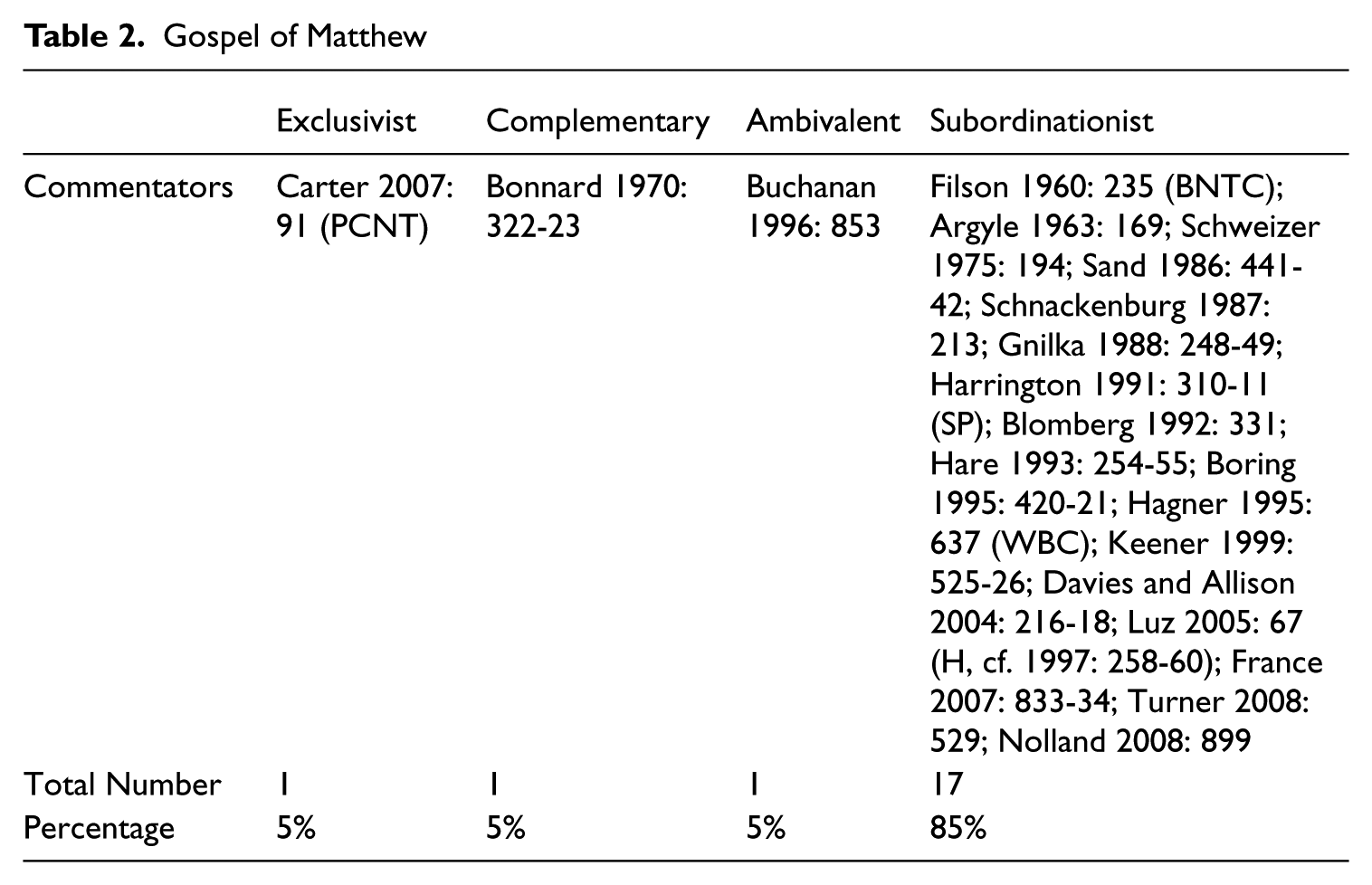
As a final point of analysis, it is worth focusing on the trends among commentators for each of the Synoptic Gospels (see Tables 1–3). The tables below present the positions of twenty commentators in English as well as several German and French language commentaries. The tables also present the positions of seven major English language commentaries: Hermeneia (H), the Post-colonial Commentary on the New Testament (PCNT), Word Biblical Commentary (WBC), New Testament Library (NTL), Sacra Pagina (SP), Anchor Bible (AB) and Black’s Commentary Series (BNTC). In the case of Matthew, the data set does not list the AB commentary since the authors (Albright and Mann 1971) do not provide a substantive interpretive comment. The NTL monograph on Matthew is not yet published.
Gospel of Mark

Gospel of Matthew
Gospel of Luke
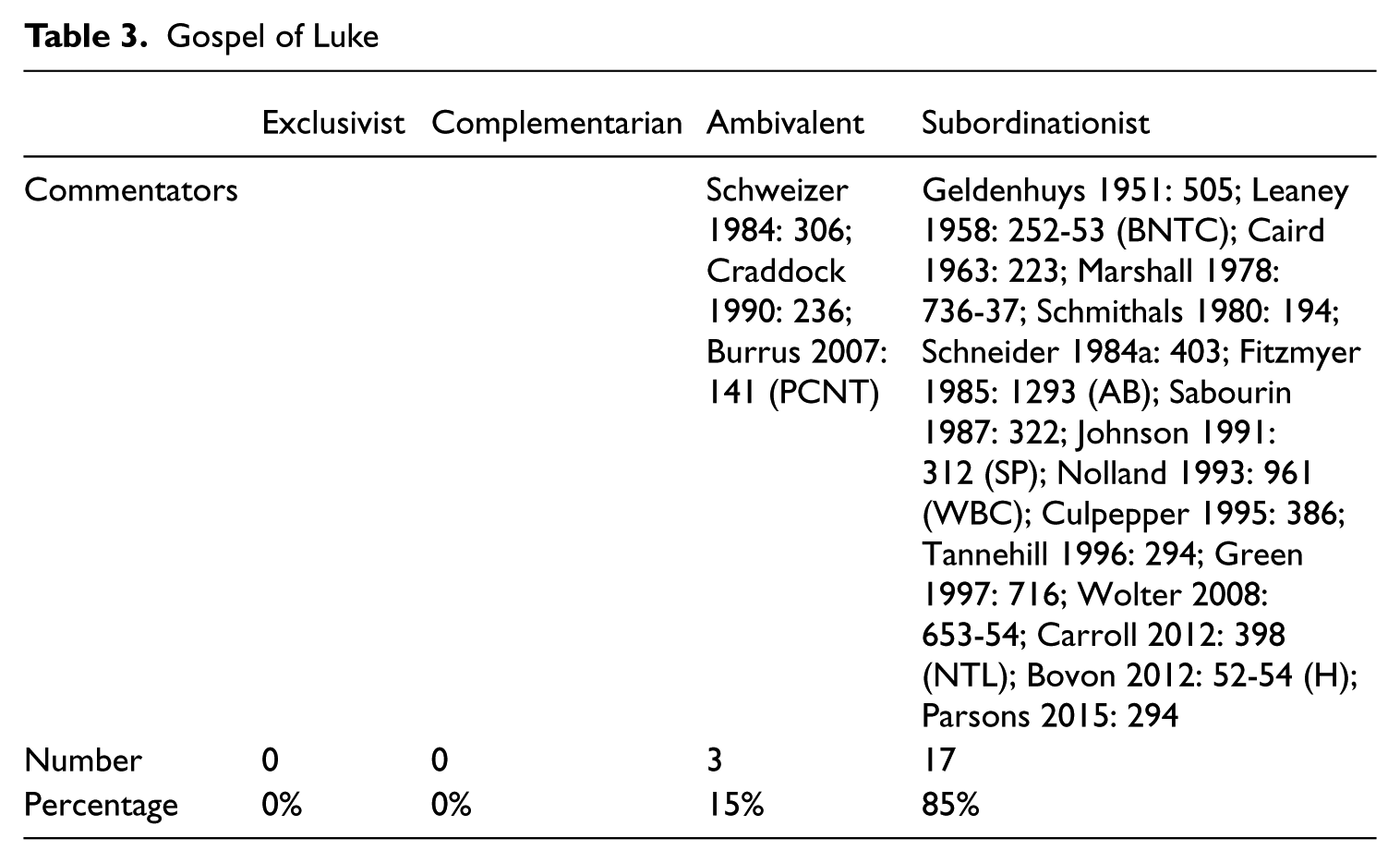
Each table includes the number and percentage of post-Second World War commentators that subscribe to the four positions outlined above ([1] exclusivist = things of God nullify things of Caesar; [2] complementarian = things of God and Caesar in parallel; [3] ambivalent = things of God and Caesar unclear in definition and relationship; [4] subordinationist = things of God prioritized over things of Caesar, both upheld).
One thing that is immediately clear is that the majority of commentaries subscribe to the subordinationist position. Although it is worth noting that ‘[t]ruth and cogency of arguments…have nothing to do with the number of scholars holding a certain stance’ (Bermejo-Rubio 2013: 20; repeated in 2014: 3), it is still striking to note this trend. Of the nineteen commentaries from the seven major commentary series, fifteen were subordinationist (79%), three ambivalent (16%), and one exclusivist (5%). It is worth noting that the examples taken from the ‘Post-colonial Commentary on the New Testament’ subscribe to the subordinationist, exclusivist and ambivalent readings, demonstrating the varied outcomes which emerge from the application of post-colonial criticism.
Once more, it should be reiterated that these interpretive categories do not necessarily act as mutually exclusive or incompatible forms of thought. Two examples will suffice to highlight this point. First, Burrus’s position in the PCNT on Luke seems to comport with three of the readings outlined here—the exclusivist, ambivalent, and subordinationist positions. In similarity to the exclusivist readings, Burrus argues that Jesus does object to the taxation and the coin, so that the accusation in Lk. 23.2 has an air of truth to it. Yet the comment is also ‘deliberately duplicitous’ and ‘veiled in ambiguity’ (2007: 141). Finally, Burrus overlaps with ‘hard subordinationist’ readings when commenting that the radical element of the command arises from the fact that Jesus is demanding the return of the coin, even as he denounces the Roman economic system and its imperial exploitation (Burrus 2007: 141). Second, France’s reading is also hard to pin down (2002; 2007). In similarity to the complementarian reading, France notes that the ‘pronouncement assumes that there is no clash between the legitimate claims of Caesar and of God’, although he does note that there are occasions when conflict is inevitable (2002: 466). France’s position comes close to Derrett’s here. Yet France aligns most closely with the ‘softer’ end of the subordinationist spectrum as he notes that Jesus’ answer is ‘an answer no Zealot could have given’ (France 2002: 466). Finally, in similarity to the ambivalent readings, France observes that Jesus ‘gives no specific guidance as to what is one’s obligation to each party’ (2002: 466; see also Marcus 2009: 826; Boring 1995: 420-21; 2006: 335-36). This open-endedness has bounds to it, of course, but ultimately it is left to the judgment of the reader to exercise appropriate discernment in any given situation (cf. also Boring 2006: 335-36).
6. New Avenues for Research
Having assessed the major currents within the interpretation of the ‘render’ command, the discussion now turns to outlining four potential avenues of research for those considering the command in future study. The first avenue relates to several questions concerned narrowly with the tribute passage in its historical context. The second fertile area for future research pertains to the history of interpretation of the command, and the third and fourth to work that is being conducted in the adjacent fields of classical rhetoric and Roman popular morality.
First, the discussion has already noted at least three areas of investigation which more narrowly relate to the tribute pericope in its historical context. These are worth highlighting once again for the benefit of future investigation. First, scholars might wish to consider which texts, historical events and traditions should inform readings of the tribute passage and ‘render’ command in their historical context. How might one go about adjudicating between these in a methodologically rigorous way? Second, given the variety of conclusions surrounding the semantic range of terms such as κῆνσος and ἀποδιδόναι, interpreters might wish to circumscribe this data by re-examining contemporaneous usage of these words. Third, and in light of Eck’s groundbreaking work (2010), future study might explore the implications for the ‘render’ saying of numismatic evidence from Roman Palestine. What is the evidence for early Jewish attitudes towards Roman taxation in our period? There still appears to be a wealth of numismatic data to be evaluated.
Second there is still much work to be done on the history of interpretation of this command, particularly in challenging overly simplified conceptions of the interpretive history. What this assessment of post-Second World War interpretations of the ‘render’ command has revealed is the enduring importance of the political framework for the command. Scholars still operate on the principle that the command discusses the respective arenas of power ruled by God and Caesar (or the church and the state). That the political import of the command continues to pervade scholarship is most obviously the case with complementarian and subordinationist readings, but it also rings true for anti-imperial, exclusivist interpretations. With these readings, the God-Caesar framework endures. Caesar’s domain is delegitimized, but a domain belongs to Caesar nonetheless since God’s kingdom can only exist over and against the Roman empire. Even readings which divest the command of any political application (Collins 2007; van Iersel 2004) react against an assumedly political framework for the command. How does this recent focus on religio-political power compare with the previous centuries of interpretation? In his comment on Mt. 22.21, Luz observes that ‘the issue in this text is precisely not a determination of the relationship of Jesus or of his followers to the state. To that degree the most important concern with the text in the history of interpretation completely misses its intention’ (Luz 2005: 67). Luz appears to portray the history of interpretation in an overly singular way, especially considering recent work on patristic interpretations that highlights some of the less obviously socio-political applications of the command (Bori 1986; Rizzi 2009; 2010: 227-34; Burke forthcoming).
Accordingly, there is still much work to do in terms of contemporary theological interpretations of the command, which might look to patristic interpretations for resourcing such readings. Those ambivalent readings that are reliant on ancient rhetorical theory have taken initial strides towards noting the open-ended nature of the gnomic utterance. Yet, by assuming that there is no genuine alternative to political applications of the command, the rhetorical readings ignore a wealth of other non-political ways of reading the command in earlier scholarship (see for an earlier instance of the co-existence of political and non-political readings Knabenbauer 1922: 254-55). Moreover, by considering political applications to be necessarily harmful, contemporary appreciation of the rhetorical genre of the pronouncement story differs radically with the previous history of interpretation in which political and non-political readings often sat side-by-side (see Origen, Hom. in Luc. 39 in Lienhard 2009: 161; see Knabenbauer 1922: 254-55 and Meyer 1883; 1890: 380-81, both of whom exhibit a concern among nineteenth-century commentators to place one’s own interpretations in dialogue with previous readings). The bounded diversity in the early use of the command challenges Luz’s claim that the history of interpretation of the command has been concerned solely with discussions of political and religious power (Luz 2005: 67). The examination of the ‘render’ command’s history of interpretation might encourage other scholars to become better acquainted with the multiplicity of applications and so be in a better position to critically evaluate the claims made, for instance, by Luz (for a clear example of this in relation to a different theme, the ‘Johannine Jews’, see Azar 2016).
One specific area of the history of interpretation to which scholars might wish to attend is the use of Old Testament intertexts. The extent to which the Synoptic texts permit or intend such intertextuality remains a live and interesting hermeneutical question. Beyond the concerns of what the Historical Jesus or the Synoptic authors meant by the phrase, there are also the doctrinal purposes to which later readings put this text (for the significance of the afterlife of scriptural texts, see Bockmuehl 2006: 66). The ‘render’ command contains a long interpretive history that remains relatively understudied. In particular, my own research explores patristic combinations of the ‘render’ command with other texts to fuse new ‘cotexts’. Such exegetical strategies mirror practices of non-Christian Greek and Latin readers of Homer (van der Valk 1963–64) and rabbinical readings of the Mishnah (Samely 2002). Cotextual practices refer to the processes of fusing two passages (linked by catchword or some other un/known criteria) to form a new textual unit of meaning (Samely 2002). It would be impossible to discuss all the proposed intertexts for the tribute pericope (see Förster 2012: 226-81). One example, however, is pregnant with interpretive potential: Gen. 1.27 (‘So God created man in his own image, in the image of God he created him, male and female he created them’).
The North-African, Church Father Tertullian (ca. 155–220 CE) was arguably the first to read the εἰκών in a parallel fashion (De Idolalatria 15.3; Scorpiace 14.2; De Corona 12.4; De Fuga in Persecutione 12.10; Adversus Marcionem 4.34.8). Tertullian creatively proposed that just as the ‘image’ on the coin meant that it belonged to Caesar, the human person (homo) bears God’s image and so belongs to God. Several interpreters have picked up on this insight—some consciously noting the history of interpretation (Giblin 1971: 525), with others not referencing it (Edwards 2002: 364; Bornkamm 1960: 123; Anderson 1976: 275-76; Pesch 1979: 227; Just 1997: 773 with a Christological note). Yet this reading has not been without its detractors (Gundry 1994: 700; France 2002: 469 n. 39; Boring 2006: 335; Marcus 2009: 818). Marshall notes that the observation that man belongs to God remains ‘a (correct) theological deduction from the saying [rather] than an inherent element in the argument’ (Marshall 1978: 736). Moreover, the comparison is between God and Caesar rather than the coin and the human person (1978: 736). For Förster, the fact that the imago dei contained no significance to New Testament authors in general speaks against its importance for the Evangelists and the historical Jesus (Förster 2012: 174; cf. Jervell 1960: 295 n. 409). Beyond the appropriateness of this intertext for the first readers, the use and combination of scriptural passages such as Gen. 1.27 in the early reception of the command remains a fruitful hermeneutical and exegetical road for future exploration.
The third and fourth areas for further research relate less narrowly to the pericope at hand, and instead focus on issues that relate to the arts and humanities more generally. Third, I submit that more attention should be paid to rhetorical units and their use by early Christian writers (see Tannehill 1981a, 1981b; Koch 2014). As Koch has noted recently, ‘The answer [of the ‘render’ command] is in the form of a gnome, that is, as a universally held saying, which wants to convey the basic life-orientation’ (2014: 222-23, my translation). Gnomes, or maxims, work like general principles which the reader must apply in concrete situations to solve specific problems. The maxim’s significance is ‘so general that its potential meaning must not be exhausted, but can also be applied to comparable questions’ (Koch 2014: 222-23, my translation). In the case of the ‘render’ command, as was seen above, the Sentences of Sextus demonstrate the application of the saying to less obviously political situations. Some commentators have at least implicitly recognized the gnomic quality of the utterance by observing that the command does not offer a universal rule of thumb, but rather encourages a degree of situation-specific application (Beare 1981: 440; Culpepper 1995: 386; Tannehill 1996: 294). This attention to the rhetorical unit of the maxim might explain the multiple applications of the command in the early Roman period. Future work must take into consideration the range of these applications (see for an appreciation of the additional theological resonances of the command within Renaissance Italy, Nygren 2016: 449-88).
Third, and very briefly, further appreciation of the command’s rhetorical genre holds significance for early Roman popular morality (see Roller 2004; Langlands 2011: 100-122; Morgan 2007: 122-59), and early Christian ethics, specifically. The use and reuse of maxims was not only a rhetorical exercise but also an ethical enterprise. Future studies might explore the extent to which it is appropriate to describe early Christian (including the Synoptic Gospels’) use of the ‘render’ command (and other sayings of Jesus) in terms of ‘situation ethics’ (see Morgan 2007: 179-82; Langlands 2011: 100-122). In these and the multitude of other ways in which research could continue, it is clear that this short and enigmatic phrase still has manifold riches to render to its readers.