




Abstract
Research and management efforts in the area of intimate partner violence (IPV) have primarily focused on male perpetrators and female victims, resulting in more limited knowledge of female IPV perpetrators and their male victims. In the current study the violence risk assessments of police officers were examined in order to outline the characteristics of female perpetrators of IPV and their male victims. In addition, the officers’ assessments of violence risk and proposed risk management strategies are presented. Results reveal some similarities between the female perpetrators and male victims and their more studied counterparts. However, differences appear to be present in the perceived violence risk posed by the perpetrators and the violence risk management strategies proposed to reduce that risk and protect the victim. The results suggest a need for further research in the area, particularly with respect to the violence risk assessment and management of female IPV perpetrators.
Introduction
Intimate partner violence (IPV) can be defined as ‘the actual, attempted, or threatened physical harm of a current or former intimate partner’ (Kropp et al., 2005: 1). Even though this definition, like others, does not specify the gender of the perpetrator and victim, the IPV literature and intervention efforts to date have predominantly focused on male perpetrators and female victims (Henning and Renauer, 2005). Although IPV perpetrated by males toward females may result, on average, in more severe injuries to the victim (Henning and Feder, 2004; Melton and Belknap, 2003; Tjaden and Thoennes, 2000), as well as more arrests and criminal justice system involvement (Babcock et al., 2003; Simmons et al., 2005), many studies have shown that female-perpetrated IPV is equally and sometimes even more prevalent.
A number of empirical studies and literature reviews have found that, regardless of the population examined, reciprocal abuse is common and that females and males perpetrate IPV at similar rates (Dutton et al., 2005; Graham-Kevan, 2009; Hines and Douglas, 2009; Kwong et al., 1999; Langhinrichsen-Rohling et al., 1995; Simmons et al., 2005). Some studies have even found higher rates of IPV perpetration among females (Archer, 2000; Stets and Straus, 1990; Whitaker et al., 2007; for a review, see Graham-Kevan, 2009).
Despite evidence of the existence of female-perpetrated IPV, much less is known about these women and the violence they perpetrate compared to their male counterparts. Some researchers suggest that the reason for this dearth of information is that the perception of IPV has not allowed for female perpetrators (Hines and Douglas, 2009). Owing to the controversial nature of the topic, much time has been spent debating the existence of and motivation for female-perpetrated IPV (for a discussion, see Straus, 2009). This controversy is longstanding and well known to those in the field. Some authors have offered hypotheses attempting to reconcile this controversy and account for the violence that studies supporting each side of the debate have found to be present (Johnson, 2008). The aim of the present paper is not to speak on this debate. Instead, our aim is to describe the characteristics of women arrested for IPV and the nature of the IPV that they committed so as to move forward the field, for, as other authors have suggested and our sample demonstrates, women are being arrested for IPV. This fact creates some urgency with respect to learning more about these women in order to provide effective violence risk management and treatment. In other words, the legal system must have knowledge of the population it is seeing in order to effectively provide services and prevent future violence (Goldenson et al., 2009; Hines and Douglas, 2009). We will first, however, outline some of the research that has been conducted to date on the nature of IPV committed by females and the characteristics of those perpetrators.
Proponents of feminist theories typically characterize violence by females towards their male intimate partners as self-defence (see Henning et al., 2003, for an example). However, studies have found gender symmetry in both violence perpetration and self-defence (Graham-Kevan, 2009). For instance, Robertson and Murachver (2007) found gender symmetry in IPV frequency, severity and injury, although variation was found in the type of physical violence, where females were more likely to throw objects, push and kick, and men were more likely to use strangulation.
Attitudes and beliefs supportive of IPV (including patriarchy, sexual jealousy, possessiveness, misogyny and minimization and denial of past violent behaviour) are commonly found among male perpetrators (Kropp et al., 2005). Similarly, some female attitudes related to IPV perpetration have been uncovered, although not surprisingly most differ from those related to violence among men. Such attitudes include victim-blaming, socially desirable responding (such as claiming self-defence), holding traditional gender beliefs and denial (Bookwala et al., 1992; Henning et al., 2005; Mihalic and Elliott, 1997; Robertson and Murachver, 2007). Researchers have also found a link between attitudes condoning violence and female IPV perpetration (Gray and Foshee, 1997). However, this finding has not been universally supported (Bookwala et al., 1992; Kane et al., 2000).
Non IPV related forms of adolescent and adult aggression and criminality have been found to be prevalent among female perpetrators of IPV (Moffitt and Caspi, 1999). However, the prevalence of such behaviour is lower among female perpetrators than it is among male perpetrators (Henning and Feder, 2004; Henning et al., 2009).
The strength and nature of the relationship between substance use and IPV perpetration is less understood for females than it is for males (Sullivan et al., 2009), where it is widely accepted to be strong and positive. Some studies suggest that substance use is more common among men (Henning and Feder, 2004), although others have found gender symmetry (Busch and Rosenberg, 2004). Several studies have found substance use at the time of the index offence and substance abuse generally to be present in a quarter or more of IPV cases involving female perpetrators (Caetano et al., 2001; Conradi et al., 2009; Stuart et al., 2003). However, others have found that, when aggression and previous victimization among female perpetrators are examined separately, the relationship between perpetration and substance abuse disappears (Anderson, 2002; Martino et al., 2005; Sullivan et al., 2009). This suggests that substance abuse may be a consequence of victimization and may not fuel aggressive behaviour among female IPV perpetrators as it does among males (Sullivan et al., 2009).
A history of victimization, through witnessing and being the victim of violence in childhood and being the victim of IPV as an adult, has been found to increase the risk of IPV perpetration among females (Bergen et al., 2004; Conradi et al., 2009; Langhinrichsen-Rohling et al., 1995; Sullivan et al., 2009; Tontodonato and Crew, 1992).
Research shows elevated rates of mental health problems, such as PTSD and personality disorders, among female perpetrators of IPV (Goldenson et al., 2007; Goldenson et al., 2009; Stuart et al., 2006). These findings indicate that personality disorders may be a risk factor for IPV among females, as they are among males (Graham-Kevan, 2009).
Although relatively little is known about female IPV perpetrators, even less is known about their male victims. Male victims of IPV evidence less fear of their female attackers than do female victims of their male attackers (Hamberger and Guse, 2002; Langhinrichsen-Rohling et al., 1995). However, males possess similarities to female victims in that they also show elevated negative symptoms (for example, depression, stress, psychosomatic symptoms and general psychological distress). It is, however, unknown whether these symptoms precede or follow victimization (Cascardi et al., 1992; Simonelli and Ingram, 1998; Stets and Straus, 1990).
One of the reasons that it is important to identify the characteristics of female IPV perpetrators is so that violence risk management strategies can be tailored to mitigate or target those characteristics for treatment. Information on the case management of female IPV perpetrators is limited, describing primarily basic legal interventions such as arrest and sentencing. Women are increasingly being arrested for IPV, currently comprising as much as a quarter of all IPV-related arrests (Henning and Renauer, 2005; Hirschel and Buzawa, 2002; Swan and Snow, 2002). Many researchers cite mandatory arrest policies as the reason for this increase. Since the implementation of mandatory arrest policies in the United States, arrests of women have increased proportionally more than those for men (Chesney-Lind, 2002). Mandatory arrest policies require police officers to make arrests in IPV cases where evidence of violence perpetration exists, regardless of the victim’s wishes. Such policies are thought to be beneficial because they remove individual officer discretion and blame from the victim since they are no longer the ones pursuing charges. Although arrests have increased, research to date on case management indicates that females who perpetrate IPV against men are treated more leniently by the criminal justice system than men or females arrested for domestic offences against victims with whom they share another type of relationship (family or homosexual) (Henning and Renauer, 2005).
Information about perpetrator and victim characteristics that lead to improved violence risk management strategies will ultimately reduce future violence by preventing recidivism from known perpetrators. Findings related to IPV recidivism have been mixed. Two studies have found lower rates of recidivism among female perpetrators compared with males (Renauer and Henning, 2005; Wooldredge and Thistlethwaite, 2002), one study found equal rates (Muftic and Bouffard, 2007) and another found that men were twice as likely to recidivate as a suspect in a new IPV offence and that females were more than five times as likely to be the victim in a subsequent IPV report (Henning et al., 2009).
Current study
The current study examines the characteristics of female IPV perpetrators who have come to the attention of police via arrest for IPV and the characteristics of their male victims. In addition, we investigate how police proposed to manage the risk they deemed present in those cases. Given the descriptive nature of the present study and the limited research in this area, particularly with respect to violence risk management, we made no predictions regarding the results, except that we do not expect them to deviate substantially from the research presented above.
Method
Overview
Approximately half of the sample (n = 52) was collected at the same time and using the same procedure as outlined in Belfrage et al. (2012). This half of the sample will hereafter be referred to as the SARA sample because data collection was completed using the Spousal Assault Risk Assessment guide (SARA; Kropp et al., 1994, 1995, 1999). The second half of the data (n = 54) was collected at the same time and using the same procedure as outlined in Belfrage and Strand (2008). This half of the sample will hereafter be referred to as the B-SAFER sample because data collection was completed using the Brief Spousal Assault Form for the Evaluation of Risk (B-SAFER; Kropp et al., 2004, 2005, 2010). Both studies analysed only male IPV perpetrators and the present study examines only the female IPV perpetrators from the samples. Female perpetrators comprised 11 percent of the SARA sample and 9 percent of the B-SAFER sample. The methodologies of both samples will be briefly summarized again herein. For more in-depth information about the violence risk assessment tools used and their validity, readers are referred to the aforementioned studies since the present study is descriptive in nature and therefore does not include this information.
The SARA sample was collected from three counties in Sweden (Kalmar, Växjö and Blekinge) and the B-SAFER sample was collected from two Swedish counties (Kalmar and Södertörn). Sworn officers of the Swedish national police in these counties were trained in the use of the SARA and later the B-SAFER (by Henrik Belfrage or P. Randall Kropp). The officers used the SARA or the B-SAFER in all reported IPV cases to assess violence risk and develop case management plans. After attending IPV calls and completing an investigation, the officers completed the SARA or the B-SAFER and recommended violence risk management strategies based on their assessments. The officers then reviewed this information with a supervisor prior to filing it in records.
For research purposes, we retrieved official police records and completed an audit of all spousal assault cases in all five counties responded to by police over a period of 18 months, beginning in 2000, for the SARA sample and over a period of 20 months, beginning in 2005, for the B-SAFER sample. The following information was coded from police records in each case: demographic data, the SARA or B-SAFER risk assessment and management plans filed after the initial investigation, whether there were any further complaints of IPV made to police involving the same perpetrator during the 18 or 20 months following the initial response by police, and new SARA or B-SAFER risk assessments and management plans filed as a result of any further complaints of IPV. The research was done in cooperation with and received approval from the Swedish national police.
Cases
All cases from the two samples in which there was a female perpetrator were included in the present study (n = 106). IPV was defined, as it is above, as any actual, attempted or threatened physical or sexual violence against a past or current intimate partner. For the sake of brevity, we will refer to the women who were investigated for complaints related to IPV as perpetrators and to the men who were their current or former intimate partners as victims. However, it should be noted that in a small percentage of cases (4 percent) the male partners of the female perpetrators were also arrested for IPV at the same time as their partner.
Procedure
Both the SARA and the B-SAFER are sets of structured professional judgement guidelines for assessing risk of IPV (Kropp et al., 1999; Kropp et al., 2005). Both guidelines were developed based on a systematic review of the scientific literature as well as consideration of existing standards of practice, ethical codes and legal principles. Both instruments were used here for descriptive purposes. The SARA comprises 20 risk factors, or items, in 4 domains (see Table 1). The B-SAFER is a shortened version of the SARA, more recently developed for use by police officers. The B-SAFER was shortened to reflect the time constraints faced by police and the number of risk factors in the SARA that required in-depth knowledge about mental health issues. The B-SAFER contains 10 risk factors in 2 domains; more recently a third victim vulnerability domain was added, with 5 risk factors related to the victim that increase the risk of continued violence (see Table 1). Where possible, items in the SARA and the B-SAFER were collapsed in order to describe the entire sample. Where item definitions prohibited this, the samples were analysed separately.
Risk factors from the SARA and B-SAFER and collapsed items for analysis

Notes: SARA = Spousal Assault Risk Assessment guide (Kropp et al., 1994, 1995, 1999). B-SAFER = the Brief Spousal Assault Form for the Evaluation of Risk (Kropp et al., 2005, 2010).
For both instruments the presence of each risk factor is coded on a three-point scale: present (that is, evidence indicates that the factor is present), possibly or partially present (evidence indicates that the factor is possibly or partially present, that is, evidence is present but inconclusive) and absent (there is no evidence that the factor is present). Because these instruments are being used for descriptive purposes only in this study, the presence ratings were collapsed into two categories – present and absent – where present included possibly or partially present. Scoring the instruments requires that two separate ratings be made for each item. SARA items are rated on their presence during the perpetrator’s lifetime and whether they are critical to risk. B-SAFER items are rated on their presence in the past (past ratings) and their presence during the four weeks prior to the evaluation (current ratings). For the current study, SARA presence ratings were used and B-SAFER past and current ratings were collapsed into one rating where the presence of one or both ratings was considered present for that item.
Based on the case information and their SARA or B-SAFER ratings, all of the police officers also made summary risk ratings on a three-point scale: low, moderate or high risk. For both the SARA and the B-SAFER, judgements of acute or immediate violence risk were made; two additional risk judgements of future violence risk and lethal violence risk were also made by the officers who used the B-SAFER.
Finally, taking into account the risk factors and risk level of the case they were handling, the officers suggested and documented the violence risk management strategies (strategies designed to reduce violence risk or protect the victim) that should be implemented in the case. In Sweden, three violence risk management strategies are mandatory, officers must check police databases for both prior convictions and weapons possession and, if there are children in the home, they must inform social services. Any additional management strategies are up to the discretion of the officer. The same risk assessment and management procedure was followed when any of the perpetrators recidivated by committing another act of IPV.
Results
All of the perpetrators in the sample were female and all of their victims were male. At the time that the police became involved in the cases the mean age of the perpetrators was 36 years (SD = 10.97) with a range of 18 to 59 years of age. A minority of the perpetrators (n = 29, 27 percent) and victims (n = 20, 19 percent) were not born in Sweden or had parents who were not born in Sweden. In the B-SAFER sample, all of the perpetrators and victims were categorized as partners. In the SARA sample, 23 of the perpetrators and victims (43 percent) were cohabitating, 19 (35 percent) were married and 11 (20 percent) were girlfriend and boyfriend (information was missing in one case). In the majority of cases (n = 58, 55 percent) the perpetrator and victim had children.
As a result of their contact with the police, all of the perpetrators were arrested and charged. It should be noted that Sweden does not have mandatory arrest policies for IPV. The majority of the women were charged with one offence (n = 75, 71 percent), 23 (22 percent) were charged with two offences, 7 (7 percent) with three offences and 1 (0.9 percent) with four offences. The most serious, or ‘primary’ offence in each case was recorded (see Table 2). Only one perpetrator had a restraining order against her prior to the index offence.
Frequency of index charges

At the time of data collection Sweden did not yet have a specific law prohibiting stalking. Molestation was the typical charge for stalking or unwanted pursuit-type behaviour. The offence of molestation did not have a sexual component in this context.
Violation of a person’s integrity means that the person has committed several crimes against the victim and as a result has been charged with one overarching and more serious crime.
Actual, attempted or threatened violence was present in 87 cases (82 percent). Physical violence was present in at least 62 cases (59 percent). Owing to the nature of the ratings, this number represents the minimum amount of violence that occurred and is likely an underestimate of the true rate of violence in this sample. Police indicated that the violent acts, threats or thoughts of the perpetrators had escalated in frequency, severity or diversity in 40 cases (38 % 9 percent missing information). Of the perpetrators, 20 (19 % 5 percent missing information) had engaged in criminal activity, unrelated to IPV, at some point during their lifetime. Evidence of violent attitudes, including those that condone or excuse IPV, were present in 19 cases (18 % 14 percent missing information). Only one perpetrator had a history of violating court orders (0.9 % 2 percent missing information); this was the same individual whose index offence involved violating a restraining order.
Intimate relationship problems, evidenced by the lack of ability to establish or sustain stable intimate relationships, were rated as present for 87 perpetrators (82 % 6 percent missing information). Evidence of substance abuse problems, including alcohol and both licit and illicit drugs, was present among 27 perpetrators (26 % 14 percent missing information). Problems related to mental health, including impairments of mental and personality functioning (such as disturbances of thought or perception, intellectual deficits, and extreme anger, anxiety or impulsivity), were noted as present among 24 perpetrators (23 % 13 percent missing information). Employment problems, including a lack of legal employment, frequent job changes or poor job performance, and financial problems were rated as present among 22 perpetrators (21 % 16 percent missing information).
Owing to minor differences between the two instruments, we were unable to collapse all of the SARA items into the B-SAFER items (see Table 1). Thus, for the SARA sample alone (n = 54), 2 women (4 percent) were rated as experiencing homicidal or suicidal ideation (22 percent missing information), and 3 (6 percent) had witnessed or been the victims of violence in childhood or adolescence (33 percent missing information).
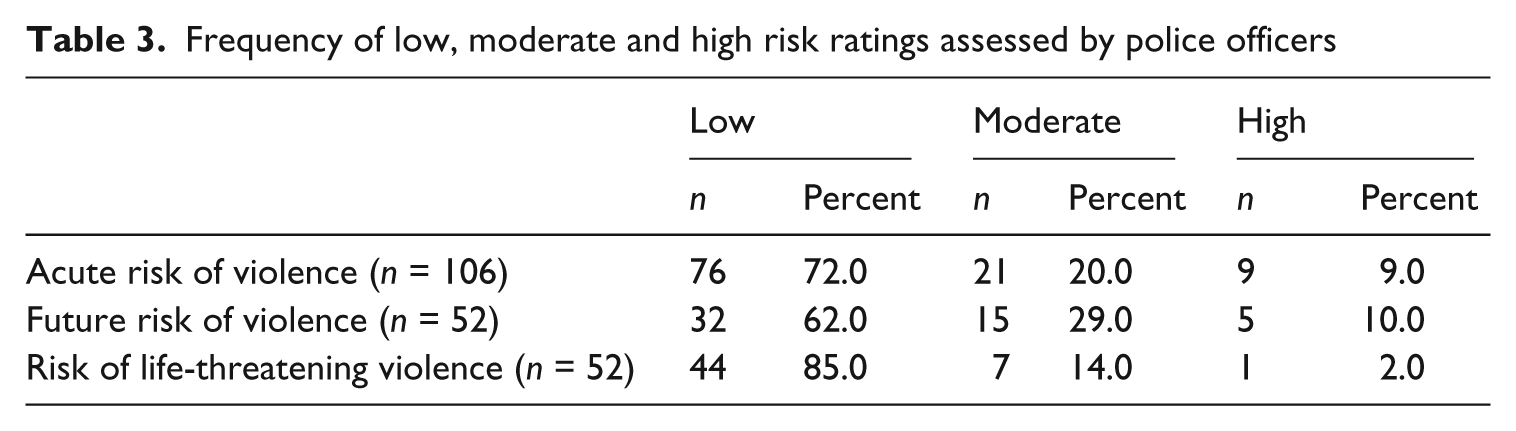
Acute or immediate risk of violence was rated by the officers in all cases, although future risk of violence and risk of life-threatening violence were rated only for the B-SAFER sample (see Table 3).
Frequency of low, moderate and high risk ratings assessed by police officers
Violence risk management
In order to gain information and manage risk, officers made attempts to interview the victim and the perpetrator in each case; however, since the interviews were voluntary they were not obtained in all cases. In 36 cases (34 percent) both the victim and the perpetrator were interviewed, in 31 cases (29 percent) only the victim was interviewed, in 15 cases (14 percent) neither individual was interviewed, and in 5 cases (5 percent) only the perpetrator was interviewed (17 percent missing information).
In 27 cases (26 percent), officers implemented more than the mandatory risk management strategies required in Sweden. On average, two (SD = 1.23) additional management strategies were implemented, with a range of 1 to 5 strategies. Restraining orders were requested in 6 cases (6 percent) (information was missing in one case). Legal aid was suggested in 4 cases (4 percent) in order to help victims navigate and understand the court process (4 percent missing information); providing this type of support to victims of IPV is common in Sweden. One victim contacted a shelter (11 percent missing information). All victims are given information about shelters. None of the victims were transported to a safe house by police.
Victim information
More detailed information about the victims was available only for the B-SAFER sample (n = 52). The majority of the men (81 percent) agreed to participate in the police investigation and agreed to have their complaint of IPV go forward through the criminal justice system. The same proportion of men also agreed to take part in risk management and safety planning with the police.
The majority of the men (n = 28, 54 percent) were considered by police to have inconsistent attitudes or to be engaging in inconsistent behaviour toward the perpetrator. Inconsistent attitudes include minimization or denial of the perpetrator’s behaviour, believing that violence is normal, blaming oneself for the violence, believing that the perpetrator’s actions are partially justified or that self-defensive violence is a good coping response. Inconsistent behaviours can include having direct or indirect contact with the perpetrator that sends ‘mixed messages’ (Kropp et al., 2008). Police found more than half of the men (n = 28, 54 percent) to be afflicted by personal problems. Personal problems can include mental health, substance use, employment and legal problems that interfere with the victim’s ability to engage in self-protective behaviour. In 14 cases (27 percent) police thought that the victim had inadequate access to resources, which can include lacking the knowledge, ability or motivation to seek out resources such as legal counsel and shelter. Police felt that 12 of the men (23 percent) had unsafe living situations, possibly owing to proximity to the perpetrator (if they continued to reside with the perpetrator), inadequate home security, or a lack of readily available emergency services. Finally, police rated 11 victims (21 percent) as being extremely fearful of the perpetrator, which includes being terrified that the perpetrator will escalate in their behaviour, cause them serious injury or seriously injure the victim’s children or other dependants. This fear is considered to be present only when it interferes with the victim’s ability to engage in self-protective behaviour.
Recidivism
Within the follow-up period of 18 or 20 months, depending on the sample, five women (5 percent) recidivated by committing a new IPV-related offence that resulted in contact with the police. Four of the women re-offended once and one re-offended 11 times. During their first encounter with police, the acute risk of three of the five women was rated as low, one was rated as moderate and one as high.
Discussion
The present study confirms some of the findings previously found in North American samples in a European sample and offers unique findings regarding male victims of IPV, IPV risk assessment and risk management by police. Our sample of cases involving individuals arrested and charged for IPV-related offences by the Swedish police confirmed the existence of female IPV perpetrators. Unlike other studies that found comparable rates of perpetration between the sexes, we found female perpetrators to be the minority. There are several possible explanations for this difference, including underreporting by male victims, officers being less apt to arrest females, officers being more prone to use alternative means of resolution with female aggressors, or females engaging in IPV at a lower rate than males in this population.
The current sample did not include any female homosexual couples. This is important to note because research has shown that the perpetration and experience of violence in homosexual relationships are different than in heterosexual ones (Bernhard, 2000). Thus, the results here should not be generalized to female perpetrators in same-sex relationships.
The perpetrators in this sample accrued a range of charges, the most common being assault or attempted assault and uttering threats. In addition, just under half of the cases involved an escalation in the frequency, severity or diversity of the IPV offences that the perpetrators had engaged in. These findings indicate that the cases were of a relatively serious nature.
In terms of the psychosocial adjustment of the perpetrators, the most common problem was in intimate relationships, which was present in the majority of cases, followed by substance abuse, mental health, and employment problems, all of which were present in about a quarter of cases. These problems indicate stressors and possible triggers of abusive behaviour, but they also represent treatment targets or areas in which assistance can be targeted to help these women reduce their offending behaviour. Witnessing or being the victim of violence as a child, although often found to be present among both female perpetrators and victims of IPV, was not common in the SARA sample in which it was assessed. It should be noted, however, that information regarding previous victimization was missing in a large proportion of the sample. Given these issues, this finding should be interpreted with caution.
The assessed risk of future violence in this sample was somewhat lower than would be expected for individuals arrested and charged for IPV-related offences. That being said, the only comparisons available are for male perpetrators. The predictions of lower risk may be accurate given previous findings of reduced recidivism and a more common outcome of victimization among female IPV perpetrators (Henning et al., 2009; Renauer and Henning, 2005; Wooldredge and Thistlethwaite, 2002). Alternatively, these predictions of risk may be artefacts of perception, meaning that police may perceive risk differently when assessing perpetrators with the same characteristics but different genders, and/or that police of risk may see male victims as less vulnerable. Another possibility is that the use of risk assessment tools designed for men could cause assessors to overlook important risk factors for female perpetrators, resulting in the perception that fewer risk factors are present.
Examining the applicability of violence risk assessment tools such as the SARA and B-SAFER for female populations is an important area for future research given that, rightly or wrongly, some professionals are using these instruments to assess and manage female perpetrators. Furthermore, should a double standard exist regarding the perception of risk based on gender, this would be important to identify and correct for the safety of victims. As mentioned in the method section, the B-SAFER was created for police since the SARA was not ideal owing to several items being time consuming and requiring judgements to be made about mental health. As such, officer ratings of such SARA items here should be interpreted with caution.
Results showed that the majority of the perpetrators and victims were living together and had children at the time of the offence. These are important factors to consider when managing risk because they represent ties between the victim and perpetrator as well as possible continued contact.
Information on the specific risk management strategies that were implemented in each case was limited. One of the biggest differences when comparing this sample with a sample of male IPV perpetrators was the limited number of restraining orders initiated herein (see Belfrage et al., 2012). In addition, only one of the perpetrators had ever violated a court order, suggesting a lack of court or restraining orders implemented for prior offences. Restraining orders are also often recommended or requested in stalking or criminal harassment cases (Meloy, 1997). However, restraining orders were not initiated for any of the eight victims of molestation in this sample. The reason for the absence of restraining orders is unclear, although it is again possible that there was a difference in the perception of risk owing to gender and therefore in the appropriate case management.
Other commonly used risk management strategies for female IPV victims (Belfrage et al., 2012), such as providing legal representation or transporting the victim to a shelter, were also rarely recommended in this sample. These results suggest that the management of male offenders is different from that of female offenders. This conclusion is not surprising given that many of the strategies (shelters, IPV treatment) available to female victims and male perpetrators are not available or not as prevalent for male victims and female perpetrators. It is important that we determine what strategies are available to and are used by male victims and female perpetrators of IPV and whether there is sufficient and diverse help and support available.
A limited amount of information was available from the B-SAFER sample about the male victims of IPV. Most of the men agreed to move forward with their case and to participate in risk management. However, over half also demonstrated inconsistent attitudes or behaviour towards their partner, indicating that, similar to female victims, men also find it difficult to move forward from abusive situations and not engage in self-blame or minimization. Like the perpetrators, most of the victims had personal problems. Approximately a quarter of the men showed extreme fear, had inadequate access to resources or lived in unsafe living situations. These findings represent both treatment and management targets for male victims of IPV that are highly similar to those of female victims.
Whether or not women commit acts of IPV in the same volume or to the same degree as men, there exists at least a subset of cases involving female IPV perpetrators that come to the attention of police. From the current sample we know that these cases are diverse and can be severe in nature. The results of the present study also indicate that cases involving female perpetrators and male victims may be handled differently from those involving male perpetrators and female victims. There are numerous reasons that this may be the case, including social perception, training and, more practically, the fact that risk assessment tools and management resources are not available for female-to-male IPV to the same extent that they are for male-to-female IPV. It is important that we acknowledge the existence of these cases and move towards determining how female perpetrators are being assessed, how male victims are being assisted and, more importantly, what gaps there are in these areas and how they can be filled.
Footnotes
Acknowledgements
Jennifer E. Storey was supported by a doctoral scholarship from the Social Sciences and Humanities Research Council of Canada.