



Abstract
The installation of CCTV cameras in the historic centre of Malaga in March 2007 was the main crime prevention initiative implemented in the city during the past few years. This was one of the first multi-camera CCTV installations on streets in Spain, which is why a proper evaluation of its effectiveness is so important for the future use of such cameras. Using a quasi-experimental design with a pre/post test, we collected data from interviews with CCTV operators, police officers and local authority officials and from surveys of pedestrians and shopkeepers. The team also examined police crime data and CCTV incident data. In this paper we will discuss the results in terms of the following three hypotheses relating to crime reduction, displacement and public security: (a) the use of cameras reduces the levels of crime, whether property crime (robberies and burglaries), crimes against people or both; (b) some of those crimes are displaced to nearby areas within or close to the city centre where there is no camera coverage but where there are similar opportunities to commit crimes; and (c) people claim to feel safer in the city centre after dark after the cameras were introduced.
Introduction
The wide acceptance and implementation in the United Kingdom of video surveillance in public places since the 1990s has allowed recent studies to claim that just in London, counting video cameras in public buildings or spaces together with those in businesses and shops with public access, there could currently be at least 500,000 video cameras. That is 1 for every 14 Londoners. If these numbers are extrapolated to the whole United Kingdom, there would be 4.2 million operating video cameras (Murakami Wood, 2009: 185–7; Norris and McCahill, 2006: 101–2). With respect to France, the rapid expansion of the use of closed circuit television (CCTV) since 1995 and its increasing speed since 2002 has meant that in 2007 approximately 300 municipalities, generally large urban centres, had operating networks of video cameras in public places, and it was a government objective to triple these numbers by 2009 (Hempfel and Töpfer, 2009: 172–3).
In Spain, there is an increasing tendency to use video surveillance in public places. Some municipalities, as a result of citizens’ demands, have decided to install CCTV cameras in public areas, mainly to stop the vandalism of monuments. This tendency has now halted owing to the economic crisis and the high cost of installing this surveillance system.
Some academic experts and privacy defenders believe that not everything is admissible to protect public space. The use of technological tools to prevent delinquency in public areas should be subject to strict controls. They should be limited to reducing crime, not used to tackle antisocial behaviour. And the right of free access to public places and the citizen’s right of privacy and intimacy should be strictly respected.
Several empirical studies show the effects of video surveillance in other European countries, in particular in northern and central Western Europe. There are, however, no studies of this sort in Spain. Hence, and given that video cameras were about to be installed in some areas of the historic centre of Malaga, our intention was to use this opportunity to design research that, following the common parameters of the studies carried out in other countries, would provide information on the effectiveness of the use of this device in crime prevention, as well as its effects on fear of crime in the controlled areas, compared with similar areas without this type of control.
CCTV on the streets of Malaga
The installation of CCTV cameras in the historic centre of the city of Malaga has been the main crime prevention initiative in recent years. Malaga is a coastal city in southern Spain. The city centre has a low resident population, although it has numerous shops, restaurants, nightclubs and offices, and it is partly pedestrianized. The city centre attracts large numbers of vehicles and people, including tourists. That is one of the reasons why police officers working in this area face a number of problems, including those associated with public order, personal security, crimes against property and against people, and traffic congestion.
The camera network in Malaga became operational in March 2007 with a total capital funding of €435,000, which came from City Hall. Initially, 17 high-resolution pan, tilt and zoom cameras with full night-time capability were installed within the two square miles of the main shopping area. The system records images in time-lapse mode, although operators can switch to real-time recording if necessary. Even though the police did not contribute either with capital funding or with maintenance costs, monitor and audio links were subsequently installed in the police station located in the main shopping square of the city. 1 The initiative to install cameras emerged from the shopkeepers. The purpose was to help Malaga become a safer place by tackling the problems of general street crime such as robberies, burglaries, damage and assaults. Thus, by using crime pattern analysis, different positions were selected where the cameras would be placed.
This was one of the first multi-camera CCTV installations in public places in Spain. Planning safer cities is a matter of growing concern. In Spain, the question of how to improve urban safety is nowadays one of the main issues on the political agenda. Nevertheless, there are also rising concerns about invasion of privacy and the possible expansion of state or police control. Public opinion has become worried about the potential misuse of surveillance cameras. There is no doubt that the presence of cameras in public areas can represent a significant increase in the level of surveillance in people’s daily lives. But people are mostly concerned about who is responsible for controlling the systems and the way in which these are used (Honess and Charman, 1992). In this sense, these concerns are not so much about the cameras themselves but about the impartiality and accountability of the people and organizations using these systems and how they are using the information they are getting.
Our study is the first to evaluate the effectiveness of CCTV in Spain. The research involves interviews with CCTV operators, police officers, local authority officials, pedestrians and shopkeepers, and an examination of police crime data and CCTV incident data. This study explores the data collected as part of a quasi-experimental evaluation of CCTV.
Objectives and research hypotheses
There are two key concerns relating to the effectiveness of CCTV as a measure of crime prevention: do CCTV cameras reduce the level of crime; if they do, is it at the cost of displacing crime elsewhere? Neither question has been answered satisfactorily yet. First, there is no agreement on the general effects of CCTV on the levels of crime: whereas some studies claim it reduces offending, in particular in closed places such as shops, buses, car parks and subways (Burrows, 1979; Poyner, 1988, 1991; Short and Ditton, 1996; Tilley, 1997), others argue that it has a temporary effect that produces crime displacement (Brown, 1995; Fyfe and Bannister, 1996). The level of contradiction in the findings of different studies may well indicate that CCTV sometimes ‘works’ and sometimes does not.
However, these preliminary studies suffer from several problems. First, they are financed by the UK Home Office, which raises some questions about the level of impartiality. Secondly, they limit themselves to observing the different levels of delinquency between the time prior to the implementation of the cameras and the period after. Lastly, they do not use control groups.
A few studies have carried out meta-analyses of some evaluations of the impact of video surveillance on the levels of crime. Welsh and Farrington (2002, 2003, 2004) analysed 17 UK and US studies; Gill and Spriggs (2005) worked on 13 studies carried out in the UK; and Welsh and Farrington repeated their research in 2009, including 41 evaluations carried out in the USA, the UK, Sweden, Norway and Canada. In every case they selected those studies that fulfilled a minimum methodological standard; for instance, those that measured crime rates in the area watched by video cameras before and after the intervention, and those where the research design included both an experimental area and a control area. In general terms, these meta-analyses reach the general conclusion that video cameras do not have a direct impact on the reduction of crime. The studies by Welsh and Farrington, which examine evaluations of programmes implemented both in city centres as well as in parking areas and residential areas, provide ambiguous results, since only studies carried out in the UK offer positive conclusions. Welsh and Farrington (2009)calculate a reduction in levels of crime of approximately 4 percent. Gill and Spriggs (2005), on the other hand, point out that the negative and positive effects of implementing video surveillance counteract each other.
Despite this confusing scenario, it can be established that, in general terms, these studies clearly indicate the lack of success of video surveillance in reducing crime. However, they offer other conclusions that have been of great use in the design of our project. The following are some of these specific conclusions:
Video surveillance systems do not have the same impact on all offenders; they have less effect on violent and impulsive crimes than on premeditated crimes.
These systems have very little effect in city centres and in residential areas (the positive effect in the UK is estimated to be around 2 percent, and it is nonexistent in cities in the United States), although they tend to reduce crime by at least 41 percent in garages, parking areas or closed places. These results seem to show that video surveillance is more effective in places of limited and controlled access. The effectiveness of cameras in reducing theft, robbery or robbery of objects from inside cars is noteworthy.
The effectiveness of video surveillance can be proportionally correlated with the coverage and the number of cameras installed.
The impact of video surveillance systems may depend on the country. It is shown that in the North American cities where they have been implemented the effect has been insignificant, in contrast to the UK. Similarly, they do not seem so effective in places where citizens are strongly opposed to their implementation, as occurred in Norway, Sweden or Canada.
The effectiveness of video surveillance can also depend on factors such as the organization of the command room that supervises the cameras (Norris and McCahill, 2006; Smith, 2004), the relationship between its operators and the police, and whether the cameras are fixed or mobile.
Video surveillance could cause a displacement of crime towards areas without cameras (Skinns, 1998).
We should not omit to mention that in the past few years there have been a significant number of studies that, in light of the scarce or nonexistent effectiveness of video cameras in reducing the number of crimes in the public spaces of specific cities, have increased their efforts to enhance the effectiveness of this technological preventive measure as an instrument of police investigation in explaining crimes and in calming the fear of crime among citizens (Ditton, 2000; Zurawski, 2007).
The main objective of this study is to provide information on the impact of CCTV on the level of delinquency on the streets, as well as on the level of citizens’ fear of crime. It also aims to establish whether the effects of the video surveillance, positive or negative, are limited only to the streets in which cameras are installed, or whether they also affect other streets nearby.
Our study intends to test the following three hypotheses:
The use of CCTV reduces levels of crime, especially property crimes (robberies and burglaries). In contrast, video cameras have a very small impact on crimes against people.
Crime is displaced to nearby areas within or close to the city centre where there is no video camera coverage, but where there are similar opportunities to commit crimes.
People claim to feel safer in the city centre after dark after the video surveillance was introduced.
Evaluation design
In order to carry out our research we decided to implement a quasi-experimental research design. Although all the information regarding the particular methodology used in this specific study has already been published (Miller, 2007), we comment in the following on the relevant details.
We identified an experimental area – that is, an area where video cameras have been installed in at least some of its streets – and a control area – that is, an area with similar characteristics to the experimental area but without video cameras. This design allowed us to isolate the impacts of using video cameras, which would have an impact only on the experimental area, from other possible impacts that are not produced by this intervention, such as economic factors, unemployment, police policies, etc., which would have an impact on both areas. The two areas under study are located in downtown Malaga. The experimental area is in the historic centre, whereas the control area is in the ‘Corte Inglés’ area. Both are shopping areas, separated by a river and with similar affluence of people and type of buildings.
With the purpose of studying the possible effects of crime displacement we chose 20 sites in each of the areas (40 sites in total). Each site in each area had its equivalent in the other area (see Figure 1). In order to pick the equivalent site we considered the size of the street, the clustering of shops and restaurants and its distance in relation to the shopping area. Thus, we have distinguished between, in the experimental area, 10 sites located on streets with video cameras and another 10 sites on streets close to these but without video cameras, and, in the control area, 10 sites located on streets similar to those with video cameras and another 10 sites on streets with similar characteristics to the streets that are close to video cameras (see Table 1).

Relationship between sites in the experimental and control areas.
Distribution of the four different types of sites.

The working plan for this research adopted a combination of quantitative and qualitative methods. Other studies carried out in different countries have evaluated the efficacy of video cameras in reducing the levels of crime by using exclusively police data. However, police data are not trustworthy, so this study does not limit itself to comparisons based on the delinquency rates provided by official sources, but instead also incorporates data from victimization surveys and in-depth interviews. Our project had several stages:
Collection of police data
We studied registered crimes from the Ministry of the Interior in downtown area of the city of Malaga during the period April 2006 – March 2008. Specifically, we looked at the reports corresponding to a year prior to the installation of the video cameras (from April 2006 to March 2007) and a year after (from April 2007 to March 2008). The crimes that were analysed (a total of 6245) were homicide, injury, theft, robbery with violence or intimidation, robbery by force, theft from a vehicle or vehicle theft without intimidation or violence, robbery by force from a vehicle or vehicle robbery with violence or intimidation, damage, and drug trafficking.
Surveys of citizens
A total of 1280 surveys of citizens were carried out. The objective was to learn whether they had suffered any crime, as well as their level of fear and perception of crime. A first wave of surveys was carried out a year before the implementation of the cameras (March 2006), and the second wave was done a year after their installation (March 2008).
Surveys of shopkeepers
A total of 55 surveys of shopkeepers were carried out in the historic centre of Malaga after the implementation of the system. The objective was to learn whether they had suffered less criminal activity in their businesses and in general what their level of satisfaction was regarding video cameras.
Interviews with operators and those responsible for the video surveillance system
A series of interviews were carried out with both operators and those responsible for the video surveillance system. The intention was to obtain information on their perception of this crime prevention system and its possible impact, benefits and costs once implemented. Most of the results of this qualitative analysis have been included in a Spanish book on this study (Cerezo and Díez-Ripollés, 2010).
The impact of video cameras on levels of crime
In general terms, it can be asserted that the installation of CCTV cameras has barely reduced crime in the streets in which they have been installed.
Let us begin by analysing the police data. A total of 3048 offences occurred during the first year under study (April 2006 – March 2007) and a total of 3197 during the second year (April 2007 – March 2008). The monthly mean number of crimes was 260. The experimental area where the video cameras were installed shows higher criminal activity in both periods than the control area, as can be observed in Table 2.
Total number of offences in each area.

If we analyse the two periods under study (2006–7 and 2007–8), the results verify that in the experimental area the number of offences increased by 5.0 percent from one period to the next (1737 during the first period and 1828 during the second). This tendency is repeated in the control area, although to a lesser extent (+3.7 percent): 1311 offences were reported during the first period and 1362 during the second period.
If we carry out a more detailed analysis in the different sub-areas, we can appreciate that in those areas with video surveillance the impact on delinquency is barely noticeable (−1.9 percent). However, in those areas close to the streets with cameras we find that criminal activity increased significantly after the installation of the cameras (+14.6 percent). This increase can also be clearly observed, although to a lesser extent, in the streets in the control area with similar characteristics to the streets with cameras (+11.1 percent). All this can be observed in Table 3.
Total number of offences by area and period under study (before and after the installation of the video cameras).

Disaggregating according to the different types of crimes (see Figure 2), most of the reported crimes in both areas were thefts (74.4 percent) and, in second place, burglaries (10.3 percent). In fact, the ‘star’ crime in these areas, according to the information obtained from police interviews, is distraction thefts from bags, purses or mobile phones. Injuries have very little impact compared with property crimes (3.5 percent). In a more detailed analysis, if we compare before and after installing the video cameras and both areas under study, we can scarcely observe significant differences, except an increase in the number of burglaries, since in 2006–7 these constituted 8.6 percent of the total number of crimes, whereas in 2007–8 they increased to 11.9 percent. This increase is slightly more noticeable in the control area (+3.7 percentage points) than in the experimental area (+3.2 percentage points). Similarly, although to a lesser extent, we observe a reduction of 1.5 percentage points in the experimental area in the number of robberies with violence or intimidation.

Percentage distribution of different types of recorded crimes by area under study.
The surveyed citizens were asked a year before the installation of the video cameras (March 2006) and a year after (March 2008) if they had suffered any crime during the 12 months prior to the survey. The general victimization rate, comparing both waves, had reduced. That is, there was a slight decrease in victimization between 2006 and 2008. Whereas 20.2 percent said they had suffered a crime during the 12 months prior to March 2006, 19.4 percent declared the same in the second wave, in March 2008.
The experimental area presents a higher victimization rate than the control area (21.3 percent versus 19.0 percent). It is important to highlight that the general reduction of 0.8 percentage points in the levels of delinquency in the two areas between 2006 and 2008 must be relativized: whereas the experimental area shows a reduction of 2.2 percentage points, the tendency in the control area is the opposite, since the victimization rate increased by 0.7 percentage points. A more detailed analysis of these data, comparing the 40 sites of the two areas, enables us to reach more conclusive results. The reduction in the victimization rate is more significant in the experimental area in the streets with video cameras (−3.6 percentage points) than in the streets close to those with cameras (−0.9 percentage points). Moreover, there was a slight increase in the victimization rate in the control area, both in the streets with similar characteristics to those with video surveillance (+0.9 percentage points) and in those with similar characteristics to the streets close to cameras (+0.8 percentage points), as can be observed in Figure 3.
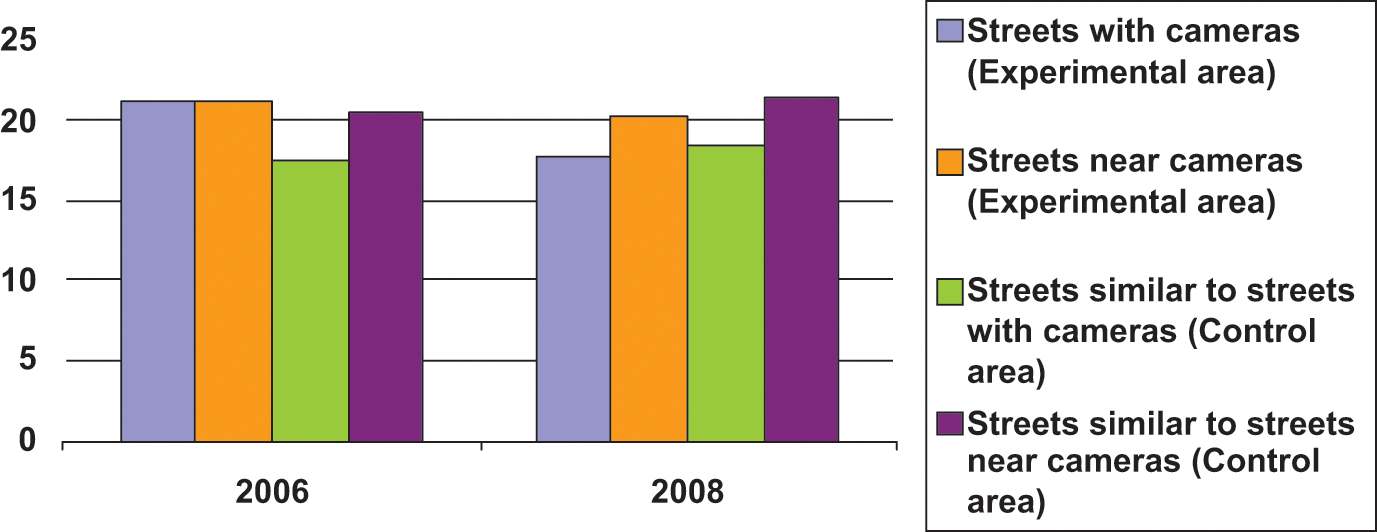
‘In the past 12 months, have you been the victim of any crime in this area?’.
Once again disaggregating according to the different types of crimes, the most frequently committed crimes, and with a large difference with respect to the rest, are thefts and robberies with violence or intimidation, which increased after the installation of the cameras, as can be observed in Figure 4. However, this increase was noticeably greater in the control area (12.5 percentage points) than in the experimental area (5.4 percentage points). Turning to the second most frequent type of crime, car theft, the tendency is different. In total these crimes diminished from one period to the next, although we must add that, whereas in the control area they were reduced by 6.2 percentage points, in the experimental area they increased by 1.1 percentage points. Regarding house robbery, this type repeats – more strongly – the tendency of thefts and robberies with violence or intimidation. Whereas in the control area in 2006 there were no cases, in 2008 these constituted 6.5 percent of the total number of crimes committed. Conversely, in the experimental area we observe a reduction of 3.2 percentage points. Something similar occurs regarding vandalism: between 2006 and 2008 it increased by 1.3 percentage points in the control area, whereas it fell by 0.3 percentage points in the experimental area. If we extend the analysis to crimes against people, we observe, in the first place, that they have a significantly lower level of occurrence in both areas. Moreover, there are no differences in tendencies between them. Injuries, which in general terms tended to decrease, represented 2.6 percent of the total number of crimes in the experimental area in 2006, whereas they are absent in 2008; in the control area they also decreased in 2008 (by 1.4 percentage points). Threats, which similarly decreased from one period to the next, represent in the control area 7.1 percent in 2006, whereas they are absent in 2008; in the experimental area the decrease is 0.3 percentage points.
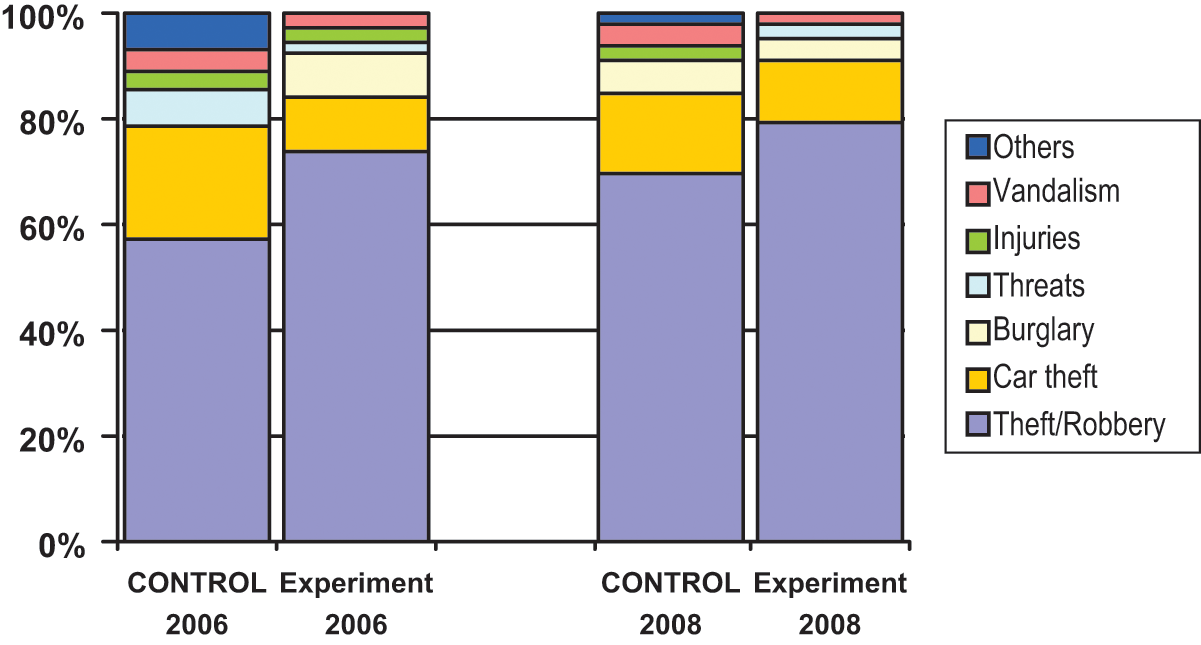
Percentage distribution of different types of crimes by area under study.
Perception of crime and fear of crime
The public
With the ultimate purpose of learning what are citizens’ perceptions of delinquency and their fear of being the victim of a crime, we showed them a card with the possible answers (they had to assign a number from 1 to 5, which ranged from very rare/none to very frequent/a lot). We did not observe a significant change in the perception of crime among the surveyed citizens before and after the installation of the cameras (see Figure 5). Regarding the perception of the frequency of crimes (‘With what frequency do you think these events take place on this street?’), there was a change in the experimental area from a mean of 2.72 to 2.67 and in the control area from 2.90 to 2.87. Regarding the fear of being the victim of a crime (‘How worried are you about being the victim of the following events in this area?’), there was a change in the experimental area from 3.13 to 3.11 and in the control area from 3.44 to 3.33.
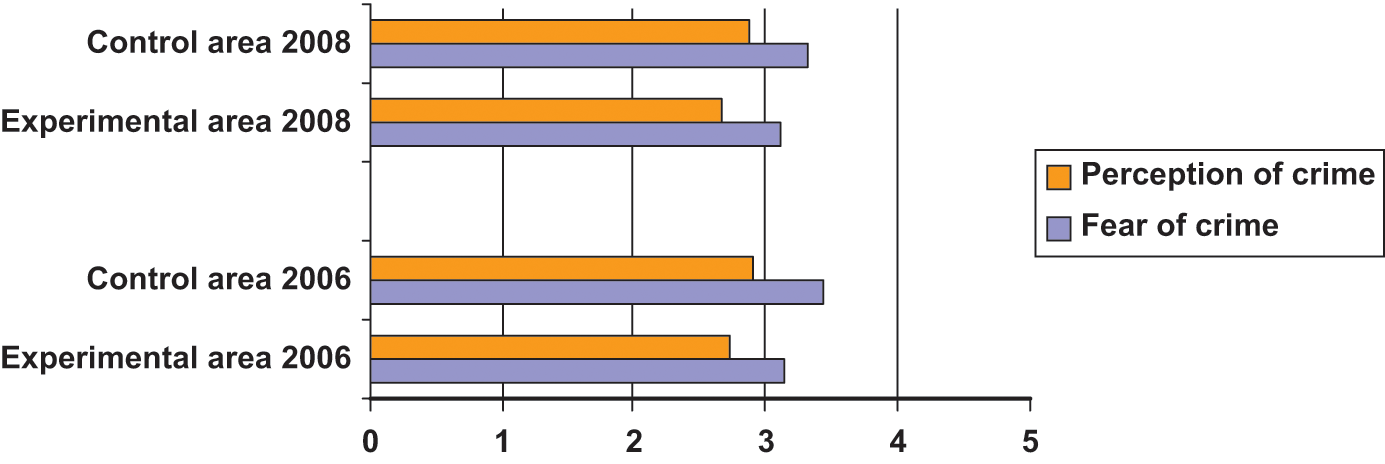
Perceptions of crime and fear of crime by area and period under study.
If we cross these questions with sociodemographic and situational variables we obtain the following results:
After the installation of the video cameras, men showed a greater fear of crime, practically at the same level as women.
There were no differences in terms of age between the two years under study. However, there was a clear divergence in worry about crime frequency between the younger and older age groups, the latter being the ones expressing greater worry.
Fear of crime is more noticeable among homemakers (women) and lower among students (young). It is important to highlight that in 2008 these numbers decreased in all categories – especially homemakers – with the exception of pensioners.
Regarding educational level, throughout the whole period under study those with elementary or secondary education showed higher rates in terms of both worry about crime frequency and fear of victimization.
Regarding the time of day at which the survey was carried out, the most significant data are that those surveyed at night had more fear of being victimized before the installation of the cameras.
Those who are more informed, that is, those who have daily access to news about crime, were clearly more afraid of being the victim of a crime throughout the whole period under study.
The shopkeepers
These same issues were presented to a random sample of shopkeepers with businesses on the streets of the historic centre with video cameras. We initially asked them about the level of security they perceived for their businesses after the installation of the video cameras. In general terms, shopkeepers expressed a greater feeling of security after the implementation of video surveillance. The most frequent level of perceived security on a scale of five possible options (a lot, quite a lot, the same, less, none) was ‘quite a lot’ (61.8 percent) or ‘the same’ (20.0 percent). They recognized that the cameras offer a greater level of peace of mind about their shops.
When asked about the frequency with which criminal events occur in general, 76.4 percent of the surveyed shopkeepers believed they are ‘very frequent’. If we enquire about particular crimes, robberies (20.0 percent) and vandalism (16.4 percent) stand out. If the question is framed in relation to the area in which their business is located, 72.7 percent considered that criminal events are ‘very frequent’. From a list of specific crimes (robbery, aggression, vandalism or drug trafficking), the majority said that robberies (41.8 percent) and vandalism (29.1 percent) are frequent in the area. If the question is framed in relation to the street of their shop, the numbers are barely altered.
The surveyed shopkeepers do not currently show worry about being victims of crimes: 87.3 percent are not worried at all. Perceptions are different when they are asked about specific crimes. Thus, with respect to theft, 89 percent of shopkeepers were still very worried that it would take place in their shop. To a lesser extent, this fear was also present regarding robbery with violence and intimidation (only 38 percent are worried a lot). The percentages are considerably lower when asked about threats and aggression: in both cases only 3.6 percent of those interviewed were very worried about being the victim of those crimes.
Public opinion on and awareness of video surveillance
During the second wave of surveys of citizens, carried out a year after the installation of the cameras on some of the streets of the historic centre of Malaga, two new questions were added to the questionnaire to find out if the surveyed people were aware of the installation of the cameras and to learn their opinion on their effectiveness in controlling delinquency. The results show that 71.8 percent of those surveyed knew that cameras had been installed on some streets of the historic centre; in addition, 85.5 percent said they thought the cameras were useful to control delinquency (see Figure 6).

‘Do you believe the installation of video cameras can control delinquency?’.
With regard to the surveyed shopkeepers, all of them knew that cameras had been installed on the streets in which their business was located. Almost half of those surveyed (49.1 percent) believed that delinquency had decreased since the installation of the cameras. Their opinion was not as optimistic as that of the citizens, which is probably owing to the fact that three-quarters of the surveyed shopkeepers said they had suffered a crime after the installation of the cameras. Despite this, 85.5 percent want the installation of more cameras because of their importance as a preventive measure against possible robberies from their business.
They were also asked about which were, according to them, the best measures for decreasing the levels of crime on the streets where they have their business. The various possible options, of which they could choose more than one, were: the installation of more cameras, an increase in police presence on the streets, an increase in the sentences for the crimes from which they suffer most, or the implementation of alternative night-time activities for young people. The police option was chosen most often, followed by an increase in sentences; the option of more cameras was only in the third place. The least popular option was the one that aimed to decrease juvenile delinquency in the long term; it was chosen by only 10.9 percent of those surveyed.
In general terms, in-depth interviews with operators and those responsible for the CCTV system showed a positive benefits/costs balance. They have the perception that the video surveillance system is a perfect tool, not only to dissuade offenders but also to detect them and mainly to provide evidence in court cases. Thus, all the operators have the impression that CCTV has had an important impact on reducing the crime rate in the city centre. In fact, Malaga City Hall is now studying the possibility of installing more video cameras on streets close to the monitored area and in some unsafe areas around the city.
Conclusion
After a year of implementation, the installation of a CCTV system on certain streets of Malaga has not significantly reduced criminal activity. On those streets, the data registered by the police indicate a decrease of 1.9 percent, and from our citizen surveys we can deduce a decrease of 3.6 percent. Nevertheless, the increase in criminal activity registered by the police on some of the streets close to those with video cameras, as well as in other streets with similar characteristics to the streets with video cameras, confirms a possible displacement effect.
The victimization rate also falls considerably less on those streets close to video cameras in relation to the area controlled by video cameras. This displacement is more evident regarding crimes against property than crimes against people, since with respect to the latter there were no significant differences between the experimental and the control areas.
These results to a great extent support the initial hypotheses of this study. With respect to the first hypothesis, we had predicted a decrease in the levels of delinquency in those places in which video cameras were to be installed, which has been confirmed. According to this same hypothesis, it was in particular the percentage of most property crimes that decreased in the experimental area, as opposed to the control area.
Regarding the second hypothesis, we proved a displacement of crime not only towards the streets adjacent to the area controlled by video cameras in the experimental area, but even towards those streets – in the control area – with similar characteristics to the streets with video cameras. We could argue that this displacement is directly caused by the installation of the video cameras and not by other factors, since criminal activity has barely changed on the streets that are further away, that is, those in the control area with similar characteristics to the streets adjacent to the area controlled by video cameras in the experimental area. We are aware that a year is not enough monitoring. In order to reconfirm the displacement hypothesis, further research is necessary.
The only hypothesis that could not be validated was the third. We did not observe significant differences between the experimental and control areas regarding perceptions of crime, in terms of either its frequency or the fear of being the victim of a crime. Nevertheless, we have been able to prove interesting variations regarding certain sociodemographic and situational variables. Among these, we highlight that the people surveyed at night showed greater worry about being the victim of a crime before the installation of the video cameras than after.
Lastly, most of those surveyed, both citizens and shopkeepers, knew of the existence of cameras on some streets of the historic centre and seemed satisfied with their efficacy. Specifically, shopkeepers recognized that the cameras offer greater peace of mind for their businesses and they want the installation of more video cameras because of their importance, according to them, as a preventive measure against possible robberies in their shops.
Finally, the results of this study, besides being in line with those obtained in other countries, show that the use of video cameras has very limited positive effects, focusing on certain types of crime and being partially counteracted by collateral effects in other related areas. On the other hand, the effects on fear of crime are not conclusive enough.
Footnotes
Acknowledgements
The research presented in this paper was conducted within the project ‘La videovigilancia en las zonas públicas: su eficacia en la reducción de la delincuencia’, funded by the Andalusian government: project number SEJ2006-01603. The project was coordinated by Dr José Luis Díez-Ripollés.