



Abstract
In the Netherlands, suspended sentences are increasingly imposed as alternatives to short-term imprisonment in an attempt to reduce recidivism. However, little research has been done to examine recidivism outcomes after suspended sentences. This study used official data on adult offenders sentenced to either fully suspended prison sentences or short-term imprisonment in the court districts of Amsterdam and The Hague (n = 2115). Using propensity score matching, no significant differences in the risk of reconviction between the two sentences were found. Regarding criminal history, first offenders given fully suspended prison sentences had a higher risk of being reconvicted than first offenders sentenced to short-term imprisonment. In contrast, recidivists sentenced to short-term imprisonment had a higher risk of being reconvicted.
Keywords
Introduction
Suspended sentences are part of the sanctioning apparatus in many Western countries. Offenders avoid imprisonment by showing good behaviour during a set period of sentence deferment after conviction (Bagaric, 1999; Jacobs et al., 2006). Suspended sentences are considered less punitive than imprisonment but more severe than probation (Morris and Tonry, 1990) and, therefore, hold a middle position in the penal ladder.
Since their introduction, suspended sentences are still considered by policymakers as a more effective sanction in reducing recidivism than (short) prison sentences (Bartels, 2009; Directoraat-Generaal Preventie, Jeugd en Sancties, 2008). Although many countries (including Spain, Australia and the UK) have examined whether this is the case, the results are inconclusive. Studies found either lower recidivism rates (for example, Bartels, 2009; Cid, 2009) or higher recidivism rates (for example, Walker et al., 1981) compared with imprisonment.
However, the above-mentioned studies have one important methodological limitation. Differences found in recidivism rates cannot simply be attributed to the type of sanction, since selection processes may take place when offenders are sentenced to suspended sentences or imprisonment. Moreover, although the studies included comparison groups, these were not matched on key variables that predict the imposition of the sanction.
An important factor related to the imposition of suspended sentences is criminal history. First offenders are more likely to serve suspended sentences whereas recidivists are more often sentenced to imprisonment (Snowball, 2011; Wartna and Tollenaar, 2006). The question arises of how first offenders and recidivists respond to either of the two sentences. To date, little is known about the effect of (suspended) prison sentences on first offenders and recidivists. Studies examining the relationship between criminal history and recidivism after suspended sentences also remain inconclusive. On the one hand, Shoham and Sandberg (1964) found that first offenders given suspended sentences showed lower recidivism rates compared with other sentences. However, others concluded that first offenders were less likely to be reconvicted after imprisonment than after suspended sentences (Bartels 2009; Walker et al., 1981). Also, Walker et al. (1981) found no difference in recidivism rates between suspended and unsuspended sentences for recidivists with more than five previous convictions.
The present study addresses two research questions. First, to what extent do recidivism rates after fully suspended prison sentences differ from those after short-term imprisonment? Second, to what extent do recidivism rates after fully suspended prison sentences and short-term imprisonment differ between first offenders and recidivists? To address these research questions, the criminal records of convicted offenders given fully suspended prison sentences or short-term imprisonment in 2006 in two of the largest court districts in the Netherlands were examined (n = 2115).
This study contributes towards a better understanding of the effectiveness of suspended sentences. It aims to extend prior research by employing propensity score matching to control for differences between offenders given suspended sentences and offenders sentenced to imprisonment.
This study also contributes to ongoing policy debates on suspended sentences in two ways. First, although there are doubts about the effectiveness of suspended sentences in reducing recidivism compared with imprisonment, judicial and political enthusiasm for this sanction remains undiminished. For example, of the total number of prison sentences imposed, in Germany 69 percent (reference year 2003) and in France 62 percent (reference year 2002) were (fully or partly) suspended (Jacobs et al., 2006). In New South Wales, Australia, the number of suspended sentences imposed between 2000 and 2007 rose by 300 percent and accounted for 4.6 percent of all penalties imposed in 2007 (Lulham et al., 2009). Of all prison sentences imposed in the Netherlands in 2010, approximately 56 percent were either partly (22 percent) or fully (34 percent) suspended (Statistics Netherlands Statline, 2013). Given the popularity of suspended prison sentences, there is clearly a need for research on its outcomes.
Second, suspended sentences are unique compared with imprisonment; in most cases ‘nothing’ happens as long as the offender shows good behaviour during a set period of sentence deferment after conviction. Only in a few cases are special conditions attached to the sentence. Research is needed to determine whether the threat of punishment ‘works’ compared with actual incarceration.
(Suspended) prison sentences in the Netherlands
In the Dutch criminal system, sanctions such as imprisonment, fines and community service can be fully or partly suspended. More specifically, for a prison sentence not exceeding two years, fines and community service may be fully or partly suspended. For a prison sentence exceeding two years but not four years, a maximum of two years of that sentence may be partly suspended. Prison sentences exceeding four years cannot be suspended. In addition, (fully or partly) suspended prison sentences may be combined with community service or a fine. Suspended sentences are always subject to the general condition that the offender must not take part in any criminal activity during his/her probation period. It is the court’s discretion to determine whether one or more special conditions accompany this general condition. Special conditions focus on the criminogenic needs of the offenders and include conditions that control or restrict the behaviour of the offender (such as restraining orders and substance abuse prohibition) and conditions that focus on influencing the behaviour of the offender (such as behavioural skills training or therapy). Special conditions are attached in approximately 20 percent of the cases. In 94 percent of the cases where special conditions are imposed, the probation service has a supervisory role (Jacobs et al., 2006).
Regarding imprisonment, the focus is more on retribution. However, offenders with a prison sentence of at least four months are eligible to participate in a voluntary Prevention of Recidivism programme. Key components of this rehabilitation programme are: (1) assessment of the risk of recidivating and criminogenic needs, and (2) utilizing behavioural interventions that reduce the risk of recidivism (Van der Linden, 2004). No current data on the number of inmates eligible for and/or who participate in this rehabilitation programme are available.
Theoretical perspectives on (suspended) prison sentences
Three criminological theories that aid in understanding expected differences in recidivism rates between suspended prison sentences and (short-term) imprisonment and for first offenders and recidivists are: labelling theory, social control theory and deterrence theory. From these theories, two opposing hypotheses can be drawn.
According to labelling theory and social control theory, it is hypothesized that offenders sentenced to imprisonment are more likely to recidivate than offenders given suspended prison sentences. The labelling theory states that, once others label offenders as criminals, the stigma attached to this label can lead to exclusion from social relationships and legitimate opportunities, such as employment, upon release (Bernburg, 2009). Such stigmatization pushes offenders into their criminal roles and consequently leads to more criminal behaviour (Becker, 1963). Although official interventions are assumed to be an important source of labelling (Garfinkel, 1956), these effects may differ depending on the severity of the formal reaction (Bernburg, 2009). Offenders sentenced to imprisonment have greater difficulty hiding their incarceration period from the community than offenders given suspended prison sentences, thereby maximizing their chance of labelling. Accordingly, offenders sentenced to imprisonment are more likely to be stigmatized and therefore more likely to recidivate compared with offenders given suspended prison sentences. In addition, labelling theory states that, amongst others, the additional detrimental impact of stigmatization by incarceration depends on the size of the rap sheet. Paternoster and Iovanni (1989: 385) argued that ‘hard-core offenders may be immune to additional labelling effects’. In other words, in line with labelling theory, recidivism may be expected to be more common among first offenders given prison sentences than among first offenders given suspended prison sentences; labelling theory is not expected to have any bearing on recidivists with a long criminal history, independent of the type of sentence.
According to social control theory, law-breaking behaviour is attributed to a weak or absent social bond (Hirschi, 1969). A strong social bond will deter individuals from criminal behaviour, since they wish to avoid losing these bonds. It is theorized that incarceration has an indirect effect on recidivism because imprisonment may weaken social bonds, which, in turn, increases recidivism (Laub and Sampson, 1993). Since suspended prison sentences mean that offenders are not taken away from their communities, thus decreasing the chance of losing their job, home and partner (Poort and Eppink, 2009), it is expected that these offenders are less likely to recidivate than those who are incarcerated. Furthermore, recidivists have fewer bonds with the conventional community and are therefore more likely to recidivate, especially when they are (again) taken away from their community for a period of time.
Deterrence theory offers a contradictory hypothesis. According to this theory, offenders given suspended prison sentences are more likely to recidivate compared with offenders sentenced to imprisonment. Deterrence theory is based on the idea that criminal acts will occur only when the benefits of committing an offence outweigh the costs of punishment. The deterrent effect is expected to be greatest when punishment is severe, certain and swift (Geerken and Gove, 1975). There is general agreement that the criminal justice system has a deterrent effect on criminal activity (Blumstein et al., 1978; Nagin, 1998) but that different types of sentences have different deterrent effects. In line with this theory, the ‘pains of imprisonment’ (Sykes, 1958) are thought to be more severe than suspended prison sentences, which are often seen as a softer sanction (for example, Freiburg and Moore, 2009). For this reason it is expected that offenders sentenced to imprisonment will have lower recidivism rates than offenders given suspended prison sentences. Related to deterrence theory is the so-called ‘short, sharp, shock’ concept, which predicts that short severe sentences (such as short-term imprisonment) are optimally effective in reducing recidivism rates. Furthermore, deterrence theory argues that imprisonment has a ‘suppression effect’, defined as ‘a tendency of the first experience of imprisonment to reduce the rate of offending’ (Wilson, 1983: 130). Accordingly, it is expected that first offenders sentenced to imprisonment (or recidivists experiencing incarceration for the first time) are more likely to be deterred from future offending than first offenders sentenced to less serious sanctions, such as suspended prison sentences.
Previous research
Several studies support the labelling and social control perspectives: suspended prison sentences lead to lower recidivism rates compared with (short-term) imprisonment. Drawn from a sample of 483 offenders sentenced in 1998 in Spain, Cid (2009) compared offenders sentenced to imprisonment with offenders given suspended prison sentences. After controlling for a number of risk factors predicting reconviction, he found that, over an eight-year observation period, those given suspended prison sentences had lower reconviction rates than those sentenced to imprisonment. He concludes that the results of his research are in line with labelling theory. Bartels (2009) studied criminal records of 588 offenders sentenced to fully or partly suspended sentences, non-custodial order or imprisonment in Tasmania, Australia. She examined reconviction rates during a two-year follow-up period. While controlling for key sentencing variables, such as offence type and prior record, she found that fully and partly suspended sentences had the lowest reconviction rates compared with imprisonment, suggesting that suspension does work. In Israel, Shoham and Sandberg (1964) found that first offenders given suspended sentences had lower recidivism rates compared with offenders given other sentences; however, it is uncertain whether the difference in recidivism rates remained if suspended sentences were compared with solely imprisonment. Lulham et al. (2009) matched offenders given suspended sentences to offenders sentenced to imprisonment between 2002 and 2004 in New South Wales, Australia. Recidivism rates of these offenders were studied in a three-year follow-up period. For offenders with no prior prison sentence, no difference in recidivism rates between suspended sentences and imprisonment was found. However, compared with offenders who had previously been to prison, those who received prison sentences were more likely to recidivate than those given suspended sentences. The authors concluded that ‘suspended sentences are as effective, if not more effective than a sentence of full-time imprisonment’ (Lulham et al., 2009: 13).
Other studies lend support to the deterrence perspective: offenders given suspended prison sentences are more likely to recidivate than offenders sentenced to imprisonment. In the UK, Walker et al. (1981) studied a sample of 2069 men aged 21 years and older, penalized by means of fine, probation, suspended sentence or immediate imprisonment. They found reconviction rates after suspended sentences to be higher than after immediate imprisonment. In addition, the authors found higher reconviction rates for first offenders given suspended sentences (27 percent) compared with first offenders given immediate imprisonment (15 percent). Bartels (2009) also found that first offenders given suspended sentences had a higher reconviction rate than first offenders sentenced to imprisonment, ‘a finding that contradicts the conventional wisdom that wholly suspended sentences are particularly appropriate for first offenders’ (Bartels, 2009: 92). Soothill (1981) focused on two cohorts (1968/9 and 1972/3) of recidivists serving a suspended sentence in London, UK. In both cohorts, 71–84 percent of the men were reconvicted within the operational period of that sentence. He concluded, ‘any belief that the use of suspended sentences will often deter the recidivist from engaging in further criminal activity can soon be dismissed’ (Soothill, 1981: 822). However, because that study lacked a control group, no conclusions can be drawn regarding possible causal effects of suspended sentences.
In summary, hypotheses derived from labelling theory and social control theory predict lower recidivism rates after suspended sentences, whereas deterrence theory argues for less recidivism after imprisonment. Both hypotheses presume that either instant or deferred sentencing will decrease the probability of re-offending for first offenders. Empirical findings on the relationship between recidivism rates and suspended sentences have supported both of these hypotheses. However, none of the studies matched on a number of key variables predicting sentence imposition and risk of recidivism, with the exception of that by Lulham et al. (2009).
Present study
The current study aims to extend previous research by employing propensity score matching (Rosenbaum and Rubin, 1983) to examine possible differences in recidivism rates between suspended sentences and short-term imprisonment, while controlling for selection bias. In addition, to test the robustness of our results against bias from unobserved variables, we applied the Rosenbaum bounds method.
A clear advantage of using propensity score matching compared with multivariate regression analysis is the high internal validity. By matching the two groups, the boundaries to which the effect estimates relate become visible, whereas in multivariate regression analysis, where covariates are used as control variables, these boundaries remain unclear (Peel and Makepeace, 2009).
As we were interested in three comparisons − that is, (1) general suspended prison sentences vs. short-term imprisonment; (2) first offenders given suspended prison sentences vs. first offenders sentenced to short-term imprisonment; and (3) recidivists given suspended prison sentences vs. recidivists sentenced to short-term imprisonment − three models were calculated using propensity score matching.
Method
Sample
Data were used from the Research and Policy Database for Judicial Documentation (hereafter OBJD) of the Research and Documentation Centre (hereafter WODC) of the Ministry of Security and Justice in the Netherlands. The OBJD contains information on all natural and legal persons (suspects and convicts) who have come into contact with the criminal justice system in the Netherlands (for details see Wartna et al., 2011).
For the present study, criminal records of all adult offenders given fully suspended prison sentences or sentenced to short-term imprisonment of maximum six months in 2006 were collected. 1 Research was done in two of the largest court districts of the Netherlands, Amsterdam and The Hague. One restriction was placed on the sample. In practice, fully suspended sentences are occasionally imposed in combination with other sentences (Jacobs et al., 2006). In this study, we focused solely on fully suspended prison sentences and excluded all cases (22 percent) where a combination of fully suspended prison sentences and other sentences were imposed. The current sample comprises 2115 offenders, of whom 27 percent were given solely fully suspended prison sentences; the remaining 73 percent were given short-term imprisonment.
Variables
Dependent variable: Recidivism
Our primary measure of recidivism was the first offence that resulted in a new conviction by the Public Prosecutor or judge. Acquittals, dismissal by reason of unlikelihood of conviction, clearance of charges by the court, minor offences (in most cases these included traffic offences) and cases that had not yet been settled were excluded. The dataset contained criminal cases up to July 2011, resulting in a follow-up period or period at risk of about 5 years (with a minimum of 4.5-year and a maximum of 5.5-year observation period).
Treatment variable: Suspended prison sentences
The treatment variable was whether the offender was given a fully suspended prison sentence or sentenced to short-term imprisonment. Regarding those offenders given fully suspended prison sentences, no distinction was made between cases where special conditions were attached to the sentence or where offenders had only to comply with the general condition.
Variables used in matching
To compare both types of sentencing, the list of potential confounding variables is long. Nagin et al. (2009) argued that, to reach an acceptable comparison between the two groups, at least the following variables should be included: age, race, gender, criminal history and offence type. 2 In addition, we added severity of offence and sentence length to the model. Suspended prison sentences are expected to have a shorter sentence length and are more likely to be imposed for less serious offences. Furthermore, age of first contact with the criminal justice system was included, and whether the offenders in the sample had previously been convicted of a sentence of imprisonment or suspended prison sentence. We were interested in the effects of the two sentences on recidivism. Because eliminating everyone who had previously received a suspended prison sentence or short-term imprisonment would result in groups that were too small, we decided to control for these variables by adding them to the matching analysis. A final variable controlled for was whether the offender was convicted in Amsterdam or in The Hague.
Data analysis
In this study, two analysing techniques were used. First, once matches were defined, we used survival analysis to examine the time to reconviction. Survival analysis is preferred in this study because it determines whether offenders were reconvicted, taking time to event and censored observation into account (Chung et al., 1991). We used the Cox proportional hazards model (Cox, 1972), a semi-parametric form of survival analysis, to compare survival distributions between fully suspended prison sentences and short-term imprisonment for all three groups. This generates a hazard ratio (HR), which predicts the risk of reconviction at any given time point after sentence imposition. In this study, we adjusted time to a new conviction for time spent in pre-trial detention and custody. In addition, Kaplan-Meier survival curves were constructed to describe the reconviction rates of both sentences for all three groups.
Second, we used the Rosenbaum bounds to examine how large the hidden bias would have to be to affect our findings. Although the three comparison groups are similar on several observed variables, matching is not robust for hidden bias caused by unobserved confounders that can affect selection process as well as reconviction. In this study, important predictors of imposing (fully) suspended prison sentences (for example, employment status and drug abuse) were not included, simply because we lacked this information. A sensitivity analysis can be done to assess how large this hidden bias would have to be to affect our results. Rosenbaum bounds are a commonly used strategy to test this assumption. This approach creates an odds ratio, called gamma (Γ), that estimates how high the odds would have to be before we need to question our findings. When Γ = 1 there is no hidden bias. The higher the odds, the more robust are findings against hidden bias (Peel and Makepeace, 2009). 3
Results
Pre- and post-matching t tests
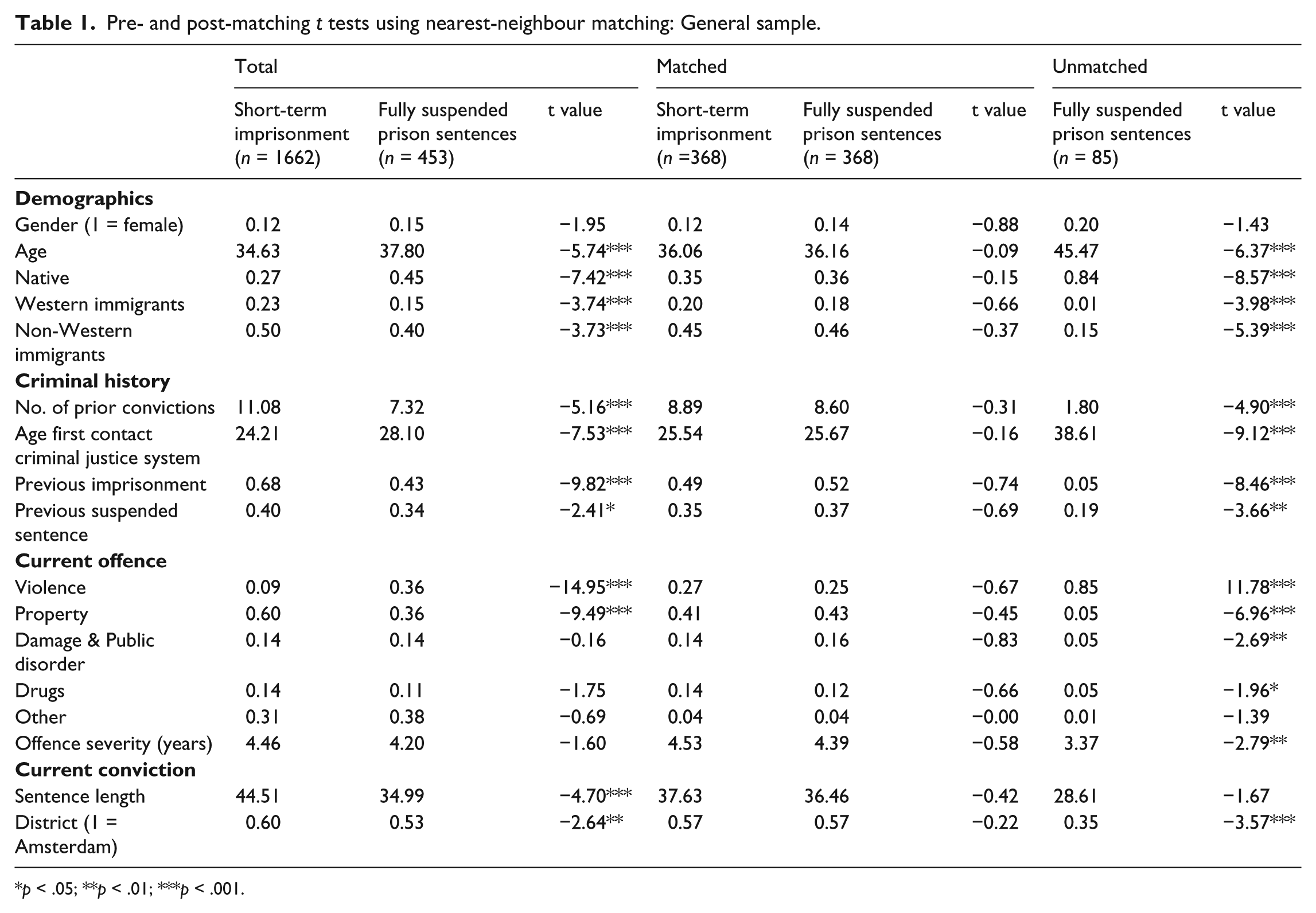
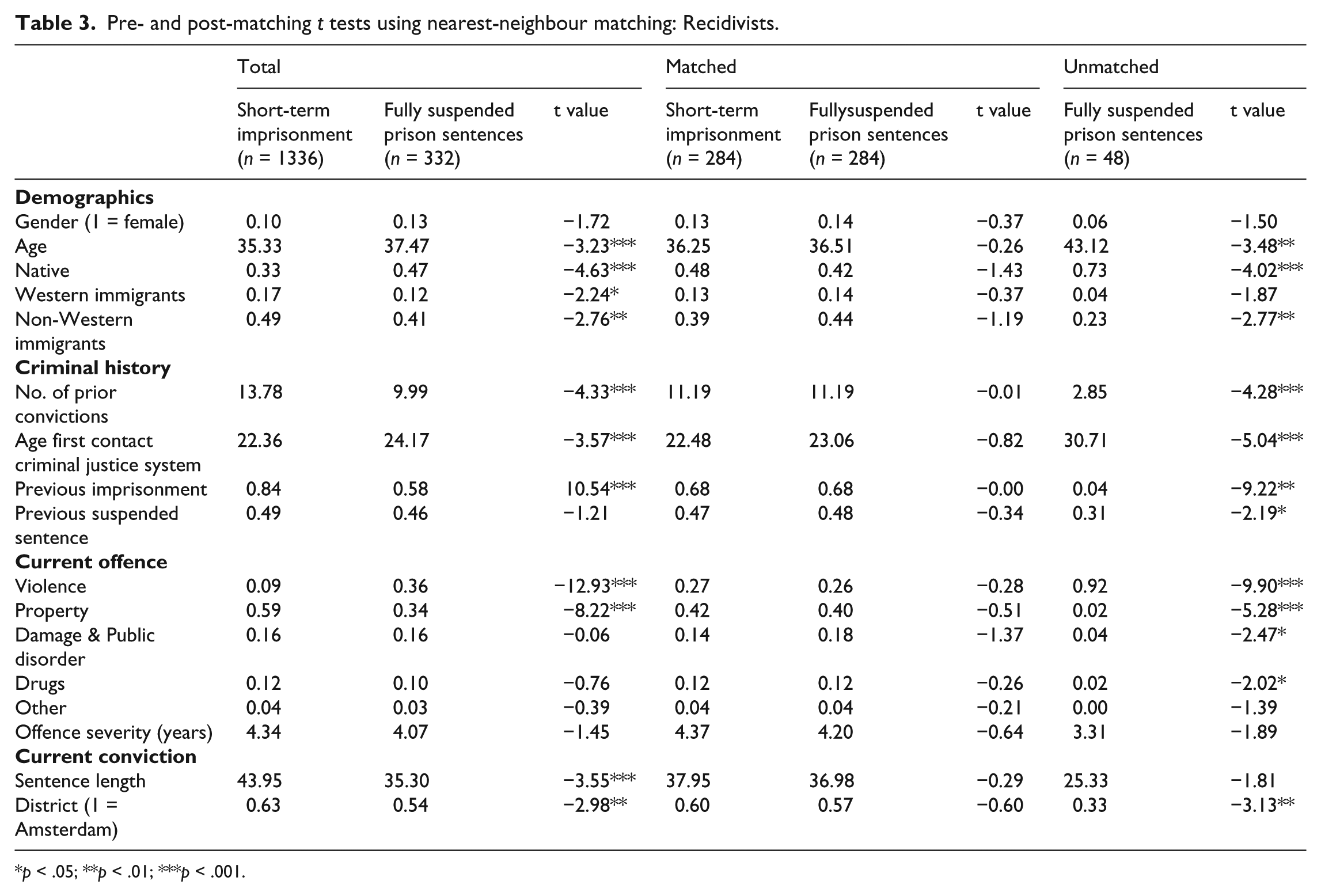
Tables 1, 2 and 3 present the results from pre-matching t tests. Nearly all covariates showed differences between offenders given fully suspended prison sentences and offenders sentenced to short-term imprisonment. In all three groups (general sample, first offenders and recidivists), offenders given fully suspended prison sentences were more likely to be older, native, convicted of a violent offence, and convicted in The Hague. Furthermore, their sentence length was lower, and the severity of the offences for which they were convicted of was less severe, than for offenders sentenced to short-term imprisonment. Regarding criminal history, the general sample and recidivists given fully suspended prison sentences had fewer prior convictions and were older when they first came into contact with the criminal justice system than the general sample and recidivists sentenced to short-term imprisonment. They were also less likely to have a prior suspended prison sentence or sentence of imprisonment.
Pre- and post-matching t tests using nearest-neighbour matching: General sample.
p < .05; **p < .01; ***p < .001.
Pre- and post-matching t tests using nearest-neighbour matching: First offenders.

p < .05; **p < .01; ***p < .001.
Pre- and post-matching t tests using nearest-neighbour matching: Recidivists.
p < .05; **p < .01; ***p < .001.
The next step was to generate scores for the propensity of receiving a fully suspended prison sentence for each offender using a logistic regression model. These propensity scores were based on the covariates presented in Tables 1–3 and ranged from 0 to 1, reflecting the probability of each offender receiving a fully suspended prison sentence given their values on these variables.
As expected, the distribution of propensity scores differed in all three comparison groups. However, sufficient overlap (also known as common support) was observed between the two sentences in all three groups, making it possible to apply propensity score matching to the data. We employed the one-to-one nearest neighbour with caliper matching and set the caliper width to 0.05. 4 The non-replacement option was used so that only one offender given a fully suspended prison sentence was matched to one offender sentenced to short-term imprisonment.
For the first comparison group (general sample), the nearest-neighbour matching resulted in a match of 81 percent, where 368 offenders given fully suspended prison sentences were matched to 368 offenders sentenced to short-term imprisonment. With regard to the second comparison, we matched 70 of the 121 (58 percent) first offenders given fully suspended prison sentences to 70 first offenders sentenced to short-term imprisonment. For the third comparison (recidivists) we were able to match 284 of the 332 recidivists given fully suspended prison sentences (85 percent) to 284 recidivists sentenced to short-term imprisonment.
We conducted t tests to compare the variables across the two sentences. Prior to matching, the three comparison groups differed significantly on nearly all observable variables. After matching, offenders given fully suspended prison sentences and those sentenced to short-term imprisonment no longer differed on any of the observed variables in all three groups (Tables 1–3). In other words, the matching procedure was effective in creating groups similar on all observable covariates and, therefore, allowed for a comparison of reconviction rates between fully suspended prison sentences and short-term imprisonment in a manner similar to a randomized experimental design.
Offenders given fully suspended prison sentences with whom we were unable to match offenders with short-term imprisonment were excluded from the analysis (see the last three columns in Tables 1–3). The unmatched group of offenders given fully suspended sentences differed significantly from their matched counterparts on several variables. In all three groups, the mean age of the unmatched group was higher than that of the matched group. Unmatched offenders were more often native and convicted of a violent offence, compared with their matched counterparts. In the first (general sample) and third (recidivists) groups, unmatched offenders were less likely to have a history of imprisonment and/or a previous suspended sentence and fewer previous convictions than the matched group. Finally, the mean age of first contact with the criminal justice system was higher in the unmatched group compared with the matched group. Since we used a select sample, it should be noted that results are not based on the entire sample of offenders given fully suspended prison sentences.
Reconviction
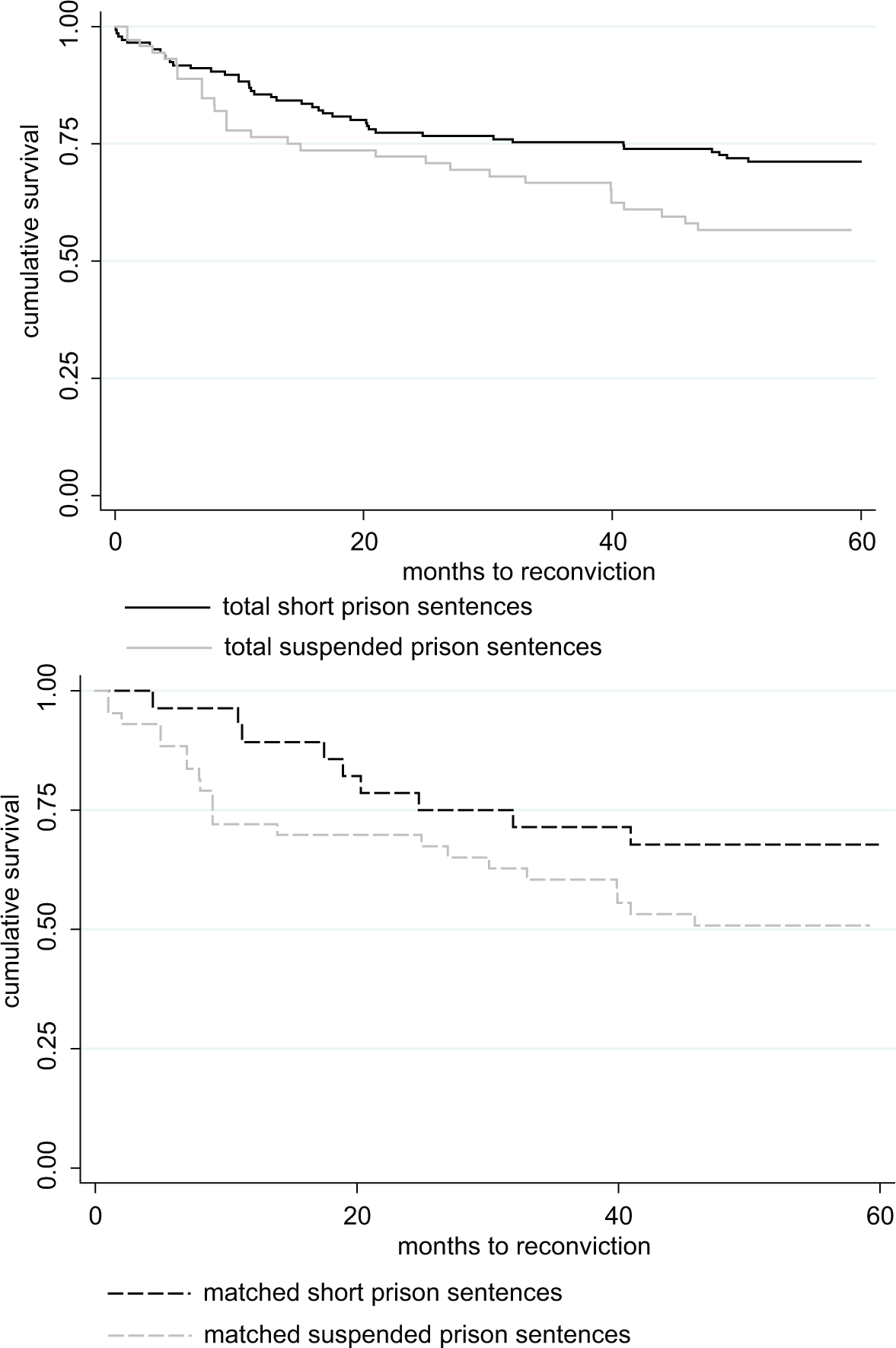
Figure 1 presents the survival curve of the time to reconviction for the total and the matched general sample. The x-axis shows the number of months and the y-axis the proportion of offenders who were not reconvicted past time t. Offenders sentenced to short-term imprisonment demonstrated a steeper curve towards reconviction, indicating a higher risk of reconviction at each time interval starting at approximately 5 months. After 60 months, roughly 80 percent of the total sample of offenders sentenced to short-term imprisonment was reconvicted compared with 70 percent of the total sample of offenders given fully suspended prison sentences. According to the Cox proportional hazards model, offenders given fully suspended prison sentences had a hazard ratio of 0.70, which means that the probability that offenders given fully suspended prison sentences were reconvicted within the observation period decreased by a factor of 0.70 (or 30 percent) compared with offenders sentenced to short-term imprisonment (Table 4).

Time to first reconviction: Total and matched general samples.
Results of Cox proportional hazards model.
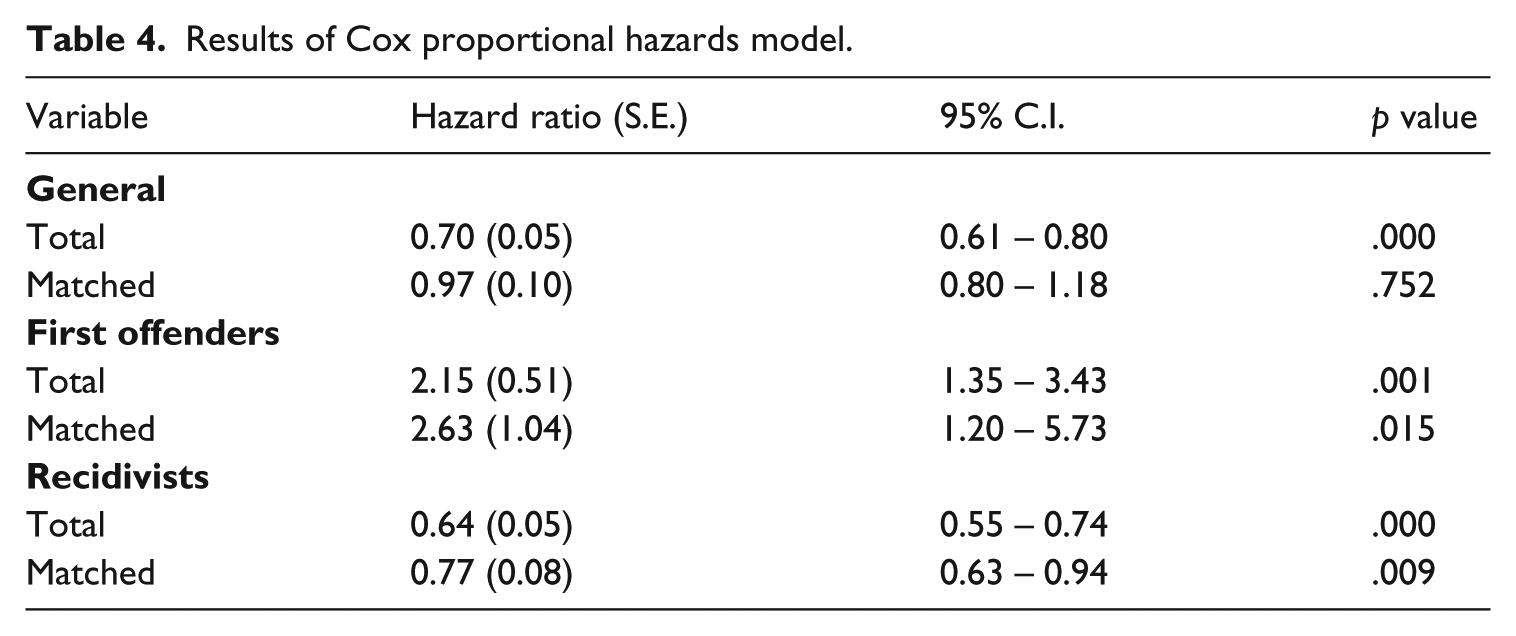
Regarding the matched sample, again, offenders sentenced to short-term imprisonment demonstrated a steeper curve than offenders given fully suspended prison sentences. However, there was no significant difference in the risk of reconviction between the two sentences (HR = 0.97, p = .752; Table 4).
First offenders given fully suspended prison sentences had a greater risk of being reconvicted within the follow-up period than first offenders sentenced to short-term imprisonment (HR = 2.15, p = .001). This difference was significant and remained significant when the two groups were matched (HR = 2.63, p = .015, or 163 percent increase; Table 4). Figure 2 presents the reconviction rates of the total and the matched samples of first offenders given fully suspended prison sentences and those sentenced to short-term imprisonment. Over a period of five years, first offenders given fully suspended sentences demonstrated a steeper curve towards reconviction compared with offenders sentenced to short-term imprisonment. This curve was even steeper in the matched sample. At the end of the observation period, 50 percent of the matched first offenders given fully suspended prison sentences were reconvicted compared with 30 percent of the matched first offenders sentenced to short-term imprisonment.
Time to first reconviction: Total and matched samples of first offenders.
Figure 3 shows the total and matched samples of recidivists given fully suspended prison sentences and recidivists sentenced to short-term imprisonment. Similar to Figure 1, the total sample of recidivists sentenced to short-term imprisonment showed a steeper curve, demonstrating a higher risk of being reconvicted (HR = 0.64, p = .000) than recidivists given fully suspended prison sentences. This significant difference remained after matching (HR = 0.77, p = .009: Table 4). Recidivists given fully suspended prison sentences had a smaller risk of being reconvicted in the observation period than recidivists given short-term imprisonment.

Time to first reconviction: Total and matched samples of recidivists.
Rosenbaum bounds
Because there are significant differences in reconviction rates between the two sentences for first offenders and recidivists, Rosenbaum bounds were calculated. Our finding that first offenders given fully suspended prison sentences have a higher risk of being reconvicted than first offenders sentenced to short-term imprisonment would be questioned if an unobservable variable would increase the odds of receiving a fully suspended prison sentence for a first offender actually given a suspended prison sentence by 55 percent (Γ = 1.55) versus a first offender sentenced to short-term imprisonment. In other words, the difference in recidivism rates for first offenders is relatively robust to hidden bias.
Our result regarding the difference in reconviction rates for recidivists is more susceptible to hidden bias (Γ = 1.05). Specifically, if an unobserved variable caused the odds ratio of receiving a fully suspended prison sentence to differ between the recidivists given fully suspended sentences and recidivists sentenced to short-term imprisonment by a factor of 1.05, we would question whether the effect was a real one.
Discussion
The objectives of this study were to compare recidivism rates after a fully suspended prison sentence with those after short-term imprisonment, and to compare recidivism rates between the two sentences for first offenders and recidivists. Based on theoretical perspectives and empirical studies, two opposing hypotheses were drawn up. According to the first hypothesis, offenders given suspended prison sentences were more likely to have lower recidivism rates than offenders sentenced to short-term imprisonment, specifically for first offenders given suspended prison sentences. According to the second and opposing hypothesis, offenders sentenced to short-term imprisonment were more likely to have lower recidivism rates than offenders given suspended prison sentences, especially concerning first offenders.
Regarding our first research question − that is, to what extent do recidivism rates of fully suspended prison sentences differ from that of short-term imprisonment − results show that, once matched, there was no difference in the risk of reconviction between the two sentences. This finding does not support either of the two hypotheses or previous research. There are two possible explanations for this. First, offenders given fully suspended prison sentences differed from offenders sentenced to short-term imprisonment in terms of variables we did not take into account in our matching, such as drug abuse or employment. Second, neither sanction exerts any effect on the risk of further offending. As we analysed only criminal records, the first explanation would appear to be more plausible than the second. Future research should include more legal and non-legal variables.
With regard to our second research question − that is, to what extent do recidivism rates of (suspended) prison sentences differ between first offenders and between recidivists − results show that first offenders given fully suspended prison sentences had a greater risk of being reconvicted compared with first offenders sentenced to short-term imprisonment, a finding relatively robust to hidden bias. This seems to support the deterrence hypothesis: imprisonment is more likely than a fully suspended prison sentence to deter offenders from future offending. It seems that the lower reconviction rates after short-term imprisonment were the result of the suppression effect of a first experience of incarceration (Wilson, 1983), whereas suspended sentences were nothing more than a ‘slap on the wrist’ (Freiburg and Moore, 2009). It is possible that offenders considered suspended sentences to be a soft option, unlike imprisonment, which gave a clear warning that their behaviour was unacceptable (Bartels, 2009). As Bagaric (1999: 548) states: ‘suspended sentence suffers from the fundamental flaw that it does not constitute a discernible unpleasantness. Rather, it merely signifies a possible future unpleasantness: if there is no breach, there is no evil.’
Our finding that recidivists given fully suspended sentences are less likely to be reconvicted than recidivists sentenced to short-term imprisonment is in line with the study by Lulham et al. (2009). Furthermore, in line with social control theory, our finding suggests that recidivists given suspended prison sentences had the opportunity to retain their social bonds with the community, unlike recidivists who were sentenced to short-term imprisonment. Staying within the community seems to have reduced the risk of reconviction. However, this finding does not seem to be in line with labelling theory. Because recidivists have already been labelled owing to their previous conviction(s), no major additional effects of the stigmatization of imprisonment on criminal activities were expected (Paternoster and Iovanni, 1989). Future research should further examine to what extent the length of a criminal history, and thus labelling, can influence reconviction rates after a fully suspended prison sentence and after imprisonment.
Limitations
Although our study is methodologically stronger than previous research, it has some limitations. The first is that analyses were done on registration data, thereby underestimating the recidivism rates because we were able to examine only reconviction rates. In addition, judges impose sentences based on factors others than those found in criminal records. To minimize possible bias, future research should include more legal covariates, such as risk of recidivating, as well as non-legal covariates, such as employment and possible breaches of suspended sentences. Second, our results are not based on an experiment whereby offenders are randomly assigned to fully suspended prison sentences or short-term imprisonment. For obvious ethical reasons this approach is not possible in a correctional setting; therefore, we are unable to draw any conclusions about the causality of our findings. Third, because we were unable to match all offenders given fully suspended prison sentences to offenders sentenced to short-term imprisonment, our results cannot be generalized to the entire sample of fully suspended prison sentences. Instead, our results apply only to those offenders who have similar characteristics to those sentenced to short-term imprisonment. A fourth and final limitation is that our analyses were performed on data from two court districts in the Netherlands. The present results cannot be generalized to other countries without taking the legal and cultural settings of suspended sentences in those countries into account.
Conclusion
To conclude, in general, incarceration did not increase the chance of recidivism compared with fully suspended prison sentences. However, short-term imprisonment carried a greater reconviction benefit for first offenders, whereas recidivists were less likely to be reconvicted after fully suspended prison sentences. Although a logical implication would be that criminal history should have a central place in determining sentencing, we are careful about drawing such a conclusion. Sentencing does not evolve solely around prior criminality. Judges also consider the place offenders hold in the community (for example, whether they are employed). Incarceration affects society’s response to offenders, making it more difficult for them to find employment and stable housing (Laub and Sampson, 1993). The absence of (in)formal social controls and stigmatization make it easier for offenders to fall into their old pattern. In contrast, fully suspended prison sentences do not take offenders away from their communities, thereby allowing them to participate in a conventional social life (Poort and Eppink, 2009).
To determine the effectiveness of (fully) suspended prison sentences additional research is needed for two reasons. First, our study focused on two specific groups of offenders, that is, those given fully suspended prison sentences and those sentenced to short-term imprisonment. By examining the ‘general’ notion of suspended prison sentences we did not differentiate between different types of conditions that can be attached to suspended sentences. In the UK, for example, offenders given suspended sentences need to comply with up to 12 requirements set by the court, including doing unpaid work and supervision (Sentencing Council, 2013). In the Netherlands, suspended sentences are occasionally imposed in combination with control-orientated and/or behaviour-orientated special conditions. In the present study, in about 25 percent of the cases special conditions were attached to fully suspended prison sentences. 5 Aos et al. (2006) found that community-based sanctions were effective only when combined with treatment or rehabilitation. Therefore, special conditions and requirements are expected to result in lower recidivism rates because they focus on individual needs and aim to change offenders’ criminal behaviour. Additional research is needed to determine the effect of the (types of) special conditions on reconviction rates.
Second, not only are suspended (prison) sentences considered suitable replacements for short-term imprisonment, but they have also gained a central place in the Dutch sanctioning system (Bleichrodt, 2009) as an intermediate sanction in the sentencing hierarchy for a specific population of offenders. In line with its practice, our study showed that a particular group of offenders given suspended sentences remained unmatched and, therefore, were left out of the analysis. This unmatched group was older, more likely to be female, native, convicted of a violent offence and a first offender compared with their matched counterparts. With the exception of age, these characteristics were also found by Wartna and Tollenaar (2006) to be specific characteristics of offenders given suspended sentences in the Netherlands. Therefore, further understanding of the complexity of suspended sentences and its effect on recidivism seem to be the next logical step.
Footnotes
Acknowledgements
We gratefully acknowledge Bouke Wartna and the Research and Documentation Centre for providing the data for this article. We thank Joke Harte, Steve van de Weijer and two anonymous reviewers for their valuable comments on earlier versions of this article.
Funding
This research received no specific grant from any funding agency in the public, commercial, or not-for-profit sectors.