



Abstract
The aim of this article is to investigate the relationship between values and white-collar crime. The analyses draw on pooled survey data covering 14 European countries. The value constructs are derived on the basis of the theory of basic human values and seven value constructs are tested in relation to three types of white-collar crime: tax evasion, insurance fraud and bribery. The results show that a majority of the value constructs are statistically significantly related to white-collar crime in the expected direction. The relationships between values and white-collar crime are particularly clear-cut regarding tax evasion and insurance fraud but more mixed regarding bribery. The value constructs ‘universalism/benevolence’, ‘power/achievement’ and ‘stimulation’ yield consistent results across all three crime types. ‘Universalism/benevolence’ levels are negatively associated, while ‘power/achievement’ and ‘stimulation’ levels are positively associated, with odds of having committed white-collar crime. The results suggest that values are relevant predictors when trying to account for variation in white-collar offending.
Introduction
Ever since recognizing the concept of crime as encompassing more than ‘merely’ poverty-related anti-social acts, much thanks to Sutherland’s (1940, 1949) work, society has come to see the danger posed by white-collar criminality. Incitements to gain knowledge in this field of research are not lacking. The Committee of Ministers of the Council of Europe claims that economic crime ‘causes losses to public revenue, has an adverse impact on society . . . and works to diminish trust and confidence in the economic system’ (Council of European Commission, 2006: 52). At the organizational level, over 42 percent of large companies in Europe have been damaged by economic crime (Schlegel, 2003). Apart from major financial losses, white-collar crime is also related to social and physical costs, including work-related injuries and deaths (Friedrichs, 2007) as well as more direct forms of victimization such as sales fraud and unsafe products (see Croall, 2009).
The white-collar crime literature highlights the fact that criminal acts are not only conducted by marginalized groups, but are also undertaken by respectable and well-integrated citizens operating from offices and board-rooms. Traditional criminological theories are often used to explain white-collar crime but empirically they tend to come up shorthanded (see, for example, Benson and Simspon, 2015; Croall, 2001; Piquero and Schoepfer, 2010; Simpson, 2013). Previous research has indeed found that white-collar criminals deviate from street criminals, for example regarding their age, educational attainment and social class (Alalehto and Larsson, 2012; Wheeler et al., 1988; Weisburd et al., 1991). It has, furthermore, been found that white-collar criminals differ from street criminals as well as non-criminals regarding psychological and personality factors (see Ragatz and Fremouw, 2010). It is less known, however, whether white-collar criminals deviate regarding their motivational principles and the abstract goals guiding their behavior, that is, their basic values. Several studies have shown that there is a relationship between values and behavior (see, for example, Bardi and Schwartz, 2003; Hitlin and Piliavin, 2004; Schwartz and Bardi, 2001), but this relationship has not been systematically examined when it comes to white-collar crime. The scattered studies available on the relationship between values and white-collar offending indeed provide some support for this claim, but these studies are few in number and often limited to a small number of individual value types as well as small samples.
The aim of this study is to systematically examine the relationships between a broad range of values and white-collar crime. The value types examined are based on the theory of basic human values (Schwartz 1992, 1994) and should be understood as a fundamental set of values shared by all people, functioning as underlying motivational and guiding principles. Their relationships with three types of white-collar crime – tax evasion, insurance fraud and bribery – are investigated using pooled nationally representative survey data covering 14 European countries.
White-collar crime
There are two broad definitions of white-collar crime: offender-based and offence-based. The offender-based definition has its origin in the work of Sutherland (1940, 1949), who defines white-collar crime based on the social and occupational status of the offender as ‘a crime committed by a person of respectability and high social status in the course of his occupation’ (1949: 9). The other, offense-based tradition stems from a critique against using offender characteristics as part of the definition. For instance, Shapiro (1990: 347) argues that this ‘confuse[s] acts with actors, norms with breakers, the modus operandi with the operator’. The offense-based tradition is instead concerned with the criminal act in itself, drawing upon legal definitions, motives and means (Coleman, 2006; Piquero and Schoepfer, 2010). Edelhertz (1970), for example, distinguishes three key elements when defining white-collar crime: (i) the need for the act itself to be illegal, (ii) the lack of physical means, (iii) and the motive of monetary or material gain or other advantage (business or personal). Some scholars such as Friedrichs (2007) would add that the crime must take place within a legitimate occupational context.
A distinction is often drawn between corporate or organizational crime and other forms of white-collar crime (see, for example, Benson and Simpson, 2015; Croall, 2001). With some more complex forms of crime personal accountability is problematic. Such crimes can be viewed as committed in the interest of an organization. Much of the difference with other forms of white-collar crime (for example occupational) is motivational – whether one commits criminal acts for personal profit (in a direct sense) or for organizational gain (for example achieving company goals). Although the debate over definitional matters is lengthy, it is not the aim of this paper to contribute to it. Suffice it to say that here we will conceptualize white-collar crime as ‘economic offenses committed through the use of some combination of fraud, deception or collusion’ (Wheeler et al., 1982: 642).
White-collar crime has received considerably less research attention than street crime. One of the main problems is that previous research often has attempted to explain white-collar crime by using conventional criminological theories (Piquero and Schoepfer, 2010; Simpson, 2013). At the micro-level, one of the most empirically tested is the general theory of crime focusing on low self-control (Gottfredson and Hirschi, 1990). Whereas the general theory of crime is successful in explaining street crime, the evidence regarding white-collar crime is mixed (Piquero and Schoepfer, 2010; Simpson, 2013). Simpson and Piquero (2002), for example, found that low self-control could not account for intentions to commit corporate crime. On the other hand, evidence of low self-control has also been found among white-collar criminals (Blickle et al., 2006). These mixed results could partly stem from the fact that some types of white-collar crime are situational in character whereas others require extensive planning and goal orientation (see, for example, Benson and Simpson, 2015; Croall, 2001).
Drawing upon the psychology literature, Piquero and colleagues argue that the personality trait ‘desire-for-control’ (Burger and Cooper, 1979) can predict propensity to commit white-collar crime (Piquero et al., 2005; Schoepfer et al., 2014). Individuals scoring high on this trait are assertive, decisive and active. They often seek to: influence others when it is personally advantageous; avoid failure through manipulation; seek leadership roles; and attribute success to internal factors (for example skill) but failure to external factors (for example bad luck) (Schoepfer et al., 2014). Another micro-level theory used to explain white-collar crime is choice theory. Although presuming individuals to be rational, this body of literature emphasizes the significance of individual norms, attitudes and values as well as traits in offending decisions (Piquero et al., 2005; Shover and Hochstetler, 2006; Simpson, 2013).
Studies show that white-collar offenders are more likely to have a psychopathic personality and less of a criminal thinking style compared with other offenders (Ragatz et al., 2012; Walters and Greyer, 2004). Furthermore, they tend to be more narcissistic than non-offenders (Blickle et al., 2006). Findings also suggest that white-collar offenders identify themselves as criminals to a lesser extent compared with groups of ‘mixed’ and ‘regular’ offenders (Ragatz et al., 2012; Walters and Greyer, 2004). Regarding the relationship between personality traits and white-collar crime, studies have found that conscientiousness, neuroticism, extraversion and anxiety correlate positively with white-collar crime whereas agreeableness correlates negatively (Alalehto, 2003; Blickle et al., 2006; Collins and Schmidt, 1993; Listwan et al., 2010). The number of studies focusing on the relationship between values and individual white-collar offending, however, is small. We have found only one study addressing the relationship between basic human values and white-collar crime. In this study, Blickle et al. (2006) found that the value ‘hedonism’ displayed a positive relationship with white-collar offending. However, although this finding is a valuable contribution to the white-collar crime literature, the study examines only one value type and thus precludes conclusions about the interrelatedness between the full range of basic human values and behavior, that is, white-collar crime.
Basic human values
Before considering the potential relationships between values and white-collar crime we first discuss the various definitions of values found in the literature, with an emphasis on the theory of ‘basic human values’ (Schwartz, 1992, 1994). Kluckhohn (1951: 395) defines values as ‘a conception . . . of the desirable that influences the selection from available modes, means and ends of action’. He thus recognizes values as a pre-fixed set of standards for evaluation guiding people’s choices. Feather (1996: 222) regards values in terms of desirable ‘ways of behaving or . . . otherwise general goals’, and Rokeach (1973) defines values in terms of preferable end-states of existence (in addition to beliefs or modes of conduct). Kulin summarizes these definitions of Rokeach and Schwartz as follows: ‘[values] can be defined as a fixed set of desirable, abstract and motivational goals that transcend specific objects, actions or situations, and instead refer to personally or socially preferable end-states of existence and to preferable modes of conduct that function as guiding principles in a person’s life’ (Kulin, 2011: 4). Put in a simpler manner, Bardi and Schwartz (2003: 1208) argue that values convey ‘what is important to us in our lives’.
In the literature, values are often conflated with attitudes, personality traits and norms (Hitlin and Piliavin, 2004). Firstly, the concept of values is more abstract in nature than attitudes (Rokeach, 1973). The former are trans-situational underlying motivations and guiding principles, whereas the latter concern evaluations of specific objects or entities (Hitlin and Piliavin, 2004; Rohan, 2000). Secondly, there is a distinction between traits and values, the former being relatively fixed aspects of one’s personality, whereas the latter refer to goals and motivations for behavior (Epstein, 1989; Roccas et al., 2002). One could have a disposition towards aggression without valuing aggressive behavior. Thirdly, the concept of norms is sometimes falsely intermixed with values; the difference between norms and values can be described as the difference between situational incentives and trans-situational motives in what influences human behavior (Hitlin and Piliavin, 2004). A telling example is that of peer pressure, where one could feel forced to act (owing to group norms) in ways contrary to personal values or beliefs.
According to a theory of universal types of values, initially proposed by Schwartz and Bilsky (1987), then subsequently refined and validated in intensive cross-cultural testing (Schwartz, 1992; 1994), people across diverse cultures share the same set of value types, although their prioritization of the values may differ (Schwartz et al., 2001; Schwartz and Boehnke, 2004). Furthermore, individuals’ values have been found to be relatively stable during their life courses (Feather, 1971; Rokeach, 1973; Schwartz, 1997).
Instead of presuming values to be independent of each other, the theory of basic human values specifies a theoretical structure of relations among different value types (Schwartz, 1992, 1994). The theory of basic human values suggests that there are 10 different value types: ‘universalism’, ‘benevolence’, ‘tradition’, ‘conformity’, ‘security’, ‘power’, ‘achievement’, ‘hedonism’, ‘stimulation’ and ‘self-direction’ (see Table 1). They are derived from three ‘universal requirements of the human condition: needs of individuals as biological organisms, requisites of coordinated social interaction, and survival and welfare needs of groups’ (Schwartz, 2003: 267). These ‘motivationally distinct, broad and basic values’ form a circumplex relational structure (Schwartz, 2003; Schwartz and Boehnke, 2004), displayed in Figure 1. Each value type in the structure is more similar in its underlying motivations to adjacent values, and dissimilar to (that is, more likely to conflict with) distant or opposite value types. For example, the values of ‘universalism’ (welfare of all) and ‘benevolence’ (welfare of people close to oneself) are similar and might overlap in terms of operationalized items or value-expressive behavior. However, they also differ sharply from ‘power’ values (dominance over others). For example, emphasizing the welfare of all citizens in a society might well be in line with looking out for people close to oneself. Such goals are likely to be in conflict with the ‘power’ value, that is, acting for social status for oneself and a will to subordinate and control others.
Definitions of the basic human value types.
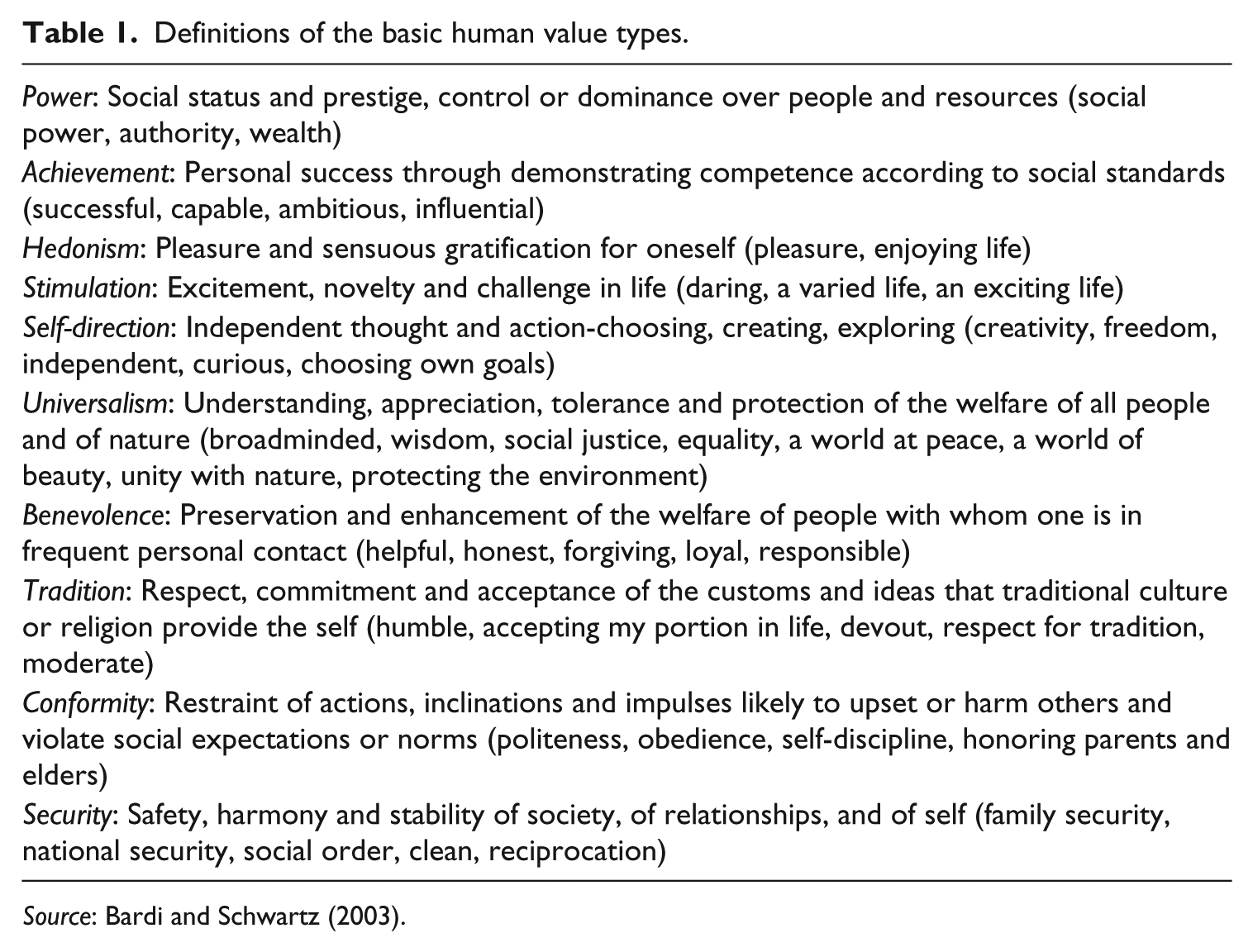
Source: Bardi and Schwartz (2003).
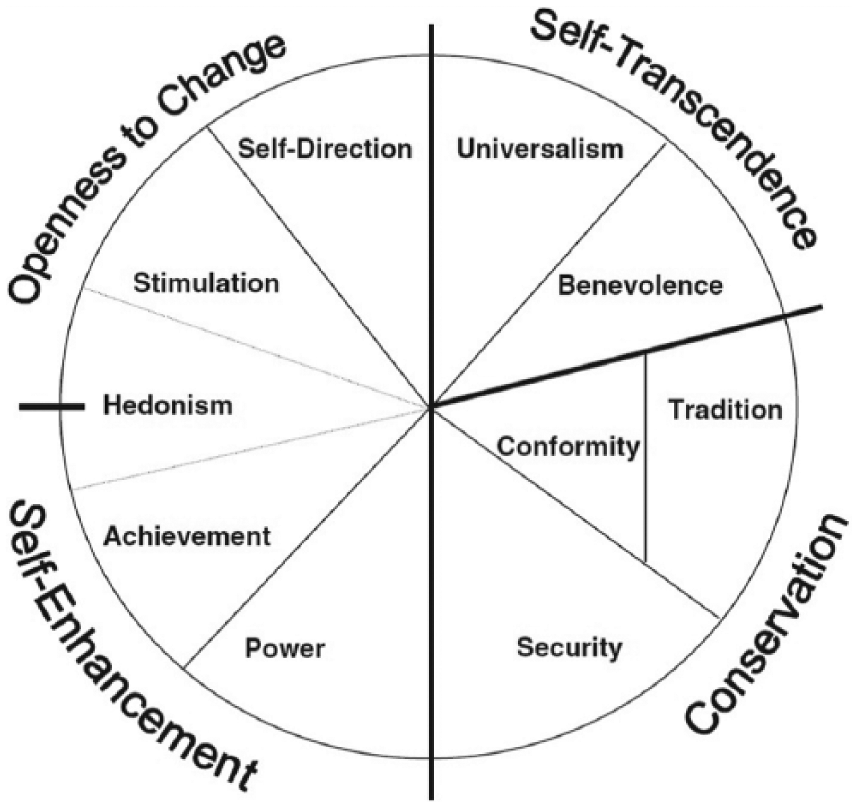
Dimensions and structural relations among basic human values.
Schwartz (1992) argues that value types can be arranged into two broad dimensions; the ‘self-transcendence’ versus ‘self-enhancement’ dimension and the ‘openness to change’ versus ‘conservation’ dimension. The higher-order type of ‘self-transcendence’ summarizes the values of ‘universalism’ and ‘benevolence’ – values representing understanding, tolerance and welfare of people and nature. The other end of this spectrum, ‘self-enhancement’, summarizes the opposite-value types of ‘power’ and ‘achievement’ – prioritizing personal success, social prestige and control. ‘Self-enhancement’ also contains elements of ‘hedonism’ (seeking the pleasures in life). The higher-order type of ‘openness to change’ contains the values of ‘self-direction’ and ‘stimulation’ –typically motivating independent thought and action, as well as seeking challenges in life and being open to new experiences. Like ‘self-enhancement’, ‘openness to change’ shares elements of ‘hedonism’. Opposed on the dimensional spectrum is the higher-order type ‘conservation’, constituting the values ‘security’ and the joint axis of ‘conformity’ and ‘tradition’. Individuals scoring high on these values typically promote harmony and security while resisting change.
A notable feature of the structure illustrated in Figure 1 is that ‘tradition’ and ‘conformity’ are placed at the same angle, with ‘tradition’ being outside of ‘conformity’. ‘Tradition’ and ‘conformity’ values thus essentially share the same broad motivational goals. However, previous research has found that they are differently associated with, for example, personality traits, views on human rights, religiosity, and parent–child similarity (Schwartz and Boehnke, 2004). It has therefore been deemed fruitful to treat them as separate values, ‘tradition’ being peripheral to ‘conformity’. The reason for the latter is the difference in levels of abstraction. ‘Conformity’ entails subordination to persons (for example teachers), whereas objects related to ‘tradition’ are more abstract in nature – for example, culture, customs and religious ideas (Schwartz, 1992).
Bardi and Schwartz (2003) argue that, aside from choice-behaviors related to high levels of cognitive awareness, values may also function through the force of habit (or similar mechanisms). When studying the full range of basic human values with a corresponding set of behaviors, they found that the structure of relations organizing value-expressive behavior is essentially the same as the structure that organizes value relations (in terms of motivational conflicts and congruities). Wojciszke (1989) argues that three preconditions must be met in order for a cognitive value structure to influence behavior: the structure must be (a) a well-established entity in a person’s cognitive system, (b) activated from long-term memory, and (c) accepted by a person as relevant and proper for conceiving of the current situation.
Previous studies on the link between values and behavior show, for example, that values are related to voting and the choice of university courses (Feather, 1988; Schwartz, 1996). Furthermore, Maio et al. (2001) found that cognitive support for values such as equality positively relate to egalitarian behavior. In terms of previous research on the relationship between values and white-collar crime, there are few studies. Halpern (2001) found that self-interest values correlate with (‘regular’) crime rates on the aggregated level. One possible explanation for this might be the distant nature of self-interest values and the fact that the crimes (non-violent, street-level crime) related to self-interest values tend to be victimless in form. Halpern argues that the less clear or impersonal the victim, the higher the risk of offending. This suggests that there might be a relationship between self-interest values and white-collar crime since the latter often constitute a ‘victimless’ crime. This is supported by the finding that high levels of hedonistic values correlate positively with white-collar crime (Blickle et al., 2006).
Hypotheses
Even though previous research on the relationship between values and white-collar crime is scarce, we formulate a number of tentative hypotheses. These hypotheses are based on the existing (limited) empirical evidence on the relationship between values and white-collar crime and the theoretical arguments presented in value theory. Value theory states that values are meaningfully interrelated to each other (Schwartz, 1992), which suggests that, given that a single value type is related to white-collar crime, we should also expect that adjacent as well as opposite values are linked to white-collar crime.
The literature reviewed supports the notion that traits and values emphasizing the self (self-indulgence, self-interest or advancement of the self) increase the risk of white-collar offending (for example, Blickle et. al., 2006; Schoepfer et al., 2014). Values that promote or take their point of origin in the individual self are consequently expected to correlate positively with white-collar crime. This corresponds to the left-hand side (that is, the higher-order types ‘self-enhancement’ and ‘openness to change’) in the basic human values circumplex (Figure 1). Conversely, values located at the right-hand side (‘self-transcendence’ and ‘conservation’) share the common feature that they are collectivistic in nature. Since value theory stipulates that values and value-expressive behavior are meaningfully interrelated (Schwartz, 1992), the values on the right-hand side, which are motivationally opposed to the left-hand/individualistic values, should thus logically be negatively related to white-collar crime.
Starting with ‘hedonism’, which has been found to positively correlate with white-collar crime (Blickle et al., 2006), we expect to find a similar relationship. Given that values are meaningfully interrelated we expect that values located opposite to ‘hedonism’ in the circumplex should correlate negatively with white-collar crime. Opposite to ‘hedonism’ are the values of ‘tradition’ and ‘conformity’, whose underlying motivations are the maintaining of social order, respect for authorities, self-restraint and conforming to social norms and expectations – abstract goals likely to constrain offending behavior. The first two hypotheses can therefore be formulated as: ‘Hedonism’ scores will be positively related to white-collar crime (
Secondly, the psychological trait ‘desire-for-control’ (positively related to white-collar crime; Piquero et al., 2005; Schoepfer et al., 2014) has many conceptual similarities with ‘power’ values in terms of underlying motivation for behavior. Although ‘desire-for-control’ does not necessarily entail the valuing of ‘power’, holding ‘power’ values always includes the desire to ‘control . . . people and resources’ (Bardi and Schwartz, 2003: 1208). Thus, we have reason to believe that high levels of ‘power’ values should be positively related to white-collar crime. However, owing to measurement issues (addressed in detail in Davidov, 2008, and Davidov et al., 2008b, and described further in the method section), ‘power’ and ‘achievement’ values will have to be treated as a unified value construct in our data set. The same holds for the opposite values of ‘universalism’ and ‘benevolence’. This merging of value constructs is in line with value theory, which stipulates that values adjacently placed within the circumplex structure of values tend to share much of the underlying motivational goals (Schwartz, 1992). Two modified hypotheses can be formulated as: Scores for the unified value construct ‘power’/‘achievement’ will be positively related to white-collar crime (
The final hypotheses will address the remaining values ‘stimulation’, ‘self-direction’ (to the left on the value circumplex, Figure 1) and ‘security’ (right side). The hypotheses are derived from the theoretical argument laid out above, that self-promoting values (left), as opposed to collectivistic (right), are more criminogenic in nature: ‘Stimulation’ and ‘self-direction’ scores will be positively related to white-collar crime (
Data and method
To test these hypotheses we use data drawn from the second round of the European Social Survey (2004). The European Social Survey (ESS) is a comparative survey covering attitudes, values and behavior across a range of subjects in most European countries. ESS is conducted via face-to-face interviews and utilizes strict random probability sampling. The data used in this study are a subset consisting of pooled data from 14 European countries: Austria, Belgium, Denmark, Estonia, Finland, France, Germany, Iceland, Luxemburg, the Netherlands, Norway, Poland, Sweden, and Switzerland. The sample size for each country ranges from 579 (Iceland) to 2256 (Austria), with the total number of respondents for the pooled dataset being 25,868. The reason for selecting these 14 countries is because the item constructs measuring values display insufficient configural and metric invariance when applied to the entire data set. The selection of countries is thus guided by methodological reasons and includes countries where the ‘meaning of the values, as measured by the indicators of the ESS, is probably the same’ (Davidov, 2008: 43).
Dependent variables
The variables relating to white-collar crimes available in the ESS data set measure whether the respondents have committed any of the following crime types: tax evasion, insurance fraud or bribery. The question wording is as follows: ‘How often, if ever, have you done each of these things in the last five years?’: ‘ . . . paid cash with no receipt so as to avoid paying VAT or other taxes?’ (tax evasion); ‘ . . . made an exaggerated or false insurance claim?’ (insurance fraud); ‘ . . . offered a favor or bribe to a public official in return for their services?’ (bribery). Respondents answered using the following scale: ‘Never’, ‘Once’, ‘Twice’, ‘3 or 4 times’, ‘5 times or more’. Each item has been recoded into a binary variable with the values 0 (‘Never’) and 1 (‘Once’, ‘Twice’, ‘3 or 4 times’, ‘5 times or more’). Respondents having committed the crime in question are thus coded 1, whereas non-offenders are coded 0.
Basic human values
To measure basic human values, the ESS includes a supplementary questionnaire; an adapted version of the Portrait Value Questionnaire (PVQ) (Schwartz et al., 2001). The ESS version of the PVQ has previously been utilized in a broad range of empirical studies looking at, for example, welfare and social policy attitudes (Arikan and Bloom, 2015; Kulin, 2011), use of communication technology (Bagchi et al., 2015), media exposure (Besley, 2008), political orientation (Thorisdottir et al., 2007; Piurko et al., 2011), support for immigration (Davidov et al., 2008a), and traditional political participation (Besley, 2006).
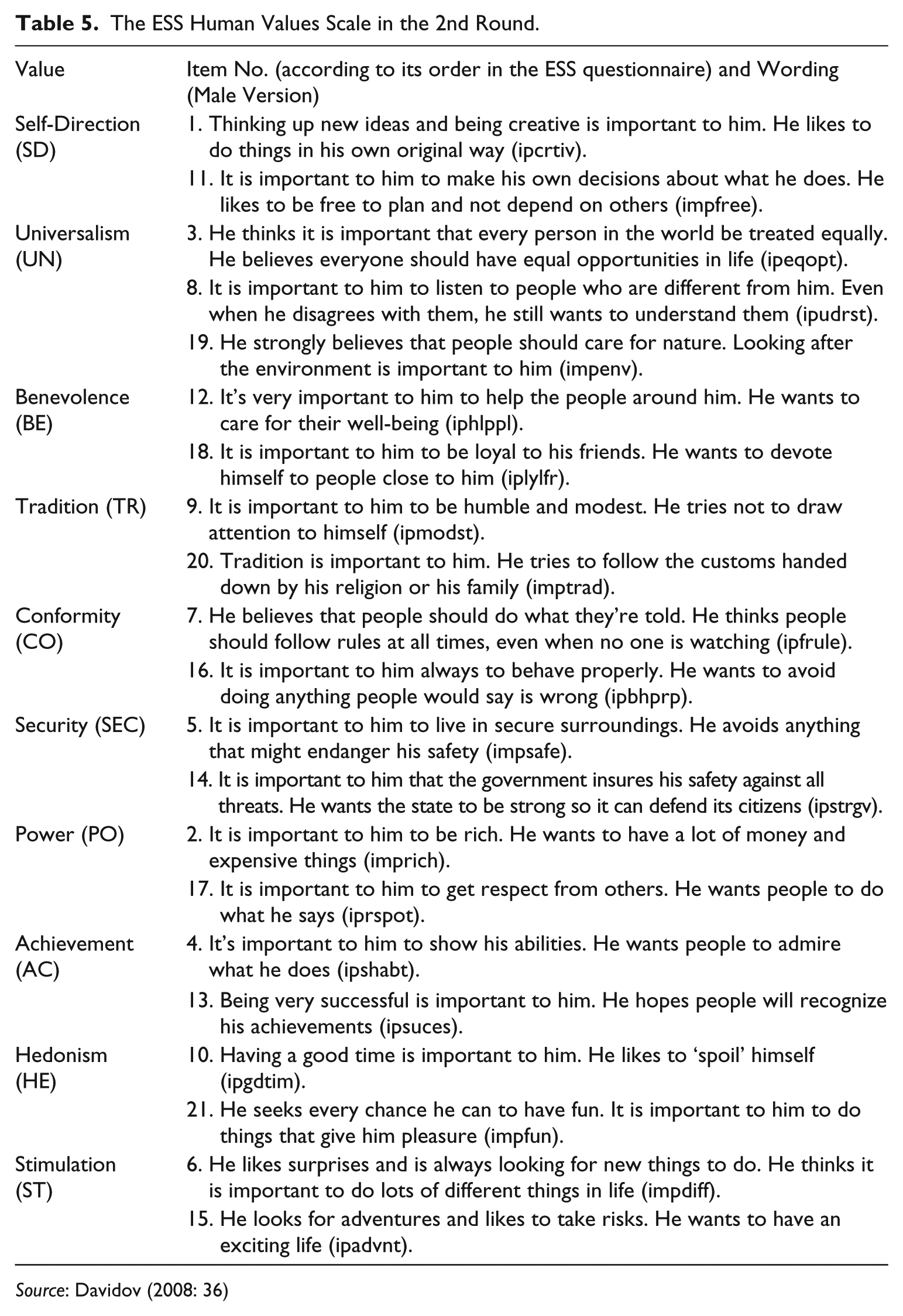
Respondents are provided with a set of 21 descriptions or portraits of people (see Table 5 in the Appendix) and asked to identify how much each person described is like them. Each value type is measured by two items – except ‘universalism’, which is measured by three items – and each item (description) is formulated in a two-sentence fashion. For example, one of the items measuring the value ‘power’ states that: ‘It is important to her to get respect from others. She wants people to do what she says’ (female version of PVQ). Each description is then accompanied by a response scale, ranging from 1 (‘very much like me’) to 6 (‘not like me at all’). In this study the scale has been reversed, meaning that higher scores on each item are equivalent to a high level of the value type measured.
In the original Schwartz (1992) value theory there are 10 value types making up the values structure. When testing the invariance of this measurement tool in the first round of the ESS, Davidov et al. (2008b) found that there were problems with high correlations between pairs of values, causing non-positive definite covariance matrices, both within and across countries. However, Davidov et al. (2008b) found support for a model containing seven value constructs, which was achieved by unifying highly inter-correlated and adjacent values. These concerned ‘power’ and ‘achievement’, ‘conformity’ and ‘tradition’, and ‘universalism’ and ‘benevolence’, which all had to be modified into three new unified value constructs.
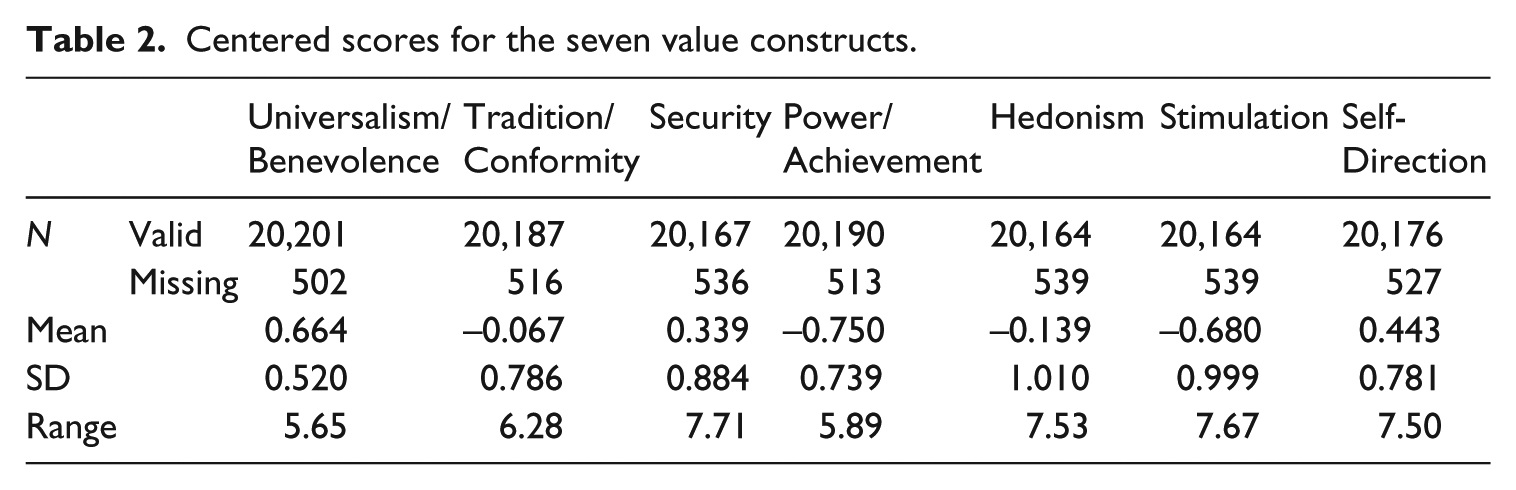
Since individuals may differ systematically in their use of the response scales, such biases are corrected for by using centered scores (Schwartz, 2003). Each individual’s responses are centered around his or her individual mean response on all 21 items. The scale for each value construct thus ranges approximately from ™3.5 to 3.5. The scales differ somewhat depending on the value type, and are not homogenized. The calculated centered scales thus represent the actual distribution within the sample and not the theoretical range. The centered mean score and standard deviation for each value construct are reported in Table 2.
Centered scores for the seven value constructs.
Control variables
We utilize four control variables commonly used in previous research (for example, Croall, 2001).
The first is gender, which is statistically significantly correlated with tax evasion (Pearson’s r: –0.112; p < .01), insurance fraud (Pearson’s r: –0.050; p < .01) and bribery (Pearson’s r: –0.030; p < .01). Of the men, 35.7 percent report having committed at least one of the three crime types, while the corresponding proportion among women is 25.6 percent.
The second control variable is age. Age is not statistically significantly related to tax evasion but is significantly related to both insurance fraud (Pearsons r: –0.077; p < .01) and bribery (Pearsons r: –0.044; p < .01).
The third control variable is education (measured in years of full-time education), which is positively correlated with tax evasion (Pearsons r: 0.122; p <.01) and insurance fraud (Pearsons r: 0.049; p < .01), but not significantly related to bribery.
Finally, socio-economic status, measured with the International Socio-Economic Index (ISEI) (Ganzeboom et al., 1992; Ganzeboom and Treiman, 1996; Leiulfsrud et al., 2005), is included as a control variable. To measure elementary status attainment, the ISEI makes use of comparably coded data on occupations (based on the International Standard Classification of Occupations, ISCO-88), education and income. The index ranges from 16 to 90 (mean: 43.31; median: 43; SD: 16.37). Higher scores on the scale indicate higher socio-economic status. The index is positively correlated with tax evasion (Pearsons r: 0.077; p < .01) but negatively correlated with bribery (Pearsons r: –0.022; p < .01) and is not statistically significantly correlated with insurance fraud.
Results
The distribution of the three dependent variables – tax evasion, insurance fraud and bribery – shows that approximately 30 percent of the respondents in the sample have committed at least one of the considered crime types. Out of these, about 95 percent has evaded taxation, about 11 percent had made a false insurance claim and approximately 4 percent had offered a bribe in return for the services of officials.
The logistic regression models presented below examine the bivariate relationship 1 between each value construct and crime type (when taking the control variables into account). Seven models have accordingly been constructed for each crime type. The results from the 21 models have been fitted into a summary table (Table 3). The results are primarily analyzed by using the odds ratios; that is, the probabilities of a respondent having committed corresponding crimes divided by the probabilities of a respondent not having committed them. Odds ratios above 1 imply higher odds of having committed white-collar crime for each point increase on the value scale. And, conversely, a value below 1 implies a lower odds ratio for each point increase on the value scale. For a more detailed discussion about logistic regression see, for example, Menard (1995).
The relationships between basic human values and white-collar crime. Bivariate logistic regression.
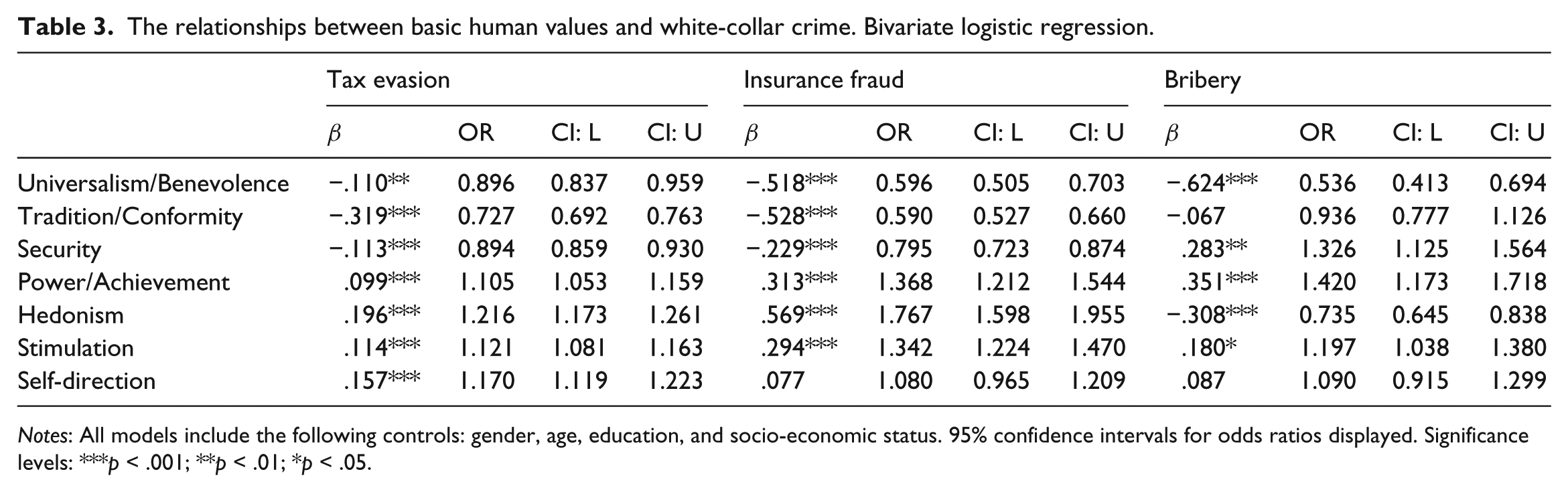
Notes: All models include the following controls: gender, age, education, and socio-economic status. 95% confidence intervals for odds ratios displayed. Significance levels: ***p < .001; **p < .01; *p < .05.
Considering first the relationships between values and tax evasion reported in Table 3, we find that all value constructs are statistically significantly related to it. ‘Power’/‘achievement’, ‘hedonism’, ‘stimulation’ and ‘self-direction’ scores are positively correlated with tax evasion, while the opposite value types ‘universalism’/‘benevolence’, ‘tradition’/‘conformity’ and ‘security’ are negatively related. The relative size of the odds ratios ranges between 0.727 (‘tradition’/‘conformity’) to 1.105 (‘power’/‘achievement’). Thus, each unit increase in the scale measuring ‘power’/‘achievement’ is associated with 10.5 percent increase in the odds of having committed tax evasion, while each unit increase in ‘tradition’/‘conformity’ is associated with 27.3 percent decrease in the odds of having committed tax evasion. Hence, the findings show that all seven associations between values and tax evasion are statistically significant and in the direction anticipated. The results regarding tax evasion thus provide support for each of the hypotheses H1a–H3b.
When examining the relationships between values and insurance fraud, we find a picture very similar to the one reported above on the relationships between values and tax evasion. All value constructs except ‘self-direction’ are statistically significantly related to insurance fraud in the directions suggested by the hypotheses. The strongest relationship is observed between the value ‘hedonism’ and insurance fraud, where the odds ratio of 1.767 entails a 76.7 percent increase in the odds of having committed insurance fraud for each unit increase on the ‘hedonism’ scale. The weakest statistically significant relationship is found between ‘security’ and insurance fraud, where a one unit increase on the ‘security’ scale is associated with a 20.5 percent decrease in the odds of having committed insurance fraud. The relationships between values and insurance fraud are thus statistically significant (with the exception of ‘self-direction’) and thereby support hypotheses H1a–H2b and H3b, but only partially H3a.
In contrast, relationships between values and bribery are more mixed. Firstly, ‘hedonism’ is unexpectedly associated with an odds ratio of 0.735 in relation to bribery. Secondly, the value constructs ‘tradition’/‘conformity’ and ‘self-direction’ (the values opposite to ‘hedonism’) are not statistically significantly related to bribery. This is contrary to the expected pattern given hypothesis H1a, which states that ‘hedonism’ scores will be positively related to white-collar crime. Furthermore, hypothesis H1b, suggesting that ‘tradition’/‘conformity’ values (located opposite to ‘hedonism’ in the value structure) should be negatively related to white-collar crime, receives no support in the data.
Regarding the constructs ‘universalism’/‘benevolence’ and ‘power’/‘achievement’, we find that hypotheses H2a–H2b are supported by the data. ‘Universalism’/‘benevolence’ values display a negative relationship with bribery, as indicated by the odds ratio 0.536, and ‘power’/‘achievement’ values display a positive relation, as indicated by the odds ratio of 1.420. ‘Power’/‘achievement’ values thus increase the odds of having committed bribery, and, conversely, ‘universalism’/‘benevolence’ values decrease the odds. ‘Stimulation’ and ‘security’ are significantly related to bribery but in the case of ‘security’ in the opposite direction than was expected. Hypothesis H3a is thus partially supported whereas H3b receives no support.
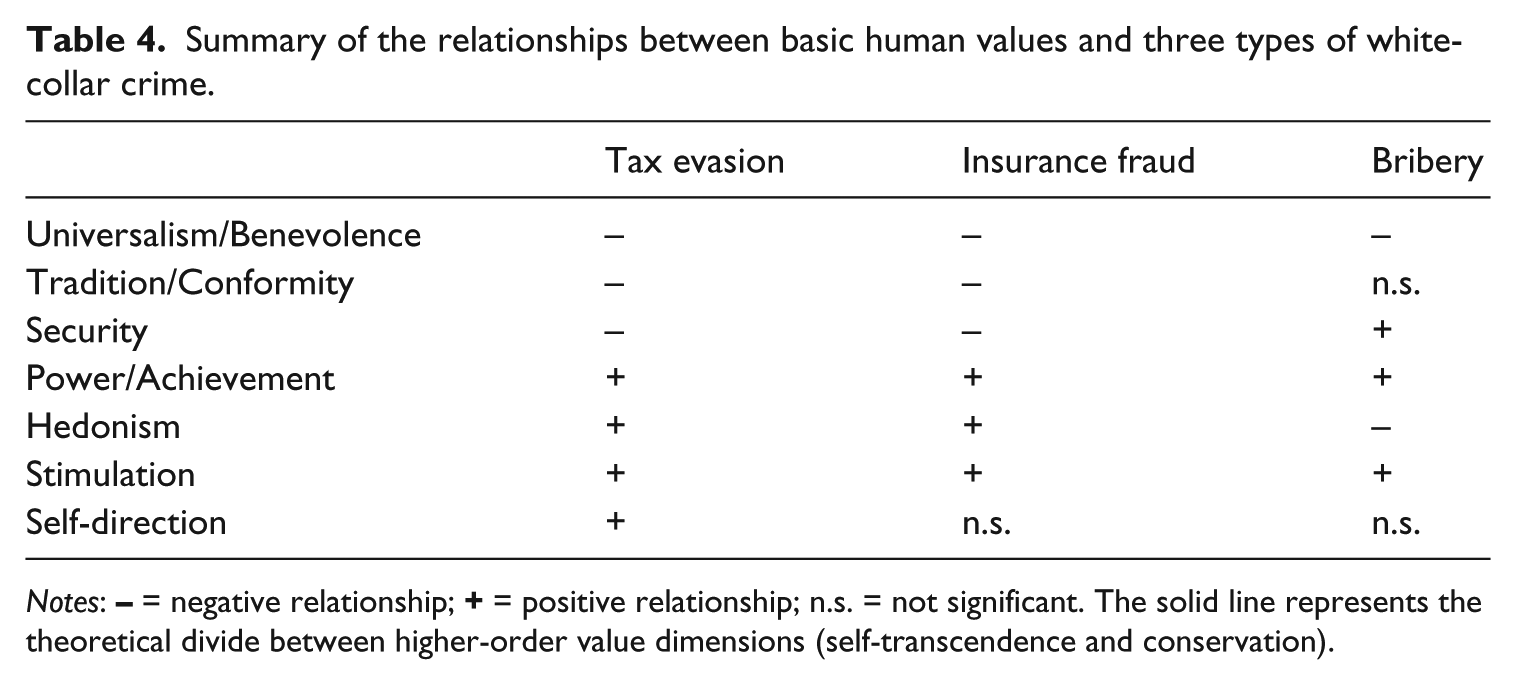
Table 4 summarizes the results. When focusing on the individual value constructs it becomes apparent that the most consistent relationships found between values and white-collar crime is for the value constructs ‘universalism’/‘benevolence’, ‘power’/‘achievement’ and ‘stimulation’. These value constructs are all statistically significantly related to each of the three crime types in the expected direction. The individual value construct displaying the weakest relationship with white-collar crime is ‘self-direction’, which is positively related to tax evasion but not significantly related to insurance fraud or bribery.
Summary of the relationships between basic human values and three types of white-collar crime.
Notes:
Table 4 also reveals that values are particularly relevant predictors for two types of white-collar crime, tax evasion and insurance fraud, whereas the results in relation to bribery are mixed. All value constructs except ‘self-direction’ display statistically significant relationships in the anticipated direction with tax evasion and insurance fraud. Regarding bribery, the values ‘universalism/benevolence’, ‘power/achievement’ and ‘stimulation’ display relationships in the expected direction, whereas all other value constructs display either no statistically significant relationship or a relationship in the direction opposite to what was expected.
Discussion
The aim of this study was to systematically examine relationships between basic human values and three specific types of white-collar crime: tax evasion, insurance fraud and bribery. Six tentative hypotheses were formulated based on (limited) empirical findings and the value theory developed by Schwartz, which defines values as abstract goals guiding behavior and holds that they are meaningfully interrelated.
The first two hypotheses postulated that ‘hedonism’ scores will be positively related to white-collar crime (H1a), while scores for values located opposite to ‘hedonism’, that is ‘tradition/conformity’, will be negatively related to white-collar crime (H1b). The results regarding ‘hedonism’ were statistically significant in relation to tax evasion and insurance fraud but not in relation to bribery. Hypothesis H1a is thereby partially supported, which is in line with previous studies that have found a positive relationship between ‘hedonism’ and white-collar crime (Blickle et al., 2006). The results regarding ‘tradition/conformity’ values are consistent with hypothesis H1b across all three crime types. High scores are associated with lower odds ratios of having committed tax evasion, insurance fraud and bribery.
As suggested by the two hypotheses formulated in relation to ‘power’ and ‘achievement’ values, as well as the opposite value constructs ‘universalism’ and ‘benevolence’, the results show that scores for the unified construct ‘power/achievement’ were positively related to white-collar crime (H2a), while ‘universalism/benevolence’ scores were negatively related to white-collar crime (H2b). Hypothesis H2a thus receives full support across all crime types, in line with the ‘desire-for-control’ theme inspiring the hypotheses regarding these values (Piquero et al., 2005; Schoepfer et al., 2014). Furthermore, as suggested by hypothesis H2b, the results show that there is a negative relationship between ‘universalism/benevolence’ and white-collar crime across all crime types.
Finally, the last pair of hypotheses postulated that ‘stimulation’ and ‘self-direction’ scores will be positively related to white-collar crime (H3a), while ‘security’ scores will be negatively related to white-collar crime (H3b). The results clearly demonstrate that ‘stimulation’ is positively related to all three crime types, whereas ‘self-direction’ is statistically significantly related only to tax evasion. The opposite value construct, ‘security’, is negatively related to tax evasion and insurance fraud but not to bribery. Thus, the data partially support hypotheses H3a and H3b.
This study has thus shown that most of the basic human value constructs available in the data are related to white-collar crime: 16 out of 21 tested associations between value constructs and the three types of white-collar crime proved to be statistically significant and in the direction predicted by the hypotheses. Relationships between the values and white-collar crime were substantially less clear-cut regarding one specific crime type, bribery, indicating that bribery is a different type of white-collar crime conducted for other motivational reasons than those related to tax evasion and insurance fraud. Most notable is the negative relationship with hedonistic values, which convey self-interest. If one were to conceive of bribery as often conducted within an organizational environment, this could perhaps indicate the pursuit of corporate rather than personal gain, thereby explaining the mixed results regarding this particular crime type.
Overall, the results suggest that the values individuals hold do matter for the risk of committing white-collar crime. Thus, the theory of basic human values represents a valuable contribution to micro-level theories on white-collar crime by providing a system of interrelated values that can be utilized to predict white-collar crime prevalence. The results of this study suggest that values emphasizing the individual (advancement of the self, seeking control, individual competence, status and prestige, challenge, excitement and independence) are positively related to white-collar crime, whereas values with broad motivational goals of welfare, tolerance, social order and relational stability are negatively related to it. However, the most important conclusion is that, whereas previous research has shown that white-collar offenders deviate from non-offenders on specific values or personality predispositions, our findings suggest that deviation follows a systematic pattern across the full circumplex comprising the basic human value system.
Some limitations of the study should also be mentioned. Due to limitations of the ESS data, a total of seven value constructs were tested. Some of the value constructs in Schwartz’s original theory thus had to be modified, creating new unified value constructs. However, future studies utilizing the Schwartz (1992) value survey or the original PVQ (Schwartz et al., 2001) would allow for the testing of all the listed values as predictors. In addition, Schwartz et al. (2012) have refined and extended the theory of basic values, identifying a set of 19 values instead of 10. It would undoubtedly be interesting to test these more finely tuned instruments against white-collar crime in the future. However, using the ESS data we were able to examine the relationships between values and white-collar crime in a broad sample of European countries, thereby providing robust evidence on the relationship between values and white-collar crime.
Another limitation of the study concerns potential cross-country differences and contextual effects. The countries included in our pooled data set undoubtedly represent quite diverse contexts in terms of institutional configurations and culture. It is reasonable to expect that the relationships between values and white-collar crime could vary in such different national contexts. Values could, for example, have a stronger impact on the likelihood of committing white-collar crime in national contexts characterized by low levels of corruption, than in others where passing ‘money under the table’ is part of the common way of getting things done. Future research is undoubtedly needed to investigate whether the relationships between values and white-collar crimes are moderated by national contexts and to identify the relevant contextual factors affecting the link between values and white-collar crime. The present study finding robust support for the relationship between basic human values and white-collar crime by using pooled data can serve as a starting point for future comparative studies.
Footnotes
Appendix
The ESS Human Values Scale in the 2nd Round.
| Value | Item No. (according to its order in the ESS questionnaire) and Wording (Male Version) |
| Self-Direction (SD) | 1. Thinking up new ideas and being creative is important to him. He likes to do things in his own original way (ipcrtiv). |
| 11. It is important to him to make his own decisions about what he does. He likes to be free to plan and not depend on others (impfree). | |
| Universalism (UN) | 3. He thinks it is important that every person in the world be treated equally. He believes everyone should have equal opportunities in life (ipeqopt). |
| 8. It is important to him to listen to people who are different from him. Even when he disagrees with them, he still wants to understand them (ipudrst). | |
| 19. He strongly believes that people should care for nature. Looking after the environment is important to him (impenv). | |
| Benevolence (BE) | 12. It’s very important to him to help the people around him. He wants to care for their well-being (iphlppl). |
| 18. It is important to him to be loyal to his friends. He wants to devote himself to people close to him (iplylfr). | |
| Tradition (TR) | 9. It is important to him to be humble and modest. He tries not to draw attention to himself (ipmodst). |
| 20. Tradition is important to him. He tries to follow the customs handed down by his religion or his family (imptrad). | |
| Conformity (CO) | 7. He believes that people should do what they’re told. He thinks people should follow rules at all times, even when no one is watching (ipfrule). |
| 16. It is important to him always to behave properly. He wants to avoid doing anything people would say is wrong (ipbhprp). | |
| Security (SEC) | 5. It is important to him to live in secure surroundings. He avoids anything that might endanger his safety (impsafe). |
| 14. It is important to him that the government insures his safety against all threats. He wants the state to be strong so it can defend its citizens (ipstrgv). | |
| Power (PO) | 2. It is important to him to be rich. He wants to have a lot of money and expensive things (imprich). |
| 17. It is important to him to get respect from others. He wants people to do what he says (iprspot). | |
| Achievement (AC) | 4. It’s important to him to show his abilities. He wants people to admire what he does (ipshabt). |
| 13. Being very successful is important to him. He hopes people will recognize his achievements (ipsuces). | |
| Hedonism (HE) | 10. Having a good time is important to him. He likes to ‘spoil’ himself (ipgdtim). |
| 21. He seeks every chance he can to have fun. It is important to him to do things that give him pleasure (impfun). | |
| Stimulation (ST) | 6. He likes surprises and is always looking for new things to do. He thinks it is important to do lots of different things in life (impdiff). |
| 15. He looks for adventures and likes to take risks. He wants to have an exciting life (ipadvnt). |
Source: Davidov (2008: 36)
Funding
The author(s) received no financial support for the research, authorship, and/or publication of this article.