



Abstract
Deterrence theory states that fear of sanctions secures compliance with the law. Empirical research on the deterrent effect of legal sanctions has remained inconclusive though. This applies especially to perceptual deterrence studies. Most of them are cross-sectional in nature and rely on measures of self-reported previous offending, which implies that they actually explain past criminal behaviour from current perceptions of risk. However, such a temporal ordering of the concepts is more congruent with experiential effects according to which previous criminal involvement lowers subsequent risk perceptions rather than depicting deterrent relationships. The few longitudinal studies that have attempted to disentangle experiential and deterrent effects are based on samples from North America. Their common finding is that experiential effects exist and that they are substantially larger than the deterrent effect. Most of them reject the notion of deterrence. This work contributes to the discussion by for the first time addressing the experience–deterrence issue with panel data collected in the UK. Results show that associations between current risk estimates and prior offending found in cross-sectional studies reflect chiefly experiential effects. Evidence in support of deterrence remains very limited.
Problem definition and state of research
Empirical criminological enquiry frequently relies on cross-sectional observational studies to test explanations of criminal conduct. Determining causality in cross-sectional research is, however, a highly problematic endeavour. There is a consensus that at least three criteria must have been met before a statistical association between two variables measured at the same point in time can be interpreted in causal terms: (1) there must be significant covariation between the variables of interest; (2) the correlation between the two variables must not be spurious, that is, continue to exist when relevant third variables are controlled; (3) the explanatory variable must precede the explained variable in time (Finkel, 1995; Taris, 2000). 1
Perceptual deterrence research – survey studies investigating the impact of perceived sanction risk on criminal behaviour – is heavily affected by the problems mentioned above. However, before exploring this issue, some general clarifications are necessary.
Deterrence can be thought of as the avoidance or omission of an act of crime because of the fear of negative consequences, with this fear being dependent on the perceived certainty of intervention and the expected severity of punishment (Wikström, 2008). Classical deterrence theory assumes that fear of legal sanctions causes people to refrain from crime (Andenaes, 1974; Gibbs, 1975; Zimring and Hawkins, 1973). It is based on three premises that are at the heart of rational choice theory: (1) human action is motivated by seeking pleasure and avoiding pain, (2) decisions to offend are made by balancing the costs and benefits of various action alternatives, and (3) individuals choose and act with at least minimal rationality. People will violate the law when the expected benefits of doing so outweigh the expected costs. The role of legal sanctions in preventing crime is thus to ensure that the cost of offending does indeed exceed its benefit.
Empirical deterrence research has produced mixed and inconclusive results (Apel and Nagin, 2011; Dölling et al., 2009; Loughran et al., 2016; Nagin, 2013; Paternoster, 2010; Paternoster and Bachman, 2013; Pratt et al., 2006; Von Hirsch et al., 1999; Wikström, 2008). The current state of knowledge on the question ‘Do sanction threats impede criminal conduct?’ stems from three types of research: interrupted time-series, ecological studies and survey studies (Nagin, 1998). Interrupted time-series studies investigate the effect of criminal justice policy interventions such as police crackdowns or increases in sentencing severity on rates of crime. Findings show that these interventions often generate an initial deterrent effect (a straw fire effect) that tends to decay over time. Whether a small sustainable (enduring) deterrent effect remains is contentious (Nagin, 1998; Sherman, 1990).
Ecological studies focus on criminal justice policies in different jurisdictions and their associations with local or regional crime rates. To determine the existence and strength of deterrent effects, they relate characteristics of the actual sanctioning policy (for example, the ratio of arrests to crimes or the average length of the imposed prison sentences) to the crime rates in these jurisdictions. The results of these largely cross-sectional area comparisons suggest that the likelihood of punishment exerts a greater deterrent effect than the severity of the punishment. Whether sentencing severity affects crime figures at all is subject to controversy (Apel and Nagin, 2011; Dölling et al., 2009; von Hirsch et al., 1999). However, debate also exists on how to interpret the more robust statistical association between actual sanction certainty and level of crime. What is normally taken as evidence for deterrence (the negative correlation between crime rates and sanction likelihood measures) may also mirror a capacity effect: ‘increased crime may overwhelm the criminal justice system’s capacity to process cases’ (Nagin, 1998: 8), thus urging judges to adopt more efficient ways of dealing with cases, which may result in reduced conviction and imprisonment rates. To separate deterrent effects from capacity effects, longitudinal studies are needed. The few studies that try to solve the simultaneity problem show inconsistent results, some indicating that the level of crime affects sanction levels (for example, Nagin, 1981), others suggesting that sanction policy influences the crime rate (for example, Levitt, 1996).
Perceptual deterrence research relies on survey studies to assess the relationship between punishment perceptions (perceived certainty of punishment or expected sanctioning severity) and measures of criminal activity (either self-reported offending in a particular period before the survey or intentions to offend in the future). These studies generally show that severity estimates are not closely tied to respondents’ behaviour. Evidence on the relationship between certainty perceptions and crime involvement is more ambiguous. The only consensus is that the perceived certainty of punishment is more important for behavioural choices than the expected severity of punishment (Apel and Nagin, 2011; Paternoster, 2010; Paternoster and Bachman, 2013; Pratt et al., 2006).
On a bivariate level, perceptual studies usually find that self-reported offending is lower among people who perceive a greater risk of detection or punishment. 2 However, the associations between offending and certainty perceptions begin to decrease substantially as soon as other influencing factors are taken into account. Controlling for third variables that may affect both perceived risk and crime involvement (for example, level of self-control or exposure to crime-prone peers) clearly weakens the risk–crime relationship, frequently depriving it of its significance (Paternoster, 2010; Pratt et al., 2006). But, even if some small deterrent-like association remains, the direction of causation is problematic in most of these studies owing to their cross-sectional nature. It is possible, as the deterrence hypothesis posits, that increased perception of risk leads to less offending, but it is also possible that committing crime leads to a more realistic (that is, decreased) perception of risk. Which causal order is true – or if there is a reciprocal relationship between perceived risk and criminal conduct – cannot be inferred from data collected at one point in time.
The major methodological weakness of cross-sectional perceptual deterrence studies is that they relate current estimates of sanction risk to self-reports of past involvement in criminality. Such correlations reflect the association between certainty perceptions measured at the time of the survey and criminal behaviour that precedes these perceptions in time. The corresponding negative correlations are actually more in line with the assumption of an experiential effect (an effect of previous behaviour on current perceptions) than they are indicative of deterrence. Low perceptions of sanction risk may be a consequence rather than a cause of criminal behaviour (Greenberg, 1981; Saltzman et al., 1982).
In view of the problematic temporal ordering of the concepts, the criticism has been raised that what cross-sectional perceptual deterrence studies are actually observing is not a deterrent effect but an experiential effect – an effect of previous criminal involvement on subsequent perceptions of risk (Paternoster et al., 1983a; 1983b; Saltzman et al., 1982). It has been shown that naive individuals with no experience of offending tend to overestimate the likelihood of apprehension or punishment (Matsueda et al., 2006; Paternoster et al., 1985; Schulz, 2014). People engaging in criminal behaviour discover in most cases that they can ‘get away with it’ (Wikström et al., 2012). 3 This causes them to lower their unrealistically high risk perceptions. In brief, offenders have a better knowledge about sanction risks because they learn by experience that being caught and punished is a rare event. From such a perspective, certainty estimates appear to be a consequence and not a cause of criminal conduct. 4
In order to interpret inverse correlations between risk perceptions and self-reported offending measured at the same point in time as a deterrent effect, apart from non-spuriousness a high degree of stability in perceived risk is necessary. The requirement of perceptual stability had already been recognized by Saltzman and colleagues (1982: 174) in their seminal work: ‘If perceptions are stable over time, then the cross-sectional experiential relationship between behavior and subsequent perceived sanctions may act as a proxy for the deterrent relationship between perceived sanctions and subsequent behavior. If perceptions of punishment risk change over time, however, deterrence researchers have been reporting a spurious “deterrent” effect.’
The few longitudinal studies that address this issue empirically usually come to the conclusion that perceptions of the certainty of detection or punishment are not particularly stable (for example, Bishop, 1984; Minor and Harry, 1982; Loughran et al., 2012; Paternoster et al., 1983a; 1983b; Pilliavin et al., 1986; Saltzman et al., 1982). There are significant changes in risk perception over time that unequivocally undermine the assumption of perceptual stability. These results raise serious doubts regarding the sufficiency of cross-sectional self-report studies in establishing deterrent relationships.
Meanwhile, there is also an extensive literature on the formation of sanction risk perceptions (Apel, 2013). These works also speak to the instability of certainty perceptions. Under the label of ‘updating’, the effects of arrest or punishment experiences on perceived sanction risk are studied. Recent results show that offenders upgrade (that is, raise) their risk estimates in response to being sanctioned (for example, Anwar and Loughran, 2011; Matsueda et al., 2006; Pogarsky et al., 2004; Schulz, 2014; Thomas et al., 2013). This implies that certainty estimates decline when unsanctioned offending increases. Nevertheless, in our view, belief updating is conceptually different from the experiential effect because the former describes a positive effect of personal punishment experiences on risk perceptions whereas the latter depicts a negative effect of criminal activity on risk assessment that is due to widespread impunity. Blending updating and crime experience tends to blur the boundaries between specific and general deterrence. 5
Hitherto, only a handful of longitudinal studies has attempted to test simultaneously for experiential effects and deterrent effects. These studies usually fit some sort of autoregressive cross-lagged panel model aimed at disentangling the two different causal pathways to samples of North American adolescents interviewed twice at annual intervals. The common finding of these path models is that experiential effects do exist and that they are consistently larger than the deterrent effect (Bishop, 1984; Carmichael et al., 2005; Matsueda et al., 2006; Minor and Harry, 1982; Paternoster et al., 1983a, 1983b, 1985; Pilliavin et al., 1986; Saltzman et al., 1982). Whether perceived sanction risk acts as a deterrent at all remains contentious. Most longitudinal studies reject the notion of deterrence (Minor and Harry, 1982; Paternoster et al., 1983a, 1983b; Pilliavin et al., 1986; Saltzman et al., 1982), although a few enquiries are able to find significant though weak deterrent effects even under these conditions (Bishop, 1984; Carmichael et al., 2005; Fagan and Piquero, 2007; Matsueda et al., 2006; Paternoster et al., 1985). Nevertheless, the general consensus is that scholars who relied on cross-sectional surveys have substantially overestimated the deterrent effect.
Panel studies ensure a correct temporal ordering of risk perceptions and criminal activity, but may be criticized for determining risk assessment long before actual behavioural choices. The longer the lag period, the lower are the chances of detecting deterrent effects. The time interval between two survey sweeps is usually one year, which may be too long to establish a deterrent impact of perceived sanction risk (Williams and Hawkins, 1986). To overcome this lag problem, the scenario or vignette technique has been adopted in perceptual deterrence research. Scenario-based studies present respondents with hypothetical situations described in some detail and ask them (1) to assess the likelihood of getting caught (sanctioned) when committing a certain type of crime in this situation, (2) to judge the severity of punishment that must be expected when caught committing the crime, and (3) to state whether or not (or how likely it is) they would offend in this situation. The scenario method is well suited to solve the temporal ordering problem because it measures risk perceptions, sanction expectations and behavioural intentions for the same point in time. The price of relying on the scenario methodology is, however, an imperfect predictive validity. Although Ajzen and Fishbein’s (1980) Theory of Reasoned Action suggests that behavioural intentions are the best predictor of actual behaviour and a few studies can demonstrate that respondents’ intentions to offend are significantly related to self-reported crime involvement (Grasmick and Green, 1980; Murray and Erickson, 1987; Wikström et al., 2012), some scepticism remains about whether people will always do what they say they will do. From a substantive perspective, drawing on projected criminality as a proxy for actual criminality generates somewhat more support for deterrence: most scenario-based studies report deterrent-like relationships between perceived sanction risk and intentions to offend and conclude that people are more responsive to the perceived certainty of sanctions compared with the expected severity of punishment (Apel and Nagin, 2011; Nagin, 1998; Paternoster and Bachman, 2013; Pratt et al., 2006; Von Hirsch et al., 1999; Wikström, 2008).
Matsueda and colleagues (2006: 97) recap the equivocal state of research as follows: ‘Longitudinal panel studies of perceived risk and self-reported delinquency find weak or nonsignificant deterrent effects (Paternoster, 1987), whereas vignette studies of perceived risk and intentions to commit crime find significant deterrent effects (Nagin, 1998).’
Current study
In this work, we adopt a longitudinal approach to revisit the debate on deterrent effects and experiential effects, but for the first time with data from a European country (the UK). We present the first European perceptual deterrence study that employs panel data to determine the effect of sanction risk perceptions on subsequent self-reported delinquency. From our perspective, cross-cultural replication is indispensable for making claims about the generalizability of findings obtained in the US. Studies aimed at testing general theories of crime or evaluating policy interventions are in special need of replication in different countries, not least in order to increase the confidence of European policymakers in the validity of the criminological knowledge base (McNeeley and Warner, 2015).
We utilize four waves of the Peterborough Adolescent and Young Adult Development Study (PADS+) (Wikström et al., 2012), a longitudinal study on the causes of adolescent delinquency conducted in an English city, to assess whether or not there is any deterrent impact of perceived sanction risk when controlling for the influence of prior behaviour on subsequent risk estimates. Unlike most other perceptual deterrence studies, which are often restricted to two waves, with four sweeps of data collection – one per year – our study enables repeated comparisons of deterrent effects and experiential effects over time.
In the remainder of this article, we will first outline some methodological properties of the present study and then, after revealing the instability of young people’s risk perceptions, report the findings of a series of dynamic path models aimed at isolating potential deterrent effects from possible experiential effects.
Methods
Data
Our data comes from the Peterborough Adolescent and Young Adult Development Study (PADS+), a longitudinal study that has followed a random sample of 716 young people who were living in the city of Peterborough in 2002. This work draws on four waves of the interviewer-led small-group questionnaires presented annually to the adolescents between 2005 and 2008. Data are taken from waves 2 to 5, which cover the ages 14 to 17. 6 Over the period analysed in this article, an exceptionally high retention rate was maintained, with 97 percent of the sample taking part in wave 5. For detailed information about the study design and the captured population, see Wikström et al. (2012).
Measures
Crime
Self-reported offending was measured by means of a total crime frequency scale. For 10 different offences (shoplifting, theft from a person, theft from a car, theft of a car, residential burglary, non-residential burglary, robbery, assault, vandalism, fire-setting), respondents were asked how many times they had committed the crime in the year before the survey. Answers were added up to form a composite frequency score. Because the distribution of these measures is pretty skewed, 7 they were all log-transformed before introducing them into linear regression models. The remaining levels of skewness (see Table 1) are not considered to be problematic, especially since robust maximum likelihood estimation procedures were employed.
Descriptive statistics and correlations.

Note: All product-moment correlation coefficients are significant at p < .001.
Deterrence
Deterrence perceptions were measured in terms of the perceived risk of apprehension when committing four types of crime (shoplifting, theft from a car, vandalism, assault). Respondents were asked ‘Do you think there is a great risk of getting caught if you [type of crime]’? The response categories were ‘no risk at all’ (0), ‘a small risk’ (1), ‘a great risk’ (2) and ‘a very great risk’ (3). Items were summed to a total score, with high values indicating an elevated certainty of detection.
In selected analyses, additional covariates are taken into account.
Morality
Personal moral rules were measured by asking participants to rate whether they thought 16 acts of rule-breaking were ‘very wrong’ (3), ‘wrong’ (2), ‘a little wrong’ (1) or ‘not at all wrong’ (0). These acts ranged from minor acts (for example, riding a bike through a red light) to more serious acts (for example, breaking into a building to steal something). Item responses were summed to create an index for each wave.
Self-control
Generalized ability to exercise self-control was measured using eight items, which asked respondents to rate whether they ‘strongly agree’ (3), ‘mostly agree’ (2), ‘mostly disagree’ (1) or ‘strongly disagree’ (0) with statements about themselves (for example, ‘I never think about what will happen to me in the future’; ‘I lose my temper pretty easily’). The scale is a modified and stripped-down variant of the Grasmick et al. (1993) scale adjusted to be more consistent with Situational Action Theory’s conceptualization of the ability to exercise self-control. For each wave responses were summed to create an index for low self-control.
Peer delinquency
Peer crime involvement was measured using a six-item scale asking if a person’s friends engaged in different acts of rule-breaking (skipping school or work, getting drunk, substance use, shoplifting, vandalism and fighting). The response categories were ‘no, never’ (0), ‘yes, sometimes’ (1), ‘yes, often (every month)’ (2) and ‘yes, very often (every week)’ (3). For each wave participants received a summated peer delinquency score.
For details of the measurement of the employed variables, see Wikström et al. (2012: 107 ff).
Findings
Instability of deterrence perceptions
Cross-sectional associations between perceived sanction risk and self-reported offending can be regarded as evidence of deterrent effects only when there is a high degree of stability in deterrence perceptions over time. This seems not to be the case here. A look at the matrix of zero-order correlations between the investigated deterrence and delinquency variables (Table 1) reveals only modest to moderate stability of sanction risk estimates. Change is found particularly for the younger ages. The older the respondents get, the less risk perceptions change over time, with time t –timet+1 correlations rising from .40 between the first two waves to .58 between the last two waves. Nevertheless, in terms of their magnitude all correlation coefficients between adjacent certainty measurements clearly fall below the threshold of .80 normally required for test–retest reliability. This implies that later risk perceptions are not good proxy measures of earlier ones, especially when dealing with young participants. 8
Correlation coefficients tell us only whether the timet+1 ordering of individuals on the perceived risk variable is consistent with their time t ordering. They do not inform us about intra-individual change in risk perceptions over time. To address the temporal stability issue from a within-individual perspective, at first a repeated measures analysis of variance was conducted. The results (Pillai-Spur = .07; F = 17.23; p = .000) indicate that risk estimates are subject to significant change over the inspected life span.
To assess whether there is variation in perceptions of sanction risk from one sweep to the next, several matched-pairs t-tests were performed (Table 2). The t-tests for paired samples indicate that there were indeed significant within-individual changes in perceptions over time, at least between years 2, 3 and 4. Perceived sanction risk drops significantly between waves 2 and 3, and also between waves 3 and 4. Only when comparing the risk estimates of waves 4 and 5 are changes insignificant, reflecting a certain level of stability between ages 16 and 17.
Stability of risk perceptions (results of paired-sample t-tests).
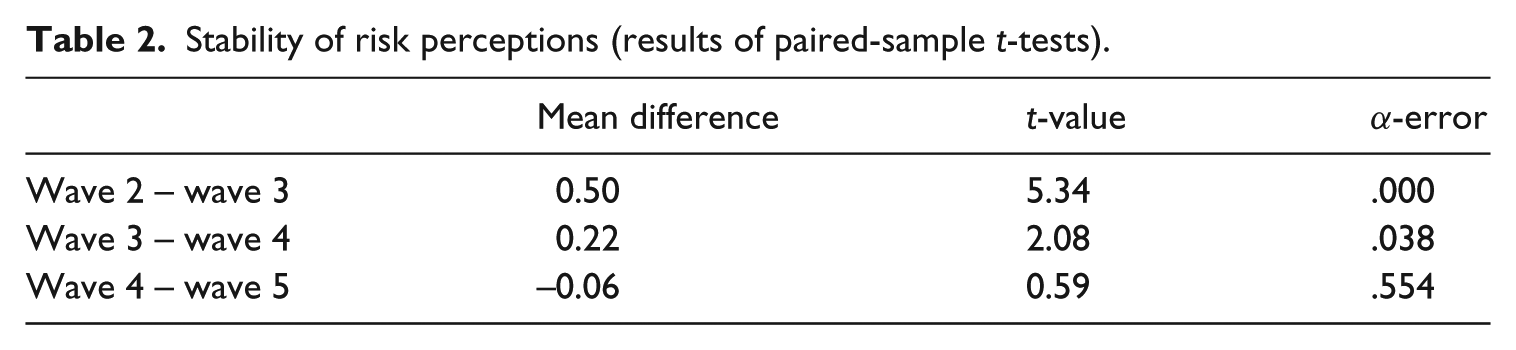
In all, these findings undermine the stability assumption necessary to interpret cross-sectional correlations between perceived sanctioning certainty and self-reported criminal activity as an indication of deterrence.
Deterrent versus experiential effects
It has been argued that the inverse relationship between perceived risk and offending frequently observed in cross-sectional studies may reflect either a deterrent effect (an effect of perceptions of sanction risk on criminal activity) or an experiential effect (an effect of criminal involvement on risk perceptions). To disentangle deterrent and experiential effects, a dynamic panel model in the form of a single indicator autoregressive cross-lagged path model was estimated (Finkel, 1995; Taris, 2000). The linear path model includes autoregressive effects between prior risk perceptions (delinquency) and subsequent risk perceptions (delinquency), cross-lagged effects of previous wave risk perceptions on next wave self-reported offending, and synchronous (same wave) effects of delinquency on risk perception. The first group of effect parameters represents stability coefficients, the second group describes deterrent effects, and the third group depicts experiential effects. 9 Figure 1 gives the corresponding standardized regression coefficients and their significance. 10 Here again, the moderate autoregressive effects found for risk perception challenge the crucial assumption of perceptual stability. Although significant, the rather modest stability parameters indicate that there is much change in perceptions of sanction risk over time. These changes seem to decrease a bit as respondents grow older.

Path model.
On balance, the findings of the fitted path model mirror those of Paternoster and his research group – evidence of moderate experiential effects compared with very weak (or absent) deterrent effects. Beginning with the correct deterrent effect (the relationship between time t perceived risk and offending reported at timet+1), it is apparent that the findings clearly challenge the deterrence doctrine. Only one out of three coefficient estimates indicates a significant deterrent effect: there is a very weak negative relationship between wave 3 certainty perception and wave 4 offending. In terms of size, the corresponding standardized regression coefficient falls below the threshold of |.10| (Cohen, 1992). The other two coefficient estimates fail to achieve significance.
As regards the experiential effect (the relationship between criminal conduct occurring between time t and timet+1 and timet+1 risk perceptions), the results are more supportive. Across all waves, prior offending exerts a significant negative influence on subsequent certainty perceptions: the more criminal acts a respondent reports for the year preceding the survey, the lower his/her current estimates of the risk of getting caught. Risk appraisal is indeed a function of previous behaviour.
Had we relied on a cross-sectional study design, as many perceptual deterrence researchers have done, we would have come to the conclusion that a weak to modest deterrent effect exists. In this case we would probably have been more criticized for failing to control for additional covariates – third variables that affect both risk perceptions and criminal conduct – than for basing our analyses on an incorrect temporal ordering of the constructs. To defuse such criticism here, we estimated a series of negative binomial regression models (Hilbe, 2011) that, aside from perceived sanction risk, also incorporate effects of time t morality, self-control and peer association on timet+1 offending (Table 3). We switch to negative binomial models here because negative binomial regression is the appropriate procedure to analyse skewed count variables that are subject to overdispersion. 11 Again, apart from the already familiar modest negative relationship between wave 3 risk perception and wave 4 delinquency, no support for deterrence can be found. 12 However, this weak certainty effect also diminishes to non-significance (B = −.168; p = .139) as soon as prior (wave 3) crime involvement is added as a control variable.
Deterrent effects adjusted for covariates (regression coefficients from negative binomial regression models).
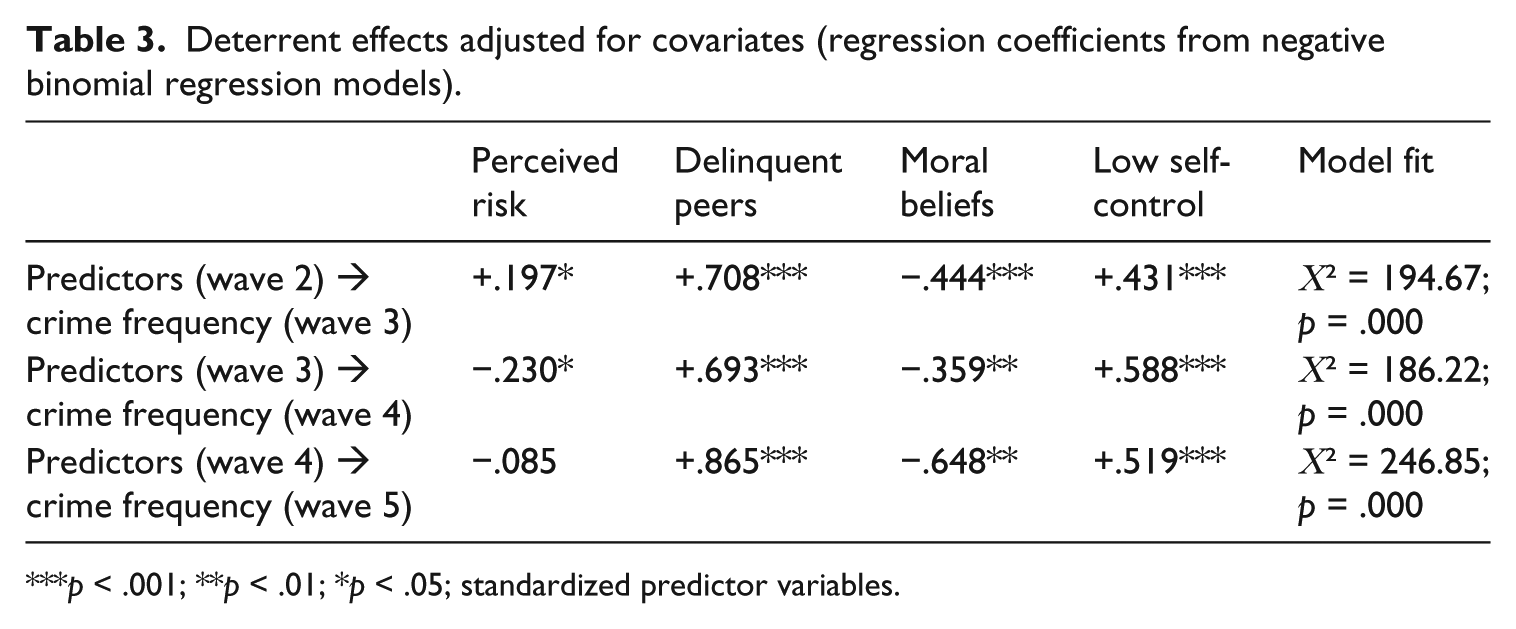
p < .001; **p < .01; *p < .05; standardized predictor variables.
The three covariates, however, do exert a significant influence on future offending. Weak morality, low self-control and exposure to delinquent peers increase the frequency of criminal conduct. Involvement with delinquent peers turns out to be the best predictor of subsequent criminality. The consistency of these observations with previous research on the determinants of criminal behaviour (Ellis et al., 2009) enhances the confidence in our results.
Sensitivity analysis
The key finding of the models presented above is that the experiential effect clearly exceeds the deterrent effect. It may be argued, however, that, in order to demonstrate deterrence relationships, a crime-specific analysis is necessary. Since in the PADS+ perceived risk is measured for four different crimes, the number of offence-specific models is also restricted to four. Table 4 shows the results of dynamic autoregressive panel models for shoplifting, theft from a car, vandalism and assault.
Crime-specific analyses (standardized regression coefficients from linear models).

p < .001; **p < .01; *p < .05.
In sum, these models tell the same story: the effect of behaviour on perceptions is larger than the effect of perceptions on behaviour. When significant deterrent effects arise (which is the case in only 2 out of 12 parameter estimations), they remain weak to substantively negligible. This observation applies to both property and violent crimes. 13
Compared with the overall crime analyses, the offence-specific experiential effects are somewhat smaller in size. This may be rooted in a lower reliability of single-item measures of perceived sanction risk. Such an observation is also consistent with the assumption that, although considerations of whether or not to commit a certain act of crime are highly offence specific, individuals draw on generalized risk estimates to determine crime-specific sanction risks. The homogeneity of the employed measures of perceived sanction risk (.70 ⩽ α ⩽ .79) supports this presumption.
It is also worth mentioning that the offence-specific analyses do not provide more evidence for perceptual stability. Perceptions of the risk of getting caught when committing a certain type of crime are highly unstable, especially for younger respondents.
The causal models reported so far, although operating with lagged variables, determine effects from comparing individuals with individuals (between-effects). Panel data also enable comparisons of the same person over time and therewith analyses of the sources of within-individual variation from one survey sweep to the next. To explain intra-individual change over time, we rely on fixed-effects regression (Allison, 2009). 1 In this model, the effect of a (lagged) predictor variable that varies over time on a response variable that is measured at several points in time is expressed by one single slope parameter, regardless of the number of measurement time points. The fixed-effects estimator is unbiased by unobserved heterogeneity because the inherent within-transformation ensures that the influence of all person-specific time-constant characteristics is eliminated.
To determine the robustness of our diagnosis of a large absence of deterrence, a fixed-effects negative binomial regression model investigating the impact of risk perception on untransformed frequency of offending was estimated. Its results indicate once more that there is no significant deterrent effect (B = +0.018; p = .312). 15
A linear fixed-effects model on perceived sanction certainty again demonstrates that adolescents with a history of offending in the year preceding the survey are more likely to assess the risk of getting caught as (very) low (B = −0.289; p = .000).
Conclusions and discussion
Cross-sectional perceptual deterrence research struggles with the problem of an incorrect temporal ordering of the included concepts. Observed associations between current perceptions of sanction risk and self-reported previous offending may be more indicative of an experiential effect according to which criminal activity informs risk perceptions rather than actually depicting deterrent effects. Longitudinal studies from the US (for example, Paternoster et al., 1983a, 1983b; Saltzman et al., 1982) show that cross-sectional studies have substantially overestimated the deterrent potential of criminal sanctions and that perceptions of sanction risk are rather a consequence than a cause of criminal behaviour.
The present article addresses the question of whether these findings also apply to a European context. Employing longitudinal data from PADS+ to disentangle deterrent effects from experiential effects suggests in several ways that the common practice of taking cross-sectional correlations between perceived sanction risk and self-reported offending as an indication of deterrence represents a serious misinterpretation.
At first our results show that there is little stability in perceptions of detection or sanction certainty over time. Perceptions measured at a later point in time are not good estimates of earlier perceptions. Statistical analyses do not support the assumption of perceptual stability that underlies cross-sectional deterrence research. Against this backdrop, it must be suspected that the associations between current perceptions of punishment certainty and prior offending found so often in cross-sectional studies reflect primarily experiential effects (the effects of one’s behavioural experience on perceptions of sanction risk) and less deterrent effects (the effects of one’s sanction risk perceptions on subsequent behaviour).
Panel models simultaneously testing for experiential and deterrent effects enhance this impression. Their results provide firm evidence of experiential effects, but fail to back the notion that perceived sanction risk deters. Whereas moderate experiential effects emerge consistently regardless of type of analysis, support for deterrence is very limited. Robust experiential effects face very weak to non-existent deterrent effects, a pattern that is repeated in offence-specific analyses.
Taken together, these findings suggest that cross-sectional studies are in fact testing not deterrent effects but experiential effects. When relying on the correct temporal ordering of the theoretical concepts, not much support for deterrence can be found. What is described in cross-sectional perceptual deterrence research as evidence for deterrence in reality depicts the impact of prior criminal involvement on perceived sanction risk, at least to a large extent. So the empirical base for independent deterrent effects is actually even weaker than previously thought (Pratt et al., 2006). With this, the assumption that behaviour and perception of risk mutually influence each other over time – in the sense of a ‘deviance amplification loop’, as Bishop (1984: 325) calls it – is also challenged: there does not seem to be much feedback from sanctioning certainty perceptions on future conduct. In all, these findings are very consistent with previous research conducted in the US.
As already observed by Bishop (1984), the experiential effect is slightly greater among younger as compared with older adolescents. Coupled with the finding that perceptual instability is also greatest when respondents are younger and that perceived risk declines as participants grow older, it may be supposed that there are indeed ‘novelty effects’ (Saltzman et al., 1982) or ‘naiveté effects’ (Minor and Harry, 1982) at work. The youngest adolescents are most likely to lack any personal experience of offending, and it is this latter group of ‘non-offenders’ that may be assumed to vastly overestimate the risk of getting caught (Nagin, 1998).
In methodological terms, the present study may be criticized mainly on two grounds:
First, at one year there is a relatively long time lag between the survey sweeps. Risk perception has been shown to be quite an unstable construct that changes considerably from one year to the next. It may also be speculated that, when respondents report on previous offending, they refer first and foremost to the last few months preceding the survey. All this places a long time span between the measurement of perceived risk and captured criminal involvement, which may result in our lagged analyses seriously underestimating the deterrent effect of sanctions (Williams and Hawkins, 1986).
Second, our panel study fails to conduct the analysis at a strictly situational level. It draws on respondents’ self-referenced but decontextualized assessment of risk, instead of capturing the perceptual and behavioural dynamics working in a specific crime-relevant setting. On the other hand, an individual’s general sensitivity to deterrence will be predictive of his or her risk perception in subsequent real-life situations (Wikström, 2008), and offence-specific analyses support the general picture of minimal to no deterrence.
Certainly questions about the generalizability of our findings to other European locations arise. Peterborough is a relatively prosperous city of more than 150,000 inhabitants in south-eastern England. Across many socio-economic indicators, as well as in terms of ethnic heterogeneity, Peterborough is quite similar to other cities in the UK. There are both affluent areas and areas characterized by high social disadvantage. However, crime rates are somewhat higher than in other English cities of comparable size (Wikström et al., 2012).
In addition to Peterborough being a quite typical mid-sized English city, the repeated observation that the PADS+ data reveal relationships between the measured concepts that are similar to those reported in several other studies makes a case for the generalizability of our results. Originally designed to test Situational Action Theory (SAT) (Wikström, 2006, 2008, 2010), the study provides findings on various hypotheses derived from the theory that are well replicated cross-nationally (for example, Hirtenlehner and Hardie, 2016; Svensson et al., 2010; Svensson and Pauwels, 2010). Because PADS+ and studies from other countries uncover identical relationship patterns when it comes to testing SAT, we are confident that our findings regarding deterrence also apply to other populations of adolescents.
More caution is necessary concerning a generalization to adults. There are hints that adults are more responsive to sanction threats than are juveniles (Watkins et al., 2008). Whether perceived sanction risk is indeed a more effective deterrent among adults remains an important issue for future research.
The policy implications of our results do not necessarily include abandoning deterrence completely. A null (or nearly null) finding in the overall population may mask a certain degree of deterrability in small subgroups of the general population. Deterrability describes the responsiveness of individuals to sanction threats (Jacobs, 2010). This deterrability may depend on the characteristics of the individual and the properties of the setting. That the effect of deterrence perceptions on behaviour is contingent on other factors has already been acknowledged by Piquero and colleagues (2011: 336), who argue ‘that the key question is not whether sanctions deterred, but under what conditions or for which kind of persons they deterred’. Maintaining that people respond differently to sanction threats is tantamount to positing that deterrence variables interact with other characteristics in crime (or compliance) causation. Personal morality (Svensson, 2015), level of self-control (Hirtenlehner et al., 2014), type of social bonds (Matthews and Agnew, 2008) and degree of intoxication (Zimring and Hawkins, 1973) may play a moderating role in this regard. When sanction risk perceptions are consequential for only small parts of the general population – for example, crime-prone people who frequently contemplate committing a crime or individuals with high risk sensitivity – the threat of punishment may prevent a considerable number of offences, whereas studies that test the overall population (including mostly people unlikely to engage in criminal behaviour) find at best modest deterrent effects. More research inspired by the notion of differential deterrability (Piquero et al., 2011) is definitely needed. With this work, we want to stimulate European perceptual deterrence research efforts that are sensitive to the conditioning role of cultural contexts, social settings and individual differences in shaping the impact of legal sanction threats.
From a theoretical point of view, the absence of an independent deterrent effect is not really surprising. SAT and accompanying empirical research (Hirtenlehner and Hardie, 2016; Kroneberg et al., 2010; Svensson, 2015; Wikström et al., 2011, 2012) suggest that deterrence matters only when the moral filter does not exclude crime from the catalogue of perceived action alternatives and crime is seen as a viable option. From this it follows that perceived sanction risk does not play an independent role in governing criminal behaviour, but becomes relevant only when moral forces are weak. 16
Furthermore, SAT makes it very clear that an individual’s personal morality (that is, internalized social norms) is more important than legal sanction threats in securing compliance with the law, and that much compliant behaviour is actually the result of habitual law abidance. The extent to which an individual’s morals and habits are shaped by legal sanction threats and local criminal justice policies marks an important field for future enquiry.
Footnotes
Funding
The author(s) received no financial support for the research, authorship, and/or publication of this article.