



Abstract
Although the prevalence of cybercrime has increased rapidly, most victims do not report these offenses to the police. This is the first study that compares associations between victim characteristics and crime reporting behavior for traditional crimes versus cybercrimes. Data from four waves of a Dutch cross-sectional population survey are used (N = 97,186 victims). Results show that cybercrimes are among the least reported types of crime. Moreover, the determinants of crime reporting differ between traditional crimes and cybercrimes, between different types of cybercrime (that is, identity theft, consumer fraud, hacking), and between reporting cybercrimes to the police and to other organizations. Implications for future research and practice are discussed.
Introduction
It is of great importance for law enforcement that victims of crimes report these crimes to the police. A victim report improves the police’s knowledge of the prevalence of different types of crimes, and is usually necessary to start a criminal investigation. Nevertheless, in most Western countries many crimes are not reported to the police (Goudriaan et al., 2004). During recent decades, a vast and growing number of studies have investigated which characteristics of crimes, perpetrators, victims, and regions are associated with the victim’s choice of whether to report a crime after victimization. These studies focus on reporting crimes after victimization of traditional crimes, including violent crimes, property crimes, and vandalism. Although some studies have compared reporting rates after victimization of different types of white-collar crime (for example, Huff et al., 2010), identity theft (for example, Copes et al., 2010), and cybercrime (for example, Domenie et al., 2013; Statistics Netherlands, 2016), no previous study has investigated the victim characteristics associated with the reporting of cybercrime victimization. Therefore, it is unknown whether theories and findings on traditional crime also apply to the reporting of cybercrime victimization.
This knowledge gap needs to be addressed for two reasons. First, it is clear that during the last two decades the prevalence of cybercrime has increased rapidly and cybercrime has become part of everyday life of citizens. For example, in the Netherlands, the country in which the current study is conducted, Dutch Statistics reported that a considerable percentage of Dutch citizens have been the victim of identity fraud (0.6 percent), consumer fraud (3.5 percent), or hacking (5.1 percent) (Statistic Netherlands, 2016). A field trial in England and Wales to improve the collection and presentation of cybercrime statistics in the Crime Survey for England and Wales shows almost 2.5 million hacking and malware incidents in 12 months (ONS, 2016). The Swedish Crime Survey reveals that the percentage of people exposed to fraud in 2014 was 3.1 percent, of which 44 percent involved the Internet (Bra, 2015).
Second, respondents from law enforcement agencies in the study by Leukfeldt et al. (2013b) into the organization of the Dutch police regarding the fight against cybercrime, note that one of the major obstacles regarding cybercrime entering the criminal justice system is that victims do not always report it to the police. Furthermore, based on a self-report study, Domenie et al. (2013) show that only 13.4 percent of victims of a range of cybercrimes report this crime to the police, the lowest being hacking victims (4.1 percent), the highest being stalking victims (30.4 percent). Van de Weijer and Bernasco (2016) also show that less than a quarter of the victims of identity theft and consumer fraud and less than 10 percent of the victims of hacking reported these crimes to the police. These numbers show the importance of gaining more information on the determinants of reporting cybercrime victimization, in order that policies can be developed to stimulate the reporting of cybercrime victimization.
A recent study among Australian online fraud victims showed that one of the reasons for not reporting victimization to the police could be the vast array of agencies and organizations to which victims can report such fraud. These agencies and organizations include, for example, law enforcement agencies, banks, consumer protection agencies, telecommunications and Internet service providers, and website providers (Cross et al., 2016). As a consequence, the victims might not know to which organization they should report their victimization, it may be necessary for victims to report to multiple organizations, and victims may be referred from one organization to another without getting any assistance (Button et al., 2014). In order to address this multiplicity of reporting options, the present study will also focus on the reporting of cybercrime victimization to other organizations than the police.
The aim for the current study is to explore which characteristics of victims are associated with reporting cybercrime victimization. The determinants of the decision to report victimization to the police will first be compared between victims of traditional crime and victims of cybercrime. Second, a comparison will be made between the determinants of crime reporting among victims of the three types of cybercrime: online consumer fraud, identity theft, and hacking. Third, the determinants of the decision to report to other organizations than the police will be examined for all cybercrime and for the three above-mentioned types of cybercrime separately. It is important to note that, when we refer to cybercrime, throughout this article we are exclusively referring to online consumer fraud, identity theft, and hacking, and not to other types of cybercrime, such as child pornography, online stalking, and malware.
The remainder of this article is divided into four sections. First, different theoretical perspectives that aim to explain the crime reporting behaviors of victims will be presented and a brief overview of previous studies on this topic will be discussed. Second, the sample, measurements, and analyses will be discussed in the methods section. The next section presents the results of the analyses and the final section contains the conclusions and discussion.
Theoretical framework
In the scientific literature on factors influencing crime reporting, a three-step decision-making model is often used (Ruback et al., 1984). In the first step of this model, an individual labels him/herself as a victim of a crime. During the second step, the victim determines the seriousness of this crime and, in the third step, the victim decides whether he or she will report the crime to the police or choose another option (for example, report to another organization, not report at all). This decision whether to report a crime can be explained from several theoretical perspectives. Following Goudriaan (2006) a distinction is made between three types of factors that might influence this decision: economic, psychological, and neighborhood factors.
Economic factors
From an economic perspective it is assumed that, when individuals have the choice of whether or not to report a crime, they will make a decision based on the expected benefits and expected costs of each alternative (Skogan, 1976, 1984). Consequently, they will choose the alternative with the highest expected value (that is, the expected benefits minus the expected costs). Several economic factors (which include all outcomes with a material character that can be expressed in terms of time or money) may contribute to the perceived costs of reporting crime. First of all, it costs time to report a crime to the police, for example time to travel to the police station, waiting time, and time to talk to a police officer. Second, because the identity of the reporting victim often becomes known, fear of retaliation might be considered as a cost factor too. How large the perceived costs of retaliation are, depends on the probability and seriousness of retaliation (Singer, 1988). On the other hand, the victim might have empathy for the perpetrator. Because reporting the crime to the police might result in the conviction of the perpetrator, this might have negative consequences for the perpetrator and the relationship between the victim and the perpetrator. Several factors also contribute to the expected benefits of reporting crime. These benefits can be financial. For example, when the victim is insured for the damage, some piece of evidence that the crime has been reported to the police is usually necessary to get the damage reimbursed by the insurance company. Moreover, the victim might expect or hope that the police can identify and prosecute the perpetrator. In that case, the victim could have financial compensation and possibly retrieve any stolen goods. In addition, victims could expect that the arrest and prosecution of the perpetrator will decrease the likelihood that they will be victimized again by the same offender, which would be another expected benefit of reporting crime.
Based on these economic factors it can be expected that several characteristics of the offense and the victim influence the victim’s decision to report a crime. First, it can be expected that, other things being equal, more serious offenses are reported more often because this could increase the expected compensation but not the costs of reporting. In line with this, previous research has shown that the degree of both financial damage (for example, Baumer and Lauritsen, 2010; Bowles et al., 2009; Gutierrez and Kirk, 2017) and physical harm (for example, Baumer and Lauritsen, 2010; Schnebly, 2008; Tarling and Morris, 2010) are positively related to the reporting of victimization of property and violent crime, respectively. Second, it can be expected that victims are more likely to report property crimes when they are insured for the damage. Previous studies have shown that this is indeed the case (for example, Robert et al., 2010; Tarling and Morris, 2010; Tolsma, 2011). Third, decreasing the costs of reporting crime by making it possible to report crime over the telephone or the Internet might lead to an increase in the victim’s willingness to report crime. Tolsma et al. (2012), for example, showed that victims were more willing to report crimes when they could report it over the phone or the Internet, instead of being limited to reporting only at the police station. Finally, the relationship between the victim and the perpetrator could either increase or decrease crime reporting behavior, depending on, for example, expected retaliation or empathy for the perpetrator. Previous studies have shown evidence for both an increasing (for example, Goudriaan et al., 2004) and a decreasing (for example, Baumer and Lauritsen, 2010; Zaykowski, 2010) likelihood to report violent crimes when the offender was known to the victim, whereas other studies did not find a significant relationship (for example, Schnebly, 2008; Tarling and Morris, 2010).
It is, however, questionable whether victims, who might experience a lot of stress and fear, are capable of making a rational decision based on a cost–benefit calculation (Goudriaan, 2006). From a psychological perspective it is therefore suggested that several psychological factors might also influence the victim’s decision whether to report a crime or not.
Psychological factors
First, the victim’s desire for retaliation might be an important argument for reporting a crime to the police since this increases the likelihood that the perpetrator will be arrested, prosecuted, and punished, which would satisfy the victim’s need for retaliation. Second, victims might be less likely to report a crime to the police when they feel guilty about their own role in the crime, for example if they believe their own behavior may have precipitated it. Victims could also feel ashamed that they have been victimized, which makes it harder for them to talk about the crime and report it to the police. In addition to these personal considerations, the victim’s’ direct social environment might influence the willingness to report crimes to the police. Family, friends, and colleagues, for example, might actively encourage or discourage reporting the crime to the police, based on their norms and experiences. The victim’s attitudes towards the police also have been shown to be related to crime reporting: when victims have more positive attitudes towards the police or have more confidence in the police, they are more likely to report their victimization (for example, Goudriaan et al., 2004; Guzy and Hirtenlehner, 2015; Tolsma, 2011).
Neighborhood factors
The psychological perspective acknowledges the influence of victims’ social environments in terms of influences of friends, families, and colleagues. From a sociological perspective it can be argued that the social environment, in terms of more structural neighborhood characteristics, also influences variation in crime reporting behavior (Goudriaan, 2006). Previous studies have investigated the influences of victims’ neighborhood characteristics such as the social-economic circumstances (for example, Gutierrez and Kirk, 2017; Schnebly, 2008), the degree of urbanization (for example, Goudriaan et al., 2004; Schnebly, 2008; Torrente et al., 2017), the degree of social cohesion (for example, Goudriaan et al., 2006; Hart and Colavito, 2011), the ethnic composition (for example, Schnebly, 2008; Gutierrez and Kirk, 2017), and the degree of residential mobility (for example, Goudriaan et al., 2006; Schnebly, 2008) on victims’ crime reporting behavior. The results from these studies were, however, ambiguous and often insignificant.
Socio-demographics
In addition to the above-mentioned factors, previous research has shown that several socio-demographics are associated with crime reporting. Most studies found that women are more likely to report crime than men (for example, Baumer and Lauritsen, 2010; Goudriaan et al., 2006; Gutierrez and Kirk, 2017; Schnebly, 2008; Tarling and Morris, 2010), and older victims are often found to report crimes to the police more often than younger victims (for example, Baumer and Lauritsen, 2010; Goudriaan et al., 2004, 2006; Gutierrez and Kirk, 2017; Tolsma et al., 2012; Torrente et al., 2017). Moreover, victims who are married (Baumer and Lauritsen, 2010; Gutierrez and Kirk, 2017; Schnebly, 2008) or who have a partner (Goudriaan et al., 2004) have been shown to be more likely to report crime than victims without a partner. Results with respect to the victim’s educational level are mixed, with studies showing a negative association with reporting violent crime (Goudriaan, 2006; Zaykowski, 2010), a positive association with reporting property crime (Gutierrez and Kirk, 2017), and no significant association with reporting various types of crime (for example, Baumer and Lauritsen, 2010; Guzy and Hirtenlehner, 2015; Khondaker et al., 2015; Schnebly, 2008; Torrente et al., 2017). The same is true for the association between the income of victims and their crime reporting behavior, as studies have shown positive (for example, Goudriaan et al., 2004; Robert et al., 2010; Torrente et al., 2017), negative (Schnebly, 2008), and insignificant relationships (for example, Guzy and Hirtenlehner, 2015; Zaykowski, 2013). In addition, homeowners have been shown to report crime more frequently than non-owners (Baumer and Lauritsen, 2010; Gutierrez and Kirk, 2017). Finally, mixed findings were found with respect to the relationship between crime reporting and ethnicity (for example, Goudriaan et al., 2006; Gutierrez and Kirk, 2017; Guzy and Hirtenlehner, 2015; Schelby, 2008; Torrente et al., 2017; Zaykowski, 2010).
The above-mentioned theoretical perspectives and previous research findings are based on studies on crime reporting after victimization of traditional crimes. The extent to which these findings are generalizable to crime reporting after cybercrime victimization, remains unknown to date. Previous studies have shown that victims of cybercrime differ from victims of traditional crime in several ways. For example, Van de Weijer and Leukfeldt (2017) show that individuals with higher scores on emotional stability are less likely to become a victim of cybercrime than traditional crime. Furthermore, although various studies indicate that factors such as openness, extroversion, lack of self-control, thrill seeking, impulsivity, and neuroticism do seem to play a role on both cybercrime victimization and victimization of traditional crimes, these factors seem to have either a stronger or weaker effect on the risk of becoming a victim of cybercrime (for example, Halevi et al., 2013; Ngo and Paternoster, 2011; Van Wilsem, 2011, 2013).
Some characteristics of cybercrime (for example, anonymous perpetrators, more distance between victim and perpetrator in distance and time) could also influence the impact of the crime on victims and their decision of whether to report a crime. For example, fear of retaliation might be less likely in case of cybercrimes, as perpetrators and victims often do not know each other’s identity. In this study, we will therefore test whether the determinants of reporting cybercrime victimization are the same as the determinants of reporting victimization of traditional crime. The current exploratory study will contribute to the existing literature because it is, to our knowledge, the first to explore the victim and neighborhood characteristics that are associated with reporting cybercrime victimization. Although it might seem counterintuitive to examine neighborhood characteristics when victimization took place in an online environment, neighborhood factors could still be relevant, since victims do live in a physical neighborhood where they interact with others who may influence their attitudes and behavior. For example, attitudes towards the police may depend on the experiences of other residents, and may thus have an impact on the victim’s willingness to report victimization.
Methods
Sample
In this study, a sample was used of 97,186 Dutch individuals who became the victim of at least one offense between 2012 and 2015. This sample was derived from four waves (that is, 2012–15) of the Dutch Veiligheidsmonitor (Safety and Security Monitor). This monitor is a cross-sectional population survey that is conducted annually on behalf of the Ministry of Security and Justice. Every year, a new large representative sample of the Dutch population is drawn in order to ask respondents questions about safety, victimization, and attitudes towards the police. Only respondents who reported having been the victim of a crime were included in the analyses for the current studies. Whether or not respondents were victimized was determined by asking the respondents if they had been the victim of 12 types of crimes during the past 12 months: burglary, car theft, theft of other motor vehicle, bicycle theft, theft from the car, pickpocketing and robbery, other thefts, violence, vandalism, identity theft, consumer fraud, and hacking. 1 For most crimes (that is, car theft, theft of other motor vehicle, bicycle theft, theft from the car, other thefts, vandalism, identity theft, consumer fraud, and hacking) respondents are asked about both their own victimization and the victimization of their household members. However, in most cases follow-up questions (for example, ‘Did it concern your own bike or the bike of another household member?’ in the case of bicycle theft) make it possible to determine whether a respondent or another household member had been the victim of the crime. When the victim of the crime was not the respondent him- or herself, he or she was excluded from the analyses since we used characteristics of individuals rather than of households to predict crime reporting behavior. Victims of ‘other thefts’ are not asked about which household member had been the victim of the crime, and are therefore excluded from the sample. Moreover, only victims with a valid score on the dependent variable (that is, crime reporting) were included in the analyses. This resulted in a final sample size of 97,186 victims and 127,413 offenses that were committed during the 12 months prior to the moment the survey was conducted. Table 1 summarizes the number of victims and the number of offenses in each of the four waves. The number of offenses is larger than the number of victims because victims could indicate having been the victim of multiple types of offenses.
Sample sizes in each wave.

Measurements
First, a distinction was made between victimization of traditional crimes and cybercrime victimization. Burglary, car theft, theft of other motor vehicle, bicycle theft, theft from the car, pickpocketing and robbery, violence, and vandalism were considered to be traditional crimes. 2 Cases of identity theft and consumer fraud were considered to be a cybercrime only if victims indicated that the crime was committed online. If this was not the case, respondents were excluded from analyses. All cases of hacking were considered to be cybercrimes. In total, 71.5 percent of the offenses were traditional crimes and 28.5 percent of the offenses were cybercrimes.
Second, the dependent variable was measured by asking respondents whether or not the offense was reported to the police. In the case of multiple victimizations of the same offense type during the past 12 months, respondents were asked only about reporting of the most recent victimization. Victims of cybercrimes could also indicate that they reported the crime to other organizations, such as banks, financial organizations, and consumer organizations.
Third, several determinants of crime reporting were measured either by respondents’ answers in the survey or by official data from Statistics Netherlands. Register data of all inhabitants of the Netherlands are kept by Statistics Netherlands and can be linked to the survey data by individual identification numbers. The gender, age, nationality, marital status, income, and household size of respondents, as well as the degree of urbanization of the area in which respondents lived, were based on these register data of Statistics Netherlands. The nationality of respondents was divided into three categories: Dutch, Western, and non-Western. The marital status of respondents was divided into four categories: married, divorced, widowed, and single. In order to measure the income of respondents, the household income according to the Dutch Tax and Customs Administration was used. These household incomes were known for every household in the Netherlands, and were divided into 100 percentiles before inclusion in the analyses. The household size of respondents was based on the number of individuals living in the household according to official records, with a maximum of 10 people in one household. The degree of urbanization was divided into five categories ranging from ‘very rural’ to ‘very urban’.
Furthermore, respondents were asked about previous victimization, degree of education, occupational status, sexual preference, neighborhood characteristics, and attitudes towards the police. Previous victimization of the same offense was measured by asking the victims of each crime how often they had been the victim of this crime in the past 12 months. By extracting the most recent offense, the number of previous victimizations was used in the analyses, with a maximum of four (or more) previous crimes. The highest degree of education of respondents was measured in the survey and respondents could choose from eight categories, which were ranked from ‘low’ to ‘high’ and included in the analyses as a linear variable. Respondents were also asked about their occupational status in the questionnaire, and based on their answers they were divided into three categories: employed, student, and unemployed. A question about the sexual preference of respondents was used, in combination with the data on the gender of respondents, to create three categories: heterosexual, homosexual, and bisexual. The livability of the neighborhood was measured by asking the respondents five different items (see the Appendix) on which they could answer on a five-point scale, ranging from ‘totally agree’ to ‘totally disagree’. Based on these five items a scale was constructed with a Cronbach’s alpha of .74. The cohesion of the neighborhood was measured by asking the respondents six different items (see the Appendix) on which they also could answer on a five-point scale, ranging from ‘totally agree’ to ‘totally disagree’. Based on these six items a scale was constructed with a Cronbach’s alpha of .86. The experienced nuisance in the neighborhood was measured by asking respondents about 13 different possible sources of nuisance (see the Appendix). Respondents could answer on a three-point scale, ranging from ‘experiencing no nuisance’ to ‘experiencing a lot of nuisance’. Based on these 13 items a scale was constructed with a Cronbach’s alpha of .78. The degree of safety in the neighborhood that respondents experience was measured by asking them to rate the neighborhood’s safety on a scale ranging from 1 (‘unsafe’) to 10 (‘safe’). The respondent’s attitudes towards the police were measured by asking them about their satisfaction with the functioning of the police in their neighborhood, on a scale from 1 (‘very unsatisfied’) to 5 (‘very satisfied’). Respondents who indicated they could not judge the functioning of the police were coded 3 (‘not satisfied, not unsatisfied’).
Analyses
Logistic regression analyses were used because the dependent variables (that is, reporting crime to the police and reporting crime to other organizations) are both binary variables. Because respondents can be victims of multiple types of crime, for some victims the data contain multiple victimizations. As a consequence, the assumption of independent observations in the logistic regression analyses is violated; without an appropriate correction this would result in underestimated standard errors. Robust standard errors were computed to correct for this clustering within victims. 3
Some variables contained a small percentage of missing values. In the case of categorical variables, an extra category for respondents with a missing value was added to these variables. For linear variables, missing values were replaced with the mean scores on these variables in order to prevent a loss of respondents. In the case of categorical variables, the most prevalent category is used as the reference category in the analyses. For example, vandalism is the most prevalent type of crime and is therefore used as the reference category for the categorical variable type of crime.
Results
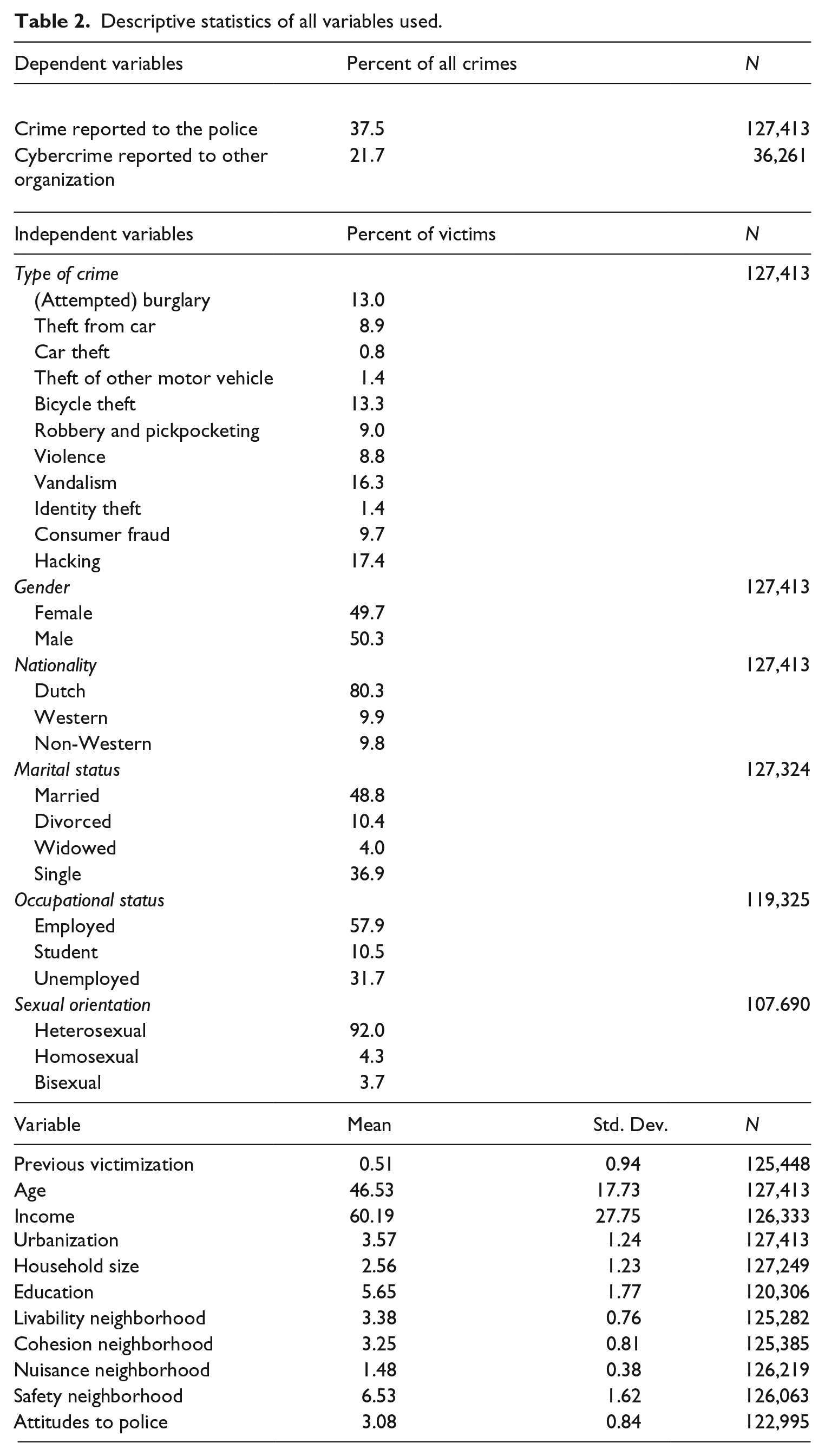
Table 2 shows the descriptive statistics for all the variables used in the analyses. As shown in this table, 37.5 percent of all crimes are reported to the police and 21.7 percent of all cybercrimes are reported to other organizations. Most victims have been the victim of hacking (17.4 percent), vandalism (16.3 percent), and bicycle theft (13.3 percent). Car theft (0.8 percent), theft of other motor vehicle (1.4 percent), and identity theft (1.4 percent) are the least prevalent crimes. Approximately half of the victims are male (50.3 percent) and most victims have the Dutch nationality (80.3 percent), are either married (48.8 percent) or single (36.9 percent), employed (57.9 percent), and heterosexual (92.0 percent). The average age of the victims is 46.53 years.
Descriptive statistics of all variables used.
Next, reported percentages of crime were compared between crime types. Table 3 shows that victims of car theft (79.9 percent), theft of another motor vehicle (74.0 percent), and (attempted) burglary (70.2 percent) are most likely to report their victimization to the police. Victims of identity theft (26.3 percent), consumer fraud (24.0 percent), vandalism (20.5 percent), and hacking (7.1 percent), on the other hand, are the least likely to report their victimization to the police. More than 82 percent of the victims of identity theft did report this to other organizations than the police, which is approximately four and five times as often as victims of consumer fraud (22.4 percent) and hacking (16.6 percent), respectively.
Crime reporting by offense type (percent).
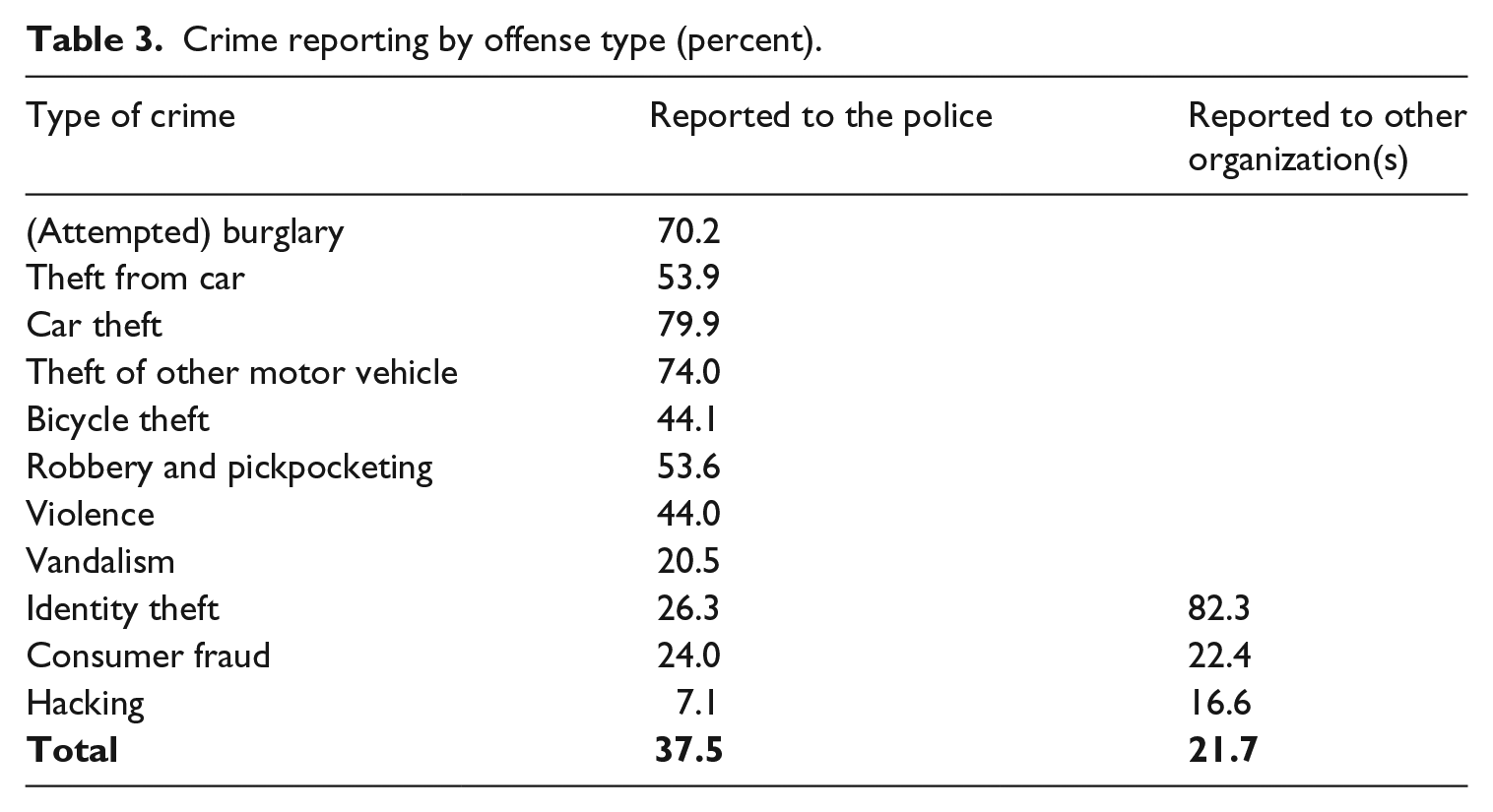
Table 4 presents the results of the logistic regression analyses on reporting victimization to the police. Model 1 presents the results for reporting all crimes combined, while Models 2 and 3 present the results for traditional crime and cybercrime, respectively. The upper rows of Model 1 show the odds ratios for the different types of crime, with victims of vandalism as a reference category. The results are in line with those in Table 3, showing that only victims of hacking have significantly lower odds of reporting crime to the police than victims of vandalism. Victims of all other types of crime have significantly increased odds of reporting crime to the police in comparison with vandalism victims. Model 1 further shows that the more often a crime was committed during the past 12 months, the less likely the victim was to report it to the police. Moreover, male victims, younger victims, more highly educated victims, and victims with a lower income were significantly less likely to report crime to the police than were female victims, older victims, less highly educated victims, and victims with a higher income. Western immigrants were also shown to be less likely than Dutch victims to report crime. Divorced and single victims reported crime to the police significantly less often than married victims, and widowed victims were significantly more likely to report their victimization to the police. In addition, victims who were students had significantly lower odds than employed victims of reporting crime to the police. Homosexual victims were also shown to have significantly higher odds than heterosexual victims of reporting crime, whereas bisexual victims had significantly lower odds of reporting crime to the police.
Logistic regression on reporting victimization to the police.

Notes: OR = odds ratio; *p < .05; **p < .01; ***p < .001 (one-sided).
Most neighborhood characteristics were also significantly related to crime reporting behavior. Victims in more urbanized areas were less likely than victims from more rural areas to report crime to the police. Victims who reported that there was more cohesion in their neighborhood were significantly more likely to report crime to the police. Moreover, when victims experienced more nuisance in the neighborhood they were significantly less likely to report the crimes. When victims felt safer in the neighborhood they also reported crime significantly less often. No significant association, however, was found between crime reporting and livability in the neighborhood. Finally, victims with a more positive attitude towards the police were shown to be significantly more likely to report crimes to the police. Although many variables in Model 1 showed significant associations with crime reporting, the pseudo R² was low (.1719), indicating that these variables do not explain crime reporting very well.
Model 2 of Table 4 shows the results for traditional crimes only. All results in Model 2 are comparable to the results for all crimes in Model 1, with three exceptions. Model 2 shows that non-Western immigrants are also significantly less likely than Dutch victims to report victimization of traditional crimes to the police. Moreover, in Model 2, widowed and homosexual victims are not significantly more likely to report traditional crimes compared with married and heterosexual victims, respectively.
In Model 3 of Table 4 only the victims of cybercrimes were taken into account. Compared with Model 2, the association between age and crime reporting is no longer significant. In addition, married and homosexual victims are not significantly more likely to report cybercrime victimization to the police than are divorced and heterosexual victims, respectively. All neighborhood characteristics, except the level of urbanization, were not significantly related to reporting cybercrimes to the police. On the other hand, the positive relationship between household size and reporting cybercrime to the police became significant in Model 3. Besides these changes in significance, some characteristics showed a relationship with cybercrime reporting in the opposite direction compared with the relationship with traditional crime reporting. First, males were shown to be significantly more likely to report cybercrimes to the police, whereas females were more likely to report traditional crimes. Second, non-Western victims were significantly more likely to report cybercrimes to the police compared with Dutch victims, whereas the opposite relationship was found for traditional crimes. Third, in Model 3 it was shown that unemployed victims of cybercrimes were significantly more likely than employed victims to report this to the police, whereas this relationship was in the opposite direction, but not significant, for traditional crimes. Fourth, the income level of victims was negatively and significantly related to reporting cybercrimes to the police, whereas it was positively and significantly related to reporting traditional crimes to the police.
Table 5 shows the results of the logistic regression analyses predicting whether or not victims of different types of cybercrime report their victimization to the police. Three victim characteristics were significantly associated with reporting victimization to the police for all three types of cybercrime: victims were significantly less likely to report to the police when they were victimized more often, when they had a higher income, and when they were more highly educated. Model 1 furthers shows that Western immigrants reported victimization of identity theft to the police significantly less often than Dutch victims. Moreover, victims of identity theft who experienced more safety in their neighborhood were significantly less likely to report their victimization to the police, whereas those who had more positive attitudes to the police were significantly more likely to report it to the police. These last three significant relationships were also found among victims of hacking (Model 3). Moreover, male victims of consumer fraud (Model 2) were significantly more likely to report their victimization to the police, as were victims living in a larger household. On the other hand, victims were significantly less likely to report consumer fraud to the police when they were older, single, a student, and bisexual rather than younger, married, employed, and heterosexual, respectively. In contrast to the negative relationship between age and reporting consumer fraud, Model 3 shows a significant positive relationship between age and reporting victimization of hacking to the police. Moreover, non-Western immigrants were significantly more likely to report victimization of hacking to the police compared with Dutch victims. In addition, victims from larger households were significantly more likely to report cases of hacking to the police. Finally, Model 3 also shows that victims living in more urban areas are less likely to report victimization of hacking to the police.
Logistic regression on reporting different types of cybercrime victimization to the police.

Notes: OR = odds ratio; *p < .05; **p < .01; ***p < .001 (one-sided).
In Table 6 the results are presented of the logistic regression analyses in which reporting cybercrime victimization to other organizations than the police was predicted. Four remarkable differences from the results for predicting reporting cybercrime to the police, as shown in Tables 4 and 5, occur in Table 6. First, whereas males were shown to report cybercrime victimization, and particularly consumer fraud victimization, to the police significantly more often, females are shown to report victimization of identity theft and hacking more often to other organizations. Second, a significant positive relationship between previous victimization and reporting of cybercrime (except identity theft) to other organizations was found, whereas this relationship was negative for reporting cybercrime victimization to the police. In other words, victims of cybercrime who had been victimized before were less likely to report this to the police and more likely to report it to other organizations. In addition, the regression coefficients of income and household size were in the opposite direction compared with Tables 4 and 5. Victims with a higher income were less likely to report their victimization to the police, but significantly more likely to report it to other organizations. Moreover, victims from larger households were more likely to report cybercrime victimization to the police, but significantly less likely to report it to other organizations.
Logistic regression on reporting cybercrime victimization to other organizations.

Notes: OR = odds ratio; *p < .05; **p < .01; ***p < .001 (one-sided).
Discussion
In this study, four samples of victims (N = 97,186) from the four most recent waves of the Dutch Veiligheidsmonitor were used to examine the determinants of the reporting of cybercrime victimization. First, a comparison was made between determinants of reporting victimization of traditional crime and cybercrime to the police. Second, determinants of reporting victimization of three different types of cybercrime (identity theft, consumer fraud, hacking) to both the police and other organizations were examined.
First of all, the results showed that victims of the three different types of cybercrime reported these offenses to the police less often than victims of most types of traditional crime. Only victims of vandalism reported crime less often to the police than victims of identity theft and consumer fraud. Victims of identity theft did report their victimization more often to organizations other than the police (82.3 percent). Victims of consumer fraud and hacking, however, usually did not report to other organizations either. This low prevalence of reporting cybercrime victimization is in line with previous studies (for example, Domenie et al., 2013) and underlines the importance of studying the factors related to this reporting behavior.
Although the results showed that several relationships between victim characteristics and reporting victimization to the police were in the same direction for victims of traditional crime and cybercrime, some remarkable differences were shown as well. For example, female victims were more likely to report traditional crimes to the police, whereas male victims were more likely to report cybercrimes. Moreover, Dutch victims more often reported traditional crimes to the police, whereas non-Western victims reported cybercrimes more often to the police. Furthermore, victims with a higher income had higher odds of reporting traditional crimes, but lower odds of reporting cybercrime. This shows that results from previous research on the reporting of victimization of traditional crimes cannot simply be generalized to the reporting of cybercrime victimization. Also, policies to increase crime reporting among victims could be adjusted for cybercrime victims in order to be more efficient. For example, campaigns aimed at encouraging the reporting of cybercrimes to the police should be aimed at a different public than campaigns to encourage the reporting of traditional crimes.
Moreover, the victim’s opinions on cohesion, nuisance, and safety in his or her neighborhood were related to the choice of whether or not to report traditional crimes to the police. However, these neighborhood characteristics were not significantly associated with the crime reporting of cybercrime victims. Apparently, victims do not link their cybercrime victimization to their physical location, even though it is likely that, for example, the computer that got hacked was located in the home of the victim.
Results with respect to reporting victimization of the three different types of cybercrime (identity theft, consumer fraud, hacking) to the police showed that only three predictors were significantly related to reporting all three types of cybercrime. Previous victimization, income, and educational level were all significantly negatively related to reporting victimization of all three types of cybercrime. Relationships with other determinants differed between the three types of cybercrime. For example, the age of victims was negatively related to reporting consumer fraud but positively to reporting hacking. When it comes to hacking, one explanation could be that the impact of the hacking incident is higher for older victims. We know that the impact of the crime is related to willingness to report it (for example, Baumer and Lauritsen, 2010; Bowles et al., 2009; Gutierrez and Kirk, 2017). It is also known that hacking is often interpersonal (see, for example, Leukfeldt et al., 2013b). School children, for example, hack each other’s accounts of online games and ex-partners hack into the email accounts or social media accounts of their exes to harass them. Perhaps the older people get, the more severe the hacking incidents get. Further research should, therefore, also include the impact of cybercrime in order to test this possible explanation.
These different crime-specific results further show the importance of studying different types of crime separately when examining crime reporting behavior. Previously found results on crime reporting of several types of crime combined might therefore not be generalizable to all crimes separately. Moreover, policies and campaigns to increase the reporting of cybercrime might be more efficient if they were adjusted for different types of cybercrime.
The results also showed that some other victim characteristics are associated with reporting crime to the police compared with reporting crime to other organizations. The most remarkable finding is that victims of cybercrime who had been victimized before are less likely to report their victimization to the police and more likely to report it to other organizations. This is in line with the findings of Domenie at al. (2013) and Cross et al. (2016), who found that in the eyes of victims the police is often not the primary organization to report various forms of cybercrime to. Possibly these victims are unsatisfied with the way the police handled a previous report (see also Domenie et al., 2013; Leukfeldt et al., 2013a; Toutenhoofd et al., 2009). Since the data do not include any information on the motives of victims for reporting crimes to the police or to other organizations this could not be tested in the current study.
Many significant results were found in all the logistic regression analyses but the pseudo R²’s of these models were low, indicating that these models do not explain reporting crime to the police very well. This shows that many significant results were probably the consequence of the large sample size, but did not contribute a lot to explaining why victims report or do not report crime to the police. It is therefore important to look not only at the significance of the regression coefficients but also at the effect sizes, which indicate that most differences in crime reporting between groups are not very large.
Strengths and limitations
This is the first study to examine the victim characteristics that are related to reporting cybercrime victimization to the police. It uses a very large group of victims in a representative sample from the general population, and examines reporting victimization to the police as well as to other organizations. This study, however, is also limited in several ways. First, all the determinants that could be examined are either socio-demographic characteristics of victims or their opinion on the neighborhood in which they live. These factors did not explain crime reporting behavior very well. Previous studies have found that several characteristics of the crime (for example, seriousness, insurance, relationship between victim and offender) are strong predictors of the victim’s willingness to report the crime. It would be desirable if future research took these crime characteristics into account too when studying the willingness to report cybercrimes. It is, for example, very likely that the amount of financial loss is strongly correlated to the victim’s choice of whether or not to report a cybercrime. The same goes for hacking: it is likely that the more severe a hack is, the greater the willingness to report this incident. The relationship between perpetrator and offender, on the other hand, might have less impact on the decision of whether or not to report a cybercrime, because victims of cybercrime do not come into physical contact with their offenders.
Second, in this study we compared the crime reporting behavior of victims of all types of traditional crime with the crime reporting behavior of victims of cybercrime. Some of these types of traditional crimes, however, are very different from the cybercrimes in this study. Violent offenses, for example, are usually committed for reasons other than identity theft, consumer fraud, and hacking. Moreover, victims of violence have physical contact with their perpetrators and are relatively often intimately related to them, whereas victims of cybercrime do not have physical contact with their offenders. Differences in the determinants of crime reporting between traditional crimes and cybercrimes could therefore be the consequence of differences in the nature of these types of crime rather than of the fact that an online modus operandi was used to commit the crime. In order to further investigate the differences in crime reporting behavior, it is recommended that future studies compare the reporting of cybercrimes with the reporting of types of traditional crimes that are as similar in nature as possible, for example a comparison between victims of online fraud and harassment with victims of offline fraud and harassment.
Third, further research should also include online equivalents of neighborhood characteristics. Indeed, technical infrastructure might be of importance. Examples include services from internet service providers and email providers (which, for example, scan and stop spam or malware), online banks (which provide a safe and secure environment for online transactions) and the technical characteristics of users themselves (for example, their operating system and use of virus scanners). Measurements of technological knowledge, experience with the Internet, and time spent online at the individual level should also be included in future studies. Because such measurements were missing in the current study, some of the associations with reporting cybercrime that were found might be biased. If, for example, younger and more highly educated individuals have more experience with the Internet and spend more time online than older and less highly educated individuals, the associations of these variables that were found might rather reflect associations between Internet use and reporting cybercrime.
Fourth, the data used in this study did not include any information on the victims’ motives for reporting a crime or not. It is therefore hard to explain differences in associations between victim characteristics and crime reporting behavior between victims of cybercrime and victims of traditional crime. Psychological factors, such as feeling guilty or ashamed after victimization, are possibly more often the reason that victims of cybercrime do not report to the police. For example, victims may feel they are partly responsible for being hacked if they did not keep their antivirus software up to date or may feel ashamed if they have been tricked into opening an infected link in an email. Previous studies have shown that police officers in such cases often blame the victim and are not willing to register the crime report (Leukfeldt et al., 2013a, 2013b; Toutenhoofd et al., 2009). Future research, for example using in-depth interviews with victims, should take these motives into account because this could contribute a lot to designing effective policies to encourage the reporting of cybercrime to the police.
Fifth, the role of organizations other than the police is becoming more and more important in fighting cybercrime (for example Boes and Leukfeldt, 2017; Jansen et al., 2017; Wall, 2010). Therefore, our study included reporting victimization both to the police as well as to other organizations. However, owing to the exploratory nature of our study, the analysis yielded limited knowledge about, for example, to which organizations victims report crime and how effective these organizations are in helping victims and in reducing cybercrime.
Finally, in this study only three types of cybercrime (identity theft, consumer fraud, hacking) were taken into account and only individual victims were studied. Since several other types of cybercrime exist (for example, child pornography, online stalking, malware) and governments and companies could be victimized too, there is still a lot more to learn about reporting cybercrime victimization.
Footnotes
Appendix
Items used to measure the livability of the neighborhood:
Items used to measure social cohesion of the neighborhood:
Items used to measure nuisance in the neighborhood:
Funding
The author(s) received no financial support for the research, authorship, and/or publication of this article.