



Abstract
The United States has adopted the targeted killing of high-ranking members of terrorist organizations to disrupt terrorist networks and exert general deterrence. The most salient of these killings occurred on 2 May 2011, when US Navy Seals killed Osama bin Laden in Pakistan. Although general deterrence suggests this should result in decreased subsequent terrorism, high-profile targeted killings can also result in increased terrorist violence through backlash. This study uses dual trajectory analysis to examine the divergent influence that the killing of bin Laden had on global terrorism trends between November 2007 and May 2014. These analyses reveal that killing bin Laden did not have the desired deterrent impact on global terrorism or on terrorism committed by Al Qaeda.
Introduction
The impact of the September 11 bombings committed by Al Qaeda in the United States (US) were heralded as a ‘black swan’ terrorism event that qualitatively changed global terrorism and responses to terrorism (LaFree et al., 2014). These attacks resulted in the deaths of nearly 3000 people, and also led to more than 40 percent of US adults experiencing trauma-related symptoms of stress (Schuster et al., 2001). These widespread traumatic impacts were often cited within political discourse to justify the creation of government agencies, increased military expenditure, and a greater policy focus on terrorism worldwide (Daskal and Vladeck, 2014). Scholars and political analysts have also noted that the response to these events was qualitatively distinct from all previous responses to terrorism (Fisher et al., 2018). Driven partially by public and political pressure for a decisive counterterrorism response and the desire for retribution (Anker, 2005), the US use of targeted killings was expanded as a method to eliminate terrorist leaders and accomplish these goals (Carvin, 2012).
Despite long-standing moral and legal opposition (Blum and Heymann, 2010), this increased use of targeted killings by the US in response to the September 11 attacks legally stemmed from Public Law 107-40 or, as it is commonly known, the 2001 Authorization for Use of Military Force (AUMF) (Daschle, 2001). Specifically tied to the September 11 attacks, the AUMF made legal the unilateral use of military force by the President against individuals, organizations, or nations ‘to prevent any future acts of international terrorism against the United States’ (Daschle, 2001: 1). This policy shift supported the expanded role of military unmanned aerial vehicles (drones) programs in Afghanistan, Iraq, Yemen, and Pakistan, and legally permitted the CIA to kill Al Qaeda militants (Orr, 2011). Targeted killings conducted by drones and other methods emerged as a prominent tactic for the US and other governments to combat terrorism (Wilner, 2010), often as an alternative to the hazardous and costly deployment of troops (Byman, 2013). For the purposes of this article, targeted killings are the ‘intentional slaying’ of individual terrorist leaders and facilitators ‘undertaken with explicit governmental approval’ (Wilner, 2010: 309). As noted by Hepworth (2014), targeted killings are typically distinct from raids enacted with the explicit goal of capture and interrogation, which are a high risk high potential reward alternative. These strikes are designed to decapitate, incapacitate, and otherwise disable the hierarchy of vertically structured groups by targeting specific individuals in tactical and political leadership positions within violent extremist organizations (Carson, 2017; Cronin, 2009).
Similar to notable terrorist attacks (LaFree et al., 2014), high-profile targeted killings are intended to qualitatively impact terrorist conflicts. The targeted killing of high-ranking and influential terrorist leaders may leave an enduring impact by escalating a conflict, leaving lasting influences on the legitimacy of sovereign nations, or by providing salient deterrent messages (Luft, 2003). In the most notable of these strikes, on 2 May 2011, US Navy Seals killed Osama bin Laden in Pakistan. US President Obama claimed this as ‘the most significant achievement to date in [the US’s] effort to defeat Al Qaeda’ (Obama, 2011). Although this killing prompted feelings of relief and of fulfilled retribution among the US public (Mitchell, 2012), the impacts that this killing had on global terrorism trajectories remains unclear.
Due to the strategic consequences, alongside the questionable legal and moral justification for targeted killings, the study of this tactic to reduce future terrorism is among the top priorities of the study of terrorism and violent extremism. The empirical literature on this topic has previously been criticized for overgeneralizing findings, leading to claims that a false consensus has arisen that targeted killings have never been effective (Johnston, 2004). Since targeted killings may yield divergent impacts for the threats posed by both individual terrorist organizations and the terrorist threat more generally (Carvin, 2012), exploring the potential for heterogeneous impacts is of primary concern. Because a single targeted killing may simultaneously decrease some terror threats while increasing others (Carson, 2017) and unexamined heterogeneity can mask counterterrorism impacts (Fisher and Meitus, 2017), previous null findings from studies examining the impact of targeted killings on subsequent terrorism may be due to unexamined variation (see Hafez and Hatfield, 2006). Indeed, recent examinations exploring this potential heterogeneity have revealed that the targeted killing of high-profile Al Qaeda leaders ‘may have rallied support for the global jihadist base’ despite the null findings from some quantitative approaches (Carson, 2017: 213). This study builds upon these studies by focusing on the ‘most infamous’ of these targeted killings (Carson, 2017: 192) – that of Osama bin Laden – through exploring the repercussions that this killing had on international terrorism trends between November 2007 and May 2014.
Deterrence and terrorism
For nearly a decade, the US and numerous national partners invested time and huge resources in the attempt to punish bin Laden for the role he played in the September 11 terrorist attacks. On numerous occasions, US President George W. Bush publicly stated that, to win the war against terrorism and deter future acts of terrorism, it was necessary to capture or kill terrorist leaders. As demonstrated in the quote below, the intended punishments for bin Laden for these attacks were explicitly framed as a ‘message’ to deter any potential terrorist seeking to attack Americans: To win this war we must be able to detain, question and, when appropriate, prosecute terrorists captured here in America, and on the battlefields around the world. After the 9/11 attacks, our coalition launched operations across the world to remove terrorist safe havens, and capture or kill terrorist operatives and leaders… We will send a clear message to those who kill Americans: No longer [sic., matter] how long it takes, we will find you and we will bring you to justice. (Bush, 2006)
Prominent terrorism scholars including Hoffman (2009) also suggest that, as Al Qaeda cannot be defeated by military means alone, contending that killing and capturing Al Qaeda commanders and operatives is required. Cronin (2009) extends this perspective by noting that any outcomes will depend upon key organizational, personal, and contextual characteristics, reinforcing this claim. Whereas Hoffman (2009) presents a theoretically inspired rationale for his position and Cronin (2009) draws upon historical examples, others have drawn entirely upon moral arguments to justify the targeted killing of terrorists (see Schmitt and Shanker, 2011). With qualitative evidence that targeted killings may create a cycle of fear within terrorist organizations leading to the execution of members suspected of being informants (Schmitt and Shanker, 2011), scholars have resorted to making non-empirically based inferences in suggesting ‘something more than correlation was at work here’ (Byman, 2006: 103). Consequently, although there is justification for the continued use of targeted killings to alter terrorist organizational structures, there is doubt as to whether the killing of any individual terrorist could influence the decisions of other terrorists through deterrence.
Before reviewing the direct empirical literature concerning the impact of targeted killing on subsequent terrorism, we first present a brief review of some of the more robust analyses of the impact of deterrence-inspired interventions on terrorism. Deterrence theory argues for an inverse relationship between the certainty, severity, and celerity of punishment and crime (Beccaria, 1764). Deterrence can be general in nature by preventing would-be offenders from offending, or it can be specific by stopping perpetrators from reoffending. General deterrence is typically measured as salient threats of punishment, which are historically and politically popular responses to terrorist threats. Yet, the deterrence perspective has been theoretically criticized for its inability to anticipate the different utility structures and reactions of terrorists (Victoroff, 2005), which may explain its lack of empirical support. Dugan et al. (2005) looked for empirical evidence of general deterrence through the introduction of metal detectors and security personnel at airports and found null impacts for terrorism-motivated hijackings. Similarly, in a study examining six UK strategies aimed at reducing political violence in Northern Ireland, only Operation Motorman, which deployed 30,000 armed service personnel, was associated with a reduced risk of terrorism (LaFree et al., 2009a).
Recent studies have also produced evidence that contradict the predictions of deterrence, as policies aimed to deter terrorism were associated with subsequent increases through possible backlash effects (LaFree et al., 2009a). Demonstrated in Spain (Argomaniz and Vidal-Diez, 2015), Israel (Dugan and Chenoweth, 2012), and globally (Piazza and Choi, 2018), there is evidence that repressive government actions may increase terrorism. It is important to note, however, that there is not consensus on this issue, and that the analytic assumptions made can impact the conclusions that are drawn. In a subsequent analysis of the data from Dugan and Chenoweth (2012), Bejan and Parkin (2015) detected that repressive actions resulted in a statistically significant reduction in Palestinian terrorist attacks. Although Bejan and Parkin (2015) modelled the reciprocal relationship between terrorism and government actions, they did not account for the different tactical periods in Israel (First Intifada, the Oslo Lull, and the Second Intifada) that were included in Dugan and Chenoweth’s (2012) analysis. Bejan and Parkin (2015: 57) conclude that these divergent findings ‘can be attributed to the varying analytical approaches’, emphasizing that a range of statistical approaches are required to triangulate the full consequences of counterterrorism interventions. Although potentially contradicting deterrence, Fisher and Dugan (2019) conclude that these findings are consistent with rational choice theory if increases in the certainty, severity, and celerity of punishment are less important to potential terrorists than the expected benefits of violence. There is thus little evidence at present supporting conclusions that interventions that solely aim to deter terrorism would result in decreased terrorism, even if terrorist organizations’ operations are disrupted.
Within the literature concerning the impacts of targeted killings on subsequent terrorism, there has also been concern expressed regarding the potential for backlash and the loss of legitimacy for nations that engage in targeted killings (Cronin, 2009). Cronin (2009) and Carvin (2012) both submit that this may exacerbate violence from those who replace killed terrorist leaders. Drawing upon the targeted killings conducted by Israel in the aftermath of the 1972 Munich Olympic attacks, empirical examinations have concluded that any downward impacts on terrorism are short-lived (Jenkins, 1987). Recent research, however, has found null short-term backlash effects following the targeted killings of Al Qaeda leadership figures (Hepworth, 2014), thus broadening the question of observation windows when examining possible deterrent and backlash effects.
These findings have been echoed in longer-observation longitudinal studies, with Hafez and Hatfield (2006) suggesting either null findings or increased terrorism in the wake of targeted killings within Israel. In examining globally the impact of the killing of top terrorist leaders, Mannes (2008) and Jordan (2009) find little evidence supporting deterrent impacts, and instead find an increase in the lethality of attacks in the wake of targeted killings and political resurgences for groups targeted by these methods. Most recently, using series hazard modelling, Carson (2017) found null or backlash effects when investigating the impact of the targeted killings of 10 political and military figures affiliated with the global jihadist movement on subsequent violence by these groups. Although specific to Islamist violence, Carson’s (2017) findings suggest that, even within an ideological milieu, the targeted killing of leaders may have heterogeneous effects.
Divergent responses to targeted killings
The empirical justification for the use of targeted killings to reduce subsequent terrorism remains scant (Gruenewald, 2017). Additional criticisms of this literature, however, reveal a number of important questions that need to be answered to properly evaluate the efficacy of targeted killings (Forst, 2017). Firstly, the methods used to assess the impact of targeted killings often make untenable methodological or theoretical assumptions, potentially driving these inconsistent results. Because no single available method is able to simultaneously account for all necessary assumptions, Forst (2017: 221) argues ‘it is [thus] essential to investigate the problem by using a variety of approaches’. Secondly, those such as Johnston (2004) have argued that targeted killings may have heterogeneous effects that may be responsible for previous divergent findings. Burke (2004) also predicted that the impact of Osama bin Laden’s capture or death would be unique and dependent upon whether he is perceived to achieve martyrdom. If true, this would mean that the impacts of targeted killings should not be generalized across cases, and that any impacts on subsequent terrorism may change with time and be dependent upon perspective. Any perceptions of the incident are likely impacted from forces within and outside of a given terrorist organization (Ross and Gurr, 1989), and, from a deterrence perspective, this framing drives any subsequent influences on terrorism through rational evaluations of the risks and rewards of terrorism. Other authors have suggested empirical models (Jiao and Luo, 2018; Sandler and Siqueira, 2006), as well as structural (Daxecker and Hess, 2013) and situational characteristics to maximize possible deterrent outcomes across numerous states and conflicts (Dear, 2013; Dulin and Patiño, 2018; Gill et al., 2016). Given the complex decision-making processes of terrorist organizations (Victoroff, 2005), targeted killings may simultaneously both increase or decrease terrorism from different actors through processes not limited to deterrence. Of note, using case studies and semi-structured interviews, Dear (2013: 295) finds that targeted killings ‘in certain limited and specific circumstances, can have an advantageous tactical effect’; however, leadership decapitation may frustrate or anger those motivated by social forces and it may galvanize movement support.
Beyond deterrence, Byman (2006) has suggested that targeted killings reduce terrorism through the mechanism of driving tactical deviations by terrorist groups to avoid detection and the removal of scarce terrorist leaders. These arguments rest upon the assumption that terrorist organizations depend upon a limited number of non-replaceable individuals within their organizational structure (Wilner, 2010). Further, it suggests that there is a homogeneously understood and agreed upon set of organizational goals and utility structure – a contention refuted by the history of fracturing and faction formation among terrorist organizations (Cronin, 2009). In accepting these arguments based upon both deterrence and diminished strategic capacity, prominent figures within the public sphere and the academic literature have been cited and used to justify the continued use of targeted killing by nations such as the US and Israel (Carson, 2017; Luft, 2003). Consequently, although both the short- and long-term impacts of the targeted killing of terrorists are unclear (Forst, 2017), political figures will likely continue to claim its success on theoretical and moral grounds. Given that targeted killings have the potential to exacerbate terrorist grievances and galvanize constituencies, understanding the impacts of targeted killings remains an important endeavour.
Black swan terrorism events and black swan responses
Although the killing of bin Laden occurred in Pakistan in response to a terrorist attack in the US that was coordinated from Afghanistan, we argue that this killing may present a black swan government response to terrorism. Black swan events draw upon the experience of European colonial exploration, whereby many empirical observations that were thought to be accurate were shown to be false assumptions about the world. Within the context of terrorism, LaFree et al. (2014) suggest that black swan terrorist events are attacks that were previously thought to be unthinkable before they occur but are explainable after these events. These black swan terrorist actions may thus have an ‘enduring impact on human history’ and shape public expectations and responses to terrorism. LaFree et al. (2014) specifically highlight the September 11 attacks in the US, the 2004 Madrid bombings, the 2005 London bombings, and the 2008 Mumbai bombings as examples of black swan terrorism events. Extending this framework, this study investigates whether, owing to the high profile of bin Laden and the global attention paid to his death, his targeted killing might function as a black swan government response that had the potential to generally influence the incidence of terrorism.
Recent evidence suggests that counterterrorism interventions are able to influence terrorism across larger geographic units. Specifically, Perry and colleagues (2016) suggest that the West Bank Barrier in Israel was able to deter terrorism from terrorist organizations operating from within both Israel and Palestine. In their evaluation, the construction of the barrier reduced the incidence of suicide bombings and other attacks locally, in addition to producing a diffusion of benefits to areas not yet defended by the barrier. This finding contrasts with the widely held concern that a displacement of terrorism to other, similar, locations would occur when the opportunity structure is manipulated at one location (Buchanan et al., 2016; Cahill, 2017; Enders and Sandler, 2004). This finding is consistent with the growing experimental evidence supporting that there is a diffusion of benefits rather than direct displacement in the criminological literature (Hsu et al., 2018; Hsu and Apel, 2015), and suggests that focusing solely on the site of an intervention may miss important counterterrorism impacts beyond those who were directly exposed to the intervention.
Ross and Gurr (1989) further argue that general deterrence is more important than the specific deterrent or incapacitation impacts for counterterrorism policy. Indeed, the principles of general deterrence are behind governments’ attempt to dissuade potential terrorists from committing acts of violence through anti-terrorism laws, target hardening, and threats of punishment (Clarke and Newman, 2006). Particularly when viewing terrorism at the national level, the most appropriate perspective from which to view the impact of counterterrorism policy efforts is the net national impact of deterrence policies through general deterrence. Ross and Gurr (1989) note that the overall impact of deterrent intervention operates primarily through vicarious exposure and perceptions. Terrorist organizations and their constituencies perceive punishments and other anti-terrorism policies differently than those subjected to punishment, because they have greater terrorist capabilities than detained offenders. Consequently, the specific deterrence perspective, although important, is secondary in comparison with the general impacts of counterterrorism efforts, because interventions could yield net increases in terrorism despite reductions achieved through incapacitation and specific deterrence.
General deterrence suggests that counterterrorism sanctions on one terrorist group or individual should also influence others who are motivated to commit similar acts. Drawing upon Stafford and Warr (1993), the indirect experience of punishment (and thus the deterrent effect) would be highest among groups more proximate to Al Qaeda and diminish for more distant groups. Despite the low likelihood of being able to statistically detect this influence (Lynch, 2011), the killing of bin Laden did achieve global recognition (see Figure 1) and had the potential to influence terrorism patterns beyond those committed by Al Qaeda at its affiliates. Beyond the claims of the US administration that the killing of bin Laden was the cornerstone for the global war on terror, recent studies have demonstrated that there was a general diffusion of deterrent benefits following a range of target hardening counterterrorism efforts (Hsu et al., 2018; Hsu and Apel, 2015; Perry et al., 2016). In light of this evidence, the full repercussions for counterterrorism likely extend beyond its specific targets, especially when the implementation is large in scale or receives widespread attention. Following this logic, rather than focusing on the direct implications of the killing of bin Laden through incapacitation or specific deterrence, this study instead examines the net impacts of this targeted killing on international terrorism to help better situate strategic counterterrorism decisions that governments make.
Owing to the long temporal lag between the September 11 attacks and the eventual killing of bin Laden, this government response displays the certainty and severity of punishment that would-be terrorists should expect from the US, regardless of the swiftness. 1 For a general deterrent effect to be plausible, however, it is necessary for the information regarding the punishment to be widely known. Within a criminal justice context, objective rates of punishment provide little useful information on deterrence and general knowledge on maximum sentences for a given crime is often poor (Durlauf and Nagin, 2011). Particularly when one of the modus operandi for terrorist organizations is to spread misinformation, any assumptions regarding perceptions of the certainty, severity, and celerity of punishment for terrorists are tenuous. To evaluate this assumption, Figure 1 demonstrates the number of news articles that were written containing ‘Osama bin Laden’ during the years before and after his killing. As can be seen in Figure 1, the Factiva Database, which systematically collects news articles from more than 32,000 licensed and free news sources, suggests that bin Laden was a common article theme, with 576,397 articles between 1998 and 2014. Although the largest spike in articles containing bin Laden’s name occurred in 2001, there were more than 70,000 articles in 2011, demonstrating that the killing of bin Laden was a well-publicized event. Particularly as these articles were published across all 103 of Factiva’s geographic regions across six continents, there is evidence suggesting that this killing had the capacity to impact terrorism on a global scale because this information was accessible to a global audience.

The number of articles written in English containing ‘Osama bin Laden’, 1998–2014.
Present study
To provide a relatively accessible means for displaying the impact that the killing of Osama bin Laden had upon global terrorism, we present a series of dual trajectory models examining terrorism trends between 2 November 2007 and 2 May 2014. These models enable a descriptive analysis through displaying the global trajectories of the incidence of terrorism before and after the killing of bin Laden. Dual trajectory analysis was selected for this study for three reasons. Firstly, because the impacts of targeted killing may be heterogeneous, this method would be able to display any divergent impacts in terrorist trends before and after May 2011. Secondly, this method presents a way of providing interpretable graphs displaying any potential impacts on terrorism that require only basic knowledge of Cartesian geometry to understand. Finally, although the groups of countries generated by this method are not real groups, these dual trajectory models may be able to identify nations where this targeted killing qualitatively changed subsequent terrorism, identifying geo-strategic locations worthy of further empirical study to better understand the impacts of targeted killings.
Following the recommendation of Forst (2017) for alternative statistical methods to better assess the impacts of targeted killings, these dual trajectory analyses complement other recent analyses by presenting ‘the big picture’ of terrorism at the national level (Dugan and Yang, 2012: 113). Although this method has a number of drawbacks, including that it is unable to directly test hypotheses, dual trajectory analyses have been successfully used to analyse the attack patterns of terrorist groups within a single nation and internationally (LaFree et al., 2009b, 2010). Consequently, although this article does not have explicit hypotheses that it is able to test, it does have an empirical prediction that is as follows.
Despite the global attention paid to the killing of bin Laden, this study predicts that a number of nations will remain unaffected with regard to terrorism. Terrorism is a rare event, and may not exist in nations for years. For these countries, it would thus be unsurprising for any counterterrorism intervention to produce null impacts regardless of its actual effectiveness (Lynch, 2011). This does not preclude the nature of terrorism being altered in a manner that is not detectable in terrorist incidents in these nations, but it would suggest that even the prominent global killing of a terrorist leader was unable to meet an observable threshold. This study concordantly predicts that terrorism will be concentrated throughout both periods within specific countries, with a number of nations experiencing no terrorism either before or after the death of bin Laden.
Data
Data for this study were gathered from the publicly available Global Terrorism Database (GTD) (START, 2016). The GTD is an event-based database that contains information on all terrorist events across the globe (LaFree et al., 2014). The GTD defines terrorism as ‘the threatened or actual use of illegal force and violence to attain political, economic, religious, or social goals through fear, coercion, or intimidation’ (LaFree and Dugan, 2007: 184). For an incident to have been included in the dataset, it must contain the following three elements:
I. The incident was intentional (the result of a conscious calculation on the part of the perpetrator).
II. The incident included some observable level of violence or the threat of violence.
III. The perpetrator of the incident was a sub-national actor. (START, 2016)
In the current analysis, we include only terrorist attacks that were perpetrated between 2 November 2007 and 2 May 2014 to provide a symmetric three-and-a-half-year window before and after the killing of bin Laden for comparison. Each temporal window was broken up into seven six-month periods for the subsequent analysis. The number and size of these windows was selected to enable enough exposure time to detect terrorism in many countries (because it is a rare event), while balancing the desire to have enough windows within the limited time after 2 May 2011 to detect potential non-linear terrorism trends. To avoid unintentionally mining these data, these decisions were made prior to compiling the present dataset.
Methods
Group-based trajectory models (GBTM) have been previously used to determine whether distinctive patterns of terrorism emerge over time. Employed by LaFree et al. (2010), GBTM have been able to examine trends in terrorist activities across a wide variety of countries within the GTD. Indeed, this previous analysis was able to demonstrate that, like other types of crime, incidents of terrorism are highly concentrated in a relatively small subset of countries. Expanding upon previous applications of this method, we use a dual trajectory model to analyse the national-level trajectories of terrorism evolving over two separate time frames (Jones and Nagin 2007). Like GBTMs, this method attempts to identify clusters of nations that follow similar progressions of terrorist violence (trajectory groups) for both periods. In addition, dual trajectory models produce measures for the continuity in group membership across these two time-periods by producing the probability for membership in each group after the death of bin Laden conditioned on group membership prior to this event. Taken together, these two outputs are able to provide evidence of stability or change within global terrorism trends after the killing of Osama bin Laden. The output from these models can be used to ascertain whether this targeted killing changed the terrorism trajectory of specific nations such as the US and Pakistan that were directly involved in the killing.
Because terrorism is a rare event and the number of terrorist attacks is a count outcome, zero-inflated Poisson (ZIP) models with cubic functions were initially used to estimate country-level trajectories (Nagin, 2005). The ZIP model was used instead of other potential models because it was likely that many countries would have experienced zero accounts for any given six-month period (LaFree et al., 2010). Also consistent with the method employed by LaFree et al. (2010), it was necessary to top code the number of terrorism incidents in each period at 125 events owing to the skewed nature of terrorist events, where nations such as Iraq were recorded as having up to 2494 terrorist incidents in a given six-month period. For the present analysis, top coding in this manner limits this study’s ability to differentiate between potentially divergent trajectories within this high terrorism range. Top coding occurred in 17 nations, 7 of which were top coded during at least one period before and after 2 May 2011 (LaFree et al., 2010). 2 Because Haviland et al. (2011) note that the ZIP model does not allow for censoring at a maximum value, all models were also run using a censored normal model, with no substantive differences in the findings presented below.
Finally, we examined trajectories of both periods simultaneously using group-based dual trajectory modelling. Using the optimal number of trajectory groups determined for each outcome measure as described above, group-based dual trajectory modelling was employed to link the trajectories of each group of countries prior to the killing of bin Laden with trajectories of each group of nations after his death. This was done to assess the transitional impact of this event by estimating the conditional probabilities of membership in the trajectory groups before and after 2 May 2011.
Findings
To contextualize the primary analysis, we firstly examine the number terrorist attacks committed by Al Qaeda before and after the killing of Osama bin Laden. Figure 2 displays the number of attacks committed each month by Al Qaeda and its derivatives between January 2000 and December 2014, with a solid vertical line marking the date of 2 May 2011. If the targeted killing of their leader deterred Al Qaeda, then one would expect the dotted line that marks their attacks after this event to be lower than the solid line that marks their attacks previously. As it can be seen in Figure 2, however, there is little reason to suspect that this targeted killing deterred Al Qaeda and its derivatives overall. Indeed, their average number of attacks per month actually increased from 4.17 attacks per month between January 2000 and April 2011, to 26.42 attacks per month between May 2012 and December 2014 (p < .001). This difference was driven by terrorist attacks occurring in Iraq and Yemen, however, which were the only two nations that saw increased Al Qaeda terrorism after the death of bin Laden (see Figure 3). Although this study notes that these rudimentary tests are not ideal for detecting differences and that the series hazard models employed elsewhere are a superior test, these easily understood tests suggest that there is little evidence that Al Qaeda and its derivatives were deterred by the death of Osama bin Laden.

The number of attacks committed each month by Al Qaeda, January 2000 – December 2014.
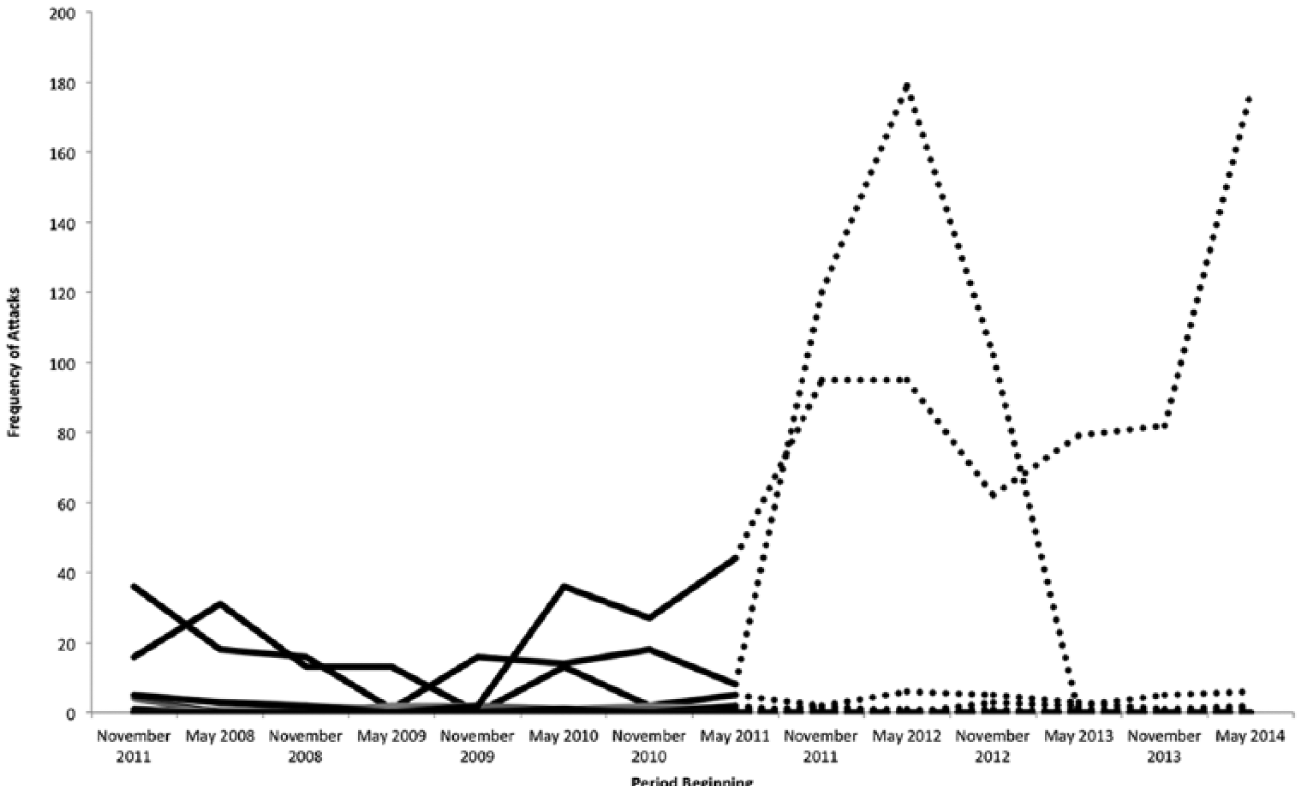
The frequency of Al Qaeda attacks in each nation.
A similar pattern also emerged for global terrorism, and Figure 4 presents the average number of terrorist attacks per country in each of the 14 six-month periods that were observed. While, once again, one would expect the dotted line to decrease immediately or gradually compared with the end and/or trend of the solid line if deterrence hypotheses were to be supported, the average number of terrorist attacks per country increased in each period following May 2011. Indeed, the number of attacks per country increased from 6.80 attacks per six-month period to 10.24 attacks per six-month period (p = .001). Consequently, this provides some rudimentary evidence to suggest that global terrorism increased in the 3.5 years following the death of bin Laden compared with the 3.5 years before. Although caution is urged in interpreting these findings, these descriptive findings provide further evidence against general deterrence stemming from the killing of bin Laden.
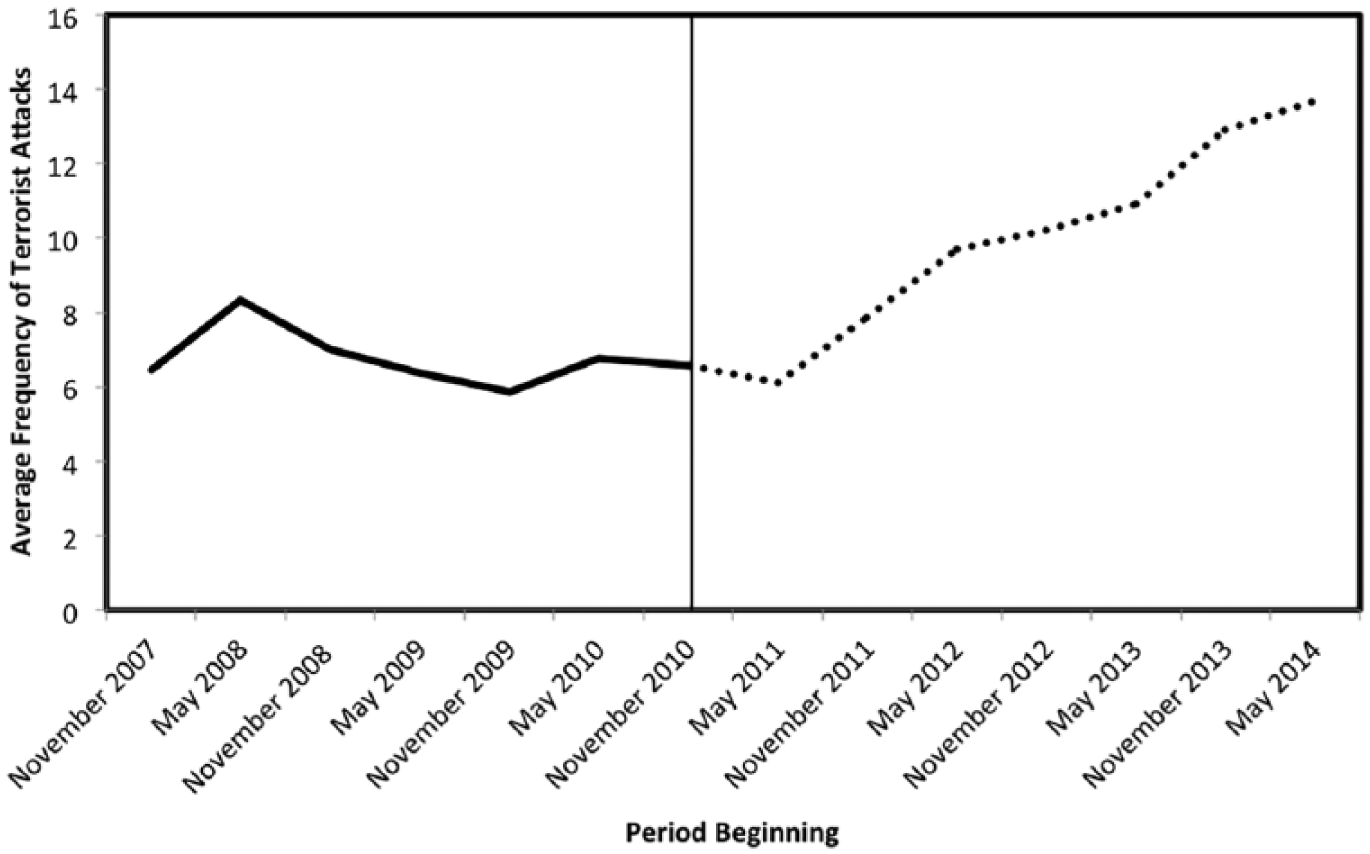
The average number of terrorist attacks per country in each six-month period: 2 November 2007 – 2 May 2014.
Turning to the primary analysis of this article, two GBTMs were used to examine whether there was any meaningful heterogeneity in the trajectories of terrorism across nations. As displayed in Figure 5, we found evidence for five groups in the period prior to 2 May 2011. Although we note that some of the group sizes were less than 5 percent and below the limit recommended by Nagin (2005), these groups were retained because they represented important and distinguishable groups within the global population. Because terrorism is a rare event and tends to be concentrated in a relatively small number of geographic locations (LaFree and Bersani, 2014), it is unsurprising that the two highest groups had relatively small membership (3.9 percent and 4.3 percent of all nations, respectively). It should also be noted from Figure 5 that approximately 85 percent of the countries across the globe had very little terrorism during this period (reflected by the Very Low and Low groups). Across all groups, however, these trajectory estimates suggest that the average number of terrorism incidents within each group was relatively stable across each of the seven six-month periods prior to the killing of bin Laden.

Group-based trajectory model output: 2 November 2007 – 2 May 2011.
In the period following the killing of Osama bin Laden, there was also evidence for five groups within these data, with groups demonstrating diverging trends across this 42-month period (Figure 6). Deterrence would predict that terrorism would have decreased within groups over this period, but the incidence of terrorism increased for four out of the five groups (excluding the Very Low group). The High group (comprising Bangladesh, Colombia, Egypt, Israel, Kenya, Lebanon, Libya, Sudan, Turkey, Ukraine, the UK, and West Bank and Gaza Strip) importantly displayed a precipitous increase during this period. Although once again this group size is relatively low, as the confidence intervals for these smaller groups do not overlap at any point, we once again submit that these groupings are appropriate and reflect the concentration of extreme volumes of terrorism within a limited number of countries around the globe. Similarly to Figure 5, however, we note that the majority of nations fell into the Very Low group, which remained close to zero on average throughout the entire observation period.

Group-based trajectory model output: 2 May 2011 – 2 May 2014.
The findings from the dual trajectory model suggest that the incidence of terrorism was relatively stable for nations that experienced the most or little terrorism. Of the nations that were within the lowest group prior to 2 May 2011, 91 percent remained in the lowest group after bin Laden’s death and 89 percent of nations that were initially in the highest group were also observed to fall in the Very High group in the later period (Table 1). Displaying some important variability, however, Table 1 indicates that members of the Very Low group prior to 2 May 2011 were observed in each of the other four groups after the killing of bin Laden. Indeed, Syria was found to go from the Very Low group in the earlier period to the Very High group in the subsequent period. This study cautions that this is almost certainly due to other political and social factors and not attributable to the death of bin Laden, but this finding does indicate that, although terrorism is concentrated in a handful of nations, a nation may go from a period of relatively little terrorism to high levels of terrorism in a relatively short period of time. Conversely, these findings suggest relative stability for nearly all nations that experienced the most terrorism, with only Colombia moving from the Very High group to a lower group between the two periods.
Probability of group membership after 2 May 2011, given group membership prior to 2 May 2011.

For nations falling in the middle three terrorism incidence groups, however, this study did find meaningful variation in the terrorism trajectories for a number of nations. The modal group for nations in the Low group before the killing of bin Laden was the Very Low group, with 45 percent of the initial Low group finishing in the Very Low group. This was also evident for the Moderate and High groups after the death of bin Laden, with the modal post-group membership being Low for the Moderate group (43 percent) and Moderate for the initial High group (38 percent). In all three of these cases, this finding suggests that a plurality of nations were subsequently classified to lower incidence groups after bin Laden’s death. Consequently, although each of the observed groups increased in terrorism over the course of the observation period, these group movements potentially indicate that many nations experienced a relative downward shift in terrorism compared with their previous levels. Despite aggregate increases in terrorism, this provides evidence for a potential general deterrent impact for select nations following the death of bin Laden. In addition, this finding suggests that there is meaningful heterogeneity in national terrorism incidence trends that would have been obscured using other statistical methods.
Importantly for the focus of this study, the US was among the nations that were observed to be in a lower terrorist incidence group after the killing of bin Laden (see Table 2 for a table documenting the membership of each group and whether each nation transitioned to a lower or higher terrorist group). In line with deterrence predictions, the US began in the Moderate group and transitioned to the Low group after the killing of bin Laden. Across the globe, 15.31 percent (n = 30) of the countries shifted trajectories to a lower group. Also among these countries were Sweden, Iran, Canada, Australia, and Austria. Most of the countries that shifted downward following the targeted killing were originally within the Low group (63.33 percent); however, another 10 (33.33 percent) shifted down from either the Moderate or the High groups. All but two of the countries in this subset shifted down by one group, with Georgia and Sri Lanka shifting down by two groups after the death of bin Laden.
Group membership for terrorist incidences.
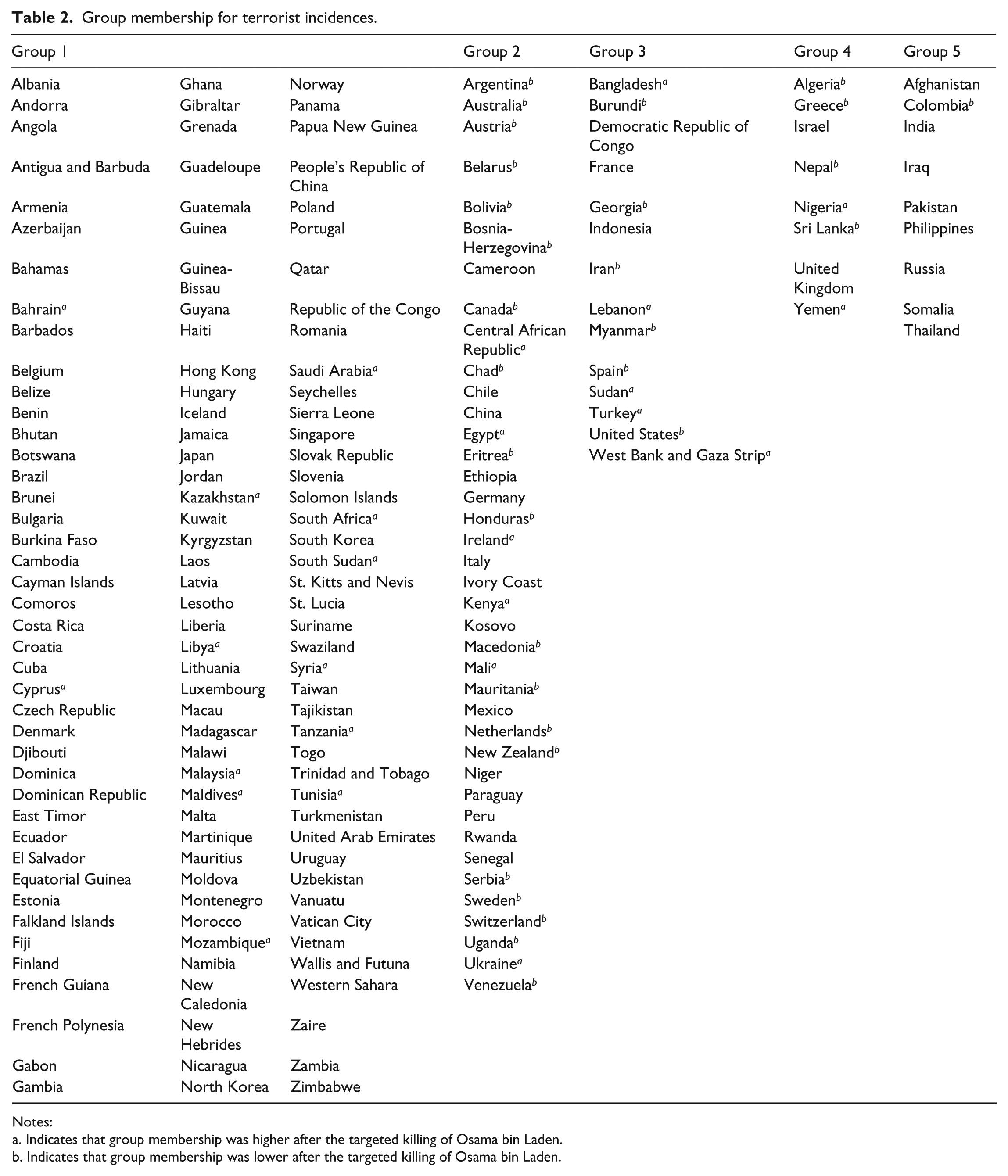
Notes:
Indicates that group membership was higher after the targeted killing of Osama bin Laden.
Indicates that group membership was lower after the targeted killing of Osama bin Laden.
Following 2 May 2011, 13.265 percent (n = 26) of the countries in the full analysis shifted upward in their trajectory group. Notably, these countries included Lebanon, Libya, Saudi Arabia, Sudan, South Sudan, Syria, Turkey, West Bank and Gaza Strip, and Yemen. Of these increasing countries, 10 exhibited a shift from the Very Low incidence group to the Low group; a further 11 countries shifted upward from the initial Low or Moderate groups; and 2 escalated from the High to the Very High group. Although most countries moving to a higher incidence group did so by only one group (76.9 percent), changes in trajectory group ranged from a one to a four group upward shift.
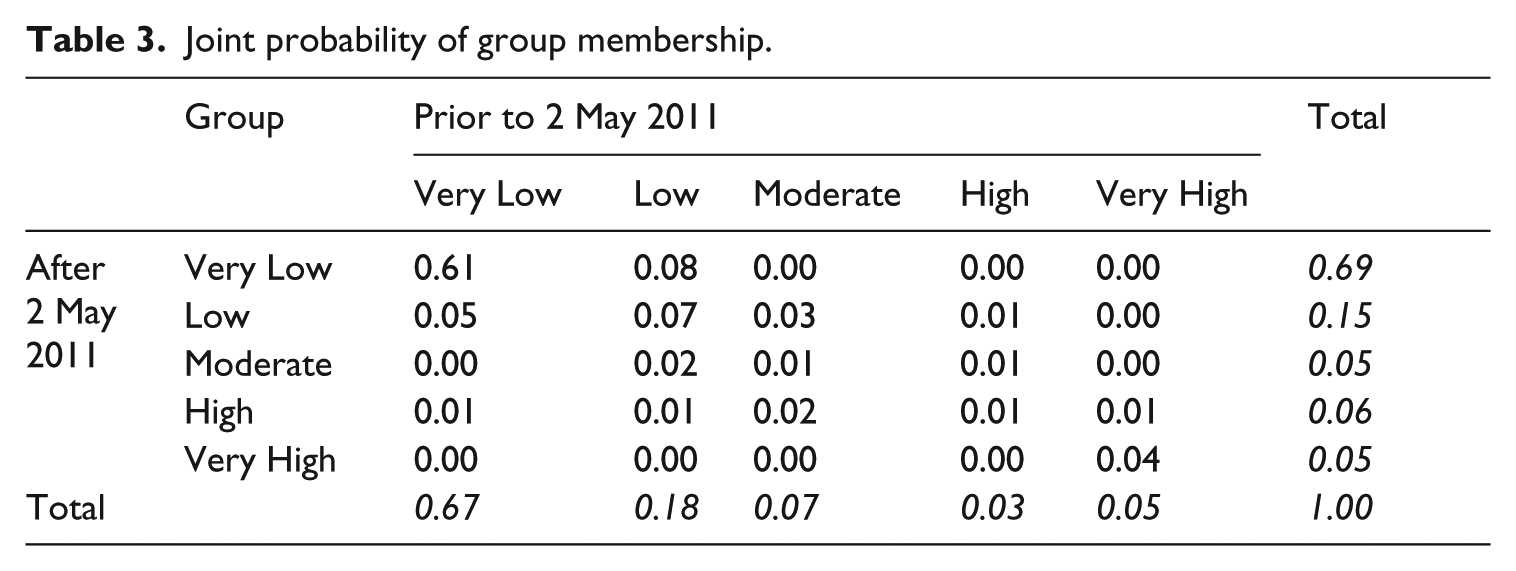
Finally, when the joint probabilities were examined from the dual trajectory model, 61 percent of nations experienced very little terrorism during the entire observation window and were classified as being in the Very Low group for both periods (Table 3). Further, 81 percent of nations were classified as being in the lowest two incidence groups throughout both periods. This table further reveals the relative stability of terrorism across nations, with 71.43 percent (n = 140) of countries remaining in the equivalent trajectory group before and after the killing of bin Laden. Interestingly among this stable subset were notable countries including Afghanistan, France, Germany, Iraq, Israel, Pakistan, Qatar, the UK, and the United Arab Emirates.
Joint probability of group membership.
Discussion and conclusions
This article presents evidence that the killing of Osama bin Laden was a major event that may have qualitatively changed the nature of terrorism in a number of nations around the globe. Our findings also suggest that this event was observed on a global scale, and was followed by detectable increases in the incidence of attacks by Al Qaeda and their affiliates in a number of strategically important nations. Given that these aggregate estimates fall in the opposite statistical tail to that predicted by deterrence or incapacitation, these basic findings would likely hold across a wide variety of statistical methods and far from the desired impacts of this targeted killing. When these findings were disaggregated, important geographic variation in the response of Al Qaeda and their affiliates’ to the killing of bin Laden also emerged. Both Iraq and Yemen saw large increases in terrorism; however, the remainder of nations either continued to experience no Al Qaeda terrorism or remained at the previous low level of terrorism that was evident prior to May 2011. Rather than suggesting clear general deterrence, these descriptive findings indicate that the death of bin Laden either produced null impacts on terrorism by Al Qaeda and their affiliates or increased terrorism in nations where Al Qaeda was already active.
The dual trajectory analysis further emphasizes the importance of geographic scope for understanding general deterrence and terrorism. Focusing solely on the US, there is evidence to suggest that the death of bin Laden marked a point where the threat posed by terrorism decreased relative to other nations. From this perspective, this may be taken as preliminary evidence of general deterrence for US terrorism beyond Al Qaeda. As noted by one of the anonymous reviewers of this study, this nonetheless raises important questions as to how best to limit the scope for understanding terrorist backlash and deterrence. Although it could certainly be argued that the isolated finding that the killing of bin Laden was followed by a reduction in US terrorism is a sign of deterrent success, this perspective would diminish the importance the subsequent increases in other involved nations. Also in light of recent findings suggesting a diffusion of counterterrorism benefits (see Hsu and Apel, 2015; Hsu et al., 2018; Perry et al., 2016), we highlight the need to theoretically explore the relative benefits of using different geographic scopes to evaluate counterterrorism policies. Additional empirical work is also required to further unpack this downward shift in the US terrorism trajectory. Specifically examining which terrorist groups and motivations this killing impacted would reveal important insights into the decision making of other organizations. In addition, the killing of bin Laden was not the only important event for terrorism that occurred during this period, and the present analysis is unable to exclude the possibility that other counterterrorism actions may be partially responsible for this shift as well. Consequently, future studies that are able to detect more nuanced temporal impacts are required to better identify the general impacts of the killing of bin Laden on US terrorism.
Expanding the scope to the international level, the general deterrent consequences of the killing of bin Laden were not supported. Indeed, the majority of nations (61 percent) did not experience a change in terrorism and experienced very little to no terrorism through the entire seven-year observation window. Consequently, for more than half of nations it is difficult to evaluate the deterrent impact of any policy or event on terrorism because this is essentially a censored outcome (Lynch, 2011). For the nations that did experience terrorism, average terrorism increased during the 3.5 years following bin Laden’s death compared with the 3.5 years before his death. This trend was not consistent with a uniform backlash or escalation from terrorist organizations. As the modal group for each of the 67 nations in the Low, Moderate, and High groups prior to bin Laden’s death was a lower group following his death, this study presents evidence that some nations saw a qualitative relative decrease in terrorism despite average increasing trends. This suggests that these nations may have reaped counterterrorism benefits whereas the nature of bin Laden’s death may have exacerbated the global terrorist threat. This heterogeneity is particularly important for nations making counterterrorism decisions, whereby the desire for retribution and national terrorism reductions may come at the cost of increased terrorism for allied nations.
Although dual trajectory analysis has a number of statistical strengths for identifying trends and important variation within a sample, it does have a number of notable shortcomings. This method is suited to looking at black swan events and broad patterns, but it does not control for other factors in the same manner as regression analysis. GBTMs are also unable to directly test hypotheses, making it difficult to make firm conclusions or to isolate the causal impact of any independent variable. As such, this study highlights that global terrorism trajectories were also influenced by other factors, including but not limited to: other counterterrorism initiatives; the killing of other top terrorism figures; changes in terrorism funding; and important sub-national political changes. Owing to the descriptive nature of the methods employed, it should be noted that all of these factors were also likely important in shaping the trajectories observed by this study. These are important limitations for examining the mechanism for the changes in trajectory that were observed and, similar to other statistical approaches (Forst, 2017), requires other statistical methods to better answer questions of this ilk. Despite these limitations, as a descriptive analysis this method was able to identify a number of key terrorism patterns and produce a number of unique insights to augment existing findings and drive future research. Coupled with the ability to graphically display findings in a more accessible and interpretable manner, this study highlights GBTM analyses and derivative models including dual trajectory analysis as tools that may add greater clarity to empirical areas that often produce conflicting empirical results. Further, it should be noted that the killing of bin Laden likely would not directly influence terrorist conflicts that do not involve the US or Al Qaeda and its affiliated organizations. Indeed, this is reflected in the findings of this research, whereby the majority of nations did not see detectable variation in their terrorism trajectory. However, these findings do indicate that this point marked an identifiable shift in terrorism trajectories for nations beyond the US and Pakistan that were directly involved.
Echoing recent findings, this study produces evidence that the killing of Osama bin Laden likely did not have the desired deterrent impact on global terrorism or on terrorism committed by Al Qaeda. The descriptive analysis produced by this study suggests that counterterrorism benefits were seen in some nations, including the US, that orchestrated bin Laden’s death. Given that important strategic nations such as Yemen saw their terrorism trajectory increase, the targeted killing of leading terrorist figures may also prove to be a double-edged sword, with local reductions coming at the cost of violence elsewhere. The dual trajectory models thus suggest a great deal of stability in terrorist trends for the majority of nations despite the global prominence of this event. Taken together, these divergent findings for individual nations may also partially explain the inconsistent findings of other studies that do not account for this heterogeneity and affirm the need to examine terrorism consequences beyond the nations and organizations that are directly involved.
