



Abstract
Traditionally, criminological research on impulsivity and crime assumes impulsivity is a uniform construct that is positively related to deviant behavior. However, psychological research on impulsivity indicates that the construct may have multiple forms, which vary in their relationship to antisocial behavior. One possibility that few studies have examined is whether some forms of impulsivity are unrelated, or negatively related, to antisocial behavior. This study uses Dickman’s (1990) functional and dysfunctional impulsivity scales and finds that dysfunctional impulsivity is a better predictor of crime than functional impulsivity, but does not differ for substance use or school deviance. These results highlight ways that impulsivity measures can be refined in the future.
Introduction
Self-control remains a central theoretical construct in the criminological literature, with much empirical support showing it is negatively related to crime (Pratt and Cullen, 2000; Rocque et al., 2016; Tittle, 2011). Gottfredson and Hirschi (1990) view self-control as a multidimensional construct, hinging on the ability to regulate behavior in the face of short-term desires. Impulsivity, one of the primary components of self-control, has also been considered a key factor in criminological studies. Individuals characterized by impulsivity behave differently than individuals who can resist temptation (Matthews et al., 2004) and, generally, impulsivity has almost exclusively been considered to be positively related to antisocial behavior (Lynam and Miller, 2004).
Research supports the notion that impulsivity is related to antisocial behavior and other negative consequences (Gerbing, et al., 1987; Lassiter, 2009; Lynam and Miller, 2004; Miller and Lynam, 2001; Moffitt et al., 2011; Vogel and Barton, 2013). Most definitions of impulsivity represent the trait as something that is undesirable to oneself and others. Claes et al. (2000) provide multiple definitions of the characteristic, such as ‘“human behavior without adequate thought” (Smith, 1952) . . . “action of instinct without recourse to ego restraint” (Demont, 1933) . . . “acting on thoughts that are not in the individual’s or others’ best interest” (Anon, 1951)’ (Claes et al., 2000: 27–8). In addition to the negative implications of definitions of impulsivity, many studies, too, have indicated that impulsivity is strongly related to non-criminal but socially undesirable behaviors, such as risky driving and smoking (Matthews et al., 2004; Mitchell, 1999; Taute and McQuitty, 2004). Although impulsivity seems to correlate with antisocial behavior, research suggests some impulsive individuals do not face negative consequences, and are even at times rewarded, for having the trait (Prentky and Knight, 1986; Rand and Epstein, 2014).
In criminology, Julie Horney (2006), in her American Society of Criminology Presidential Address, pointed out the possibility that there are different flavors of impulsivity or self-control. She argued that her self-control is strong in some contexts (showing up for work) and poor in others (saying no to dessert). Others have also recognized that impulsivity may be multidimensional (for example, Whiteside and Lynam, 2001). Impulsivity in certain contexts and in certain situations is not necessarily antisocial. In fact, some forms of impulsivity may be ‘heroic,’ such as quickly saving a person’s life (see Rand and Epstein, 2014). A more nuanced conceptualization of impulsivity may help improve the explanatory power of self-control theory (Weisburd and Piquero, 2008).
Although some research has examined variability underlying impulsivity, identifying which forms are more strongly related to risky behavior (for example, Whiteside et al., 2005; Whiteside and Lynam, 2001), few have sought to determine whether some forms of impulsivity have positive or neutral consequences. Matthews et al. (2004), however, contend that impulsivity sometimes leads to positive outcomes. Impulsive individuals may have a greater enjoyment of life and be more creative. Rather than impulsivity representing an unambiguously negative trait, it may be benign in some instances, or even beneficial.
To build upon previous work on impulsivity and crime, this article utilizes two measures of impulsivity and examines their relationship to various forms of deviance. Around 30 years ago, Dickman developed two forms of impulsivity, labeling them functional and dysfunctional. These measures have been used almost exclusively in psychology to the exclusion of criminology. We draw on these measures in an analysis of over 500 college students. We compare these impulsivity measures in their ability to explain crime and deviance in three areas: general antisocial behavior, substance deviance, and school misbehavior.
Impulsivity and crime
Self-control has been analyzed across many disciplines and has been used to explain behaviors from crime to disordered eating to compulsive shopping/spending (Baumeister, 2002; Lassiter, 2009; Levy, 2013; Hickmann, 2004; Tangney et al., 2004). Much of the literature on self-control indicates that individuals with high self-control are more likely to experience beneficial life outcomes than individuals with low self-control because these individuals delay gratification and plan their behaviors (Duckworth, 2011; Moffitt et al., 2011). Criminologists have examined self-control in relation to crime and some argue that a lack of self-control can account for all criminal behavior (Gottfredson and Hirschi, 1990). This bold claim has been subject to much research, with generally supportive results, at least in terms of the link between self-control and antisocial behavior (Pratt et al., 2014; Pratt and Cullen, 2000; Vazsonyi et al., 2017)
Gottfredson and Hirschi (1990: 90) argued that individuals lacking self-control ‘will tend to be impulsive, insensitive, physical (as opposed to mental), risk-taking, short-sighted, and nonverbal.’ Such individuals are vulnerable to momentary temptation. This view of self-control is similar to Murray’s earlier conception, viewing individuals with low self-control as quick acting without reflection (Murray, 1938). Self-control theory has received widespread empirical support (see, for example, Pratt and Cullen, 2000) but is limited in how well it explains antisocial behavior (Weisburd and Piquero, 2008). Although Gottfredson and Hirschi’s (1990) concept of self-control included six distinctive characteristics, impulsivity, in particular, is an important component (Forrest et al., 2019). Additionally, Zimmerman (2010) argued that scholars who have taken the ‘trait-based approach’ by focusing on the characteristics of the offender view impulsivity as a prominent explanation for offending behavior.
Most research in criminology suggests that impulsivity should be positively related to crime and antisocial behavior. For example, much work has indicated that impulsivity predicts antisocial behavior across a wide variety of samples (Gordon and Egan, 2011; Meldrum, 2016; Meule, 2013; Vogel and Barton, 2013). Thus impulsivity, a major component of criminological measures of self-control, is an important construct in the explanation and understanding of antisocial behavior.
Impulsivity: Unidimensional or multidimensional?
Research in criminology often considers impulsivity as unidimensional and uniformly positively related to crime (see, for example, Nagin and Pogarsky, 2001; Vazsonyi et al., 2006; Zimmerman, 2010). Yet research outside of criminology has recognized that impulsivity is not necessarily a unidimensional trait nor is it necessarily a risk factor for crime. Two measures, the UPPS (Urgency, Premeditation, Preservation, and Sensation-seeking) Impulsive Behavior Scale, and the Barrett Impulsiveness Scale (BIS) are popular in psychological research (Meule, 2013; Whiteside et al., 2005; Whiteside and Lynam, 2001). Both of these scales have multiple dimensions (four for the UPPS and three for the BIS). Thus they seek to tap a range of impulsive tendencies, whereas in the criminological literature it is more common to use one measure. In fact, in oft-used measurement strategies to capture Gottfredson and Hirschi’s self-control concept (for example, the Grasmick et al., 1993, scale), certain subscales that are meant to be distinct from impulsivity are actually part of the UPPS scale measuring that trait (for example, sensation or risk seeking).
A few studies have assessed whether different constructs of impulsivity differ in terms of how they relate to antisocial behaviors, including whether different forms predict different kinds of acts. Lynam and Miller (2004) examined the UPPS scale in relation to aggressive attributions and alcohol use. They found that lack of premeditative thinking was the strongest and most consistent form of impulsivity in relation to antisocial behavior whereas lack of perseverance was not related to antisocial behavior. Key for the purposes of this article, they argue that impulsivity consists of multiple traits – not one. Derefinko et al. (2011) also examined the UPPS in relation to aggression, finding that sensation-seeking and lack of premeditation were related to overall violence but urgency was most strongly related to intimate partner violence. Interestingly, lack of perseverance was not significantly related to violence. Another study measured Whiteside and Lynam’s (2001) four dimensions of impulsivity, finding that all (including perseverance) were related to antisocial behavior on the bivariate level but one, ‘urgency,’ was not in a regression analysis (Miller et al., 2003). Urgency was, however, significantly related to aggression. A recent meta-analysis of the UPPS found that each component of impulsivity was significantly related to substance use and aggression (Berg et al., 2015).
Other studies have compared different impulsivity measures with respect to their relationship to antisocial behavior. Gordon and Egan (2011) found that the Eysenck Impulsiveness Questionnaire performed best predicting post-prison convictions. Another study examined four versions of impulsivity measures, finding all to be strongly associated with antisocial behavior (Luengo et al., 1994). The purpose of most of these studies seems to be identifying which type of impulsivity is related to different types of antisocial or maladaptive behaviors. For the most part, these studies did not examine whether there are some forms of impulsivity that are unrelated to antisocial behavior, assuming, as most work does, that impulsivity, in all its manifestations, should be positively related to antisocial or maladaptive behavior, with the dimensions simply varying in terms of how well they predict such behavior or which behaviors they predict. What this body of research, particularly in criminology, has not adequately examined is the idea that some forms of impulsivity may have prosocial, functional, or at least neutral behavioral correlates. We turn to that distinction next.
Heroes vs. criminals
Although low self-control and high impulsivity are often framed negatively in terms of behavioral outcomes, certain work indicates this may not be the case. The type of impulsivity matters in how it is viewed and its consequences. Prentky and Knight (1986) contend that impulsive behaviors that preserve life are prosocial whereas those that threaten life are antisocial. Likewise, Dickman (1990) argued that there are functional and dysfunctional forms of impulsivity, implying that some individuals are successful while performing tasks impulsively, and others are not. Not all individuals experience negative consequences for their impulsive actions – and some might even be praised. It seems necessary to further assess the different types of behavior that impulsive individuals engage in before defining the characteristic so negatively.
Taute and McQuitty (2004) studied the connection between impulsivity and charitable donating, which they defined as a prosocial act. They explained that impulsivity in the context of donating was mediated by various social and personal norms about helping others and gift giving. The researchers found that the connection between impulsivity and prosocial behavior was not significant in their study. They did find that impulsive donating behavior aroused emotions such as guilt for giving into impulses and feeling good about giving, further supporting psychological suggestions that emotions influence impulsivity. Likewise, Pearn and Franklin (2012) considered how altruism relates to impulsive water rescuers who save individuals who are suffering from some form of aquatic trauma, such as drowning. They argued that these individuals have an ‘impulse to rescue’ (2012: 332–3). Since these impulsive aquatic heroes will take action no matter what, they must be well equipped with the proper skills while rescuing in order to prevent risking their own life.
Research on psychopaths and heroes suggests interrelationships between personality traits. Smith and colleagues (2013) found that disinhibition, or lack of impulse control to delay response for instant gratification, may be a common characteristic displayed by both heroes and psychopaths. Both groups can be defined by a level of fearlessness and engagement in novel activities; it is the outcome of their behaviors that defines pro- and anti-sociality (Lykken, 1996).
In fact, research is fairly clear that heroic individuals often act without calculated thought (for example, on an impulsive basis). Rand and Epstein (2014) collected data on Carnegie Hero Medal Recipients (for those who put themselves in danger to save others). An analysis of ratings of 51 statements showed that, for the most part, the heroes acted without thinking, on impulse. They concluded that often people will act selflessly when pushed to make a split-second decision (see also Rand et al., 2012; Rand and Epstein, 2014; Righetti et al., 2013; Robson, 2015).
It is important to note that individuals who are impulsive can also act in ways that are neither harmful nor beneficial to society. An impulsive individual who is able to quickly look at a restaurant menu and decide what to order is not harming nor benefitting anyone (Matthews et al., 2004). Prosocial impulsivity and benign impulsivity seem to exist and should be studied further to examine whether there are forms of impulsivity without attendant negative consequences.
Functional and dysfunctional impulsivity
Distinguishing antisocial vs. prosocial forms of impulsivity would seem to be important. Fortunately, a measure of impulsivity does exist that attempts to separate prosocial vs. antisocial components. In 1990, Dickman introduced two measures of impulsivity, which he labeled functional and dysfunctional impulsivity. He defined impulsivity as ‘the tendency to deliberate less than most people of equal ability before taking action.’ Dickman argued that dysfunctional impulsivity includes the tendency to act without much aforethought, leading to poor outcomes. In contrast, functional impulsivity is acting without aforethought where the product of behavior is beneficial to the actor. Individuals who are dysfunctionally impulsive do not typically perform tasks correctly or complete the actions they wish to carry out, whereas functionally impulsive individuals are typically successful in completing tasks correctly and are able to overcome barriers.
Dickman (1990) found that individuals who are functionally impulsive tend to experience positive consequences and experience pride from their precise, quick-witted behavior. Dysfunctionally impulsive individuals tend to experience more difficulties and frequently fail when trying to complete tasks. They are more likely to be dissatisfied and lack the pride that functional impulsives experience. Importantly, dysfunctional impulsives, or people who fail at tasks they are attempting to perform quickly, seem also to have antisocial/aggressive tendencies (Dickman, 1990, 2000; Vigil-Colet and Codorniu-Raga, 2004; Vigil-Colet et al., 2008). Vigil-Colet and colleagues’ work has shown that functional impulsivity is not positively related to aggression, whereas dysfunctional impulsivity is (Vigil-Colet and Codorniu-Raga, 2004; Vigil-Colet et al., 2008). These studies focus mainly on aggression and few studies examined the differences between functional and dysfunctional impulsivity and general criminal/antisocial behavior.
In fact, much criminological work examining impulsivity and self-control seems to be utilizing forms of dysfunctional impulsivity or else not distinguishing forms of impulsivity. For example, in the Grasmick scale, often used to test Gottfredson and Hirschi’s self-control theory, impulsivity is measured by four items, including not stopping to consider the consequences of actions (similar to an item in the Dickman dysfunctional impulsivity scale) and doing whatever brings pleasure now at the expense of a distant goal. These two items appear largely dysfunctional and the other two do not reference any beneficial result of the impulsive actions. Research using the dataset of the National Longitudinal Study of Adolescent to Adult Health (Add Health) often incorporates an impulsivity index that includes items such as ‘When making decisions, you generally use a systematic method for judging and comparing alternatives’ (see, for example, Vogel and Barton, 2013; Wolfe and Hoffmann, 2016). These items are related to overall impulsivity, but do not reference benefits or consequences of the actions and thus fail to distinguish functional vs. dysfunctional forms of impulsivity.
To the extent that some forms of impulsivity are prosocial or functional, they should not predict antisocial conduct or should predict it less well than dysfunctional forms of impulsivity. Thus, the purpose of this study is to examine two versions of impulsivity measures, thought to reflect opposite consequences. We expect that our measure of dysfunctional impulsivity will have a stronger and more consistent relationship to crime and antisocial behavior than functional impulsivity.
Data and methods
Data
The data for this study come from students at a small private northeastern college and a large public university in the southeastern US. An online survey was distributed to undergraduate students at both schools (the entire student body at the liberal arts school and the college of liberal arts and social sciences at the large university). Targeted emails were also sent to the athletics department and the sociology department at the liberal arts college. These two institutional settings were chosen to maximize variation in responses and demographics, particularly race and social class. At the beginning of the survey, students were notified that they could stop taking the survey at any time and that their responses would not be used for any means other than for the purposes of this study. A total of 693 students initiated the survey and 688 provided consent to participate. Valid cases for particular variables range from 559 to 561, 1 and we focus on those individuals in at least one of our primary regression models (n = 561). The response rates for each school are difficult to calculate because we cannot confirm how many students saw the email notification for the survey. During the semester that the survey was distributed to the private college students, there were 1744 students enrolled, and there were 4368 at the college of liberal arts and social sciences in the large university. However, the goal was not to obtain a representative sample of the two schools but to test theoretical relationships. Thus a high response rate was not a key focus of the study and we do not claim any representativeness of our sample.
Independent variables
To measure impulsivity, we constructed two different scales. The Dickman (1990) functional and dysfunctional impulsivity scales were included in this study, using all items in both scales. Each scale asks respondents to read statements and respond ‘true’ if the statement describes them or ‘false’ if the statement does not describe them (Dickman, 1990). Dickman’s (1990) work supports the notion that different types of impulsivity exist. He defined impulsivity as ‘the tendency to deliberate less than most people of equal ability before taking action.’ He argued that dysfunctional impulsivity is the ‘tendency to act with absence of forethought when this behavior can create problems.’
There are 11 questions in the functional impulsivity scale and 12 questions in the dysfunctional impulsivity scale. Respondents were asked to respond ‘true’ or ‘false’ to these questions. An example of the functional impulsivity scale is ‘I like sports and games in which you have to choose your next move very quickly.’ An example of the dysfunctional impulsivity scale is ‘I frequently buy things without thinking about whether or not I can really afford them.’ See the Appendix for a list of items in each scale.
To calculate impulsivity scores, items were coded such that higher values reflect more impulsivity, then summed. Scale scores were calculated as long as at least 75 percent of the items had valid responses. The alpha reliability (analytic sample) for the dysfunctional impulsivity scale was .79 and the alpha for the functional scale was .81.
Dependent variables
To measure crime and antisocial behavior, we asked respondents about criminal behavior, substance use/deviance, and school deviance. For the first two, we drew from items used by Pfefferbaum and Wood (1994). We used all items in their interpersonal delinquency scale, with the exception of ‘participated in a gang fight.’ We then adjusted the item ‘Had a serious fight at work or school’ to ‘picked a physical fight with someone else,’ for clarity. We also included items from their ‘property’ and ‘vandalism’ subscales. We included a new item, ‘taken something from a store without paying for it,’ to cover shoplifting. Finally, we omitted ‘arson’ and ‘work deviance.’ This first measure, which we labeled crime scale, contains 11 items and included general acts of delinquency, such as ‘Within the past year, have you used a gun, knife, or weapon to get something from someone else?’ These items are scored dichotomously such that 1 = yes, 0 = no. Next, we measured substance deviance with five questions regarding substance use or selling over the past week. For example, ‘Within the past week have you gotten drunk on beer, wine, or liquor?’ This scale also drew on Pfefferbaum and Wood’s (1994) substance delinquency scale, except for one item we included asking whether the respondent sold marijuana or other drugs in place of a question asking if they had drunk beer, wine, or liquor. These items are scored similarly to the crime scale. Finally, the school deviance scale contained three items and asked respondents to provide information about their behavior in school in their lifetime. One question from this scale asked, ‘In your life have you hazed another person (student, peer, teammate, etc.) or forced them to do something against their will?’ Again, this was a dichotomous scale such that 1 = yes and 0 = no. Scores were calculated if respondents had at least 75 percent valid items. See the Appendix for full item lists for each of these three scales.
We generated variety scores for all three deviance scales. These scales represent the number of unique acts the respondent engaged in. For example, the crime scale can theoretically range from 0 to 11, the substance deviance scale can range from 0 to 5 and the school deviance scale can range from 0 to 3. A score of 0 would indicate the respondent did not engage in any of the acts and a maximum score indicates that they engaged in each of the acts listed. Variety scores are often seen as preferable to summative scores for delinquency because they do not give unequal weight to less serious, more common acts (Sweeten, 2012). In addition, research has indicated that variety scores are more reliable and valid (Sweeten, 2012). In addition, because each item was scored dichotomously, frequency scores were not possible to construct. Each respondent received a value on the scales if they responded to at least 75 percent of the questions on that scale.
Covariates
We included several covariates to use as control variables in our analyses, based on past research. Studies have indicated gender differences in both impulsivity and antisocial behavior (Gottfredson and Hirschi, 1990; Pfefferbaum and Wood, 1994). Gender was coded into 1 = male, 2 = female, 3 = other. From this, we created a male variable scored 1 if male and 0 if not. Age is also related to both impulsivity and antisocial behavior in previous research (Gottfredson and Hirschi, 1990; Steinberg et al., 2008). Age was scored continuously and calculated from date of birth. Cognitive ability is a known correlate of antisocial behavior (Hirschi and Hindelang, 1977; Vigil-Colet and Morales-Vives, 2005) and so we included GPA (grade point average), scored numerically from 0 to 4 (one respondent who indicated their GPA was over 4 was coded as missing). Social class has been found to be associated with antisocial behavior in past research (Braithwaite, 1981). To represent social class, parental level of education was coded on a scale of 1 to 9, 1 indicating the lowest level of education (‘no high school diploma’) and 9 indicating the highest level of education (‘doctorate degree’). Finally, race is also related to our main variables (Hindelang et al., 1979; Lynam et al., 2000). Race was coded into six groups, 1 = ‘white,’ 2 = ‘black and African American,’ 3 = ‘American Indian or Alaskan Native,’ 4 = ‘Asian,’ 5 = ‘native Hawaiian or Pacific Islander,’ 6 = ‘other.’ We created a variable, black, scored 1 if black and 0 if otherwise, which we use in the analysis. Finally, to control for the school attended, we created a dichotomous measure scored 1 if the student attended the small private college, 0 if the public university.
Analytic plan
In order to analyze the effect of our various impulsivity measures on crime and deviance, we first calculated bivariate correlations. Next, we estimated a series of multivariate binomial regression models examining the effect of each impulsivity scale separately and then together with its pair to determine whether the effect varied. This follows the method of Piquero and Bouffard (2007), who compared the effect of two self-control scales on crime. Importantly, because our dependent variables are not simple frequency scales or binary measures of antisocial behavior, count style regression models (for example, Poisson or negative binomial) or binary regression (logistic) techniques are not appropriate. In other words, our variety scales can be thought of as a series of trials in which a respondent can have a success or a failure. Thus, they are independent trials, and the score on the measure is the number of successes out of a finite number of possibilities. This differs from typical frequency-type scales where the upper bound is unlimited. The model is similar to logistic regression and can be interpreted similarly by exponentiating the coefficients into odds ratios (see Apel and Kaukinen, 2008; Britt et al., 2018; Rocque et al., 2016). Here, the coefficients correspond to the odds of committing an additional act in the variety scale. The model is given by:

where π represents the probability of success on any trial (here, having committed the antisocial act); Y is the number of successes out of n trials; N varies by measure – 11 for the crime scale, 5 for the substance scale, and 3 for the school deviance scale. We also account for missing data in each scale by allowing the number of trials to vary by respondent.
Results
Table 1 provides descriptive statistics for the study variables for our analytic sample (for example, those in at least one of the main regression models predicting deviance). The total sample size varies by the outcome measure because not all questions within the survey forced a response. The average age of the sample was 22.88 years old. The average GPA was 3.22. The majority (74.33 percent) of the survey respondents identified as female, and the majority (70.05 percent) of survey respondents were white (22.10 percent were black or African American). The modal parental education category was bachelor’s degree (29.23 percent); 19.79 percent of survey respondents attended the private college, with the remainder reporting being students at the large university (see Table 1).
Descriptive statistics.
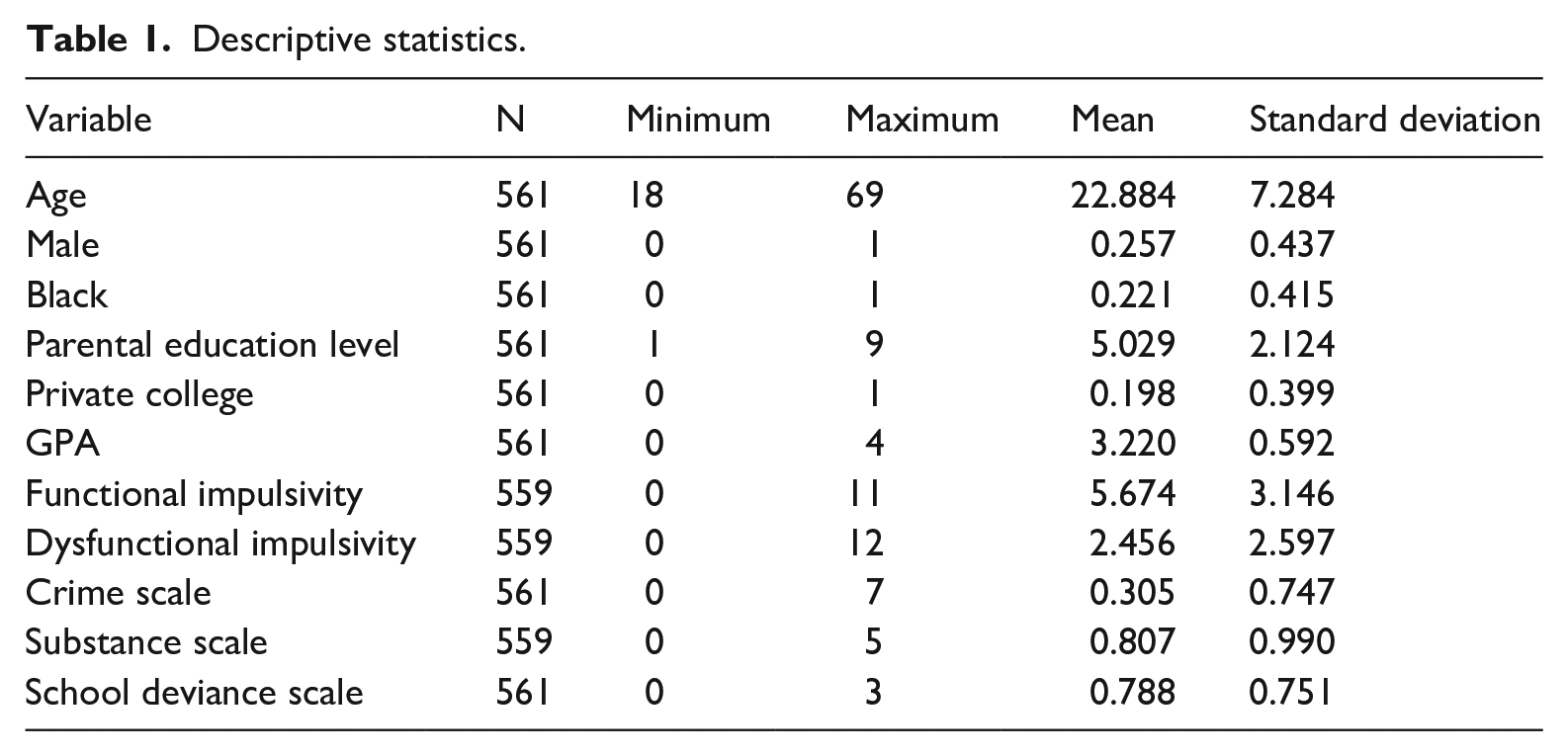
With respect to the antisocial behavior scales, our sample is, expectedly, not highly deviant. The crime scale averaged less than 1 act out of 11 (0.305). No respondent reported engaging in all 11 acts. The scores are higher for substance deviance, with an average of 0.807 (out of five types of act). Finally, the school deviance scale shows an average of .788 (out of three acts).
In Table 2, we show Pearson correlations between the variables of interest for our analytic sample. In terms of the functional and dysfunctional impulsivity measures, a positive and significant relationship exists for each of the three dependent variables for dysfunctional impulsivity. Interestingly, a positive and significant relationship also exists for functional impulsivity and deviance. The differences between the correlation coefficients for functional and dysfunctional impulsivity are not significant at the p > .05 level for any of the deviance measures using a Fisher r to z calculation (not shown). 2
Correlations between impulsivity and antisocial behavior (n = 557–561).
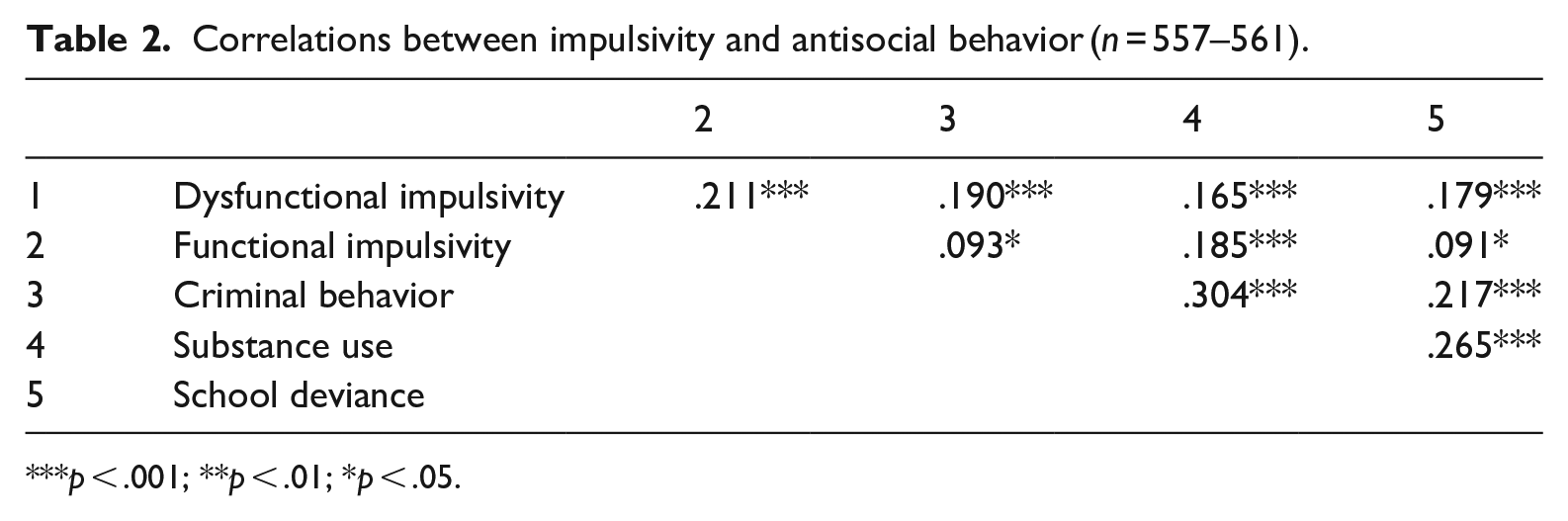
p < .001; **p < .01; *p < .05.
We next turn to our series of binomial regression models, reported in Tables 3 through 5. Recall the models used for these analyses are similar to logistic regression where coefficients can be exponentiated and interpreted as odds ratios. Odds ratios are shown in each model for ease of interpretation. In Table 3, the relationship between each measure of impulsivity and crime is shown. Model 1 indicates that functional impulsivity has a significant relationship with crime, an increase of one unit on the functional scale corresponding to a 6 percent (OR 1.06) increase in the odds of committing an additional criminal act. In Model 2, we see that dysfunctional impulsivity is also positively and significantly related to crime, but the OR is larger (1.14); a one unit increase in that scale corresponding to a 14 percent increase in the odds of committing an additional crime. Further, in Model 3, in which both functional and dysfunctional impulsivity are included, only dysfunctional impulsivity remains statistically significant. Interestingly, the OR for dysfunctional impulsivity is largely unchanged (from 1.14 to 1.13). A test of the equality of dysfunctional and functional impulsivity coefficients indicates they are significantly different at the (p > .05) level.
Binomial regression of impulsivity on criminal behavior.
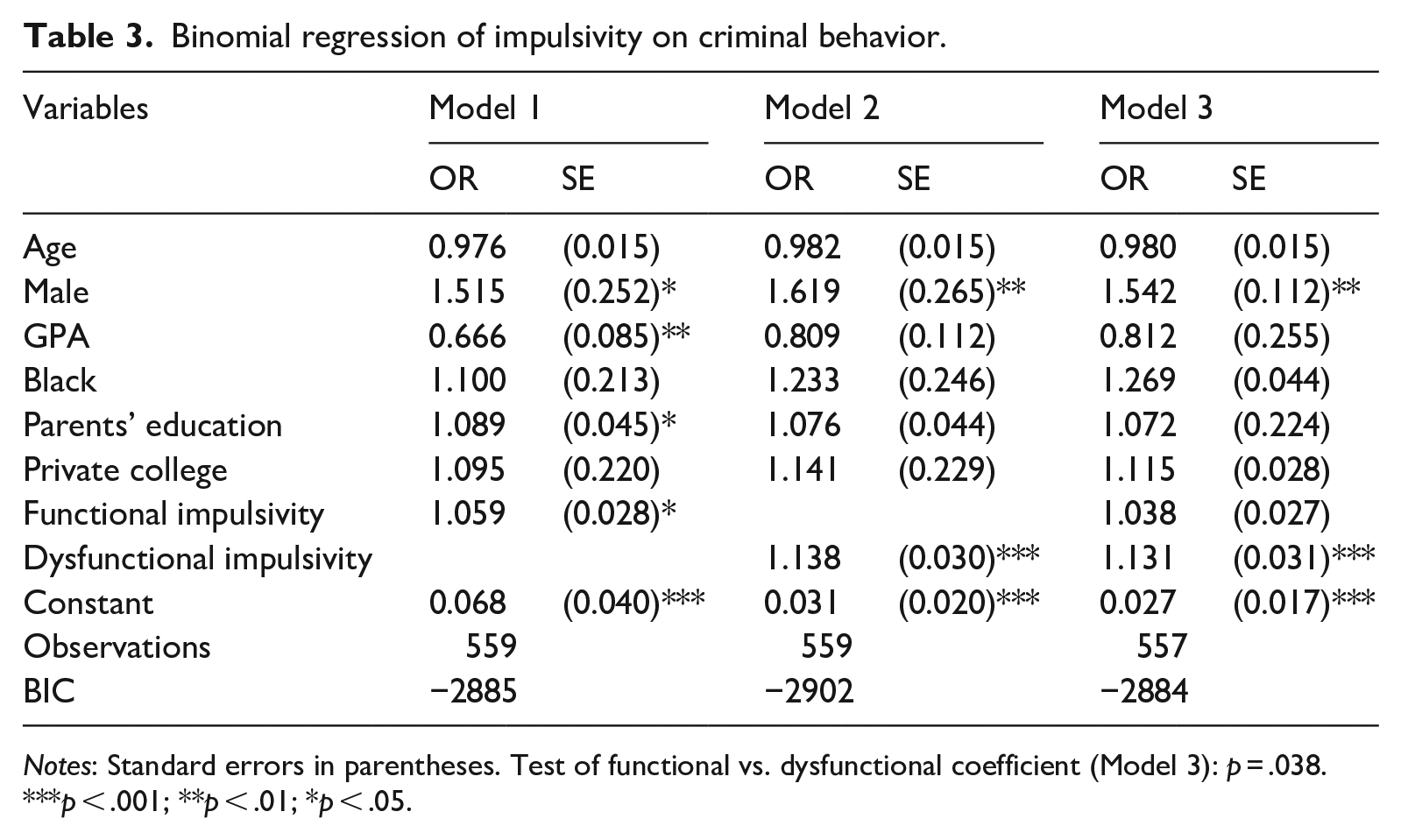
Notes: Standard errors in parentheses. Test of functional vs. dysfunctional coefficient (Model 3): p = .038.
p < .001; **p < .01; *p < .05.
Binomial regression of impulsivity on substance deviance.
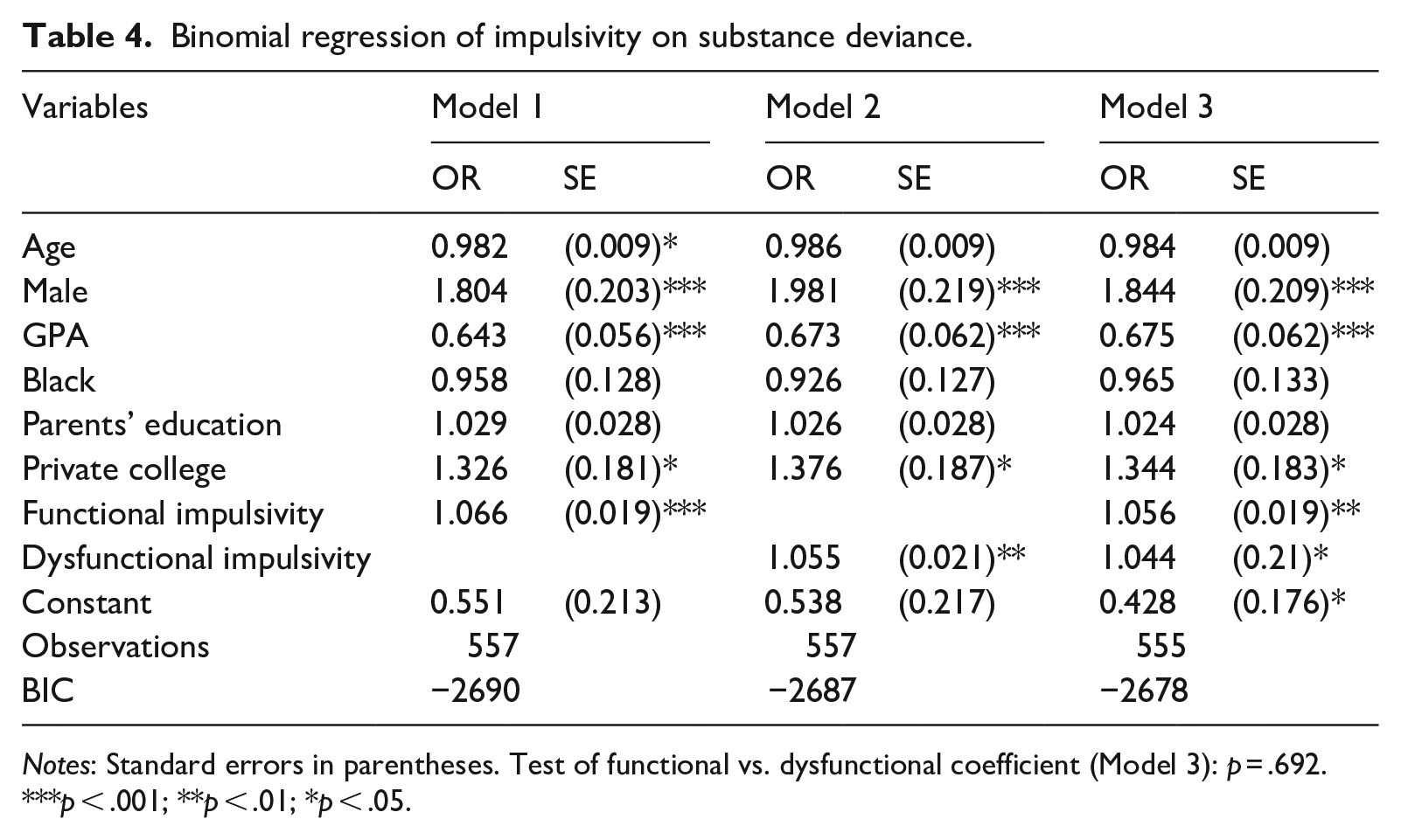
Notes: Standard errors in parentheses. Test of functional vs. dysfunctional coefficient (Model 3): p = .692.
p < .001; **p < .01; *p < .05.
Binomial regression of impulsivity on school deviance.
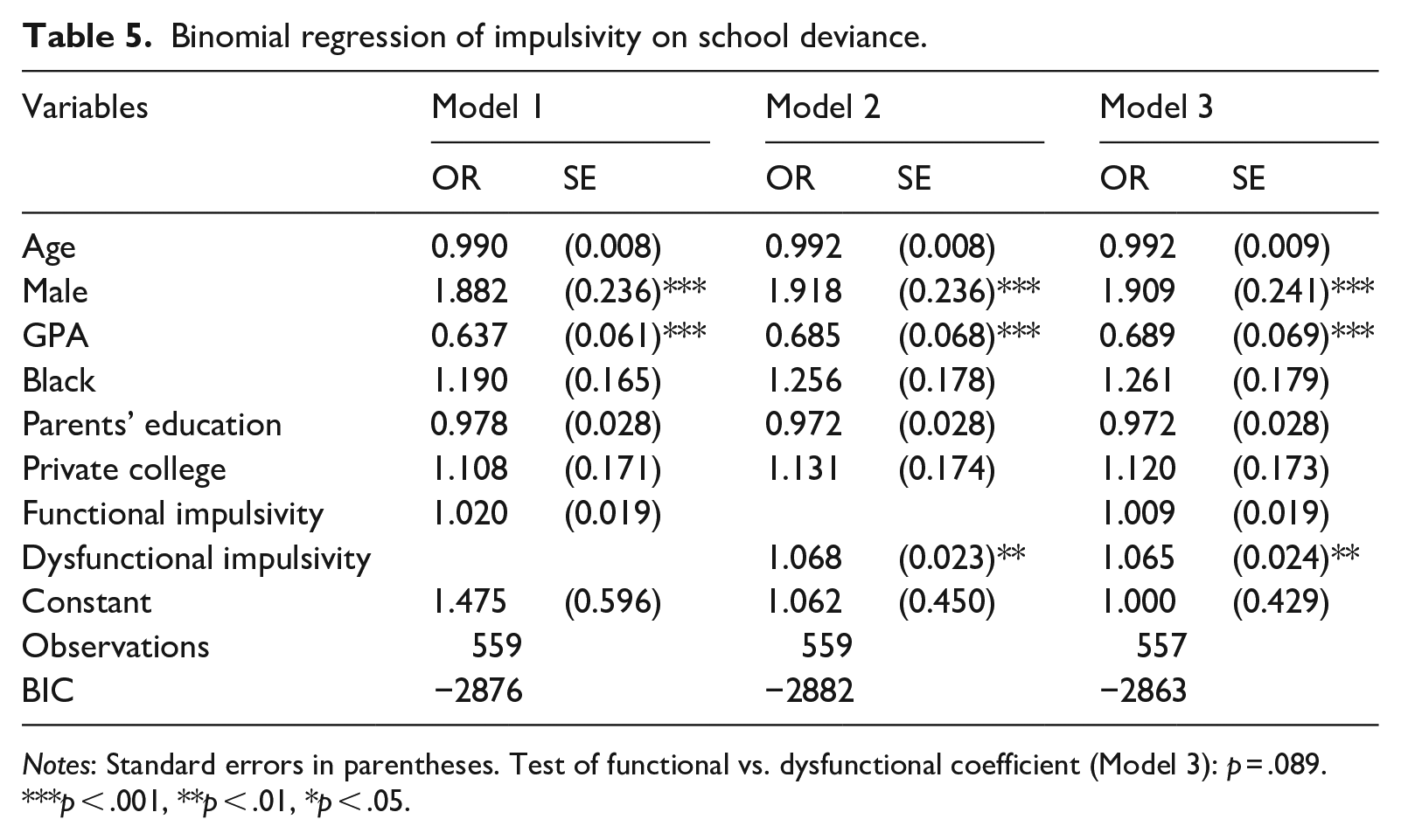
Notes: Standard errors in parentheses. Test of functional vs. dysfunctional coefficient (Model 3): p = .089.
p < .001, **p < .01, *p < .05.
In Table 4, we repeat the analysis from Table 3 using the measure of substance deviance. Here we see that functional and dysfunctional impulsivity (Models 1–3) are related to substance behavior in a positive and statistically significant manner. Surprisingly, the OR is somewhat higher for functional impulsivity than for dysfunctional impulsivity in both the single and the combined models, but the coefficients do not differ statistically. This is perhaps to be expected though, since functional impulsivity had a higher bivariate correlation with the substance scale than did dysfunctional impulsivity. We also performed a sensitivity analysis (not shown) by removing the item indicating the selling of marijuana from the substance scale (so that it was solely referring to substance use). The results are substantively similar with both functional and dysfunctional impulsivity statistically significant in Model 3 and not statistically distinguishable from one another.
Table 5 reports the results of the regression analysis examining school deviance. The story for dysfunctional impulsivity is largely the same. That is, it is statistically significant and positively related to deviance in the school setting. Functional impulsivity is not significantly associated with school deviance in any model. In the combined models (Model 3), dysfunctional impulsivity is associated with an OR of 1.07. The dysfunctional impulsivity coefficient is not significantly different than functional impulsivity at the .05 level, though, since functional impulsivity is not statistically significant, this is evidence that dysfunctional impulsivity is more consistently related to school deviance. Overall, despite some similarities, the results of these models suggest that there do appear to be differences in types of impulsivity and not all are related to crime and antisocial behavior. The tendency of criminological research to assume impulsivity is carte blanche predictive of deviance (even if in differential ways) therefore seems misguided.
Discussion
The goal of this study was to examine differences in types of impulsivity as they relate to crime and deviance. We hypothesized that certain forms of impulsivity are correlated with antisocial behavior whereas others are not. In fact, it may be that certain forms of impulsivity are related to prosocial actions. To examine these possibilities, we surveyed college students in the northeast and southeast United States and drew on the work of Dickman (1990) to develop measures of functional and dysfunctional impulsivity.
We then examined how these measures of impulsivity related to three forms of deviance: general crime, substance deviance, and school misbehavior. Our findings indicated that, in general, dysfunctional impulsivity was strongly associated with deviance but functional impulsivity was not. In regression models in which both forms of impulsivity were entered, functional impulsivity was not significant in two of the three models but dysfunctional impulsivity was significant for all three. The coefficients for dysfunctional impulsivity differed from functional impulsivity statistically in the first model (crime). The only form of deviance to which functional impulsivity was statistically significantly related was substance deviance (and the coefficient for this model did not differ from the dysfunctional impulsivity coefficient). Here, functional impulsivity actually had a higher odds ratio than dysfunctional impulsivity.
Theoretical and policy implications
Overall, this study has several implications for self-control theory and criminological research in general. The findings of the analyses suggest that there are forms of impulsivity that are better predictors of antisocial behavior than others. The possibility exists that impulsivity is not always related to negative behavior or maladaptation. Theories based on the notion that impulsivity or low self-control is the primary cause of crime therefore need to be refined. Certain forms of impulsivity, that is, may be a primary cause of crime, but certain forms of impulsivity are not. In fact, some forms of impulsivity may not predict antisocial behavior at all; some may be associated with prosocial behavior (but we did not test that possibility here).
At the same time, the findings of this study suggest that, not only is dysfunctional impulsivity positively related to crime, but, in some cases, so is functional impulsivity. This suggests that, whereas functional impulsivity might theoretically promote prosocial acts, it might simultaneously increase the risk for certain kinds of delinquency. Such a finding supports the theoretical position that self-control is related not only to delinquency but to a host of other analogous acts – some of which might be not be considered criminal. For example, our data indicated that, when dysfunctional impulsivity was taken into account, functional impulsivity was related only to the substance scale. This finding may be a consequence of using a college sample for whom the use of substances such as alcohol is not necessarily antisocial or dysfunctional but is normal. It remains to be seen, however, whether functional impulsivity is empirically related to prosocial (heroic) acts, because we did not have such measures in our data.
Differentiating functional and dysfunctional impulsivity may be of some use to clinicians. Both forms of impulsivity can be potentially problematic and lead to antisocial behavior. For example, someone who might not be specifically dysfunctionally impulsive, but who might enjoy engaging in thrill-seeking behavior, can still be at risk for delinquency. Those who conduct assessments would be wise to look at various measures of impulsivity even if they are not particularly ‘antisocial’ or ‘dysfunctional.’
In the case that an individual screened by a clinician shows an inclination toward impulsive behavior, programs can focus on instilling self-control and reducing impulsive tendencies. Although some of the origins of self-control are most certainly genetic (see, for example, Wright and Beaver, 2005) and fairly resistant to change, there have been successful programs that address deficits in self-control. For instance, the Fast Track intervention program administers the PATHS (Promoting Alternative Thinking Strategies) curriculum to all participants, which is ‘designed to help children develop emotional communication, social understanding, self-control, and problem-solving abilities.’ 3 Various studies have found the program to be effective at reducing problem behavior after the program and in the long term (Bierman, 2002; Bierman et al., 2004) and it has been evaluated with genetically sensitive designs showing differential impacts depending on genetic vulnerability (Albert et al., 2015).
We are certainly not the first to show that impulsivity is multidimensional. Our research, after all, relied on a measure that decomposed impulsivity into functional and dysfunctional variants. However, most work continues to view impulsivity to be generally antisocial or negative in its manifestations. If certain forms of impulsivity are not related to antisocial behavior (and some forms are related to prosocial behavior), theoretical accounts utilizing impulsivity need to be reappraised.
Limitations and implications for future research
To begin the examination of the effect of different types of impulsivity on a variety of antisocial behaviors we made use of a convenience sample of college students with a relatively low response rate. Although college samples are certainly useful for exploratory research, the results here cannot be generalized to all college students or to the general population. Further, students at both schools had not committed many official crimes and therefore it is not clear how impulsivity might be related to antisocial behavior of more serious or clinical samples. In that sense, college samples have clear limitations (see Hagan and McCarthy, 1997). Yet recent work has shown that, although college samples are different than criminal ones, they are still useful for theory testing (Wiecko, 2010).
Additionally, our data were limited. For example, this was a cross-sectional survey and so the association between changes in impulsivity and behavior over time could not be examined. We also did not examine the role of our impulsivity measures in prosocial outcomes. Therefore, we could not assess whether or not impulsivity was related to both antisocial behavior and ‘heroic’ behavior. It may be that certain types of impulsivity are related to both types of behaviors. This possibility makes theoretical sense because impulsive personality is likely to be linked to extreme behavior on both ends of the sociality spectrum given the need for quick and spur of the moment thinking for these types of behaviors. Supplemental analyses (not shown) indicated that functional but not dysfunctional impulsivity was related to being a varsity athlete in our study, which may suggest it is related to prosocial performance.
Future research should attempt to further refine forms of impulsivity. Do some forms predict ‘prosocial’ behavior? The survey used in this study contained a limited measure of prosocial and antisocial impulsivity but the psychometric analyses indicated low reliability. Additional items should be explored to create more psychometrically sound measures to differentiate forms of prosocial vs. antisocial impulsivity. In addition, although we controlled for race and sex, these demographics should be explored more fully in relation to impulsivity. Do men or blacks have higher or lower dysfunctional impulsivity? Does the effect of different impulsivity forms vary by race/sex? In a supplemental analysis (not shown) we found some differences, where men had higher impulsivity levels (both functional and dysfunctional) than females and blacks were lower than non-blacks. Research should examine these relationships in more detail.
Conclusion
The prominent role that self-regulation and impulsivity have on increasing negative social and personal outcomes is now strongly supported. Low self-control and impulsivity are found to be related to delinquent behavior (Pratt and Cullen, 2000), drug use (Sussman et al., 2003), victimization (Pratt et al., 2014), and even minor antisocial acts such as imprudent airline behavior (Meldrum, 2016). Even though there are some questionable assertions of the original formulations of Gottfredson and Hirschi (1990), the relationship between self-control and negative outcomes is not one of them.
Despite learning much about the connection between self-control and delinquency over the past several decades, little is known about ‘positive’ or ‘neutral’ forms of impulsivity. We wished to fill in this gap by examining different forms of impulsivity and their relationship to delinquency, drug use, and school deviance. Supporting prior research, dysfunctional impulsivity was consistently related to these outcomes. Interestingly, functional impulsivity was also positively related to some of these outcomes – particularly substance abuse. Our study highlights the varying strength of multiple forms of impulsivity on antisocial acts as well as the role of impulsivity in different life outcomes.
In sum, our study has provided a nuanced investigation of impulsivity and expanded what is already known regarding the relationship between impulsivity and delinquency. Impulsivity does not appear to be uniformly related to antisocial or negative behavior. It may very well increase the ability for some people to act heroically, but the same characteristics that make heroic acts possible (for example, spur of the moment thinking, disregard for future consequences) also increase the potential for one to become involved with delinquent and deviant behavior. The current study is certainly not the final word on these matters but can provide a foundation for further empirical consideration of the issue.
Supplemental Material
Appendix_11-11-19_1 – Supplemental material for Rethinking self-control and crime: Are all forms of impulsivity criminogenic?
Supplemental material, Appendix_11-11-19_1 for Rethinking self-control and crime: Are all forms of impulsivity criminogenic? by Brynn E. Wendel, Michael Rocque and Chad Posick in European Journal of Criminology
Footnotes

References
Supplementary Material
Please find the following supplemental material available below.
For Open Access articles published under a Creative Commons License, all supplemental material carries the same license as the article it is associated with.
For non-Open Access articles published, all supplemental material carries a non-exclusive license, and permission requests for re-use of supplemental material or any part of supplemental material shall be sent directly to the copyright owner as specified in the copyright notice associated with the article.
