



Abstract
Research in the field of developmental psycho-criminology shows that conduct disorders and deviant behaviours are frequently associated with traumatic and adverse developmental experiences. Personality traits and psychopathological symptoms also increase the risk of criminality. However, the role of psychopathological symptoms in the relationship between adverse childhood experiences and offending has rarely been researched. The present study was designed to throw further light on these issues by analysing risk factors in a group of adolescents and young adults in a juvenile detention centre in southern Italy. Results support the idea that the accumulation of risk factors is a major factor in recidivism and highlight the key role played by the contexts and emotional environments in which children and adolescents grow up. They also underline the link between paternal antipathy and hostile behaviours and the potential impact of paternal antipathy and hostility on triggering delinquent trajectories. Our study’s main limitations are its small sample size and the absence of longitudinal measures. Nevertheless, combining detailed measures of a wide variety of factors with risk assessments drawn up by professionals who work with young offenders provided insights into the most suitable interventions for young delinquents. More precisely, because young offenders are victims of adverse childhood experiences as well as perpetrators of delinquent acts, interventions aimed at changing their life courses must adopt a global perspective that encompasses both their personal characteristics and their family circumstances, in order to provide an external environment conducive to non-recidivism.
Keywords
Introduction
Preventing and treating juvenile delinquency have long been important issues for social and judicial services throughout the world. According to official statistics, despite a decline in overall juvenile delinquency rates, 30 to 40 percent of antisocial adolescents reoffend in adulthood (see Mastropasqua et al., 2013, for Italian data or Krohn and Lane, 2015, for European and US rates). Consequently, there is an urgent need to develop comprehensive models of juvenile deviancy and delinquency that can be used to guide probation and social reintegration and thereby facilitate prevention and treatment by welfare and legal professionals (Lay et al., 2005). As reported by Dünkel (2014), trends and orientations in juvenile justice systems in Europe reveal the expansion of educational and alternative measures that aim to improve the compliance of the juvenile offender (mediation, victim–offender reconciliation or family group conferences are good examples of such strategies). The balance between support and control has evolved differently in different states, with consequences for the work of professionals and differing effectiveness in terms of prevention of the risk of recidivism (Goldson, 2019). Special treatment for children and adolescents who come into conflict with the law varies across the world (Souverein et al, 2019). In some countries (such as Belgium, Sweden, Netherlands and, partially, France and Italy) a ‘welfare’ model prevails, which focuses on the needs of the child, diagnosis and treatment, whereas other countries favour a ‘justice’ model (such as the UK), which emphasizes accountability, punishment and procedural formality. In both cases, in order to be able to design effective interventions, an essential step is to identify the individual risk factors and combinations of factors that most strongly predict delinquent trajectories.
Research on ‘what works’ approaches and the efficacy of correctional treatment programmes in reducing recidivism (Goense et al., 2016; Haqanee et al., 2015; Weisburd et al., 2017) show that the most effective institutional interventions are based on careful assessment of the recidivism risk, because this enables them to precisely target the criminogenic factors (psychological problems, family relationships, educational problems, substance use) underlying the delinquent behaviour (Andrews and Dowden, 2006). The development of systematic risk evaluation methods based on clinically relevant risk assessment/management models, rather than on a violence prediction model, has helped improve violence risk assessments for children and adolescents in a variety of contexts (for example, juvenile justice settings, mental health facilities).
Andrews and Bonta’s ([1994] 2010) Risk–Need–Responsivity (RNR) model provides a framework for conceptualizing risk management and reduction strategies and for ensuring that interventions aimed at helping offenders match identified needs and are therefore as effective as possible (Andrews et al., 1990). This approach involves identifying both static and dynamic risk factors. Static risk factors are ‘historical’, structural and relatively immutable variables that reflect a subject’s personal and criminal antecedents (age of first offence, characteristics and seriousness of the offence, presence or absence of recurrences, previous institutional placements). They define a subject’s long-term general risk condition (baseline risk status) (Douglas and Skeem, 2005). In contrast, dynamic risk factors, also called criminogenic needs (Andrews and Bonta, [1994] 2010), are susceptible to change. Modifying these factors can have cumulative and interactive effects on reducing the likelihood a subject will reoffend (Assink et al., 2015; Hillege et al., 2017; Lemmon, 2006).
In this regard, the literature shows that experiencing repeated and cumulative trauma is the most important risk factor (Baglivio et al., 2014; Duke et al., 2010; Fenimore and Jennings, 2018; Schimmenti, 2018; Steiner et al., 2011). Furthermore, protective factors have cumulative effects whose impacts may be greater than the effects of increasing any single protective factor or domain (Andershed et al., 2016; Fontaine et al., 2016; Janssen et al., 2017).
Many studies have investigated the role of the contexts in which children grow up as short- and long-term risk factors for violent behaviour in adolescence (Farrington and Ttofi, 2011; Temcheff et al., 2008; Van der Laan et al., 2009). Adverse childhood experiences (ACEs) increase the risk that an individual will engage in violent or deviant behaviour during adolescence (Felitti et al., 1998; Herrenkohl et al., 2003; Herrenkohl et al., 2007; Hetzel and McCanne, 2005; Maniglio, 2009; Widom and Maxfield, 2001; Wolfe et al., 2001). Even in the presence of other factors, a history of maltreatment is a highly significant risk factor (Lemmon, 1999; Maxfield and Widom, 1996; Smith and Thornberry, 1995; Wiebush et al., 2000), with most studies reporting links between different types of maltreatment (physical abuse, sexual abuse, neglect) and delinquency (Currie and Tekin, 2006; Ireland et al., 2002; Mersky and Reynolds, 2007; Ryan and Testa, 2005). In addition, several studies have considered the consequences of maltreatment, trauma and ACEs in general for young people who offend (Ford et al., 2012; Fox et al., 2015; Malvaso et al., 2017). Recently, Morrow, Villodas and Cunius (2019) have stressed the importance of considering the complex interactions between risk factors for juvenile delinquency across multiple contexts. In contrast, growing up in a close-knit and supportive environment with non-authoritarian parents or guardians is considered a protective factor with respect to violent behaviour in adolescence (Baldry and Farrington, 2005; Schlack et al., 2013; Spriggs et al., 2007).
Another form of child abuse that has been studied extensively is neglect, a construct that includes all forms of parental neglect, both emotional and material, with respect to a child’s primary needs, schooling and friends (English et al., 2005; Jonson-Reid et al., 2012; Logan-Greene and Jones, 2015). Chronic parental neglect is the most important predictor of juvenile delinquency (Cicchetti and Cohen, 2006; Hoeve et al., 2009; Kerig and Becker, 2015). Adolescent offenders who have suffered serious and continuous forms of neglect are at greater risk of reoffending and have much higher recidivism rates than young offenders who have not suffered this form of abuse (Ryan et al., 2013).
In a study by Robinson, Lopez and Ramos (2014), adults who experienced parental antipathy and neglect as children reported higher emotional instability, introversion and antagonism, and lower openness and conscientiousness in adulthood. Parental antipathy was also linked to a more socially variable personality and to lower authenticity trait scores. These results may be related to studies showing the absence of a positive and affectionate parent–child bond and the presence of neglect, inconsistent parenting and severe punishment to be determinants of personality disorders (Debowska and Boduszek, 2017; Frodi et al., 2001; Johnson et al., 2000; Sevecke et al., 2016). In addition to the role played by ACEs and development contexts, recent research has consistently found links between violent behaviour and externalizing psychopathological problems, low levels of empathy, aggressiveness, antisocial traits and the presence of peers with criminal records (Ferguson et al., 2009; Logan-Greene et al., 2010; Schaffer et al., 2009; Voisin and Neilands, 2010). Minors involved in criminal proceedings frequently show clinical symptoms of psychological distress (Grisso and Schwartz, 2000; Vermeiren et al., 2006; Wasserman et al., 2004) and a study of young delinquents in Italy found a correlation between psychopathological problems and recidivism risk (Maggiolini et al., 2009).
Researchers’ and clinicians’ recent interest in young people who are involved in both the child protection and justice systems (Giallella, 2015; Malvaso et al., 2019; Wright et al., 2017) has led to a need to understand the characteristics of these so-called ‘crossover youth’. According to the literature on this topic, they are likely to come from disadvantaged family backgrounds, have parents with psychiatric disorders, have experienced domestic violence (Herz et al., 2010; Malvaso et al., 2018) and have significant mental health concerns (Goodkind et al., 2013).
The present study, carried out with a sample of young offenders in Italy, built on recent advances in this field in order to evaluate the risk of recidivism in young prisoners as a function of static and dynamic risk factors, most notably childhood care experiences and forms of psychopathological distress. Drawing on studies in the field of developmental and life-course criminology, our aim was to examine juvenile crime from an ecological perspective in order to identify factors and patterns of factors that have an impact on the risk of recidivism. Hence, our aim was not to establish causality and explanations, but to find correlations between variables (Farrington, 2000). Taking into account recent findings in this field, we formulated the following three primary hypotheses:
Method
Participants and procedure
The present study was part of a larger research project on the association between juvenile delinquency and childhood maltreatment that we have been conducting in conjunction with the Juvenile Detention Centre in Palermo (Italy) since 2015. For all the adolescents included in the study, we obtained permission to administer the questionnaires from the relevant supervising magistrate. We also obtained informed consent from potential participants and excluded from the study those who did not wish to take part. All the parties involved (adolescents and judicial authorities) were clearly informed of the study’s objectives and the methods to be used before they gave their assent. For those adolescents who were still minors, we obtained consent from their parents/guardians, who were provided details of the study during an information meeting.
We also guaranteed the anonymity and confidentiality of the data collected and offered participants the opportunity to attend an explanatory meeting, held after the questionnaires had been administered. Inclusion criteria for the study were the ability to give valid, informed consent and the absence of mental disorders, serious medical conditions and language barriers.
Participants were 60 male Italian adolescents and young adults, aged between 15 and 24 years (M = 19.15, SD = 2.16). In terms of education, 21.7 percent of participants had completed primary school, 76.7 percent had completed junior high school, and 1.7 percent had completed senior high school. All the participants were single and 7 percent had children. Almost two-thirds (63 percent) of the participants had been tried and sentenced, and the remaining 37 percent were on remand. Most of the offences were crimes against property, either robbery (50 percent) or theft (27 percent), but they also included murder (8 percent), drug trafficking (7 percent), sexual violence (3 percent), attempted murder (2 percent), extortion (2 percent) and illegal possession of a weapon (2 percent).
We administered the questionnaires during two individual sessions. In addition, the educators and psychologists assigned to each case completed a recidivism risk assessment for each participant.
Measures
The Childhood Experience of Care and Abuse–Questionnaire (CECA-Q, Bifulco et al., 2005) is a self-report instrument derived from the validated CECA interview (Bifulco et al., 1994, Italian version validated by Giannone et al., 2011). The questionnaire’s subscales evaluate a wide range of ACEs: parental antipathy (separate scales for mother and father figures), parental neglect (separate scales for mother and father figures), and physical, psychological and sexual abuse from any adult. Respondents rate their relationships and experiences before the age of 14, providing separate ratings for their mother and father figures. The antipathy and neglect subscales are rated on five-point Likert scales ranging from 0 (‘not at all’) to 4 (‘definitely’). Scores for each item are summed in order to provide separate scores for the respondent’s relationship with each parent. The physical abuse subscale includes an entry item (‘When you were a child or teenager were you ever hit repeatedly with an implement [such as a belt or stick] or punched, kicked, or burnt by someone in the household?’), followed by five additional questions assessing the context and severity of the physical abuse. Items are summed to give a severity of physical abuse score. Sexual abuse by any adult is assessed using four items (for example, ‘When you were a child or teenager did you ever have any unwanted sexual experiences?’) requiring ‘yes’, ‘no’ or ‘unsure’ responses. All the subscales have high internal consistency (with significant Cronbach’s alphas of between 0.80 and 0.81) and adequate test–retest reliability (Bifulco et al., 2005). In addition, the CECA-Q has good concurrent validity with the CECA interview and other measures of ACEs (Bifulco et al., 2005).
The Symptom Checklist-90-R (SCL-90-R; Derogatis,1994, Italian version validated by Prunas et al., 2012) is a self-report questionnaire comprising 90 items measuring nine primary symptom dimensions. It provides an overview of a patient’s symptoms at a specific point in time and covers a wide spectrum of internalizing (depression, somatization, anxiety) and externalizing (aggression, hostility, impulsivity) psychopathological symptoms. Responses can be used to calculate a Global Severity Index (GSI) as a general indicator of an individual’s psychological problems.
The risk of recidivism checklist (Maggiolini et al., 2008) was completed by the psychologist and the educator responsible for each adolescent. These professionals collected and quantified numerous details of the adolescent’s criminal history (age of first offence, number of previous offences, previous probationary measures, response to previous measures), environmental risk factors (traumatic events in the past, previous interventions by social services, family’s cultural integration, commitment to school and work, type of friends, parental involvement in education, social support, educational skills) and the presence of protection factors. The checklist is used to calculate a recidivism risk score, with higher scores indicating greater risk.
Data analysis
After using skewness and kurtosis indices to check the monovariate normality of distributions, we used Mardia’s coefficient to test the multivariate normality between variables. We also calculated descriptive statistics (mean, standard deviation) and correlations between the variables, and determined Cronbach’s alphas in order to assess each scale’s internal consistency. We assessed the significance of the correlations detected and each variable’s impact on the risk of recidivism by testing a mediation model using Amos 16.0 software (Arbuckle, 2007). We then used bootstrapping with 5000 randomly generated samples to test the significance of indirect effects (Preacher and Hayes, 2008). Standardized coefficients (β) and statistical significance are reported for each regression equation. Because our model was a just-identified model with zero degrees of freedom, we did not compute model fit indices (Kenny et al., 2015).
Results
ACEs and risk factors relating to developmental contexts
A large percentage of participants had experienced separation from primary care figures and had therefore been taken into institutional care for shorter or longer periods of time (Table 1). In particular, over half of the participants had experienced separation from their mother (n = 30, 50.0 percent) or from their father (n = 41, 68.3 percent). Regarding their ‘detention history’, 65.0 percent of the participants were in a detention centre for the first time and the remaining 35.0 percent had already served custodial sentences. In addition, only 40.0 percent of the participants had not spent time in out-of-home residential care, whereas 20.0 percent of participants had been in out-of-home care once and 40.0 percent had been in such care on two or more occasions.
Separations from parents and previous placements during childhood (N = 60).

Responses to the CECA-Q enabled us to further investigate the quality of the participants’ relationships with primary care figures. These relationships were generally dysfunctional, most frequently owing to antipathy and neglect (Table 2) from both parents. Abuse by parents, especially psychological abuse, was another major feature of our sample (Table 3). In fact, 75 percent of the participants reported experiencing psychological abuse in the form of repeated episodes of humiliation, fear, threats and psychological terror, and 30 percent reported receiving physical abuse from their parents. More than half of the participants in this latter category (16.7 percent of the total sample) were physically abused by other individuals, as well as by their parents. Finally, a small number of participants (3.3 percent) had experienced sexual abuse.
Antipathy and neglect experiences from parents during childhood (N = 60).

Experiences of maltreatment and abuse during childhood (N = 60).

Psychological distress
GSI scores showed that the participants were suffering from quite severe psychological distress and psychopathological symptoms (Table 4). Mean GSI scores indicated the presence of psychopathological symptoms (M = 0.89; SD = 0.46), with 45.0 percent of participants presenting moderate symptoms (M = 0.85; SD = 0.17) and 23.3 percent of participants presenting serious symptoms (M = 1.58; SD = 0.27). Mean scores were particularly high for obsessive-compulsiveness, anxiety, hostility, paranoid ideation and sleep disorders. Of particular note is the hostility dimension, which includes thoughts, feelings and actions that are characteristic of anger, a negative affect state. Items reflect all three modalities of expression, and indicate the presence of feelings such as resentment, irritability, aggression and rage.
GSI and psychopathological symptoms evaluated by SCL-90.

Note: Cut-off scores: <0.60 = mild symptomatology; between 0.60 and 1.20 = moderate symptomatology; >1.20 = severe symptomatology.
Risk of recidivism
According to the recidivism risk checklists (Table 5), only 10.0 percent of participants were assessed as having a reduced risk of reoffending, whereas this risk was intermediate for 46.7 percent of participants and high or very high for 43.3 percent of participants. More detailed examination of the indicators showed that the most common risk factors within our sample (Table 6) were those relating to the participants’ ‘criminal history’, because most of them had been in detention on several previous occasions. Other common risk factors within our sample were parents’ educational style, contact with adults or peers who encourage antisocial behaviour and substance use.
Global evaluation of recidivism risk.

Note: Cut-off scores: between −9 and 0 = mild risk; between 1 and 9 = moderate risk; between 10 and 18 = high risk; >18 = very high risk.
Presence of recidivism risk factors.

The mediation model and the impact of paternal antipathy of hostility
We obtained significant correlations between a number of risk factors and psychopathological symptoms, especially between symptoms of hostility and total recidivism risk (r = 0.395, p = .001). In addition, unfavourable childhood experiences correlated significantly with recidivism risk factors. Most notably, paternal antipathy and paternal neglect correlated significantly with age of first offence (antipathy: r = −0.305, p = .005; neglect: r = −0.264, p = .005) and with number of offences (antipathy: r = −0.267, p = .005; neglect: r = −0.208, p = .005).
We tested hypothesis H3 by using a mediation model to explore the relationships between ACEs, psychopathological symptoms and recidivism risk. We selected only those variables that were significantly correlated. Analysis of the mediation model showed that the effect of antipathy on recidivism risk was mediated by symptoms of hostility. As the standardized regression coefficients for the direct effects of the variables show (Figure 1), paternal antipathy was significantly related to hostility (β = 0.261; p = .038) and age of first offence (β = 0.344; p = .006). Hostility was significantly linked to age of first offence (β = 0.251; p = .045). Results of the bootstrapping analysis (Table 7) showed that hostility fully mediated the effect of paternal antipathy on age of first offence: After taking into account indirect effects, the direct effect of paternal antipathy on age of first offence decreased from β = 0.344 to β = 0.065, and was no longer significant (p = .057).
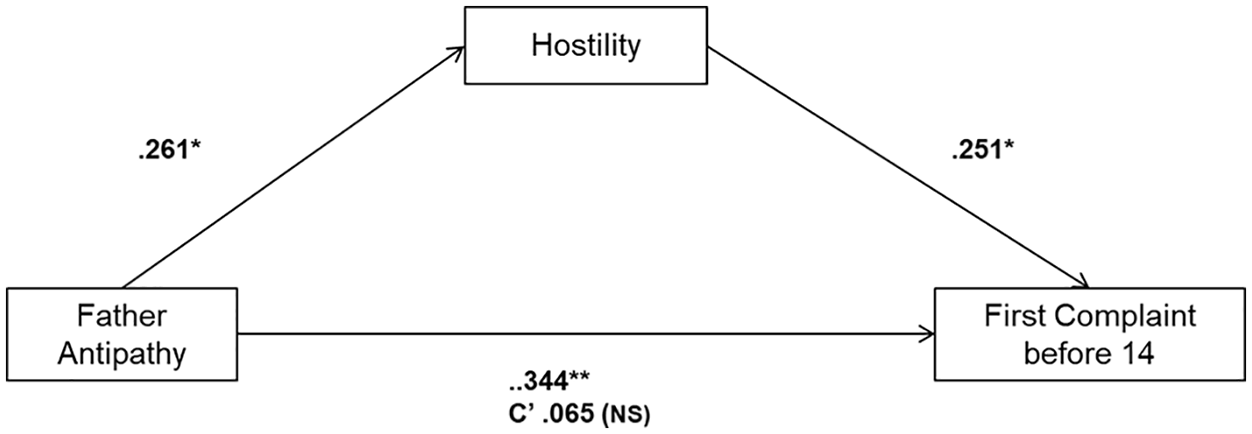
Mediation model: Effects of father antipathy and hostility on age of first complaint.
Mediation model: Indirect effect of father antipathy on age of first complaint.

Note: N = 60; bootstrap sample size = 5000; CI = confidence interval.
Discussion
The present study investigated links between recidivism and patterns of risk factors in young offenders in a juvenile detention centre, focusing on experiences of neglect and abuse during childhood and the presence of psychopathological disorders. Particular attention has been given to father antipathy, which is more related to the psychopathological problems found in young offenders. Our goal was to highlight dimensions that should be targeted by interventions aimed at helping these young people. Indeed, different types of psychoeducational intervention are required in penal institutions for minors, compared with adult institutions.
Despite the fact that juvenile delinquency is decreasing in Western countries (Aebi et al., 2017) and the understanding of factors related to juvenile delinquency and the characteristics of effective care has increased significantly, young people within the juvenile justice system are among the most vulnerable citizens (Souverein et al., 2019), particularly as a result of developmental and mental health problems affecting their delinquent trajectories. Moreover, fieldwork has shown the need to identify recidivism factors in young offenders, because current interventions rarely take into account these factors and professionals are often left feeling powerless and disappointed when adolescents reoffend despite their experience of detention appearing to show them ‘new possibilities’. Hence, it is essential for educators and psychologists to be able to apply research-based interventions that can, in turn, be evaluated in order to assess their impact on the life courses of adolescents in difficulty.
The issue of recidivism risk factors for young offenders is usually addressed within the framework of a juvenile justice system whose aim is to restore young people’s dignity. Two of the main ways of doing this are to promote self-awareness and to encourage young offenders to recognize their weaknesses and inadequacies as elements that do not exclude taking responsibility for their actions and making choices about the immediate future.
A large proportion of the adolescents in the present study had suffered neglect and maltreatment by their families, and stories of early separation and absent parents, unstable families, and feeling excluded, rejected, ignored and abused were extremely common. Many of our participants had suffered physical abuse, but other forms of maltreatment, ranging from antipathy and neglect to outright psychological abuse, were even more prevalent. These data are in line with the literature on this issue, which shows that young people who demonstrate antisocial behaviour and/or antisocial functioning have often had particularly difficult and repressive childhoods. Parents (if they are present) and other significant adults who neglect children in their care (do not see them, ignore them, act as if they were not there) may sometimes become violent, often unpredictably. In such cases, children who have become used to being neglected and ignored are sporadically and unexpectedly subjected to unwelcome attention, which can take the form of severe, violent and often humiliating punishment. Thus, because emotional and material neglect appears to be a dominant feature of these adolescents’ childhoods, their transgressive behaviours (substance abuse, prostitution, violent and dangerous behaviours) can be interpreted as expressions of a tendency to continue neglecting themselves and others.
A family educational style involving inconsistent forms of discipline, poor supervision and physical punishment appears to be a major risk factor. The strong correlation between an adolescent’s tendency to display antisocial behaviour and the father’s criminal record may be explained by a combination of the absence of a paternal figure and negative identification processes. Moreover, a parent who has or has had problems with the law will probably see their authority undermined. In this regard, delinquent behaviour is more strongly linked to paternal bonds than it is to maternal bonds (Lundahl et al., 2008). Often in the life stories of these young people, the father is absent both physically (whether due to his refusal to recognize the child, divorce, imprisonment or death) and emotionally. And, when the father is present, he exercises his function inadequately by either neglecting the child or being excessively authoritarian (Henry et al., 2005). Compared with these observations, the results of our sample are of considerable interest. We found a correlation between paternal antipathy and the lowering of the age at which youth engage in their deviant career. Furthermore, paternal antipathy is more correlated with hostility traits, which is one of the predictive risk factors not only in the development of delinquent trajectories but also in the increased risk of recidivism. This suggests the importance of considering the specificity of the paternal experience of antipathy as an important element to understand and accompany these young people.
Because a large percentage of the adolescents in our sample reported earlier placements in out-of-home community care, it is interesting to examine in more detail cases of ‘crossover youth’ (Baglivio et al., 2016; Herz et al., 2012). For these adolescents it seems that the cumulative effect of exposure to ACEs, placement in the child welfare system and involvement with the juvenile justice system explain their high risk of reoffending (Baglivio et al., 2016).
The literature has long highlighted the prevalence of clinical symptoms of psychological distress in detained minors. Again, our data are consistent with those reported by the previous studies mentioned above, but they also provide details about the different forms this distress may take. For example, mean scores for obsessive-compulsive symptoms, anxiety, hostility, paranoid ideation and sleep disorders were particularly high. Some of these symptoms, including certain forms of compulsive agitation (repeatedly washing one’s hands, constantly cleaning and disinfecting one’s clothing and surroundings) and paranoid cues (expressed as a fear of being spied upon, of conservations being bugged, or of others wanting to cheat/harm you) could be seen as responses to being in detention, rather than solely as pre-existing features. In addition, sleep disorders, characterized by nightmares with specific connotations and difficulty falling asleep, are typical signs of incarceration trauma.
The risk of developing mental health problems is very high for young people involved with the juvenile justice system, especially for those who were maltreated as children (Brown et al., 1999; Colins et al., 2009; Harkness et al., 2006; Wanklyn et al., 2012). Furthermore, this effect is cumulative, so young people who have suffered multiple ACEs have an even higher risk both of developing mental health issues (Edwards et al., 2003; Salazar et al., 2011) and of recidivism (Chang et al., 2003; Ford et al., 2010).
Researchers now agree (Carroll et al., 2009) that antisocial behaviours cannot be understood without considering the complex interactions between numerous factors of different orders, including individual factors (genetic, demographic, personality), historical factors (ACEs, poor adaptation by the family to their living environment, standards, culture, etc., multi-problem families), clinical factors (psychopathology, drug addiction) and contextual factors (negative peer group influences, poor formal and informal educational contexts). The present study considered these factors together and globally with the aim of contributing to our understanding of the extremely complex issue of juvenile delinquency, a phenomenon that occurs at the crossroads between the delicate developmental phase that is adolescence and the social and individual process of delinquency.
Our study’s most important limitation is the small sample size, which reduces the generalizability of our results. In addition, our data are purely transversal, because it is impossible to obtain longitudinal data within the Italian justice system owing to the difficulty of monitoring young people over long periods of time. In fact, adolescents who were once supervised by an area’s juvenile social services department often move into the adult justice system when they come of age, but without any record of this transition being kept (to the detriment of research and, most importantly, their ongoing care). Nevertheless, we collected an extremely rich and detailed corpus covering a wide variety of variables, measured using highly reliable indicators. Involving the social workers and institutions responsible for the adolescents was essential in recruiting volunteers to take part in the study, who willingly provided a large quantity of data.
The tests included in our study were administered as an integral part of the psychological intervention being followed by each adolescent. These interventions are designed to help young people reflect on aspects of their lives and characters that contribute to shaping their identities. Hence, they were encouraged to think about the impact of their family history and the paths they chose as a way of finding security, feeling protected and dealing with painful events in their lives, as well as the pain they have inflicted on others, sometimes without understanding why they did so. In addition, collecting a wide variety of information about individuals who are still developing, such as these young offenders, makes it possible to reflect on the different types of psychological ‘treatment’ pathways that can be envisaged to help them. The first step in this process is to determine the psychological dimensions the proposed intervention will target most strongly in order to create a relational space in which individuals can discover and experience new aspects of themselves and of others.
Input from the psychologists and educators who drew up the recidivism risk assessments for each participant further enriched our data by enabling us to combine risk measures based on clinical judgements with the participants’ self-report data. Our results were in line with those reported in the literature, as they showed that the risk of reoffending depends on the combined effect of static and dynamic factors, thereby highlighting the importance of multifactor models.
Viewed from a psycho-criminological perspective, our results highlight the need for measures and interventions aimed at reducing the risk of an adolescent reoffending to take into account the trauma most of these young people have experienced. Because young offenders are victims as well as perpetrators, understanding and coming to terms with both aspects of their life course must be central aspects of treatment and prevention interventions. Focusing on an adolescent’s development and the overall context in which that development occurred (especially the family, but also peer groups and other secondary socialization agencies) can forestall the recourse to violence and antisocial behaviour.
Because adolescence is a period of emotional fragility and immaturity, young people in detention may ‘block out’ the questions going through their heads, putting them off until an indefinite tomorrow. These unanswered questions can easily crowd and confuse their minds. Consequently, many such adolescents go through an apparently ‘empty’ period, brought on by the fickleness of the affection they have received, whose impact they hide beneath the self-worth they derive from maintaining appearances and peer group recognition. By using psychological interviews with each participant to review their questionnaire’s results, it was possible to get them to realize the inconsistencies of certain aspects of their identities as ‘juvenile delinquents’ and, at the same time, to help them see their punishment as atonement for offences involving a rupture of the social pact. The curiosity and dismay that arose during some of these review sessions show the importance of establishing a ‘good’ clinical relationship when working with these young people and the potential value of interventions that place the individual at the centre of a transformative and individualized process.
Using validated and standardized tools we were able not only to identify some of the factors that affect the formation of these young people’s personalities but also to evaluate different ways of using these tools to identify each individual’s characteristics. In fact, how these tools are used will vary according to the timing of the evaluation with respect to parameters such as the age at which the offence was committed, how long the person has been in custody, length of sentence, and stage within the intervention. For some young people, the evaluation’s results help them reflect on their situation and enable them to open up and provide a glimpse of the person inside. Others, who tend to hide their emotions and cannot find the words to express their malaise, are able to show how they feel through their answers to the test’s questions. For yet others, the test makes them aware of the fragments of reality they are unable to perceive and, to an even greater extent, it reveals the impact these fragments have on their lives and the choices they make. Ensuring a welcoming and reassuring atmosphere when administrating the questionnaires and taking the time to explain our objectives, answer questions and address concerns were essential factors in obtaining our data. When analysing the results, we tried to avoid rigid categorizations. Identifying psychopathological traits was just one of the aspects we took into account within a more complex framework aimed at providing a clearer understanding of juvenile delinquency, especially the phenomenon of recidivism.
Interventions focusing on the family and prevention strategies aimed at reducing the risk an adolescent will start out on the path to delinquency are essential. However, it is also possible to get adolescents to turn back from this path, even after it has become well established, by helping them mobilize emotional resources and develop new attachment styles and contexts. In line with a recent study by Malvaso et al. (2019) that showed the importance of ensuring that adolescents who have committed multiple or very serious offences are not removed from the child protection system, our results show that these young people are also those with the highest risk of recidivism. Consequently, if adolescent offenders are to receive the most appropriate interventions, the juvenile justice and child protection systems must work together closely when dealing with young people who have committed multiple and/or serious offences.
