



Abstract
Intra-national conflicts with racial or ethnic elements can complicate post-war reconciliation. From 1992 to 1995, much of the former Yugoslavia, a nation largely drawn from three distinct ethnic groups, was embroiled in such a conflict. After the signing of the Dayton Peace Accord, it was feared that schools would become a surrogate battlefield for school-aged children within the newly created nation of Bosnia and Herzegovina (BiH). Group threat theory and the imbalance of power thesis provide differing views on such conflicts. Group threat theory posits that as a population – in this case a school – approaches maximum ethnic diversity, the residents – in this case the students – will feel increasingly threatened, resulting in higher cross-group victimizations. The imbalance of power thesis suggests that a group’s decision to victimize another group depends on the relative lack of ethnic diversity: the extent to which one ethnic group dominates a school, the likelihood of victimization of any smaller groups increases. We explore which of these two theories best explains victimization levels within a sample of 2003 school-aged BiH adolescents born in areas dominated by Muslim Bosnians, Eastern Orthodox Serbians, or Roman Catholic Croatians. We find that there is an ethnic component to victimizations: students born in Serbia face higher levels of victimization than do their Bosnian-born counterparts under conditions that fit better with group threat theory than the imbalance of power thesis. We speculate about the significance of these findings for national ethnic harmony in BiH.
Introduction
Schools are social microcosms of their respective communities (Brunson and Miller, 2009; Morrison, 2001). They also act as social control mechanisms, regulating student behavior through rule teaching and enforcement (Gottfredson, 2001). The interdependence between communities and their schools is well documented across a range of topics, including economic conditions, crime, politics, family life, and social support via social network ties (Benabou, 1996; Brunson and Miller, 2009; Christenson and Reschly, 2010; Hubbard et al., 2006; Wood, 2008). Schools can serve as physical safe havens and provide students with a sense of normalcy even during times of conflict (Barakat et al., 2013).
Schools in formerly war-torn areas, including nations enjoying relative peace in a post-war era, may have to confront forces that challenge beliefs about schools and social cohesion. As Buckland (2006: 7) observed: ‘While education does not cause wars, nor end them, every education system has the potential either to exacerbate or to mitigate the conditions that contribute to violent conflict.’ We contend that schools in Bosnia and Herzegovina (BiH) represent a possible battleground and catalyst for continued student-on-student inter-ethnic violence (Nelles, 2006).
Post-war BiH had a decentralized system of school governance vested in local municipalities and regional cantons. These geographic areas are generally split along ethno-national lines. Beginning in the mid-1990s, BiH politicians, through the passage of divisive education laws, promoted latent or even blatant ethnic division among school-age youth (Nelles, 2006). The net result was schools that may ‘entrench intolerance, create or perpetuate inequality and intensify social tensions that can lead to civil conflict and violence’ (Johnson and Van Kalmthout, 2006: 3).
The claim that ethnic identity-driven conflicts in the post-World War II era have caused the deaths of millions and the displacement of tens of millions seems beyond dispute (Horowitz, 2000; Mann, 2005; Reynal-Querol, 2002). As Horowitz (2000: xi) notes in the second edition of Ethnic Groups in Conflict: More than the secessionist wars in Biafra or Bangladesh, more than the mass killings in Rwanda or Burundi, more than the ethnic brutality of previous decades in more than a score of countries, the violent fragmentation of [the former Soviet Union and the former Yugoslavia] convinced Western opinion that group loyalty still had a murderous aspect in the heartland of Europe a half century after Hitler.
Ethnic conflicts can yield other forms of victimization beyond genocide and population displacement. In fact, our goal in this work is to investigate the linkages between the ethnic origins of school-attending youths in post-war BiH and their self-reported victimizations. Specifically, the main ethnic groups include Roman Catholic Croats, Eastern Orthodox Serbs, and Muslim Bosnians, the latter called Bosniaks. For decades following World War II, the three religious groups had coexisted; however, at the start of the 1992 war, long-simmering ethnic and religious differences began to percolate to the surface and conflict soon enveloped the region.
The current study employs two theories that offer different reasons for the emergence of intergroup conflict. According to group threat theory, conflicts between groups grow out of their respective economic and political power arrangements (Blalock, 1967; Blumer, 1958). Each identifiable group in a geo-political area sees other groups as a threat to its social, political, and economic position in the larger community. This theory has applications to the public school. Using a group threat framework, children in schools with populations that approach maximum diversity will perceive the greatest threat, resulting in the highest cross-group victimization levels (Blalock, 1967). Conversely, the imbalance of power thesis tells us that a group’s relationships with other groups depend on the relative imbalance of physical or social power existing between groups (Agirdag et al., 2011). This second theory is not, strictly speaking, about person-to-person imbalance – as in a very strong person bullying a far weaker-appearing peer on the playground. Rather, power imbalance predicts that victimizations are more likely when one identifiable group is numerically much larger than others in the same geophysical space, whereas relative peace is the result of a balance in relative group size (Graham, 2006).
In sum, we explore the viability of each theory’s arguments as an explanation of victimization experiences reported by school children living in a region torn by war only a decade before. Before addressing this work’s central issue, we first turn to an overview of the 1992–5 war in the former Socialist Federal Republic of Yugoslavia (SFRY) and the role of education in the emergent BiH.
The Balkans war: 1992–5
Beginning in August 1990, following the devolution of the SFRY, the former nation split into several autonomous and semi-autonomous entities. One of the SFRY’s republics, BiH, with its three socially and culturally distinct constituencies, was in a politically awkward position. Some residents of BiH, primarily Bosnian Serbs, desired to stay with a Yugoslavia dominated by the Republic of Serbia, whereas others, primarily Bosniaks and Bosnian Croats, favored decentralization and eventual independence (Budimlić et al., 2010; Hjort and Frisen, 2006; Trbovich, 2008). After several years of political wrangling, a national sovereignty election was held in early 1992, which was boycotted by Bosnian Serbs. The outcome was never in doubt, as 99.7 percent of those voting – roughly two-thirds of all eligible voters – favored complete separation from Yugoslavia and the creation of an independent Bosnia and Herzegovina (Commission on Security and Cooperation in Europe, 1992).
A series of armed conflicts quickly followed, some involving Bosniaks and Croats allied against Serbians and still others pitting Bosniaks against Croats. These lasted from early 1992 through the signing of the Dayton Peace Accord (DPA) in December 1995 (U.S. Department of State, 2015). Within parts of BiH, fighting was especially brutal and violent, including acts of so-called ‘ethnic cleansing.’ A literal translation of a Serbo-Croatian phrase (etnicko ciscenje), ethnic cleansing is ‘the expulsion, imprisonment, or killing of an ethnic minority by a dominant majority in order to achieve ethnic homogeneity’ (Merriam-Webster, n.d.). Mann (2005: 4) reminds us that the ‘essentially modern’ phenomenon of ethnic cleansing can occur as one group seeks to establish its hegemony over another group identified as ‘the enemy.’ As importantly, Mann (2005: 6) notes that, in cases of ethnic cleansing, ethnicity ‘trumps social class as the main form of social stratification,’ or how a society is ordered. The results are often, as was the case in the former Yugoslavia, horrific (Andreopoulos, 1997; Mann, 2005).
After the conflict, it was found that up to 8000 Bosniak men had been killed in the Srebrenica massacre by persons linked to the Bosnian Serb Army, called an act of genocide by the International Criminal Tribunal for the Former Yugoslavia (2004). The best available estimate suggests that upwards of 100,000 soldiers and civilians died in the war, nearly two-thirds being Bosniaks (Ball et al., 2007).
What makes the Bosnian war and its aftermath unique is the DPA’s decision to form a nation made up of three semi-autonomous regions split along ethnic lines and following geographic boundaries formed out of the conflict (Szasz, 1997). Since 1999, BiH has consisted of the Federation of Bosnia and Herzegovina (FBiH), occupied primarily by Bosniaks (52 percent), Bosnian Croats (22 percent) and Bosnian Serbs (18 percent). The Republika Srpska (RS), with over 80 percent Bosnian Serbs, envelopes the FBiH on three sides. Situated between the left and right halves of the RS is the self-governing Brčko District, populated by roughly one-third Bosnian Croats, 30 percent Bosnian Serbs, a quarter Bosniaks, and about 10 percent ethnic Yugoslavs (Central Intelligence Agency, n.d.).
At the time of data collection, the BiH was subject to a different kind of fighting, one for the hearts and minds of the nation’s population. The people of BiH felt the war’s social and psychological after-effects long after active combat (Brown and Cehajic, 2008; Hjort and Frisen, 2006; Klarić et al., 2007). Many critics questioned if reconciliation was possible, as politicians were still ‘rattling their [nationalist] sabers’ to remain in power well into the 21st century (Franovic and Rill, 2009: 31) and memories of neighbor-on-neighbor war-time atrocities committed in multiethnic towns and villages had dimmed little since the war (Parent, 2012).
Education in post-war BiH
A defining issue for the various geo-political groups in BiH has been the nation’s school system (Bush and Saltarelli, 2000; Risher and Kabil, 2010; UNICEF, 2009). The DPA gave authority over public education to three political entities. The FBiH further parceled out some control over education to the 10 local cantons but kept most of it in Sarajevo (Risher and Kabil, 2010). The DPA’s goal was to provide equal access to an educational system that would assist in coalescing the nation. In practice, however, the schools became instruments of segregation and not reconciliation (Risher and Kabil, 2010; Tveit et al., 2014). In this regard, Bush and Saltarelli (2000) found four negative elements commonly observed in post-conflict educational systems were endemic in BiH: (1) manipulating history for political purposes, (2) manipulating textbooks, (3) instilling self-worth and hatred for others, and (4) segregating education to ensure inequality, lowered esteem and stereotyping.
The consensus among international pedagogical experts is that education in BiH could be but was not yet – or not at the point that the data were collected – an effective instrument of community-building and reconciliation (Barbieri et al., 2013; Tortsi, 2009; UNICEF, 2009). As previously discussed, schools are, after families, perhaps the most influential and effective mechanism of community-building, especially when there is ‘local ownership’ within the impacted communities (Donais, 2012; Weinstein et al., 2007). As explained by Donais (2012: 1), ‘in post-conflict contexts, the notion (of local ownership) conveys the commonsense wisdom that any peace process not embraced by those who live with it is likely to fail.’ However, most BiH schools were in effect mono-ethnic, employing a ‘two schools under one roof’ model implemented in 1997 and abandoned in 2012 (Hunt et al., 2013; Tveit et al., 2014). The two schools under one roof policy meant that different ethnic groups taught in a single building experienced very different curriculums, each focusing on their respective ethnic affiliation, history, religion, linguistics, and language. Moreover, teaching about the history of the 1992–5 war varied by the dominant ethnic and religious identity of each village, town, or enclave (that is, neighborhood) (Massey et al., 1999). The history of the war generally took an ‘us against them’ stance when it came to identifying who were victims, defenders, and aggressors (Kreso, 2008). Education appears to have been used for post-war propaganda and ethnic division, further exacerbating and perpetuating ethnic conflicts and social marginalization (Oberschall, 2000).
In summary, the political ethno-histories taught in the decade after the war served as a collective narrative of ‘our people,’ linking post-war generations in BiH to an ethnic identity already shared by war survivors. The repackaging and manipulation of the Balkan war story depended upon the storyteller (Oberschall, 2000; see also Hayden, 1996). The construction of collective narratives that either implicitly or explicitly stereotyped, diminished, and degraded out-groups further exacerbated the divisive tensions that were identified as being partially responsible for the war (Fischer, 2006; Salomon, 2004). Inequality and exclusion – driven by ethnic identity – formed the basis of fear and perceived threat, and they have important consequences for inter-ethnic intolerances in the context of ethnic enclaves (Massey et al., 1999). By the early 2000s, the exploration of ethnicity-based school victimizations through a multi-level process nesting students in schools and schools within neighborhoods was a well-established practice (Benbenishty and Astor, 2005). The likelihood that students in BiH schools escaped pervasive inter-ethnic distrust seems low, and many victimizations are likely to have had an inter-ethnic component. A primary goal of this study, then, is to explore the theoretical ties between students’ ethnic identities, their schools’ ethnic demographic composition, and the self-reported victimization levels of students in those schools.
Understanding ethnic identity and victimization in post-war BiH
Once considered normative in the SFRY, post-war ethnic mixing and integration at the city and neighborhood levels were by the end of the first decade of the 21st century no longer a social reality (Adjudkovi and Biruski, 2008). Most scholars do not consider either pre-war ethnic relations or ancient ethnic hatreds a major cause of conflict in former Yugoslavia (Gagnon, 1994; Sekulić et al., 2006). Instead, nationalist politicians seemed to incite war and violence by politicizing ethnic identity, resulting in segregated ethnic enclaves and severed cross-ethnic ties (Gagnon, 2006; Sekulić et al., 2006). Tragic events during war became part of the cultural narrative (Gagnon, 2006). What was once a muted distrust among Bosniaks, Eastern Orthodox Serbians, and Roman Catholic Croatians evolved into reason enough for heightened intergroup violence (Costalli and Moro, 2011).
By the late 1990 and early 2000s, the nations of the former Yugoslavia were among the most factionalized areas in the world, as measured by ethnicity, linguistics, and religious diversity (Alesina et al., 2003). Divisions along these lines alone may not explain the consequences of civil wars such as experienced by BiH in 1992–5 (Reynal-Querol, 2002). What is needed is a theoretical framework to examine which school children are being victimized due to their ethnicity by what other students.
Clearly, schools are central to understanding ethnic conflict in post-war BiH. We focus on BiH’s various ethnic groups within the schools, each group relative to the others. As previously described, two theories offer possible conceptual lenses through which to view the ties between ethnicity and victimization. The diversity of ethnicities and races reflected in each school, called integration or evenness, is crucial for both models (Graham, 2006; Massey and Denton, 1988). First, group threat theory stipulates that economic and political contexts are foundational to the existence of frustration and negative attitudes between in-groups and out-groups (see Blalock, 1967; Blumer, 1958). At its core, the perspective centers on the in-group’s greater negative attitudes towards the out-group because of a real or perceived threat to in-group interests (see, too, Blumer, 1958; Quillian, 1995; Riek et al., 2006; Stephan et al., 2009).
Group threat theory further suggests that children in schools with populations that approach maximum diversity will perceive the greatest threat, resulting in the highest cross-group victimization levels (Agirdag et al., 2011). Maximum diversity reflects polarization. Reynal-Querol (2002: 32) contends that, under a polarization model, ‘the situation that leads to the point of maximum tension is when there are two social groups with the same size.’ Hence, she also sees polarization or ethnic evenness as leading to increased conflicts and victimizations.
Conversely, the imbalance of power thesis suggests that a group’s decision to victimize or remain peaceful towards one or more other groups depends on the relative imbalance of physical and/or social power existing between various groups (Agirdag et al., 2011; Cederman et al., 2013). A key part of such power is the ability to inflict punishments and distribute rewards (Blau, 1964; Emerson, 1962; French and Raven, 1959). Viewed from this perspective, victimization is more likely to happen when one group is much larger than another, whereas relative peace between groups is the result of a balance in relative group size (Agirdag et al., 2011; Olweus, 1997), a prediction that is the opposite of that modeled by group threat theory. In situations of power imbalance, as diversity levels in each community approach equality (where all significant groups are represented in roughly equal proportions in the community), the groups conflict more, where conflict can be broadly defined as various forms of intolerance towards each other or narrowly defined as subjecting ‘the other’ to heightened levels of personal victimization (Agirdag et al., 2011; Lam, 2013; Semyonov et al., 2012).
Research questions
This article’s central thesis is that school environments interact with individual-level ethnic identifies and can impact individual-level victimization outcomes. A school’s social environment may reflect power arrangements manifested at geo-political levels. Here, the focus is on aggregations of ethnicities between and within schools and how they impact individual-level victimization. In this context, personal identities are often embedded in an ethnic identity that provides a basis for differentiation from others who do not share it.
We employ the following research questions to explore the victimization experiences of public school students in BiH:
Is there a significant ethnic effect on victimization across schools?
Is there a significant ethnic effect on victimization within schools?
Does the effect of school diversity on personal-level victimization depend upon individual-level ethnicity?
With which theoretical perspective do the data best agree – group threat theory or imbalance of power thesis?
The observed relationships between self-reported victimization levels, personal ethnic identity, and level of school ethnic evenness should be largely unaffected by the concurrent examination of personal-biographical measures and crime-related measures drawn from multiple domains.
Research methods
Data sources
In 2007, researchers at the University of Sarajevo’s Faculty of Criminal Sciences used a 12-page self-report questionnaire to gather information about individual and family demographic characteristics, youths’ gang involvement and offending, and ecological risk and protective factors such as victimization and family relationships. The researchers drew items related to youth offending and risk and protective factors from measures with demonstrated psychometric properties (Elliott et al., 1985).
The researchers collected the data from a two-stage cluster sample of 2206 youth between the ages of 13 and 17 studying in 53 primary and secondary schools located in the five largest cities in BiH: Sarajevo, Banja Luka, Mostar, Tuzla, and Zenica. The administrative areas of the city school systems included not only these named cities, but also the surrounding suburban and rural areas. Schools constituted the first cluster and classrooms the second. The final sample reflected the relative size of each area, and within each area the researchers selected the schools at random for participation. In the selected schools, researchers also randomly selected classrooms, and invited all students in the selected classrooms to participate. Complete responses were available for 2003 respondents, because we excluded 203 respondents owing to missing values; this figure represented nearly 90 percent of all available students in the selected schools.
Dependent variable
Four items measured respondents’ self-reported victimization. Each asked how often the youth had experienced a specific form of victimization. Personal victimization questions were whether respondents ‘had been hit by someone’ or ‘attacked by someone.’ Property victimization questions asked about being the victim of a robbery or a victim of theft. All items used a five-point scale to measure victimization during the previous 12 months (1 = never, 2 = once or twice, 3 = 3–5 times, 4 = 6–10 times, 5 = more than 10 times). Scores on the four items were summed to form a victimization index with a range from 4 to 20. The following mean victimization index scores (and standard deviations) were noted for youth indicating a particular country of birth (COB): Bosnia-born = 5.34 (SD 1.76); Croatia-born = 5.76 (SD 2.24); Serbia-born = 5.49 (SD 1.82); and Other COB = 5.75 (SD 1.89).
Independent variables
Our research questions focus on individual ethnic identity and the ethnic composition of each school. We employed COB as a proxy measure of ethnic identity. The Montenegrin responses (n = 20) were collapsed into the Other category. Within our final sample, 1778 (88.8 percent) were by birth Bosnian, 90 (4.49 percent) were Croatian, 55 (2.75 percent) were Serbian, and 80 (3.99 percent) were Others. For analytic purposes, Bosnia-born was the reference category.
In the interests of as complete a test as possible, we employ both Blau’s index and Theil’s H as measures of each school’s ethnic diversity. The measurement of diversity (that is, within unit variation) describing the distribution of individual traits such as ethnicity remains an active area of study (Reardon and Firebaugh, 2002; Van Dick et al., 2008; Van Knippenberg and Schippers, 2007; Williams and O’Reilly, 1998). Conceptualization and related measurement issues are part of this focus, which led Harrison and Klein (2007) to suggest the organization by type of the various diversity indexes: separation, variety, and disparity. Separation and disparity refer to differences in attitude or position and to differences in power status and hierarchy, respectively. For our purposes, we focus on diversity as variety. Diversity as variety assumes that, ‘within units, members differ from one another on a categorical attribute V . . . units differ in the extent to which members are evenly spread across all categories of V . . . differences between units in their relative spread or diversity on V will be associated, usually positively, with vital unit consequences (e.g., problem solving. . .)’ (Harrison and Klein, 2007: 1204).
Blau’s index
Blau’s index (1977) builds upon indexes used in other disciplines such as economics (for example, Herfindahl, 1950; Hirschman, 1964) and ecology (for example, Simpson, 1949). 1 Applied to our school data, a maximum value occurs when students in a school are spread equally or obtain ‘evenness’ within a school and would be indicated by a value of 0.75.
Theil’s H (Theil’s diversity index)
Thiel (1972) proposed a diversity index that combines information on the number of entities or groups in a unit (for example, a school) and the corresponding proportion of each group within the unit (Hao and Fong, 2011). 2 Zero occurs when all individuals are members of a single group (no diversity) and the maximum score occurs if individuals are evenly distributed among the M groups. The entropy index is, therefore, a measure of ‘evenness’ that captures the degree to which groups are evenly distributed within units (Massey and Denton, 1988). The higher the number, the more diverse the school’s ethnic populations. The maximum score occurs when all groups have equal representation in a school, such that the proportion of each group is the same.
Control variables
We used several control variables drawn from the life-style exposure literature, which suggests that daily routines can impact victimization risk (Hindelang et al., 1978; Maxfield, 1987; Meier and Miethe, 1993). Table 1 contains the descriptive statistics for the individual- and school-level variables. Such things as self-reported delinquency and criminal activity, general rule breaking, drinking and other drug use, and aggressive behavior can increase victimization rates. We include parental monitoring and commitment to school as protective factors. Biological sex, too, is seen as a risk factor of some importance.
Descriptive statistics.

Failed to pay for movies, bus fare, etc.
Lied to gain entrance or make a purchase.
Refers to self-reported instances over the previous 12 months of the following: damaging property, carrying a hidden weapon, hitting someone with the idea of hurting them, using a weapon or force to get money, involvement in group fights, and attacking someone with a weapon.
Two risk/protective measures within the family domain are often linked to victimization experiences (Esbensen et al., 2010; Zimmerman and Rees, 2014). Each subject responded to four items related to parental monitoring measured on a five-point scale (1 = strongly disagree to 5 = strongly agree). The responses captured the extent to which (a) youth informed parents where they were going, (b) parents knew where the youth was when not at home or at school, (c) youth knew how to get in touch with parents, and (d) parents knew whom the youth was with when not at home. Collectively, these items reflected two domains of monitoring – parental knowledge of an adolescent’s whereabouts and adolescents’ disclosure of activities to parents – identified by Hoeve and colleagues (2009) as essential for understanding parental effects on youthful misconduct. Reliability analyses indicated the summated four-item Parental Monitoring scale tapped a single latent variable (alpha = 0.78). Second, we also include a dichotomous variable to capture the family structure of the respondent’s home. Living Arrangement is dummy-coded so that 0 equaled other than two parents, while 1 equaled two parents living at home.
Two items reflected students’ self-reported delinquency and drug use (Gatti et al., 2015). Respondents were asked if, in the past 12 months, they had (a) avoided paying for something such as movies, bus or subway rides (Stealing) and (b) lied about their age to get into some place or to buy something (Lied about Age). Each was measured on a five-point scale (0 = never, 1 = once or twice, 2 = 3–5 times, 3 = 6–10 times, 4 = more than 10 times). Our models included two indicators of drug use in the past 12 months as separate variables (Tobacco Use and Alcohol Use), measured on a five-item scale, ranging from a score of 0 for never to 4 for nearly every day.
Six items asked about aggressive and violent behavior, including ‘damaged property,’ ‘carried a hidden weapon,’ ‘hit someone with the idea of hurting them,’ ‘used a weapon or force to get money,’ ‘was involved in group fights,’ and ‘attacked someone with a weapon’ (Smith-Khuri et al., 2004). For each self-reported behavior we used a five-point response set indicating how often the youth had engaged in Aggressive Behavior over the previous 12 months: 0 = never, 1 = once or twice, 2 = 3–5 times, 3 = 6–10 times, 4 = more than 10 times. The scale’s internal consistency was good (alpha = 0.8).
Criminologists tend to view school as a protective measure (Zimmerman and Rees, 2014). We used four items to create a School Commitment scale: (a) ‘I try hard in school’, (b) ‘In general, I like school’, (c) ‘Grades are very important to me’, and (d) ‘I usually finish my homework.’ Possible answers used a five-point Likert agreement–disagreement response set, which created a reliable scale (alpha = 0.72).
Our analyses also control for age in years (Age) and gender, in this case being male or not (Male).
Modeling strategy
Our strategy for creating multi-level models begins with a null model to establish a baseline for evaluating larger models. After examining the null model with no predictors to assess variability at each level, we estimated two-level regression models (hierarchical linear models – HLM), which simultaneously examined individual-level ethnicity and school-level ethnic diversity indexes as predictors of the victimization index (Raudenbush and Bryk, 2002). The HLM approach generates efficient slope estimates and unbiased standard errors when level-one units (that is, persons) nested within level-two groups (that is, schools) share similar traits (that is, are clustered). It also allows for estimation of cross-level interactions. To answer our question about the personal ethnicity/school ethnic diversity interactions, we modeled the slopes of the school-level ethnicity indexes as a function of the personal ethnicity variables. Lastly, we estimated a full model inclusive of a host of important individual-level control variables related to individual-level victimization outcomes. As none of the individual-level ethnicities varied significantly across schools, we opted not to model these slopes with random coefficients. As a protection against model misspecification, we re-estimated the models allowing for the coefficients of the individual-level ethnicity variables to vary randomly across schools. The results that form the basis of our findings were substantively unchanged when using this alternate modeling strategy.
Findings
Question 1: Is there a significant ethnic effect on victimization across schools?
To examine if there was school-level variation in the victimization outcomes, we first estimated an unconditional model without level-one or level-two covariates. Those analyses (not shown) indicated that there was significant school-level variability in youth self-reported victimization (τ00 = 0.147, p < .001), justifying our multi-level modeling strategy.
Question 2: Is there a significant ethnic effect on victimization within schools?
In Table 2, we add the key independent variables (that is, respondent COB and indexes of diversity) to the unconditional models. Both the Theil’s and Blau’s indexes suggest that school-level diversity has a positive and significant association with respondent victimization. This finding is consistent with the view that relationships among pupils in school may reflect ongoing ethnic and political tensions in BiH (Smith, 2010).
Hierarchical regression models of victimization outcomes regressed on respondent country of birth, Blau’s index, or Theil’s diversity index.

Notes: n = 2003; β = Linear Coefficient; SE = Standard Error.
Reference category: Bosnia.
p < .05; **p < .01; ***p < .001 (two–tailed tests).
Question 3: Does the effect of school diversity on personal-level victimization depend upon individual-level ethnicity?
An initial answer to our third question comes from adding cross-level interaction terms between respondent COB and the corresponding diversity index to the models. The interaction effects in Table 3 use the Bosnian COB as a reference category. Once again, the positive and significant cross-level Serbia × the interaction terms for both Theil’s and Blau’s indexes, coupled with the significant negative effect of individual-level Serbian ethnicity, are consistent with our hypothesis that the effect of school-level diversity manifests in different ways depending upon individual-level ethnicity. 3
Preliminary interaction analysis for association between individual ethnicity, Blau’s index, and Theil’s diversity index.

Notes: n = 2003; β = Linear Coefficient; SE = Standard Error.
Reference category: Bosnia.
p < .05; **p < .01; ***p < .001 (two-tailed tests).
We explored this effect by calculating the average marginal effects of school diversity (that is, simple slopes) for each individual-level ethnicity on victimization levels. In Figure 1, we see the slope of the line for the average marginal effect of school ethnic diversity as having a slightly positive and significant effect on victimization across for Bosnia-born youth (b = 1.14, p < .05). However, the overall effect on increasing levels of diversity for Serbians is much stronger (b = 7.48, p < .000). We tested the difference between these two slopes and found that the effect of increasing diversity on victimization levels for Serbia-born youth is significantly higher compared with that for their Bosnia-born counterparts (
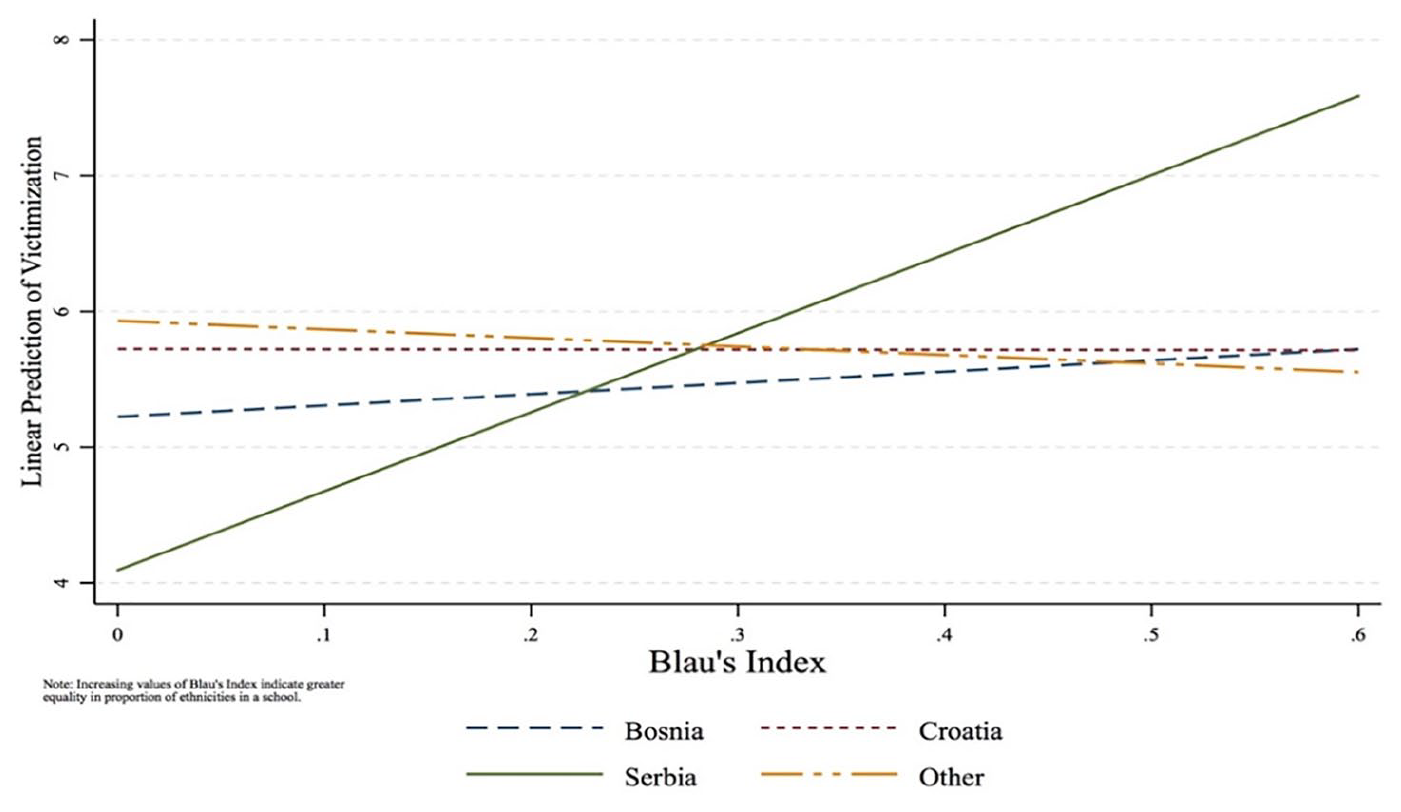
Relationship between individual ethnicity and predicted respondent victimization across values of Blau’s index.
Similar findings are evident in Figure 2. The effect of diversity measured using Theil’s index is positive and significant for Bosnia-born students (b = 0.78, p < .05). For these school children, increasing levels of school diversity lead to increased levels of victimization. The effect of increasing levels of diversity for Serbia-born students is also positive and significant (b = 5.43, p < .001). Again, there is a significant difference between these two effects, with the effect of increasing diversity being stronger for Serbia-born students compared with that for their Bosnian counterparts (

Relationship between individual ethnicity and predicted respondent victimization across values of Theil’s diversity index.
In Table 4, we provide a more conservative test of our third hypothesis by controlling for an array of variables that previous researchers suggest are related to victimization. As expected, the cross-level respondent COB/school diversity interactions for both indexes remain positive and significant for Serbia-born students. These findings, coupled with the significant negative effect reported for both indexes of individual-level Serbian COB (−1.26, p < .05; −1.13, p < .05), are consistent with our suggestion that the effect of school-level diversity manifests in different ways depending upon individual-level ethnicity.
Hierarchical regression models of victimization outcomes regressed on individual ethnicity × Blau’s index or ethnicity × Theil’s index interaction and controls.

Notes: n = 2003; β = Log-Odds Coefficient; SE = Standard Error.
Failed to pay for movies, bus fare, etc.
Lied to gain entrance or make purchase.
Refers to self-reported instances over the previous 12 months of the following: damaging property, carrying a hidden weapon, hitting someone with the idea of hurting them, using a weapon or force to get money, involvement in group fights, and attacking someone with a weapon.
Reference group: Bosnian.
*p < .05; **p < .01; ***p < .001 (two-tailed tests).
We again calculated the average marginal effects of school diversity for the different individual-level ethnicities (data not shown but available on request). Our findings remain consistent with the simpler model presented in Table 3. The effect of increasing levels of school diversity as measured by Blau’s index has a strong positive effect on victimization for Serbian students (b = 5.822, p < .01). This effect for Bosnia-born students is no longer significant (b = 0.83, p > .05). There is a significant difference between these two slope coefficients, indicating a stronger positive effect of increasing levels of diversity on increased levels of victimization for Serbia-born students compared with Bosnians
Figure 3 also provides additional insight into the most common COB within schools and its relationship to school diversity. The proportions of each COB group within a school and the schools’ corresponding diversity indexes will tend towards convergence at higher levels of diversity. However, Bosnia-born students consistently represent the numerical majority in the school samples. Recall the magnified effect of increasing diversity for either index on Serbia-born students’ victimization levels when compared with all other reported COBs.
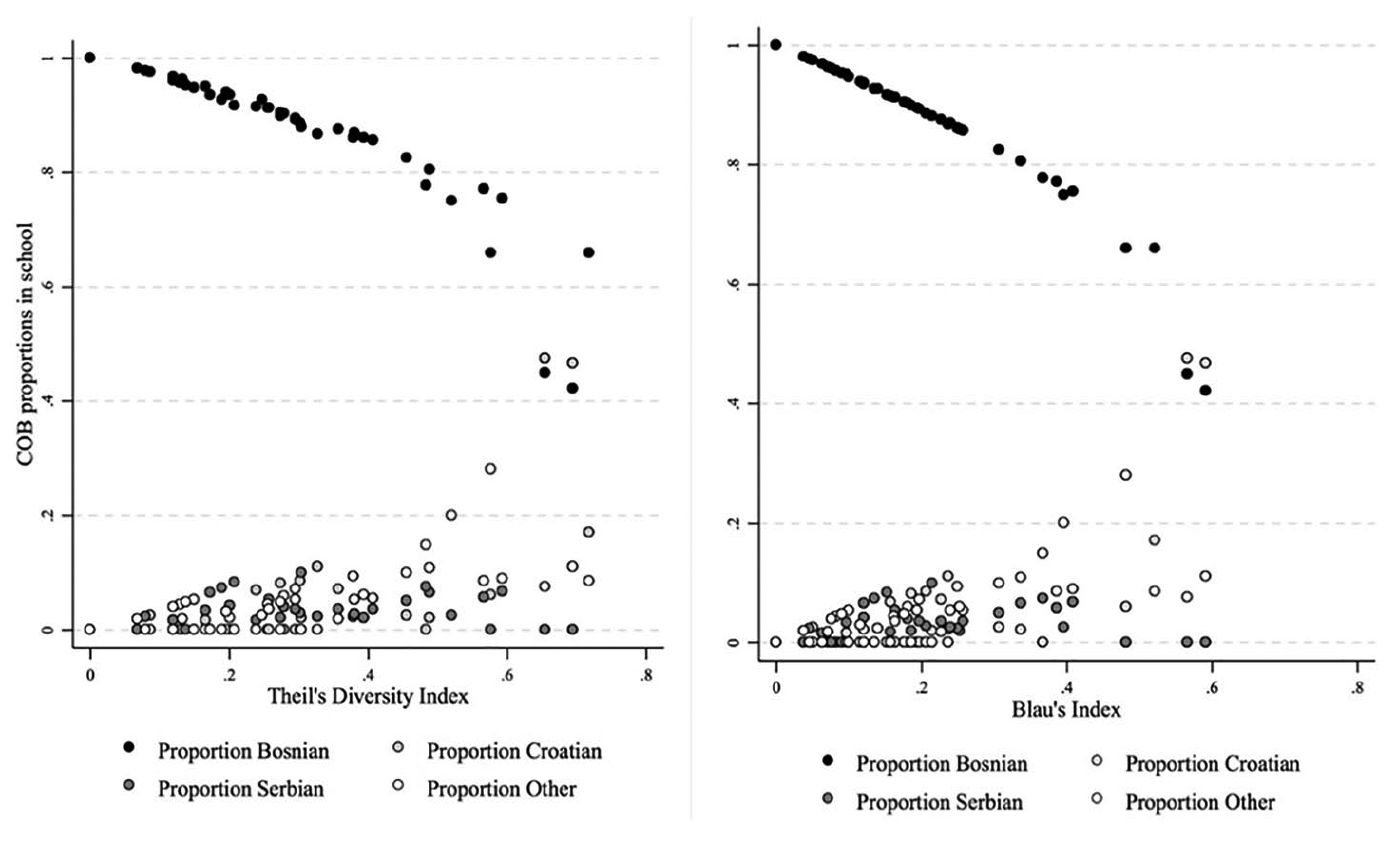
COB proportions in school by diversity index.
Question 4: With which theoretical perspective do the data best agree – group threat theory or imbalance of power thesis?
Overall, our findings are consistent with theoretical ideas of majority–minority power struggles, spatial dominance, and intolerance captured by group threat theory (see Blau, 1977; Blalock, 1967; Massey et al., 1999; Sekulić et al., 2006). Assuming respondent COB provides an adequate proxy measure of ethnic identity, intergroup contact between the study’s three main groups may foster tolerance when there is a clear majority within a school. However, this tolerance may falter as evenness in group representation increases within schools. This observation may be particularly true for post-war BiH, where post-war nationalism constituted a powerful political platform and a student’s own ethnic identity may determine positive or negative experiences during school (Aleksić and Đorđević, 2013).
In both Models 5 and 6 for the individual difference covariates, self-identified gang members in our sample had on average significantly fewer victimizations than non-gang members, a finding that runs counter to extant findings reported by other US and European researchers (see Carson and Esbensen, 2014; Fox et al., 2011; Klein, 2006). Lying about one’s age significantly increased victimization levels in both models, as did aggressive behavior and tobacco use. Drug use, however, failed to perform in similar ways. As importantly, age, gender, parental monitoring, school commitment, and living arrangements failed to play significant roles as covariates.
Summary and conclusions
The present study examined whether ethnicity was related to self-reported victimizations across a wide range of BiH schools, simultaneously considering both the direct and the moderating effects of the levels of evenness of ethnic representation. Our results are consistent with group threat theory: as the level of evenness in ethnic representation increases within schools dominated by Bosnia-born students, the victimization levels of Serbian students increased. Our results also suggest that personal ethnic identity’s impact on victimization within BiH schools depends on school demographics and tends to reflect neighborhood and state-level relations between the constituent ethnicities in BiH. This finding agrees well with the theoretical notion that out-group levels of threat perceptions are partially driven by a history of conflict with the in-group (Shamir and Sagiv-Schifter, 2006). Educational researchers report that, at the time of the data collection, BiH schools essentially endorsed between-group stereotypes and intolerances (Quist and Resendez, 2002; Shamir and Sagiv-Schifter, 2006). Furthermore, the reality or perception of threat from another group can lead to emotional responses such as fear, anxiety, and anger, with behavioral responses inclusive of overt aggression, retaliation, and harassment (Stephan et al., 2009). Such negative responses are precisely what most school administrators would normally try to prevent.
Given the ferocity of the Balkan war, both Roman Catholic Croatians and Bosniaks generally came to view Serbs during and after the conflict as ‘the enemy’ (Costalli and Moro, 2011; Mojzes, 2011; see, also, Ball et al., 2007). Serbian school children have expressed remorse and guilt over the excesses of ‘their side’ in the 1992–5 war (Brown and Cehajic, 2008). Although Roman Catholic Croats and Bosniaks also fought each other, albeit infrequently, these conflicts did not appear to translate into higher post-war victimizations for the Croatia-born youth in our study. Victimizations were highest for Serbia-born youth only in a situation of evenness compared with those born in Bosnia. It was more than just being a minority group outsider or being a non-Bosnian, then, that determined one’s suitability as a target for victimization. We suspect that it is the deep-seated distrust and distain felt by Bosnia-born youths for Serbia-born youths, likely a product of the war, that can help us understand these victimizations. Again, this situation is more probable as the out-group approaches parity or evenness with the group that defines itself as egregiously victimized in the past (Hayden, 1996).
The current study does have several important limitations. First, we do not measure individuals’ ethnic identity directly and instead use country of birth as a proxy. The absence of a direct measure also precludes us from determining how strongly each student identifies with his or her chosen ethnicity. Although COB can serve as a meaningful proxy for ethnic identity (Stronks et al., 2009), an individual’s ethnic identity in post-war BiH represents an exceptionally sensitive and complex personal, social, and political topic. For example, political manipulation continues to derail attempts to conduct the first complete census since the beginning of the war, originally scheduled for completion in 2013. A central concern is the collection of individuals’ self-determined ethnic identity, language, and religion. Nonetheless, our findings using COB tend to agree with theoretical expectations surrounding inter-ethnic relations in BiH.
Although we find a clear connection between evenness in the distribution of ethnicities in BiH schools and victimization, we recognize that some of this association may be due to students’ pre-existing level of dissatisfaction with the level of ethnic segregation found in the city or town in which the school is located. That is, the significant inter-ethnic differences in victimization levels may, at least in part, be driven by the minority ethnicity’s frustration with the segregated housing and political tensions still prevalent in BiH. One way to test this would be to measure segregation at the city level and include city as a third level in our multi-level model. These types of data would normally be included in a city- or country-level census and, as noted, is problematic for the study of segregation in post-war BiH.
Lastly, we recognize that the cross-sectional nature of our data exposes us to issues of causal ordering. Longitudinal data would allow us to control for and parcel out the effects of prior levels of victimization on current levels of victimization and capture a more precise estimate of the effect of individual and school-level measures of ethnic identity.
In conclusion, the relationship between individual ethnicity and victimization in BiH schools is moderated by the ethnic distribution at the school level. Namely, as the representation of Serbia-born youth in a school increases towards numerical equality with Bosnia-born youth, victimization of Serbia-born youth increases. We see this as evidence of school demographics and individual characteristics reflecting inter-ethnic tensions found in BiH neighborhoods and the Balkans war in general. The role of schools in peace-building efforts could be one of reconciliation of new and younger generations of Bosniaks, Croats, and Serbs. However, should ethnicity continue to be a political issue and used as a measure of national loyalty, ethnic tensions will be further entrenched in BiH and be reflected in the victimization levels of BiH students.
Footnotes
Acknowledgements
The following individuals at the University of Sarajevo participated in the data collection phase of this study: Almir Maljevic, Elmedin Muratbegovic, Muhamed Budimlić, and Eldan Mujanović.
Authors’ Note
Points of view are those of the authors and do not necessarily reflect the official position of the U.S. Department of Justice. An earlier version of this work was presented at the 15th Annual Conference of the European Society of Criminology in Porto, Portugal, 2–5 September 2015.
Funding
The author(s) disclosed receipt of the following financial support for the research, authorship, and/or publication of this article: This research was supported by Research Award 1704-257 from the International Center, National Institute of Justice, Office of Justice Programs, U.S. Department of Justice.
