




Abstract
Institutional anomie theory (IAT) describes the potentially criminogenic impact of economically dominated social institutions. Although originally cast at the macro level of society, more efforts have emerged lately to capture the IAT framework on the individual level, resulting in a need for appropriate measures representing the presumed marketization processes. Our study addresses this need by offering a theoretically derived, comprehensive measure of the individual-level instantiation of an anomic culture depicted in IAT, that is, ‘marketized mentality’. Structural equation models testing for the single higher-order factor marketized mentality are calculated with a representative random sample of Poland’s population. Finally, the implications and limitations resulting from the analyses are discussed.
Introduction
One highly relevant research programme in criminology of the past 25 years is institutional anomie theory (IAT; Messner and Rosenfeld, 2001). Grounded in the classic sociologies of Durkheim, Parsons, Polanyi, and Merton, IAT represents a critical stance towards capitalist economies and claims that they undermine the moral foundations of societies (see Hirschman, 1982: 1466). IAT argues that the combination of imbalances in the institutional structures with cultural pressures towards anomie fosters high levels of serious crime. IAT directs attention to a specific institutional constellation prominent in capitalist societies, that is, an institutional imbalance in the form of economic dominance. Economic dominance is manifested through three processes: (1) the devaluation of non-economic institutional functions and roles, (2) accommodation to the requirements of economic roles when they conflict with those of non-economic roles, and (3) a penetration of economic norms into other institutional domains (see Messner and Rosenfeld, 2001/2013).
Originally, IAT was cast at the macro level of explanation and received satisfactory support in numerous macro-level studies (Messner and Rosenfeld, 2006). More recently, theoretical attempts (Messner et al., 2008) and empirical attempts (Muftić, 2006; Stults and Falco, 2014; Rosenberger, 2016) to transfer the theory to the micro level have emerged followed by efforts to apply the IAT framework to a multi-level setting (Groß et al., 2018; Hirtenlehner et al., 2013; Hövermann et al., 2016). Because the bulk of the previous individual-level studies mostly dealt with one of the three processes described in IAT – the process of penetration of market values into other non-economic social institutions – the proposed operationalizations suffer from a lack of complexity.
Our study addresses this problem by suggesting new, theoretically grounded measures not only depicting all key concepts of IAT at the individual level but also aiming at introducing and integrating the aspect of anomic success. While doing so, we combine prior efforts to operationalize IAT at the micro level by Bieliński (2013) and the social-psychological concept of ‘marketized mentality’ by Hövermann and colleagues (2015a, 2015b, 2016). The development of reliable and valid indicators of micro-level phenomena described by IAT is of great importance for further empirical research covering cross-level processes, and for understanding structural and cultural mechanisms guiding processes of economic domination in modern capitalist societies. We explicitly focus on the impact of the cultural and institutional dynamics of marketization on individuals, whereas potential behavioural outcomes – such as crime – are not covered. In doing so, we analyse the results from a representative survey conducted in Poland in 2016 and estimate structural equation models.
Focusing on Poland is particularly interesting because the country is a capitalist, yet former socialist, country and marketization processes are expected to have occurred rather recently. Prior cross-national studies on IAT (for example, Hövermann et al., 2016) showed an already relatively high pervasiveness of economically dominated institutions in Poland; thus the country serves as an ideal case for studying how these cultural and structural processes are reflected at the micro level. Accordingly, another objective of the study is to generate insights into the extent to which marketization processes emerge and are perceived in rather young capitalist countries.
Institutional anomie theory
IAT takes as its starting point the Durkheimian notion that a precondition for a well-functioning society is the social regulation provided by a strong normative order. The major social institutions of society such as families, the polity, or educational systems are the sources of such regulation and cultivate the external constraints that channel behaviour in socially acceptable directions. Any society is characterized by an arrangement of social institutions reflecting a balancing of the often competing institutional requisites and claims – a distinctive ‘institutional balance of power’ (Messner and Rosenfeld, 1997a: 213). Thus, the effective functioning of any given institution may conflict with the requirements of another, because there are competing demands associated with role performances and appropriate orientations towards action in the respective institutional domains.
IAT identifies an economically dominated institutional configuration as particularly likely in capitalist countries. This institutional structure leads to dysfunctional and eventually weakened non-economic institutions, which can no longer provide effective normative regulation of individual behaviour (Messner and Rosenfeld, 1997a: 217) and no longer promote their distinctive non-economic normative orientations. Instead, egoistic, utilitarian motives associated with the market economy prevail and technical expediency guides the selection of the means to pursue personal goals regardless of the normative status of means – or, in other words, a state of anomie (Messner and Rosenfeld, 1997a: 213–16).
Anomie in IAT is consistent with Durkheim’s ‘cult of the individual’ and the notion of progressive anomie (Durkheim, 2005: 213–16, 218; see also Bieliński, 2013, 2016). It also refers directly to the Mertonian tradition and denotes a culturally prescribed striving for economic success that is largely resistant to non-economic moral and normative restraints, that is, a striving for success guided by a ‘by-any-means-necessary’ mentality. This anomic orientation is grounded in a culturally dominant constellation of economic values and norms: achievement orientations, individualism, universally applied standards of success, and a monetary fetishism. This axionormative constellation is referred to as part of the ‘American Dream’ ethos in the scope of IAT. At the same time, non-economic values and beliefs that might represent a cultural counterbalance tend to be overwhelmed by market-oriented values (Hövermann et al., 2015a; Messner and Rosenfeld, 2001: 89).
According to IAT, this economic dominance in the institutional balance of power is manifested through three processes: (1) a devaluation of non-economic institutional functions and roles, (2) an accommodation to the requirements of economic roles when they conflict with those of non-economic ones, and (3) a penetration of economic norms and values letting the logic of the marketplace intrude into other realms of social life (see Messner and Rosenfeld, 1997a: 213; 2001: 68–76; Messner et al., 2008: 168).
IAT stipulates that economic dominance combined with the corresponding cultural ancillaries is conducive to high levels of crime. More precisely, two processes stimulate criminality: one – the strong cultural emphasis on the success goal while neglecting the legitimate means for attaining it, and two – weakened non-economic institutions being unable to regulate individual behaviour preventing crimes. The basic schema of IAT as originally formulated is depicted in Figure 1.
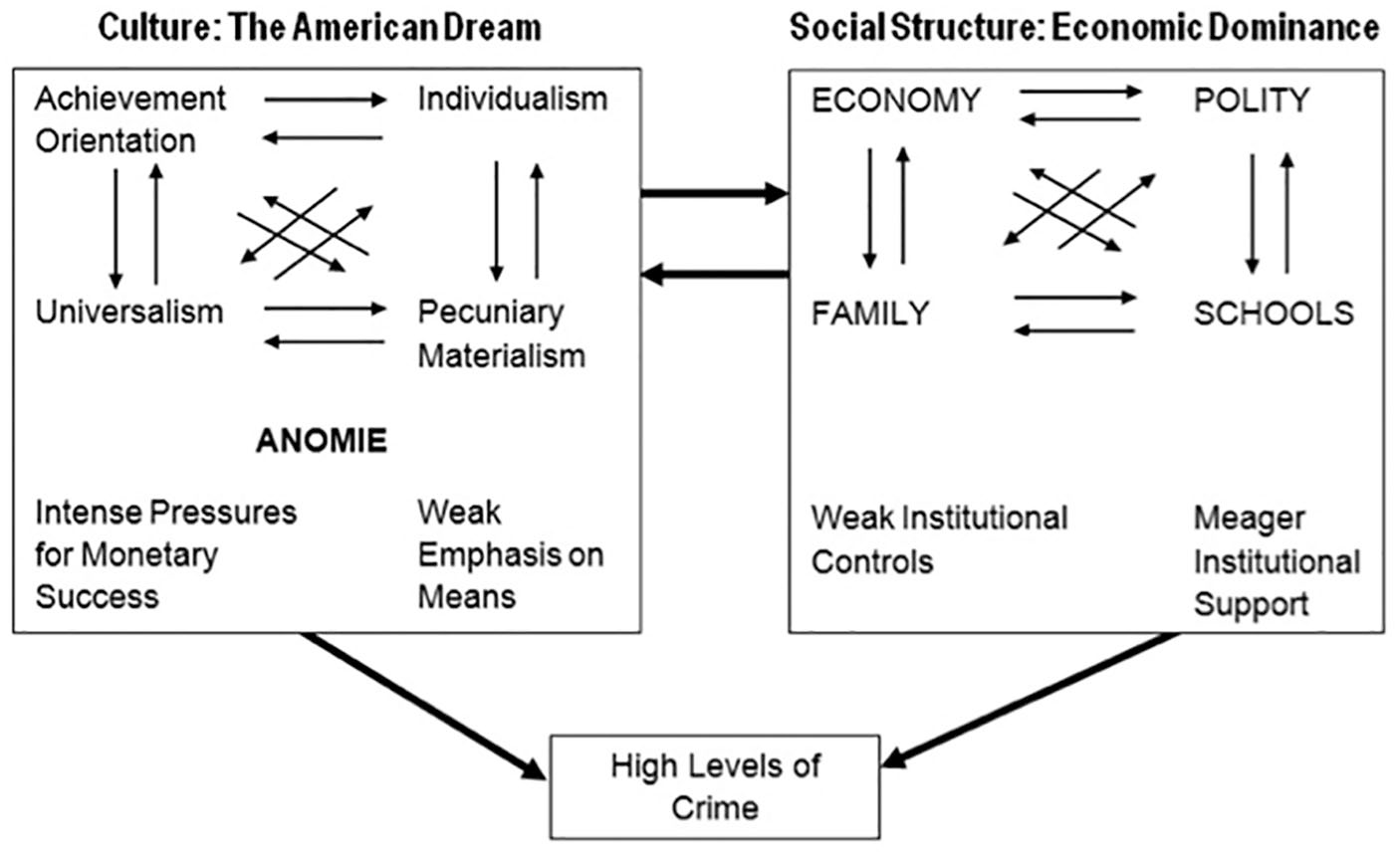
Schema of institutional anomie theory.
One very promising theoretical extension is the studies by Hövermann and colleagues (2015a), who introduced ‘marketized mentality’ (MM) as a conceptual lynchpin for joining macro and micro levels of theorizing informed by IAT. Building on the theoretical framework of Messner and colleagues (2008), they conceptualized MM as an individual-level instantiation of the anomic culture depicted in IAT (see Messner, 2003). Studies on MM have indicated its relevance for explaining not only criminal behaviour but also prejudicial attitudes, and therefore extended the scope conditions of IAT by translating the IAT-informed mechanism from the explanation of crime to the phenomenon of prejudice (Hövermann et al., 2015a).
Owing to the need to rely on secondary data analyses in prior studies, several different conceptualizations and operationalizations of MM informed by IAT have been applied to capture this individual-level phenomenon, resulting in the lack of a consistent, comprehensive, and theoretically derived MM measure. The bulk of these conceptualizations capture the consequences of societal penetration processes and a lack of normative control described in IAT (Messner and Rosenfeld, 2001/2013) at the individual level – a dominance of egoistic, market values at the expense of moral solidarity.
State of research
A huge body of empirical research has emerged that is informed by IAT. It is generally supportive of the theory, although the results are far from consistent. Earlier studies tested IAT mostly at the macro level and concentrated on the institutional structure of societies (for example, Bjerregaard and Cochran, 2008; Chamlin and Cochran, 1995; Cochran and Bjerregaard, 2012; Messner and Rosenfeld, 1997b; Piquero and Piquero, 1998; Savolainen, 2000; Schoepfer and Piquero, 2006). Messner and Rosenfeld (2006) compiled the results of these earlier applications of IAT and concluded that the findings for the institutional component of IAT were reasonably robust. Different macro-level indicators of economic dominance, often reflecting the generosity or extensiveness of social welfare provisions designed to protect citizens from the vicissitudes of the market, were fairly consistently related to levels of crime.
Fewer studies have taken culture into account when testing IAT, yet still mostly remaining at the macro level of analysis (Baumer and Gustafson, 2007; Chamlin and Cochran, 1997; Stults and Baumer, 2008). Although most of these studies support IAT because the cultural dynamics are closely connected to crime (Chamlin and Cochran, 1997; Stults and Baumer, 2008) and this connection proved to be particularly relevant in countries with enfeebled non-economic institutions (Baumer and Gustafson, 2007), not all tests of the cultural component of IAT have been fully supportive (Cullen et al., 2004; Dolliver, 2015; Hughes et al., 2015). In particular, the original notion of ‘American exceptionalism’, which assumes the highest anomie in the United States, has been challenged in some studies (Cao, 2004; Jensen, 2002), leading to an adjustment of IAT’s theoretical aspiration to explain crime rates in capitalist western societies more broadly.
Recently, a growing number of studies have focused on the task of transferring IAT to the micro level and on developing appropriate individual-level measures. Muftić (2006) created measures of universalism, individualism, achievement orientation, and monetary fetishism, as well as the commitment to different societal institutions at the individual level in her study on student cheating. Her findings are in line with IAT, in that students sharing the values of universalism and fetishism of money were more likely than others to cheat; commitment to the family and polity was negatively associated with cheating.
In a subsequent theoretical essay, Messner and colleagues (2008) proposed a heuristic model linking macro–micro levels of analysis within the framework of IAT. They hypothesized that economic dominance and anomie, along with a value orientation that they characterized as ‘disintegrative individualism’, should be reflected in actors who tend to be insensitive to the moral status of the means of action, who prioritize economic roles over non-economic roles in their everyday lives, and who engage in instrumentally motivated behaviours governed primarily by considerations of costs and benefits (Messner et al., 2008: 174). They observed that, although applications of IAT at the individual level were rare, the results were promising and accordingly encouraged further efforts along these lines.
Another attempt to model processes directly tied to the theoretical explications derived from IAT was a study by Bieliński (2013). He hypothesized that every manifestation of economy-dominated institutional balance of power, although mutually correlated, promotes a high level of normative disorientation. Thus, his statistical model treated normative disorientation (anomie) as an outcome variable, and penetration, money fetishism, accommodation, and devaluation served as independent variables. Based on data from a representative survey of the Polish adult population, he found that only money fetishism is positively correlated with the level of normative disorientation. He concluded that IAT cannot be successfully applied to the context of Polish society with this model. Nevertheless, his measurement models of latent constructs revealed sufficient validity of IAT-informed individual-level indicators.
Stults and Falco (2014) presented another attempt to transfer IAT to the individual level with their study using a national survey of US high school seniors and analysing whether violence, theft, and substance use are related to individual commitments to economic and non-economic institutions. Their results revealed considerable support for IAT. They found that students with a higher commitment to the values of the market economy committed more violence and substance use. Moreover, adherence to non-economic institutions yielded in many cases the expected negative effects and was associated with lower levels of offending.
Another fruitful micro-level study, by Rosenberger (2016), revealed highly interesting insights into the relationship between cultural and institutional dynamics. Rosenberger employed measures of an individual commitment to the American Dream, as well as integration in non-economic institutions, and identified the amount of TV consumption as one important driving force and transmitter of the American Dream and economic dominance.
In 2015, Hövermann and colleagues introduced the social-psychological concept of MM as a micro-level instantiation of the macro-level processes theorized in IAT. In their first papers (2015a, 2015b), they showed with survey data from Germany that this theoretical framework is useful for understanding prejudice towards a subset of purportedly unprofitable out-groups such as the unemployed, the homeless or disabled persons, who are easily stigmatized as being unprofitable, economically useless or burdensome, when evaluated according to criteria of ‘profitability’. In a study on German students (Groß et al., 2018), the concept of MM proved to be highly relevant for explaining self-reported juvenile delinquency and inclination for instrumental violence.
Hövermann and colleagues (2016) also applied their concept of MM to a multi-level design with 25 European countries, along with innovative macro-level measures of an institutional imbalance consisting of economic dominance and unimportant non-economic institutions. Their conceptualization of MM is based on the Schwartz values of Power and Achievement and a lack of Universalism and Benevolence (Schwartz, 1992; see also a similar conceptualization by Hirtenlehner et al., 2013). They revealed not only that MM varies between the countries but also that this variation is related to features of the institutional structure as predicted by IAT. MM is more prevalent in countries where the institutional balance in society is dominated by the economy and non-economic institutions are weakened. Moreover, the protective effects of non-economic institutions on developing MM are buffered in countries with economic dominance in the institutional structure.
Hövermann and Messner (2019a) recently employed the MM concept in multi-level analyses covering 58 countries and provided evidence that the prevalence of MM in a particular society is closely tied to the extent to which the economy dominates the institutional balance of power. Moreover, MM proved to be a good individual-level predictor of justifications for instrumental offences. Another recent study by Hövermann and Messner (2019b) applied the MM concept to explain anti-immigrant attitudes with World Values Survey data. The results confirmed their previous finding from a German sample for a multinational sample: MM helps account for anti-immigrant attitudes over and above existing prejudice predictors.
The present study
Our research builds upon previous efforts to operationalize key concepts of IAT and offers new and innovative individual-level measures by employing a representative sample of the Polish population. We focus here on societal marketization processes as denoted by IAT; measures of their behavioural or attitudinal corollaries are not included.
Previous operationalizations of the main concepts of IAT at the individual level have mostly concentrated on processes of penetration. Most commonly, researchers operationalized the commitment to the ‘American Dream’ ethos as the individual-level counterpart of economic dominance (Hirtenlehner et al., 2013; Muftić, 2006; Rosenberger, 2016). In contrast, other researchers created alternative instruments for measuring a ‘syndrome of market anomie’ (Karstedt and Farrall, 2006) or ‘values of the market economy’ (Stults and Falco, 2014) as described above.
The theoretical concept of MM by Hövermann and colleagues (2015a, 2015b) proved to be more sophisticated and comprehensive, however. In their series of studies (Groß et al., 2018; Hövermann et al., 2015a, 2015b, 2016; Hövermann and Messner, 2019a, 2019b) the researchers captured the penetration aspect extensively as the ‘American Dream’ ethos and a lack of solidarity values, as Schwartz values (Schwartz, 1992), and as market values intruding into other realms of social life such as choosing friends and valuing social groups. The processes of devaluation and accommodation, however, have been captured less comprehensively. Their sub-concept of ‘market-dominated role performance repertoires’ captures the prioritizing of economic roles over non-economic roles, but with only a single item.
This article builds on the theoretical conceptualization of MM by applying more comprehensive instruments. This research strategy allows for close ties with the theoretical explications of IAT because it explicitly takes the three principal manifestations of economic dominance as a starting point: penetration, accommodation, and devaluation, as proposed by Bieliński (2013). Moreover, this article builds on the efforts by Hövermann and colleagues (2015a: 415) to include the aspect of anomic success as the respondents’ willingness to pursue success ‘by-any-means-necessary’. Following these lines and taking the theoretical expectations of IAT into account, we aim to include aspects of anomic success into a measure of MM. 1
Previous studies have revealed a relatively high prevalence of societal marketization in Poland. In a cross-European study, Poland, among other post-socialistic East European countries, exhibited relatively high economic dominance in the institutional balance of power (Hövermann et al., 2016). Therefore, our first rather exploratory step is to analyse the prevalence of the depicted processes at the individual level in Poland. In a second empirical step, we test whether the described aspects of marketization are demonstrated concurrently at the individual level. By calculating several structural equation models, we seek to analyse whether the theoretically expected item structure can be found empirically in the Polish sample. In IAT, the three aspects of economic dominance are described as ‘three interrelated ways’ (Messner and Rosenfeld, 2001: 70) indicating a simultaneous, or even reinforcing, interrelationship. Accordingly, it is reasonable to expect the three aspects to be closely connected at the individual level too. We therefore hypothesize the following:
Data
The empirical basis is a representative general population survey conducted in Poland by TNS in November/December 2016. The sample size is 1050 respondents aged >15 years. The survey sampling design was based on a random sample scheme stratified by the size of place of residence, province (‘voivodeship’), gender, and age. The survey data were gathered by computer-assisted personal interviews. A product of design weight and post-stratification weight is applied during statistical analysis.
Because important parts of the suggested MM measures are job- and work-life related, we focus in our analyses on working participants. Accordingly, a subset of working respondents from the original sample was drawn and is used for the statistical analyses. This reduces the size of the analysed dataset to N = 597 respondents. 2
Measures
Marketized mentality
We assume that the level of economic dominance over non-economic social institutions is manifested at the individual level. These manifestations are subject to empirical observation and thus are measurable in terms of the intensity of the phenomena under investigation. We follow Bieliński’s (2013) strategy by first applying operationalizations of the three processes elaborated in IAT: penetration, accommodation, and devaluation. Following this, we present the measures for the anomic success aspect, which will eventually be added to the MM measure. The choice of indicators was largely theoretically driven; nevertheless, we provide scale reliability measures (Cronbach’s alpha, Guttman’s lambda and omega) for each set of items (see the exact wording of each item in Table 1).
Frequencies of translated items for subdimensions of MM.
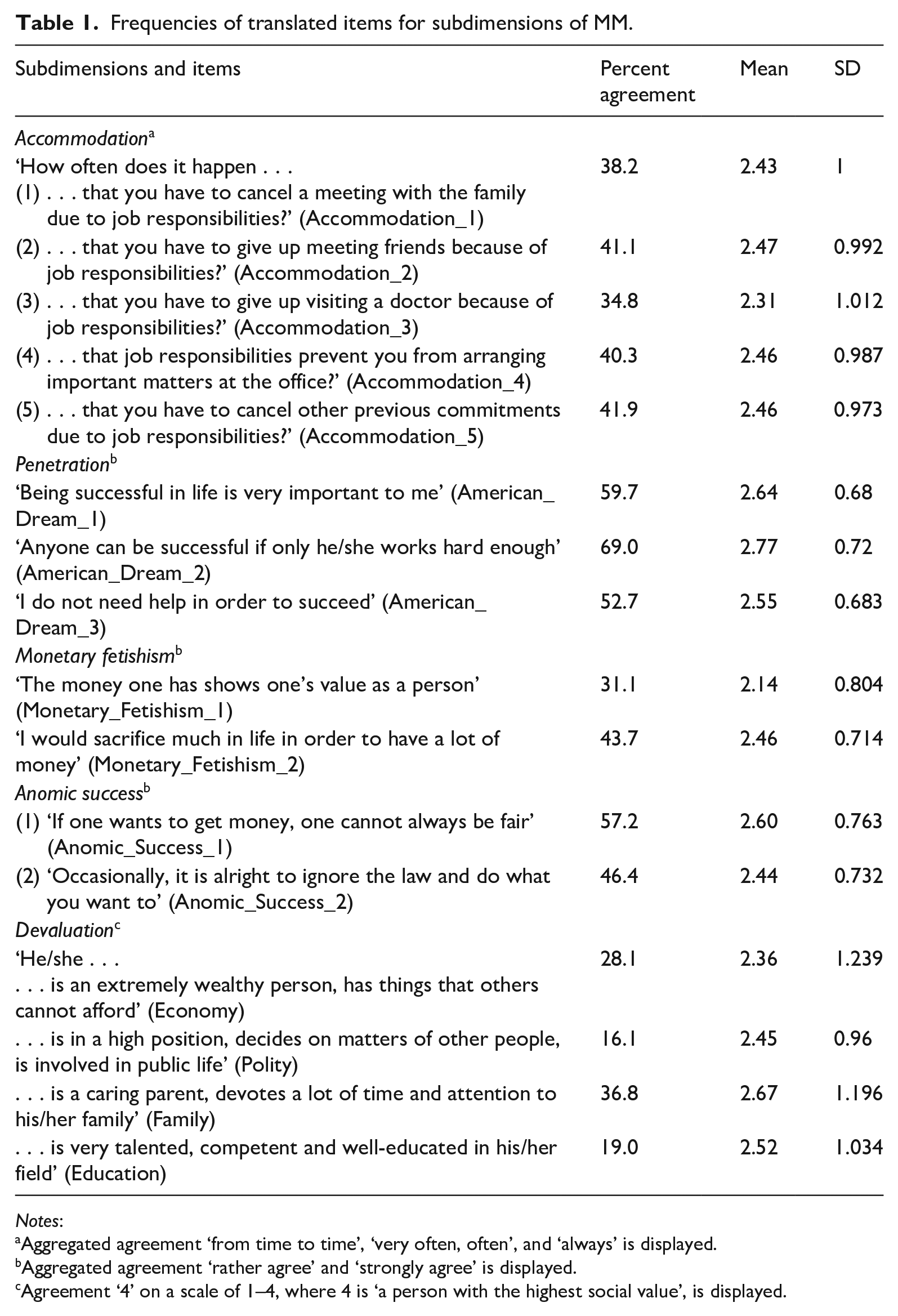
Notes:
Aggregated agreement ‘from time to time’, ‘very often, often’, and ‘always’ is displayed.
Aggregated agreement ‘rather agree’ and ‘strongly agree’ is displayed.
Agreement ‘4’ on a scale of 1–4, where 4 is ‘a person with the highest social value’, is displayed.
Penetration
Penetration of market values into other non-economic social institutions is operationalized in terms of the acceptance of individualism, universalism, and achievement orientation values (Messner and Rosenfeld, 2001: 62) as well as the fetishism of money. Although these IAT-related values have been operationalized several times before, the items used here (four-point scale: 1 = strongly disagree; 4 = strongly agree) are taken from Bieliński’s (2013) study.
The value of individualism (item ‘American_Dream_3’ in Table 1) denotes a conviction that a person should rely on his/her own abilities and others are perceived as potential competitors and rivals in the quest for success. The value of universalism (‘American_Dream_2’) is understood as a belief that material success is a goal that can and should be fulfilled by each and every member of a society. An achievement orientation depicts that individuals are encouraged to self-identify and independently achieve their goals (‘American_Dream_1’). The effectiveness of pursuing these goals is a criterion for evaluating individuals, and failure means devaluation as a member of society (Messner and Rosenfeld, 2001: 62). A final aspect of penetration is the fetishism of money, which refers to a belief that material success is a superior goal (‘Monetary_Fetishism_2’) and that the amount of accumulated economic resources is a universal measure of accomplishment of an individual’s aspirations (‘Monetary_Fetishism_1’) (Messner and Rosenfeld, 2001: 63). Cronbach’s alpha of standardized variables, Guttman’s lambda (G6), and omega measures indicate moderate scale reliability for all items of penetration (.618/.594/.618, respectively).
Accommodation
The domination of economy in the institutional balance of power undermines the ability of non-economic social institutions to regulate the individual’s behaviour (Messner and Rosenfeld, 1997a: 216–17). As a result, in role-conflict situations, economic-oriented behaviours are performed more often than those conforming to the expectations of interaction partners within non-economic social institutions. In other words, the economic role is prioritized over non-economic roles. Accommodation to economic social roles is operationalized in terms of the frequency of individual prioritization behaviour. Respondents were presented with descriptions of five actions denoting abandonment of private and social commitments due to job responsibilities. The five items originally designed by Bieliński (2013) refer to non-economic institutions and their corresponding roles. The frequency of each behaviour was measured on a five-point scale (1 = never; 5 = always). Cronbach’s alpha, Guttman’s lambda (G6), and omega indicate a very high scale reliability (.885/.862/.884, respectively).
Devaluation
Economic dominance in the institutional balance of power also affects the role-prestige hierarchy. The inability of enfeebled non-economic social institutions to regulate behaviour is reflected in the devaluation of non-economic social roles. This is manifested in positioning economic-related social roles at the top of the role-prestige hierarchy (Messner and Rosenfeld, 2001: 70). We build on Bieliński’s study (2013) by measuring the relative value attributed to individuals performing roles within the social institutions of economy, politics, family, and education. Respondents were presented with four descriptions of individuals and asked to rank the descriptions corresponding to the esteem in which they hold each of them (four-point rank: 1 = a person with lowest value; 4 = a person with highest value). Because the values of the variables created from the rank questions are interdependent, only the variable reflecting the relative rank of the successful businessperson was included in the models because this person representing the economy is of greatest interest in this context (item ‘Economy’ in Table 1). This strategy avoids a number of problems at the stage of statistical modelling and measures the position of a successful businessperson relative to other persons associated with non-economic social institutions. The higher this value, the more the successful businessperson is valued by the respondent in relation to persons associated with other non-economic institutions.
Anomic success (normative disorientation)
Under conditions of economy-dominated institutional (im)balance of power, individuals are prone to normative disorientation in a form of a ‘by-whatever-means-necessary’ attitude to the attainment of socially prescribed goals (Messner and Rosenfeld, 2001: 62, 76–9). This aspect has been previously subsumed as part of the values of the ‘American Dream’ ethos (Hövermann et al., 2015a) and reported as correlated with money fetishism (Bieliński, 2013). When societal marketization has impacted and undermined the individual’s values, it is mainly about achieving the ends, not so much about the means to achieve them. Therefore, this aspect could be part of the ‘penetration’ aspect in our study. We identify this aspect of MM with Merton (1938) as the anomic success attitude and operationalize it by using two items from the European Social Survey Round 2. Agreement with the first anomic success item portrays a conviction that economic success can be achieved only via illegitimate means (‘Anomic_Success_1’), while agreement with the second one reflects the low regulative capacity of the law (‘Anomic_Success_2’; see Table 1 for the exact item wording). The reliability measures are: Cronbach’s alpha = .605, Guttman’s lambda (G6) = .433. Although these items reveal relatively low levels of measure reliability, we argue that they maintain high face validity.
Statistical methods
In order to exemplify the prevalence of the micro-level manifestations of the economy-dominated institutional (im)balance of power, we report frequencies and correlational results. For testing the hypothesis, structural equation modelling (SEM) and a single exploratory factor analysis have been employed. SEM does not ensure that the model with the best fit measures is the one that reflects the actual co-occurrence of observable variables or latent constructs. Thus, SEM involves testing many competitive yet theoretically driven models in order to establish the final form of the model (see Schumacker and Lomax, 2016). The structural equation models presented here take the form of confirmatory factor analyses (CFA) with several levels of higher-order factors (detailed results of the subsequent SEMs and correlation matrix are available in the Appendix in the online Supplemental Material).
The SEM parameters are calculated by using weighted least squares (WLS) estimators. Statistical analyses and data transformations are conducted with R Language and Environment for Statistical Computing (R Core Team, 2020). The model is estimated using the ‘lavaan’ package (Rosseel, 2012).
Results
In their cross-country study, Hövermann and colleagues (2016: 238) reported country-level measures of institutional imbalance favouring the economy. They revealed relatively high levels of economic dominance for Poland, which scored as number 8 out of 26 European countries in terms of institutional imbalance. Therefore, we assume that the frequencies presented here delineate individual-level symptoms representative of societies in which the institutional structure is to a considerable degree dominated by the economy.
We start by analysing the prevalence of the marketization processes (see Table 1). Around 40 percent of all respondents state that, at least ‘from time to time’, they have to adjust non-economic role commitments due to job responsibilities. The agreement to the items of the penetration aspect are widespread, as well. More than half of the respondents (partly even almost 70 percent) agree with the individualism, universalism, and achievement orientation items. Around 30 to 44 percent agree with the statements that serve as indicators of monetary fetishism. Moreover, around half of the respondents share acceptance of statements capturing anomic success. Finally, regarding the devaluation aspect, the results reveal that the highest proportion of respondents (37 percent) value the caring family person highest, followed by the successful businessperson (28 percent). Around 16 to 20 percent assess the persons associated with the polity or education as having the highest social value. Although this result concerning the devaluation aspect points to the continuing very high importance of the family institution in Poland, it also reveals the high reputation of the business world in Poland.
Considering the large share of respondents in Poland reporting agreement with the items, we conclude that the marketization processes informed by IAT do not depict a marginal phenomenon, but rather constitute a substantive prevalence at the individual level in Poland.
SEMs of marketized mentality
In order to find a measurement model, we empirically tested several models given the expectations formulated in H1 (see the results in Table 2). We start with a confirmatory factor analysis model (Model 1) with a single latent variable – MM. This model serves as our starting point, because we make no assumptions whatsoever about the structure of the latent variables. This first model includes all 11 original items of the hypothesized three dimensions loading on MM. The results show rather weak fit measures (CFI = .71, RMSEA = .079, PClose = .00, SRMR = .131). Moreover, the structure of the standardized factor loadings reveals that the latent variable MM is mainly defined by items of the accommodation dimensions (.75 − .84), whereas the other items load rather weakly on the MM latent variable (.12 − .46).
Results from CFAs (N = 597).
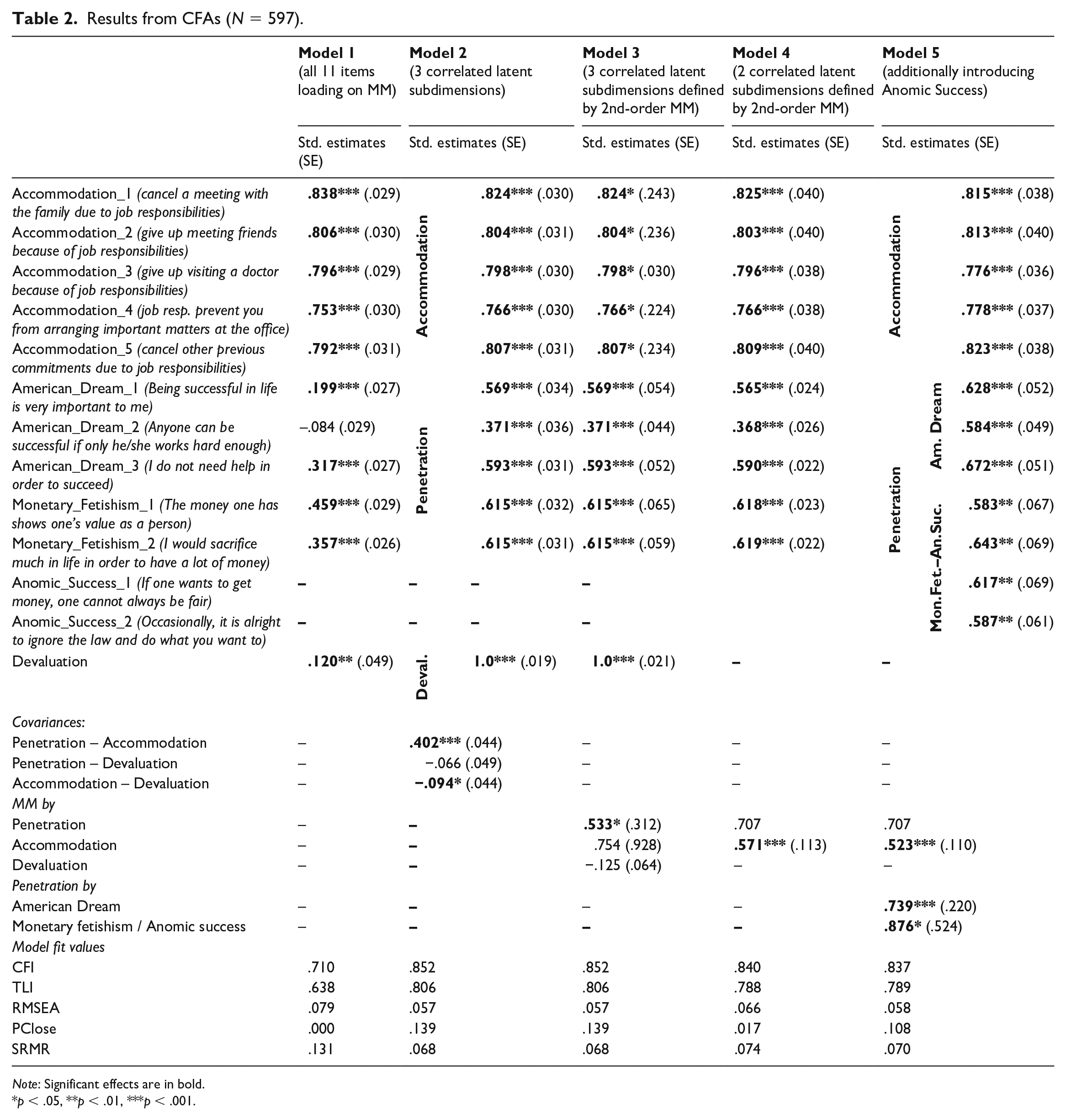
Note: Significant effects are in bold.
p < .05, **p < .01, ***p < .001.
In a second step, we introduce the three originally hypothesized latent variables and evaluate a CFA model consisting of penetration, accommodation, and devaluation (Model 2). As described above, accommodation is represented by five items, the penetration latent variable includes measurement items of the American Dream ethos and monetary fetishism, while the aspect of devaluation is reflected by a single item. The model fit clearly improved (CFI = .85, RMSEA = .057, PClose = .139, SRMR = .068) and the second model is characterized by stable measurement sub-models of penetration and accommodation. Only the ‘universalism’ item (‘American_Dream_2’) has a low, yet statistically significant, standardized factor loading of .371. Nevertheless, the structural part of the model shows that only the penetration and accommodation latent variables are correlated as theoretically expected (r = .402, p < 0.00), whereas the correlations of the devaluation variable with the accommodation and penetration latent variables are close to zero and statistically insignificant.
We proceed with a third model that introduces the higher-order latent variable of MM and assumes that all three latent variables of penetration, accommodation, and devaluation are defined by it. The measurement sub-models are largely the same as in the previous model, as are the model’s fit measures, which meet the cut-off fit criteria (CFI = .852, RMSEA = .057, Pclose = .139, SRMR = .068; see Hu and Bentler, 1999). The penetration and accommodation latent variables’ measurement sub-models reveal reasonably high loadings (except again for the ‘universalism’ item loading Beta = .371). Nevertheless, the structural part of the model has two limitations: the accommodation loading on MM is statistically insignificant and, more problematically, the devaluation factor loading not only is not positive, but is even negative. Therefore we conclude that the models tested so far do not reflect the assumed theoretical expectations formulated in our hypothesis.
We proceed with testing adjusted models that provide theoretical validity and empirical fit. A first adjustment is to exclude the devaluation aspect. The devaluation variable strongly deviates from the theoretical expectations in the previous two models: it is not positively (or even slightly negatively) correlated with the other two latent variables and it shows no relevant loading on the second-order latent variable of MM.
Accordingly, the next model (Model 4) consists of only two first-order latent variables – penetration and accommodation – and one second-order latent variable – MM. In order to identify the model, the factor loading of the penetration latent variable on the second-order latent variable of MM has been fixed at 1. The measurement sub-models of penetration and accommodation are stable and reveal relatively high factor loadings. The model fit measures marginally decreased yet remain within the cut-off criteria (CFI = .84, RMSEA = .066, Pclose = .017, SRMR = .074). The structural part of the model shows the theoretically expected structure of the remaining first-order latent variables.
In a final step, we aim at including and introducing the aspect of anomic success to the model. We therefore proceed with an exploratory factor analysis that additionally includes the two items of anomic success (see Table 3). The analysis suggests a three-factor solution, with a first factor defined by accommodation items, a second factor by American Dream items, and a third factor by monetary fetishism and anomic success items. 3 This solution splits the penetration dimension into one American Dream factor and one monetary fetishism/anomic success factor.
Factor loadings and factor correlations of exploratory factor analysis.
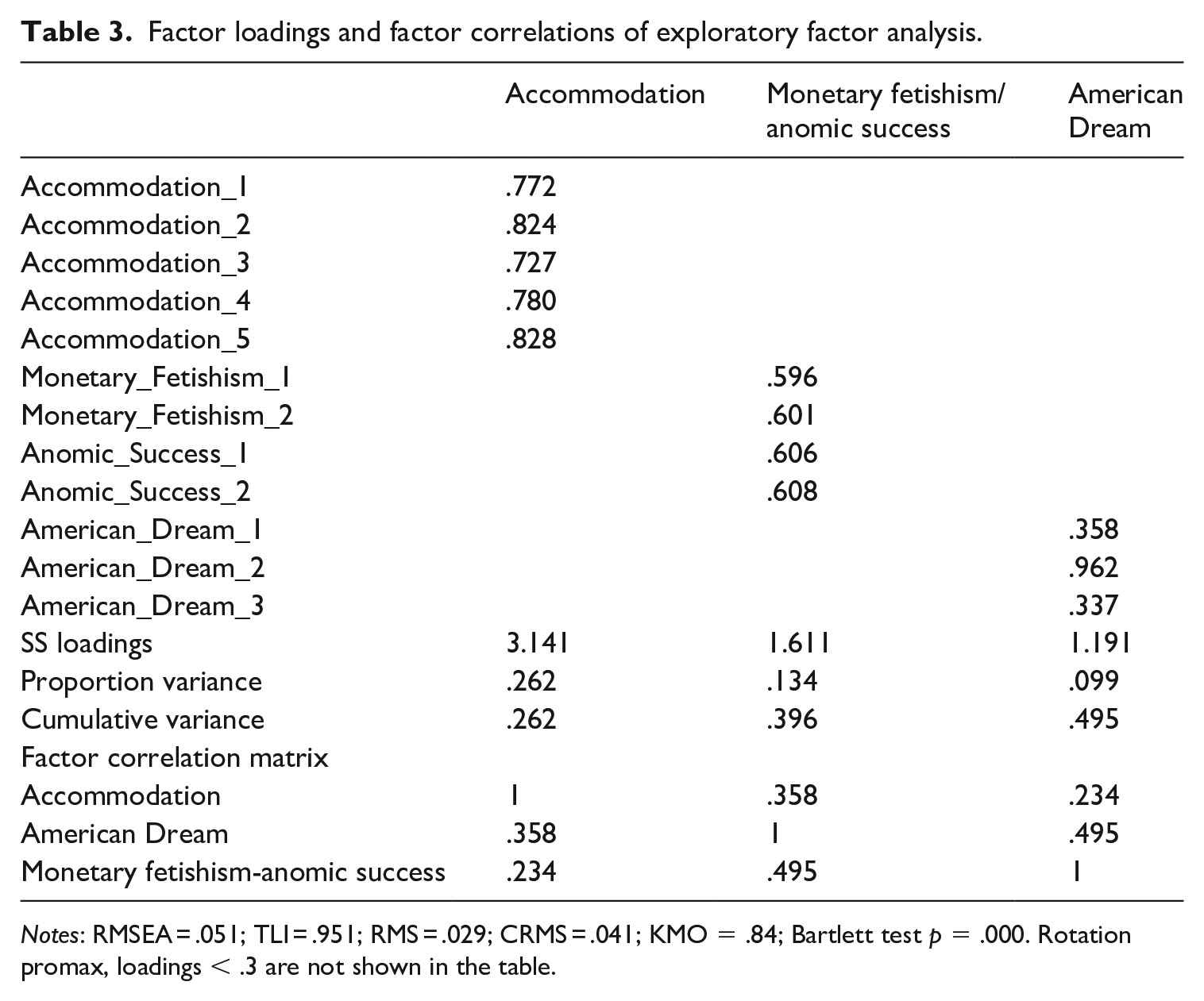
Notes: RMSEA = .051; TLI = .951; RMS = .029; CRMS = .041; KMO = .84; Bartlett test p = .000. Rotation promax, loadings < .3 are not shown in the table.
For two reasons, we continue our analyses with a model that strongly builds on this EFA finding. We suggest additionally modelling a higher-order penetration factor consisting of the factors of American Dream values and monetary fetishism/anomic success. One reason for this model is the much closer fit to our theoretical framework and objective of this article. Penetration depicts one of the three principal ways of manifesting economic dominance on which we build our operationalization. As we have argued already in the theoretical section, in line with Hövermann et al.’s (2015a) conceptualization and Bieliński’s (2013: 176–84) findings, it is reasonable to understand American Dream, monetary fetishism, and anomic success as all part of marketization penetration processes. The second argument is the empirical finding that the EFA reveals the highest correlation (.495***) between the two factors now summarized under the higher-order penetration factor.
Accordingly, the final model (Model 5) includes accommodation and penetration as two higher-order factors defining MM and penetration defined by the first-order factors American Dream and monetary fetishism/anomic success (see Figure 2). The fit measures of this model are acceptable too (CFI = .837, RMSEA = .058, PClose = .108, SRMR = .07). 4 The model remains stable, in both the measurement and the structural part, with very evenly distributed factor loadings. The reliability of these final 12 variables included in the MM measure is reasonable (Cronbach’s alpha = .787, Guttman’s lambda (G6) = .823, omega = .81). Therefore, anomic success fits nicely in the penetration concept, depicting a subdimension together with the monetary fetishism items.
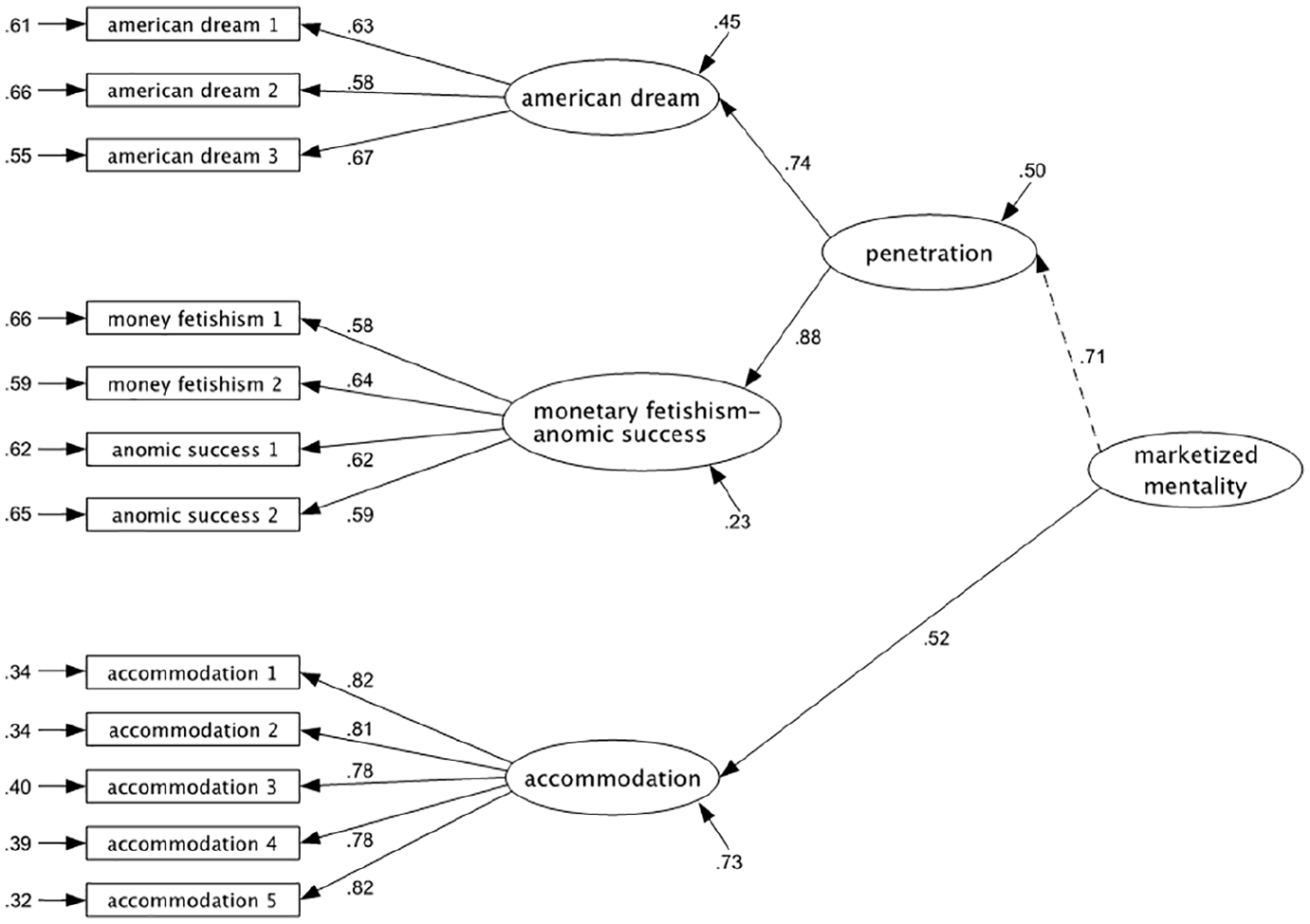
Model 5: Final CFA model of marketized mentality (standardized model parameters, WLS estimator).
Conclusion and discussion
The aim of the study was to introduce new, valid, and reliable micro-level measures of the key concepts of institutional anomie theory. We focused on the impact of cultural and institutional dynamics on individuals and build on prior attempts to operationalize IAT at the individual level by Hövermann and colleagues (2015a: 415) and Bieliński (2013).
The empirical analyses with data from a representative survey of the Polish working population aged >15 years yielded a mixed picture regarding our theoretical and empirical expectations. On the one hand, we were able to successfully provide micro-level measures depicting previously neglected aspects of IAT in a final model that combines a relatively high theoretical validity with a reasonable empirical fit.
The results suggest that the individual-level counterpart of economic dominance may be more comprehensively measured by individual-level manifestations of processes of accommodation and penetration – including measures for anomic success. All these aspects are commonly shared among some respondents, as empirically reflected in the higher-order latent factor MM. In particular, the additional recognition of processes of anomic success is an important advancement in depicting MM at the individual level in a more detailed way. This empirical result is consistent with the theoretical underpinnings of IAT as well as with previous operationalizations of MM. Messner and Rosenfeld (2001: 62) argued that each of the American Dream values contributes to the ‘anomic character’ of this cultural ethos. Anomie counteracts and suppresses any normative restraints and is not limited to monetary goals (Messner and Rosenfeld, 2001: 78). Furthermore, Messner and Rosenfeld conclude, in a detailed discussion on the aspect of penetration, that economic dominance is expressed at the cultural level concurrently with the American Dream ethos and anomie. Both of these aspects of penetration are defined as ‘mutually supportive and reinforcing’ (Messner and Rosenfeld, 2001: 76). In addition to that, Messner and colleagues (2008: 174) expected that the dominance of the economy should be reflected at the micro level by individuals tending to be insensitive to the moral status of the means of action and who engage in instrumentally motivated behaviours governed primarily by considerations of costs and benefits – the very aspects depicted in our anomic success measure. Accordingly, and in line with our empirical findings, anomic success and monetary fetishism were correlated in previous studies (Bieliński, 2013: 176–84) or even combined as part of the American Dream ethos (Hövermann and colleagues, 2015a: 415), which is considered in the penetration aspect in this article.
The detailed findings regarding the empirical structure of the aspects of American Dream, monetary fetishism, and anomic success presented in the final model offer some more insights. Apparently, there are two subdimensions of the penetration processes: one captures marketized values of the American Dream such as achievement, individualism, and universalism orientations; the other one comprises a focus on monetary goals combined with a ‘by-any-means-necessary‘ orientation referring to the devaluated norms to achieve the goals. In other words, the second factor ideally captures the core of the pressures towards anomie described in Messner and Rosenfeld’s Crime and the American Dream (2001: 62, 76–9): it is important that you reach your materialistic, money-focused goals, not how you get there. The empirical finding to split up the two dimensions might be caused by the fact that both dimensions of the monetary fetishism/anomic success factor directly point to the aspect of money, whereas the American Dream values also capture different aspects of marketized values.
However, our suggested measure for the process of devaluation could not be integrated into this measure of MM. One set of possible interpretations of this result concerns operationalization and methodological issues. The type of item employed for devaluation differs considerably from those for the other aspects, which could result in the observed pattern. Unlike all the other measures, the devaluation item was designed as a rank question. Moreover, it is represented by a single dichotomous item, which almost as a consequence results in lower factor loadings. The second set of issues concerns the specificity of Polish society in regard to the high value put on the family institution. Prior studies, as well as the presented frequencies of our own data, suggest that the family used to be and still is the main common point of normative reference for people in Poland (Felisiak, 2017; Nowak, 1979; Tarkowska and Tarkowski, 1990). Further conceptualizations that take these worthwhile findings into account are necessary in the future to refine this aspect in the measure.
Nevertheless, and given these remarks, the results indicate that the proposed micro-level counterpart of an institutional imbalance may at least partially be applied to Polish society. Not only does a significant proportion of the Polish population report marketization processes, as reflected in our measures, but also these measures are to a large extent composed and interrelated as theoretically expected. This fact opens up perspectives for the effective application of micro- or multi-level empirical studies utilizing IAT in the broad spectrum of capitalist societies.
Despite the fact that the results provide new perspectives on studies employing IAT, our study has several limitations. First, a lack of cross-national data prevents a validation of the measurement instruments and the suggested model of MM in cultural contexts other than the Polish one. Secondly, the random sample design of the study was intended to map the Polish population aged >15 years. The fact that items measuring accommodation processes are applicable solely to the working population results not only in a considerably decreased sample size, but also in potential additional biases. Thus, further methodological research is needed to design collateral indicators of accommodation that would be applicable to all sections of the population while still manifesting high theoretical validity. Moreover, the proposed measurement instrument could not be applied to test its exploratory power for phenomena such as individual criminality, which is a desirable task for future research.
The low correlation between the devaluation of non-economic social roles and other aspects of MM encourages us to produce one more interpretation of our results. The exposure of an individual to the social conditions of institutional economic dominance may have mediating or moderating effects on the internalization of the ‘American Dream’ ethos (penetration). In other words, the results of our study direct attention to a highly relevant differentiation when it comes to individual-level applications of IAT: the mere exposure to macro-level economic dominance vs. the actual internalization and endorsement of marketization processes. Whereas our measures of penetration and accommodation focus on aspects of the internalization and endorsement of marketization, the devaluation item instead asks for a societal prevalence of marketization – what is socially valued and not necessarily what the respondent values.
The processes of penetration and devaluation refer to what Merton called normative and opportunity structures. They consist of norms, values, and prestige hierarchies that are expected in IAT to be prevalent in a society under an economy-dominated institutional balance of power (Merton, 1964; see also Sztompka, 1986: 163). However, accommodation refers to behavioural outcomes of the normative structure. When a role-conflict situation arises, an individual is compelled to select from the competing expectations of interaction partners and responds through behaviour. Therefore, accommodation may have manifold micro-level effects depending on whether or not an individual has internalized the ‘American Dream’ ethos and whether an individual is exposed to the social conditions of economically dominated institutional imbalance.
The MM concept assumes that high levels of exposure to market-dominated social conditions are accompanied by high levels of internalization of the ‘American Dream’ ethos, a role-prestige hierarchy promoting economy-related social roles, and choosing economy-related role performances in role-conflict situations. Although this may be true in many cases, as the majority of previous studies suggest, yet some inconsistencies in the empirical results of previous research, as well as of our study, allow for an alternative interpretation. Low internalization of the ‘American Dream’ ethos and high exposure to market-dominated social conditions may also result in a low level of devaluation while still choosing economy-related role performances in role-conflict situations. This is a micro-level social condition, which Durkheim described as fatalism or regressive anomie (Durkheim, 2005: 213, 239, 248; see also Besnard, 1988, 1993; Bieliński, 2013, 2016). To capture these potentially conceivable constellations, IAT-informed individual-level conceptualizations should additionally consider exposure to market-dominated social conditions, thus allowing them to be analysed separately.
The proposed measurement tool, as well as the items used in previous individual-level studies, makes it hard to disentangle exposure to market-dominated social conditions from the internalization of aspects of market-dominated social institutions. The MM concept was explicitly designed to capture the individual-level adaptation of marketization, not as denoting ‘mentalities exposed to marketization’. Our findings suggest taking seriously the differentiation between the internalization of the ‘American Dream’ ethos and exposure to market-dominated social conditions. Thus, we need better measurement tools in order to capture the missing aspect with additional indicators that could relate to both individual-level non-economic institutional integration and macro-level economic dominance.
Supplemental Material
sj-docx-1-euc-10.1177_1477370821996853 – Supplemental material for Perceived marketization in Poland: Translating key concepts of institutional anomie theory to the micro level
Supplemental material, sj-docx-1-euc-10.1177_1477370821996853 for Perceived marketization in Poland: Translating key concepts of institutional anomie theory to the micro level by Jacek Bieliński and Andreas Hövermann in European Journal of Criminology
Footnotes
Declaration of Conflicting Interests
The author(s) declared no potential conflicts of interest with respect to the research, authorship, and/or publication of this article.
Funding
The author(s) disclosed receipt of the following financial support for the research, authorship, and/or publication of this article: The preparation of the manuscript was supported and funded by the Collegium Civitas, Warsaw, Poland, to Jacek Bieliński and by a Deutsche Forschungsgemeinschaft (DFG, German Research Foundation) research fellowship to Andreas Hövermann (HO 5858/1-1).

Supplemental material
Supplemental material for this article is available online.
Notes
References
Supplementary Material
Please find the following supplemental material available below.
For Open Access articles published under a Creative Commons License, all supplemental material carries the same license as the article it is associated with.
For non-Open Access articles published, all supplemental material carries a non-exclusive license, and permission requests for re-use of supplemental material or any part of supplemental material shall be sent directly to the copyright owner as specified in the copyright notice associated with the article.
