




Abstract
In this paper, I explore the concept of ‘vulnerability’ from the perspective of migrant sex workers living in Malta, a small island in the Mediterranean affected by international migration flows, which has recently witnessed political debate over the reform of sex work policies. Drawing on the lived experiences of a group of people who are commonly labelled ‘vulnerable’, the article presents a relational understanding of vulnerability as fluid across time and space and articulated on four levels (systemic, societal, situational and individual). It critically discusses aspects such as criminalisation, lack of protection, violence by clients and exploitation through the eyes of migrants with experiences of sex work; whilst concurrently highlighting, wherever possible, the resistance strategies they deploy to prevent and contrast different vulnerabilities.
The analysis shows that understanding vulnerability in migrant sex work requires taking stock of migration regimes, their impact on the push to migrate and on the experience of migration, whilst also paying attention to criminalisation and widespread gaps in protection for sex workers. These phenomena jointly contribute to migrant sex workers experiencing ‘vulneramentality’, namely a form of governing, controlling and categorising populations rooted in vulnerability. Vulneramentality exacerbates extant vulnerabilities, pushing further to the margins already marginalised populations. It also creates novel ones, where they did not originally exist, with the ultimate objective of further entrenching exclusion.
As witnessed in Malta, vulnerability has tangible reverberations over migrant sex workers’ safety from violence and exploitation. Although they creatively leverage different strategies to resist systemic vulnerabilities depending on their personal resources, their social positioning and their location within the sex work industry, their ability to resist restrictive systemic factors remains, understandably, limited. Resisting vulneramentality cannot be an individual endeavour: it requires structured and coordinated reform at different levels of society.
Introduction
In recent years, the concept of ‘vulnerability’ has gained increased traction in policy, academic and practitioner debates (Brown, 2015). Although the protection of ‘vulnerable’ people (Aas and Gundhus, 2015) is frequently invoked by governmental and non-governmental actors alike, scholars have highlighted vulnerability's potential to fall prey to instrumentalisation (Brown, 2024; Butler, 2016). A glaring example of this are arbitrary categorisations of individuals and groups as ‘vulnerable’ (or conversely, ‘not vulnerable’), used to justify intrusive interventions by agents of the state (Munro and Scoular, 2012), and conditioning their deservingness of support (Brown, 2024; Glyniadaki, 2021)
Among the casualties of vulnerability discourses are sex workers, particularly those at the intersections of various identity markers, such as migration status or sexual orientation (Brooks et al., 2023; Munro and Scoular, 2012). ‘Vulnerability’ has proved particularly expedient to proponents of the neoabolitionist school of thought to argue that sex work is, by default, exploitative (Barry, 1979; Mackinnon, 2011; Pateman, 1988; see also Heber, 2020 for a critical analysis). By conflating sex work, exploitation and trafficking, they have adamantly advanced the view that sex workers’ – and more broadly, women's – vulnerability can only be eradicated by wiping out the sector as a whole, via the criminalisation of the buyer and the consequent reduction of demand (Vanwesenbeeck, 2017).
There have been attempts to move beyond this monolithic reading of the sex work sector to tease out the specific vulnerabilities faced by sex workers, and investigate the factors that contribute to exacerbating them, or conversely, mitigating them. Focusing on vulnerability intended as exposure to sexual health risks and violence, research has shown that repressive policing models and the partial or full criminalisation of sex work enhance sex workers’ experience of harm (Rossoni and Camilleri, in press; Oliveira et al., 2023; Platt et al., 2018). They face higher rates of sexual transmitted infections (STIs) and HIV, and increased client and police violence with reverberations on their physical and emotional wellbeing.
Very limited research has attempted to conceptualise vulnerability as lived experience via empirical inquiry engaging sex workers (Brown and Sanders, 2017; Brown et al., 2024). In order to contribute to bridging this gap, in this paper, I explore vulnerability from the perspective of migrants with experiences of sex work living in Malta, a small island in the Mediterranean affected by international migration flows, which has recently witnessed political debate over the reform of sex work policies. The aim is to move beyond viewing sex work as inherently engendering vulnerability, instead examining whether migrant sex workers perceive themselves as vulnerable and identifying the factors they see as shaping that vulnerability. The analysis highlights how vulnerability often coexists with resistance and explores the strategies sex workers deploy to manage their risks.
Putting the perspectives of those typically labelled as ‘vulnerable’ first is essential, especially since vulnerability is a deeply political concept. In the context of sex work and migration, this helps expose how protective discourses can reinforce social control (Munro and Scoular, 2012; Wahab and Panichelli, 2013), while unaddressed vulnerabilities, as defined by sex workers themselves, can cause further harm. Rooting this analysis in Malta contributes to filling a gap in the limited scholarship on migrant sex work in this setting, offering evidence to inform more grounded policy and practice.
Vulnerability: What's in a name?
Vulnerability has been the subject of extensive debate across disciplines as varied as philosophy, sociology, criminology, law, and disaster risk studies. Gilson (2024) underscores its conceptual and experiential complexity, describing vulnerability as ‘an experience and a concept, a theoretical lens and a normative notion’ (Gilson, 2024: 263). This richness allows for nuanced understandings, but also opens the door to reductive or harmful uses.
Within legal theory, Albertson Fineman (2008) offers a foundational critique of liberal ideals of equality and autonomy, arguing for vulnerability's reconceptualisation as a ‘universal, inevitable, enduring aspect of the human condition’ (Albertson Fineman, 2008: 8). While acknowledging individuals’ differing positions in institutional and socio-economic structures, Fineman highlights the state's role in producing and managing vulnerability, calling for increased public responsibility (Albertson Fineman, 2008, Albertson Fineman, 2017).
Philosophical approaches echo and expand on Fineman's argument. Boublil (2024) critiques the ‘neoliberal and masculinist’ ideal of invulnerability (Boublil, 2024: 278), instead positioning vulnerability as the foundation of relationality and openness. For her, vulnerability is not merely exposure to harm, but also the capacity to be moved by others’ expressions and differences. Still, she warns of vulnerability's political instrumentalisation, particularly in migration regimes where failure to prove vulnerability can lead to exclusion and criminalisation (Alagna, 2024; Butler, 2004; Sachseder et al., 2024).
Gilson (2024) synthesises these perspectives, stressing vulnerability's dual nature as universal and socially situated, shaped by race, gender and institutional power. She conceptualises vulnerability as inherently ambiguous, containing within it both injury and resistance. Resistance, for Gilson, arises precisely within the temporal and emotional limbo of anticipating harm, offering a means of divergence from imposed paths. This ambiguity is not a flaw but a critical resource to challenge dualist and exclusionary logics (Gilson, 2018; Oliveiro, 2018).
These insights build on Butler's (2004: 2016) framing of vulnerability as inseparable from agency and resistance. Vulnerability, for Butler, is both imposed and enacted; it can be mobilised for collective or individual transformation. Together, Butler, Gilson and Boublil reposition vulnerability as an ambivalent but generative force.
Despite the valuable insights offered by philosophical inquiry, theorisations of vulnerability based on how it is lived remain, to date, limited. Brown's research in England and Wales is a notable exception. Drawing on Gilson and Boublil, Brown explores how ‘vulnerable’ groups – including sexually exploited children and sex workers – navigate and negotiate vulnerability narratives (Brown, 2015, 2017, 2019; Brown and Sanders, 2017; Brown et al., 2024). Her findings highlight competing constructions: from essentialist views of inherent weakness to situational accounts tied to systemic injustice. Brown and Sanders (2017) find that sex workers often reject vulnerability as weakness, while simultaneously acknowledging adversities shaped by criminalisation, stigma and gendered/racialised harm. Despite institutional efforts like Sex Work Liaison Officers, Brown et al. (2024) critique their limited impact amidst austerity and structural violence.
Ultimately, Brown and Sanders (2017) define vulnerability as a social position shaped by historic injustice, cultural stigma, and intersecting oppressions, animated by ‘a multitude of identities, stories, embodiments, emotions, practices and performances’ (Brown and Sanders, 2017: 439). Yet, Brown (2024) stresses the need for further research into how vulnerability is actively lived, particularly within marginalised groups such as sex workers, trauma survivors and people experiencing homelessness.
Sex work in Malta
If ‘lived vulnerability’ in sex work is a research priority, scientific inquiry into the sex work industry as a whole – including in its intersections with migration and potentially, trafficking and exploitation – is an even greater priority in the Maltese context, where academic publications on the topic are in short supply. To start addressing this gap, I was recently involved in a mapping exercise of the sex work sector in Malta culminating in a short co-authored paper drawing on two separate samples featuring close to 50 local and foreign sex workers, a ‘pimp’ and stakeholders working in policy and support services (Camilleri and Rossoni, forthcoming). Similarly to research conducted elsewhere, the paper emphasises the diversity of the sector (Karandikar et al., 2024; Mellor and Benoit, 2023), both in terms of sex worker profiles (age, nationalities and gender identities – with a strong presence of cis females – level of education) and type of involvement in sex work.
In Malta, sex work is legal but surrounded by vague laws criminalising related activities such as solicitation and cohabiting with other sex workers (Government of Malta, 2024). Empirical findings show diverse forms of sex work: street-based (notably in Gzira and Marsa), indoor services, erotic performance and digital sex work. Entrants to the sector include those transitioning from other jobs locally or abroad, combining sex work with other employment, or shifting between different forms of sex work. Migration and sex work do not always overlap: some arrive with the intent to continue sex work; others enter it during or after migration due to hardship or limited options (Bowen, 2021). Some exit sex work post-migration, reflecting how choices evolve based on personal circumstances, legal constraints and market dynamics.
Sex workers often navigate fluctuating migration statuses (Bloch et al., 2014), impacted by restrictive sex work and migration regimes (McBride and Janushev, 2021). Many work independently via digital platforms, though some rely on third parties, ranging from collaborators to exploitative actors. While trafficking and coercion were reported, participants also emphasised autonomy. As Skrivankova (2010) suggests, experiences fall on a spectrum between decent work and severe exploitation, with many cases occupying a complex grey zone.
Method
This paper draws on 26 interviews conducted with migrant sex workers living in Malta between 2022 and 2024. In order to gain access to my research population, I collaborated with a public sexual health clinic. In addition, I conducted outreach activities in open and closed centres for refugees and asylum seekers. Given the preoccupation that patients accessing the clinic may feel compelled to take part in the research, I went to great lengths to make them aware that participation was entirely voluntary. While no remuneration was provided, free sexual health kits were handed out to participants upon interview completion as a token of appreciation for their time and contribution.
The research sample consists of migrants with experiences of involvement in the sex work industry above the age of 18 of all nationalities and migration statuses, genders and sexual orientations. Sex work experience included street sex work, indoor escorting, erotic dancing/performing and digital sex work. This allowed for representation of a variety of experiences and for broad exploration of vulnerability across different life paths.
In light of the sensitivity of the topics at hand and the presence of potential language barriers, I combined semi-structured interviews relying on a loosely structured, conversational approach with photo elicitation. Butler's (2004: 2016) theorisation of vulnerability and resistance served as a starting point to design the interviews. At various points I inquired about participants’ experiences of vulnerability in Malta, asking them if they could walk me through times when they had felt ‘vulnerable’, ‘insecure’ or ‘at risk’ or linking back to previous events they had disclosed to elicit related thoughts and emotions. I asked them to dig deeper into the emotions attached to their life in Malta and their involvement in the sex industry, as well as with the aid of images, captured their reactions to stereotypical depictions of the sex work industry and migration to Malta. The pictures were instrumental to shed further light on lived vulnerabilities or better contextualised an experience that was difficult to articulate through words.
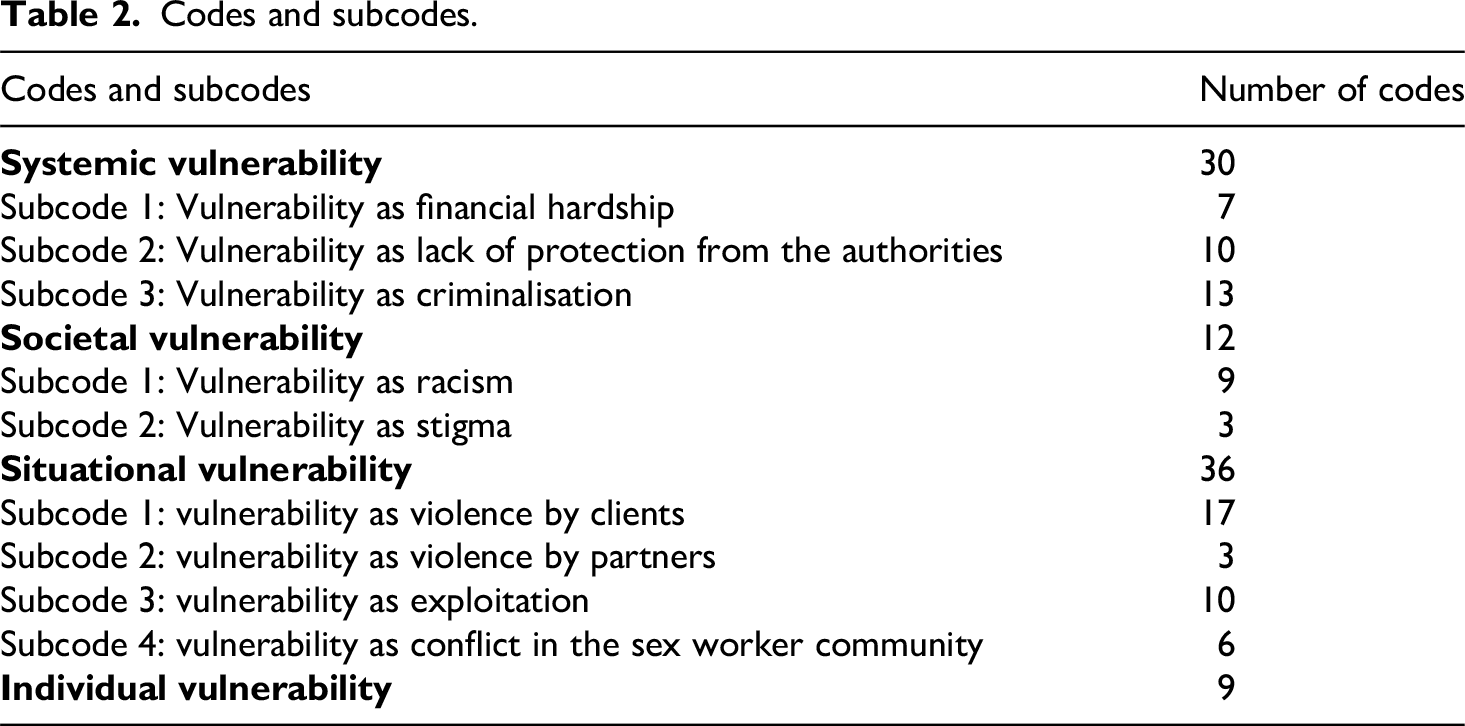
Interviewees were asked to provide a conjectural name and surname which could not be linked back to their person for safeguarding purposes. Interviews were recorded with participants’ consent; alternatively, detailed notes were drawn up. Once digitally transcribed, they were analysed via qualitative analysis software Atlas.ti. The coding process was inductive: although the two main macro-themes of vulnerability and resistance guided the analysis, relevant sub-codes were created based on trends organically emerging from reading the documents (Elo et al., 2014). Results were categorised based on these codes and allowed for a conceptualisation of vulnerability on four levels: systemic, societal, situational and individual (see Table 1 and Figure 1). This categorisation is somewhat reminiscent of and inspired by the socio-ecological model of violence (Courage to Act, 2022) yet emphasises the profoundly relational character of vulnerability, the mutual influence of the different levels and the overarching impact of time and space on human experience (Table 2).
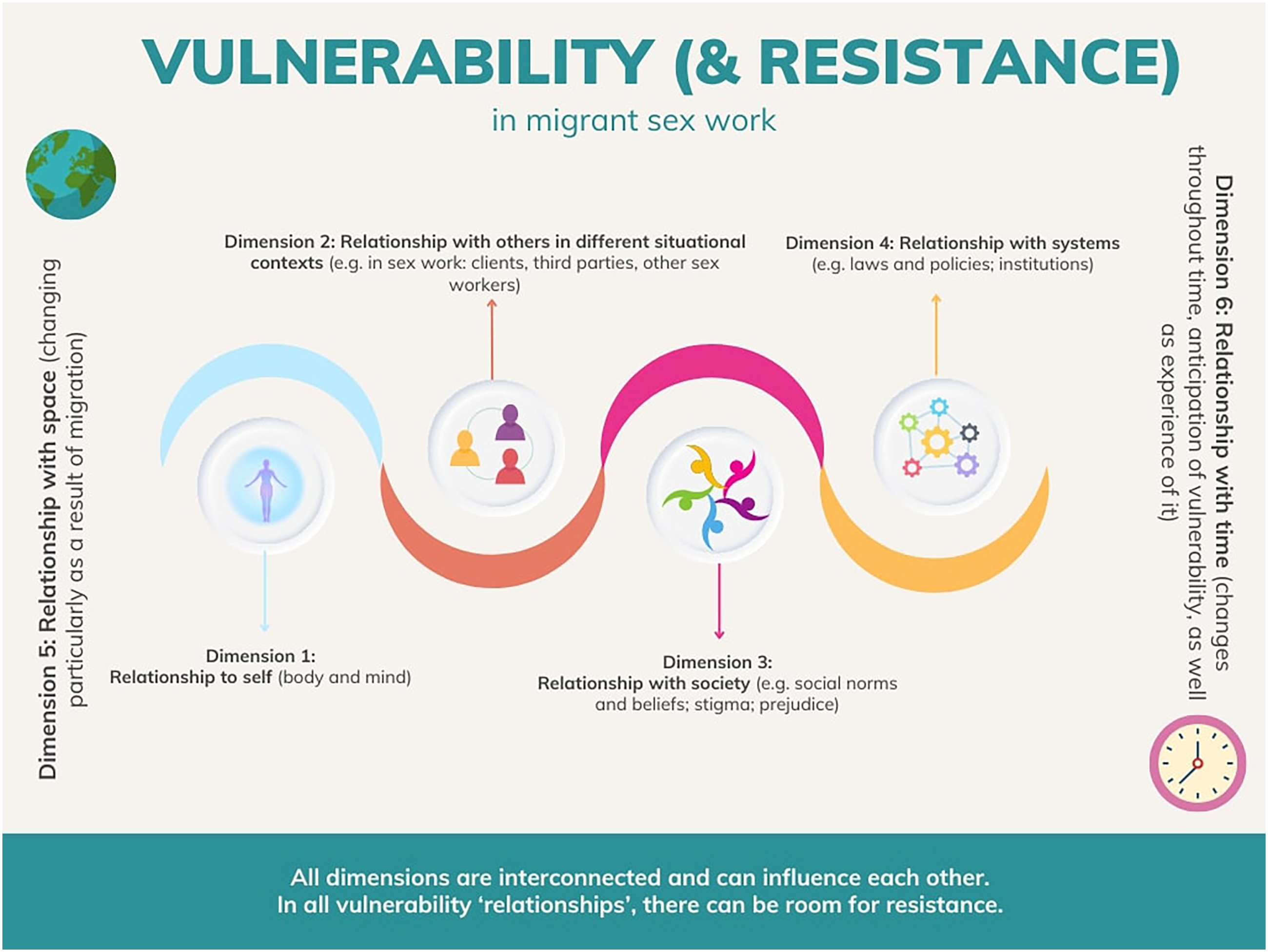
Vulnerability framework.
Characteristics of sample.
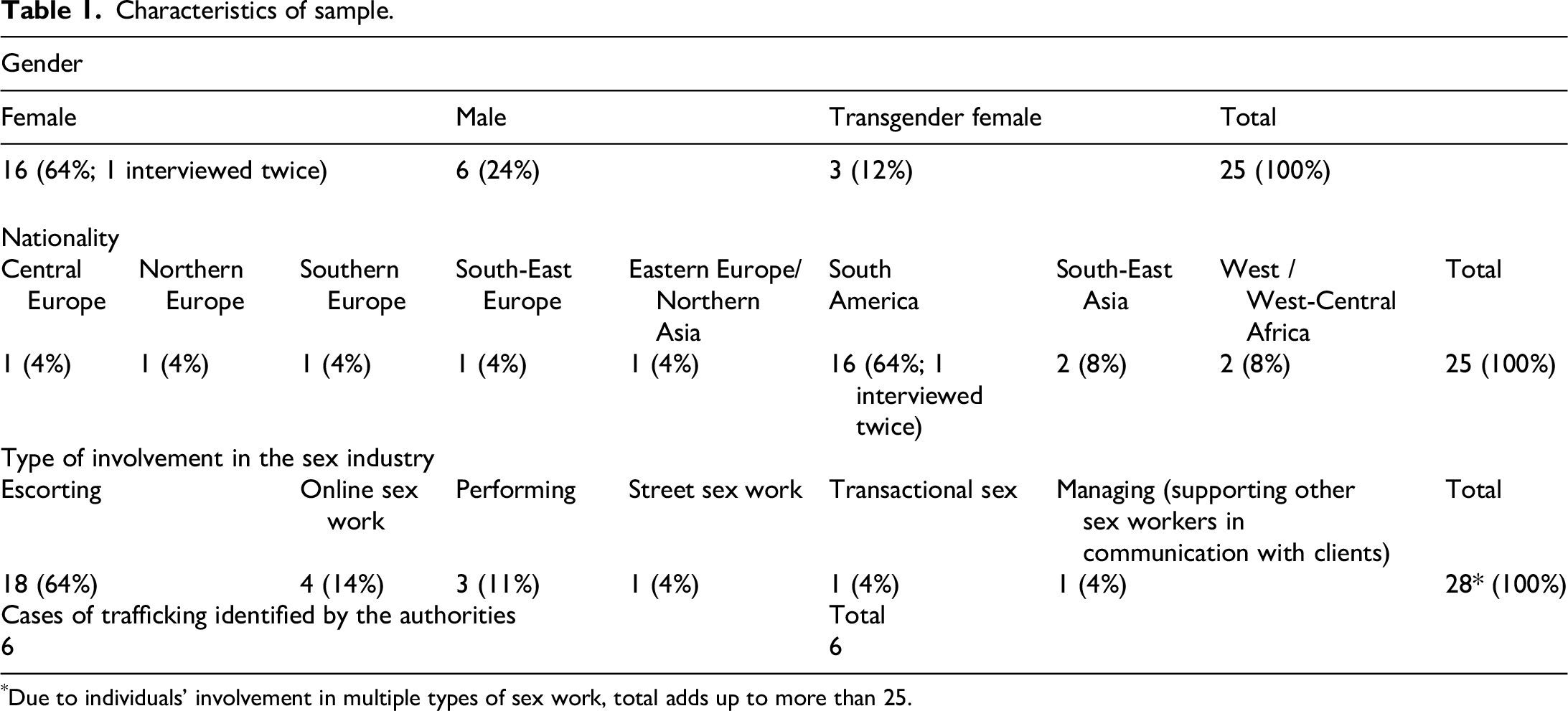
*Due to individuals’ involvement in multiple types of sex work, total adds up to more than 25.
Codes and subcodes.
The vulnerability framework must be situated within the broader context of vulneramentality, a concept I developed a posteriori to describe how vulnerability operates as a tool of governance based on the findings of the empirical data. Drawing on Foucault's theory of governmentality – which highlights the dispersed, often subtle nature of power through norms, institutions, and everyday practices (Foucault, 1991) – vulneramentality captures how neoliberal states manage populations by framing vulnerability as both a justification for intervention and a mechanism of control. As Butler (2009) notes, the act of naming vulnerability can grant protection to some while rendering others invisible or expendable. This dynamic is particularly evident in the treatment of migrant sex workers, who are either victimised or criminalised under migration and anti-trafficking regimes (Brown, 2015; Wacquant, 2009). Vulneramentality connects these structural forces to individual experiences, revealing how strategies of resistance or self-protection (Legg, 2018; Scott, 1985) are often reactive responses to entrenched precarity. It cuts across all six dimensions of the vulnerability framework: discourses on vulnerability shift across time and space (Dimensions 5 and 6), are embedded in societal and systemic structures (Dimensions 3 and 4), and also manifest in situational and individual lived experiences (Dimensions 2 and 1). While it can be internalised, vulneramentality can also be contested – individually or collectively – across each of these dimensions.
Ethical considerations
Malta, a small island shaped by colonial legacies and situated along major migration routes, holds an ambivalent stance toward foreigners (Xuereb, 2022). This contradiction is filtered through hierarchies of race, class, gender, and language, all of which shaped this research. My own foreignness, despite a white European appearance, became a point of connection with participants, many of whom expressed relief that I was not Maltese.
Multilingualism and regional familiarity further facilitated trust. Interviews were conducted in English, Italian, and Spanish, with occasional informal conversations in Russian. Speaking in participants’ preferred languages helped reduce asymmetries, although it led to an overrepresentation of Latin American voices. Moreover, while being a queer woman fostered rapport in stigmatised settings like sex work, it limited entry into gendered spaces such as massage parlours, where exploitative dynamics made access ethically difficult.
Importantly, participants knew I held no institutional power. Many had already received decisions on their claims, reducing strategic self-presentation. In one case, I followed up post-detention, which helped contextualise initial disclosures. Interviews occurred within a deeply stigmatised Maltese context, where sex work and migrant precarity are silenced and this is, in my view, also one of the reasons why participants chose to disclosure intimate narratives, given the frequent challenges to talk openly about their experiences.
This is not to deny asymmetries of race or migration status, but rather to problematise the dichotomy between ‘powerful researcher’ and ‘vulnerable participant’. Some participants, for instance, earned more in a month than I did in several, yet those same individuals could be deported soon after. Vulnerability is thus contextual, relational and often contradictory. Fieldwork becomes a site where these tensions are both encountered and negotiated.
Limitations
This study's strength lies in its person-centred, non-paternalistic approach to vulnerability, prioritising participants’ lived experiences. I avoided imposing external meanings onto their words, focusing primarily on their direct responses to questions about vulnerability or related themes such as safety and wellbeing. In detention settings, I refrained from asking about vulnerability explicitly due to participants’ already difficult circumstances. Still, reflections on vulnerability often emerged spontaneously.
A key limitation is the temporal specificity of participants’ accounts. Since vulnerability is dynamic and evolves with changing conditions (de Ruiter and Van Loon, 2022), responses may have been shaped by recent experiences or mood at the time. While I maintained informal follow-up with some participants, longitudinal tracking was not systematically possible, as many did not wish to stay in touch or relocated after their time in Malta. Despite the relatively small sample, the research makes a positive contribution in the light of the size of the island and the limited research in the field.
Results
Vulnerability at the systemic level
Given the extensive evidence that systems – intended as laws and policies – have such a significant impact on sex work (Oliveira et al., 2023), it should come as no surprise that vulnerability associated to the systemic level was one of the most frequently mentioned by participants. Systemic vulnerability was linked to three main sub-themes: financial hardship, lack of protection from the authorities and criminalisation.
Vulnerability as financial hardship
Financial hardship was a key systemic factor prompting entry into the sex industry during migration, though not the sole motivation. Participants framed financial vulnerability differently – ranging from inability to meet basic needs to the pursuit of a more comfortable life.
RS and RC, two young women from Latin America whom I met in a closed centre setting, had engaged in full service escorting both in their home countries and in Malta. When asked what had motivated them to access the industry, they mentioned ‘lack of alternatives’ (RS) and the need to ‘support the kids’ (RC). RC, a university graduate with previous work experience in the corporate sector, was quick to point out that: ‘money simply wasn’t enough’. Echoing this, AB qualified her previous involvement in cam modelling in South-East Asia as ‘just an easy way to earn money’.
In an analogous manner, JG spoke of the challenges of acting as her family's sole breadwinner highlighting how migration for sex work provided her with an opportunity to improve her financial circumstances: I was the one who contributed to my home, all my money was for my mother, a little for me and a little for the monthly travel expenses. It was not enough, I was always short, I was always short, so I took the decision to come to Malta because I had a relative here.
Although these dynamics are doubtless reflective of systemic patterns of vulneramentality, it was interesting to note that different individuals reacted and resisted in distinct ways to such pressures and forces based on their social positioning and resources. One of the manners in which this was observable related to negotiations over involvement in the sex work industry. If sex work and migration were viewed by various participants as a pathway out of financial hardship, there were also respondents who chose to access sex work selectively, when pressing financial needs arose. For VD, from Latin America, sex work was the most palatable alternative when she could not secure gigs in the beauty and wellness industry. When I have financial difficulties, I have to do it. … I have to, because living here is difficult and expensive, and I have a fairly high standard of living. [VD] I had a really bad month, I got Covid, I didn’t have any work and I couldn’t get any work and couldn’t see anything for the foreseeable future, so I started and I did really well in the first month. Now I’m a bit over it right now because I’m not putting as much of an effort into it but I still enjoy doing it. Really, if something happens, I wouldn’t know what the fuck to do. I don’t even consider it a vulnerability, it's become something almost normal, I’ve gotten used to it.
Vulnerability as lack of protection from the authorities
Vulnerability was expressed by many participants as the anticipation (or experience) of lack of protection from the authorities. BW recounted a time when she sought assistance from the police when fearing for her safety on the street, only to be turned away: I was once in a situation where I went to the police station at night and I was like: ‘guys drive me home because my buses have stopped and I don’t really feel like walking’… my part of town was known to be dangerous and they were like: ‘no we can’t’ and I was like : ‘why’? And they were like: ‘because you’re a woman’. And I was like: ‘that's exactly why you should drive me home because I’m a damsel in distress’ and they were like ‘no!’ And I ended up walking and I don’t like walking because I get honked at and it's a tunnel so they refused me in that sense.
In a similar manner, AR, a performer from Northern Europe engaging in digital sex work with previous experience of full service escorting, spoke of her fears walking the streets alone at night. While conceding that she ‘generally feels safe’, her knowledge of the authorities’ management of cases of sexual violence made her hesitant that should something happen, she would receive dignified support: Hearing all the facts of how people don’t get any kind of support, or if they are being somehow abused or getting sexual harassment or anything like that, it's not being handled at all, it's just being brushed under the carpet. It's not really reassuring, the safety … And that's also the reason why I haven’t done any new, like ‘proper’ face-to-face sex work here either … I don’t think it's safe to do that here. I: What about the police? Do you think the police would protect you? LO: Not the police! I feel protected from crime. I: Because there's less crime … LO: I don’t know statistically, but when you compared it with [country of origin]. Remember, all of Europe is [country of origin] … I don’t trust anybody. I: But if you needed to, would you call the police? JG: The truth is that no, because I’ve been here for 4 months and I became illegal. If anything were to happen, the police would accuse me that I am illegal. I can’t go to the police. Because first of all, you have a problem with a client and the first thing they threaten you with is the police. If they call the police, you go to [country of origin]. You have a problem with a trans woman who has documents from Italy … so they call the police, you go to [country of origin] and they go to Italy. [AG]
At the intersections of unstable migration status and engagement in sex work, vulnerability as lack of protection often spiralled into criminalisation. Cases in point are the testimonies of various participants who were apprehended by the authorities and detained in view of deportation. Me.M's and SV's vivid descriptions of this process are a window into this distressing lived experience.
The five of us were at home watching a series, I was waiting for a food delivery. They knocked on the door very loudly and I thought it was my delivery. One of my friends and I were caught in the bedroom, the others behind the kitchen. [MeM]
We were in pink pyjamas, I was scared, I didn't imagine it was the police. I thought they were bad people, I ran away. They took everything, cell phones, money, they started an investigation. [SV]
ZL and NB, also detained due to their involvement in illegal activities connected to sex work, spoke of detention as unjust punishment. ZL: You know, they treat us like criminals. We’re not stealing anything, we’re not hurting anyone, we’re not harming society in any way. We haven’t killed anybody, we haven’t stolen anything … NB: Yes, it's true, just like criminals.
Vulnerability at the societal level
Societal vulnerability describes vulnerability linked to exclusionary societal beliefs such as sexism, racism and other forms of discrimination. Overwhelmingly, participants reported vulnerability at this level in the form of experiences of racism in their everyday lives. AR from Northern Europe and PS from Latin America were vocal about discrimination in housing. The basic ‘go back to your country’ and ‘if you’re not happy about how things are handled here, why did you come here if you’re not happy about it’ … the amount of scamming that I’ve went through like through renting and getting my deposit back, it's crazy. [AR] They treat you like trash. They say that [country of origin] is corrupt, but sorry … someone come here and when it comes to housing, they put 3 people in a flat, 1500 euro for a flat. Here the minimum is 1200. How can you pay 1200 euro if you earn 1300, obviously you need to share with other people … Here the landlords do contracts for 9 people for flats. [PS] The level of racism here … you feel it, you perceive it, you hear it, you listen to it daily. A level of racism that increases with the gradations of skin tone. … Black people put to work on scaffolding, to bleach the walls of Valletta, Capital of culture … without a fucking protection, and only Black people. In the Covid frontlines, in all the Covid testing centres, there were only and exclusively Indian nurses and doctors! [AN] Racism, racism. Here there are a lot of racist. We still have slaves. Malta is a place for slaves. [LO]
As documented by international research (Benoit et al., 2018), stigma surrounding sex work, of which BW's experience is an example, is widespread and deep-seated. While some participants reported being open about their involvement in the sector with their family members, most chose to shield it from their loved ones. The stigma surrounding sex work is a clear expression of vulneramentality, compelling individuals to conceal their involvement and reinforcing marginalisation. Disclosure can simultaneously lead to internalising or resisting vulnerability labels: speaking openly may challenge stereotypes but also exposes individuals to scrutiny. Conversely, concealing sex work can deepen isolation yet offer a sense of protection. This tension reflects how vulneramentality shapes not only external perceptions but also personal strategies for navigating visibility and safety.
ZL's testimony below shows that vulnerability discourses rooted in stigma and stereotyped and sexualised beliefs around gender and national belonging extend to the police force, affecting policing practices and contributing to criminalisation. ZL: They found me sleeping … There was nothing in the flat, but the Prosecutor said that it was obvious that it was an ‘environment of prostitution’. They had no proof about this, but obviously then they started investigating and they found our profiles in the Escort page I: Why do you think they said this about it being an ‘environment of prostitution’? ZL: I don’t know, maybe because we’re from Latin America.
Situational vulnerability
Situational vulnerability describes vulnerability experienced in different situational contexts such as the workplace, in social interactions or intimate relationships. Situational vulnerability is often tied to systemic or social vulnerability, but finds its expression in interactions with others. For the majority of respondents, it emerged primarily in situations connected to sex work, involving encounters with clients, relationships with third parties or with other sex workers. In these interactions, vulnerability arose primarily as violence, exploitation and to a lesser degree, conflict within the sex worker community.
Vulnerability as violence
Vulnerability as violence by clients was one of the most common experiences relayed by participants. While for those working online, risks of violence were lower, participants engaging in digital sex workers spoke of harassment at the hand of subscribers or of other forms of violence stemming from their engagement in the industry (e.g., by intimate partners). As for other forms of vulnerability, violence was often experienced at different steps of the migration journey in sex workers’ interactions with clients. For the purpose of brevity and in the light of similarities between episodes shared by participants, here I focus exclusively on violence experienced in the sex work sector in Malta. In this work one sees everything. Clients who want to kill you, clients who want to rape you, clients who … everything. [AG] It's harder than in [home country], here they are coarser and bolder. [RS] I told him: no, I can’t give you your money back, I did my job, if you came quickly it's not my fault, you already came, you already paid me, you’re leaving. He stood up from the bed, I thought he was going to put his clothes on and leave, but he didn’t, he stood up and grabbed me by the neck. [AG] A boy much older than me, who wanted violent sex, but I hadn't understood it. And I managed to get him off my back. Once recently, someone came who wanted me to perform oral sex without a condom and became very aggressive … I recently had a psychological trauma. I attended a couple, normally I do not like women but for good money I do it. He asked me for money back and threatened me … I had an experience with someone who hurt me in intimate parts and I can't function … everyone is usually passive, and I can't function. [VD] An Indian man came, he took a look in the apartment, he took me by the neck and threw me on the bed. [PS] It happened with two clients who were violent and tried to strangle me. [BV] Then in the apartment across the street I helped a trans girl, she was alone. Then the guy told her he wanted to turn off the light, it was completely dark, and she said no, no, no, the guy hit her, turned off the light and with one arm he grabbed her here [mimics hands on neck] and with the other he grabbed her face like this, and he bit her face. Then she started screaming, and screaming … The guy was very high, very, very high, and he went out, we went up to the house, checking that the girl was okay and obviously she had a bruise here on her face, we looked for ice and everything. And that's when the guy came back and started banging at the door. There were five of us holding the door and we weren’t able to. The guy knocked down the door, knocked down the door and told us that he wanted to kill us. ‘I will kill you, I will kill you, I will kill you’. [AS] And I used to go to [location in Malta] at night and I did this for 14 years in [country of origin]. I should have learned something to protect myself. But before yes, I had a knife to protect myself. [LO] I had some problems, because I was in the site [for escorts] and I cancelled this to avoid some problems …And someone find me there and he was good male, muscles, whatever, 40 years, married and he told: ‘ok, I’ll bring whiskey and you can take whiskey. And do you mind if I take coke?’ And I said: ‘no!’ And he lost the control over himself … he was the double my size. This is the worst thing that happened here. And in this moment, I discovered how powerful I am because I raised my voice and said: ‘It’s time, you have to go now’. [LO] He then let me go and I pushed him away and told him that he couldn’t do that with me. He noticed I was super angry and he changed entirely, he was trembling. [PS] I was very new … I broke free, ran to the kitchen and grabbed a knife. ‘Either you’re going to leave, you’re going to leave the easy way or you’re going to leave the hard way’. [AG] He told me: you are an illegal here, I am going to call the police and let the police come to your apartment. I said, ‘Ok, call the police. I have your chat, I have your number, your photo, because I had your profile picture, I show this to the police’. Some out of shame for what I make public, say: ‘ok I'm leaving’.
Vulnerability as exploitation
Situational vulnerability also emerged in the form of exploitation, yet far from organised groups and ruthless traffickers being the only culprits, interviews revealed the existence of a broad constellation of responsible actors.
In the case of participants from Africa, the dynamics documented were akin to those highlighted by international research on trafficking and gender-based violence in migration (Adeyinka et al., 2023; Freedman et al., 2022a; Igbinomwanhia and Ugiagbe, 2024). It is worth mentioning that Malta has transposed the Palermo Protocol definition of trafficking into national legislation. 1
Both FE, a minor at the time of travel, and VM recounted experiences of exploitation in Libya. She [her neighbour] took me to Libya and I found myself in this place with many girls … I was happy I don’t know what I was going to do. After some hours, the girls tell me – you are not ready? They tell me some men will come and play with me and give me some money … In the evening I was called … She gave me to an elderly man. He asked me what is your name? And he asked me to remove my clothes. I tell him: ‘no! I’m not going to remove my clothes because my grandma told me that when a man touches you, you are going to get pregnant’, but my neighbour said: ‘You have to pay the money I used to bring you here. Do you think I bring you here for free?’ [FE] I was 19 and I lived in Libya in prison. I tried to escape many times, but it was too dangerous because the police would bring me back and there was so much abuse. The police would come and sell girls like me … It happened to me twice and the man would invite all his friends and say: ‘I have this toy’. It was really awful. [VM] I ended up here thanks to a friend of a friend who put me in touch with the person who runs the shop. I don't know his nationality. I was locked in a house for 2 months without going out. They had my passport and cell phone. [BV] Before I left, I was told I was going to be an escort and that I could have sex whenever I wanted, but that wasn't the case and I was forced to do it. I couldn't go out alone, and the deal was that 45% of the money I earned went to me and 55% to the bosses. [HL] This time was different from the last. I was only locked in the house for 4 days, seeing about 50 clients. It was very different and exhausting. [GG] I started working in [name of club] and then reality hit me … So they told me to do private dance. It was 10 euro dressed, 25 topless and 50 full. At first I said fuck it, I’m going to do it dressed, I am going to stay dressed up. But when you go in private, there are sofas and they are not separated. I do a dance dressed but then there is one gypsy next to you and she's doing all and blowjobs and this and what is one going to say? Obviously. And there it hit me. And the manager one day came to me and he told me …: ‘If you want to make money, you have to do what the gypsies are doing’. I travelled to Germany, I wanted to experiment. … But I had an experience with a man, he made me an appointment for a whole day. And I charged 1000 euros for one night … When I got to the apartment, the man tried to make a bank transfer and he told me: ‘there is no service but tomorrow we can go to the ATM, I'll withdraw the money and give it to you tomorrow’. And I said: no problem, go ahead … We went to the ATM and it was a very cold morning, very cold and there were no people … I had 200 euros in my bag, when I opened my bag the 200 euros that I had were not there … I got upset. ‘I'm going to call the police!’ ‘What police?’ And he ran away. And I was alone, it was raining, it was 6 in the morning, the sun hadn’t risen yet, I didn't have my 1200 euros to call anyone. I started to cry. [JG]
As with experiences of violence, responses to exploitation were shaped by participants’ individual capacities to recognise risk and assert themselves, for instance, by confronting clients who refused to pay. Yet this reliance on personal skill is itself symptomatic of vulneramentality in that responsibility for protection is devolved to the individual, while withholding structural support. This dynamic was particularly stark in cases of police exploitation, described in a few interviews, where power asymmetries rendered resistance near to impossible. Participants recounted instances of officers leveraging their authority to demand free services or impose informal sanctions, highlighting how those rendered vulnerable by systemic neglect are exposed to further abuse by the very institutions tasked to protect them. And in some cases policemen fall in love with the woman and that's that, you come with me, free services, this is really common. [AN] MM: Do you know I know this guy in the police, he is buying the drugs from me and once almost catch me and he suck my dick. I: What? MM: It's complicated situation … I: He almost caught you … MM: Yes and I started talking with him and he said it's illegal and that stuff and that stuff and I ask him: do you want to suck my dick, he was so fucking …. I put my pants down … (doesn’t finish sentence) I: And he did it? And he let you go? It only happened once right? (silence) I: No, more times? Same guy? MM: Yes
Vulnerability as conflict within the sex worker community
Although there were participants who spoke about community-building and mutual support among sex workers, there were also respondents who highlighted the vulnerabilities stemming from conflict with other sex workers. Tensions often developed, as both AG and SE noted, from competition over clients and occasionally intersected with broader acrimonies within the LGBTIQA + or other communities (Formby, 2017). I’m really scared for what I do and what I am. In fact, I am very scared of my own community. Some people are very bitter. [VD]
Vulnerability at the individual level
Although this paper does not focus on individual vulnerability, it is worth noting that it emerged in various interviews with respondents referring to internal states of mind and being, or the relationship with their own bodies. Reflecting on their experience in the sector, more than one respondent relayed feeling numb, disconnected from their spiritual side or cynical. A couple of participants revealed their struggles with sex addiction and the feelings of guilt and inadequacy that derive from them. Others spoke of the challenges stemming from living with HIV 2 or grappling with loneliness. Despite this, it would be a mistake to attribute vulnerability at the individual level to participation in the sex work industry, given that various participants spoke with pride about their ability to flourish in the sector and the sense of empowerment gained from it. This was particularly the case for participants engaging in performing, who described vulnerability as intimately connected to exposing one's body, whilst also highlighting the powerful sense of empowerment linked to it. At the same time, as previously underscored, vulnerability at the individual level was often influenced by broader vulneramentality mechanisms, evident in the widespread anxiety shared particularly by those who feared removal as a result of irregularity.
Conclusions
When I first set off to design this research, I had no expectations as to what I would find. Yet as I analysed my fieldwork data, I was struck by I was struck by the pervasiveness of experiences of vulnerability. Despite their diverse backgrounds, all participants – without exception – mentioned vulnerability. In line with philosophical perspectives, vulnerability emerged as an ordinary yet widespread feature of human experience (Boublil, 2024; Butler, 2016; Gilson, 2018).
Although participants shared exposure to systemic, societal, situational, and individual vulnerabilities, their experiences were far from uniform. This reflects trauma literature suggesting that while harmful events may have shared features, people experience them in distinct ways (Muldoon et al., 2019; Olff et al., 2025). Recognising vulnerability, therefore, requires attention to specific lived experiences while remaining alert to the systems that produce them.
In Malta, migrant sex workers’ experiences of vulneramentality are shaped by intersecting factors – gender, race, class, and migration status. Yet, as theories of situated and context-driven intersectionality remind us, such categories cannot fully account for the complexity of individual lives (McKinzie and Richards, 2019; Yuval-Davis, 2015). Politics, histories, and geographies matter too, intersecting with personal value systems and self-understandings.
Vulneramentality plays a role in exacerbating extant vulnerabilities, pushing further to the margins already marginalised populations. It also creates novel ones, where they did not originally exist, with the ultimate objective of further entrenching exclusion. This is also, most likely, the reason why it was difficult to identify instances where vulnerability can be a site of care, empathy and joint recognition of a shared human experience – as such positive potentials are significantly constrained in contexts of criminalisation. Although there were reports of sex working uniting to support each other, these cases were quite isolated. The legal and social environment fosters stigma, surveillance and fear, thereby privileging isolation and individual reliance and foreclosing the possibility for vulnerability to be embraced or mobilised as a source of solidarity or freedom. The mismatch between philosophical inquiries around vulnerability and the lived experiences of marginalised groups is further evidence of the value of the research undertaken for this paper and of the pressing need for further exploration in this direction.
Understanding vulnerability in migrant sex work necessarily requires taking stock of migration regimes, their impact on the push to migrate and on the experience of migration, whilst also paying attention to criminalisation and widespread gaps in protection for sex workers. In Malta, these gaps have concrete reverberations over migrant sex workers’ safety from violence and exploitation. Although migrant sex workers creatively leverage different strategies to resist systemic vulnerabilities depending on their personal resources, their social positioning and their location within the sex work industry, their ability to resist restrictive systemic factors, remains, understandably, limited.
Resisting vulneramentality cannot be an individual endeavour: it requires structured and coordinated reform at different levels of society, not least in the sex work policy, migration and labour fields. This paper has shown that empirical research rooted in the lived experience of vulnerability is instrumental to better understand vulnerability as conceptualised by individuals who are commonly labelled ‘vulnerable’. Further research is needed to build onto these insights and support meaningful policy change in migrant sex work in Malta and beyond.
Footnotes
Acknowledgements
I wish to acknowledge the precious time that my research participants have dedicated to me, sharing intimate details of their lives and trusting me with them. Moreover, I would like to thank my supervisors, Prof. Dr Mr Maartje van der Woude and Prof. Dr Joanne van der Leun for their ongoing support.

Ethical approval and informed consent statements
This study was approved by Leiden Law School Ethics & Data Committee on 12 April 2022 with protocol number 1326. Consent for publication was provided by all research participants.
Funding
The author(s) disclosed receipt of the following financial support for the research, authorship, and/or publication of this article: The author would like to acknowledge financial support from the Dutch Society for Criminology partially funding her fieldwork.
Declaration of conflicting interests
The author declares no potential conflicts of interest with respect to the research, authorship, and/or publication of this article.
Data availability statement
The data that support the findings of this study are available from the corresponding author upon reasonable request.