



Abstract
Background
The aim was to explore how the clinical ethics committees in Norway have worked and functioned within mental health care and addiction treatment services.
Methods
Analysis of 256 annual reports from clinical ethics committees from 2003 to 2012 and a survey to clinicians who had used a clinical ethics committee.
Results
Dilemmas related to coercion, confidentiality, information, and patient autonomy dominated. The committees established only for psychiatric hospitals, had received more cases from mental health and addiction services than the committees also serving somatic services. Many of the case discussions involved both somatic and mental health care, complicated legal issues as well as ethical dilemmas. Mental health care professionals that have used the clinical ethics committees evaluated the clinical ethics committees deliberation as useful.
Conclusion
Given the many difficult ethical dilemmas in mental health care ethics work need to be strengthened. The complexity of the cases requires varied and interdisciplinary competence and training among the clinical ethics committee members.
Introduction
In Norway, ethics support in hospitals is mainly provided through clinical ethics committees (CEC). The CEC generally serves both mental health care and somatic services. With substantial economic support from Norwegian Health Care Authorities, all 20 Norwegian health trusts have one or more CECs today. 1 Five trusts have had committees specifically for mental health care and/or addiction treatment; three of these remain active today. Centre for Medical Ethics (CME) has the national responsibility for building competence in the committees, as well as doing research and evaluating their work. In addition to having hospital staff as its members, many of the committees have external members with legal or ethics competence, and a patient- or lay-representative. The committees write annual reports that CME usually receives a copy of. Evaluations of the work suggest that the committees work with important questions, and that they are seen as useful by clinicians dealing with ethically difficult decisions.2,3
The impression, after nearly 20 years’ work, is that CEC work has been dominated by somatic health care. In order to bring mental health care and addiction treatment more into clinical ethics work, it has been recommended that one or more committee members are representatives from the mental health or addiction field. 4 Norwegian health authorities have declared that coercion in mental health care should be reduced. Use of coercion is one of the most difficult ethical challenges in somatic as well as in mental health care. Norway has two separate laws regulating coercion in somatic and mental health care. In the law regulating forced somatic treatment to a patient who resists such treatment, lack of competence to consent is the main criteria. In the mental health care legislation, however, lack of competence is not among the formal criteria. There, the main criterion for using coercive measures is serious mental disorder. 5 Furthermore, one of the two following has to be fulfilled: The psychiatric treatment is deemed to be necessary due to the potential treatment benefits for the patient (“the treatment criterion”) or that the patient is assessed to be a great danger to himself/herself or to others (“the danger criterion”, e.g. suicidal patients).
In 2011, CME received funding for a 3.5-year project called Psychiatric Health care, Ethics and Coercion (PET). The goal was to strengthen ethics work in mental health care and addiction treatment, with a special focus on coercion. A central question in that regard is whether the CECs’ activity contributes to strengthen ethics in mental health care and addiction treatment. The aim of this article is to summarize the work of Norwegian clinical ethics committees relating to psychiatry and addiction, with special focus on the following questions:
How many cases from mental health care and addiction treatment has CEC discussed, and what is the distribution of cases between somatic and mental health care/addiction treatment? Which topics are central in CEC discussions from mental health care and addiction treatment? Other activities relevant for ethics in mental health care and addiction treatment? How do clinicians who have used CEC to discuss cases from psychiatric wards and addiction treatment evaluate the discussion?
Material and method
The study is divided in two. The first part is a review of annual reports the Centre for Medical Ethics received from the committees over the last 10 years (2003 to 2012). These reports contain descriptions of the cases which have been discussed in the CECs, and the activities which the committees have been involved in during the year. If all the existing CECs had written an annual report in this period, and if all these had been sent to CME, we would have received 339 annual reports. In this study, “case” means discussions of ethical dilemmas tied to specific patients, as well as more general discussions of ethical dilemmas the health professionals encounter. Search for case discussion and activities related to mental health care and addiction treatment was done through thorough reading of all the reports and digitally through the following search terms: different terms representing psychiatric and addiction diagnoses, mental health services and drug addiction services, coercion, competence, and consent. We included any cases and activities that emerged within mental health care and addiction treatment, and also tasks related to somatic services if a psychiatric diagnosis or drug addiction was a dominant aspect. When we were uncertain of whether or not cases were relevant to this study, or more information was needed, we attempted to obtain supplementary information from the. After inclusion, we read through all the included cases and other activities, and agreed upon a list of the most common ethical topics represented in the cases and a list of other types of activities. These lists were also inspired by previous similar studies of health care.2,6–8
Topics in some of the 144 cases from mental health care and addiction treatment that were discussed in clinical ethics committees between 2003 and 2012.
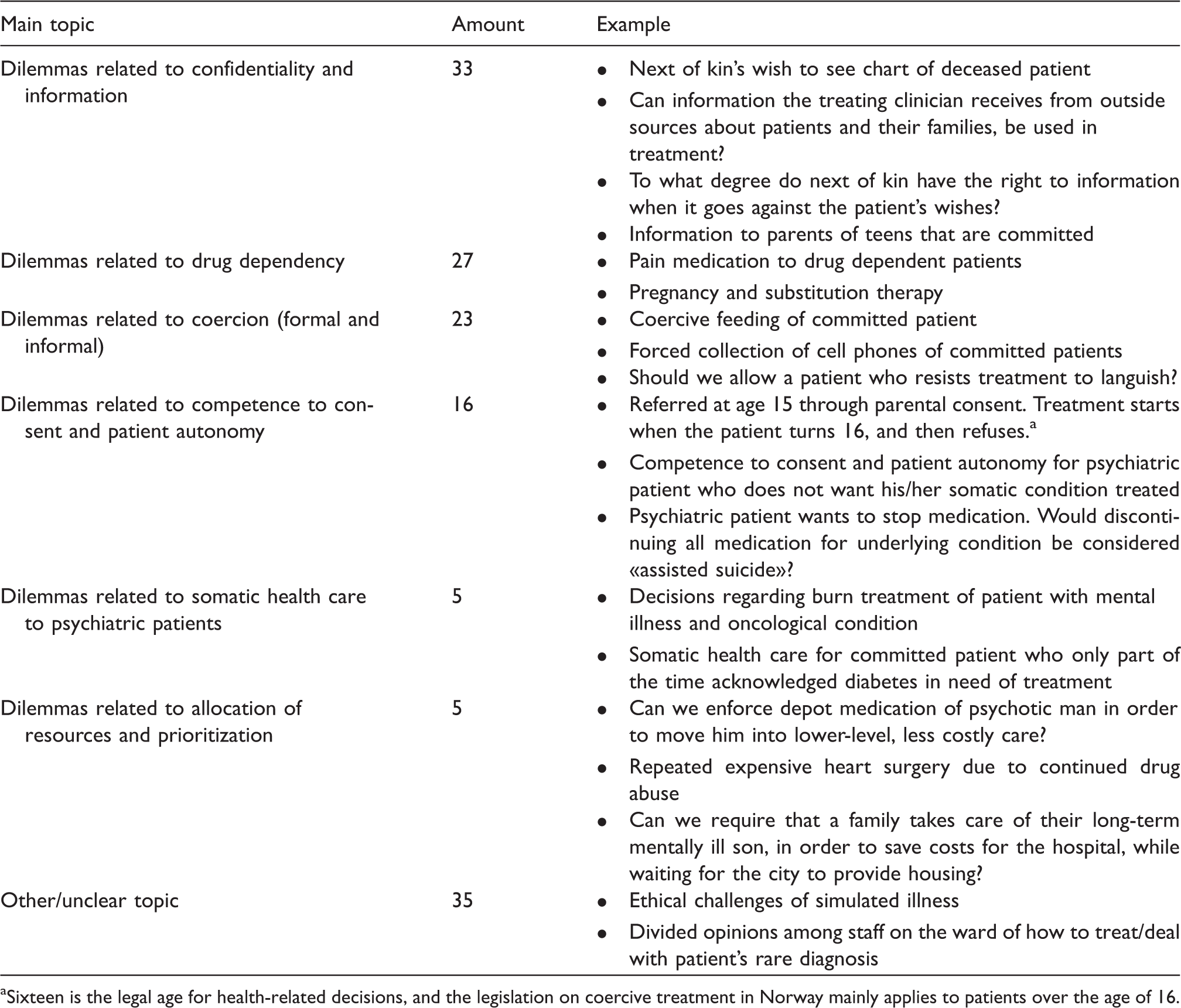
Sixteen is the legal age for health-related decisions, and the legislation on coercive treatment in Norway mainly applies to patients over the age of 16.
The second part of the study is based on re-analysis of data from a study assessing clinicians’ evaluations of CEC after referring a case to CEC. 2 Previously, these data have been analyzed and published collectively for somatic medicine and psychiatry. Now we wanted to specifically look at whether mental health care professionals also saw the CEC discussions as useful. In May of 2008, the Centre for Medical Ethics requested that all ethics committees in Norway pass on a questionnaire to all clinicians who had submitted cases to the committee over the last 18 months. The survey was anonymous, and the questionnaires were returned directly to the Centre for Medical Ethics so that the clinicians could answer the questions without fearing negative reactions from their colleagues in the local CEC. To acquire an overview of the response rate, each ethics committee was asked to report how many questionnaires it had distributed. The form contained 27 questions, including: why the ethics committee had been contacted, the ethical problems in focus, and the clinician’s assessment of the outcome of the CEC discussion. The clinicians were asked to score the usefulness of the CEC discussion on a scale from 1 (not useful) to 5 (very useful). For this particular study we chose the five questions which were relevant to our topic: the number of cases dealing with mental health care and addiction treatment, why CEC was contacted and the clinicians’ evaluation of the CEC discussions.
Results
In the 10-year period, CME received a total of 256 annual reports which is at least 75% of all possible annual reports. As the number of CECs has increased during the study period, the number of reports received varied from 9 in 2003 to 35 in 2012. The layout and length of the reports vary from 1 to 12 pages. Accordingly, the cases described vary substantially from one or two sentences to one or two pages. It turned out to be difficult to obtain supplementary information because meeting notes were hard to access, or were inadequate, as well as some cases being so old that no one remembered them.
Of the 775 cases described in the reports, we found 144 cases related to mental health care and addiction treatment. These 144 cases were then scrutinized more closely, and categorized. In addition, we found a number of cases where we could not know whether they came from a somatic or psychiatric ward. These were equally relevant to both types of health care, and some examples are: “Committee has discussed ethical dilemmas in a patient case tied to use of coercive treatment”. “Confidentiality and necessary information to follow patients”. These types of cases were not included in our study. Among the 144 were 27 cases related to addiction. The five committees that were only serving the mental health and addiction treatment field were responsible for 45 (31%) of the total 144 cases. Many of the cases contained several ethical dilemmas and were categorized according to the main ethical dilemma. The most common dilemmas were related to confidentiality (33), dilemmas related to drug dependency (27), formal/informal coercion (23), competence to consent and patient autonomy (16).
Topics in the CEC discussions
As already mentioned, many of the cases were complicated—ethically, legally, and medically. In the following example, self-harm had resulted in repeated need for somatic treatment: Is it right to use coercive mental health care and custody to prevent self-harm, when it is against the patient’s will, and when the patient most likely does not have the competence to consent, but we are unsure of whether the patient suffers from serious mental disorder?
This case raises questions such as the correct use of coercion, self-harm dilemmas (in which somatic health care, and prevention and treatment of serious somatic injuries are involved), assessment of competence to consent, and uncertainty regarding the main legal criteria (serious mental disorder). The case also illustrates how having different laws for psychiatric and somatic health care complicates cases in which mental disorder with serious somatic consequences are involved. The following retrospective case also illustrates the fact that somatic and mental illness frequently are intertwined, and that coercion and voluntariness may be particularly difficult to deal with when the patient has a serious somatic illness and also suffers from mental illness. The handling of the case had led to uneasiness on the ward, and the question was whether the case could have been solved differently.
This was a depressed patient in a psychiatric ward for the elderly. The patient also had a serious somatic condition and was in need of an urgent somatic intervention. However, the patient resisted such treatment, she wanted to die. The wish to die appeared understandable, and the patient did not lack the competence to consent. The ethical dilemma was: To which degree was it acceptable to use pressure to obtain consent for somatic treatment. The CEC discussion clarified the different values and interests, and the staff found the discussion to be useful, and something they would use in similar cases in the future.
A third case illustrates how laws and professional ethics seem to be in conflict: This was a seriously ill, self-harming, unruly youth with a developmental disability. The only thing that would calm the patient down was isolation. The patient was under the legal age that allows for such measures. Yet, treating staff described this as the least violating, and most justifiable way to treat the patient’s behavior. The responsible health care personnel needed a view from outside on whether their unlawful action aiming at the patient’s best could be ethically justified. 9
Other activities
Of 912 activities described in the reports, 153 were related to mental health care and addiction treatment. Fifty four committees reported that they have arranged seminars/lectures with topics relating to mental health care and addiction treatment (a total of 153 seminars/lectures/other activities), or worked in other ways with ethics in mental health care. The committees specifically for mental health care and/or addiction treatment were involved in 112 activities. The main topic in the majority of the seminars was different ethical aspects of the use of coercion, for instance coercive addiction treatment, or coercive feeding of children and teens. Another example is when and how to assess the competence to consent. Several committees have held seminars for new employees, or ethics lectures for residents. Other examples of activities include: onsite reflection groups, writing consultative comments, or designing guidelines for areas of mental health care. The topics of the seminars were often based on complex cases that the committees had discussed.
Clinicians’ evaluations of the CEC discussion
Twelve of the 43 cases evaluated by the clinicians, and included in the previous study, 10 were related to mental health care. All were referred because the clinicians wished to elucidate the values and challenges at stake, and 11 of the 12 also requested a discussion in order to learn from the case, to reduce difficulties in similar situations in the future. Five of the 12 clinicians requested a discussion to get advice regarding a difficult decision. Seven of the 12 cases involved issues of coercion, three involved resource allocation issues, and in three of the cases confidentiality/information dilemmas were involved. The clinicians evaluated both the prospective discussions and the retrospective consultations as useful. Professionals in mental health care and addiction treatment reported an average of 3.6 (of maximum 5) for perceived usefulness of the ethical discussions, compared to 3.3 in somatic services.
Discussion
With this many, and such varied cases as described in the annual reports, the reports are shown to be valuable documentation material that gives us insight into what kinds of ethical dilemmas dominate mental health care and addiction treatment. Especially important is insight into how intertwined somatic and psychiatric health care can be, in some of the most difficult ethical dilemmas. All the activity that the committee partakes in, regarding mental health care and addiction treatment, shows the great span of this work. Although the evaluation done by the clinicians who have used CEC in individual patient cases only includes a few clinicians from mental health care, the survey indicates that the clinicians find the CEC discussion meaningful. The survey confirms the findings from the annual reports; cases which include formal and informal coercion and patient autonomy issues, dominate.
Distribution of cases between somatic and mental health care/addiction treatment
It is worth noting that a small group of committees, working only for mental health care and addiction treatment, have had a relatively large amount of the cases. Somatic medicine cases by far outnumber psychiatry, and addiction treatment in Norwegian health care—in terms of operating costs and positions—and also in the cases and other activities included in the CECs work. However, given the many obvious ethical dilemmas in mental health care involving vulnerable and powerless patients, the number of cases from mental health care seem somewhat underrepresented in the committees which serve both somatic and mental health care. 11 It may be worth asking why? One reason could be that the field is more heavily regulated by law than the somatic, and therefore staff members that are in doubt of what is right or wrong consult laws first—for instance through the control commission—before consulting the CEC. 12 The commissions control the use of coercion in psychiatric health care, and the patient may contact the commission to complain about coercive measures. At the same time, we cannot ignore the possibility that the threshold for bringing difficult cases to clinical ethics committees is higher than in somatic care. Perhaps onsite ethics reflection groups on the wards (which some health care trusts in Norway have established within mental health care) are a less “threatening” forum to vent doubt and uncertainty in? These reflection groups generally only include employees on the ward, and are facilitated by one of these employees, who has received special training. Yet, some cases are so complex, as well as being conflict-ridden that consulting a forum with some more distance from treating personnel and sufficient interdisciplinary competence may be necessary. An alternative and perhaps less threatening model to a CEC in such conflict-ridden and complex cases would be a smaller group or team with special competence in ethical dilemmas in mental health care. 13 Such a team could either be a part of the CEC, or a freestanding team, instead of or in addition to CEC. Reflection groups, moral case deliberation groups, and ethics rounds may also be valuable supplements to a CEC.
Complicated cases require comprehensive competence
Many of the cases from mental health care and addiction treatment require complicated ethical, as well as legal, judgments. In addition, sufficient medical, psychological, nursing, and social care knowledge are necessary when the diagnostics is challenging and the prognosis uncertain. A well-functioning CEC with varied and interdisciplinary competence can contribute to the case being discussed in sufficient breadth and depth, and also to a better involvement of all stakeholders, which in turn can lead to more important clarifications and more and better possible solutions. The annual reports show that a majority of the committees have members with professional backgrounds in mental health care and addiction treatment. We see it as both a strength and a necessity that the “case owner” takes part in the discussion along with anyone who can illuminate the case. In this way, necessary information and professional skills are brought into the discussion. By participating in the CEC discussion, the “case owner” obtains a closeness to the discussion that a report cannot give. Kalager’s survey 2 found that the majority of those clinicians who contacted CEC for a case discussion also wished to “get an outsider’s view” on their case. The fact that difficult cases are also used actively in seminars for the staff, suggests that the case discussions can be arenas for learning, even for those not directly involved in the case.
Implications for practise
The fact that the five committees that have served the mental health and addiction field have had a relatively large proportion of the cases (one-third), strengthens the idea that it may be useful to have specific committees for mental health and addiction. Due to the complexity of the cases, a prerequisite for having specific mental health committees is that they can obtain a high enough number of cases to build sufficient experience and competency. One reason for having CECs serving both somatic and mental health care is that many cases involve mentally ill patients who refuse health care for somatic conditions, or patients under somatic care who also have mental health problems, which complicate treatment and care. Accordingly, all CECs need members from both mental and somatic health care services. This study does not warrant a firm conclusion of whether separate CECs for mental health care is the best model for strengthening ethics support and reflection in this field. As members of various CECs, and through close contact with all the CECs in Norway, our impression is that the health care trusts that now have a committee serving only mental health care and addiction treatment, have found it to be useful to invite members from the other committee (serving somatic services) into these kinds of complex cases.
Weaknesses of the study
A flaw in most of the annual reports is that the cases that have been discussed are described so briefly that it may be difficult to elucidate precisely what the problem really was, why the case was brought to CEC, how it was treated, and what the outcome was. One reason for this could be the demand for anonymity in the annual reports that is especially important in smaller hospitals and in cases from psychiatry and addiction treatment, where personal traits and disorders can be important facts in the case. The overlapping categories are another weakness. The strength of the study is that the data material is extensive; it illuminates the complexity of the cases in mental health care and addiction treatment.
Conclusion
The review of annual reports shows that many cases from mental health care and addiction are brought for discussion in Norwegian clinical ethics committees and coercion and confidentiality topics are common. Clinicians who have referred cases find the discussion useful. The few hospitals that had their own committees for mental health care and addiction treatment had had the most cases from this field, relatively speaking. Given the field’s ethical weight of seriously ill and vulnerable patients, it seems reasonable to suggest that focus on mental health care and addiction in ethics committees should be strengthened. We have no reason to believe that the situation in Norway is different from other European countries.
The many cases that have a mix of somatic and psychiatric health, and complicated legal questions, especially dealing with coercion, show the necessity of varied and comprehensive competence and training among CEC members.
Footnotes
Authors’ contribution
All three authors have contributed to the conception or design of the work; or the acquisition, analysis, or interpretation of data for the work and drafting the work or revising it critically and final approval of the paper. All authors have consented to publication and that the paper has not been nor will be published elsewhere.
Declaration of conflicting interests
The author(s) declared no potential conflicts of interest with respect to the research, authorship, and/or publication of this article.
Funding
The author(s) received no financial support for the research, authorship, and/or publication of this article.