



Abstract
Pharmacists play a central role in caring of diabetic patients. During patient-centered care, important ethical issues and conflicts may arise, which makes ethical skills for pharmacist important toward conflict-resolution so this study aimed to assess compliance of Iraqi pharmacists with ethical principles while providing their care to diabetic patients. A cross sectional study by a validated questionnaire format was given to a convenient sample of 95 community pharmacists in Baghdad—Iraq. The questionnaire assesses the ethical practices of each pharmacist by using indirect questions through a simulated case which is commonly encountered in private pharmacies in Iraq. Most participated pharmacists failed to respect patient autonomy and they are not encouraging their patients to participate in decision making about their treatment. Participated pharmacists also failed in applying ethical principle of veracity during educating the patient about serious drug side effects. Furthermore most pharmacists had financial conflict of interests that undermine the pharmacist ability to fulfill the primary professional and ethical obligation to ensure patient's beneficence, justice and autonomy. Meanwhile most participated pharmacist may be good in maintaining their professional competence, yet the majority failed to develop their competence by keeping their knowledge up to-dated. In conclusion pharmacists failed to apply ethical principles during their usual care for diabetic patients.
Introduction
Diabetes mellitus (DM) is a heterogeneous metabolic disease with worldwide prevalence of more than 7.5%.1–3 This prevalence is higher in Middle East countries 4 approximating 20% in Iraq. 5 DM is associated with micro-vascular complications such as retinopathy, nephropathy and neuropathy; and macro-vascular complications such as myocardial infarction, hypertension and peripheral arterial disease. 6 Control of blood glucose level is essential to prevent both acute and chronic complication of diabetes especially in newly diagnosed DM patients. 7 Pharmacists play a central role in caring for DM patients to ensure tight glycemic control through patient education about their drug usage and drug monitoring not only to assess drug safety and effectiveness but also to assess patient adherence to anti-diabetic medications. 8 As pharmacists move toward more patient-centered care, important ethical issues and conflicts may arise within the therapeutic relationship, requiring the pharmacist to use ethical knowledge and skills for conflict-resolution. 9 With deeper understanding of the pharmacist to ethical principles and pharmacists' code of ethics, an improved therapeutic outcome for the patient is likely to be achieved. 9 So this study aimed to assess the compliance of Iraqi pharmacists with the pharmacists' code of ethics while providing their care to diabetic patients.
Methods
Sample size and study design
A questionnaire was approved by ethical committee of Baghdad University—College of pharmacy (Appendix). The questionnaire was given to a sample of 95 community pharmacists who work in Baghdad—Iraq during June 2015, selected on the basis of convenience; all were informed about the aim of the study. Seventy-four (78% of the 95) pharmacists agreed to participate in this study.
The questionnaire that was used in this study to assess the ethical practices of the pharmacist during his/her care for diabetic patients was prepared by the authors of this study and based on the American diabetes association code of ethics for care of diabetic patients. 10 The questionnaire was reviewed by two clinical pharmacists who were asked to help in identifying any vague words or unclear questions. The questionnaire has two parts. The first part contains general questions like the gender, age, degree of education and years of experience for the participating pharmacist. The second part focuses on assessing ethical practices (patient autonomy, veracity, professional competence and pharmacist's conflict of interest) of each pharmacist.
The second part uses indirect questions through a simulated case (a prescription with scientific name for anti diabetic medication for a diabetic patient), which is commonly encountered in private pharmacies in Iraq.
Statistical analysis
Chi square test was used to test the statistical significance of difference for categorical variables. A web version of chi square calculator from the following site was used for this purpose. http://www.quantpsy.org/chisq/chisq.htm
The p values less than 0.05 were considered significant.
Results
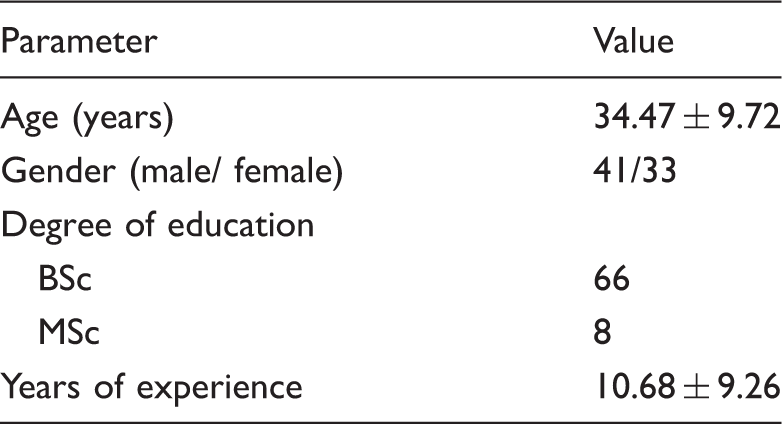
General demographic data for participated pharmacists.
Pharmacist's response to dispense anti-diabetic medication that is written in its scientific name in the prescription.

For this question, any pharmacist who answered one of the two medication dispensing questions with yes and the other with or no was not included in statistical calculations.
Pharmacist role in educating and caring of diabetic patients.

Pharmacist financial conflict of interests.

Ethical response of participated pharmacists to the simulated cases.

Discussion
In this study, the aim was to assess the ethical practices of pharmacists during their usual care for diabetic patients. Since it is very difficult to directly monitor pharmacists in their community pharmacies, this study was designed in a questionnaire format that is commonly used in health research.11 It is well known that the answers in such questionnaires may be subjected to a high degree of bias. Therefore the questions were written and arranged in an indirect way to reduce the likelihood that the pharmacists would not be able to guess the subtle aim of each question.12
In the questionnaire of this study, the answer of the pharmacists for the first two questions (indirect questions) about medication dispensing was used to assess the pharmacist's role in respecting the ethical principle of patient autonomy by allowing each patient to share a decision about his/her treatment without any obliged recommendation by a pharmacist.
This study showed that the majority (85%) of the pharmacists who responded prefer to dispense medications from a specific manufacturer according to prior pharmacist's knowledge with physician preference without discussing available treatment options to the patient. Similarly it was found that pharmacists usually dispense prescribed medications according to physicians' preference for medications from specific manufacturers.13,14 Additionally physicians are usually reluctant to the role of the pharmacist of discussing available treatment options to the patient15 and since the majority of pharmacy income is dependent on physicians' prescriptions,16 so it is reasonable that pharmacists try to avoid conflicted situations with physicians to ensure physician satisfaction to maintain the economic gain in the pharmacy from his/her prescriptions.
On the other hand, the result of this study showed that most (77%) of the responding pharmacists override patient autonomy by recommending a specific product to the patient if it is available in the pharmacy in large quantities without incorporating the patient in a scientific discussion about available treatment options.
Similarly WHO17 stated that the availability of medication can drive medication dispensing in pharmacies. Social relationships between pharmacists and physicians can also affect the choice of dispensed medication.
Previous studies found that providing patients with information about generic alternatives could help them choose medications with lower costs, which may be more suitable according to their limited budget.18 This ethical action is very important in countries with many people below poverty line like Iraq.
According to the questionnaire design in this study, only five pharmacists who did not accept to dispense a medication according to their opinion or availability in pharmacy were allowed to answer the next question which was a direct question to assess pharmacist's role in encouraging patient to take an active role in decision making through discussing all treatment options with the patient; Only one of the five pharmacists mentioned that he did not discuss treatment options with his patients at all, while the remaining four pharmacists at least sometimes were discussing treatment options with their patients.
In this study 69 (93%) of pharmacists make direct decisions about patient treatment without discussing available treatment options with the patient, Sameem and Al-Tukmagi19 stated that only 52% of Iraqi pharmacists do not discuss the available treatment options with their patients. It may be that the difference between the findings is because that the pharmacists in the Sameem study were asked in a direct way, while in this study all questions were indirect. Also, that the questions in that study were general rather than specific questions for pharmacists during their care for diabetic patients.
Overall 95% of participated pharmacists were failed to comply with ethical principle of respecting patient autonomy, similar to the finding of this study it was found that the application of ethical principle of respecting patient autonomy is poor by pharmacists.20 Meanwhile patient autonomy should be respected according to pharmacists code of ethics through encouraging the patient to share decision about his care with other health care professional21; additionally the incorporation of a diabetic patient in discussion process with health care professionals can result in excellent medication adherence and hence better therapeutic outcome in regard to blood glucose control.22
One of the major ethical roles for pharmacists is patient education and counseling which improve patient compliance and adherence to prescribed medications that results in treatment success23 which in turn leading to clinically and statistically significant improvement in the quality of life of the patient. 24
In this study, questions 4 and 6 were indirect questions to assess pharmacist's veracity in educating the patient about proper use of the prescribed medication to ensure beneficence to the patient.
This study showed that although 77% of participated pharmacists are honest in educating patients about physician instructions which are mainly focusing on dosing regimen, but only 17% of them were acting honestly in warning patients about serious side effects.
For pharmacists to work ethically they should be honest not only in educating the patients about drug usage, but also should be honest in educating and warning patients about all drug side effects and how to prevent such side effects to reduce mortality rate from these side effects,25 since dishonest acts by pharmacist may lead to avoidable harms to the patient,9 and approximately 11% of patient hospitalizations occur due to iatrogenic drug effects.26
Similar to the finding of this study most pharmacists in Jordan,27 Switzerland,28 and UAE29 educate their patients with basic information that are usually written in prescription through physician notes, but only a minority of pharmacists discuss further information with the patient about medication effects and how to adhere to such therapy. Failure to act ethically in this regard occurred because people tend to engage in activities in which they feel confident and competent and avoid those in which they do not.30
In this study, question 5 was aimed to directly assess pharmacist's professional competence. Any pharmacist who usually educate his/her patients with physician instruction without additional information was considered lacking professional competence, while pharmacists who sometimes educate their patients with further information besides physician instruction, were considered to maintain their competence and only those who always educate their patients with extra information were considered to develop and maintain their professional competence. So the results of this study showed that only 31% of pharmacists maintain and develop their competence, this finding is confirmed by the results of this study in that most pharmacists depend on physician notes rather than their knowledge to educate their patients about the correct use of their medications. The cause for such finding was related to pharmacists themselves since only a small percent of pharmacists had a personal competence development plans31 besides that there are many barriers to join continuous medical educational programs like lacking sufficient time by working in community pharmacies, the location and type of educational courses that provided, and finally lack of understanding about continuing professional development.32,33
In this study, question 7 was a direct question that can be answered only by pharmacists who stated that they are always educate their patients about serious side effects, this question aimed to assess the professional competence of the pharmacist and his/her role to ensure non maleficence to the patient. All pharmacists who answer this question answer ethically in that they educate their patients about the symptoms of these side effects and how can such effects be prevented, since it is well known that sufficient clinical competence is necessary to ensure pharmacist's role in preventing drug side effects through patient counseling and education.34
A conflict of interest is a set of conditions in which professional judgment concerning a primary interest (such as a patient's welfare or the validity of research) tends to be unduly influenced by a secondary interest (such as financial gain).35
In this study, question 8 was an indirect question that aimed to assess pharmacist's conflict of interest between his /her financial benefit and both patient beneficence, and autonomy. The results of this study showed that most participated pharmacists favor to convince the patient to buy certain products that they already have rather than the requested product by the patient. Similarly it was found that pharmacist benefit is an important incentive to convince patient to use specific product. 36
For a pharmacist to practice ethically and put his/ her interests aside should answer Q8 by telling the patient about non availability of same requested product.
While question 9 which asked the pharmacists about their willingness to sell a non expired insulin vial which was badly stored, this question was an additional indirect question to assess pharmacist's conflict of interest, which may possibly occur between the pharmacist financial benefit and patient non maleficence. This study showed that many pharmacists agree to dispense the non expired insulin vial even if they know that it is damaged due to storage problems, since improper storage can shorten the expiry date of the medication, at which insulin is one of the most highly affected drugs and thus selling such drugs expose the patient to many risks.37 These behaviors by pharmacists are unethical and means that pharmacists have financial conflict of interests in favor of patient autonomy, beneficence and non maleficence.
In conclusion, pharmacists who are working in community pharmacies at Baghdad–Iraq failed to apply ethical principles during their usual care for diabetic patients.
Footnotes
Declaration of Conflicting Interests
The author(s) declared no potential conflicts of interest with respect to the research, authorship, and/or publication of this article.
Funding
The author(s) received no financial support for the research, authorship, and/or publication of this article.