



Abstract
Background
Administrative staff, including principal investigators, administrative managers, and elected officials, have a crucial role in ensuring the ethical conduct of the clinical research that occurs in their organisations. However, only few studies have focused on their perspectives.
Aim
This study describes the ethical aspects of clinical research from the perspectives of the administrative staff at university hospitals in Finland.
Methods
Qualitative data were collected with semi-structured face-to-face interviews (n = 31), and subjected to content analysis.
Results
Four core perspectives emerged: human subject autonomy and its acknowledgement in clinical practice, increased tension between the regulations and practice of clinical research, concerns about a changing research environment, and factors that promote ethical research conduct in hospitals.
Conclusion
Ethics always extends beyond the law. Therefore it is important to strengthen researchers’ ethical sensitivity through education. Furthermore, we should reinforce elements such as organisational culture, cooperation, and a workable research infrastructure that support good research ethics in hospitals.
Background
Clinical research is a central part of everyday work in hospitals. Stakeholders responsible for enabling, managing and executing research-related tasks, include, for example, principal investigators, clinical staff and managers.1–4 Thus, ethical conduct of clinical research and functional human protection system are not solely the responsibility of the researchers, but also of hospital staff members and managers.5–7 Despite a recent increase in focus on the roles and responsibilities of clinical staff and researchers in the literature,5,6 little attention has been given to the perspectives of the administrative staff, i.e. principal investigators, administrative managers and elected officials. The perspectives of these research stakeholders are critical for gaining a more holistic view of the ethical aspects of clinical research in hospitals. 2
Previous literature has emphasised the critical role of administrative staff in ensuring the ethical conduct of clinical research in their organisations,8–10 as well as in protecting the rights and wellbeing of human subjects.4,8,9 Administrative staff are responsible for providing the infrastructure and environment for research, which then support good research ethics in their hospitals.6,10 They ensure that adequate resources such as staff, space and equipment are available. Additionally, they assure that the staff is qualified, by means of education, training and experience, to perform the research-related tasks in an ethical manner.6,11,12 Administrative staff must also ensure that appropriate support is offered to researchers and clinical staff during their research activities. 6
Administrative staff involvement is based on legislation, guidelines and ethical principles. Thus they have legal and moral obligation to ensure high quality, ethical clinical research. 4 Research ethics is intended to protect human research subjects, and to guarantee good scientific practice. It provides guidelines for the responsible conduct of research, and for human subject protection. 13 Clinical research involving human subjects must follow the ethical principles of autonomy, beneficence, nonmaleficence and justice. 14 Furthermore, clinical research is regulated by international and national guidelines and legislation that provide standards for research ethics and quality. 15 However, the relationship between law and research ethics is important. Ethics, which must closely fit specific situations, cannot be easily legislated.8,13,16 Therefore, simply abiding by laws does not always guarantee good research ethics.8,13,17 Both legal and ethical obligations should be taken into account when making decisions during research. 8
The administrative staff’s role in securing the ethical conduct of clinical research is topical for at least three reasons. Firstly, they are responsible for meeting organisational obligations and for contributing to the organisation’s strategic goals, which typically include research objectives. 18 Secondly, due to the increased complexity of clinical research,2,3,19,20 the role of the administrative staff has become more significant. For example, clinical research has become increasingly multi-institutional and team-oriented, which involves many stakeholders and requires multidisciplinary expertise.2,3 Thus, essential prerequisites for ethical clinical research are collaboration and communication between researchers, hospital staff and managers.2,5,21,22 Thirdly, regulatory requirements for clinical research have increased significantly, causing new ethical issues in the clinical research process. 19 For example, obtaining regulatory approval has become a burdensome, bureaucratic process.23,24 Highly complex research regulation systems that vary with the type of research may complicate the researcher’s work and hinder research activity. 24 As a result, planning, preparing and organising the ethical conduct of clinical research in hospitals have become challenging tasks 20 in which the administrative staff play a central role.
Researchers and other responsible stakeholders face multidimensional and challenging issues associated with the ethical conduct of their clinical research activities on a near-daily basis. 8 Identifying the perspectives of a variety of clinical research stakeholders is critical for gaining a more holistic view of the ethical aspects of clinical research in hospitals. 2 Thus, the aim of this study was to describe the ethical aspects of clinical research from the perspective of the administrative staff in two university hospitals in Finland.
Methods
Design
This study consisted of a qualitative descriptive design. Semi-structured face-to-face interviews and inductive content analysis were used.
Research settings, participants and data collection
The study was conducted in two public university hospitals in Finland, where the implementation of clinical research is based on statutory duties laid down by Finnish legislation. 25 Together these hospitals provide highly demanded, specialised medical care to nearly 276,000 people every year and employ nearly 7800 people. More than 315 clinical research projects began in these hospitals in 2013. In Finland, implementation of clinical research is regulated by the Medical Research Act, 26 which requires all clinical research studies to be evaluated by an ethics committee.
Main responsibilities of administrative staff in clinical research process at university hospitals.
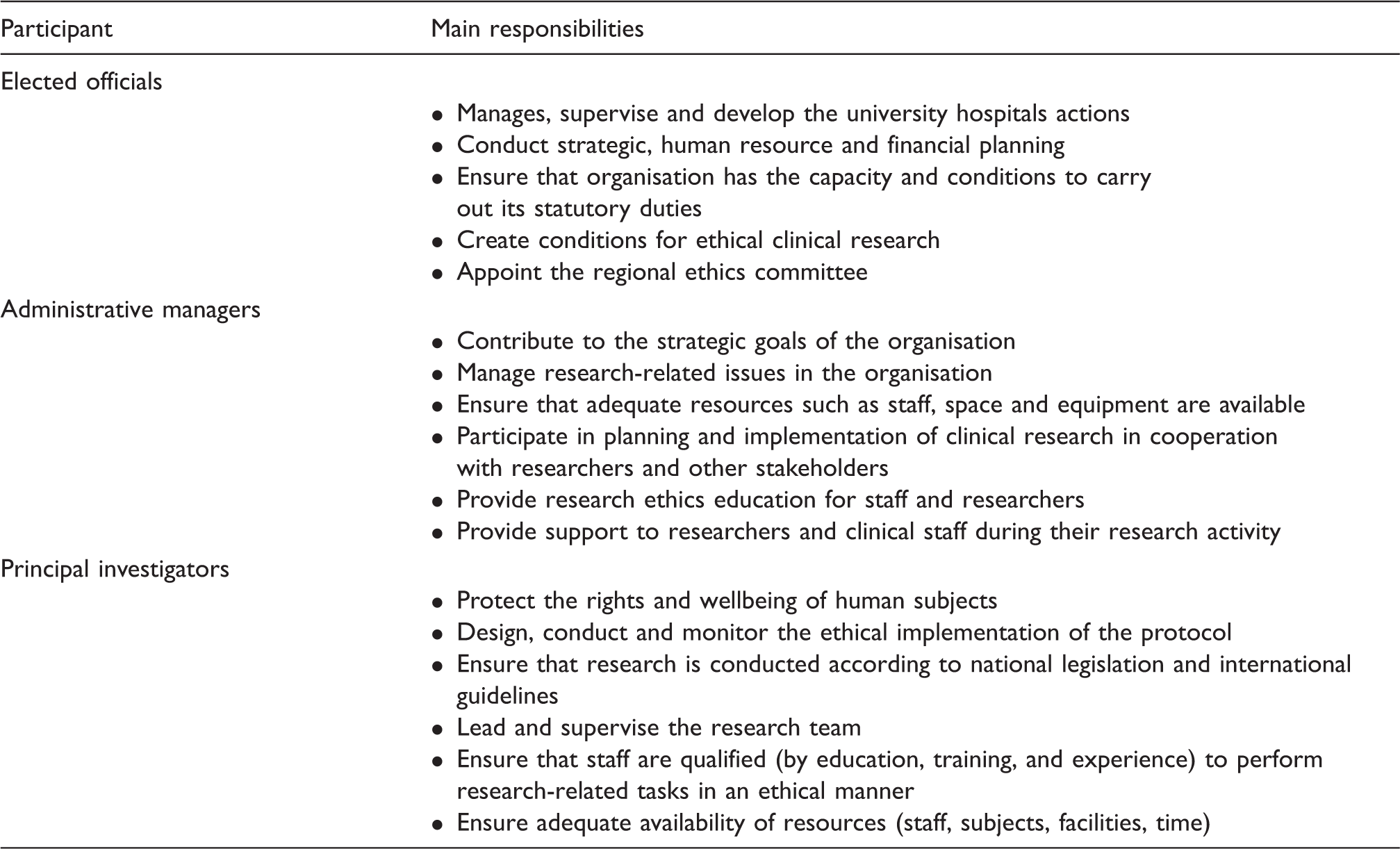
The study sample consisted of 14 men and 17 women. The average age of the participants was 53 years. All participants were highly educated and had a university degree. Principal investigators had an average of 10.2 years of experience in managing a research team, and had led 3–10 research projects (average 5.6 projects) at the time. The managers had an average of 11 years of experience in management positions, and elected officials had an average of 6.5 years of experience as board members. Some participants had a dual role, as they worked at the organisations as principal investigators and as administrative managers. These participants described the phenomenon from both perspectives.
Semi-structured face-to-face interviews were used to capture the individual perceptions and experiences of participants with the phenomenon. These interviews are effective for exploring relatively wide and complex ethical issues and conceptual phenomena in a structured but flexible manner.28,29 Questions in the semi-structured interview were developed based on previous literature, 28 and they were concerned with the respect for autonomy and the ethical conduct of clinical research in the hospital. 14,22 Four preliminary interviews were conducted to ensure the suitability of the interview questions, and we included the data from these interviews, as no major changes were made. 27 The first author conducted the interviews between May and October 2014. Each interview was audio recorded and lasted 40–78 min.
Data analysis
The data were analysed by inductive content analysis
30
guided by the research question.
31
Data from all participants were analysed as a whole. First, the interviews were transcribed verbatim, resulting in 336 pages (A4) of text with 1.15-line spacing. The transcripts were read several times to obtain an overall understanding of the data. In the second phase, meaningful units, such as words, a few words, and sentences, were extracted from the data. Subsequently, the meaningful units were condensed, coded and grouped into subcategories based on their similarities and differences. Finally, the subcategories were abstracted to the main categories.
30
Based on the inductive content analysis, four main categories were identified and named. The created main categories were as follows (Figure 1): (i) human subject autonomy and its acknowledgement in clinical practice, (ii) increased tension between relevant regulations and clinical research practice, (iii) concerns about a changing clinical research environment, and (iv) factors that promote ethical conduct of clinical research in hospitals.
Ethical aspects of clinical research from the perspective of the administrative staff: main- and sub-categories.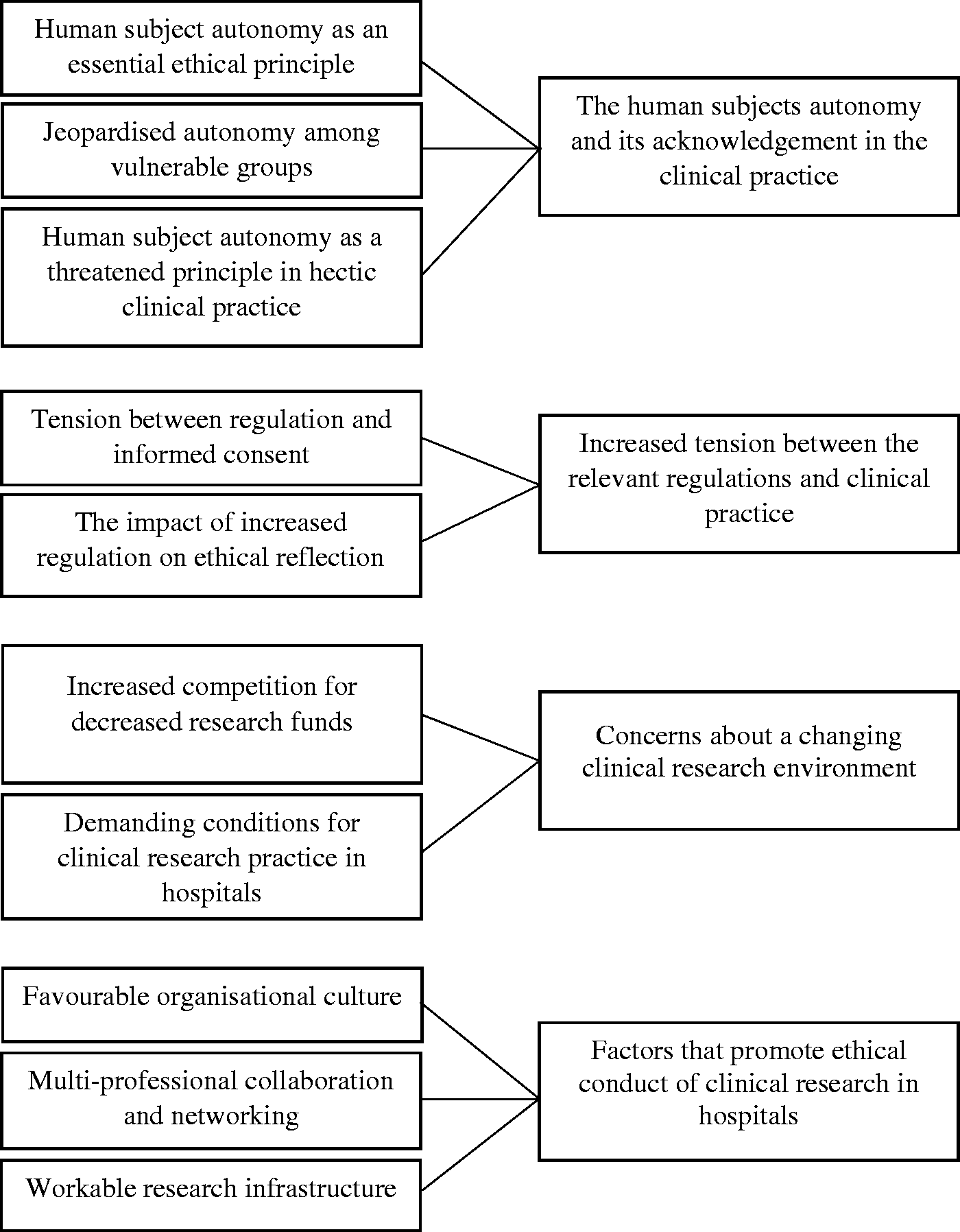
Ethical consideration
Approval for this study was obtained from the university hospitals. According to Finnish research legislation, this type of research does not need approval from an official research ethics committee. 26 All participants received an information sheet stating the purpose and voluntary nature of the study, and a written informed consent was obtained prior to study participation. Anonymity and confidentiality were protected by assigning a numerical code to each participant and removing all personal data that could identify the participants.
Results
Based on our analysis, the participants’ perception of and experiences with the ethical aspects of clinical research at the university hospitals in Finland can be divided into four main categories (Figure 1): (i) human subject autonomy and its acknowledgement in clinical practice, (ii) increased tension between relevant regulations and clinical research practice, (iii) concerns about a changing clinical research environment, and (iv) factors that promote ethical conduct of clinical research in hospitals.
Human subject autonomy and its acknowledgement in clinical practice
The participants expressed that, in clinical research, the autonomy of human subjects is considered an essential ethical principle, but also that this principle was threatened in daily research practice. Moreover, they said that researchers had the main responsibility to protect the human subject’s autonomy throughout the research process. Protection of autonomy required close cooperation between the researchers, managers and staff during planning and implementation of clinical research.
The participants believed that the human subject’s autonomy was jeopardised particularly among vulnerable groups that require special protection from the researcher. For instance, human subject voluntariness was endangered among children when researchers had difficulties to ensure whether children were volunteering willingly or because of their parents. Participants also raised the point that researchers were responsible for ensuring the voluntary nature of human subject participation, e.g. in situations when women were unable to give consent due to cultural reasons. Furthermore, vulnerable groups’ informed consent was jeopardised in some cases. For example, there was discussion on whether an elderly person’s memory disorder or an acutely ill person’s sense of urgency in the situation prevent these patient groups from receiving sufficient information and whether they fully understand this information before making an informed decision. Furthermore, interviewees emphasised that informed consent is not permanent, and researchers are responsible for contemplating changes in the medical condition of human subjects and renewing consent if necessary.
The participants expressed that human subject autonomy was threatened due to the hectic nature of clinical research practice. For example, it was difficult to find common time to inform the staff about research and recruitment. Therefore, the participants were concerned about the staff’s ability to consider human subject autonomy during recruitment at the site. Another concern of the interviewees was whether subjects receive enough information about the research and have ample time to consider participation. This concern arose because staff were often forced to conduct recruitment alongside their main duties. Due to the fact that the recruitment situations at the ward were sometimes hectic and the recruiter was a member of staff, there was a risk that the human subjects would not understand the difference between care and research. One interviewee stated: “Yes, it can be difficult to understand the information, particularly when it is disclosed in a hurry; and if recruitment takes place in the hospital, the difference between clinical research and care may remain unclear.” (ID: 10)
Increased tension between relevant regulations and clinical research practice
According to the participants, the regulations that provide guidance for ethical conduct of research with human subjects are fundamental for clinical research, and compliance with the regulations is a prerequisite for the protection of human subjects. However, the interviewees were concerned with potential tension between regulation and informed consent. In some cases, increased regulations could also act against their purpose. The interviewees pondered whether increased regulation had caused the function of the informed consent to shift from protecting human subjects to protecting the legal status of researchers and their organisations. As one interviewee pointed out: “Informed consent should be practiced primarily to safeguard the interests of the human subject, but now it seems to protect more the researchers’ and organisations’ legal status and position.” (ID: 26) However, the interviewees expressed that researchers were responsible for following the regulations that guided the disclosure of information to human subjects, even though the regulations did not always serve the best interest of human subjects. For example, an information sheet that fulfilled all the requirements had become long and complex and is written in bureaucratic language, making it difficult for human subjects to understand the essential information.
The participants said that increased regulation may contribute to an inability to continually comply with the regulations in daily research practice. This meant that researchers find it difficult to fulfil the authorities’ requirements while meeting the demands of research practice as one of the participants described: “It seems that they have drifted apart, what we need to have technically on the paper and then what actually happens in practice.”(ID: 12) For example, when the recruitment was carried out during medical procedures, only verbal information was offered to human subjects because the time available for the human subjects to familiarise themselves with the information was limited. In addition, the conflict between regulatory compliance and research practice became apparent in the handling and storage of confidential research data. Even though in the official ethics committee application the data protection practices were described as according to the regulations, still the research data might have been unprotectedly stored in the researchers computers or in the domains of the organisations.
The interviewees were also concerned that increased regulation may contribute to quality of researchers’ ethical reflection during the process of obtaining ethics committee opinion. They believed that researchers’ reflection on ethical questions had become more mechanical, with the sole aim of fulfilling necessary requirements. One interviewee pointed out: “We generate forms, information sheets, and other paperwork for the ethics committee, just to comply with the guidelines and requirements. It is kind of a mechanical action. Usually the ethics committee still finds something to comment on, maybe that some wording is wrong and needs to be changed.”(ID: 7)
Concerns about a changing clinical research environment
The participants expressed concern about a changing clinical research environment and its impact on ethical research conduct. One strong theme that arose during the interviews was the participants’ worry about increased competition for decreasing research funds. The participants explained that research funding decreased significantly in recent years. This was related to increased competition between the researchers as well as between the university hospitals. The participants reported that increased competition and pressure to get funding could lead to conduct clinical research with poor motives, such as an aim to increase the number of scientific publications. Additionally, participants observed that researchers were under increased pressure to conduct high-value research. Thus it was possible that less profitable but relevant research topics were less frequently investigated. Yet another burden involved pressure imposed by the organisation on researchers to conduct clinical investigations to secure government funding for the organisation. Moreover, participants raised concerns about a rise in the number of industry-funded clinical studies and the associated reduction in transparency, for example, in dissemination of results. This was an issue because participants felt that industry-funded studies more often published results that favour the industries. Thus, it was important to the participants that sources of funding, institutional affiliations and conflicts of interest are clearly expressed.
Study participants described the conditions for clinical research practice at their respective hospitals as demanding, due to hectic and burdensome routines of care. They felt that the hectic nature of their basic work affected the quality and ethicalness of clinical research, as researchers and staff had insufficient time to focus on conducting the investigations. One participant described the situation as follows: “Given the hectic clinical practice and the pressure of clinical work, there is always a risk that the research remains a bit inferior, which might lead to the fact that research is not as high quality or not as ethical.” (ID: 12) In addition, motivation to carry out clinical research alongside basic clinical work was considered endangered, particularly among young researchers. Participants also described that changes in the health care environment, such as increased outpatient care and shorter care periods, pose new challenges to, for example, ethical recruitment of human subjects.
Factors that promote ethical conduct of clinical research in hospitals
The study participants explained that the administrative staff have an important role in ensuring and maintaining the research environment and conditions within the organisation that enable the ethical conduct of clinical research.
According to the interviewees, the first factor that promoted ethical conduct of clinical research in hospitals was a favourable organisational culture in which the principles and practices guiding the conduct of clinical research were acknowledged and displayed. It was essential to the participants that hospital staff recognized their role in protecting human subjects, and acknowledged and maintained a commitment to the principles and values that guided ethical conduct of clinical research. One participant explained: “The culture there (in the organisations), that is, the organisation’s course of action, its adherence to ethical principles that are non-negotiable, and familiarity with these principles among everyone on staff, will send the message that this is the way our organisation proceeds.” (ID: 22) The duty of the administrative staff was not only to convey ethical principles with their own exemplary actions, but also to demand compliance from the staff, and to supervise them. One important factor for organisational culture was open communication about the ethical aspects of clinical research. However, the interviewees said that the discussion about ethical aspects of clinical research was typically focused on the ethical questions raised in the certain research projects. A broader discussion rarely occurred. They considered it important to promote broader discussion at varying levels within the organisation to make the ethical aspects of clinical research more visible.
The second organisational factor that promoted ethical conduct of clinical research was multi-professional collaboration and networking among the researchers, managers and hospital staff. It was considered important that plans and decisions regarding the implementation of clinical research were made in collaboration with these stakeholders. The participants also described challenges that were related to collaboration, such as diverging working methods among stakeholders and difficulties to find common time for regular communication. Furthermore, the participants said that cooperation also needed promotion because they believed researchers were sometimes forced to face the ethical questions raised during the research process on their own. They said that through increased networking within organisations, it would be possible to discuss, share thoughts and get advice and support from peers. One interviewee pointed out: “It is important that organisations hold events to foster cooperation and networking, as ethical principles would circulate better and there would be joint discourses about them. Often, a researcher has the problem of being pretty much on his own with ethical problems. It would be good if researchers could discuss the problems with someone else.” (ID: 28)
Interviewees said that the third factor that promoted ethical conduct of clinical research in organisations was a workable research infrastructure, including research administration services, established and clear practices, and sufficient resources. Hospital research administration services facilitate researchers’ work in a complex, bureaucratic, clinical research process and support ethical aspects of clinical research. However, the interviewees highlighted the need for clear, established practices to guide research conduct at the hospitals. For example, in some cases the data protection and filing practices seem unclear. Interviewees also described the mutual practices between the university hospitals as unestablished, which caused challenges for multicentre research projects. Moreover, resources such as well-educated hospital personnel, adequate space facilities and sufficient time were considered essential prerequisites for ethically conducted research. However, interviewees were concerned that not all hospital personnel display the same level of interest in and competence for supporting the clinical research process. Therefore, provision of education on research ethics to clinical staff as well as managers was seen essential. The lack of the adequate space, for example, negatively affects the achievement of human subject privacy and confidentiality when recruitment had to occur in a room with an outsider.
Discussion
Based on the findings of this study, we identified four central ethical aspects. Firstly, human subject autonomy is a fundamental ethical principle, but it is also jeopardized in everyday research practice in hospitals. Secondly, tension between the regulations and clinical research practice has increased and may complicate the ethical conduct of clinical research. Thirdly, we identified concerns related to a changing clinical research environment and its impact on ethical research conduct. Fourthly, our findings identified some organisational factors that may promote ethical conduct of clinical research.
The first major ethical aspect was the fact that our participants considered the autonomy of human subjects as a fundamental but jeopardised ethical principle in daily clinical research practice in hospitals. According to our participants, as well as previous literature, several factors may affect the realization of human subject autonomy, such as inadequate or overwhelming information,32–34 hectic nature of the recruitment process,5,22 and limited time to consider participation.15,22,34 Safeguarding the human subject’s autonomy in clinical research practice is not solely the responsibility of researchers, but also a concern of other responsible stakeholders, such as hospital managers, clinical staff and elected officials.1–7 In line with an earlier study, our participants stressed that the cornerstone of protecting human subject autonomy is collaboration between all key stakeholders (i.e. researchers, administrative staff, nursing management and clinical staff) during the planning and implementation of clinical research.2–3,5,15,22 However, one important finding of this study is that the collaboration was sometimes insufficient and could even lead to situations where the researcher or clinical staff were forced to face ethical questions on their own. Thus, it is important to strengthen collaboration and networking between stakeholders by providing opportunities for discussion, reflection and support from peers. 7 However, methods for safeguarding human subject autonomy in clinical research practice remain a central question.
Another important aspect emerging from our results is increased tension between the regulations and clinical research practice which may complicate researchers’ work and human subject protection. Regulations guiding the ethical conduct of clinical research are an important basis for human protection15,16 but our participants reflected on whether, in some cases, regulations in their current form protect the legal status of researchers and organisations more than the rights of human subjects. This finding corroborates earlier findings in the literature.16,35,36 Furthermore, as described in our findings, increased regulations may also complicate researchers’ work, hinder ethical reflection, and lead to superficial and mechanical action whose aim is fulfilling all necessary regulations and completing the right forms. This result may indicate that not all moral rationale behind the regulations is fully recognized. Therefore, there is a need for greater transparency related to clinical research regulations,16,37 their contents, meaning and implementation. Research ethics committees, scientific community as well as hospital organisations17,13,15,16,35 should promote and maintain open discussion about the clinical research regulations, moral rationale behind the regulations and the ethical aspect of clinical research in general in order to raise awareness of research ethics. 37 The key issue to reducing tension between the regulations and clinical research practice is to ensure that researchers and clinical staff have adequate research ethics training and knowledge of the regulations and legislation.13,38,39 According to previous studies, greater knowledge of ethical norms may be associated with better critical reasoning.40,41 In addition, the ethical sensitivity and reflection skills of researchers and clinical staff should be strengthened.13,33 This is important because regulations cannot cover all everyday situations, and ethical problems typically arise in cases where the regulations are not met. 33
Our findings also elucidate some of the current concerns related to a changing clinical research environment. General worry about increased competition for research funding and pressure to publish and gain visibility was a strong common theme throughout the interviews. Competition and pressure can lead to better performance from researchers. However, they can also go against the ethos of science, creating incentive for practices that damage high quality, ethical clinical research. 42 Furthermore, excessive publication pressure may lead to scientific misconduct. 43 Participants in this study also emphasised several factors, such as hectic and burdensome basic work, lack of sufficient resources and changes in the health care environment, which may complicate the work of researchers and have an impact on the ethical conduct of clinical research.44,45 There is an urgent need for increasing governmental research funding, but at the same time considering how existing research funding can be utilised more effectively. 46 Furthermore, we should determine a means for supporting researchers and clinical staff in their efforts to conduct clinical research in an ethical manner in changing the clinical research environment.
Finally, our findings highlight some organisational factors that may promote ethical and responsible conduct of clinical research and underline the important role of administrative staff in securing and providing the research environment that should serve as a basis for ethical clinical research. Our results, as well as previous studies earmark one main factor, organisational culture, as critical.10,35,47 The key issue in organisational culture is that hospital staff acknowledge the principles and values that guided ethical research conduct, committed to comply with them and recognized their role in protecting human subjects. The administrative staff role is to convey ethical principles and values with their own exemplary actions, demand those compliance from staff and supervise research action in their organisation. Moreover, as our participant said workable research infrastructure, i.e. research administration and clear processes and practices in particular, facilitates researchers’ work in a complex, bureaucratic, clinical research environment and helps maintain good research ethics. However, our participants were critical of the organisations’ unclear practices, as well as practices that varied at the national level. In that sense, we think that it is important to facilitate researchers’ work and secure the ethical conduct of clinical research by clarifying and harmonizing these practices. 24 Therefore we think that hospital research administration should seek ways to reduce bureaucracy, which can be avoided by streamlining the actions and efficiency of the research administration.48,49 Furthermore, regulatory authorities, health policy makers, researchers and health care personnel should come together to seek ways to streamline and harmonise the processes that govern whether and how clinical research is conducted as well as the related regulations and guidelines. 47 Finally, both previous literature and our participants highlight that administrative staff have the responsibility to ensure that adequate resources, including staff, time, space and equipment, are available and used reasonably6,11,12 and that the clinical staff is qualified, by means of education, training and experience, to perform the research-related tasks in an ethical manner.6,11,12 Administrative staff must also ensure that appropriate support is offered to researchers and clinical staff during their research activities. 6
Our results show that the administrative staff are the stakeholders responsible for ensuring and maintaining the ethical conduct of clinical research in their organisations. The administrative staff’s perspective of the ethical aspects of clinical research has received little attention in previous studies, which mainly focus on the perspectives of researchers and clinical staff. 6 Thus, an awareness of their perspective is critical for gaining a holistic understanding of the ethical aspects of clinical research at their hospitals. Our study completes previous knowledge and together forms an entity in which all the main stakeholders (researchers, clinical staff, research managers, administrative staff, and elected officials) are involved.
Limitations
Study limitations include the relatively low number of participants. However, our data was rich, detailed, and representative, and saturation was achieved. 27 Due to the small number of participants and study features regulated by Finnish national legislation, the findings of this study are contextual and transferability is limited. Moreover, one challenge in this study was that our participants represented three different professional groups, each with a unique perspective of ethical aspects of clinical research. This posed challenges for data analysis and for achievement of a coherent picture of the data.
Conclusion
Human subject autonomy is a fundamental principle in clinical research, but this principle is also threatened in research practice in hospitals. Methods for safeguarding human subject autonomy in clinical research practice remain a central question. Tension between relevant regulation and clinical research has increased, and along with a constantly changing research environment, complicates researchers’ work. Thus the primary goal is to determine a means for supporting researchers and clinical staff in their efforts to conduct clinical research in an ethical manner. Ethics always extends beyond the law. Therefore it is important to strengthen researchers’ ethical sensitivity through education, while bolstering other factors that can support good research ethics in hospitals. These other factors include organisational culture, cooperation and a workable research infrastructure.
Footnotes
Acknowledgements
We want to thank those interviewed for their enormous participation.
Declaration of Conflicting Interests
The author(s) declared no potential conflicts of interest with respect to the research, authorship, and/or publication of this article.
Funding
The author(s) disclosed receipt of the following financial support for the research, authorship, and/or publication of this article: The Finnish Work Environment Fund and Olvi foundation.