



Abstract
Background
The complexity of decision-making in the paediatric context is well recognised. In the majority of cases, parents and healthcare professionals work together to decide which treatments the paediatric patient should receive. On occasions, however, parental wishes conflict with what clinicians think is best for the paediatric patient. Where persistent disagreement between clinicians and parents exists, clinicians must ascertain if they have a moral, professional, and legal obligation to overrule the parents' decision and implement their preferred option.
Purpose
Few decision-making frameworks to assist in addressing the ethical issues that arise in clinical decision-making relate specifically to the paediatric context. Diekema's Harm Threshold Framework and the Zone of Parental Discretion (ZPD) Framework assist in determining whether parental decisions should or should not be overridden. This paper examines the similarities and differences between these frameworks.
Methods
The frameworks are analysed in terms of their underlying principles, scope, threshold for harm, mechanisms for resolving clinician/parental differences and mechanism(s) for overruling parental decisions. The ZPD Framework incorporates an additional component that is also considered in this paper.
Results
Similarities: Both frameworks use similar definitions of harm, consider the harms associated with overriding parental requests, and, ultimately, resort to state intervention as the mechanism for overruling parental decisions but only as a last resort. Differences: The ZPD Framework is broader in scope and has a far lower harm threshold than Diekema's Harm Threshold Framework. Diekema's Framework relies exclusively on the Harm Principle and is used exclusively for parental refusals to treatment whereas the ZPD Framework also incorporates the Best Interests Standard and can be used for parental refusals as well as requests for treatment that clinicians consider potentially harmful.
Conclusion
While the frameworks share similarities, there are also considerable differences. This analysis highlights the theoretical differences and helps identify which framework may be most useful to clinicians and ethicists in specific cases.
Background
In the vast majority of cases, parents are best placed to make decisions that will promote their child’s wellbeing when children lack capacity to make decisions for themselves. Great legal and ethical weight is placed on doing what is in the ‘best interests’ of the child, but it is also widely acknowledged that parental decisions cannot and, according to relational accounts of best interests standards, should not always aim to achieve the very best for each child, as doing so may disadvantage siblings, the whole family as a unit or other members of society.1–3 In fact, some parental decisions are not only sub-optimal but may in fact cause some level of disadvantage to a child. Despite this, such decisions are not overruled because parental autonomy is regarded as a prerequisite for the overall wellbeing of the child and family, 3 and it is acknowledged that unwarranted interference could result in greater harms4,5 to the child, the parents, the family and, ultimately, society at large.
For parental decisions to be respected in the clinical context, they need to be such that they do not result in a child being harmed to such an extent that the child suffers considerable and permanent losses to their overall wellbeing and ability to prosper in life (to the extent allowed by their medical condition). Deciding to overrule parental decisions is not done lightly for a number of reasons including consideration of the harms arising from interference itself, social norms, legal reasons and personal and professional reasons. As a result, clinicians are usually reluctant participants in such a process, which they only engage in after numerous lengthy discussions with the parents, and often only after having sought the views of trusted colleagues, clinical ethics expertise (where this is available and known to clinicians), legal expertise within the hospital and/or advice from hospital administrators.
To help determine whether there is sufficient justification for overruling parental decisions, clinicians and ethicists may also turn to theoretical frameworks, as these help determine and clarify the level of harm parental decisions might impose on the child. In addition to enabling a more thorough consideration of all the pertinent ethical and other related issues, the use of such frameworks can contribute to greater consistency in decision-making and therefore fairness in the approaches adopted by clinicians. However, despite their potential value in helping sift through the complex issues associated with each decision, such frameworks are only used when healthcare professionals are familiar with them and perceive them as being valuable.
There are numerous ethical decision-making frameworks that provide a structured way of resolving complex ethical issues. Some are general in nature and provide guidance in relation to general requirements when considering ethically complex decisions in the clinical context. 6 There are, however, limited frameworks designed specifically for paediatric decision-making. This paper considers two frameworks underpinned by the Harm Principle: Diekema’s Harm Threshold Framework 4 and the Zone of Parental Discretion Framework (ZPD),5,7,8 as these frameworks apply specifically to decision-making in the paediatric context. (Note: Diekema himself does not provide a descriptor for his framework but has agreed to the one proposed here. The paper aims to briefly describe each and compare their scope, threshold for harm, mechanisms for resolving clinician/parental differences and mechanism(s) for overruling parental decisions, as well as to consider some of the subtleties of one component of the ZPD Framework, which has no corresponding component in Diekema’s Framework. The aim is to clarify the similarities and differences between the two, and importantly, the areas where their use will be most helpful, and to highlight the complexities of negotiating and balancing conflicting principles.
The Harm Principle applied to parental decision-making in paediatrics
The Harm Principle is often relied on in paediatric decision-making to assist in determining when parental decisions should be overruled. The core premise of this principle, as originally articulated by John Stuart Mill, is that no one has the right to interfere with a person’s actions, unless these cause harm to others. 9 Feinberg adds that interfering with another’s action is only permissible when the interference can avert the harm(s) in question. 10
Diekema’s Harm Threshold Framework
Applying Diekema’s Harm Threshold Framework and the Zone of Parental Discretion Framework.
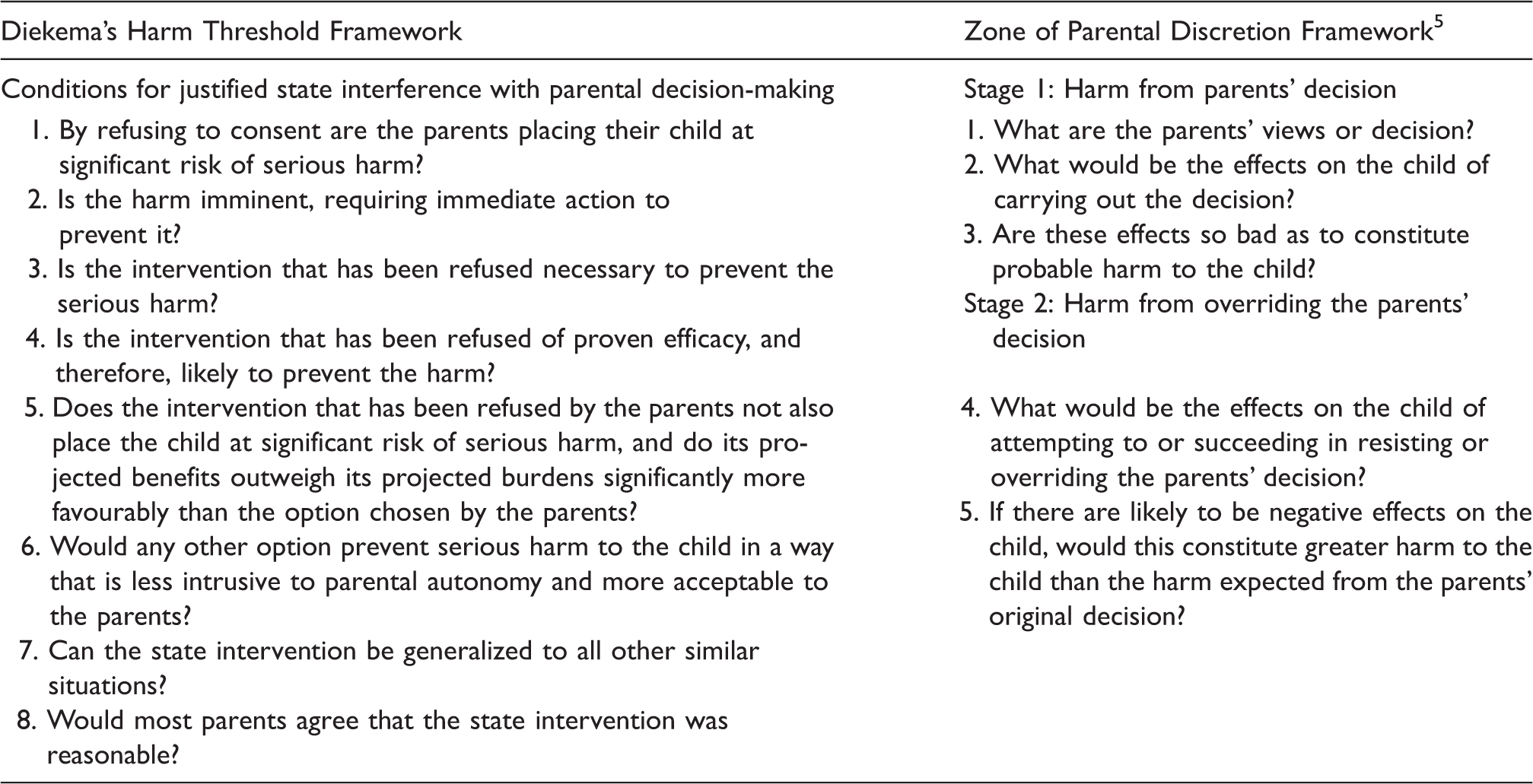
Zone of Parental Discretion Framework
The ZPD is a more recent conceptual tool for clinicians and clinical ethicists. It was developed to consider parental preferences for treatment or non-treatment, which may be harmful to paediatric patients who lack capacity to make decisions for themselves and which parents and clinicians cannot agree on, despite efforts to resolve profound differences of opinion. The ZPD is also based on the Harm Principle but also acknowledges the role of the Best Interests Standard in the broader decision-making process clinicians (and parents) engage in. This framework aims to help identify whether a parental decision, either to treat or not treat their child, falls within a broad area within which parental decisions should not be overruled because, although not optimal, the decision would, in all likelihood, not cause a level of harm to the child that warrants intervention. In other words, this framework recognises that all decisions should be left to parents unless they are likely to result in probable harm to the child. The Harm Principle is relied on to ascertain whether a parental decision falls beyond this ‘zone’ where parents’ decisions should be accepted and beyond which clinicians are not only justified in overruling the parents’ decision but are ‘ethically required’ to do so. Unlike Diekema’s framework, however, the concept of clinician intervention is much broader and includes all means employed to override parental decisions (e.g. a clinician’s refusal to adopt a parental decision and coercive efforts to force parents to change their position). Focus on the space within which parents are entitled to exercise their decision-making authority (i.e. the zone of parental discretion) aims to help us consider how both the child’s wellbeing and parental rights to make medical decisions for their child interact and to help clinicians and ethicists balance these values, which may, on occasion, appear to be in conflict.
In this framework, ‘harm’ is defined as being a ‘significant setback to (the child’s) interests’, where ‘interests’ should be construed as being significantly broader than merely good clinical outcomes for the child and should include other elements of life that contribute to a child’s overall wellbeing, present and future. Two sets of questions require responses in order to apply the ZPD framework and ascertain whether parental decisions should be accepted (even if sub-optimal) or be overridden (see Table 1).
Similarities between the frameworks
Comparing and contrasting the frameworks discussed assists in clarifying their focus and how they can be applied to examine potentially harmful parental decisions in the paediatric medical context (see Table 2). The two frameworks are based on the same ethical principle and acknowledge the same values in the decision-making process. Therefore, there are numerous similarities between the frameworks, as shown below:
Both frameworks consider whether interfering with parental decisions may, in fact, cause greater harms to the child than non-interference. Both frameworks view the reasons behind the parents’ decision as being irrelevant and note that it is the outcome of the decision for the child that is the key concern, as it may result in (probable (ZPD) or a significant risk of serious (Diekema)) harm to the child. The ZPD framework provides a concise definition of ‘harm’ but when considered in greater detail, we find it is very similar to the sense of harm that Diekema seems to adopt by referring to numerous definitions put forth in the literature. In attempting to resolve parental/clinician differences, both frameworks aim to first exhaust every other means of communicating the potential harms to parents to influence their decisions and both view overruling parental decisions as the very last resort. Diekema’s Framework explicitly notes that state interference with parental decisions should be avoided if there is ‘an acceptable alternative that is less intrusive to parental decision-making autonomy’ (see Diekema,
4
p. 253). Key features of Diekema’s Harm Threshold Framework and the Zone of Parental Discretion Framework.

Differences between the frameworks
While there appear to be numerous similarities between the two frameworks and potentially fewer differences, the differences between the two are marked and determine which framework is appropriate for use depending not only on the context but also on one’s preferences. The key and most substantial differences relate to the scope and focus of the frameworks, the conception of what ‘intervention’ entails and the threshold for intervention (see Table 2). An additional difference relates to the role of the clinician in the decision-making process and, ultimately, to claims in the ZPD framework about ethical entitlements that parents have for their child in medical decision-making. The latter is discussed more fully below following the presentation of key differences between the frameworks.
Diekema’s Harm Threshold Framework deals exclusively with parental decisions that could result in harm, while the ZPD Framework incorporates a component (the zone of parental discretion) relating to decisions which parents should be entitled to make even though they do not coincide with clinicians’ recommendations as well as a component dealing with those parental decisions that may result in probable harm and should therefore be overruled. Diekema’s Harm Threshold Framework discusses ‘intervention’ in terms of involvement of the state via child protection services or the courts. The ZPD Framework conceptualises ‘intervention’ more broadly to include clinician responses/actions to overturn parental decisions as well as state involvement. The ZPD Framework is much broader in scope, as it considers both requests and refusals for treatment, while Diekema’s Framework only considers parental refusals for treatment. The ZPD Framework has a far lower harm threshold (probable harm) than Diekema’s Harm Threshold Framework (significant risk of serious harm), which must also be preventable and imminent to warrant interference from the state. Both frameworks acknowledge the importance of parental decision-making, but the developers of the ZPD urge clinicians to continue to influence parental decisions if they are not optimal for the paediatric patient even if clinicians are required to accept them, because they fall within the zone of parental discretion. Diekema’s Harm Threshold Framework relies exclusively on the Harm Principle, because the focus is limited to harmful parental refusals of treatment. In the ZPD Framework, conversely, the Best Interests Standard appears to remain relevant within the zone of parental discretion, as clinicians are acknowledged as appropriately relying on it when trying to influence parental decisions within this zone (p. 21).
Discussion
These frameworks are intended to be used where there is persistent disagreement between parents and clinicians on what course of action should be taken for a paediatric patient. Examination of the two frameworks points to the central position that the paediatric patient rightly occupies and whose welfare clinicians are obliged to protect when parents cannot or will not. Examination of the frameworks also highlights the fact that our society places great importance on the central role that parents play in their child’s life.
There are great similarities between the two frameworks as a result of the underlying premises on which they are based. However, there are also considerable differences in focus, which arise from the purpose for which each framework was developed: Diekema’s Harm Threshold Framework has a single aim and a single focal point in relation to the nature of the parental decision being overruled. It aims to identify when the harm is so great that the state should become involved to decide in the place of the parents who wish to forego treatment(s) for their child. The ZPD Framework, however, has two key aims and deals with any kind of decision parents persistently disagree on with clinicians. This framework aims to identify the space in which clinicians should not interfere with parental decisions even though they disagree with them and feel they may not produce the very best outcome for the child. In addition, like Diekema’s Framework, the ZPD Framework also aims to articulate the level of harm to the child that requires intervention, and it provides guidance on parental decisions that should be overruled, as they pose probable harm to the child.
A choice between the frameworks will depend partly on the child’s circumstances and partly on the users’ beliefs. For example, if parents insist that clinicians adopt option X rather than the recommended option Y, Diekema’s Harm Threshold Framework would not be suitable, as the parents are not refusing treatment but rather are requesting a different option. In addition, because there are theoretical differences between the two, clinicians and ethicists may be drawn to one rather than the other in cases where both frameworks could be used. For example, the harm threshold is significantly higher in Diekema’s Harm Threshold Framework compared to the ZPD Framework, an issue which may not sit comfortably with some clinicians or ethicists.
In the ZPD framework, the tension between doing what is (clinically) best for the patient and respecting parental autonomy is highlighted by the fact that clinicians are urged to sustain efforts to modify parental decisions which are not the best available (but which are within the ZPD) in order to further benefit the child. 5 It is viewed as a professional and moral duty for clinicians to continue to strive for the very best clinical decisions for their patient, especially in cases where parents have opted for what clinicians consider to be a less than optimal treatment choice. In fact, it is further clarified by the developers of the ZPD that the Best Interests Principle is the principle that appropriately guides clinicians in their clinical decisions. 5 On the other hand, the ZPD is also put forth as bringing to the fore the value of respecting parental autonomy, as there is recognition that parents are ethically, legally and socially charged with the responsibility of making decisions for their child. It is entirely appropriate and necessary to make clear all the facts that support clinicians’ recommendations. Following such explanations of why clinicians support one option over the other, it is likely that some parents will be persuaded to adopt the clinicians’ recommendation. It is also likely, however, that some parents will continue to support another option despite the explanations provided by clinicians. If we are to respect parental decisions which lie within the ZPD (as well as the parents themselves), this would require not continuing beyond a certain point to try to influence parents to make better clinical choices for their child. The tension in the stated focal points of the ZPD highlights the complexity that parents, clinicians, and ethicists face in paediatric medical decision-making. This lack of internal coherence in this aspect of the ZPD framework also brings to the fore the truly challenging position parents and clinicians find themselves in when two important values conflict: that of ensuring the paediatric patient receives the best treatment available to him/her and the parents’ right to make decisions for their child in accordance with their beliefs, values, wishes and broader considerations.
The ZPD also unintentionally highlights the potential difficulty that clinicians face in considering other aspects of the child and the family’s life that parents take into account but that clinicians may not intuitively focus on because of their focus on clinical factors and outcomes. It is not difficult to imagine how challenging it must be for clinicians, heavily influenced by their medical education and training, to look beyond clinical facts when deciding what is best for their young patient. 12 In addition, the language used by the developers of the ZPD also recognises that clinicians are in a position of power as they can ‘allow’ (see McDougall et al., 5 p. 21) or not a treatment decision to be implemented. Even though there is considerable focus on ‘shared decision-making’ in the literature, the very descriptor of which connotes shared power and influence, the ZPD developers acknowledge that clinicians often do in fact hold a superior, more powerful position, as has been noted elsewhere. 13
Conclusion
This paper has sought to place two frameworks based on the Harm Principle side by side to make clear the similarities and differences between the two. Doing so provides a clearer understanding of which framework is best suited to specific paediatric situations where there is persistent disagreement between parents and clinicians about the course of treatment for the child. The paper has also highlighted the complexities that underlie decision-making in the paediatric context where others are making decisions for the patient. The tension between making good clinical decisions for a paediatric patient and truly respecting parental autonomy in cases where parental and clinician decisions diverge significantly and persistently is evident in the ZPD Framework.
Such frameworks aim to provide some structure to the consideration of complex issues which influence decision-making in the intricate paediatric context. As the developers of the ZPD rightly acknowledge, no one framework can address all the issues that arise in clinical decision-making and it may be that more than one framework or tool is required to arrive at a considered decision about how to handle conflicting parental/clinician views on the best course of action for paediatric patients and their families. 5 What is certain, however, is that such decision-making frameworks articulate a variety of theoretical perspectives and encourage us all to consider a wide range of issues which may otherwise not have received the attention they require.
Footnotes
Acknowledgement
The author is very grateful for the comments on an earlier draft from Professor Ian Kerridge, A/Professor Henry Kilham and Professor David Isaacs.
Declaration of Conflicting Interests
The author(s) declared no potential conflicts of interest with respect to the research, authorship, and/or publication of this article.
Funding
The author(s) received no financial support for the research, authorship, and/or publication of this article.