



Abstract
The coronavirus disease 2019 (COVID-19) pandemic placed Switzerland's healthcare system into an extraordinary situation, creating a profound ethical challenge of deciding which patients to treat. While in-hospital triage received much attention, little is known about pre-hospital triage and its ethical implications. The purpose of our study was to explore the perceptions of stakeholders involved in Swiss healthcare regarding pre-hospital triage during the COVID-19 pandemic in Switzerland, with a particular focus on how it affected the treatment and care of older people during times of resource scarcity. We conducted 57 qualitative interviews with such stakeholders and analysed them with reflexive thematic analysis. We identified three main themes (1) ‘Tracing pre-hospital triage’ captures participants’ reflections on how hospital access may have been restricted before patient arrival; (2) ‘Exploring pre-hospital Silent Triage’ outlines, based on participants’ assumptions and explanations, the occurrence of Silent Triage; (3) In ‘Examining concrete mechanisms of pre-hospital triage’ we refer to explicit actions taken to avoid hospitalization. Although many participants believed urgent hospitalization was always available, our study highlights signs of Silent Triage. These were mainly based on our participants’ descriptions about the persistent concern over the potential to overload the healthcare system and their suspicions of self-triage among older adults. To prevent future Silent Triage, it is imperative to make real-time hospital data on capacity available and to ensure public communication that affirms equal access to care.
Introduction
The coronavirus disease 2019 (COVID-19) pandemic put Switzerland into an extraordinary situation, requiring systemic responses to address unexpected challenges across the healthcare system. To manage the substantial influx of patients, hospitals implemented a range of measures, such as large-scale testing for COVID-19, restricting elective procedures, transferring patients to intermediate care units, creating additional ventilator capacity, and avoiding treatments that required intensive staffing.1–3 This situation underscored a profound ethical challenge: Deciding which patient should be treated when confronted with limited resources, 4 an issue that was generally referred to as triage. 5 Triage guidelines were either updated or newly developed in response to the COVID-19 pandemic, with a primary focus on improving the prioritization of patients within intensive care settings.2,6,7 Some of the recommendations sparked ethical debates.8–10 Grounded in ethical reasoning, areas of consensus in the guidelines include promoting fairness, and avoiding discrimination while rejecting policies that rely on a first-come, first-served approach. 11 Other triage criteria, such as the consideration of stages of life and recognizing prosocial behaviour have been focus of an ongoing debate.12,13 In Switzerland, guidelines incorporating age-based criteria for resource allocation were discussed controversially, gaining both scientific and public attention, particularly regarding concerns over ethical implications and potential discrimination based on chronological age.14–16
Whilst there was a lot of focus in media and research on in-hospital triage, for example through numerous ethics papers debating scenarios such as the allocation of ventilators,4,8,17,18 the preceding processes that determined whether a patient could even access hospital care received far less attention. 19 We refer to these processes as pre-hospital triage, a term used to describe the screening of patients by emergency services on the way to the hospital, 20 but which also applies more broadly to any triage decision taken to determine whether a patient should be referred to a hospital, for instance by general practitioners. 21 In the methods below, we revisit the definitional and conceptual issue related to pre-hospital triage.
Pre-hospital triage became critically important during the COVID-19 pandemic, as acute care hospitals, particularly those with intensive care units, faced fear of system overload. Although guidelines for pre-hospital triage were established in Switzerland to prevent hospital overcrowding during the COVID-19 pandemic in theory, 2 little is known about the specific pre-hospital triage mechanisms that were applied in practice and about their ethical implications.
Qualitative studies exploring pre-hospital triage procedures are lacking, leaving a gap in understanding the full scope of hospital accessibility during the COVID-19 pandemic. It is important to address this knowledge gap for three main reasons:
Pre-hospital triage needs to be further investigated, because it is related to the risk that this type of triage was ‘silent’.22,23 Whereas conventional triage mechanisms rely on deliberate decisions according to explicit criteria that directly affect identifiable individuals, Silent Triage—frequently rooted by scarce resources—highlights the lack of awareness and passive approach concerning most affected individuals. It can be defined as ‘an unintended, prospectively oriented, passive and unspoken process’.
19
Such a process can result in a disruption of the public health principle of equal attention to health threats. It also entails long-term exclusion from specific health benefits for the individuals involved, which could exacerbate health inequities, especially when institutionalized. Further, Silent Triage primarily involves competing interests between groups with specific future health needs rather than individuals in health emergency situations.
19
Pre-hospital triage is at higher risk of being ‘silent’, since it happens in a decentralized way in nursing homes, general practitioners’ practices, or in ambulance organizations, where systematic data collection is scarce. Because many stakeholders are involved, decisions about patient prioritization are more likely to be made less systematically than within a hospital. Switzerland provides a particularly suitable context for studying this topic due to its distinct healthcare system structure. The healthcare system is decentralized, segmented, and characterized by decision-making power sharing between various instances.
24
This means that in Switzerland the possibility of making autonomous decisions exists at various levels, including on a very small scale. This autonomy complicates the capture of pre-hospital triage mechanisms, as decisions are often made individually or locally, without a centralized coordination or standardized approach. From an ethical perspective, this decentralization underscores the need to understand how healthcare professionals adapted their pre-hospital triage practices in response to specific challenges, particularly in contexts of resource scarcity where equitable and just decision-making becomes a specific challenge. The course of the COVID-19 pandemic showed differences across the regions of Switzerland. At the onset of the pandemic in 2020, some cantons in the Romandy (mainly French-speaking areas in Western Switzerland) and areas close to the Italian border recorded the highest number of COVID-19-related deaths.
25
Hence, it can be assumed that there were large regional differences in applying pre-hospital triage. Further, anecdotal evidence suggests that various healthcare institutions, in particular nursing homes managed the COVID-19 pandemic in very different ways, with some making extraordinary efforts to save residents’ lives, while others were accused of having failed to provide adequate care. These differences, as represented in various media reports,26–28 were anecdotally observed not only between larger regions but also within the same cantons. This raises ethical concerns about fairness and justice in healthcare. If access to medical care varied by region or institution, this suggests unequal treatment that challenges the principle of equal value for all patients.
Study goal and rationale
We conducted qualitative semi-structured interviews with a diverse group of stakeholders involved in the Swiss healthcare system (SSH) to investigate pre-hospital triage procedures during periods of limited healthcare resources, such as those experienced during the COVID-19 pandemic. The study aimed to explore not only the formal triage procedures but also informal or Silent Triage decisions made before hospital admission. Additionally, we sought to identify regional variations in these practices across Switzerland.
Methods
Ethics approval
The study was approved by the Ethics Commission of Northwest and Central Switzerland (EKNZ) (ID: AO_2022-000 72). Participants signed an informed consent form stating risks and benefits to participate in our study and could retract at any time during the process of data collection.
Data collection
Our qualitative study is part of the Swiss wide research project ‘Decision making in times of scarce resources: A mixed method study’ designed by TW and BE. We gathered qualitative data from various SSH in the French- and German-speaking regions of Switzerland between February 2023 and February 2024. As part of the project, we also gathered quantitative data from older individuals about their views on resource allocation in situations of public health emergencies. In this paper, we present findings from the project`s qualitative component. We report our study by following the consolidated criteria for reporting qualitative research (COREQ) checklist. 29
For the overall project, our team created a semi-structured interview guide, featuring open-ended questions addressing various topics: experiences of pre-hospital triage during the COVID-19 pandemic, moral injury and moral distress, Advance Directives, dealing with scarcity of resources and their lessons learned. The interview guide was initially developed in English and subsequently translated into German and French—the languages in which the interviews were conducted. A back-translation process was employed to ensure the accuracy and consistency of the translations. 30 To assess the clarity, adequacy, relevance, comprehensiveness, and representativeness of the interview guides items, we shared it with several project collaborators, including physicians in leadership positions at Swiss geriatric healthcare institutions and members of pandemic task forces who were involved in pre-hospital triage decision-making during the COVID-19 pandemic for review. Additionally, two pilot tests were conducted by ES and OV with two HCPs, which led to the refinement of the interview guide. For this paper, we analysed data that are related to pre-hospital triage. Questions in the interview guide focused specifically on investigating pre-hospital triage as applied to older adults (with frailty), given the disproportionate impact of the COVID-19 pandemic on this population.31,32 This focus was further informed by the intense ethical debates about how to allocate medical resources to older individuals. 33 Our project team defined the term pre-hospital triage as follows: Pre-hospital triage are measures designed to prevent the overloading of acute care hospitals, especially the ones that provide intensive care. These measures include implementing gatekeeping strategies to reduce hospital admissions, such as limiting access for nursing home residents and postponing non-essential treatments. 21 A translated copy of the interview guide in English is included in the Supplemental material.
The interviews were conducted by two female PhD students: ES, who has a background as a clinical nutritionist, and OV, who has a background in philosophy. Both received training about qualitative interview techniques as parts of their doctoral programme. Interviews were held in French, German or Swiss German. All interviews were recorded on audio, with the participant’s written consent and then transcribed verbatim by ES, OV and a medical student intern. For the French interviews, an offline automatic transcription tool was used, but transcripts were then checked manually by OV. We paid particular attention to eliminate identifying information from the transcript to protect interviewees’ identity. The Swiss German interviews were transcribed in standard German. Participants were given the option to review the interview transcripts if they desired. Of those who demanded their transcript (n = 20), none requested any changes or retractions of the statements made during the interview.
Recruitment
To recruit participants, we applied snowball and purposive sampling. 34 We developed a list of potential participant groups by engaging project partners with expertise in the organization of care provision during COVID-19 (e.g., members of task forces). We then drafted a list of professional groups that have been stakeholders in the healthcare sector during the COVID-19 pandemic and were involved in pre-hospital triage decisions. Our inclusion criteria consisted of SSH in the cantons of Basel, Zürich, Geneva, Lausanne and Valais who were actively involved in pre-hospital triage decision-making during the COVID-19 pandemic. Based on these criteria, SSH working in the following sectors met our target group: Ambulance organizations, nursing homes, primary and home palliative care institutions, hospitals, ethicists with clinical and non-clinical affiliations and cantonal administration.
Consequently, we compiled a list of individuals and institutions within each stakeholder group. Potential participants were contacted via email, phone or in person (n = 129). Sixty-two (48%) of those agreed to participate. Five persons who agreed to participate could not take part in the study due to time constrains. After completing 57 interviews, we determined that data saturation had been achieved, as the participants consistently raised the same recurring topics. 35 Participants received information about the study and an informed consent sheet via email and could choose between in person interviews and Zoom calls. No one else was present during any of the in-person or online interviews aside from ES/OV and the participant. Upon request, the core questions of the interview guide were provided. Two participants indicated a wish to receive the questions beforehand. At the designated time and location for the in-person or online interview, ES and OV repeated the study’s purpose, emphasized that all data are handled confidentially, and reminded participants that they could withdraw from the interview at any point during the interview. Subsequently, participants signed an informed consent sheet. Incentives were not provided for participating in the study. No prior relationship existed between ES/OV and the participants before the study began. Participants were aware of ESs/OV’s affiliation and that they were conducting PhD research on the topics covered in the interview. Thirty-six interviews were held in person mainly at the workplace of the participants, 21 via Zoom. The duration of the interviews ranged between 30 and 98 min and had an average duration of 58 min. Field notes were taken after each interview to capture the perceived atmosphere, the availability of time, and any language issues that arose from the different dialects spoken by ES and the interviewee. Additionally, notes were made when any unusual occurrences happened during the interviews, such as interruptions. After the interviews, participants were asked to recommend additional participants pursuant to our snowball sampling method.
Data analysis
We utilized reflexive thematic analysis to examine the data and followed Braun and Clarke’s six-phase approach.36,37 We oriented ourselves within a critical realist/contextualist framework, acknowledging that the responses of our interview participants represent their versions of reality; nevertheless, during data analysis, we produced interpretations of these realities. 38 During the analysis, our assumptions and interpretations—informed by our own experiences—were discussed to incorporate an iterative reflexive approach. We coded the data corpus inductively using the software MAXQDA. The whole project team read selected interviews and established a comprehensive list of codes to use for subsequent transcripts. During the coding process, meetings between members of the project took place to re-evaluate the code list and discuss new codes. The project team includes the co-authors who have expertise in qualitative methodology and come from interdisciplinary backgrounds (bioethics, medicine, gerontology, legal analysis and philosophy). Specifically, for this paper, ES retrieved a data set relevant to the topic of pre-hospital triage, and deepened the analysis based on the initial list of codes. Thereafter, an auditing meeting led by ES took place, who presented a selection of quotes and illustrated the structure of the analysis to AM and OV. This led to an adaptation and refinement of the thematic structure, improving cohesion and a well-integrated presentation of the themes and sub-themes. After the adaptationof the initial analysis, another audit meeting took place with ES and TW to further enhance the reflexive analysis of our data. Consensus on the final themes was accomplished using an iterative process that included feedback from CN and BE.
Results
Fifty-seven SSH participated in our study (Table 1). In the following, we explore their perceptions of pre-hospital triage.
Participant demographics.
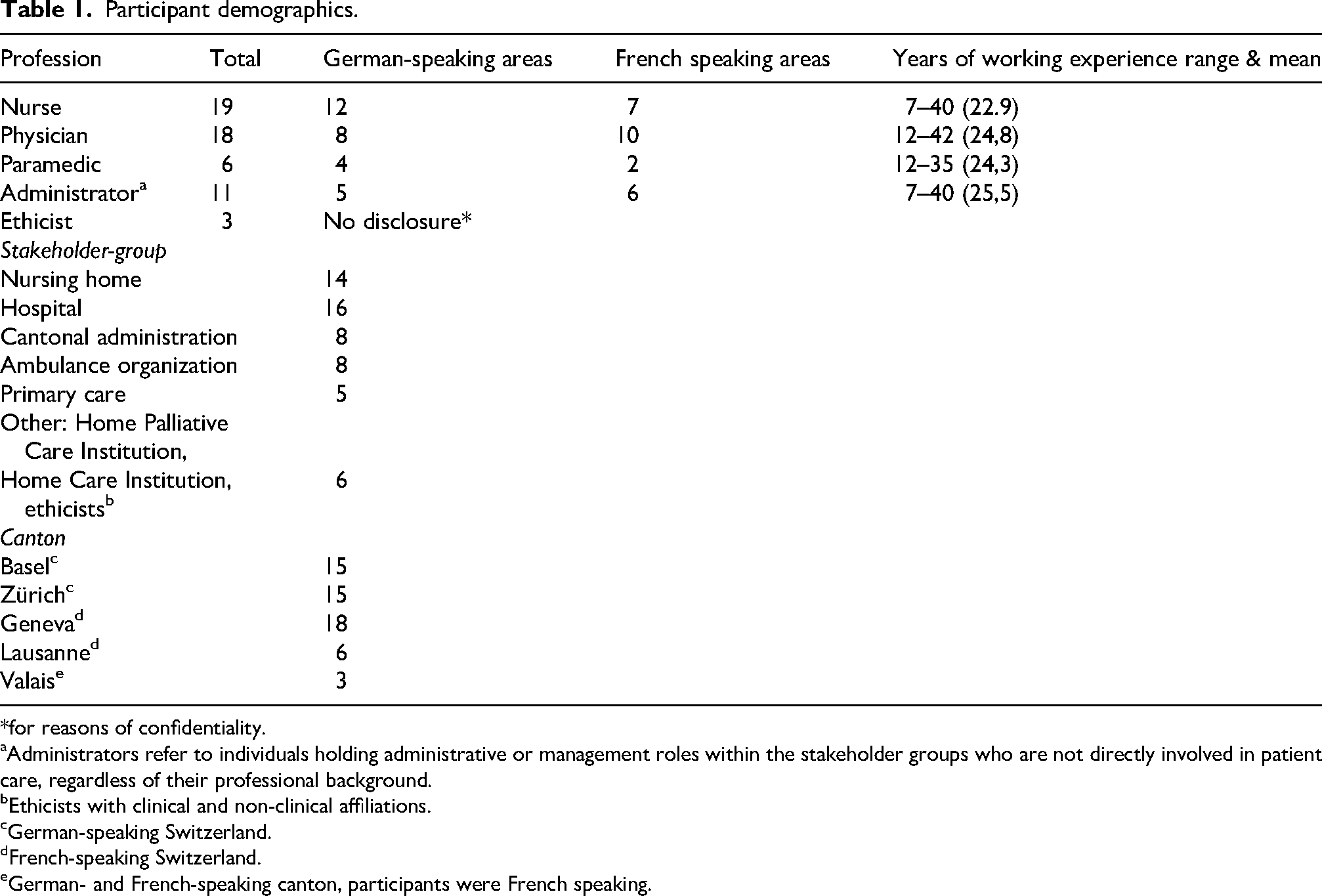
*for reasons of confidentiality.
Administrators refer to individuals holding administrative or management roles within the stakeholder groups who are not directly involved in patient care, regardless of their professional background.
Ethicists with clinical and non-clinical affiliations.
German-speaking Switzerland.
French-speaking Switzerland.
German- and French-speaking canton, participants were French speaking.
While we initially planned to structure our analysis according to regional differences, the differences observed were not substantial enough to serve as a basis for developing distinct thematic categories. We chose instead to organize the analysis around professional groups and key themes related to pre-triage mechanisms, exploring these from multiple angles. The analysis is thus structured around the three main themes and their corresponding sub-themes (Figure 1). We selected the quotes presented in this manuscript based on their relevance according to our interpretation of the data. Our interviewees were neither consulted about nor asked to provide feedback on our analysis, but ES and CN, two authors of this manuscript, are healthcare professionals who worked in hospitals during the COVID-19 pandemic.
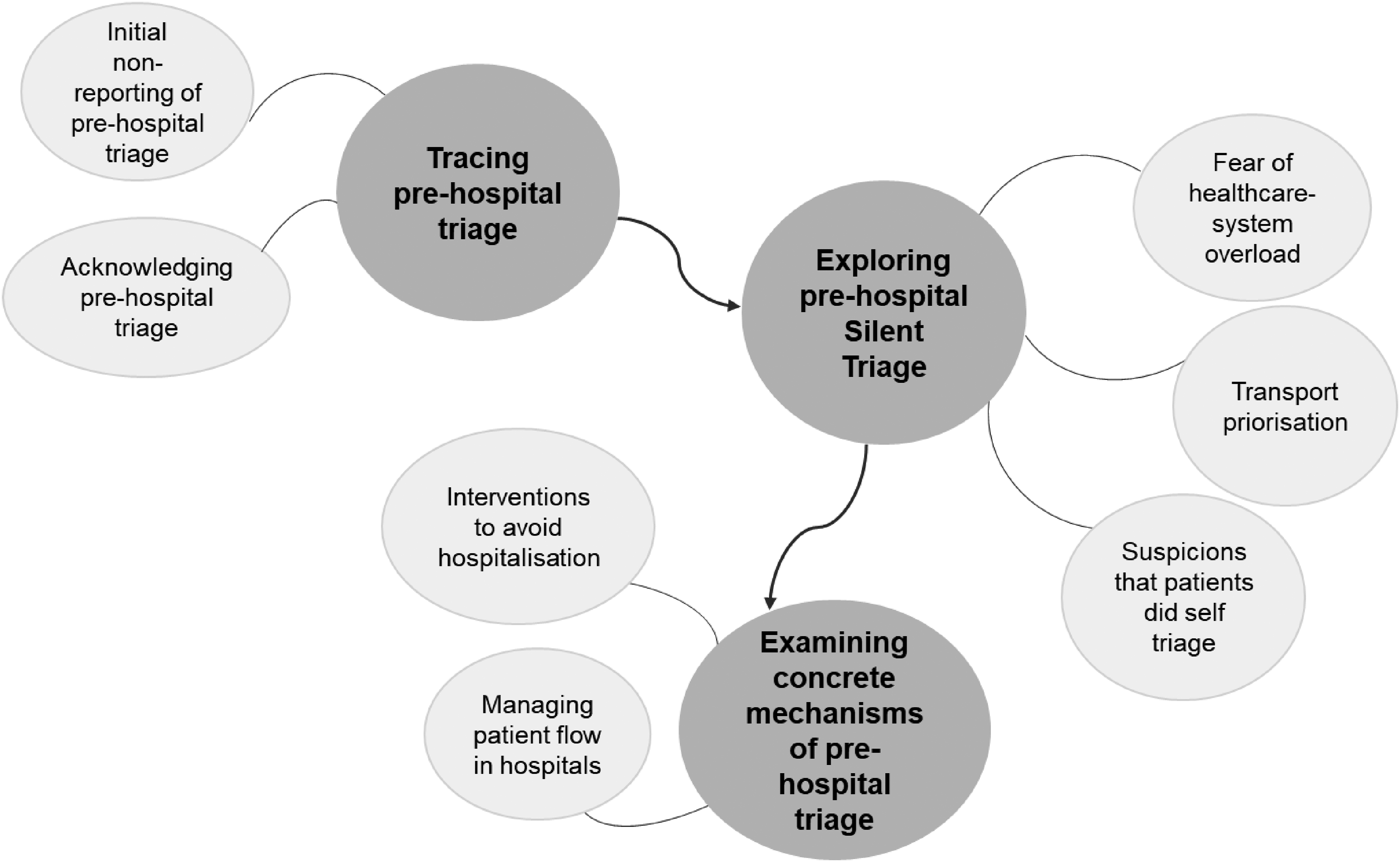
Illustration of the three main themes and their corresponding sub-themes. The main themes are ‘Tracing pre-hospital triage’, ‘Exploring pre-hospital Silent Triage’ and ‘Examining concrete mechanisms of pre-hospital triage'.
Tracing pre-hospital triage
In this theme, pre-hospital triage is traced by capturing participants’ reflections on how access to hospital care may have been restricted before patients arrived at the hospital.
Initial non-reporting of pre-hospital triage
When asked directly about pre-hospital triage, almost all participants indicated that despite an increased demand throughout the COVID-19 pandemic, hospitalization was accessible for all individuals who required or desired it. In stating so, they initially gave the impression that no triage happened to their knowledge. I've never been confronted with a situation where hospitalization was categorically refused. Never. (PV21, administrator) As far as I know, nobody had to be kept away from the hospital. So whoever wanted to come, came and was taken care of. (PE06, physician) I also asked about this in [names specific group]. There are 12 to 13 [SSH] who meet weekly for training. No one could confirm to me that they couldn't hospitalise someone because there was no bed. (PE26, physician)
Acknowledging pre-hospital triage
As the interviews progressed, participants revealed several indicators that—contrary to initial non-reporting—pre-hospital triage processes have taken place and further underwent changes during the COVID-19 pandemic. Hence, interviewees noted that, on the surface, the healthcare system appeared to function appropriately. Nonetheless, some pointed to a hypocrisy in this context, suggesting that Silent Triage that included a discrimination of patients had taken place. They frequently spoke about pre-hospital triage procedures by mentioning concrete examples that are related to Silent Triage, rather than referring to explicit policies recommending that certain patients be prioritized. They further suspected that during the COVID-19 pandemic, there was a negative impact on the health of many individuals, particularly nursing home residents, people with chronic illnesses, and cancer patients. Older people, I think, are the ones who really paid the price for the 2nd wave of October 2020. […] In [name of department], we saw patients who were being triaged [by chronological age], without it ever being made explicit. (PV04, physician) But in fact, there was a kind of hypocrisy where politicians and ethicists said that they didn't have triage and that we didn't apply these criteria because, officially, we were never in a state of shortage. […] And then, in practice, triage has taken place. (PV05, physician) I think I remember that the nursing homes were very cautious and tried not to burden the emergency system. And I think, yes, this [Silent Triage] has led to many deaths. (PE11, nurse)
Several interviewees provided hints on why they felt Silent Triage took place during the pandemic. For example, a decrease in patient numbers in emergency departments of hospitals was noted. One interviewee explained that less residents of nursing homes were sent to hospitals. Others observed that older patients living with severe frailty were—compared to pre-pandemic times—not admitted to hospital’s emergency departments. Further, Silent Triage was suspected because not as many patients as expected reached ICUs: We knew roughly how many people were in intensive care compared with the number of people who had contracted it. […] the number of cases actually admitted to intensive care was significantly lower than the number of cases we would have expected […]. And my first reaction to this graph was: It is Silent Triage! (PV23, ethicist) The intensive care unit population at our clinic had become younger. And we had no explanation for this. […] Where are the older people? Have they already died or are there other mechanisms? (PE21, ethicist)
Exploring pre-hospital silent triage
In this theme, we explore how Silent Triage occurred in the pre-hospital phase, based on the perspectives and practices of our participants. Rather than being explicitly communicated or documented, these triage mechanisms were shaped by situational judgments and perceived pressures and cues. Hence, the following sub-themes explore unspoken, unofficial forms of pre-hospital triage.
Fear of healthcare system overload
The interview data shows that participants were consistently concerned about overloading the healthcare system, frequently believing it already operated at its limits. This led them to a cautious approach to allocate resources. One participant observed that this fear influenced decisions regarding hospitalization, with an underlying aim to prevent system capacity from being exceeded. There was the constant talk of ‘we mustn't overload the system, we mustn't overload the system’, so obviously by repeating this, […] the [healthcare provider] who is in contact with an older sick person thinks of the duty not to overload the system, […] so this person wouldn't be sent to hospital […]. (PV04, physician)
Participants also indicated that their constant concern about overloading the healthcare system affected how they followed guidelines, potentially leading to informal pre-hospital triage. First, our interviewees criticized the overwhelming number of guidelines, as it proved challenging for them to apply them effectively making it non-transparent how and which ones were applied: ‘There were recommendations from everywhere. Unfortunately, not always consistent’. (PE26, physician) Second, physicians working in hospitals feared that the implementation of guidelines entailed the risk that patients have not been hospitalized due to reliance on outdated triage criteria that failed to account for the actual capacity of hospitals. If we have criteria that are too strict, we run the risk of triaging, even when the situation [in the hospital] is calm. (PV13, physician) Pre-hospital care institutions do not have real-time knowledge of bed availability. And that's an important factor, because in a crisis situation, a shortage of beds is likely to make triage criterions stricter. (PV10, physician)
Transport prioritization
Interviewees working for ambulance organizations revealed that they took proactive measures that were guided by the aim to avoid hospitalization whenever possible. A paramedic explained that they made following recommendation more frequently: ‘Stay at home or call the family doctor, do not go to hospital’. (PE13, paramedic) Several other paramedics referred to the challenge of finding a hospital bed, which potentially influenced pre-hospital triage procedures. We sometimes had very long waiting times until a place [=treatment destination] could be found. […] It wasn't clear where we could hand patients over, where further treatment was guaranteed. […] So the information about the current status of bed availability was insufficient or poor in my opinion. (PE17, paramedic) It then became more difficult when it came to transferring patients to the hospitals because sometimes there was an admission stop. […] As a result, you had to drive a longer distance to the next nearest hospital. (PE02, paramedic) It was pointed out during daily reports that there are very few beds available, which inevitably meant that ambulance staff tried to use these beds sensibly. (PE17, paramedic)
Based on this information about scarcity of hospital beds, they made efforts to hospitalize only patients who were in urgent need for hospital treatment, for example, by considering chronological age criteria. The younger the patients were, the more often a recommendation against hospitalization was given: 'It always depends on the situation but in general there was the tendency: The younger patients were, the more they have been advised to stay at home’. (PE13, paramedic) One paramedic explained that triage decisions are typically guided by established algorithms. Nevertheless, the lack of knowledge and experience with the new virus presented challenges, complicating the development of effective triage methods. Hence, pre-hospital triage procedures required continuous reassessment to set appropriate criteria for hospitalization. Without clear, evidence-based criteria, paramedics had to rely on subjective judgments and evolving guidelines, which increased the likelihood of unintentional pre-hospital triage. When we have a new pathology, a new situation, we have to invent new triage methods. […] And so we had to re-evaluate all these situations to say ‘Ah, we're going to set the bar here. Everything above is OK, everything below is OK’. Then maybe the next day we said ‘No. So now we're setting the bar here because yesterday we had a situation that was a little bit dangerous’. (PV25, paramedic) Paramedics were often annoyed: ‘Do we really have to pick up a very old person from long-term care again?’ You could already see the stress they were under. […] But at the same time you can't just say: ‘Yes, there are no transfers per se in the case of the very old.’ So we clashed on that point many times. (PE07, nurse)
Suspicions that patients did self-triage
During the interviews, various participants assumed that many individuals triaged themselves by refraining from seeking hospital care, unless a critical emergency, such as severe breathing difficulties, necessitated immediate intervention. Interviewees from nursing homes reported that, in general, residents express a preference of not wanting to be hospitalized: ‘Most residents actually almost never want to go to the hospital’ (PE19, nurse), and that residents who ask for maximum medical care interventions are a rare exception: ‘Hospitalization with maximum care is the exception rather than the rule’. (PE14, nurse) During the COVID-19 pandemic, our interviewees assumed that this general preference was reinforced, because residents voiced their fear of getting infected by COVID-19 during the hospital stay. Hence, they repeatedly voiced their desire not to be hospitalized. Only a small number of residents want to be admitted to hospital anyway. And definitely not during a pandemic. Residents were probably much more afraid of being infected in hospital than they were with us. (PE25, administrator)
In this context, interviewees suspected that media was an influencing contributor to fear, which discouraged individuals from seeking medical help: ‘People saw the news on TV, they saw people dying in hospitals. So often, patients told us: “I don't want to go to hospital because I will die in hospital”’. (PV08, physician)
Examining concrete mechanisms of pre-hospital triage
Building on the previous theme, ‘Exploring Pre-Hospital Silent Triage’ (Figure 1), this theme focuses on explicit, observable mechanisms of pre-hospital triage. While the previous theme highlighted subtle and informal pre-hospital triage, here we examine how participants described deliberate pre-hospital triage based on official and outspoken mechanisms.
Interventions to avoid hospitalization
Outside the hospital setting, many interventions were made to avoid hospitalizations to prevent overburdening hospitals. Concerning primary care, general practitioners explained that they made an effort to avoid hospitalizations during the COVID-19 pandemic and keeping patients at home was a priority. ‘It was our task to help ensure that what the hospitals were doing remained manageable for the staff’. (PE01, physician) One general practitioner said that this measure was twofold: So it's not just a question of preserving hospitals, but also of preserving the quality of care. In other words, if you send people to a system that's saturated, the quality isn't as good for them either. So we were quite motivated to keep people at home, and we did it perhaps even more than usual, by committing all possible means. (PV08, physician)
One general practitioner explained that patients were called at frequent intervals to ask about their state of health: It was our job to [not overburden the hospitals]. […] Of course, for a long time, we simply provided regular support for our patients by telephone and approximately every two days we had a telephone conversation […]. (PE01, physician)
Also, home care institutions pursued the goal to avoid hospitalization as much as possible, for example, a special team was formed to care for patients with a COVID-19 infection including close cooperation with the ambulance in case the condition of patients worsened, and hospitalization was required: We set up this team to care for Covid patients at home, to free up places and avoid overcrowding hospital beds. […] We also had an agreement with 144, the emergency services, so that if a patient wasn't feeling well at all, they would intervene within 10 min in an emergency at home to take the patient to hospital. (PV12, administrator) What we did was work with the nursing homes to see how, as far as possible, they could keep patients at home and not hospitalise them, […]. We also put in place guidelines for nursing home doctors, so that they could take the best possible care of patients. (PV22, nurse) We tried to strengthen and advise the nursing homes so […] that they gain the competence to be able to care for the residents in the homes in such a way that there is no further spread [of the virus]. (PE15, physician)
Active measures were also taken by ambulance organizations to avoid hospitalization. Paramedics explained that triage criteria were adapted for example, by applying the ‘can wait’ category more frequent that might have led to no hospitalization at all. Further, a care algorithm was created as a tool for pre-hospital triage decision making. Also, a directive was issued advising patients with minor health concerns to remain at home. Additionally, the criteria for withdrawing resuscitation were applied more flexible, resulting in an earlier withdrawal. I think we have certainly increased the ‘can wait’ triage category. When we used to say: ‘Have to go to the hospital now’ we said ‘This can wait’. […] We also had instructions from the medical management. But the instructions were only that we should make patients aware that they could very well help themselves at home in the case of trivial matters. They would be better off than being cared for in hospital because resources were scarce. (PE13, paramedic) So our main mission during the COVID period was to leave anyone who didn't need to go to hospital at home. For this purpose, we created a care algorithm [for decision making]. And then, quite simply, if the overall state of health was still acceptable, we left them at home. (PV26, physician) And the criteria for discontinuing resuscitation were also interpreted a little more flexibly. So that they would say sooner: ‘stop, we're stopping’. That was a specific measure that affected pre-hospital triage. Ultimately, even after the fact: Yes, a resuscitated patient does need a place in intensive care afterwards if the patient is successfully resuscitated. (PE04, paramedic)
Managing patient flow in hospitals
In the following, we explore various strategies that were implemented to manage patient flow and maintain capacity for in-patient care in hospitals.
Numerous participants explained that hospitals reduced non-COVID-19 treatments by excluding patients with certain health conditions: ‘Everything that wasn’t absolutely necessary was cancelled’. (PE30, nurse) Hence there was a suspension of elective procedures including certain surgeries and the reallocation of resources to increase care capacities for COVID-19 patients: ‘Hospital care has been much more limited … Surgical care’. (PV04, physician) ‘The [non-urgent] operating programs were stopped, […], and we multiplied the number of internal medicine beds’. (PV03, nurse) In addition, throughout the interviews, a consistent emphasis was placed on the importance of avoiding hospitalizations to prevent the overburdening of hospitals. This approach aimed to alleviate pressure on hospitals by treating patients in alternative care settings when feasible. Additionally, expedited patient discharge was identified as a key strategy to increase bed availability, ensuring that hospital resources were prioritized for those requiring more urgent medical care: ‘We tried to discharge people more quickly to maximize the capacity in the hospital’. (PV05, physician) Hence, in between care wards in nursing homes were established to being able to unburden hospitals, which was based on instructions by the government to establish these facilities: We have also opened an isolation ward here, where we have taken on relief tasks for the hospitals. So, we cared for people who tested positive for COVID and could not go home because of the risk of infection, but could not stay in hospital. (PE25, administrator)
Discussion
The purpose of our study was to explore the perceptions of SSH regarding pre-hospital triage during the COVID-19 pandemic in Switzerland, with a particular focus on how it affected the treatment and care of older people during times of resource scarcity. This topic carries important ethical implications, as triage decisions made outside formal hospital settings raise questions about justice and transparency. 19 Older adults are particularly relevant in this context, as they may face heightened risks of exclusion or unequal treatment during public health crises.39,40
Our participants initially claimed that hospitalization remained accessible for everyone during the COVID-19 pandemic, suggesting that no pre-hospital triage occurred. However, as interviews progressed, they spoke about topics related to Silent Triage, including mechanisms that affected certain individuals, such as nursing home residents. Based on this, our analysis first explored pre-hospital triage procedures that were outside explicit policies, but are closely connected to the principle of Silent Triage. Then we analysed and reflected participants’ statements about interventions that were based on official or outspoken mechanisms. These included disclosed and clearly traceable efforts by primary care institutions, nursing homes and ambulance organizations to actively avoid hospitalizations.
A major debate in the ethical literature on pandemic triage has concerned whether chronological age should serve as a criterion for limiting access to care during times of resource scarcity.11,41 In Switzerland, anecdotal evidence suggests that some healthcare institutions in certain regions may have used age as a triage factor during the COVID-19 pandemic. 23 Against this backdrop, we sought to explore whether such practices occurred in Switzerland and whether regional differences in pre-hospital triage existed across linguistic areas and institutions. However, our participants, regardless of the canton or region in which they worked, provided accounts that were largely similar. None reported applying a strict chronological age threshold for pre-hospital triage. On the contrary, advanced chronological age sometimes seemed to be a criterion for prioritization. For example, paramedics and interviewees working in emergency departments reported that they usually prioritized patients of advanced age. Furthermore, responses regarding the decision-making process for hospital admissions were consistent across participants. For instance, in the case of nursing homes, decisions were typically made by general practitioners, frequently in collaboration with the nursing home staff and with consideration of the resident's preferences. However, the content of responses regarding pre-hospital triage showed that certain patterns were more prominent within specific professional groups. Only ethicists used the term ‘Silent Triage’ and were particularly critical of its occurrence. Nurses working in nursing homes, as well as nurses and physicians in hospitals, predominantly elaborated on the self-triage behaviours of residents and patients. Paramedics, due to the nature of their work, most frequently applied pre-hospital triage and described how their approach changed during the pandemic—for example, by more carefully assessing whether hospitalization could be avoided. Administrators and general practitioners commonly discussed how they established care provision outside of hospitals to actively avoid hospitalization, such as by increasing medical support within nursing homes.
To the best of our knowledge, our study contributes important new findings as no other qualitative study explores pre-hospital triage mechanisms, and most studies focus on triage within the hospital setting mainly regarding intensive care unit triage.11,18,42,43 For instance, Merlo et al. 44 conducted qualitative interviews with nine physicians working in COVID-19 hospitals in the Canton of Ticino, Switzerland, to capture their attitudes towards triage guidelines for intensive care treatment. They ‘found that participants held different views regarding the nature of the guidelines, saw decisions on admission as a matter of collective responsibility, argued that decisions should be based on a medical futility principle rather than an age criterion’. 44 Similarly, our study found that decisions regarding hospitalization were generally not based on chronological age but rather on patients’ overall health status, social circumstances, and expressed wishes. Hence, decision-making was built on the medical ethical principles such as beneficence and respect for autonomy. 45
Although many pre-hospital triage measures derived from explicit, written, or openly communicated criteria, participants also provided indications that Silent Triage occurred alongside these official practices, which raises ethical concerns. Prominent were interviewees’ perceptions that the phenomenon of self-triaging occurred: individuals—particularly older adults—chose not to seek medical help. Similar assumptions were made by Wirth et al. 3 who examined how the Covid-19 pandemic, particularly the 2020 spring lockdown, affected inpatient hospital admissions in Switzerland and found lower numbers of admission of people aged 40–79 years and suspect that this group actively avoided healthcare services. 3 In line with these findings, a study conducted in the Netherlands explored the extent, characteristics, and underlying motivations for delayed emergency department visits during the first wave of the Covid-19 pandemic. It revealed that a relatively large proportion of emergency department visitors reported delays in seeking care—often driven by misperceptions about the accessibility of services and the legitimacy of their need for emergency treatment. 46 Our participants attributed to the media an influencing role in shaping individuals’ decisions of forgoing medical treatment. These assumptions align with findings in the existing literature as it is reported that both mainstream and social media have been key in spreading information throughout the COVID-19 pandemic, facilitating the swift distribution of scientific research while also contributing to the spread of misinformation, resulting in a rise of ageist messages.47–51 This misinformation and ageist media portrayals, which framed older adults as inherently vulnerable and less valuable, as well as suggesting they would likely die from a COVID-19 infection, may have contributed to self-triage behaviours among older individuals. Our interview participants strongly criticized self-triaging behaviours, expressing concerns that they might have resulted in harm, particularly in cases of acute medical conditions. They suspected acute medical events like heart attacks were not properly diagnosed, potentially having led to preventable deaths. Additionally, they noted that individuals with chronic diseases, such as diabetes and cancer, were often not receiving the necessary treatment. Similar observations have been highlighted in the literature, showing that healthcare interventions decreased, specifically at the pandemic’s onset and that individuals omitted medical treatment: Globally, healthcare utilization declined by approximately one-third during the initial months of the COVID-19 pandemic. 52 In Switzerland, during the first wave of COVID-19 in Spring 2020, elective in-hospital procedures dropped by 52.9%. Although numbers normalized over the summer, a net deficit remained by the end of the year. 53 Emergency admissions also saw a significant decline during the spring lockdown in Swiss hospitals. 3 Menon et al. 54 conducted a survey of 5397 adults in the Canton of Geneva, Switzerland, between November 2020 and January 2021. They found that 8.0% had forgone healthcare since the start of the COVID-19 pandemic and underscored the risks of abstaining from medical treatment due to its potential negative health outcomes. 54 However, there is no precise, officially documented total number of individuals in Switzerland who died because of not being admitted to a hospital, making it difficult to quantify the full impact of triage decisions and self-triage behaviours on mortality during the pandemic.
Nevertheless, our participants elaborated on their efforts to respect the will of older individuals. This included their requests to remain in their accustomed environments for example, by applying a more throughout assessment of nursing home residents’ condition before deciding about hospitalization, and providing more comprehensive care within nursing homes. Interviewees acknowledged that changes in environment could be highly distressing for residents, especially for those living with dementia. This is well supported in the literature, with multiple studies highlighting the adverse effects of hospitalization on individuals living with dementia, such as delirium, falls, accelerated cognitive decline, and severe distress. These outcomes are frequently attributed to the disruption of the consistent environments, caregivers and routines they rely on.55–60 It is also known that hospitalizations for people with dementia are often avoidable, and efforts should be made to prevent them whenever possible.58,61–63 During the pandemic, these efforts were made intensively.
Further, participants reported that initiatives were undertaken to systematically evaluate nursing home residents’ preferences concerning hospitalization. In fact, Advance Care Planning gained popularity during the COVID-19 pandemic 64 and was frequently considered ‘as vital to resource allocation in times of crisis’. 65 While actively inquiring about individuals’ wishes regarding medical care during extraordinary situations like the COVID-19 pandemic presents challenges in implementation accompanied by ethical concerns, it can also yield benefits, such as the prevention of burdensome overtreatment. 64
Strengths and limitations
A major strength of this study is its focus on an under-researched topic, shedding light on the complexities of pre-hospital triage, which has been scarcely explored in previous literature. Additionally, the study benefits from a large sample of 57 SSH from different professions and organizations, providing a variety of perspectives that make the findings more comprehensive.
A limitation of this study is that social desirability bias may have influenced participants’ responses, as the sensitive nature of the topic about pre-hospital triage could have led them to present their views in a more favourable light. Despite assurances of confidentiality and anonymity in the informed consent process, participants possibly still felt a sense of loyalty to their institutions, which could have affected their willingness to disclose certain sensitive details. The use of snowball and purposive sampling may have led to a selection bias as participants potentially shared similar experiences and views, potentially limiting the diversity of perspectives and influencing the overall findings.
Conclusion
Although a large number of our participants stated that no pre-hospital triage occurred for individuals requiring urgent hospitalization due to acute medical emergencies, our study reveals several ethically relevant shortcomings within the Swiss healthcare system that must be addressed in future scenarios involving limited medical resources. We could trace Silent Triage and identified two main factors that contributed to it: (a) Study participants’ descriptions about the persistent concern over the potential to overload the healthcare system. This fear, however, was frequently not grounded in real-time data about hospital capacity, which may have led to overly cautious decisions and the withholding of necessary care in situations where sufficient resources were actually available. From a medical ethics perspective, this raises concerns because decisions about hospitalizations may have been influenced more by assumptions about availability than by evidence, potentially undermining core ethical principles such as beneficence, non-maleficence, and justice in the fair allocation of care. 45 To prevent Silent Triage in times of medical resource scarcity that is based on assumption about medical resource availability, a nationwide strategy to make real-time data on hospital capacity accessible to non-hospital care providers needs to be established, to enable decisions based on actual conditions. (b) Our study participants suspected a high prevalence of self-triage, particularly among older adults, who may have avoided seeking medical care due to fear of overburdening the healthcare system. This behaviour was often attributed to ageist media content, and narratives that framed older adults as especially vulnerable. From an ethical perspective, this is concerning because it risks leading older adults to view forgoing medical care as a moral obligation, rather than a free and informed choice. Hence, clear and consistent communication to the public is needed in times of scarce healthcare resource to emphasize the availability of medical care and reinforce that everyone—regardless of age—is equally entitled to receive medical treatment.
Supplemental Material
sj-docx-1-cet-10.1177_14777509251372983 - Supplemental material for Ethical perspectives on pre-hospital triage mechanisms among Swiss healthcare stakeholders during times of medical resource scarcity: A qualitative study
Supplemental material, sj-docx-1-cet-10.1177_14777509251372983 for Ethical perspectives on pre-hospital triage mechanisms among Swiss healthcare stakeholders during times of medical resource scarcity: A qualitative study by Elisabeth Stock, Olga Vinogradova, Tenzin Wangmo, Christian H Nickel, Andrea Martani and Bernice S Elger in Clinical Ethics
Footnotes
Acknowledgements
The authors thank all participants who shared their precious time and valuable experiences. Our gratitude goes to our project collaborators for the highly appreciated support of our study. We also want to thank Fabienne Moser for her help in transcribing the interviews and her support in the initial stage of data analysis.
ORCID iDs

Funding
The authors received the following financial support for the research, authorship, and/or publication of this article: This study is funded by the Käthe-Zingg-Schwichtenberg-Fonds (KZS) of the Swiss Academy of Medical Sciences – Schweizerische Akademie der Medizinischen Wissenschaften, (grant number KZS 10/21). The funder did not play any role in the design of the study, collection of data and analysis, decision to publish, and manuscript preparation.
Declaration of conflicting interests
The authors declared no potential conflicts of interest with respect to the research, authorship, and/or publication of this article.
Data availability statement
The study data and materials cannot be made publicly available because of the sensitive nature of the data and the confidentiality commitments made to the participants.
Supplemental material
Supplemental material for this article is available online.
References
Supplementary Material
Please find the following supplemental material available below.
For Open Access articles published under a Creative Commons License, all supplemental material carries the same license as the article it is associated with.
For non-Open Access articles published, all supplemental material carries a non-exclusive license, and permission requests for re-use of supplemental material or any part of supplemental material shall be sent directly to the copyright owner as specified in the copyright notice associated with the article.
