



Abstract
Post-consumer polyethylene terephthalate (PET) plastic bottles, after some pre-processing, were chemically depolymerized for the production of terephthalic acid (TPA), an important monomer of PET resin. The optimized condition of PET hydrolysis was 100°C with 80% v/v aqueous sulfuric acid liquor for 30 min reaction time. The terephthalic acids (TPAs) were filtered out from the reaction mixtures with a sintered glass filter. The viscosity of recycled hydrolysis liquor was measured before it was used in a successive batch of PET depolymerization. The viscosity of hydrolysis liquor increased gradually from 5 mm2/s to 87 mm2/s. TPA yields were obtained from 85.03 ± 0.03% to 99.20 ± 0.06% and the color of TPA changed from bright white to off-white in the final batches. The structure of TPA was confirmed by FTIR, mass analysis, and 1H-NMR spectroscopy. The purity of TPA was found to be 95–98% from the HPLC study via external calibration technique. Thermogravimetric analysis (TGA) determined the thermal degradation patterns of TPAs and residual weights. This experiment reveals that repeated use of sulfuric acid hydrolysis liquor would be a good option for PET depolymerization in terms of resource utilization, TPA quality as well as sustainability.

Keywords
Introduction
Polyethylene terephthalate (PET) is one of the highest utilized polyester thermoplastics. The worldwide production of PET resin was 50.01million tons in 2016 with a forecasted annual growth rate of 9.17%.1,2 PET plastic has found all-over applications due to its high moldability, strength, transparency, toughness, and cheap production cost. The major sectors of PET consumption are bottle production for water, beverages, and other drinks. In 2016, 485 billion PET bottles were produced worldwide which has been increased to 583.3 billion in 2021. 3 PET is not biodegradable and remains in the environment for hundreds of years. Most PET bottles are used as single-use plastics and thrown away to the environment almost immediately after consumption of water or drinks it contains. This creates a huge pressure on landfill facilities and deteriorates the quality of agricultural land, river bodies as well as the marine environment.4-7 Being thermoplastics in nature, PET bottles can be recycled thermo-mechanically. The recycled PET resin can be used in similar applications or lower-valued applications based on the qualities of the recycled resin.8-10 PET resin when undergoes multiple thermo-mechanical recycling its molecular weight and intrinsic viscosity are reduced. Some unwanted and detrimental chemicals like acetaldehyde are also produced during the recycling process. 11 Moisture and polyvinyl (chloride) in PET waste badly deteriorate the transparency and color of the recycled PET resin.12,13 Chemical recycling, on the other hand, converts PET polymer to its monomer(s) and other simple chemical compounds. The monomers thus produced can be used to synthesize high-quality virgin grade PET resin.14,15
Several approaches to chemical recycling for PET plastics have been studied. Among these glycolysis, methanolysis, hydrolysis, aminolysis, and pyrolysis are prominent. Each of these processes has its benefits and drawbacks.16-20 Hydrolysis, a well-studied chemical recycling route for PET, has been conducted in several pathways- (i) neutral hydrolysis, (ii) acidic hydrolysis, (iii) basic hydrolysis, and (iv) enzyme-catalyzed hydrolysis. The hydrothermal conversion of unwearable polyester waste from textiles to TPA was achieved at a high yield but with moderate purity. 21 The chemical conversion of PET concerning depolymerization agents, reaction conditions, and the kinetics of reactions was also studied. 22 Dissolution of waste PET into biomass-derived γ-valerolactone before alkaline hydrolysis was investigated highlighting it as an environmentally benign process. 23 Enzymatic hydrolysis of waste PET along with the screening of natural bacteria and recombinant variants as sources of the enzyme was also reported. 24 In acidic hydrolysis of waste PET H2SO4, HNO3, and HCl are mostly used.25-28 In this study, H2SO4 was taken as a catalyst for the hydrolysis depolymerization reaction of waste PET bottles. The hydrolysis reaction of PET was conducted in a batch reactor and the hydrolysis liquor was recycled. The recycled hydrolysis liquor was used repeatedly for the PET depolymerization reaction and this recycling process for hydrolysis liquor continued for several times. The effectiveness, efficiency, and limiting factors for repeated use of acidic hydrolysis liquor for PET depolymerization have been studied critically for the first time in this experiment. The parameters for hydrolysis reaction have been fixed based on percent PET conversion and product quality as well as quantity. TPA, an important monomer for PET resin synthesis, which was produced in the hydrolysis reaction of waste PET, has been characterized by different analytical techniques. The structure of TPA was confirmed by FTIR, NMR, and mass analysis. The purity of TPA was analyzed by HPLC, connected to a PDA detector. Thermal degradation of the TPAs was studied by a TG analyzer and variations in their degradation patterns were compared. Physico-chemical parameters such as solubility of derived TPAs were investigated in water and common organic solvents. The melting point, a pertinent property to determine the product quality, of TPA powders was measured accordingly.
PET, denoted by recycling code-1, is one of the most studied plastic for mechanical and chemical recycling. At present several units all over the world are operating mechanical recycling for PET waste, though there are several technical and economical constraints. Chemical recycling is rather a new approach to PET recycling with vast potential. It is presumed that an appropriate chemical recycling process for PET will eliminate most of the current drawbacks of recycling operations. Thus, the development of an efficient chemical recycling method for PET waste would certainly be progress in terms of resource recovery, waste management, environmental benefits, and sustainable development. Acidic hydrolysis of PET with repeated use of hydrolysis liquor is one such approach. The findings of this experiment will increase the level of our understanding of PET hydrolysis and valorizing plastic waste into valuable resources in the most sustainable approaches.
Materials and methods
Materials
Waste PET bottles were collected from Dhaka city and around, Bangladesh and were used in depolymerization after proper cleaning. Reagent grade H2SO4 and distilled water were used for the preparation of hydrolysis liquor. Distilled water was also used for the washing of TPA products. The batch reactor was made up of a three-necked flat bottom flask with a reflux cooling unit and stirring arrangement. Sintered glass filter was used for filtration of TPA from hydrolysis liquor. Ubbelohde glass viscometer was used for measuring the viscosity of hydrolysis liquor. HPLC grade water, methanol, and deuterated DMSO were used for the instrumental analysis of TPA.
Methods
Preparation of waste PET
Cap and label were removed from the collected waste PET bottles. The bottles were then subjected to tap water washed, detergent wash, and finally hot water wash. The PET bottles were cut into 5–10 mm small pieces and dried in an oven at 105°C for 2h. The cleaned and dried PET pieces were stored in an air-tight container for further use.
Preparation of hydrolysis liquor
Reagent grade 95% H2SO4 was diluted to 80% v/v of H2SO4 using distilled water. Slow addition of H2SO4 into the water was maintained to avoid overheating. When hydrolysis liquor was cooled to room temperature, it was kept in a sealed glass bottle safely.
Hydrolysis reaction
Hydrolysis of waste PET was conducted according to the method described in the reported literature
28
with some modifications. In each batch of the hydrolysis reaction, 10 g of pre-processed PET flakes (5–10 mm sizes) and 200 ml of hydrolysis liquor was mixed in a three-neck flat bottom flask. The ratio of PET flakes to hydrolysis liquor was maintained to 1:20 w/v. A PTFE coated magnetic stirring bar of 8 mm x 35 mm size was placed in the flask. The reaction mixture was placed on a hotplate with a magnetic stirrer. The water-cooled reflux system was attached and a graduated thermometer was placed through the neck of the flask to monitor the temperature. The temperature of the reaction mixture was adjusted to 100°C and 500 rpm continuous stirring was maintained. The conversion of PET polymer to TPA through hydrolysis reaction was allowed to conduct for 30 min. A white precipitate of TPA appeared in the reaction mixture. The reaction scheme for depolymerization of PET with H2SO4 hydrolysis liquor is presented in Figure 1. After 30 min of depolymerization of PET, the reaction mixture was allowed to cool to room temperature. The white precipitate of TPA was filtered with no. Three analytical sintered glass filters. The hydrolysis liquor was collected as filtrate. The product TPA was washed 3–4 times with distilled water. The TPA was then dried in an oven at 105°C for 6h and was kept for subsequent yield, structural, and other Physico-chemical analysis. Reaction scheme for hydrolysis conversion of PET into terephthalic acid (TPA) using aqueous sulfuric acid liquor.
% Conversion of PET and Yield calculation of TPA
The white precipitate of TPA from the reaction mixture was filtered, washed, dried, and weighed in a four decimal point precision balance for yield calculation. The initial weight of dried PET was recorded and final undepolymerized PET was separated from the reaction mixture by dissolving TPA in DMSO and filtering undissolved PET. The unreacted PET was dried and weighed for percent conversion calculation. The yield percentage was calculated based on initial dried PET taken for reaction. The stoichiometric mass balance was considered in every yield calculation. The percent conversion of PET and percent yield of TPA were calculated according to equations (1) and (2).


Viscosity measurement of hydrolysis liquor
The viscosity of initial fresh hydrolysis liquor and recycled liquor from hydrolysis reaction was measured in an Ubbelohde type glass-viscometer. Viscosity was measured at room temperature (25°C), similar to TPA filtration temperature. Hydrolysis liquor was taken carefully in an Ubbelohde viscometer and a hand pump was used to fill the viscometer tube. The falling time of liquor was measured by a stopwatch. Three measurements were conducted for every sample. The constant of the Ubbelohde tube was multiplied by falling time in seconds to get the kinematic viscosity of the hydrolysis liquor.
FTIR analysis of TPA
FTIR spectrum of TPA was taken by ATR-MIR spectrometer. The dried powder of TPA was taken on the diamond ATR and the spectrum was measured between 4000-650 cm−1 region. ATR gauge pressure was applied to 60 units. The scan number was 32 and the resolution was 4 cm−1. Peaks were labeled and analyzed for the functional groups in TPA. The spectrums of TPAs obtained in this experiment were compared with the standard TPA spectrum.
Mass analysis
Mass analysis of TPA was conducted by GC-MS with EI ionization. TPAs were dissolved in HPLC-grade methanol, filtered through a 0.22µm syringe filter, and injected through an automated GC glass capillary inlet. The inlet temperature of GC was 280°C and the column temperature program was as follows: initial 40°C, 20 ⁰C/min to 280°C and was held for 10 min. The electron impact (EI) ionization source with an excitation temperature of 150°C was employed for fragmentation of the TPA molecule and resulting m/z fragments were scanned to obtain the mass spectrum. Mass spectrums of derived TPAs were compared with the standard TPA from previous reports.
Proton-NMR of TPA
The structure of derived TPA was further studied by 1H NMR. TPA was dissolved in deuterated DMSO solvent and was taken into an NMR tube. Bruker 400MHz NMR spectrometer was used and the measurement was conducted in the range of 0–15 ppm. 1H NMR of derived TPAs was studied for types of proton and was compared with the standard TPA 1H NMR.
HPLC analysis of TPAs
The standard and experimental TPAs have dissolved in HPLC-grade methanol. A binary solvent system with methanol and water was applied as a mobile phase with 95:5 volume ratios. Reverse phase C18 column was thermostat at 40°C and 1.0 ml/min flow of mobile phase was maintained. The Signal was recorded in a PDA detector. The external calibration curve was created with standard TPA and percentages of TPAs in experimental products were determined against this calibration.
TG analysis of TPA
Thermal analysis of TPA was taken in PerkinElmer Pyris1 TGA in a nitrogen gas (inert) environment. The temperature range was 30–850°C with a heating rate of 20 ⁰C/min. The TGA curve was analyzed for % mass change at different temperature ranges and % residual mass at the end of the temperature program. The difference in thermal degradation properties and impurities in TPAs was obtained as residual mass from TG analysis.
Results and discussion
Terephthalic acid (TPA) yield and variation in its physical properties
Depolymerization reaction conditions and percent yields of TPAs from recycled PET plastic bottles.

In recycled hydrolysis liquor, dissolved TPA from the first batch was remained and carried to the successive batch of reactions. The hydrolysis liquor was previously saturated by TPA from the first batch of reaction and the yield of the subsequent batch became higher. In a previous investigation, 92% conversion of TPA was achieved from the hydrothermal hydrolysis of PET. 21 Microwave-assisted depolymerization of PET into TPA and EG was investigated, where 100% conversion of PET into TPA was attained at 120°C. 29 In this experiment around 100% TPA yield was obtained at a lower temperature (100°C). Moreover, the hydrolysis liquor was repeatedly utilized for four consecutive batches of reaction, and the product quantity, as well as quality, were obtained almost identical.
The color of TPA from virgin liquor was bright white and its color gradually turned off-white as the number of recycled of the hydrolysis liquor increased. The TPAs obtained in different batches of experiments are presented in Figure 2. TPA obtained from waste PET bottles by hydrolysis through repeated use of hydrolysis liquor.
Percent PET conversion and color and viscosity chart of hydrolysis liquor.

Viscosity of hydrolysis liquor and its reusability
The kinematic viscosity of initial-virgin hydrolysis liquor was found to be about 5 mm2/s (Table 2). In the fourth repeated use of hydrolysis liquor, viscosity was increased to about 87 mm2/s and was very difficult to filter through a sintered glass filter.
An increase in viscosity was due to the presence of co-product ethylene glycol (EG) and dissolved TPA in recycled liquors. The higher viscosity of successive recycled liquor limits the number of recycling. Appropriate extraction methods of EG and dissolved TPA from recycled hydrolysis liquors are necessary to overcome this setback.
FTIR analysis of TPA
The main peaks of TPAs were detected at 2814, 2534, 1675, 1574, 1509, 1280, and 782 cm−1. The peaks at 782 cm−1 indicate the para-substituted arene group of TPA. The peak at 1280 cm−1 indicates the C-OH bond. The peaks at 1509 and 1575 cm−1 are for aromatic C=C bonds. The strong peak at 1675 cm−1 is for the C=O group of carboxylic acid. The peaks at 2814 and 2534 cm−1 are for the OH group of carboxylic acid. The IR spectrums of TPAs are presented in Figure 3. From the figure, it is clear that TPA was produced in each experiment, and batch-to-batch variation was insignificant. FTIR spectra of TPAs obtained from hydrolysis of waste PET.
The representative peaks of every functional group in the TPA structure are well fitted by the IR spectrum. The IR spectrums of derived TPAs also complied with the standard TPA spectrum.
Mass analysis of TPA
Mass spectrums of TPAs from GC-MS EI ionization in an inert Helium environment and at 70eV fully complied with the mass spectrum of standard TPA in the NIST mass spectrum database. The mass spectrum of TPA from the NIST mass library and waste PET conversion have been presented in Figure 4. Mass spectrum of terephthalic acid (TPA)- (a) in NIST library, (b) product TPA from waste PET conversion.
The molecular ion peak was found at 166 m/z and the highest abundant base peak was at 149 m/z. Other significant and large peaks were at 121 m/z, 65m/z, 50m/z, and 39 m/z. The major peaks as well as the minor peaks in the mass spectrum of standard and product TPAs were found identical. The batch-to-batch variations in mass spectrums of TPAs were found insignificant.
Proton NMR of TP
Two types of proton peaks were obtained in the NMR spectrum (Figure 5) at 8.01 and 13.27 ppm other than the solvent peak at 2.50 ppm and moisture peak at 3.39 ppm. A strong peak at and around 8.01 ppm is for the protons of the aromatic ring of the TPA structure. The broad peak at 13.27 ppm is for the proton of carboxylic groups. The proton NMR of TPAs in this experiment was compliant with the proton NMR of standard TPA. The proton NMR spectra of derived TPAs from different batches of this experiment were found to be identical. This represents the confirmation for the production of TPA in each successive experiment of waste PET hydrolysis. Proton NMR spectrum of TPA produced in this experiment.
Purity analysis of TPA by HPLC
An external calibration curve using standard TPA was formed in the range of 10 mg/L to 50 mg/L. The correlation coefficient (R2) was obtained 0.99. A sharp TPA peak was observed at the retention time (RT) of 1.03 min. The response was calculated on the basis of peak area. The purity of TPA for virgin hydrolysis liquor batch was found to be 99.2%. The purity decreases gradually to 98.7, 97.6, and 95.7% in successive batches. The decrease in purity was probably due to the presence of ethylene glycol and other process impurities in TPAs. Additional washing and recrystallization of TPA from the solution would remove the residual impurities.
TG analysis of TPA
Thermal degradation of TPAs starts at about 200°C and is completed at about 590°C, as depicted in Figure 6. The weight change in this range was due to the thermal degradation of TPA. Thermal degradation patterns were found almost similar for all the TPAs. Thermogravimetric analysis (TGA) of Terephthalic acids (TPAs) from different batches.
In every case, weight change for TPA was found to be above 95% which indicates the minimum impurities. Around 1–2% weight was found as residual weight at the end of thermal treatments. The residual weight for TPA from virgin liquor was lower than the residual weight for TPA from successive recycled liquors. The slight increase in residual weight might be due to the processing impurities and co-products of the reaction.
Physical properties of TPAs
Common physical properties of derived TPAs.
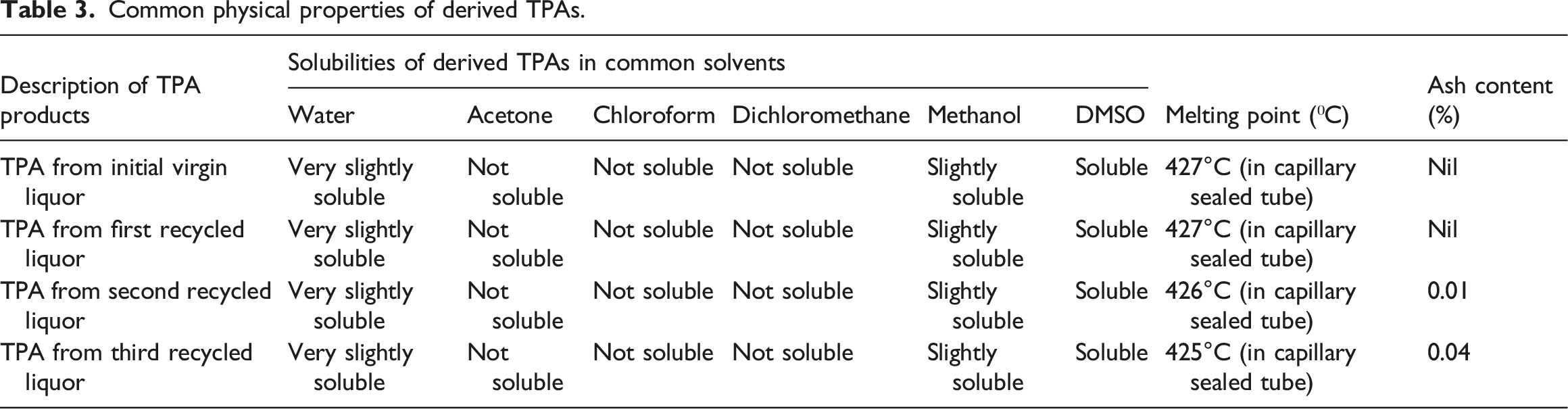
The solubilities of TPA in DMSO, water, and N, N-Dimethylformamide solvent systems were determined and the solubility data were correlated with an empirical equation. 30 The Physico-chemical properties, like melting point, solubility, and purity of TPA along with its commercial importance were also studied. 31 The physical properties of TPAs obtained from this experiment were found comparable to the literature values. The melting point of TPA (427°C) was exactly the same as the reported value. The melting point was reduced by 1–2°C in the cases of second and third recycling due to the presence of some impurities. Like the previous investigation, the TPAs from this experiment were very slightly soluble in water, insoluble in dichloromethane, and soluble in DMSO.
Conclusion
Acidic hydrolysis of post-consumer waste PET plastics has been conducted for the production of TPA. The hydrolysis reaction parameters, such as PET to liquor ratio, acid concentration, reaction time, and temperature have been discussed. TPA was obtained as a white precipitate from the reaction mixture through vacuum filtration. TPA was washed with distilled water, dried in an oven, and characterized with different analytical techniques for its structural confirmation, purity, and thermal properties. The purities of TPAs obtained in this study were 95% and above. PET depolymerizations were around 100% in 30 min of reaction time. The FTIR, 1H NMR, and mass analysis of TPA conformed to the typical TPA. TG analysis of product TPAs showed a similar pattern of thermal degradation with minimal residual impurities. Thus, sulfuric acid hydrolysis of waste PET through repeated use of hydrolysis liquor showed great potential for the production of TPA. The hydrolysis liquor was collected after each batch of reaction and its viscosity was measured. The viscosity of recycled hydrolysis liquor was increased gradually due to the presence of co-product ethylene glycol (EG) and other trace amounts of process impurities. After four repeated use of this hydrolysis liquor, the viscosity increased to a point when it was difficult to filter the reaction mixture to separate TPA. Thus, it is recommended that in the future study a suitable extraction method for EG from hydrolysis liquor need to be developed. To overcome environmental hazards due to plastic pollution and to recover valuable resources, recycling is a pivotal strategy. The chemical recycling of PET to its monomer TPA will pave the way for better environmental management, and facilitate a circular economy.
Footnotes
Acknowledgements
The authors are grateful to the staff of the Fiber and Polymer Research Division, BCSIR Laboratories Dhaka, BCSIR for their all-out support during the experimental works. The authors are also grateful to the BCSIR authority and the Ministry of Science and Technology, Bangladesh for their financial support through which all the instrumental and experimental facilities have been created.
Authors’ contributions
Muhammad Saiful Islam: Conceptualization, Methodology, Data curation, Investigation, Writing- Original draft, Writing- Reviewing and Editing; Zahidul Islam: Data curation, Investigation, Validation; Md. Rashed Hasan: Formal analysis, Data curation, Investigation; A. H. M. Shofiul Islam Molla Jamal: Proton NMR analysis and data interpretation.
Declaration of conflicting interests
The author(s) declared no potential conflicts of interest with respect to the research, authorship, and/or publication of this article.
Funding
The author(s) received no financial support for the research, authorship, and/or publication of this article.
