




Abstract
The article considers the Millennium Development Goals (MDGs) concerned with poverty, education and gender (MDG 1, MDG 2 and MDG 3). Despite considerable achievements associated with the MDG approach, which entails international and national target setting and monitoring, a sharp distinction between areas of social policy is entailed. In addition the approach suggests sufficiency, for example providing a minimum level of education or gender parity, rather than a fuller notion of equality, is good enough. These processes of classification, which entail horizontal and vertical boundaries, are examined, partly drawing on Bernsteinian ideas, and partly through reflections on the concept of intersectionality. Data collected from discussions in Kenya and South Africa with administrators in national and provincial government and teachers implementing the poverty, education and gender MDGs are explored. These show a tendency to work primarily with ideas based on lines, associated with the MDG targets rather than to think more complexly about structure, agency and context in addressing inequality. Thus professionals who confront problems of poverty, gender inequality and inadequate education in day-to-day work lack appropriate resources or processes for gathering information or reflexively engaging with it. The missing resources are partly financial, in that there are not budgets of time or money to attend to making connections. But in addition they are conceptual. Ideas which take a direction to social justice. In the place of a reasoned and reflexive professional language of practice, everyday ideas that connect poverty with gender and schooling are expressed. These tend to reproduce social distance and blame. Putting intersectional ideas to work in ways that consciously and creatively challenge existing sites of exclusionary power appeal key in success or frameworks to the MDGs.
The Millennium Development Goals (MDGs), adopted at the UN General Assembly in September 2000, have been a unique opportunity to bring countries together around a shared set of concerns and actions linked to clear targets, each measured by associated indicators. Three MDGs address global problems of poverty, lack of schooling and gender inequality. 1 However, persistent critiques of the MDGs include, firstly, that in specifying goals, targets and indicators there is a separation out of concerns with education, health and poverty so that each is approached down its own track with little thought to contributions from the others; sometimes this approach has generated contradictions between MDGs (Melamed and Sumner, 2011; Waage et al., 2010). A second critique is that the approach to development entailed by the MDGs focuses on results and sets aside engagement with larger ethical questions concerned, for example, with the nature of social justice or global obligation (Gore, 2010). Waage et al. (2010), Fukuda-Parr (2010) and Fukuda-Parr and Hulme (2009) see this as entailing a rejection of equity for crossing minimum lines of sufficiency. Both critiques implicitly invoke a particular form of boundary setting. The charge of working in differentiated areas of social policy identifies boundaries which run vertically deploying modes of professional knowledge and practice associated with particular administrative forms. The charge of providing education, food, income or health care only up to a bare minimum invokes horizontal boundaries, in which particular kinds of ideas about sufficiency and the location of responsibility are professionally and administratively endorsed. This article considers the ways in which these processes of setting horizontal and vertical boundaries in education and social policy have effects which empty out the space in which a reasoned professional language might develop to consider how poverty, lack of education and gender inequality can be linked. This limited language entails processes of delimitation that frustrate attempts to work cross-sectorally. The lack of attention to the development of a language of linkage is associated with difficulties in developing forms of practice that could address these relationships and consider transforming boundaries.
The first part of the discussion considers the nature of some of the boundaries associated with education and gender in the MDG framework reflecting on some of the insights from social theorists of classification. In the second part, the content of different approaches to thinking about poverty, gender and schooling are disentangled and the concept of intersectionality is presented. Its usefulness in facilitating thinking about poverty, gender and schooling together is assessed. In the third part, in order to illustrate the absence of linguistic forms and practices that make possible associations between poverty, gender inequality and education, data collected through comparative case studies in South Africa and Kenya regarding the implementation of the first three MDGs is presented. This documents the difficulties practitioners experience in linking across areas of social policy. The language they deploy constructs particular boundaries. Some of the evasions associated with these disconnections raise problems for the operationalization of intersectionality as a concept associated with transformation and social justice. The concluding section draws out the implications of these difficulties of boundaries and weak articulations for creating a language and practice to link poverty, gender and schooling. It points to the need for further work on how reflective connections can be made.
Boundaries and levels in education, social policy and practice
The boundaries and levels attributed to education, social policy and practice in the MDG framework raise questions with regard to theorizing the classificatory system. In education Bernstein, drawing on Durkheim, pointed out ‘the structure of society’s classifications reveals both the distribution of power and the principles of social control’ (Bernstein, 1977: 86). Bernstein gave particular attention to changes in the structuring of education knowledge and pedagogy and the move from highly differentiated ‘collection codes’ to more progressive ‘integration codes’ (Bernstein, 1971a). Classification referred to ‘the degree of boundary maintenance’ in education and is associated with power, while frame referred to the degree of control ‘to determine the message system, pedagogy’ (Bernstein, 1977: 88). Framing operates within classification and focuses on sequence, design, pace, and can itself be strong or weak, in that strong framing dictates a particular location of control over the transmission of knowledge. In later work Bernstein (2000) refined some of these sharp dichotomies looking at vertical and horizontal types of knowledge structure, weak and strong grammars and explicit and tacit modes of transmission. Thus, not just the boundaries themselves but the actions associated with them require careful scrutiny.
From very different premises a number of other writers have considered the question of the relationship of forms of power and the formulation of knowledge. For example, Foucault (1970) has looked at the ways in which discursive forms shape classifications of social practice with generative results for the sociology of education (Donald, 1992; Popkewitz and Brennan, 1998). From the early nineteenth century different positions with regard to comparative education have given particular attention to taxonomies, considering historical shifts in how and why features of education systems are linked together and held apart (Cowen and Kazamias, 2009). Against this critical reflection on forms of ordering, a parallel vein of theorization on plurality, hybridity and the breaking down of borders has emerged (Bhabha, 1994; Moi, 2001). For many scholars on gender this has come to be associated with work on intersectionality, as discussed below.
A number of writers on the MDGs have observed that the classificatory system and the separation out of distinct MDGs, each with its own indicators and targets, has meant that it has been difficult for policy synergies to be realized. The absence of these synergies has amplified the difficulties of achieving particular MDGs (Gore, 2010; Waage et al., 2010) For example, the lack of attention in MDG2 to what girls might learn at primary school, and whether they are able to progress to secondary school, limits the achievement of the target in MDG3 on increased women’s representation in parliament and that in MDG6 on larger numbers of skilled birth attendants to decrease maternal mortality. Drawing on Bernstein, the question this suggests is what forms of power and principles of social control are in play to obscure the need for these connections and for MDG targets to link up more coherently.
Lack of connection or what Waage et al. (2010: 7–10; 21–2) call insufficient attention to holism is also associated with the attenuation of the vision of development on which the MDGs rests. Gore (2010) has described this vision as a Faustian bargain in which concerns with substantive ethical values have been set aside for a focus on results. In my work on conceptualizations of poverty, gender and education I have pointed to the way in which the MDG indicators invoke particular kinds of thresholds, set as minimum levels or lines to be crossed – for example earning more than $1 a day, or completing primary school – and that the only way in which gender can be analysed in this classificatory system is by using a descriptive term relating to boys or girls, men or women, so that the larger relational dynamic associated with gender is lost to the policy frame (Unterhalter, 2009; Unterhalter et al., 2012). Drawing on Bernstein, it is evident that each MDG is strongly bounded through a classificatory process that is associated with indicators and levels, and perceived separately, but within each MDG the framing of definitions of achievement allows injustice to be perpetuated, because the form of framing does not clearly indicate how forms of gender inequality or stigmatization of the poor are to be tackled. Thus the argument that suggests itself is that the form of social control associated with the MDG thresholds needs investigation. Clearly, a classificatory frame which sets levels of sufficiency so low, and classifies gender so minimally, may be associated with deflating demand, and obscuring understanding of the complexity of gender or poverty. In itself this framework needs to be understood as a manifestation of particular social forces. It is thus no accident that the MDGs were agreed at what was a high tide mark for global corporate capital, and a number of advocates of the MDGs have argued for them on the grounds that without them the harsh effects of galloping globalization would be intolerable (Sachs, 2008).
While Bernstein (1971b) suggests that integration codes are associated with a change in the strict hierarchies that characterize different knowledge systems, there is no guarantee that integration codes carry transformational ideas concerning justice or inequality. Indeed for Bernstein, because integration codes deal with everyday problems and weakly classified forms of horizontal knowledge, they are generally not associated with powerful forms of knowledge. Thus while the classificatory boundaries associated with gender, poverty and schooling have been called into question through alternative critical framing of ideas, notably that of intersectionality, particular social justice implications and actions cannot be simply read off from an approach to knowledge or practice that deploys ideas about connection and multiplicity.
Classificatory boundaries and intersectionality: gender, poverty, schooling
The horizontal and vertical boundaries evident in the MDG framework invoke particular ideas about poverty, gender and schooling. But in the process they reduce the more complex relationships associated with the inequalities in these areas of social relationship to simple forms. Thus, the challenge is both to address the interconnections between the various areas and to consider the form of hybrid relationship that might be transformatory. Undertaking these two separate, but connected, activities can become difficult, partly because they are sometimes elided, and partly because we have so little policy and practice around multidimensional equality to generate a language with which to consider change.
In earlier work (Unterhalter, 2009, 2012a) I have discussed the importance of separating out particular ways in which poverty, gender and schooling are described, analysed or connected. These classificatory systems are each associated with particular ways of noticing or neglecting the connection between social policy areas. I distinguish between three meanings of poverty: as a line, as a net and as fuel. These meanings and classificatory approaches link with different ways of thinking about gender and implicitly about understanding what is to be done regarding girls’ schooling
In thinking about poverty as a line, one can count the numbers of women and men above or below a poverty line, whether or not this is understood in terms of income or consumption or multidimensional understandings such as those used by the United Nations Development Programme (UNDP, 2011). The UNESCO Global Monitoring Report draws directly on the notion of poverty as a line in understanding education poverty as those who are above or below a distributional level of two or four years at school (UNESCO, 2010: 138–53). This idea about poverty works with an understanding of what I have called (Unterhalter, 2007: 3) gender as a noun, thus a descriptive identification of numbers of girls and boys in or out of school or achieving particular grades or levels of employment. The classificatory system here associates years of schooling with aspects of education, and while there has been considerable concern (Perlman Robinson, 2011; World Bank, 2011) that many children who attend school do not learn basic literacy and numeracy, in shifting attention to learning, what is invoked again is crossing a particular line of attainment. Thus for some in talking metonymically about enrolling all children, girls and boys, regardless of wealth quintile, in school and ensuring basic literacy and numeracy, there is a wish that the part – crossing the line of earnings or years in school or attainment – equates to the whole – a full realization of rights. However, in practice, as the data discussed in the next section shows, the form of classification ensures that schooling is often not understood by practitioners in ways that open up a wider transformation of gender or social relations.
I contrast this notion of poverty as a line with a different notion of poverty as structural, a net, in which the economic relations of survival, including the sexual division of labour in the household, mean that it is difficult to transform gender relationships which are enmeshed with particular relations of production and esteem concerning the kinds of work and forms of status available for women and men (Unterhalter, 2009). In this analysis gender is understood as a feature of unequal household, community and national power relationships, and I have referred to this approach as seeing gender as an adjective, an attribute (Unterhalter, 2007: 3). In this analysis the social division associated with poverty as a net is marked by a racialized, ethnicized or status marked boundary which imposes particular economic, social, political and cultural relationships on poor households. Women and girls are often associated with marking the boundary because of their dress, concerns about who they marry and at what age. Thus what is noted comes to be, for example, ethnic identity and girls who are taken out of school, rather than a more nuanced appreciation of how ethnicity, gender and the relations of poverty might make it difficult to escape from the network of relationships in which gender, ethnicity and poverty all connect and shape structures of inequality. The MDG framework does not use these approaches to classifying gender, poverty or schooling, although this is seen in some other UN documents such as the Beijing Declaration of 1995. However, these have generally had the fewest resources allocated to realize the policy directions they outline (Duran, 2010; Payne, 2011)
The third meaning I provide for poverty is as a fuel, using two meanings of the word (Unterhalter, 2009). Fuel can propel you forward, energize, and result in an activism that can move an individual or a community out of poverty. But a fuel, such as petrol, is also a toxin. Some forms of identification evident in studies of the ‘voices of the poor’ are associated with adaptive preference, and satisfaction with very little education. Some studies report that poor women think that because they are poor they are stupid (Deprez and Butler, 2007; Oommen, 2005). These forms of enactment of poverty, just like crime and violence as the forms of survival, are often toxic for the poor. Anger at a certain ascribed gender identity could propel a community or groups or girls or boys out of poverty, but it could also take the form of ‘acting out’ dangerous gender identities associated with masculinity and femininity (Greany, 2012; Parkes, 2007; Swartz and Bhana, 2009). I have referred to these processes as entailing ‘gender as a verb’ (Unterhalter, 2007: 3–4.) It may be that girls and boys repeatedly act and consolidate particular gender identities at school, either because they are trying to use school as a platform to get out from particular identities and relationships, to cross the borders or cut the mesh of the net, or because they accept inadequate schools are ‘good enough’ because they are poor and hence ‘deserve’ no better.
Gender forms and is formed by different processes where poverty presents lines of income or consumption, nets of difficult or rewarding relationships and fuels to drive or undermine change. Schooling may work to reinforce exclusions and mark the lines and network of relationships dictating who can pay or adapt to particular school gender regimes and whether the fuel of action it provides is nourishing or destructive. But schooling can also contribute to building the relationships of support that sustain poor communities and provide the fuel to transform gendered relationships of poverty. Distinguishing the different forms of meaning regarding poverty and gender in play in processes of boundary formation and attempts to overcome this appears a fruitful path to travel. However, it is also useful to understand not just the difference between the three classificatory systems, but also their interconnections, and much feminist discussion over 20 years has considered the salience of the concept of intersectionality for appreciating the complexity and multidimensionality of forms of oppression and the mutable kinds of alliances that need to be built to effect change.
Intersectionality
The term intersectionality, which highlights how social, cultural, political and economic categories connect with each other, was coined by Kimberlé Crenshaw in the late 1980s (Crenshaw, 1989, 1991), although even before that date many feminist scholars noted how women’s subordination entailed aspects of race, gender and class division, all of which involved relational dynamics that were economic, political, social and cultural (Anthias and Yuval-Davis, 1983; hooks, 1981, 1992, 1994; Nnaemeka, 2004; Skeggs, 1997). Crenshaw (1991: 1242) noted how the existing forms of classification of race and gender worked to ‘exclude or marginalize those who were different’ yet held out the aspiration that ‘the social power in delineating difference need not be the power of domination; it can instead be the source of social empowerment and reconstruction’. The idea of intersectionality was thus, from its origins, an idea of social transformation.
What the academic discussion of intersectionality raises is how a language and actions can be developed that challenges established forms of classification. Monica McLean and Andrea Abbas (2009) have written from a Bernsteinian perspective with regard to university education in sociology and knowledge generation. They are concerned with ‘the discursive gap between everyday localised knowledges and specialised formalised knowledges’, the interchange between the two and the formations of sites for alternative imaginings of the world. Change thus lies in opening up the discursive gap in which an alternative language and practices can be created. However, an implication of their analysis is that, unless we understand the connection between the everyday knowledge of intersectionality and the specialized and formalized knowledge associated with administration, professional practice and the allocation of resources, intersectionality will remain largely in the form of an idea removed from practice.
The project of engaging with intersectionality has been particularly fraught and the problem of it becoming a meaningless ‘buzzword’ has been noted (Davis, 2008). Debates about intersectionality abound. One group of commentators question whether the notion implies that all forms of social division are roughly equivalent and whether it over-emphasizes structures of subordination (Brah and Phoenix, 2004; Phoenix and Pattynama, 2006; Valentine, 2007). Others consider how ideas about complexity and their methodological challenges can help deepen understanding about how intersectionality works (Choo and Ferree, 2010; McDowell, 2008). Intersectionality is seen to offer some potential to look at how gender or race can be explored in terms of individuals, structures and social ideologies, with reflections on power differentials (Yuval-Davis, 2006), and is seen to be particularly promising in offering approaches to a politics of transformation that takes on board knowledge formation as a lived, relational practice. Intersectionality has been interestingly used in looking at how social policy responds to gender mainstreaming approaches (Verloo, 2006) and considered in relation to the fluidity and multiplicity of the forms gender takes in many global, national and local contexts (Chow et al., 2011). Discussion of intersectionality in education has been taken forward by many black British and American feminist writers who have drawn on powerful accounts of experience, and analyses of marginalization, exclusion, to present black feminism as signifying a constellation of progressive politics (Ali et al., 2011; Hill Collins, 1998). It can be seen that much of the enthusiasm for intersectionality is associated with the challenge it presents to existing hierarchies of analysis and forms of gendered exclusion from power. But, while it is clear that intersectionality has considerable analytical promise, the ways that it is realized in practice are not yet well documented. The work on intersectionality clusters at a number of poles – some of it conceptual, some of it exploring how experience is constructed and lived, with few studies of how the idea of intersectionality has been put into practice in social or education policy. The question of what is connected with what in intersectional policy thinking, politics and practice, what kinds of processes are selected and why, has not been much examined in education contexts. Without a clear understanding of how the transformational values associated with intersectionality are realized, the promise of this challenge to existing classificatory systems still remains to be confirmed.
In order to explore classificatory categories, the framing of ideas and languages of practice and the promise of the notion of intersectionality in a particular work setting, the next section draws on data collected as part of a research project exploring work to implement the poverty, gender and schooling components of the MDGs.
Researching poverty, gender and schooling in South Africa and Kenya
The Gender, Education and Global Poverty Reduction Initiatives (GEGPRI) research project, conducted between 2007 and 2011, 2 collected qualitative data on the views of those working to implement the MDGs in ten different sites. The analysis of this data provides many examples of forms of boundary setting that work both horizontally and vertically. GEGPRI aimed to look at understandings of policy and practice concerning global action on gender, education and poverty policy in multiple sites. Data was collected in two countries – South Africa and Kenya – and a number of global organizations. Ten case studies were completed of six government bodies, namely the national Department of Education in South Africa and the Ministry of Education in Kenya, a provincial department of education in each country, and a school in each country in a matched neighbourhood on the edge of a large city serving a poor population. In addition four case studies were made of non-statutory bodies – a non-governmental organization (NGO) working on questions of poverty and schooling in a rural setting in each country, and an NGO working at the national level in each country, engaged in discussions with global networks. The case studies were supported by a number of interviews with staff working on aspects of gender and education in selected global organizations. Research methods comprised documentary analysis (including review of websites and publications over ten years), interviews and focus group discussions (133 hours), observations, field notes, and report-back meetings in each research site on preliminary findings. The research was conducted over three years to enable some documentation of change. In all the research settings engagements with the global frameworks were examined, and the particular meanings attributed to gender, poverty and education explored (Unterhalter et al., 2011; Unterhalter, 2012b). 3
South Africa and Kenya were chosen as the countries for the case studies as both are marked by large inequalities associated with wealth, location and race. But, in both, governments have given substantial attention in policy and practice to poverty, the expansion of schooling and gender issues. Table 1 summarizes the initiatives in Kenya and South Africa over the last 20 years to address gender inequalities, expansion of schooling and poverty. It can be seen that substantial policy was in place in both countries, and a number of initiatives were being rolled out in some of the most disadvantaged areas. In addition governments in both countries have taken prominent roles in supporting the MDGs and the Education for All (EfA) movement (Unterhalter, 2012b).Thus both countries were settings in which considerable work was being done in engaging with global and national agendas regarding education, gender and poverty.
Initiatives in Kenya and South Africa to address gender inequalities, expansion of schooling and poverty.

In all the case study sites, civil servants, some of them very senior, teachers and NGO workers acknowledged the operation of particular forms of classification that made it difficult to respond to the complexity of education as a field of social policy. They commented both on the vertical boundaries between particular areas of work and the horizontal specification of meeting a particular level of need. Because gender, poverty and education cannot be contained by the system of classification associated with the MDGs, these areas provide particular difficulties. However, the nature of the difficulties with classification were different in each site.
The national level: Department and Ministry
At the national level in both countries there was a specific unit or desk that was tasked with work on gender, and for both linking this with the work of other departments was a challenge (Dieltiens et al., 2009; Unterhalter and North, 2011b). The administrative structure in each country made linking across vertical boundaries to address gender and poverty particularly difficult: We work in silos, there is little opportunity to make those connections and also because . . . you are very much pushed to deliver on projects . . . I worked in the Y for a few months, around 2005/6, what I’ve realized, the HoD [Head of Department] was a woman and she took quite an active interest in women in construction, but when she left and X came in, suddenly we don’t give much attention to those things. Gender issues sometimes tend to be situational – depending on who you are and what you are thinking about. (South African National Official 27, 12 November 2008) Now the issue of poverty – we have not tackled the issue of poverty because it is not in our mandate to tackle the issues of poverty. For us as educationists is to offer education that is quality education, enhance retention, completion and transition rates to the next level. We believe that when we have done all these then indirectly we are contributing towards poverty eradication because then you end up with an informed nation, informed people who know what they are supposed to do for their country but directly we are not charged with the responsibility of poverty eradication. (Kenya National Official 16, 10 November 2009)
It can be seen that both these officials, although they held senior positions in national departments, did not feel that they had the authority to step beyond a particular remit to take forward work on gender in the South African case or poverty in the Kenyan case. The classification of work was made somewhere else and their remit was to deliver on more narrowly conceived projects. However, there was potential in South Africa, when a particular official gave leadership on addressing gender inequalities in the construction sector, but this was not sustained when she was moved. What these instances indicate is that working outside or beyond the classificatory system may be possible through individual effort, but that overall a simple technical or personal fix can remain contained and constrained without a deep level transformation of the ethical orientation of the work.
A similar sense of a boundary in relation to sufficiency, linked with attainment levels in South Africa and enrolments in Kenya pervaded concerns: I think at the moment we’re so bogged down in getting kids to school, getting quality of teaching, getting kids to read. We’re so bogged down with those basic issues at the moment that they tend to overpower the gender issues. As we get these things sorted out, then we will be able to focus more on the gender things. (South African National Official 9, 12 November 2008) . . . in our gender policy we have been keen to incorporate both boys and girls in school. We make it plain. Our agenda is to have both boys and girls in school. (Kenya National Official 5, 21 May 2008)
It can be seen here that the horizontal boundary of sufficiency – be this linked with learning to read or enrolling in school – is seen to trump other concerns. It is this that is the main feature of the agenda. The reasons for this are associated with powerful national concern at the low attainment of South African school children in international tests (Fleisch, 2008; Soudien, 2011) and the pressures associated with aid and trade for Kenya, where the expansion of school provision was often taken as an indication of Kenya making progress on good governance and thus meriting continued financial flows and regional status (Colclough, 2012). Particular formations of national and international power are thus implicated in the ways in which classifications of sufficiency are set.
The provincial and district level sites
For officials at the provincial level, working to policy set nationally, the boundaries of classification were set less by department structures and more by constraints of time and money. But here too there was a strong sense that in order to fulfil a remit sufficiency had to be good enough and wider engagements with rights or equality were too overwhelming. In South Africa Province Official 1 (4 February 2009) noted several factors that impede the provincial education department (PED) action on gender and poverty in education, ‘. . . unless you have the resources to do [the actions], they just remain on paper and for me that is the challenge’. She highlighted two kinds of resources, where there were gaps – human and financial. In many districts, a particular officer known as a Gender Focal Point (GFP) was appointed to work on gender matters. Yet it was acknowledged that often GFPs lacked the necessary competence for such work, and some did not have ‘positive’ attitudes, did not feel ‘dedicated’ to implement the actions. In addition Province Official 1 (4 February 2009) also pointed to an inadequate budget as an impediment: Even if I wanted to spend more time on [gender equality work], what would I be doing without a budget? (South Africa Province Official 1, 4 February 2009)
With an inadequate budget the Provincial Official 1 continued to pursue the PED’s mandate on gender equality in education. However, this was only possible through short-term occasional funding from sources such as NGOs and other directorates. This meant that the PED’s gender equality actions were not sustainable in the long term.
The attempts to build alliances across departments and sectors in South Africa were not well enough supported to challenge the system of classification that tended to marginalize work on gender (Karlsson, 2010). Similar difficulties in building and sustaining a connection between the work on education and poverty were acknowledged. The provincial government had declared war on poverty and HIV and AIDS and the PED was working in collaboration with other government departments to concentrate all its efforts and resources to that end (Province Official 5, 1 October 2010). But building the relationships to undertake and sustain those collaborations was challenging. Province Official 1 contended that the impact of the PED’s actions on poverty would have results only in the long term and that the PED’s core business being education was not ‘a contribution that faces poverty in the face’ (Province Official 1, 4 February 2009). The scale of the provincial education system with about 6,000 schools and over 70,000 teachers, serving poor communities, placed enormous demands and pressures on the PED. Province Official 1 said ‘you are an official at provincial level. Alone you cannot do anything in terms of the [large] numbers of schools or the educators that you can try and reach . . . The only way that you can be effective to some degree is to work with officials from other directorates’ (Province Official 1, 4 February 2009). But the time and money to do that, and consider some of the gender issues, were just not available. The boundaries were set here by resources much more than ideas.
In Kenya, work on gender at the province level was not so well staffed as in South Africa. An attempt had been made to appoint gender officers in the various districts, but these were not in post in all districts. One person had to cover gender issues in four districts, as part of a brief that included culture, social services and, ‘now we are incorporating the gender aspect’ (Kenya Field Notes, 17 September 2008). Even when officers were in post there was a stress on lack of staff and money. Here there was less comment on whether staff had adequate knowledge, experience or commitment to work on gender, poverty and education, and more a concern at the lack of teachers. Free primary education had led to an enormous expansion of enrolments, but not enough teachers. Virtually every officer interviewed commented on this: because you find a school has up to class eight and they have only two teachers. We have a very severe shortage of teachers and it is not only [in the district], it is national crisis . . . We are saying education for all. But what is the quality? Are there resources? (Kenya District Official 7, 24 November 2008)
Education for All was sufficiency, enrolling all children in school, but there were not enough teachers in post to make this a reality. There was some mystification amongst provincial officers regarding their understandings of gender, education and poverty. One of the senior officers in the province did not associate gender equity issues with his brief, saying ‘Gender issues are not found at the provincial headquarters but in the villages . . ., where early marriages take place and . . . where they practise FGM [female genital mutilation]’ (Field notes, 16 September 2008). A number of the male officers at the provincial level would not easily identify gender issues in their work. A boundary of location was set regarding the nature of gender inequality, which was considered to be at some remove from the work of the province; one officer upon looking at the interview guide for the research said: What do you mean gender, education and poverty? You see I do not understand all these things you have put here. I do not know what you really want. (Kenya Field Notes, 16 September 2008)
Only the female officer in the provincial office was quick to share her frustrations at the gender regime. She claimed that as the only senior woman in the education department she did not get any respect even from junior male officers recruited after her. She was expected to perform what were deemed appropriate feminine roles like typing and organizing for catering services whenever there was a function in the province. Gender equality was widely seen to entail no more than ensuring equal number of boys and girls accessed school. One senior educational officer said: . . . the challenges we are facing here are related to enrolment because, even if we talk of enrolment, we go to the community. What they will do is that they will give us the boys leaving the girls at home. Even if we went, got the girls and brought them to school, after a while they move out. The parents participate in these. They look at the physical appearance of the girl and then they start now withdrawing them from school . . . so there is a lot of gaps on gender policy . . . implementation is difficult. (District Official 8, 25 November 2008)
Discussion of gender tended to focus on the problems of particular local communities who practised early marriage or kept boys out of school to herd cattle. Gender inequities associated with education are thus located somewhere else, outside the responsibility of the education department. As one officer put it: Gender concerns are many, depending on the locality. For example in those districts where they do not believe in sending girls to schools it is a problem . . . They see education for girls as a waste of time. The girls are married off at an early age . . . Others worship bravery and warriors. Therefore, boys do not value education because education is viewed as something for the cowards. The brave ones go to conduct raids and they are respected by the community based on how many cattle they bring home after the raids . . . Those raids affect education so much in these districts. For example when one community is planning a raid all the boys are withdrawn from school to go for the raid. (Province Official 4, 16 September 2008)
At the provincial level, South African officials expressed much more interest and concern than their Kenyan counterparts to work on gender and poverty together, but both groups felt constrained by lack of resources and time, and for both there was inadequate space to think about how to make connections that did not just draw on common-sense ideas. In both countries, however, provincial level officials did not have the capacity to formulate policy and were positioned so that they were implementing directions set at national level. For both the major concern, in line with priorities set by the national government, was to have children in school. This was such an enormous task that their language of practice did not take on a wider realization of rights, which might entail concern with equality, not stigmatizing through attributing particular essentialized identities associated with poverty or gender.
Thus, while at the national level there is quite a strong classification with regard to separating work on poverty, gender and schooling, and a notion that the crosscutting work will be done closer to delivery in the provinces and districts, at provincial and district levels there is not enough resource, either in financial or political terms, to develop the interconnections, and the boundaries are kept in place by default.
The school sites
At the school level the form of boundary setting transmutes again. Here, in the absence of clear leadership to address poverty and gender in ways that make dignity and equality significant, there is an articulation by teachers in both countries of a language of social distance from the poor children they teach and concerns with gender equality. In neither country are schools positioned as having the power to formulate policy or initiate decisions about practice. In both, schools follow directives that originate in the province, having been handed down from central government. The specialized knowledge of policy is thus centrally held, and narrowly conceived. There are very few pointers as to how, other than in following orders to get children into school and secure attainment, the everyday knowledge about poverty or gender may be oriented to more equitable distribution.
Interviewees in both countries spoke about the effects of the form of actions on gender and poverty the school was taking. In South Africa learners singled out for additional food parcels and school uniforms often refused them and this frustrated school staff: . . . some of the kids they are afraid to tell us they don’t have . . . But when you come to class and say [that] those who have nothing, they must come to me, then no, they won’t come . . . They are too shy. Yes. They are too shy . . . I said ‘somebody who wants food must take’. They didn’t. They wait that side. And then I go to him: ‘Why don’t you take this food because I know your mother is not working?’ He didn’t say anything. He just take the food. (Teacher 1, 26 July 2010)
When individual parents were singled out and asked to visit the school the response was a similar hanging back, and teachers found it difficult to consider the difficulties of shame that might be driving this: When it comes to parents visiting, [the parent of the needy child] won’t come. Those who see that they’ve got a problem and then you call a parents meeting: no; but those who don’t have a problem, the parents will come! But for those that we said ‘no, we want these parents because . . . [the learners] are not studying, they are not doing well at school, they have nothing to wear’ and then you make these parents visiting, [but] they won’t come . . . We don’t know why the parent don’t come to school! Because they’re supposed to come and tell us the problem! (Teacher 1, 26 July 2010)
From a Bernsteinian perspective there was thus not strong, explicit framing about the role and purpose of parental involvement, which would be beneficial to parents and teachers. Without this, stereotypes and missed connections grew. Frustration is evident in these responses by teachers and school officials about lack of engagement with the school’s initiatives. But this frustration is directed at the poorest learners and their parents, and a wider framework is not deployed to understand these actions, let alone assess their gender dynamics.
Similarly in Kenya, the effects of hunger and poverty on children’s attendance and learning were noted by teachers, but the general view was that these levels of want were a problem for the children’s family, not for the wider school community or the state. The Deputy Head teacher noted the effects of hunger on learning, but did not feel able to venture a view on what should be done. She emphasized: There is a slum near the school . . . The children go without food the whole day. The children come from very poor homes and this is affecting their performance. If a child is hungry especially in the afternoon, the child may not understand anything. (Deputy Head teacher, 2008)
Teachers too were well aware of the effects of poverty and hunger. When asked to discuss specific pupils and what might lead to poor performance, they noted how slow learners who could not read were walking ‘long distances to school’ (Senior teacher, 27 January 2010), staying at school ‘without food the whole day’ (Deputy Head teacher, 2008) experiencing poverty at home, peer pressure to do manual work and a lack of ‘parental love’ (Teacher 12, 2008). But teachers could not express a view on what should or could change these conditions. This may have been because of their uncertainty in talking to the research team about organization within the Ministry or it may have been because they have limited knowledge of the kind of poverty reduction and gender equality initiatives that have been put in place in other countries in Africa.
This apparently limited knowledge was often associated with levels of blame of poor parents that went some way beyond the kinds of frustrations reported in South Africa with limited responsiveness to school initiatives. The Head teacher described parents coming from the slum area as ‘very lower class people who have received little education’ (Head teacher, 2008). One parent School Governing Body (SGB) member at a report-back meeting expressed considerable reservation about reinstating school feeding: Even if you gave the children food until they are satisfied and the parents back home have not eaten, once the children get home, they will be taken for child labour. As they have to look for money that will keep the family going. And therefore feeding only the kid [pupil] in school will not be solving anything. And therefore we are asking the NGO’s to come and provide food for the families at home too. Mothers will ask them to take care of the younger children. (Parent in report back to school, 29 July 2008)
The somewhat angry notion that the poor are never satisfied and that feeding children might have bad consequences in that it would allow poor parents to require their children to work for income indicates the considerable distance in understanding between the more comfortably off parents who sat on the SGB and those who experienced want. A number of distancing boundaries were evident in the way some SGB members and teachers spoke about poor families. The SGB treasurer explained it from her perspective as a parent: In our school, most of the students come from the nearby village and they have not been raised up in Christian families. They are brought up in a house that has only one room and the whole family . . . share the same room. This in turn affects their interaction with other children in school . . . parents should bring them up in the expected manner. (SGB 1, 29 May 2008)
Here overcrowding in slum housing and children’s behaviour are associated with them being non-Christian, across a boundary of respectability. The way that poverty was associated with transient populations was also blamed on the poorest parents: ‘parents know that they are only here for a while and they will move. This makes them reluctant in contributing money for developing the school’ (SGB 1, 29 May 2008).
It can be seen that at the school level the links between poverty, schooling and gender are experienced daily and that neither vertical nor horizontal forms of boundary are in place. Teachers and members of the school governing body generally frame the connections across these three areas in terms of blame. Inherent in this language of blame is a stress on the responsibility of mothers, and a lack of consideration of questions concerning the gender dynamics of poverty. The administrative classificatory systems at work in the national department are not maintained at this level. Here poverty is framed by social distance and a silence regarding critical examination of gender. While intersectional forms of description are in play, in that poverty is being connected with education and aspects of gender identity, these intersectional meldings are not working towards social justice or equality. It appears that a limit of intersectionality as a de-contextualized idea is an assumption that simply connecting is always in the direction of social transformation. It is evident from these examples that linking can take the form of bringing together common-sense assumptions which maintain inequalities of class and gender identities, rather than challenging or critically examining them. Possibly, in place of this weak framing, what is needed at local, district and national level is more formal, ethically informed direction, and assessment of information regarding how inequalities reinforce each other. Intersectional knowledge about social justice does not just happen.
The data from these case studies show how the forms of horizontal and vertical boundary in place in each site are different. Processes of classification are linked with particular forms of work relationships, but they also point to the ways in which a critical reflection on the language and practices associated with boundary setting is more evident in some sites – the South African national and provincial departments, notably – and much less frequently articulated in all the others. In the next section I make some attempt to theorize these different instances drawing on some of the discussion of intersectionality and gender.
Boundary maintenance, intersectionality and the struggle over classifying gender and poverty in schools
The discussion about intersectionality alerts us to some of the classificatory processes used in enacting gender, education and poverty policy. Reviewing the data presented in the previous section, Table 2 suggests three forms of boundary maintenance and intersectionality evident in the talk of teachers and officials. Powerful groups rely on boundary maintenance for particular conduits regarding resources, assessments of sufficiency and linking ideas about poverty, gender and education. Intersectional moves are associated with middle-level professionals who do not have the financial or policy resources to fully realize their potential. They work under conditions of strong classification, with weak processes for framing with regard to accessing resources, determining sufficiency and developing a language that allows for the linking of poverty, schooling and gender. Addressing the problem of boundary maintenance and the limits of intersectionality is not a technical problem, but an issue of power with regard to the distribution of resources, and the significance allocated to particular forms of knowledge
Three forms of boundary maintenance and intersectionality.
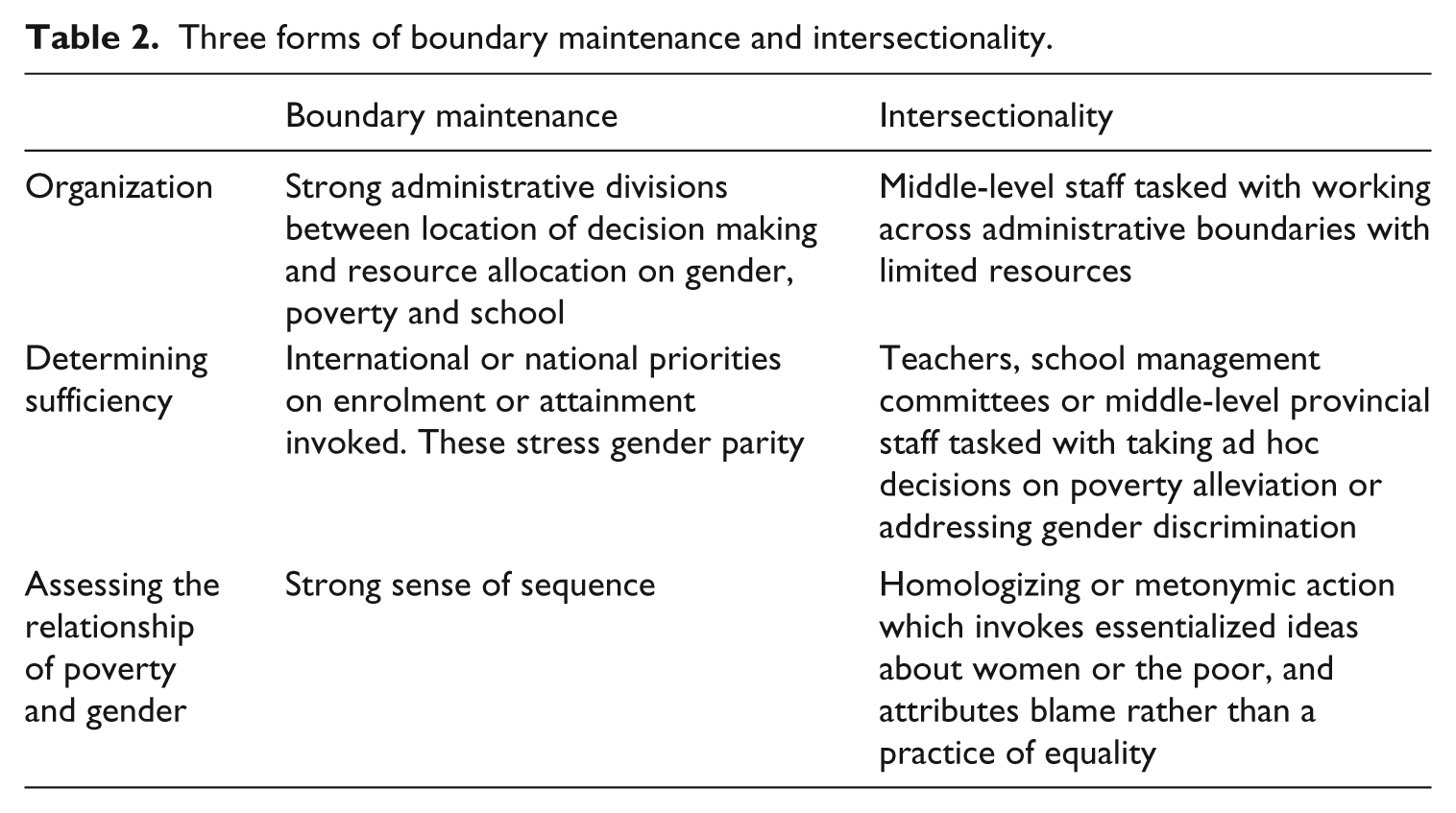
Boundary maintenance in all the research sites takes the form of separating out administrative sections, drawing on international endorsement on national policy to strongly frame ideas about sufficiency. In considering the relationship between poverty and gender the approach suggests that in order to get things done one must either address poverty first and then gender or the other way round. By contrast intersectionality is very difficult to realize in practice and is often the responsibility of middle-level professionals with inadequate time or budget for the complexity of the work. Insufficient attention is given to gathering, circulating and reflecting on information. In this context, decisions about sufficiency are often dependent on particular local decisions in which, for want of a clear ethical orientation about social justice, ‘common-sense’ distance, rather than connection is more frequently used as the basis of decisions. Other ways in which weak framing appears is that the relationship of work to poverty and gender invokes forms of homologizing. Thus work on poverty is considered similar to work on gender. In other places the work takes metonymic forms. It is assumed that if one addresses some form of poverty, for example lack of food, or some form of gender inequality, for example lack of sex education, one is taking on all the complexity of the associated inequalities. But, in the absence of a stronger framing of knowledge, this is not the case. The blurred action at school level on both together often depend on weak framing, essentialized assumptions about girls or the poor, frequently expressing exasperation or blame.
Both the forms of boundary maintenance and of intersectional engagement appear problematic. The first does not link areas of work and ideas that require connection. The second, because of the limited resources to work with the language and practice concerning connections, does not deliver on a promise of social justice and transformation.
Conclusion
The argument highlights the importance of critique of the power relations associated with a system of classification and the kinds of ideas kept apart or linked together. Thus the tendency to work primarily with ideas based on lines, rather than to think more complexly about structure, agency and context in addressing inequality yields a social policy in which for the professionals who confront these problems in day-to-day work there are inadequate resources or processes for gathering information or reflexively engaging with it. The missing resources are partly financial, in that there are not budgets of time or money to attend to making connections. But in addition they are conceptual, so that the ways in which ideas connect in the direction of social justice is not modelled at the international or national level and replicated downward to province, community or school. In addition no space or analytical authority is given for reflection on everyday practice and how this can help with reviewing processes of classification and framing. Indeed the MDGs, in their concern with particular kinds of results, have set in place vertical silos and horizontal floors, reproducing information, authority and policy which enforces boundaries, rather than facilitating flows of ideas, reflexive engagement with context and challenges to existing sites of power.
However, in focusing on the importance of interconnection, theorists of intersectionality have tended to overlook what is connected with what, and how. In making a case for this blurring they have not always been able to be clear enough about the values their notions of plurality articulate, or the kinds of strategy that might help it be realized. They have tended not to engage with the sources of power associated with classification or formulate strong forms of framing a counter-hegemonic language of practice. The problem, however, is not a simple technical one that might be easily addressed if, say, provincial officials could run programmes on gender, poverty and schooling. What is at issue relates to how knowledge is produced and circulated, how the insights of the poor tend to be marginalized, and how resources associated with money, time, language and professional practice tend to flow in the direction of existing sites of power rather than social justice or transformation. Leadership from provincial officials and teachers who challenge, rather than reproduce, the ideas that poor girls are in deficit might be a place to start. So, too, would a critical review of the origins of our classificatory systems, and the ethical ideas implicit in the divisions they express.
The kind of negative integrations made by parents and teachers suggests that intersectionality cannot in and of itself generate social justice. However, putting intersectional ideas to work in ways that consciously and creatively challenge existing sites of power is a line of practice that requires investigation. Doing so would call on reflexive practice and clarification regarding an ethical social justice orientation. Participatory approaches are likely to be an important component of working through the challenges of pluralism but, like intersectionality, participation is not a technical fix that stands apart from an approach to challenging existing directions on classification and framing in policy and practice and what this might entail for all levels, international, national, provincial and local. The importance of theorizing and clearly specifying ethically informed ideas about the connections between poverty, gender and education seems crucial for evolving policy vocabularies that might prevent a successor MDG project from repeating the problems of the present.
Footnotes
Acknowledgements
This article has developed from a number of discussions with colleagues about intersectionality and the Millennium Development Goals. My thanks for written comments on earlier versions to Ann Phoenix, Rosie Peppin Vaughan, Andrew Dorward, Monica Maclean, and the two anonymous referees who have all helped deepen the argument. In addition, my thanks to Claire Postles for help with tracking down references and attending to formatting.
Funding
This research received a specific grant from the publicly funded Economic and Social Research Council (ESRC). See Note 2.
Notes
Biographical note
Elaine Unterhalter is Professor of Education and International Development at the Institute of Education, University of London. She has written widely on gender, education and international development. Her work includes the prize-winning book Gender, Schooling and Global Social Justice. She led the academic team which contributed to the 2010 UN Girls’ Education Initiative (UNGEI) Conference Engendering Empowerment: Education and Equality (E4).