




Abstract
How can access to public elementary schools of variable quality be justly distributed within a school district? Two reasonable criteria are: (a) that children should have equal opportunity to attend high-quality schools, and (b) school assignment policies should foster an overall increase in the number of high-quality schools. This article analyzes Boston Public Schools’ new school assignment plan in light of these criteria. It shows that Boston Public Schools’ plan violates equal opportunity by giving middle-class families privileged access to existing high-quality schools. Boston Public Schools arguably panders to more-advantaged families, however, in order to pull them into the system and deploy their economic, political, and social capital to increase the total number of high-quality schools. Is this ethically defensible? To answer this question, we need to develop an ethical theory of pandering: of privileging the interests and preferences of already unjustly privileged actors because the consequences tend to benefit everyone. Such a theory will need to be ethically pluralistic and weighted along a contextually sensitive continuum, rather than rendered in all-or-nothing terms.
Keywords
How should access to public elementary schools be distributed within a school district? What are the characteristics of a just school assignment system? Ideally, of course, every child would attend a high-quality school that fully serves her needs; however, those are defined/understood. 1 But this ideal takes us outside the realm of distributive justice since distributive justice is relevant only under conditions of scarcity. If every child has access to a school that is and will remain high-quality, then scarcity is eliminated and distributive justice is eliminated as a concern.
So let me ask instead: How should access to public elementary schools of variable quality be distributed within a school district? What are the characteristics of a distributively just school assignment system when some district schools are much worse than others?
These are questions that Boston Public Schools (BPS) faced when it attempted to reform its school assignment system in 2012–2013. 2 The purpose of this article is to describe the ‘Home-Based Plan’ BPS adopted in 2013, to evaluate it in light of two prima facie reasonable criteria of distributional justice around school access, and then to raise questions about the ethics of BPS’ choices – and by extension, the ethics of public institutions more broadly – when these two criteria come into conflict. In particular, I will propose that two reasonable criteria for distributing access to schools of variable quality are as follows: (a) children should have equal opportunity to attend schools that are currently deemed to be high-quality; (b) school assignment policies should foster an overall increase in the number of quality schools available in the district. I will argue that Boston’s Home-Based Plan gestures toward the ideal of equal opportunity, but in point of fact is far more focused on the second goal of ‘growing the pie’ of good schools, which it does by giving middle-class families privileged access to existing high-quality schools in order to draw them into and keep them in the system.
As I explain in further detail below, integrating schools and the district as a whole by class so as to reduce hypersegregation of poor children is an essential means of increasing school quality at scale. 3 By giving middle-class families privileged entry into already high-quality schools, BPS helps those schools maintain their hard-won gains. It also incentivizes these families, who are now vested in the success of the BPS, to use their inequitably large social, political, and economic capital on behalf of the district (e.g. in fighting state-level budget cuts). In addition, middle-class families who enter the lottery and then are assigned a low-quality school can sometimes be enticed to ‘take a chance’ and take up their assigned seat with the goal of improving the school. Without the sense that they had a reasonable shot at being assigned a decent school, however, these families would likely have never entered the lottery in the first place. By preventing preemptive flight, BPS thus creates additional opportunities to woo privileged families to discover ‘hidden gems’ and put their capital into strengthening a lower-quality elementary school. 4
This unequal privileging of already-privileged families, however, raises important questions about the ethics of pandering: that is, the ethics of privileging the interests and preferences of already unjustly privileged actors because the consequences tend to benefit everyone. What philosophical and policy judgments should we reach about the permissibility of pandering? When pandering is justified, should it be transparent or obscured? In the case of the BPS in particular, is the level and type of pandering appropriate, too little, or too much?
Boston’s home-based school assignment policy: A brief primer
BPS’ ‘Home-Based Plan’, which took effect in 2013 to govern assignments for the 2014–2015 school year, is a novel elementary school assignment policy. All children entering kindergarten (called K2) are assigned ‘baskets’ of 10–18 elementary schools to which they can apply through a BPS-wide lottery. Families find out their basket of schools by inserting their home address into http://www.discoverbps.org/. Each family’s basket includes all schools that are less than a mile away from where they live (their ‘walk zone’), the three city-wide elementary schools, an Early Learning Center, and any elementary school that the child’s siblings already attend. In addition, the basket must include at least two schools whose Massachusetts Comprehensive Assessment System (MCAS) test scores place it in the top 25% in the city (Tier I schools), at least two more schools whose MCAS scores are in the top 50% (Tier I or II schools), and an additional two schools with MCAS scores above the bottom 25% (Tier I, II, or III schools). 5 Families will have some of these schools already within their walk zone. Additional schools will be added based on proximity to the family’s address; if a family has one Tier I, two Tier II, and one Tier III schools in their walk zone, for example, then the closest additional Tier I school, and the next closest additional Tier I, II, or III school, will be added to their basket. Families’ choices also include one or more ‘option’ schools – meaning schools that are traditionally underchosen because they are universally thought to be lousy, and hence very likely to have space to accommodate all applicants – to ensure that every child is guaranteed a seat at one of the schools in their basket. 6 Figure 1 summarizes families’ basket construction.
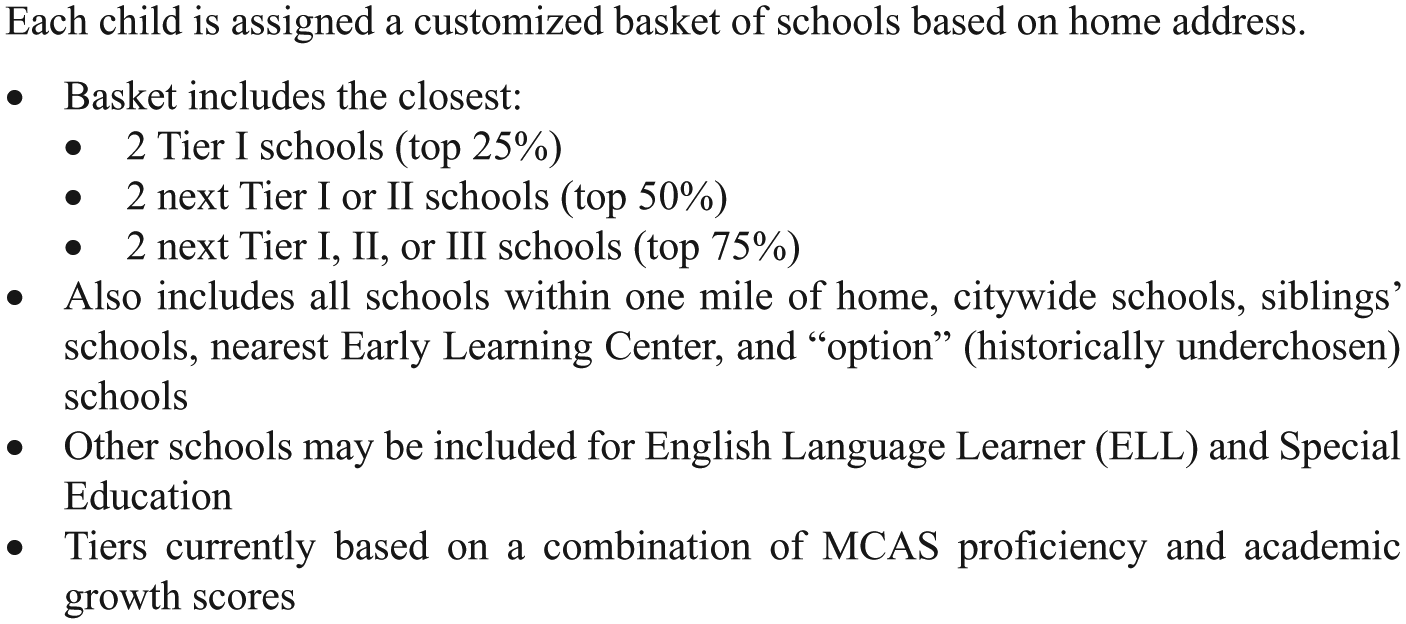
Kindergarten access under Boston’s Home-Based Plan.
After touring schools in the fall, families have about a month to submit a rank-ordered list of the schools in their basket to one of the Family Resource Centers. There is no preference given to families who submit their choices earlier versus later during this ‘school choice time’; all families who meet the early February deadline are entered into the first round of the lottery. A computer then runs an algorithm to assign children to schools. Children who already attend the school, say because they lotteried into pre-kindergarten (called K1) the previous year, are guaranteed that they can remain. Siblings of current students have next highest priority. After that, children are assigned in order of school preference and their randomly generated lottery number, with better numbers breaking ties. Families are not informed of their lottery number; rather, all these calculations are done by the computer. Families are simply informed of the final results in March.
The assignment algorithm does not take into account demographic features of the children (e.g. in order to ensure race/ethnicity, gender, or income balance), nor does it control for distance from the school other than by the initial basket construction. All kindergarten seats are made available to be assigned in this initial round (except for those committed to K1 students staying in the same school); hence, popular schools are filled by the end of Round 1. Families who enter later rounds of the lottery, because they move to Boston during the spring or because they were unaware of, disorganized about, or overwhelmed by the process of entering the initial lottery, therefore have much more restricted school choices.
Families who do not like their assignment, or who did not enter the first round, can enter the lottery in Round 2. It operates just as Round 1 did, except that there is also a ‘parent compacting’ option, which enables groups of families to join together and enter the lottery for an underchosen school (i.e. one that still has a number of seats available) as a group. This is intended to make unpopular schools more attractive as groups of parents can commit to engaging in and improving the school together. It is also intended to stop families with the resources to do so from deciding to exit BPS in favor of charter, parochial, or independent schools or in favor of moving to another district.
Because the Home-Based Plan is so new, data are only just starting to be analyzed and made public. Families seeking a seat for the 2014–2015 school year – the first year under this new system – learned the Round 1 results in March 2014. Among these, 73% were assigned one of their top three school choices. There was some disparity in K2 choice satisfaction by race (as of January 2015, data on family choice and assignment by income have not yet been released). In total, 87% of Asian families, as opposed to 76% of Black families, 77% of Hispanic families, and only 61% of White families, received one of their top three choices. At the same time, these were also significant differences by race in families’ preferences for schools by tier. Whereas about 85% of Asian and White families designated a Tier 1 or 2 school as their top choice, only 58% of Hispanic families and 47% of Black families named a Tier 1 or 2 school as a top choice for their kindergartener. It is impossible to know at this stage whether these disparities were due to differences in parents’ knowledge about schools, their assessments of relative school quality, geographic proximity to higher-tier schools, or other factors. K2 assignments reflect these differences in expressed preferences, as well as in the opportunity structures I discuss below. Of the Asian K2 students, 70% were assigned a high-quality (Tier 1 or 2) school, as were 63% of White K2 students. By contrast, only 50% of Hispanic K2 students and 39% of Black K2 students were given a place at a high-quality school. On the other end of the spectrum, a full 40% of Black K2 students were assigned to a Tier 4 school, as compared to 23%, 22%, and 10% of White, Hispanic, and Asian students, respectively. 7
Equality of opportunity and the BPS Home-Based Plan
There are a number of different values at play in BPS’ Home-Based school assignment plan. In this section, I explore one inarguably important value: namely, children’s equal opportunity to access a high-quality education. A basic premise of most contemporary ethical theories (and of most Americans’ intuitions) is that a child’s family background should not determine his or her opportunities in life. Whether he or she comes from a rich or a poor family, one that has lived in Boston for generations or just arrived last week, every child in Boston deserves an equal opportunity to realize success in college, career, and citizenship (and arguably many other goals, as well) – which means every child deserves an equal opportunity to a high-quality education. 8
The Home-Based Plan promotes equality of opportunity most notably by limiting the correlation between neighborhood residence and school access. If students were assigned to schools solely on the basis of their home address, then ‘geography would be destiny’. Wealthier, more informed, and better-connected families would rent or buy homes near high-quality neighborhood schools. Poorer and/or less informed families, often especially new arrivals, would be consigned to neighborhoods that feed to poorer quality schools. The Home-Based Plan attempts to counteract this pattern. Although the plan relies on students’ addresses to construct their baskets of choices, it also explicitly tries to realize the principle of equal opportunity by ensuring that every family has at least four high-quality schools (which I define as Tier I or II – schools in the top 50% in the city), and at least six quality (defined as Tier I, II, or III) schools, in their choice basket. In this respect, even the most isolated and impoverished families can be confident that they will have the opportunity to list some high-quality schools on their lottery form.
The Home-Based Plan also, perhaps counter-intuitively, promotes equality of opportunity by limiting the overall number of schools that are in each family’s basket. Under BPS’ former school assignment plan, Boston was divided into three large geographic zones. Families could try to lottery into any school in their zone, any school within a mile of their house, and any city-wide school. This gave families the ‘opportunity’ to choose among 25 or even 30 elementary schools – a number and range of choices that could prove overwhelming even to the most informed and organized parents. As a result, parents with high levels of social capital organized both formally and informally to trade information about schools (and about techniques to game the lottery, until the algorithm was changed in 2006), while other families were forced to choose more blindly. By restricting families’ choices to 10–14 schools, on average, the Home-Based Plan paternalistically increases potential equality of opportunity by making it more likely that all families can learn enough about the schools in their basket to make reasonable choices that reflect their true preferences.
At the same time, BPS’ Home-Based Plan limits equality of educational opportunity in some significant ways. First, the Home-Based Plan provides all families an equal minimum set of options, not an equal maximum. There is an equal floor: Everyone has at least four high-quality (Tier I or II) schools in their basket and at least six schools in their basket that are not of the lowest quality in the city. Even families who live far away from quality schools are therefore ‘leveled up’ so that their minimum basket is equal to all other families’ minimum basket. This is a common and often appealing form of equality. But notice that by not ensuring an equal maximum, or ceiling, the Home-Based Plan still permits significant inequality in families’ baskets of opportunities. Many families have only four high-quality schools in their baskets, while some families have as many as seven high-quality schools in their baskets.
Second, simply being able to list schools for the lottery is not really what opportunity is about. Opportunity is far more reasonably understood as one’s chance of getting a seat in a high-quality school – which varies significantly depending on the size and competitiveness of the high-quality schools in one’s basket. For example, in the 2013–2014 school year, 26 schools in Boston had 44 seats or less in K2, while 31 schools had 60 or more K2 seats. Differences in size can add up – as can the actual availability of seats. Full-inclusion schools, for example, may appear to have 22 K2 seats available, but actually be reserving 14 of them for students with special needs. Even more frustratingly, schools with pre-kindergarten (K1) programs may appear in prospective K2 families’ baskets, but in fact have no available K2 spaces because the already-enrolled K1 students will rise up to take all the spots. Sibling priority may also radically reduce the number of seats open to new families. Hence, families that have the same number of quality schools in their baskets may have a two-, three-, or even fourfold difference in the number of open quality seats in their baskets. 9
Let’s consider these disparities as they play out for two possible children: one living in the solidly middle-class neighborhood of West Roxbury and the other in the low-income Dorchester neighborhood. West Roxbury has a child poverty rate of 5%; Dorchester’s child poverty rate is 29%, nearly six times higher than West Roxbury’s. I chose an address in each neighborhood, then used BPS’ on-line tool to get the basket of schools for a prospective regular education kindergartener (non–English Language Learner (ELL), non-special needs) at each address. Let’s call the West Roxbury kindergartener ‘Celia’; the child living in Dorchester we’ll call ‘John’.
Celia ended up with 13 schools in her basket, including 6 high-quality schools – three Tier 1, three Tier 2 – with a total of 339 K2 seats. She has no Tier 3 schools in her basket because the six closest schools to her house were all in the top two tiers. Her basket does include, however, three ‘option’ schools in order to guarantee she will receive a K2 seat assignment. John, by contrast, ended up with 14 schools in his basket, including only 5 high-quality schools – two Tier 1, three Tier 2 – with a total of 268 K2 seats. He also has one Tier 3 and three option schools in his basket. 10 Already, it is clear that John’s family faces a slightly greater information burden and has access to 21% fewer high-quality seats than Celia does. Furthermore, a much higher proportion of the seats in his basket are in the bottom 50% of BPS schools. Celia’s basket contains 145 seats in option schools; John’s basket contains 256 seats in Tier 3 and option schools. While John’s basket is virtually evenly divided between seats in the top and bottom half of the school distribution, Celia’s basket contains more than twice as many high-quality seats as low-quality ones. 11
These differences between Celia’s and John’s formal versus substantive equality of opportunity are further exacerbated by the number of other children competing for the same K2 seats. Competition for seats is a function of the population density of young children living in the neighborhood and their likelihood to enter the BPS lottery, both of which make John’s already inequitable situation worse. As in any city, the population of the city of Boston is not spread evenly between neighborhoods. Low-income neighborhoods are generally denser than middle- and high-income areas, with more people living in apartments than in houses and with those dwellings close together on smaller lots. Also, some neighborhoods cater more toward families with school-age kids, while other parts of the city house more adults who are childless or whose children have grown. These differences in population age and density, along with differences in the size and location of high-quality schools, mean that competition for high-quality school seats varies considerably across neighborhoods.
Returning to Celia and John, for example, the West Roxbury neighborhood has a population density of 700 young children (ages 9 or under) per square mile, while Dorchester’s population density is triple that: 2135 young children per square mile. Because baskets are based on students’ home addresses, meaning that children who live near each other will have the same basket of schools, this means that John is likely competing against three times as many children for the 268 high-quality seats in his basket than Celia is competing against for the 339 high-quality seats in her basket.
Unsurprisingly, these competition disparities track both income and race. There are 13 Boston neighborhoods with a young child density under 1500. These neighborhoods on average are 51% White, have a median income of US$59,920, and have a 21% child poverty rate. By contrast, the seven neighborhoods with a young child density over 1500 on average are 26% White, have a median income of US$41,855, and have a 33% child poverty rate. Or, described another way, an average of 1162 children per square mile – about 59% of whom are White – live in neighborhoods with a median income over US$50,000 per year. An average 1798 children per square mile – only 24% of whom are White – live in neighborhoods with a median income below US$50,000 per year. 12 On average, therefore, low-income children of color are facing significantly stiffer competition for high-quality school seats than are middle- and upper-income White children in Boston.
If there were significantly more high-quality schools in low-income neighborhoods than in middle-class neighborhoods, then the greater availability of seats might offset this competition disparity. But as in virtually all US cities, high-quality elementary schools in Boston tend to be clustered disproportionately in wealthier neighborhoods, not poorer ones. A total of 15 high-quality schools and approximately 15,800 children aged 0–9 years, for example, reside in the nine neighborhoods in Boston that have a child poverty rate below 20%. By contrast, the 12 Boston neighborhoods with a child poverty rate over 20% host a total of 22 high-quality schools – and 43,500 children aged 9 and under. In the higher poverty neighborhoods, in other words, nearly three times as many children are competing for spots in only 1.5 as many high-quality schools.
These statistics are all predictive rather than demonstrative of actual inequities in school access. I summarized above the initial data coming out of the 2014 lottery, showing significant differences by race in parents’ designation of a ‘high-quality’ (meaning Tier 1 or 2) school as their top choice for their kindergartener. As I also noted above, we do not yet know whether such differences reflect significant disagreements in assessment of school quality or whether they stem from other differences such as geographic proximity or knowledge. Early analysis from MIT’s School Effectiveness and Equality Initiative seems to show that, given all families’ actual choices in the lottery, families in poorer neighborhoods could have had a higher chance than families in wealthier neighborhoods of being assigned a high-quality school had they prioritized such schools in their baskets – but in fact the outcomes seem to have been at least partly reversed because families in wealthier neighborhoods more consistently prioritized Tier 1 and 2 schools (Boston Public Schools, 2014). 13 Moving forward, it will be important further to analyze selection and assignment patterns and determine whether formal equality of opportunity (i.e. a leveled-up set of quality schools in everyone’s basket) actually translates to substantive equality of opportunity (i.e. likelihood of gaining a seat in a quality school). In addition, it should be possible to run a simulation using BPS’ lottery algorithm in order to analyze how the basket construction structures children’s opportunities to access quality schools. Pretend that every child who entered the 2014 lottery preferred higher tier schools to lower tier schools and, within each tier, preferred closer schools to farther-away schools. Aggregated simulations of the BPS lottery under these conditions would reveal whether children from different neighborhoods or income brackets truly do experience disparities in real access to quality schools or not.
Even before these analyses are conducted and made publicly available, however, there are obvious ways in which the baskets could be constructed so as to achieve more substantive equality of opportunity. Even keeping schools (rather than seats) as the distributive metric, BPS could ‘level down’ by taking extra high-quality schools out of some families’ baskets and also potentially by inserting more low-quality schools into their baskets. This approach would equalize families’ minimum and maximum opportunities to access quality schools. It would also equalize the burdens of gathering information on multiple schools, in this case by increasing the burden on previously more privileged families. Alternatively (or in addition), census data and/or prior school demand data could be used to calculate a competition index for school seats. K2 seats in schools with K1 programs could also be discounted given their likely unavailability to children not already enrolled at the school. Families’ baskets could then be built so as to equalize seat-level competition rather than school access.
There are also ways to achieve more substantive equality of opportunity by revising the lottery algorithm itself. In San Francisco, children from neighborhoods with low average test scores (a sadly reliable proxy for income) are given weighted priority in the lottery. If this were applied in Boston, then even if low-income children have fewer and more competitive high-quality schools in their baskets than middle-class children do, their likelihood of gaining a seat at a good school could be equalized. In Cambridge, ‘controlled choice’ mechanisms ensure that every school reflects the broader socioeconomic demographics of the city. If the lottery results in a school that has a disproportionately high or low percentage of low-income children as compared to the system as a whole, then they are reshuffled (before the assignments are finalized) so as to ensure a more equitable distribution of children among schools – and more equitable distribution of schools among children. Again, this system could be used in Boston. In fact, BPS engaged in balancing procedures for many years to ensure that schools were racially and ethnically diverse, until it ended the policy in 2000–2001.
Expanding quality schools: ‘Growing the Pie’ by reversing middle-class flight
These are very straightforward means of increasing substantive equality of opportunity for kindergarteners in Boston: Level families’ baskets up and down by capping the number of high-quality schools in a family’s basket. Add more option schools to some families’ baskets so as to increase their information burden (which is another form of leveling down). Use quality seats rather than quality schools as the metric for building families’ baskets. Give some priority in the lottery to children from low-income neighborhoods. Analyze the initial lottery results before they are released and adjust student assignments if schools seem inequitably distributed among families or if families are inequitably distributed among schools. More complexly, use prior school choice and census data to calculate competition indices for schools or seats and equalize baskets by competition index rather than by sheer number of seats or schools.
Should advocates for a distributively just school assignment system in Boston start advocating for these reforms? Not necessarily.
Leveling-down approaches to equality are often bitterly opposed by those who would directly lose opportunities. It’s one thing to agree that all Boston children should have some opportunity to lottery into high-quality schools. It’s quite another to agree that one’s own child should be denied the opportunity to lottery into a particular nearby high-quality school because other children across town don’t have access to as many high-quality schools. This approach strikes many people as being merely punitive or motivated by the ‘politics of envy’, rather than as expressing a positive value such as equality. Now it’s quite possible that this opposition to leveling-down approaches is irrelevant as a matter of principle. It can be hard to justify a principle of equality that ends exactly where one’s own sacrifice would begin. On the other hand, opponents of leveling-down approaches might have principled reasons to oppose a concept of equality that tears down rather than builds up. Equality of opportunity may rightly be seen as an appealing principle insofar as it lifts up those with fewer opportunities, but not necessarily insofar as it wantonly reduces opportunities because some families have more than others. In this respect, it may be adequacy of opportunity, not equality of opportunity, that people truly embrace as a value.
Moreover, leveling-up weak equality (or adequacy) is likely to be compatible with a second commonsense feature of a just school assignment policy: namely, that it should foster an overall increase in the number of quality schools available in the district. The best – really, the only – way educational and social reformers know how to improve urban schools at scale is to eliminate hypersegregation of low-income children of color. Fifty years’ worth of studies have demonstrated that children of all socioeconomic backgrounds tend to do better in low-poverty schools; more recent studies have shown convincingly that school composition may even trump family background when it comes to academic achievement. The effects can be profound: low-income children who attend low-poverty schools, for example, do better on average than middle-income students do in high-poverty schools. These patterns are replicated internationally. 14 Furthermore, the magnitude of these school composition effects on the achievement of low-income children may be larger than the magnitude of within-school innovations such as teacher hiring and firing, curricular shifts, data-driven instruction, lengthened school days, or other popular education reforms.
In particular, no other intervention in schools serving hypersegregated low-income students of color has proven replicable and reliable at scale. Although there are some highly touted hypersegregated schools, these are rare, often limited in their apparent achievement to the particular high-stakes standardized tests by which they are being measured, and challenging to replicate. A study of over 62,000 US public schools, for example, found that less than 1% of low-income schools 15 – and only 0.3% of low-income schools serving over 50% students of color – achieved even decent academic results: at least two-thirds of students demonstrating proficiency on state-standardized tests in two subjects, in two different grades, over two years. To be clear, this amounted to 39 academically acceptable high-poverty schools across the entire country in 1999–2000 (the year from which the data were drawn). This is compared to about a quarter of low-poverty and low-minority schools – or 10,174 schools across the United States (Harris, 2007). 16 BPS elementary schools exemplify this persistent, stubborn relationship between hypersegregation and academic struggle. Tier I schools have a student body that is, on average, 28% White and 36% non-poor; option schools, by contrast, are on average 5% White and 16% non-poor. Similarly, only 3 out of the 18 Tier I schools have a student body that is over 80% low-income, while only 2 out of the 19 option schools have a student body that is under 80% low-income. 17
Although a few hypersegregated charter networks – amounting to at best a few hundred schools across the country, including some in Boston – may now be achieving more consistent positive results than this, their academic achievements have proven difficult to scale within districts, with a full range of students, and along measures beyond state-standardized test scores. Boston-area charters, for example, have been lauded as the most effective in the country and are also highly segregated. But they also serve radically lower percentages of ELL and special needs students; they have much higher attrition rates than the BPS at virtually every grade level; they tend not to ‘backfill’ with new students, so their student body becomes ever-more selective; and their average SAT (standardized college entrance test) scores, while still significantly higher than Boston’s, are far worse than one would predict given their MCAS scores, suggesting that they may teach to the high-stakes MCAS test rather than providing an overall superior education.
There are a number of reasons that schools that serve a critical mass of middle- and high-income students, as well as White students, tend to be higher quality. Such schools tend to have more parent involvement, fewer discipline problems, higher levels of homework completion, lower levels of both student and teacher mobility, higher percentages of children who enter school ‘ready to learn’, fewer suspensions and expulsions, more extracurricular activities, more whole-child supports like guidance counselors and nurses, fewer interactions with law enforcement, fewer students who are battling homelessness or chronic illnesses, more experienced teachers, and larger per-pupil expenditures thanks both to regular budget allocations and to additional fundraising (Kahlenberg, 2012a; Orfield et al., 2014; Orfield and Frankenberg, 2013).
Some of these school characteristics are due to the characteristics of the families themselves. Wealthier parents, for example, tend to have greater capacities to donate money to the Parent-Teacher Association (PTA), to maintain more stable living situations, and to expose their children to academically enriching opportunities from birth onward. Many of these school characteristics are also due to the social, cultural, and political capital these families are able to deploy both within and beyond the school in order to serve their own children. For a variety of unjust but nonetheless politically and socially potent reasons, high-income and White parents are more likely to be successful in lobbying officials to limit or reverse school budget cuts, for example, or to change a school policy that they believe is harming their children.
Nor do White and non-poor parents necessarily even need to deploy such capital, as their children are often preemptively served better by schools and districts. The cultural congruence between overwhelmingly White and middle-class educators’ expectations and White and middle-class students’ behaviors, for example, can create a virtuous cycle that nurtures academic achievement, teacher and administrator stability, developmentally appropriate disciplinary policies, and other aspects of a strong and positive school culture. To say that socioeconomic and racial integration is a key factor for improving schools at scale, therefore, is not to suggest that low-income children and families of color are intrinsically educationally deficient. Nor is it to suggest that they intrinsically benefit from simply sitting next to middle-class and White children. Rather, it is to say that there are multiple, persistent, and significant instrumental benefits to having a critical mass of White and non-poor children in one’s school.
To create low-poverty schools, however, districts must actually attract non-poor families into the system – and equally importantly, not push middle- and high-income families out of the system. Leveling-up approaches are far more likely to attract and retain such families than are leveling-down policies that families interpret as a direct assault on their educational rights and interests. If leveling-down policies induced well-resourced families to exit BPS when they might have stayed under a leveling-up policy like the Home-Based Plan, therefore, then that might be a good reason to trade equality of opportunity for adequacy of opportunity.
Boston has a good reason to be concerned about White and middle-class flight. Unusually for the United States, where close to 90% of children attend public schools, only 74% of all school-age children living in Boston attend BPS schools. Of the approximately 20,000 Boston children who are not enrolled in BPS, about one-third attend charter schools, one-half attend parochial or other private schools, and 15% are bused to suburban public schools through the inter-district METCO program. Socioeconomic data are not available on all of these students, but the ethnoracial data are stark. Nearly half (47%) of all White children and one-third (31%) of Black children living in Boston attend non-BPS schools, as compared to Hispanic (12%), Asian (14%), and other/multiracial (15%) children. As a result of these patterns, 87% of children who do attend BPS are non-White, and about three-quarters are low-income (i.e. eligible for free or reduced price lunch). If more White and middle-class families living in Boston entered the lottery and then took up their school placements, then these demographics would look quite different.
Furthermore, many non-poor and White Boston families flee the city before their children reach school age. Every year, in fact, more than 2250 children under the age of 5 years move out of Boston (Reardon, 2012). Census data suggest that about half of those who migrate to or from Boston head from/to out of state. But the other half move within the state – many to surrounding suburbs. This may be because their growing families need more space, another bedroom, perhaps a back yard. But it may also be because their families seek educational reliability and predictability. They want to know where their children will attend school, and have some confidence that the school will be of good quality. Unsurprisingly, movement out of Boston is concentrated almost entirely among households with high levels of education and income. 18
Families with economic means, therefore, hold a trump card with BPS: that of threatened exit. BPS knows that privileged families will and do exit preemptively to the suburbs (often when their children are 2 or 3, in time for their children to integrate into their new neighborhoods well before the start of kindergarten). Furthermore, privileged families who remain in the city can exit into charter, parochial, and other independent schools, or if they are families of color, into suburban districts via METCO. If BPS wants to convince such families to stay in Boston, enter the lottery, and then actually enter the school system, therefore, then it must offer inducements to such families not to engage in preemptive exit. These inducements include address-based basket construction, a lottery unweighted by demographic characteristics, absolute priority to first round lottery entrants, and the back-end reassurance of parent compacting. Taken together, these inducements offer privileged families some extra assurance that they will win rather than lose the lottery and hence that it’s worth sticking around to play the lottery in the first place. 19
By inducing families to stay and play the lottery, BPS keeps high-quality schools integrated by race and class, thus ensuring that the schools are likely to remain high-quality. It also ‘grows the pie’ by inducing families to enter the system even if they are assigned to a low-quality school. Many Tier 3 schools, Boston officials argue, are actually ‘hidden gems’ that feature committed teachers, families, and school leaders. Middle-class families who have invested time, energy, and hope in BPS – as indicated by their entering the lottery – may be convinced to embrace the ‘gem’ to which they have been assigned, especially if they meet other middle-class families also entering kindergarten at the school. In this way, apparently low-quality schools can become integrated within just a couple of years, and quality metrics can change rapidly as a result. Such demographic shifts, especially when led by families who think of themselves as ‘saviors’ of a school or as ‘urban pioneers’, can be highly problematic. Even the most well-intentioned middle-class parents often exacerbate injustice by misrecognizing, marginalizing, and even excluding low-income families of color. These collective efforts are effective, however, at integrating formerly hypersegregated schools – and often therefore at raising test scores and other ‘objective’ measures of overall school quality.
Finally, increasing the number of middle-class families in BPS can help the district as a whole, even if these families remain disproportionately concentrated in already high-quality schools, by mobilizing them to act on behalf of district-wide improvement. In Spring 2014, for example, several groups of BPS parents organized to increase city funding of Boston schools and to defeat statewide charter school legislation that could have cost BPS tens of millions of dollars. One parent group in particular – QUEST, which is substantially but not solely composed of middle-class BPS parents whose children attend disproportionately high-quality schools and which coordinated efforts with other, more diverse grassroots organizations – was credited/blamed by politicians and activists on both sides for torpedoing the charter school legislation.
Theorizing the ethics of pandering
So, in pandering to privileged families, BPS reinforces unjust inequities of opportunity while creating the conditions for the system overall to increase in quality. The question arises, therefore: What are the ethics of pandering? In other words, what ethical principles should guide public policy when equal opportunity and overall well-being – including the welfare of the least-advantaged – come into conflict with one another? I can’t answer this question completely in this article, but let me offer up a few thoughts to move the theory forward.
First, I want to clarify why this is a problem of pandering and not one of either compromise or unjust coercion. BPS does not face a question about what compromises it should make because privileged families do not have a reasonable or legitimate claim that they can (or do) articulate about why their privilege should be maintained, let alone reinforced. Middle-class families themselves recognize this. They don’t openly assert, ‘We should get priority in accessing quality schools because otherwise we’ll leave’, as this is not a plausible claim as a matter of policy. Compromise seems to require competing articulable claims on both (or multiple) sides. School assignment policy in Boston does not involve such claims. On the flip side, it would also be unfair to say that just because privileged families have no defensible claims to special treatment, then their capacity to threaten exit must be unjust or coercive. The unequal power possessed by middle-class and high-income families clearly has unjust antecedents: varieties of racism, classism, xenophobia, and other forms of prejudice and discrimination; unjust capital flows and wealth accumulation; global inequities; and so forth. These inequalities are also undoubtedly perpetuated by contemporary structures and institutions that maintain historical injustice. Nonetheless, these families’ use of their power to ensure that their children access quality schools is not in itself unjust. It is appropriate – perhaps even obligatory – for parents to do what they can to ensure that their children attend a decent school. 20 They have BPS over a barrel, but not because they’re behaving immorally. 21
Second, an ethics of pandering hence must address a particular kind of normative question: not the bounds of acceptable compromise, nor the ethics of dealing with knaves, but rather the characteristics of ethically defensible public policy-making in a presumptively fixed context of systemic injustice, where privileged individuals are nonetheless justified in acting in their own self-interest. Let me flesh this out a bit. Systemic injustice is presumptively fixed because policy makers can legitimately wrestle with whether or not to pander (and to what degree) only if they do not have the jurisdictional authority to tackle the background injustices head-on. If by contrast they could actually mitigate systemic injustices, then they should clearly do that rather than further reinforcing groups’ unjustified privilege through inequitable treatment. BPS finds itself in the possible position of pandering, for instance, because it can revise school assignment procedures but cannot make policy that appreciably reduces family poverty or socioeconomic inequality writ large. That is why BPS is forced to decide whether to privilege already-advantaged families in allocating opportunities that under any just background conditions would be equiprobably distributed. The fact that pandering is about violating norms of equal treatment (and in particular, turning Rawls’ difference principle on its head) is also why the ethics of pandering is about defensible rather than just policy-making. Pandering is not just, but it may be, the least-unjust policy available, and hence the most ethically defensible option given the circumstances. 22
The ethics of pandering are confined to circumstances under which privileged individuals may properly act in their own self-interest because that’s what makes pandering potentially normatively justifiable rather than merely strategically necessary. It’s not about giving into unjust coercion but accommodating legitimate individual choices that are unfortunately made within an unjust context. That’s not to say that these legitimate choices are the morally best choices. If every middle-class family in Boston with school-age children committed to BPS, for example, then BPS would instantaneously cease to be a high-poverty system. School quality district-wide would likely increase rapidly (once expansion and funding challenges were sorted out), and both middle-class and low-income children would be more or less assured of attending at least a decent school. So, collective commitment to BPS would be both normatively and empirically better than individualistic withdrawal to private and parochial schools or the suburbs. 23 But in the absence of such a miraculous instance of collective action, privileged families are justified in opting out of low-quality BPS schools and into decent schools elsewhere, although this action sustains and even exacerbates existing inequities.
Third, I suggest that an analysis of pandering will have to be ethically pluralistic. Ethical pluralism is necessary because equality of opportunity may be a different kind of value – one that may rest on different fundamental ethical presuppositions – from the value of increasing overall social welfare by increasing the total number of quality schools. The former tends to rest upon ideals of democratic equality, civic respect, and/or individual rights. The latter, by contrast, is more consequentialist in orientation; what matters is the final outcome, that everyone have greater educational opportunity and access, rather than the relationship in which children or families stand with one another in the meantime. Although often these two sources of ethical judgment are considered to be either exclusive of or in hierarchical relationship to one another, I believe that a case like this demonstrates that in non-ideal contexts, at least, they each have a role in informing the same ethical policy analysis. 24
Fourth, perhaps as a result, judgments about the ethics of pandering will inevitably be weighted along a contextually sensitive continuum, rather than rendered in all-or-nothing terms. It cannot be that ‘growing the pie’ should always trump equality of opportunity to access high-quality schools, no matter what the disparity in access. Nor, however, should equity always trump overall increase in quality. On the one hand, it has to matter that if pandering to already-privileged families works to pull them into the BPS, their infusion of economic, social, and cultural capital is likely to benefit many children. Increasing the welfare especially of the least advantaged (who are most likely to be enrolled in the BPS) is a compelling claim of justice. On the other hand, it also has to matter that public policies that pander to already-privileged families are profoundly inequitable and simply reinforce existing, unjust inequities. This is perhaps especially true in an arena like education, where there is strong consensus that all children should have equal opportunities to learn. Public policies that distribute educational opportunities unequally to 5-year-olds, and especially that favor already-privileged 5-year-olds, seem simply unjust. Furthermore, insofar as it is virtually impossible for BPS to admit publicly that their school lottery policies are designed to favor middle-class families, such lack of transparency is arguably profoundly civically disrespectful – especially toward low-income families who are already subject to so much civic disrespect and who are now disproportionately losing in the school lottery to boot.
There is more work to be done before we can firmly answer either fundamental questions about the ethics of pandering in non-ideal policy contexts or specific questions about the ethics of Boston’s Home-Based Plan for school assignment. I do hope, however, that this case study enables a more careful and coherent debate about both, among philosophers, educators, policy makers, and citizens.
Footnotes
Acknowledgements
For feedback on earlier drafts, I would like to thank Andres Alonso, Harry Brighouse, Andrée-Anne Cormier, Jacob Fay, Jennifer M. Morton, Anne Newman, Timothy G. Reardon, James Ryan, Christopher Winship, Megan Wolf, participants in the Spencer Foundation Philosophy of Education Institute in Chicago, and participants in the Radcliffe Workshop on Justice in Schools. I am also indebted to Kelly Dowd, Research Manager at the Boston Redevelopment Authority.
Funding
This research was generously supported by a Milton Fund grant from Harvard University. Discussion of an earlier draft was supported by a grant from the Radcliffe Institute for Advanced Study at Harvard.