



Abstract
This research aims to (1) study the current state and needs of the community to enhance participation in Community Learning centres (CLCs) in Cambodia, and (2) consider the required coverage of guidelines to enhance community participation in CLCs. The research utilized a mixed-method design which conducted a survey with a sample of 28 CLC committee members and 197 community people using stratified random sampling. The quantitative data were analyzed through means
Keywords
Introduction
Human resource development is crucial in stimulating economic growth in any country in the world, especially in developing countries that need more human resources to boost their economy and deal with other problems such as natural disasters, poverty, and conflicts, among others (Benveniste et al., 2008). No doubt, education is one of the key players in developing human resources through formal, informal, and non-formal education (Broadbent et al., 2006). Schools and universities are the main actors in providing formal education to students, which are not able to produce enough human resources for one country to exacerbate their economic growth (World Bank, 2017). Consequently, informal and non-formal education has played a complementary role in providing education to learners through community learning centres (CLCs). The main aim of CLCs is to serve as a platform and venue for community people to have access to informal and non-formal education. Importantly, CLCs are not only a place for rendering alternative education, but they also provide community people with the right to make decisions and do something together to serve their purposes (UNESCO, 2008). Furthermore, in the case of Cambodia, which is a small country in Southeast Asia, is defined by the United Nations as one of the world’s least developed countries which have experienced the brutal legacy of the Pol Pot regime. As a result, almost three million people were killed, and Cambodian education was decimated with all the schools being shut down (Grigg-Saito et al., 2008). Cambodia’s human resources became scarce, which requires a great demand from the Cambodian government and other relevant stakeholders to put in selfless efforts to elevate and amplify human resources through inclusive and holistic education (World Bank, 2017). Based on the Ministry of Education, Youth and Sport (MoEYS) less than 20% of Cambodian students finish higher education, which contributes to a human resource shortage. This shortage becomes a major stumbling block to achieving sustained economic growth and desirable dream to become an upper-middle-income country in 2030 and a high-income country in 2050 (2019). CLCs in Cambodia, like those in other countries, have played a crucial role in developing human resources by providing informal and non-formal education and other training opportunities to Cambodian learners (Department of Non-Formal Education, 2018). However, informal and non-formal education seemed to receive less attention from the Cambodian government and other relevant stakeholders (Broadbent et al., 2006). Informal and non-formal education have been taken for granted from the Cambodian government and other relevant stakeholders since they put more attention to and provide value to formal education which has concrete curriculum and trustful accreditation to students (Ministry of Education, 2019). There are a limited number of initiating policies and strategies from government to foster and improve informal and non-formal education status quo. Moreover, Cambodia only established education law in 2007 and a national policy on lifelong learning in 2019 which articulated a low level of the Cambodian government’s willingness and efforts on promoting informal and non-formal education comparing to other subsectors (Royal Government of Cambodia, 2007). Based on the non-formal education report, financial constraint is one of the major issues in non-formal education due to low budget allocation from the Cambodian government. These challenges cause a major impact on informal and informal education’s operation, and CLCs in Cambodia are sufficient numbers to provide inclusive education to everyone (Department of Non-Formal Education, 2018). For instance, approximately 356 CLCs have been opened by the Cambodian government and other developing partners (UNESCO, 2017). In addition, CLC is one of the critical means of improving living standards, community development, and lifelong learning by serving as community library services and information, providing training skills, counseling services, social and cultural activities (Department of Non-Formal Education, 2014). Even though there is an increasing number of CLCs, some critical issues are hindering the CLCs from performing their roles to serve the community’s benefits (i.e., learning spaces, meeting venues, making collective decision, and knowledge share outlets). These issues include lack of community participation, limited human resources, limited financial supports, poor physical infrastructures, and lack of a sense of ownership and commitment from the community people. According to Department of Non-Formal Education (2000) and other previous studies, community participation in the CLCs is one of the main issues among other issues. Without the significant engagement of community participation, community learning centres will not correctly function and be able to implement their assortment of activities and programs which benefit the community people through informal and non-formal education (Lokollo & Dahlan, 2020). Particularly, there are insufficient mechanisms and guidelines to strengthen community participation in the CLCs by the Cambodian government and other relevant stakeholders. In this sense, it is necessary that all stakeholders come up with practical suggestions of good practice that can form guidelines and strategies to enhance community participation in the CLCs and ensure that CLCs can run and execute their programs and activities smoothly and effectively (Bhuyan et al., 2005). The concepts of citizen participation by Arnstein (1969) and of community participation by Shaeffer (1994) were applied in this study as those concepts can provide a mirror to reflect on issues of community participation in the CLCs in Cambodia and other countries. Engagement with the CLCs does not solely refer to participation in training programs, it also refers to using services, mobilizing resources, diagnosing the needs, planning programs, monitoring and evaluation, and making decision. These concepts have manifested that those types of participation can stimulate organizations or community learning centres to more active and perform their function well. Against this background, this research study attempts to proposed “Guideline to Enhance Community Participation in Community Learning Centres in the Kingdom of Cambodia”.
Research objectives
This study has two main objectives. (1) To study the current state and desirable needs of community people in enhancing participation in community learning centres in the Kingdom of Cambodia. (2) To consider the required coverage of guidelines to enhance community participation in community learning centres in the Kingdom of Cambodia.
Literature review
Defining community learning centres
According to UNESCO (1999), community learning centres are one of the resource centres which provide learning activities related to lifelong learning for everyone in the local community to make their communities more vigorous and organize them. This centre serves as a reservoir of information and knowledge to reach out to the community people to strengthen their knowledge and skills which enable them to participate in the decent market (Aziz & Raza, 2001). The establishment of CLCs does not only motivate local people to value their traditions, but it also serves as the community source of knowledge and information. Moreover, CLCs foster the people’s knowledge and skills, which move them to be more self-independence, and this process is to promote the development of the community as the whole system (Kanno et al., 2006).
In short, community learning centre refers to a place where people in the community are established to provide learning spaces for various purposes, such as training, teaching, communication, and problem-solving. Roles and Principles of Community Learning Centres have been considered as community-driven entities representing promising initiatives, and their principles are to concentrate on literacy and continuing education to promote Education for All (EFA) (UNESCO, 2008). At the other extreme, there is evidence that formal education alone cannot fulfill all the addressing goals which needs other agents to put those goals forward. CLC is regarded as an effective mechanism to deliver non-formal and informal educational activities to strengthen the inclusive goals of 2030 (Boonaree & Tuamsuk, 2013). The practice of education in CLCs is able to target people at the grass roots level in terms of human resource development and adopts an integrated non-formal education approach to deliver programs for the realization of Lifelong Education for All (Kanno et al., 2006). Furthermore, all the CLC’s activities benefit disadvantaged groups, minorities, women, and seniors. While formal education cannot fill this gap, non-formal and informal education is more flexible and informal way of delivering knowledge to the target groups. The main roles of CLC are to train community people to more competent through delivering non-formal and informal educational activities such as functional literacy, equivalency programs, life skills, health improvement, and income generating programs (Henry, 2001). Consequently, community learning centres have generated many positive impacts on the elevation of literacy and continuing education in both developed countries and developing countries which enable those countries to produce sufficient human resources to meet the market demands (UNESCO, 2008). The pilot project of community learning centres was the first initiated by UNESCO’s Asia Pacific Program Education for All (APPEAL, 2001) in 1998 as the purpose of developing a community-based education program, particularly in non-formal education (NEF) program as the delivery mechanisms (UNESCO, 2008). This project’s primary function has tempted to promote CLCs as a critical driver for various countries' education program strategies. It shows that community participation is one of the fundamental elements in driving the CLCs toward sustainability. As to ensure durability and holistic development, this project aims to empower communities by exploring new ways to assist them in establishing and running CLCs by themselves and enhancing CLCs to effectively serve all people in the communities (UNESCO, 1999).
Theoretical concepts on community participation
A ladder of citizen participation (Arnstein, 1969) and a rung of community participation (Shaeffer, 1994) provide insights into the participation in the CLCs in general. That information will be used to analyze the problems of community participation and guidelines to enhance their participation in the CLCs in Cambodia.
A ladder of citizen participation
Arnstein (1969) mentioned that citizen participation is a little like eating spinach, which means no one is against it in principle because it is suitable for everyone. Participation is a long process in which it takes time to see the progress and reach the ultimate goals. Arnstein (1969) mentioned eight steps of citizen participation such as manipulation, therapy, informing, consultation, placation, partnership, delegated power, and citizen power.
The bottom rung of citizen participation are manipulation and therapy. There are considered as ‘nonparticipation’, which is a kind of deceived engagement. Those kinds of participation are created by the powerholders for their sakes and benefits. Therapy referring the participation of community people through receiving the services (Kline & Le Gates, 1971). For example, community people participate in receiving health and education services. Informing people is the third rung of the ladder participation (Arnstein, 1969) which occurs through social media, leaflets, newspapers, and other means. The fourth rung is a consultation which is just one-way communication, where the citizen does not provide a chance to give their feedback and make a comment. Placation is the fifth rung in the ladder, which is one of the highest tokenism levels because they provide some spaces for the have-not power to make some decisions, but it still hides some interests of powerholders. The sixth rung is a partnership that enables the citizens to negotiate and do the trade-off with the government or benefactors. The seventh and eighth rungs are delegated powers and citizen control, in which the have-not citizen obtains most of the power, especially in the decision making process. Delegated powers and citizen control are the goal of participation which could help community people build a strong community.
A rung of community participation
After a study of Arnstein’s (1969) ladder of citizen participation, Shaeffer (1994) modified this concept to “A Rung of Community Participation.” There are seven rungs of community of community participation such as mere use of services, involvement of resources, attend programs, participate in consultation, make partnerships, involve in implementation, and make a decision. The first rung is just the use of services, which indicates the lowest level of participation, and the community people participate just to utilize the schools and centres services. The involvement of resources is the second rung, in which community members contribute their materials, physical labor, and finances to the schools. The third rung is attending programs, in which people go to the schools and centres to join in the training programs and activities.
The fourth rung involves further involvement and a consultation in which people have some opportunities to express their comments and suggestion. However, as this rung is just a one-way flow of information, it is still limited. Partnership is the fifth one in which the local people collaborate with powerholders to support other relevant actors’ programs. The power of the community members is a bit higher compared to different levels of participation. The sixth rung is implementation in which the participants can practise their proposed programs and setting up activities. Lastly, the seventh rung is making a decision, which is the highest power, centres should provide to community people. In this level of participation, the local people are able to make any decision that is aligned with their interests and needs.
Shaeffer (1994) noted that the four rungs below the use of services up to consultation are considered “inactive participation or passive collaboration.” The top three rungs are determined as “active participation.” In other words, it is genuine participation with decision making power.
In sum, these types of participation will be utilized in the research methodology part to analyze and understand the current problems of community participation in CLCs in Cambodia. These concepts provide detailed information about all forms of participation which is crucial for the researchers to capitalize community participation formulation and structures in the CLCs in Cambodian. Moreover, the insights provide by this theoretical framework will be used to propose guidelines to community participation in CLCs in Cambodia.
Relevant research studies
Several research studies have concentrated on community participation and challenges in of community learning centres.
Kongkalaung (2007), for example, studied Bangkok community learning centres’ needs and guidelines for organizing non-formal education and informal education activities. She has conducted questionnaires with 323 community people in community learning centres, and the statistics utilized for the data analysis include percentage, mean, standard deviation, t-test, and one-way ANOVA. The results showed various needs of people who were looking for diverse non-formal and informal education programs. On the other hand, people with various education levels had different demands. The guidelines for organizing non-formal and informal education activities in Bangkok community learning centres were as follows: organizing a lively and conducive to engagement library, organizing suitable activities for all ages, providing pertinent information related to life skills, internet service, expanding size and areas of Bangkok community learning centres.
Pham Le (2017) worked on the contributions of CLCs to personal and community development. This study aims to understand the operation and contributions of CLCs to the development of the communities in Myanmar, where officially there are more than three thousand CLCs, one of the highest numbers among Southeast Asian. The study results draw from nearly 6-week fieldwork in Myanmar from data collection, including visits to selected centres, informal conversations with key informants, focus group discussions and semi-structured interviews with villagers and government official and NGO representatives. The establishment and contributions of CLCs are investigated through the social capital lens. Three factors are found to be conducive to the operation of CLCs: effective local leaderships and community-based organization that encourages local ownership; the crucial role of the facilitators; and substantial community interest and support. CLCs contribute to individuals’ betterment and develop communal attitudes and communities’ social capital that facilitates cooperative actions. Whereas, the community received benefits from the CLCs through knowledge, community services, learning spaces, and common reunion setting. According to this study, individual and community found more common interests in organizing their activities at CLCs to develop their societies.
Pich (2008) studied community learning centre development in Svay Rieng province in Cambodia using qualitative or quantitative methods. The results of the study showed their important points. First, with a strong awareness of CLC information, most people were happy to be involved through meetings and use of services in comparison to other forms of participation. Moreover, the study highlighted that their contributions to CLCs through their money and materials were still limited (not high levels for labor forces). Although the percentage of people participating in the decision making stages was relatively low, the participants were from different social statuses such as farmers, local authorities, or influential persons (the rich and layman). Second, committees’ methods for resource mobilization were becoming more effective because they had built community awareness of CLCs’ benefits through the meeting and functional networks and linkages with stakeholders. Lastly, those factors driving community participation were influential communication networks between CLCs and either local authorities or local community people, high community awareness on CLCs, and interesting courses in the CLCs for communities such as life skills, vocational skills, and literacy skills.
Overall, these researchers have utilized the concepts of community participation in various contexts and settings as well as various sectors and disciplines. These authors established key points regarding the issues of community participation. Many mechanisms have been identified to enhance community participation which may mitigate problems of community participation. These contributions to research on community participation in education have inspired the researchers’ aims to study current states and desirable needs of community people in enhancing their participation in Cambodia as well as to come up with practical guidelines to enhance community participation in community learning centres in Cambodia.
Methodology
Research design
This study employed descriptive research to propose guidelines to enhance community participation in CLCs Cambodia. This research involves both quantitative and qualitative data. For instance, qualitative research refers to “any kind of research that produces findings not arrived at by means of statistical procedures or other means of quantification” (Strauss & Corbin, 1990, p. 17). Whereas, quantitative researchers seek causal determination, prediction, and generalization of findings and qualitative researchers seek illumination, understanding, and extrapolation to similar situations (Hoepfl, 1997). Hence, the use of qualitative and qualitative data can help us process the insight information of current state and desirable needs of community participation in the CLCs, and the proposed guidelines would enhance community participation in the CLCs in Cambodia.
Participants and sampling method
This study involved three groups of people, such as community people, CLC committee members, and Cambodian experts.
Community people
CLCs are locating in all provinces in Cambodia, and one group of selected CLCs should be located in the urban areas which contain a diverse people coming from various provinces around Cambodia. These selected CLCs should be in Phnom Penh city which is a capital city in Cambodia. On the other hand, another select CLCs should be in a rural area that consists of indigenous group and minority people. To attain this purpose, we used a simple random sampling to select community people who are participating in and living around the CLCs because it could ensure that every sample has an equal chance to be chosen (Campbell et al., 2017). We employed the simple random technique by writing all the names of each province in Cambodia and used fishbowl research technique to select two provinces among the 25 provinces in Cambodia. We then used a purposive sampling technique to choose CLCs in those two provinces to ensure that the sample contains various characteristics in terms of location, groups of people, knowledge, and living standards. Following Taro’s Yamane (1973) sampling methods, the sample of community people is 258 people.
CLC committee members
We utilized a purposive sampling to select 50 CLC committee members from the CLCs in two selected provinces. The criteria to select CLC committee members were as follows: (1) They worked as administrative staff or teachers or trainers at the CLCs. (2) They are experienced working with community people for at least 1 year or more. (3) They had interests and knowledge about community participation in the CLCs.
Cambodian experts
We employed the purposive sampling method to select five key informants for in-depth interviews and online survey The key informants were purposively selected from the Department of Non-Formal Education of MOEYS, non-governmental organizations (NGOs Education Partnership, and Deutscher Volkshochschul-Verband e.V. (DVV) International in Cambodia), professors from the Department of Lifelong Education of Faculty of Education, Royal University of Phnom Penh University, and CLCs leaders and managers working closely with community people.
The criteria to select the respondents were as follows: (1) They have in-depth knowledge about non-formal and informal education. (2) They used to work and conduct research relating to community participation in the community learning centres. (3) They are interested in working with community people and understand their mentality well.
Research instruments
Three different research instruments were utilized in this study. They included (1) a survey form, (2) an in-depth interview, and (3) a rating scale guideline. The survey form focused on the current state and desirable needs of community participation in the CLCs in Cambodia by constructing questions from the theoretical framework above. Moreover, an in-depth interview and a rating scale guideline sought for practical guidelines to enhance community participation in the CLCs in Cambodia.
Data collection
There were three processes of data collection as follows: • • •
Data analysis
The SPSS software was used to analyze all the information from community people and the CLC committee members. The information from the two groups was analyzed separately to study the current states and desirable needs of community participation in enhancing community participation in community learning centres in Cambodia. Because community people and the CLC committee members are working closely in the CLCs, the researcher employed PNImodified which is an instrument for measuring the difference or gap between current states and desirable needs, adjusted from the original priority needs and indexed by Suwimon Wongwanich (Wongwanich, 2005).
The formula is as follows:
PNImodified = (I – D)/D.
Here, I (Importance) refers to community people’s desirable needs in enhancing their participation in the CLCs and D (Degree of success) refers to the current state of community participation in the CLCs in Cambodia.
After drafting the proposed guidelines, the researcher conducted in-depth interviews with selected respondents. The researcher asked respondents to make a comment and give constructive feedback on the recommended guidelines for further improvement. The researcher also used a rating scale technique by asking the respondents to rate each item on the proposed guidelines. The frequency and percentage were used to evaluate the results through a 5-point Likert-Scale (Best & Kahn, 2006). The criteria include 4.50 to 5.00 (the highest level), 3.50 to 4.49 (high level), 2.50 to 3.49 (moderate), 1.50 to 2.49 (low level), and 1.00 to 1.49 (the lowest level). Moreover, the evaluation form was computerized by SPSS version 22. The researcher then synthesized each item’s total score from all respondents to produce final guidelines to enhance community participation in Cambodia’s community learning centres.
The information from the interviews with key informants was transcribed and coded to represent their ideas. Those data and information help the researcher build practical and suitable guidelines to enhance community participation in the CLCs in Cambodia.
Research procedures
This research procedure is comprised of three stages, as shown in Figure 1. The conceptual framework based on research procedures.
Results
Participants’ demographic characteristics.

Research objective 1: The current state and desirable needs of community participation in enhancing community participation in community learning centres in the kingdom of Cambodia
Mean, Standard Deviation, a total of the current states and desirable needs in enhancing community participation in CLCs.

As seen in Table 2, the results showed that current states of community participation in enhancing community participation in community learning centres in the Kingdom of Cambodia are a moderate level (
For the current states of each component of community participation in the CLCs, it demonstrated that utilizing services (
Regarding the desirable states of each component of community participation in the CLCs, it showed that making decisions is the highest level (
Overall, the current situation of community participation and the practices of CLCs in enhancing community participation are at a moderate level, while the desirable needs of community participation in improving community participation in the CLCs in Cambodia are at a high level. The outcome of these means and high standard deviation indicate the great need of community people and the CLC committee members to enhance their participation in the CLCs.
Total of current and desirable needs and priority needs of community people.

Research objective 2: Guidelines to enhance community participation in community learning centres in the kingdom of Cambodia
The guidelines’ development underwent four main stages: the draft of guidelines based on research findings, constructing guidelines evaluating form, and conducting the in-depth interview, and delivering Likert-scale questionnaires to improve the draft guidelines’ practicality and feasibility.
The results of the questionnaires.

There are five main components in the overall picture and 27 subcomponents of the proposed guidelines to enhance community participation in the CLCs in Cambodia. Developing a manual for a career roadmap, Men, Money, Materials, and Management (4 Ms), building transparency, and rehabilitating decentralization have the highest mean scores (
Hence, the guidelines to enhance community participation in community learning centres in the Kingdom of Cambodia are the subcomponents and components of community participation which have higher value than the means of overall rating scores by the Cambodian experts (
The results of in-depth interviews
The proposed guidelines were primarily based on the Cambodian experts’ suggestions and comments during the in-depth interviews. Most of the proposed guidelines were received with great satisfaction and support from the experts; however, some revisions and modifications are required to improve the guidelines.
The comments and suggestion from the in-depth interview with Cambodian experts were interpreted and summarized in more detail as follows:
Firstly, diagnosing needs have played a significant role in enhancing community participation. The subcomponent “Diagnosing learners' needs and committee reading community’s comment” is not necessary to include there and a bit redundant. It would need to be replaced or removed. They were also happy to see subcomponents “Developing a community comment box, and monthly meeting.” However, the experts recommended defining the term and the meaning more clearly to make it more tangible and practical. "[…]. This point sounds ambitious to me as I have read it, I feel it is the same as "Monthly Meeting." I am not sure about it too. It is a good idea to modify or delete this one and try to find something more relevant." (A005, 5 Jan 2021)
Secondly, the experts acknowledged the “Planning program,” which is a crucial component in which all stakeholders work together to strengthen community participation. However, everything comes from a grassroots level, not from the top level. Students should learn both the practical knowledge and the theory. The trainers change their teaching approaches to cultivate the learners’ interest and quickly see their learning benefits. "[…] The problem is that the training plan cannot choose the topic and skills of training programs diversely because it is based on their subjective opinion without consulting with the community." (A002, 28 Nov 2020) "[…] The sewing cloth is one of the most popular training programs because they like learning it, and it is also easy to find a trainer too. The other skill is a bit passive, and it is quite hard for us to be a good trainer. […]" (A004, 18 Dec 2020)
Regarding the career pathway and marketing linking, there are some arising suggestions from the experts: "[…] after completing their learning, the CLCs committee members should have a clear career pathway for them. Since those learners are poor, the government should collaborate with private sectors to provide a grant or loan to develop their career or business…." (A001, 12 Nov 2020)
Thirdly, regarding the “Implementing Program,” there should be more emphasis on the direction and goals of the CLCs in implementing the programs. "We should make it concrete and visible for them. We have worked with the schools, and I think it can apply to the CLCs. The school should work closely with the CLCs too since the high school has students. So, they can exchange with each other to build local wisdom. […] it should start from having a strategy, and the leader should have a clear vision and goal." (A003, 7 Dec 2020)
In the component of “Men, Money, Material and Management” of the CLCs, the experts mentioned the following: "[…] the centres' leadership has been recruited from the school principal to take the lead, making the centres' management plan less certain because they work both for the school and in the centres […] we should recruit the community people's leaders who have strong commitment such as retirement teachers, doctors, and so on." (A002, 28 Nov 2020)
Moreover, the experts have emphasized the importance of CLC leaders and members’ capacity building. "[…] we should enhance capacity building of the CLCs leaders through training by providing a chance to have a short visit both local (different provinces) and abroad to exchange knowledge and experiences. Once they came back and brought those ideas to implement and strengthen their capacity, it could show the community people the benefits of the CLC. " (A001, 12 Nov 2020)
Fourth, the experts pointed out that “Monitoring and Evaluation,” should follow “CLC Based Management” since the government should delegate more authority to CLC leaders and community people. By doing so, they can effectively build trust and a sense of ownership among the community people. "[…]. CLC Based Management is the most important thing for building trust and ownership among community people. The roles of the Ministry should be supervisors and facilitators. NGOs should work in alignment with the government to complete the need of the community people." (A003, 7 Dec 2020)
Lastly, to involve community people in “Decision Making,” it is vital to spread information to everyone for them to acknowledge and understand the benefits of participation. "Community referendum is mentioned as the draft guidelines that play an essential role in providing the community people an equal chance to participate in decision-making processes and represent their voices.” (A003, 7 Dec 2020 and A001, 12 Nov 2020).
Increasing the budget allocation in CLCs is a point that most of the experts agreed with, as it is one of the primary mechanisms to push CLCs forwards and to attract more community participation. "There is a clear-cut budget allocation. CLCs should have their own bank account to manage their budget to run their activities. Once the CLCs have their budget allocation, they should involve community people in making decisions with budget plans." (A001, 12 Nov 2020)
Discussion
This study is designed to provide insight into the current state and desirable needs of community participation in enhancing community participation in CLCs in Cambodia. The results showed that current states of community participation are at moderate levels while desirable community participation needs in enhancing community participation in CLCs in Cambodia are at high levels. The findings are in line with previous studies such as community learning centre development in Svay Rieng province in Cambodia, the contributions of CLCs to personal and community development, and community participation in health development in Thailand (Le, 2017; Pich, 2008; Tassniyom, 1997). Moreover, various methods and guidelines were also suggested by Shaeffer (1994) and Arnstein (1969).
The findings regarding the current state of community participation in the CLCs showed that current states are at moderate levels (
The results of this study revealed the proposed guidelines to enhance community participation in the CLCs in Cambodia by diagnosing needs, planning programs, implementing programs, monitoring and evaluating, and decision making. The findings also agreed with the existing literature review with some new emerging dimensions based on the questionnaires and in-depth interviews with five Cambodian experts to study the practicality and feasibility of guidelines to enhance community participation in the CLCs. Cohen and Uphoff (1980) expressed their ideas on enhancing community participation in diagnosing needs by conducting a regular meeting with community people to listen to their comments and suggestions and disseminating updated information to them so that the centres have enough information. It is crucial to have a box in each centre or school in Cambodia to receive comments and suggestions from the community (Knowles et al., 2011). To manage the centres effectively the concept 4 Ms (money, material, men and management) need to execute the implementation of their programs in the CLCs (Aziz & Raza, 2001). Littrell (1971) mentioned that building trust and transparency regarding their working progress in the community could inform the community people of the centres' success and failure. To allow community people to participate in the decision making process, it is vital to empower them to feel belonging and ownership (Hardina, 2002). The proposed guidelines were found to be aligned with manual for management of community learning centres which discussed the best practices and mechanisms to manage CLCs smoothly as well as to mobilize resources from community people (UNESCO, 2014). In addition, ACTED also established guidelines to manage community learning centres by outlining the concepts of CLCs, mechanism to establish CLCs, and managing and operating CLCs procedures (ACTED, 2016). This resourceful information in combination with guidelines from the research findings could produce solid and practical guidelines to enhance community participation in CLCs in the Kingdom of Cambodia.
Overall, the current situation of community participation in the CLCs is relatively low. Simultaneously, there is a great need from community people and the CLC committee members to enhance community participation. The problems of community participation are from two main actors, the government and grassroots community groups
Conclusion
This study has shown that community participation in enhancing community participation in CLCs in Cambodia is still moderate. The desirable needs of community participation in enhancing community participation in the CLCs are at high levels. It requires great efforts from the government and other stakeholders to heed their attention to mitigate problems and develop practical guidelines to enhance community participation in CLCs in Cambodia. In addition, the guidelines were finalized and put forward to the Department of Non-Formal Education of MoEYS, Cambodian higher education institutions, and other related NGOs as follows:
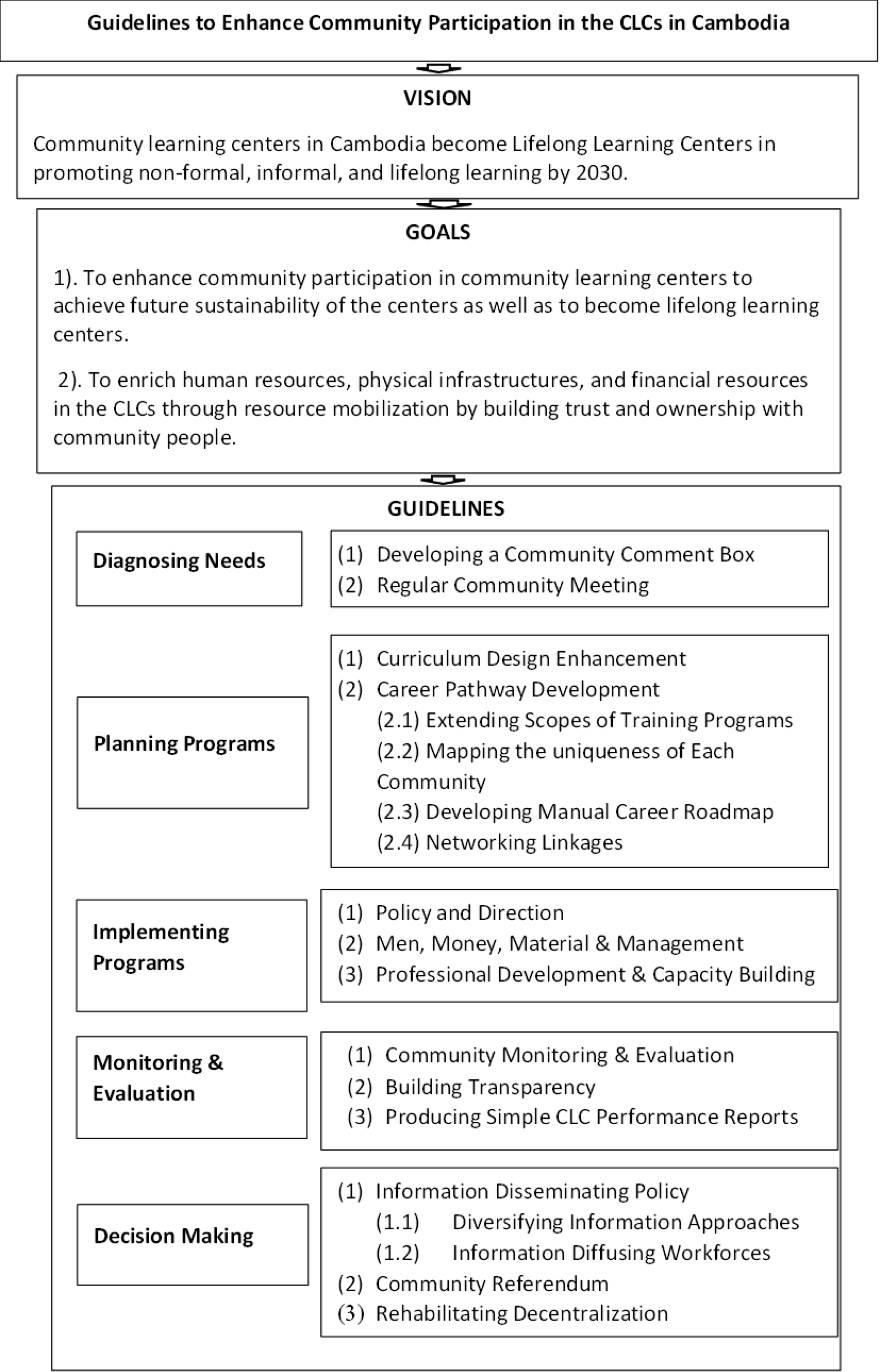
The proposed guidelines to enhance community participation in the CLCs have divided the roles and responsibilities of community people, CLC committee members and experts in following:
Community people
• Community people have a role to participate in any activities which are invited and organized by the CLC committee members • They have to contribute their ideas in diagnosing programs and planning programs to make sure that the CLC committee members to receive sufficient information
CLC committee members
• CLC committee members have a responsibility to make sure that community people are able to participate in the CLCs through using services, attending programs, monitoring and evaluation, and decision making. • CLCs committee members have to collect information and opinion of community people to ensure that they are able to initiate a responsive program to needs of community people.
Experts
• They have a role in studying the current situation of community participation in the CLCs in Cambodia • Experts could provide some recommendation and mechanisms to the CLC committee members and community people to enhance their activities in the CLCs • Experts have a responsibility to conduct research on the operation of CLCs and improvement of community participation in the CLCs as well as to propose as strategies to advocate to government and relevant stakeholders.
Recommendations
Recommendations for further development
All relevant stakeholders such as the government (MoEYS and CLC committee members), policymakers, and community people, should be involved in enhancing community participation in the CLCs as follows:
Ministry of Education, Youth, and Sport (MoEYS): (1) MoEYS should focus on the CLC committee members’ capacity building by providing an equal chance for them to join in training programs and short visits to local and international sites, enabling them to experience diverse environments, skills, and knowledge. (2) MoEYS should change CLC committee members’ roles from a leader to be a supervisor and facilitator to delegate more power and authority to the CLC committee members to manage and implement programs.
CLC committee members
(3) The CLC committee members should use technology by creating their own YouTube channel and Facebook page to showcase their activities and available facilities. (4) The CLC committee members shall establish programs and activities based on the need of community people
Policymakers and experts
(5) The policymakers shall utilize these guidelines to enhance community participation in the CLCs to attain its vision as to become a lifelong centre in the Kingdom of Cambodia. (6) The policymakers shall link community learning centres with public-private partnerships (PPP) to extend networking and job market opportunities for community people after finishing their training programs
Community people
(7) Community people should change their perception and mindset from seeing non-formal and informal education as an inferior subsection to formal education. (8) Community people should focus on diagnosing their needs, planning programs, implementing programs, monitoring and evaluation, and decision making in the CLCs.
Recommendations for further studies
Due to the scope and limitations of this study, we recommend prospective students, professors, practitioners, and scholars should extend the research study scope with a more significant population sample so they can fully understand the current state and desirable needs of community participation regarding how to enhance community participation in community learning centres in the Kingdom of Cambodia.
Footnotes
Declaration of conflicting interests
The author(s) declared no potential conflicts of interest with respect to the research, authorship, and/or publication of this article.
Funding
The author(s) received no financial support for the research, authorship, and/or publication of this article.
