



Abstract
Functional literacy is the learning of knowledge and skills for vital necessities as a higher level of basic literacy and then the operational use of this information in individual, socio-cultural, or economic fields. This research aims to examine the opinions of teachers in the context of functional literacy related to the II level primary education program for adults conducted in Public Education Centres. A phenomenological design was used in the study. A total of 12 teachers working in literacy courses in Public Education Centres were included in the study group. This study was conducted by taking the opinions of teachers and concluded that the second-level literacy courses are not sufficient at the social, individual, and educational levels in the context of functional literacy. In the context of these results, it is recommended that the content of the II level primary education program is reconstructed to provide functional skills in a framework that enriches daily life practices focused on the needs of adult individuals.
Introduction
Most of studies of adult learning are carried out by having been influenced by traditional learning theories focused on children’s learning and learning practices fed from these theories. On the other hand, since adults have completely different characteristics as learners, learning practices for adults should also have different characteristics (Knowles, 1988). Originated in Greek, pedagogy means the teaching method of an academic subject or a theoretical content and it is used instead of the science of education (Stevenson, 2015).
The word pedagogy comes from the Greek words “paid” (child) and “agogus” (education). With the beginning of the studies on adult learning in the 20th century, various problems have been encountered in the field of practice. One of the main problems is that pedagogy is based on an approach that is based on the transfer of knowledge and skills as the aim of education, and in this context, emphasizes the logic of examination (Knowles, 1988).
Moreover, the facts that possible effects of the speed of social change based on an individual’s average life span are increasing day by day, and the question whether of what is learned in childhood and youth periods will be useful later in life have also been frequently mentioned. Useful information in one’s 20s is not useful in their 30s.
Once there had been an acceptance of adult learning as a distinct field in the 1920s, the main question for academics and practitioners are trying to answer is how adults learn. Since that time there has not emerged a common answer on how to teach, and different theories and models have begun to be presented (Meriam, 2001). The book “The Meaning of Adult Education,” written by Lindeman in 1926, was the first study to consider adult learning as a separate field. This book explains how adults will be subjected to teaching practices differently from children. In Lindeman’s (1926) study, in which he stated that new methods and techniques should be developed that would provide a basis for qualitative increase based on experience rather than quantitative increase, education is defined as life itself, not a process that prepares for the unknown. For this reason, the whole life should be considered as a learning process.
In lifelong learning, learning activities should be included to effectively fulfill the duties and responsibilities required by the situation, rather than memorizing content and also it should not be forgotten that adults are problem solvers who consider the problems encountered in real-life conditions, and care should be taken to present the content that they can use at that moment (Corley, 2008). The main thing desired by adults is functional content that will build on the repertoires of their experiences and provide answers to vital problems (Clardy, 2005). Functionality can be defined as the ability to use the skills and abilities that individuals need to take an active and responsible role in their social environment, daily life, workplace, and educational environment in adult education (Qualifications & Curriculum Authority, 2007).
In parallel with the transformation in adult learning, literacy learning has evolved in a direction that emphasizes functional skills and focuses on learner experience. Literacy is the ability to identify, understand, interpret, create, communicate, and calculate using printed and written materials associated with changing contexts (UNESCO, 2018). Literacy is the ability of an individual to understand, evaluate, and use a written text to be involved in social life and achieve their goals PIAAC (2009). Literacy includes the continuity of learning that enables individuals to achieve their goals, develop their knowledge and potential, and fully participate in their community, and in a wider sense, their society (UNESCO, 2017).
Developed by Freire (2013), critical literacy provides a framework for centering on adult life experiences on the acquisition of functional skills by adults. Contrary to the pedagogical perspective, functional skills that aim to connect with social life such as interpreting, questioning, thinking about something, and acting from experiences are of fundamental importance in adults’ learning processes of how to read and write. In our age, literacy is not seen as an intermittent process, but as a continuous activity that permeates the whole life, and evolves into a process that is always needed and needs to be developed in daily life and ensures functionality along with social changes (Popovic, 2014).
Functionality and literacy appear as a collection of acquisitions in which functional skills are added to literacy in maintaining daily life. In the most basic sense, functional literacy is the ability of an individual to use literacy competencies and knowledge in cultural, social, and economic fields (Özenç & Çarkıt, 2021). In other words, functional literacy is learning basic knowledge and skills related to literacy and mathematics and then using them in daily life (Özenç & Doğan, 2014). Functional literacy can be addressed as the transition from basic literacy to functional literacy and can be considered as the operational use of acquired knowledge and skills in individual, socio-cultural, or economic fields. To be considered literate, one has to read short texts and to be considered functional literate, one has to be able to contribute to their society in line with the ability to sustain their own development, including situations that require calculation other than writing (Bhala, 1995).
In the context of communication skills, functional literacy is defined as a synthesis of the knowledge of basic grammatical principles, how language is used in social settings to perform communicative functions, and knowledge of how utterances and communicative functions can be combined according to discourse principles (Canale & Swain, 1980). As the sum of all these types of knowledge, in today’s globalizing world, and in the context of acquiring skills that will work in real life, functional literacy is the process of acquiring basic cognitive skills, using these skills to contribute to socio-economic development, acquiring personal and social awareness, and engaging in a critical reflection in keeping up with social changes with this awareness (UNESCO, 2015). Ultimately, functional literacy in the global world is a multidimensional socio-cultural phenomenon that includes legal, economic, cultural, linguistic, knowledge, and other components (Iliukhina et al., 2021).
Functional literacy is a holistic process that requires using different skill sets that make up the content of many sub-literacy types. Media literacy, which includes the ability to access content from various sources such as print, visual and internet, health literacy, which requires knowledge of child care and factors affecting physical and mental health, financial literacy, which includes accessing employment opportunities and managing financial assets, civic literacy, which requires knowing the rights and responsibilities of citizenship and applying them in life, informatics literacy, which includes informatics, web tools and computer use competencies, legal literacy, which requires knowing the legal remedies and following the laws and procedures, and scientific literacy, which includes the knowledge of scientific facts, concepts, principles, and theories, and the ability to apply the relevant information in daily life, constitute the parts of this process. In other words, functional literacy creates the opportunity to fulfill many functions that are not just about reading and writing. In this respect, functional literacy, besides contributing to individual well-being, also produces social contributions (Cocchiarella, 2018; Downing, 1970; Ezziane, 2007; Livingstone, 2004; Mihalcova et al., 2014; NRC, 1996). Thus, individuals who have reached the level of functional literacy develop social, personal, economic, and legal competencies such as taking an active role in activities like voting, donation, association membership, etc., participating in processes such as family budgets, taking an active part in decisions about children, making decisions on one’s own showing the development of self-efficacy including positive self-perception, consulting others, defending their rights, following the developments in the world, comprehending the texts they read, and analyzing news contents (Kağıtçıbaşı et al., 2005).
Functional literacy, as the literature reveals, is a life-long process that is based on basic literacy skills, requires multifaceted personal development, and manifests itself with behaviors, decisions, and lifestyles. In this sense, it creates a context that makes both personal and social contributions possible. In this context, determining the place of functional literacy education in literacy courses given to adults through Public Education Centres and examining these courses in the context of functional literacy emerge as a necessity in terms of raising well-equipped individuals required by the age.
In this respect, adult literacy course activities in Turkey are carried out by Public Education Centres affiliated with the Ministry of National Education of Turkey. These courses consist of Level I and Level II. With the new curricula implemented as of the 2021–2022 academic year, a total of 160 hours of lessons are given in the First Level Literacy courses including 80 hours of Turkish, 40 hours of Life Skills, and 40 hours of mathematics. The I Level Literacy Teaching and Basic Education Program aims to give adults; “(1) language and mental skills related to listening/watching, speaking, reading, and writing that they can use for life, (2) basic mathematics skills, and (3) basic knowledge and skills related to daily life” (Ministry of National Education of Turkey, 2018a). In the II level courses, on the other hand, 220 hours of lectures are given including 90 hours of Turkish, 58 hours of mathematics, 36 hours of social studies, and 36 hours of science and technology. The II Level Basic Education Program aims to give adults; “(1) knowledge, skills, and attitudes equivalent to the level prescribed by the primary school program in formal education, (2) knowledge and skills that will enable them to use the Turkish language properly, (3) basic mathematical knowledge, skills, and attitudes related to daily life that they can use for life, (4) knowledge, skills, and attitudes regarding life sciences, and (5) knowledge, skills, and attitudes for solving personal and social problems by comprehending the basic elements and processes that make up the environment, culture, and history in which they live” (Ministry of National Education of Turkey, 2018b). In this sense, while the I Level Literacy Education and Basic Education Program aims to provide adults with basic literacy skills, the II Level Basic Education Program aims to develop basic literacy skills and enable individuals to be multi-faceted in transferring the knowledge they have acquired to daily life. The state of reaching these developmental goals towards functional literacy still remains up-to-date as a problem area. Therefore, this study aims to examine the opinions of teachers in the context of functional literacy related to the II level primary education program in Public Education Centres. For this purpose, answers to the following questions were sought:
About the teachers who work for the II Level Basic Education Program in Public Education Centres; 1. What are their views on functional literacy in terms of practice? 2. What are their views on the materials they use in the context of functional literacy? 3. What are their views on functional literacy in terms of trainee experiences and achievements? 4. What are their views on the training program they implemented in the context of functional literacy?
Method
Research design
In the research, phenomenology design was used to learn the opinions of the teachers, who were working in the II Level Basic Education Program in Public Education Centres, on functional literacy. The phenomenology design aims to reveal the perceptions or experiences of the individuals participating in the research about a phenomenon, the methodology attaches importance to subjective consciousness, and active consciousness making sense is considered valuable (Cohen et al., 2007).
Study group
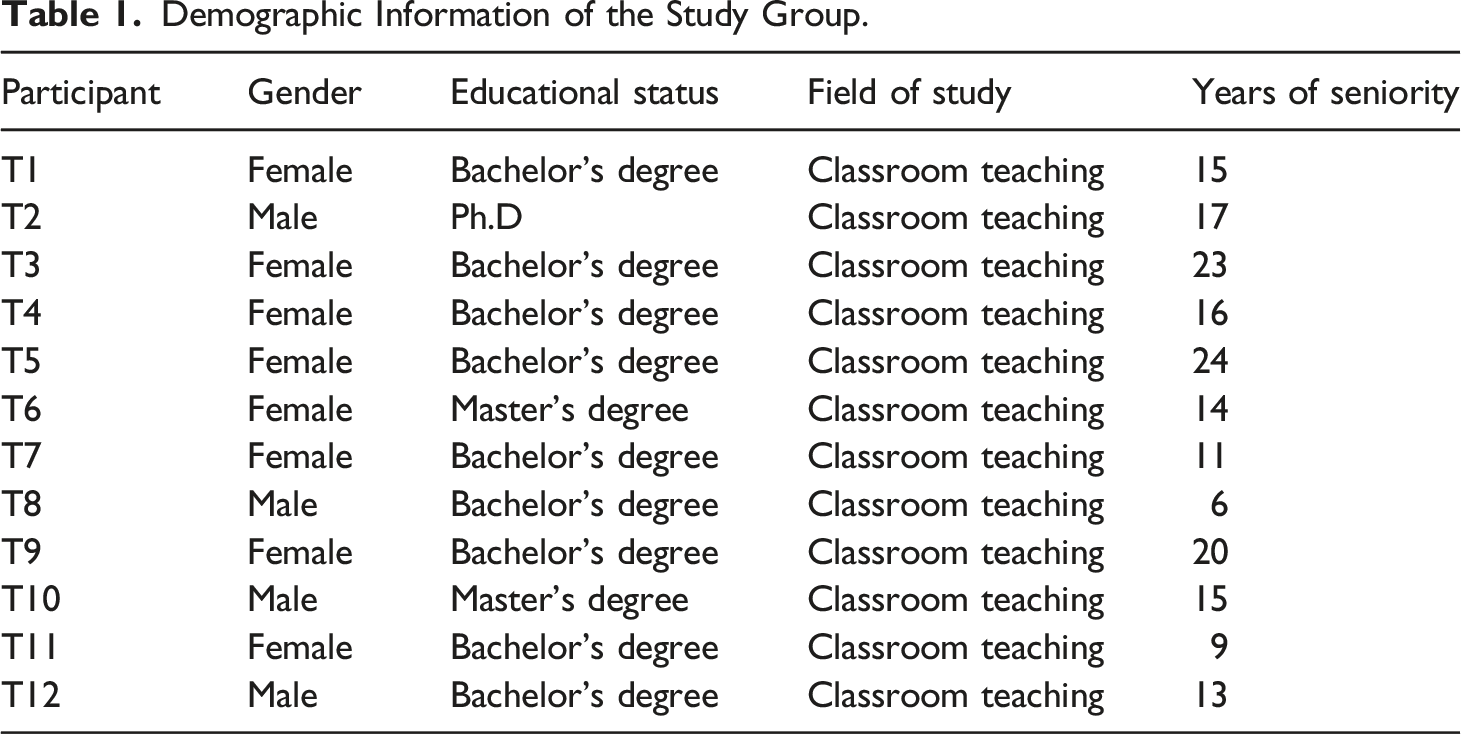
The Convenience Sampling Method, which is one of the non-probabilistic sampling methods, was used to determine the study group in the study. As part of this method, volunteers who were easily accessible to the researcher and who had suitable qualifications for the research were included in the study group (Gravetter & Forzano, 2012).
Demographic Information of the Study Group.
Data collection tools
In the research, “focus group interview,” which is one of the qualitative research methods, was used to collect data. The interview method enables the understanding and collection of the information existing in the minds of the individuals by using the natural language about the life experiences of the participants, as well as the discovery of the key features, meanings, and interpretations in the individual perception of the phenomenon (Kvale, 1996). Focus group interviews, on the other hand, include discussions, examinations, or interviews in small groups (4–12 participants) about a determined phenomenon, problem, or focus (Marshall, 1999).
In the two focus group interviews (in groups of six people) conducted to collect data in the research, an interview form consisting of semi-structured questions was used to reveal the perceptions, interpretations, and experiences of the participants about the phenomenon. According to Merrıam (2018), the questions asked to the participants in the interviews consisting of semi-structured questions are neither fully open-ended nor detailed questions and have semi-structured qualities. In this direction, in the first part of the interview form created to collect data in the research, the participants were informed about the interview, their consent was obtained, and interview questions were posed to the participants. Some of the semi-structured questions asked to the participants are as follows; 1. Can you evaluate the applications you have carried out in the 2nd level literacy courses for adults in terms of functionality? 2. Can you evaluate the materials and tools you use in the 2nd level literacy courses for adults in terms of gaining functional skills and competencies? 3. What are your thoughts on whether the 2nd level literacy courses for adults you have worked for are functional in terms of curriculum and program? Can you please explain? 4. When you evaluate the 2nd level literacy courses for adults in terms of trainee experiences, what can you say about functionality? 5. Have you observed any changes in functional skills and competencies in your trainees who have completed the 2nd level literacy courses for adults? What do you think about this?
Data collection
Focus group meetings with participating teachers were held in December 2021, and the relevant interviews were held online and recorded due to the pandemic effect. During the interviews, attention was paid to the personal and legal situations that could negatively affect the emotional state of the participants, an interview environment was provided where they could feel comfortable and express themselves easily, at the same time, measures (internet, voice, noise, etc.) to prevent the interruption of the interview were taken by the researcher (Field & Morse, 1989).
Analysis of data
To analyze the data obtained in the research, the content analysis technique, which is one of the qualitative research analysis techniques, was used. The meanings that define the research phenomenon were reached by reducing the data obtained in successful content analysis to concepts, concept groups, conceptual systems, maps, or categories (Elo & Kyngäs, 2008; Hsieh & Shannon, 2005). In this process, which is defined as the abstraction process, content analysis can be performed inductively or deductively (Elo et al., 2014). In this process, the researcher should consider three stages while conducting the content analysis. These are about the results and include (1) preparing the results (collecting appropriate data for content analysis, making sense of the data, and choosing the analysis unit), (2) organizing them (open coding, categorizing, and abstracting), and (3) reporting them (Elo et al., 2014).
In the research, the data obtained from the focus group interviews were firstly transcribed using a word processing program and then analyzed using the MAXQDA program. The data obtained were inductively coded within the framework of the research questions and then these codes were interpreted under various categories and themes. Also, the participants were expressed as T1, T2……… with the intent of hiding the participant information to ensure personal security in the analysis and reporting of the data.
Validity and reliability
To increase the validity and reliability of the study and ensure credibility and transferability in this framework, as Merriam (2018) stated, the research process was handled ethically, the data collection process was carried out in a detailed and in-depth manner, long-duration interviews were conducted with the participants, the obtained data were submitted for confirmation of the participants, and action was taken in line with the awareness that would prevent researcher bias and subjectivity.
Findings
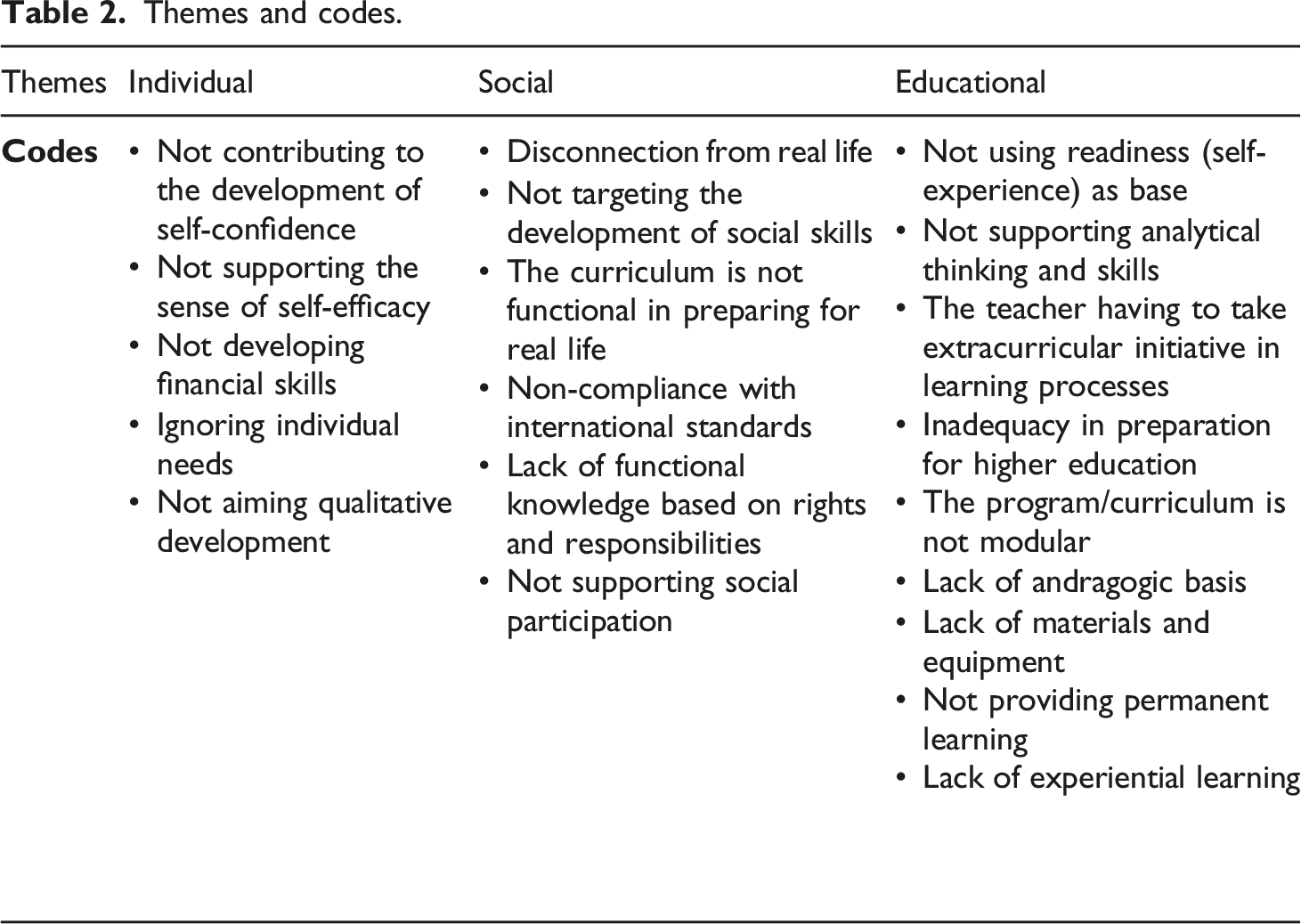
Themes and codes.
Individual level
An analysis of the opinions of the teachers about the 2nd level literacy courses for adults held in Public Education Centres reveals that the current program, tools, and practices at the individual level in the context of functional literacy are insufficient in contributing to the development of self-confidence, supporting the sense of self-efficacy, developing financial skills, and supporting qualitative development and they ignore individual needs.
The participants T1 and T6 emphasized that the 2nd level literacy courses ignore the needs of the individuals, the curriculum and the books used are insufficient in this sense, and there is no satisfactory content for maintaining their daily lives. Similarly, T12 emphasized financial literacy in his speech and expressed that the current program at the time was insufficient to meet daily needs. “Although it is not in the curriculum… There is only the act of filling out a form in our curriculum and there are writings and so on, but we can work on withdrawing one’s salary from the bank, for example… You know, if we could actually have a chance to apply it a little more in life, for example, if we could take people according to age groups and bring them in front of an ATM, but we can’t do it. We don’t have too many opportunities” (T1). “They never looked at the book… I entered the classroom and was shocked. I said, “what am I going to teach you?” They say, “teacher, we do not understand these books; tell us what you can tell us”. They want to progress as much as we can in social studies, science, and mathematics and I come to these classes in line with their needs” (T6). “For example, how to withdraw money from a bank, what forms are filled out in a hospital, how to write a petition, what are the basic computer skills, what should be considered when making a family budget, there is the pandemic, what should be done? In this sense, content that can be used in daily life is not offered” (T12).
Different participants expressed that the current training program is insufficient in gaining individual competencies such as self-confidence, self-efficacy, and qualitative development. T7 stated that the current program was insufficient in developing the self-confidence needed to be included in business life. T10 stated that the courses were insufficient to provide qualitative development and did not provide multi-faceted development. “...we see women who have never worked and in fact they do not dare to work. They do not dare to work because they could not create that structure until that age. It is necessary to support their efforts to take a bit different place in life. Here the program falls short. No content removes their shyness” (T7). “...In general, I think that the courses are not developmental, I think that these courses and books are dull and have insufficient information. We can say that the subjects that they can think more broadly and express individually and mostly touch on feelings and thoughts are missing” (T10).
Social level
An analysis of the opinions of the teachers about the literacy courses held for adults in Public Education Centres exhibits that in the context of functional literacy, the current program, tools, and practices at the social level are insufficient in preparing people for real life, developing social skills, meeting international standards, acquiring knowledge of rights and responsibilities, and supporting social participation.
Participants often stated that the current program was insufficient to prepare individuals for real life. Participant T1 stated that the program and the books used were insufficient to prepare individuals for real life and help them overcome potential problems. T3, one of the participants, emphasized the lack of the program and offered suggestions for eliminating this deficiency. “Basic education is being given but we do not have a comprehensive program that can give them knowledge and skills that they can use everywhere in daily life. As we said, they do not use the computer, you know, they don’t know how to use the internet or how to use it correctly… We do not know if they can put what they have learned into practice. The course hours are insufficient and we can’t get a response because our trainees cut off communication with us after the course” (T1). “The program can be divided into different modules and on top of the existing training, some daily life training applications can be added. To repeat, this program has shortcomings in terms of quantity and quality in general.” (T3).
Participants stated that the program was insufficient in developing individuals’ social skills and preparing them for social life. At this point, it has been stated that the course content is far from functional. T2, in his speech in which he evaluated the course experiences in terms of program and content, stated that the trainees could not acquire functional competencies and were not ready for social life. T8, on the other hand, stated that the course program was exam-oriented and insufficient in preparing for social life. “…There were not many people who could acquire functional skills, and I understood it this way, for example, the course ended, a few months passed and they re-registered for the course. They had not fully learned in the past course; they were already obsessed with letters and symbols. Because they had not repeated their old course information, they attended the course forgetting, this was the first thing that caught my eye” (T2). “…second-level courses are insufficient in terms of preparing for social life, as it has a mission to prepare for exams. People come to enter the social life. We relay exam priority information to them. The content is like this…” (T8).
T4, one of the participants, emphasized the international dimension of sociality and stated that the current program was insufficient to meet international standards. “...I do not let them leave without attending the second level. I mean, they take those courses one after the other, but it is still very difficult for them to gain functionality under European standards. The absence of books, computers, and materials is also effective in this…” (T4).
At the societal level, another issue that is expressed is that the current program does not provide the necessary content based on knowing and exercising their rights and responsibilities as a citizen. T11, one of the participants, pointed out the rights and responsibilities in her speech and stated that the current program is very didactic and does not produce real solutions. “There is no content that answers which solution is expected from which institution. Quite didactic and encyclopedic information is presented in the second level books about the management of institutions…” (T11).
Educational level
An analysis of the opinions of the teachers about the literacy courses for adults held in the Public Education Centres reveals that the current program, tools, and practices at the educational level in the context of functional literacy are not based on personal experiences, do not support analytical thinking, do not have a support program other than the initiative of the teacher, are insufficient in preparing for upper levels, are not modular, are not based on andragogy, and do not provide permanent and experiential learning.
Participant T5 stated that the course program did not focus on life experiences, did not consider the readiness levels of the trainees, and was not based on the andragogic context. T9, on the other hand, stated that the content of the program, which ignores age differences, is prepared without being based on learning differences. “I think the level of readiness is very important in terms of quality of life after the course because the dough we have is not a child and they have a past, no matter how much they took part in life before us, we can move them up one or two levels. However, the teachers themselves take initiative in this regard; the program is not supportive in this sense…” (T5). “…we need an intermediate program to classify these trainees by age groups. If we have an intermediate program, we will see that especially our trainees over the age of 50 will not attend the 2nd level course from now….” (T9).
Participants stated that the course content is far from developing analytical thinking and does not encourage multidimensional thinking. T3 stated that the information in the course content consists of information based directly on memorization, and in this respect, it does not encourage multi-dimensional thinking. T7 stated that the content of the book used in the course provided information based on memorization and did not have content that would improve multi-dimensional thinking skills such as learning by discussion. “I think these courses and books are dull and have insufficient information. We can say that the subjects that they can think more broadly and express individually and that mostly touch on feelings and thoughts are missing…” (T3). “The books remained at the level of giving information, the activity sections could have been increased. It would be nice to have activities where they could discuss, think, and write. Also, there had to be a tablet computer. Because, okay, we train them at primary school level, but these individuals are also preparing for life, so we could offer computer usage and much other information from the tablet” (T7).
The participants stated that they had to act on the initiative of the teacher due to the inadequacy of the course program, the content as well as the books used. T8 stated that he personally made an effort to overcome the inadequacy of the program and that the program and the books prepared for the program did not support the teacher. T5, on the other hand, stated that in addition to the curriculum, she conveyed the life-facilitating content that is not included in the program content to her trainees on her personal initiative. “… we bring empty boxes to class, we read their expiration dates together, we read the bills, we bring the bills of these months, we teach them how much they will have to pay this month and how much money they need to allocate. We do these, but none of them are in the program sir but we do them. I try to address both knowledge and behavior in young groups as much as possible. There, too, we sometimes have to play small games personally…” (T8). “...I am trying to give the whole curriculum in the book. Apart from that, I try to teach current issues by saving time and preparing printouts and documents… I make them learn phone numbers, addresses, and ID numbers. At least, I make it easier for them to receive basic education in the society....” (T5).
Discussion
In his article, Valdivielso (2006) states that two types of discourse have developed in the context of functional literacy, the first of which is the discourse with the participation of governments, supported by organizations such as UNESCO through international conferences. This discourse is more development-oriented. The other discourse produces content that is put forward by non-governmental organizations and researchers and focuses more on the individual. These two perspectives, which are shaped in an individual and social context, affect each other. This interaction manifests itself in UNESCO definitions. Functional literacy, as mentioned in the UNESCO (2005) report, means the acquisition of the content in systematic integrity that is necessary for the individual to acquire the skills that will enable the individual to be an active member of social life in the globalizing world and gain awareness both at the individual and social level.
Functional literacy at the individual level is addressed through what the individual has and does not have. By emphasizing the social context at the social level, the focal point is the individual’s acquisitions on a social basis (Valdivielso, 2006). This framework, which is put forward at the social and individual level, is compatible with the distinction between the individual and the social level that was revealed as a result of the analyses of this study. In addition to these levels, the educational level, which is a more technical and specific level, is the other level that emerges as a result of analyses. Research findings reveal that literacy courses conducted in Public Education Centres have inadequacies at the individual, social, and educational levels.
Kağıtçıbaşı et al. (2005) listed the presence of self-efficacy perception, positive self-perception, and self-confidence as functional literacy acquisitions at the individual level. The analyses in this study reveal that literacy trainees cannot achieve the necessary acquisitions in terms of self-efficacy (Kansu & Hızlı Sayar, 2018), which means being aware of one’s potential, and self-confidence, which means being aware of one’s value (Kaya & Tastan, 2020), as well as qualitative development at the individual level. Perception of self-efficacy indicates a potential that contributes to individuals’ achievement of their goals that affect their lives in many ways and satisfaction in their lives (Bandura, 1977; Yılmaz et al., 2012). Similarly, individuals with high self-confidence perceptions are individuals who are highly motivated to solve the problems they encounter. Individuals with a developed perception of self-efficacy and self-confidence and who are aware of their abilities at the point of problem-solving are individuals who are ready to acquire the necessary personal acquisitions in the context of functional literacy. The study by Özenç and Çarkıt (2021), in which the relationship between functional literacy level and problem-solving skills is positive, proves this. Likewise, Arko and Addison (2009) revealed the effects of individual-level acquisitions of functional skills in a study on participants in functional literacy courses. According to this study, individuals whose qualities such as understanding texts and making calculations at an individual level improve, in addition to contributing to their personal well-being, can get involved in social life more easily.
Another top heading, in which the findings of this study are collected, is the social level heading. This study concluded that at the social level, functional literacy acquisitions in terms of conformity to real life, development of social skills, awareness of rights and responsibilities, and awareness of the universal context are insufficient considering the current program. The lack of functional literacy skills in the social context shows that individuals cannot access the acquisitions they need to survive. Considering that learning is defined as the process of achieving the acquisitions required by real life (OECD, 2000), it becomes clearer that the second-level literacy courses from which the data of this study were obtained are insufficient in gaining functional literacy competencies at the social level. At this point, as seen in the study by Akello et al. (2017), there is a positive relationship between functional literacy and quality of life, thus, as Akello et al, (2017) stated, governments and NGOs need to take responsibility in helping individuals doing what is necessary to survive in modern life and acquiring functional skills in a globalizing world.
Research findings reveal that second-level literacy courses are insufficient in providing thinking competencies including analytical skills at the educational level. Developing thinking skills is a process that includes the ability to have and apply knowledge, reasoning competencies, and being able to manage oneself and others (Stojkovic & Cumming, 1995). Also, the fact that functional literacy is based on an andragogic foundation in its educational dimension creates another necessity. In this context, this study has also revealed the andragogic deprivation of the courses in terms of teacher views. Andragogic perspective, as expressed by Freire (2013), requires a learning environment based on adult life experiences. Andragogy, unlike the pedagogical perspective, is based on a self-voluntary internal motivation between the individual and the learning process and requires a connection between the experiences of interpretation, questioning, reflection, and social life in the learning processes, of which the individual is the subject. Thus, Isa (2019) revealed in field studies that content prepared on an andragogical basis makes the learning process possible in terms of functional literacy and enables individuals to learn. An analysis of the research findings and the discussion in the context of the relevant literature demonstrate the need to organize the learning processes of adult individuals differently due to their different needs. Adult individuals want their learning processes under their control and they consider it necessary to create a learning environment where they can transfer their experiences. In this context, a learning design on an andragogic basis provides a suitable learning environment for adults (Clardy, 2005). Therefore, the study concluded that the learning environment designed in line with a process that takes into account the needs of individuals and based on the life experiences of individuals increases the motivation to learn and makes learning permanent.
Conclusion
As demonstrated by both international organizations such as UNESCO and many researchers included in this study, the acquisition of functional literacy skills both contributes to the individual’s personal well-being and enriches social life. This study, which was done by taking the opinions of teachers, analyzes the second-level literacy courses in the context of functional literacy on a social, individual, and educational basis and reveals that (1) the content is prepared in a pedagogical framework and prioritizes accumulation of knowledge focused on academic success rather than the needs of the adult individual; (2) the past experiences and knowledge of adults that will enable them to take an active part in learning processes are ignored; (3) there is no content regarding adults having the responsibilities required by their roles in the social field; and (4) the needs, motivations, and learning needs of adults are ignored.
In the context of these results; (1) preparing the content and curriculum in a framework that enriches daily life practices focused on the needs of the adult individual; (2) creating a teaching process that takes into account the past experiences and knowledge of adults, which will enable them to take an active part in learning processes; (3) revising the course duration to allow acquiring new information and providing enough time to transfer the information to real life; (4) updating the course content at the point of focusing on the problems in daily life and providing solutions to them; and (5) creating the content for the responsibilities required by the roles of adults in the social field are considered necessary in terms of the efficiency of the second level literacy courses in terms of functional literacy.
Footnotes
Declaration of conflicting interests
The author(s) declared no potential conflicts of interest with respect to the research, authorship, and/or publication of this article.
Funding
The author(s) received no financial support for the research, authorship, and/or publication of this article.
