



Abstract
Nowadays, urban planning and urban design are facing big changes in the use of different digital tools. Reaching out and engaging citizens and other stakeholders in urban design process are significant for good practice. Main problem discussed in this article is the lack of suitable tools/interfaces for instant collaboration between government, profession, and public. Article focuses on immersive environments, as full immersion could offer better notion of different proposals of urban design. As a case study, Immersive Terf is chosen; more exactly, article focuses on new approach and new development of tool Urban Redesign Terf. Deep immersive collaboration on design could free participant’s mind and increase level of freedom in design/planning process. Immersive environments have already been used in building information modeling (BIM) managment, but innovation part, presented here, are technological: significant changes in the software and walk-through big models, which is the base for urban design and urban planning process.
Introduction
The rapid development of digital tools, computing, networking, and virtual reality technologies and the increased desire of the public to be involved in the future of their city/neighborhood caused the need for the interface for urban engagement in urban design process. Not only the freedom to be involved in the design process of the neighborhood or the city where you live but also the freedom to be involved at any time, at any stage, from anywhere is required. In the research of building virtual worlds in 1998, Ingram has already pointed out that there is “a requirement for a balance between complete freedom to build anything, anywhere and the creation of a pleasant space and the need to produce an understandable and relatively well ordered environment.” 1
Urban design integrates a variety of disciplines connected with design and planning directly (urban planning, urban design, architecture, and landscape architecture) and indirectly (spatial sociology, anthropology, engineering, geography, geodesy, environmental psychology, transport planning, economics, and others). The public participation process in urban design can be defined as cooperative design, where designers (professionals) and users (public) are involved on an equal footing.2,3
Information technology presents a tool for public participation in urban planning, from participatory planning geographic information system (GIS), three-dimensional models, communication platforms, computer games, and augmented reality technologies. 4 Moreover, the real and virtual cities have been already explored, 4 three-dimensional visual urban simulations, 5 the augmented round tables, 6 urban simulations and the Luminous planning table, 7 mixed reality as a simulation tool in urban planning projects, 8 and many more.
In this article, we will focus on exploration of immersive environments. Gordon et al. 9 have already in 2011 explored the possibility of immersive planning, and he stated that “immersive planning is a conceptual model with which to conceive the process of public participation that focuses on the depth and breadth of user experience.” He framed approaches to public participation within three categories of immersion: challenge-based, sensory, and imaginative. Moreover, some methods of obtaining user immersion in one or a combination of these categories were defined: GIS, computer-aided design (CAD), planning support systems (PSS), virtual environments, and digital games. 9 Also the Second Life has already been explored as a potential tool of urban planning, where virtual reality was used to make transparent how users understand and interpret proposed urban designs. 10 However, there is still no real life example of using immersive environments for public participation in urban design process and no exact methodology or tool that could be used for this purpose.
Table 1 presents the classification and comparison of visualization techniques and digital tools for public participation in urban design, and it is based on the review of related work. 11 Comparison is made on the basis of usefulness for public participation in urban design, level of immersion, and level of freedom.
Classification and comparison of visualization techniques and digital tools for public participation in urban design. 11
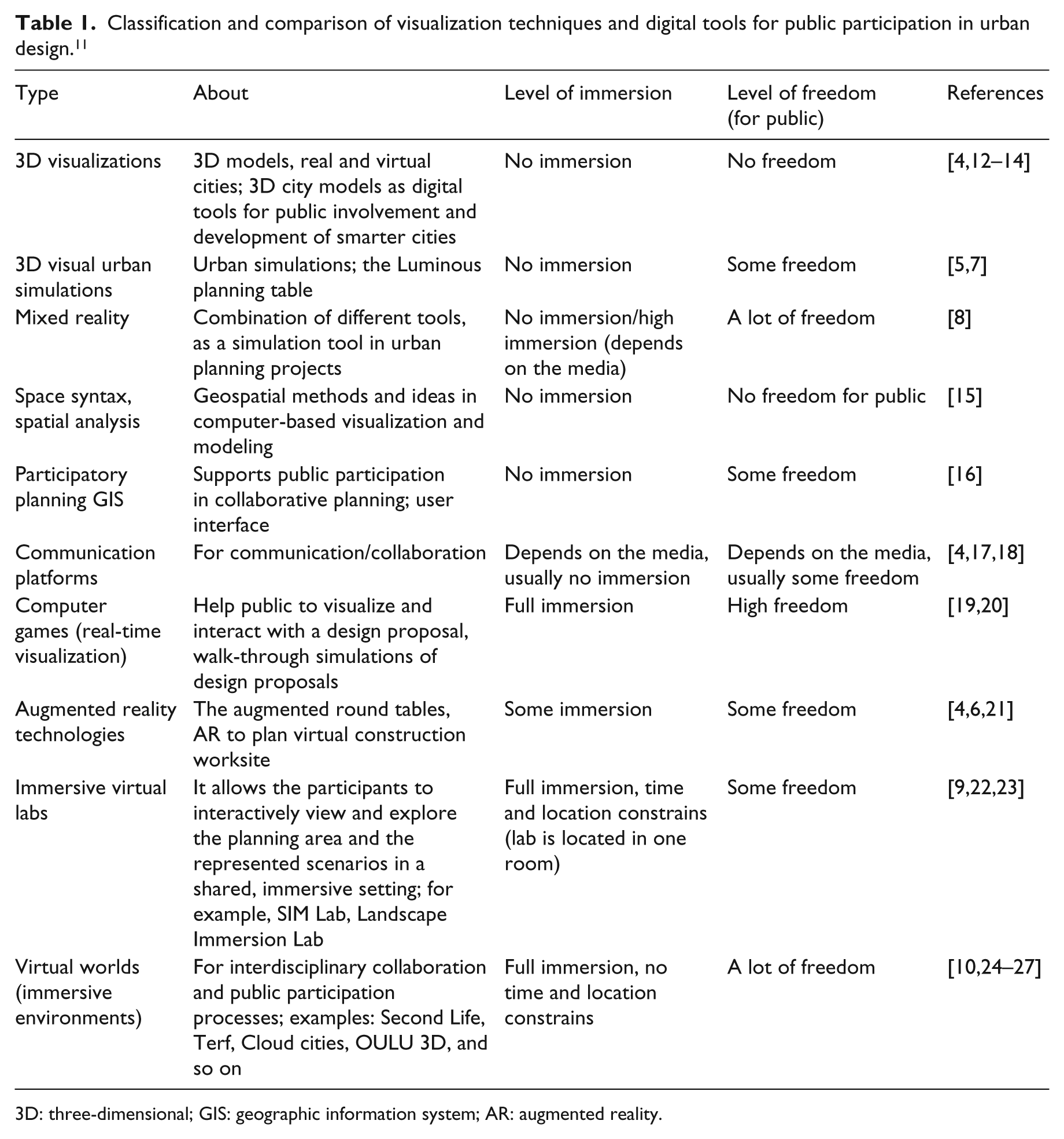
3D: three-dimensional; GIS: geographic information system; AR: augmented reality.
Moreover, some good experiences in immersive environments were analyzed, where as a case study immersive Terf was chosen. Table 2 presents examples of using immersive environment Terf in different collaborative work and its potential use in public participation process.
Some experiences in immersive environment Terf (case study).
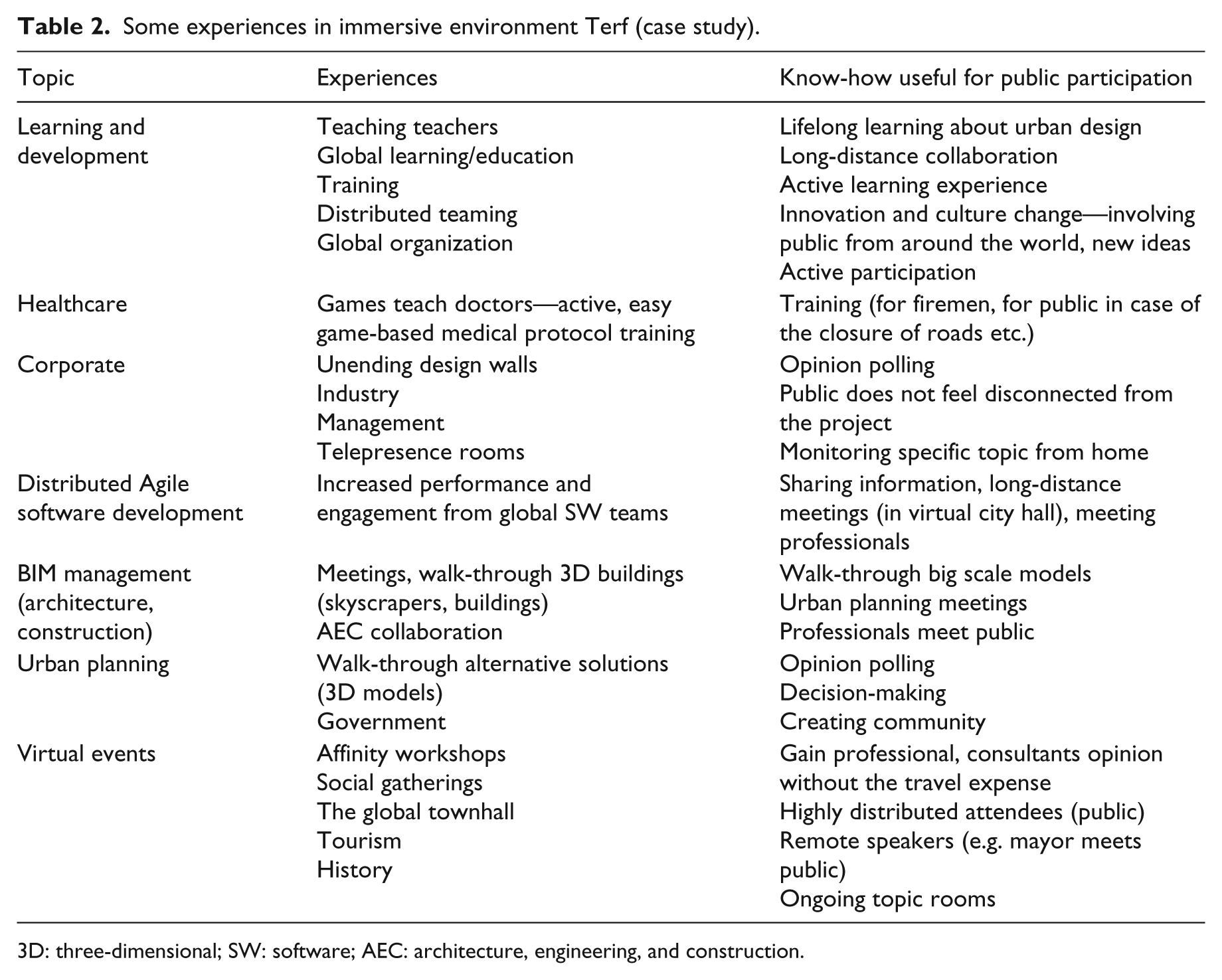
3D: three-dimensional; SW: software; AEC: architecture, engineering, and construction.
Described examples of collaborative work in immersive environments and its positive experiences show that immersive environments could be applied also in other fields. Concerning construction industry, immersive environments have already been used for BIM management (Stanford PBL Lab is using immersive Terf for BIM management for several years now), but since they enable the walk-through 3D models, we see potential of moving it further and using it also in urban planning, urban design, and in next stage also in geodesign by improving the software (SW) to enable walk-through big urban models.
Problem definition
The main problem of the article is defined as following:
Lack of design freedom for public on one side and designers/planners on another side.
Lack of tools for urban engagement in urban design process.
First, the public is usually not involved in the entire process; most often they are involved only on the final stages of the design process. Usually, they are only informed about the final proposal and not fully engaged into design process.
Second, designers (architecture, engineering, and construction (AEC) professions) also do not have enough freedom in design process because the power of government (stakeholders, politics, city etc.) is too high, and AEC profession has to do what the government says, even it is not the best for the city.
Government (politicians, stakeholders etc.) usually collaborates with AEC professions in the early stages, as it is seen on the Figure 1, but the public is usually involved in the final stages of urban design process. There are “missing tools” for collaboration between all of them that would make the process easier and faster. These “missing tools” could increase the participants’ (government, AEC profession, and public) satisfaction at the end of the project and even lead to more sustainable and better design.
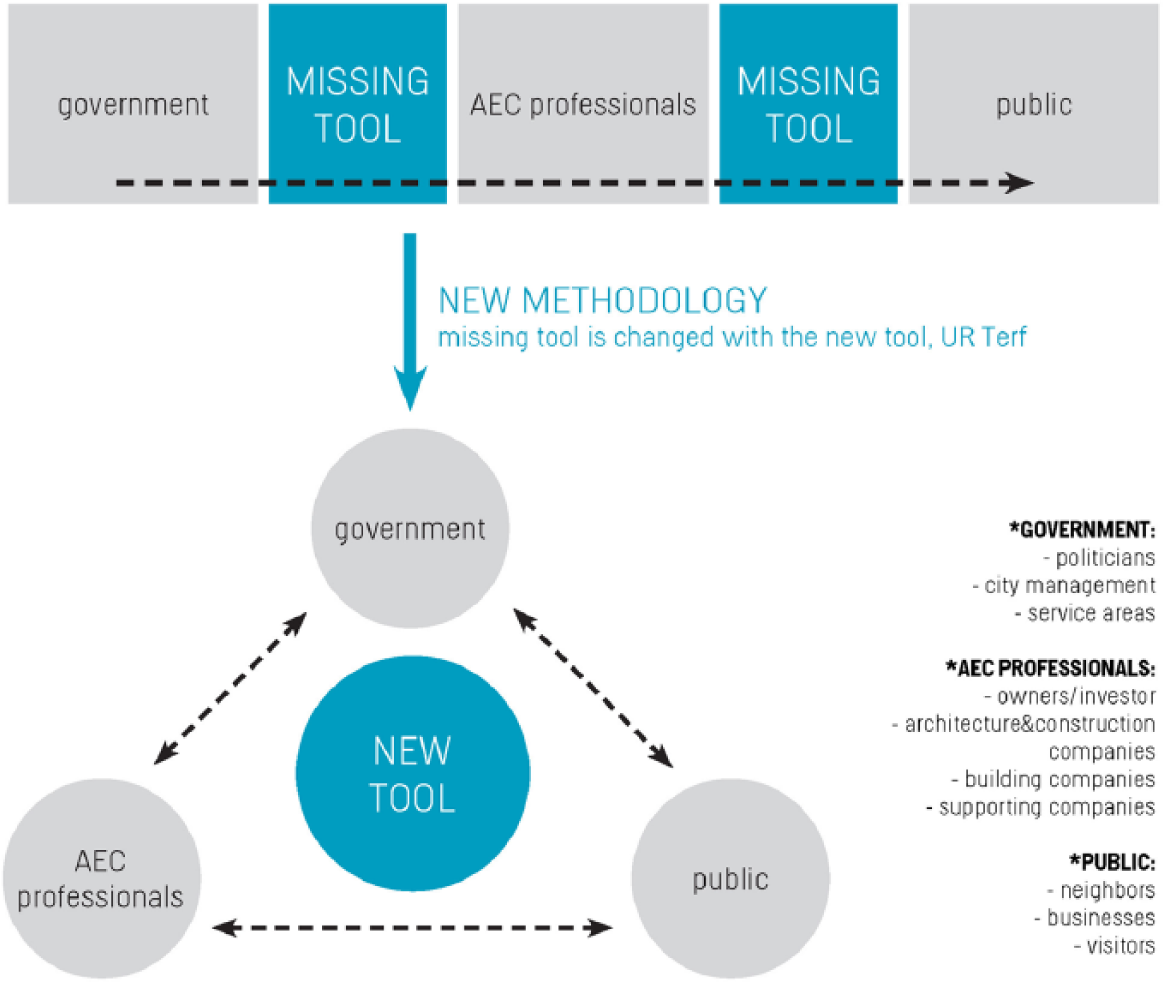
Missing tools in the urban design process and suggestions for improvement.
Figure 1 presents the possible outcome of the changed process, where one-way communication should be transformed into circle communication by adding new tool. The main aim of this article is to define new methodology/approach in urban design process and new tool for urban engagement. The focus of the article is the development of new SW for public participation in urban design/planning process: development of the SW ‘Urban Redesign Terf (UR Terf)’.
Methodology
Research is based on qualitative and quantitative research where the potential of using virtual worlds in the process of urban design from the first stages of the design process to the construction and maintenance phase was explored. 11
As a case study, immersive environment Terf was chosen, and the possibility of using it in urban design process and urban engagement was explored. The research was based on direct collaboration between researcher (urban design expert) and representative of the company (immersive expert), and the main aim of the research was to develop new SW, UR Terf. Urban redesign focuses on the action of redesigning something/designing something again in a different way; therefore, we will use in the future expression urban (re)design: combination of designing something (first phase) and changing it through the lifespan of the project (second phase).
In the next stage, UR Terf will be tested in the real life (in one actual urban (re)design problem).
The article is divided into two parts:
Development of new tool (development of UR Terf);
Development of new methodology/approach for urban (re)design process.
Freedom in urban (re)design
In the context of urban (re)design and public participation, the notion of freedom could be addressed to different participants, at different stages of design/planning process. On one side, there is the freedom of involvement, so the option to be engaged into design/planning process at each stage of the design process, and on another side, the freedom to express opinion be fully engaged, participate in the design/planning phase, and consequently make the role of each actor more equal. Nevertheless, the freedom to choose the interface (tool) or to have freedom to participate at any time, from anywhere is also explored in this article.
Based on the study and review of literature,3,28,29 we defined three main groups of planning process: (1) planning: talking about the future of the site, designing; (2) constructing: BIM coordination, building; and (3) managing: community building. Each stage was divided in subgroups; so in general, we defined following groups: (1) planning: before planning, current situation, behind the scenes, choices and voting, winner/chosen design; (2) construction: bridge—moving from idea to the project, BIM, professional discussions, final plans, building and constructing; and (3) managing: using, discuss, community building, maintaining. Figure 2 presents the role of government, AEC profession, and public at each stage.
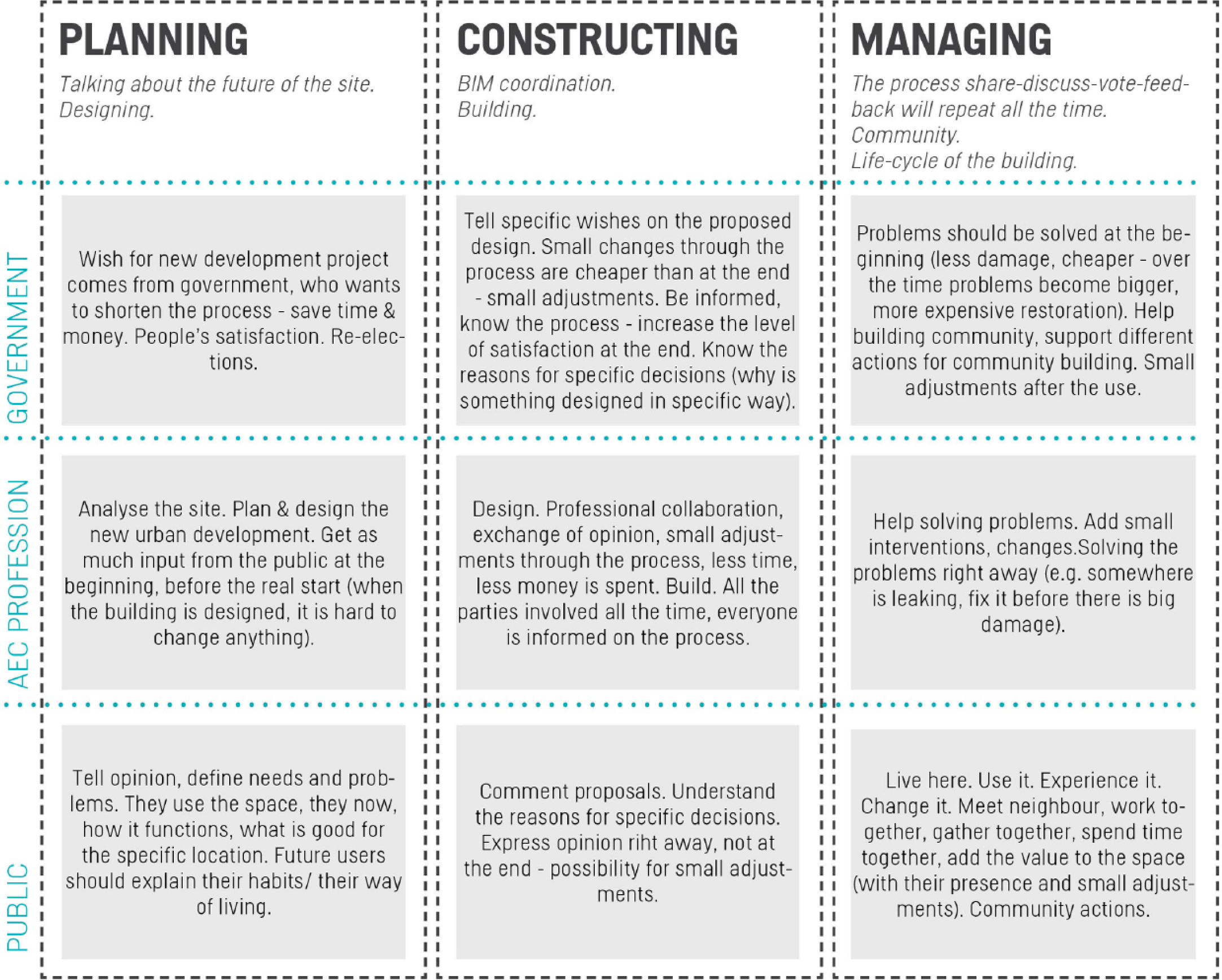
Three main stages of the urban planning and the role of different participants.
Urban planning is a complex process, 30 where “stakeholders–architects, politicians, citizens, and others bring individual viewpoints into the process,” and by using different interfaces, mutual consent of all parties must be achieved. 8 For the purposes of our study, we defined three main groups of the participants:
Government: politicians, city management, service areas;
AEC professions: owners/investors, architecture and construction companies, building companies, supporting companies;
Public: who live there, who work there, and who talk about it.
Some people are involved through the entire process, from the early stages to the maintenance, while others participate only on several stages.
Immersive collaboration in urban (re)design
Public participation is an important part of urban (re)design process, and with immersive planning, the depth and breadth of user experience could be achieved. 9 Many research have already explored the role of virtual environments,31,32 augmented reality,33,34 mixed reality, 8 recent technologies, 35 immersion for urban planning, or urban (re)design process.22,36
Immersive environments are becoming more and more used for long-distance collaboration, but not a lot for urban regeneration and planning and transport projects. Immersive collaboration in urban (re)design brings the feeling of being in the future urban park/neighborhood/city to the participants. In this article, we focus on new approach of using immersive environment for urban planning and urban (re)design projects. As a case study, we chose immersive environment Terf, 24 and based on qualitative and quantitative research in previous stage of research,11,37 we developed UR Terf, a digital tool for urban engagement.
About Immersive UR Terf
Immersive Terf is an immersive environment, a virtual world, which has already been used for long-distance collaboration in companies that have offices in different locations (mostly in the United States), for construction management, medicine and so on, and we wanted to explore possibility of using it in urban planning and in public participation process. AEC professionals are usually using tools like Revit, AutoCAD, SketchUP and so on, so the tools that are not understandable to the public and do not offer collaborative tools. Virtual collaboration is harder, and it requires more time and energy, especially the collaboration AEC profession–government. However, there is hardly seen collaboration AEC professionals–public, this involvement is usually limited on basic presentation tools and is based face-to-face.
Unlike other tools, which do not give enough freedom, Immersive Terf offers more options what to do with the tool, more freedom: ability to access it from anywhere and anytime, walk-through three-dimensional model, stop wherever you want, leave sticky notes. It presents a combination of different tools (screen share, collaborative tools, drag/drop, immersion etc.—comparison to other tools is seen in Table 3).
Collaboration features in Immersive Terf and in other digital tools.
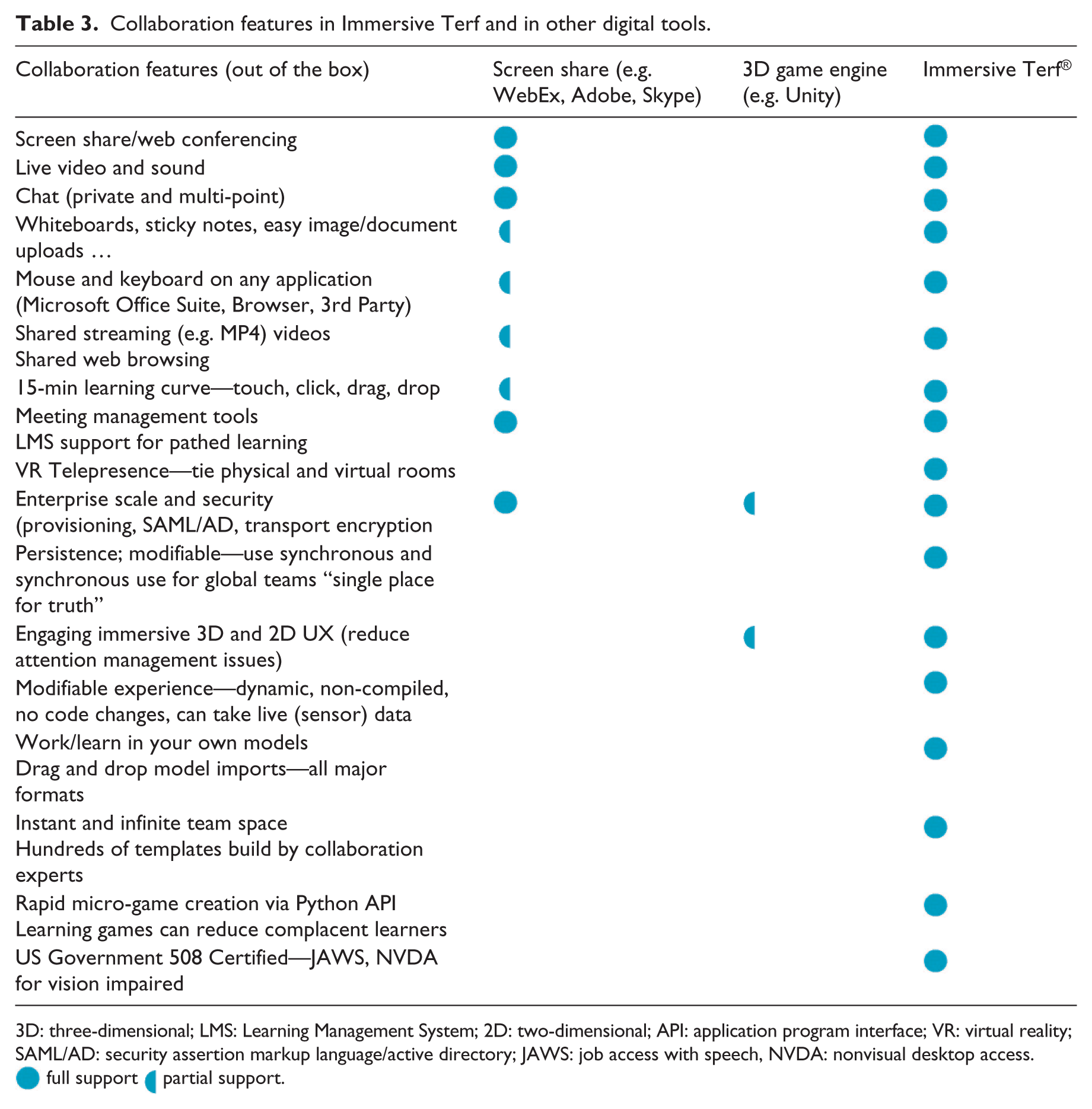
3D: three-dimensional; LMS: Learning Management System; 2D: two-dimensional; API: application program interface; VR: virtual reality; SAML/AD: security assertion markup language/active directory; JAWS: job access with speech, NVDA: nonvisual desktop access.
 full support
  partial support.
Using smart solutions for public engagement
UR Terf was designed to support urban (re)design process and offer all participants the ability to be involved on one side and get the feeling of future development project on another side. It can simplify the process of involving the public in the planning and design of city or urban space. It is virtually laboratory for discussing urban design issues, communication and collaboration between professional (experts) and public (non-experts), and at the same time also for interdisciplinary collaboration. The laboratory is used for information, communication, collaboration, and education of different participants. It is virtually based, without time and location constraints, but it can be also combined with traditional ways of collaboration. It is a platform that combines different tools and enables the ability to import small and large-scale three-dimensional models into it and walk through them. This helps them to see what proposed solutions mean for their city and experience the site with their avatar. Terf could be used also for decision-making process: you can meet others, share information, evaluate different proposals, and decide together which proposal is better.
Real value from virtual reality: three-dimensional models in Terf
Three-dimensional models could be used in virtual worlds where you can walk through the virtual built environment. 38 Virtual worlds can assist you in experiencing space and gaining experience in the real world, 39 they want to emulate physical space, its image, services, and interactions of people. They exist in direct connection to the physical space. 40 UR Terf allows importing of large three-dimensional models of urban settlements as the opportunity to do walk-throughs of the three-dimensional models of urban design proposals (Figure 3). It offers experiential design aspect (pedestrian view) and planning design aspect (bird view).
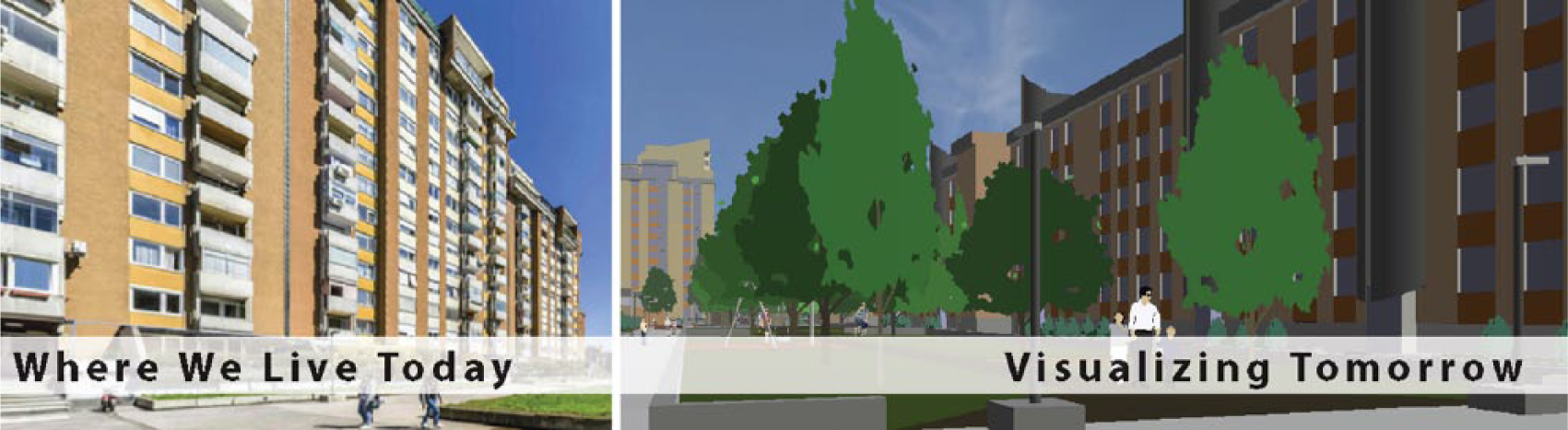
Real value from virtual reality.
Some user experiences from the qualitative research where we explored users interaction with Terf and which was conducted in Terf in 2013 37 are “it is very useful, it is good that you can walk through the urban space, preset views are an advantage, animation is suitable for people,” “very clear, you know exactly where you are on the platform,” “it is easy to use, many people can potentially use it,” “it enables users to gain a sense of space,” “a tool that helps form opinions, it is very appropriate at this stage,” “this tool is only for younger people,” “it is good for increasing motivation,” “I feel like I am dealing with a computer game.”
Urban engagement through the entire urban (re)design process
New approach to urban engagement in urban (re)design process was developed and is presented on Figure 4 and is based on combination of traditional and digital tools, so combination of physical and virtual urban engagement.
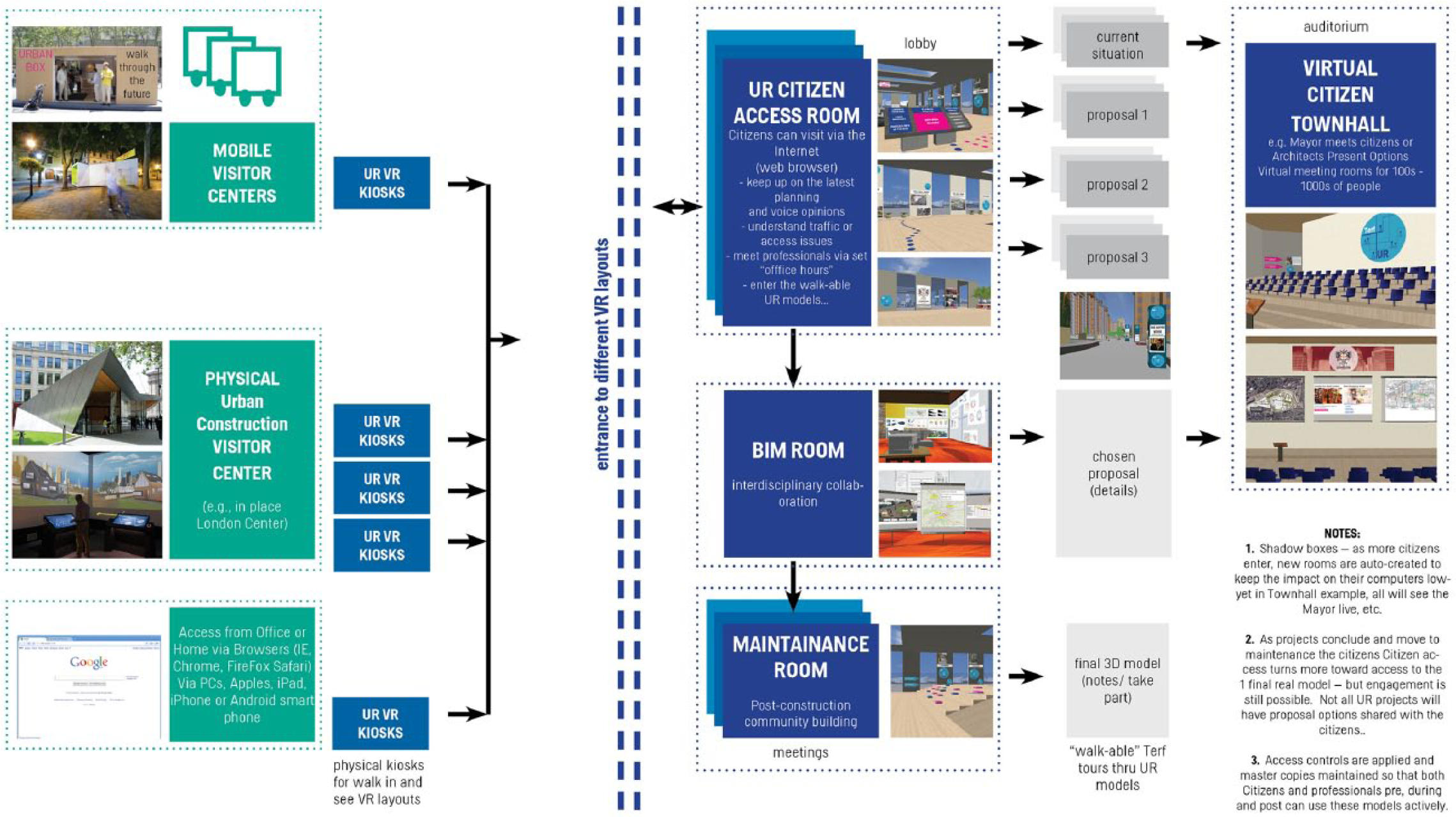
Urban (re)design process in UR Terf.
Figure 4 presents the proposed urban engagement through the entire process of urban (re)design, from the early stages to the construction and maintenance phase. We developed the special rooms, where different participants could be involved (some of them are only for information about the project, other also for engagement in the development phase): UR citizen access room, BIM room, maintenance room, virtual citizen townhall. Moreover, we developed special rooms, where you could walk through different three-dimensional models of current situation, different urban proposals, architectural building and so on. Moreover, the Figure 4 shows how traditional and digital methods/tools could be combined and together present mixed reality. Different virtual reality (VR) layouts could be accessed through UR VR kiosks, which are placed in mobile visitor centers, physical urban construction visitor center, home/office.
Mobile visitor centers
Mobile visitor centers are entrance to the virtual visitor center; they are placed on the streets and offer the hybrid, combination of physical and virtual environment. The main aim is to come closer to people and to be easy applicable to different cities. The urban city box is placed in the city center and provides walk through the future. They are portable and could be moved anywhere all around the city and they offer access to VR layouts through VR kiosks. Additionally, the VR experience in immersive environment is upgraded with traditional methods for public participation (e.g. meetings, round tables etc.).
Physical urban construction visitor center
Physical urban construction visitor center offers physical experience and is usually placed in city’s visitor centers (e.g. in London Building Center or London Visitor Center or Crystal—Siemens Building or King’s Cross Visitor Center). There is access to VR layout through VR kiosks, combined with traditional methods and other tools such as like touchable screens, interactive design tables, and so on.
UR citizen access room
UR citizen access room offers virtual experience: citizens can enter from home computers, from iPads, or smartphones. The citizen in this area of your cities or neighborhood will be able to enter any time, day or night, from work, home, or the train on their way to or from work. It is a general-purpose area with messages from public servants such as mayor or police to help before or during construction. It can provide doorways to neighborhood townhall meeting rooms, to future neighborhood walk-through rooms as well as work areas for architects and city planners. UR citizen access role is “keep up on the latest planning and voice opinions, understand traffic or access issues, meet professionals via set ‘office hours’, and enter the walkable UR models.”
BIM room
The architects, city planners, construction companies, and their suppliers along with those who manage the city services work hard before, during, and after large construction projects. UR Terf is by these professionals on large construction project and can save thousands even millions by keeping teams coordinated on schedule and aware of efforts that affect their areas. In this BIM or collaborative workspace, they can share blueprints, Revit model renderings, budgets, and even have video meetings. These rooms are covered with work that is critical, and they contain the “single place for truth” on many topics for large projects.
UR Terf enables architects to literally drag and drop their Revit or other models directly in for walk throughs. Consider the power of this kind of walk through for owners, city planners, mayors, police and fire, and other critical city officials. UR Terf provides the ability to share screens, even mouse and keyboard and live video, within these models as well as within the virtual BIM rooms.
Maintenance room
After the construction is done, this environment serves as a meeting place for ongoing maintenance and even enhancements over time. Citizen access turns more toward access to the one final real model—but engagement is still possible.
Virtual citizen townhall
UR Terf enables to have 10,000 attendees in virtual meeting room, and at the same time, there could be hundreds of people in the physical meeting in real townhall. Technology enables to keep meeting rooms a reasonable size to promote a positive feeling of access to the speakers but also enables large audiences, whole neighborhood into meetings. This delivers high touch without overwhelming the attending public and presenting speakers.
Three-dimensional model walk-through
Three-dimensional models are important as they offer virtual experience of future development project and user experience through walk-through is a necessity in public participation process. Different models could be imported to UR Terf: big scale models (urban planning), architecture models (BIM models), and small-scale models (interior design). Terf offers “walkable” tours through the models.
Results
The main result of this article is an innovative way of participatory design process, more in detail, we could define the following results.
New SW UR Terf;
Walk-through big urban models (from BIM management to urban design/planning and geodesign).
The innovation is a new methodology that focuses on advancing and evolving the whole “pipeline” and can bring benefit at each stage on its own, works as a whole but does not require the entire pipeline to change to bring innovation at each stage. To deliver this innovation, we are enhancing and innovating at a SW product level that has never been done before in combination. It is a tuple of innovations in the SW, combining the current immersive framework SW with larger models, enhanced simplicity, increased scale and use of cloud technology to incorporate the “citizens engagement” such as the smart deployment of social input within the immersive locations, and the ability to support each stage as these innovations come together. We cannot underplay the simplicity factor here. Making sure all three constancies can participate in this pipeline is innovative and has to be simple.
The SW today can do the first several steps and is in use in this area for Virtual BIM and Planning and is being evolved to meet the reminder over the next years to meet the other aspects.
Discussion
Adding immersive environments to urban (re)design process increases the level of engagement. They present valuable addition to traditional tools and existing digital tools as they offer full immersion, users’ experience of future city/neighborhood. New freedom in urban (re)design work is achieved, as participants could get involved from anywhere and anytime. Moreover, they have the freedom of choice of the tool/media that they would like to use for participation process. On one side, AEC professionals design with freedom (from urban planning to architecture), the government has the freedom to see how the planning process is evolving and express their wishes and requirements, and on the other side, the public has the freedom to participate at any stage of the design, anytime, from anywhere and the freedom to choose the most suitable media/tool (which could be traditional or digital). Immersive environments present the future tool for urban planning and architecture, in direct connection with other digital tools, or even traditional tools.
Freedom of choice
Public has the freedom to participate in urban (re)design process from the early stages of design process. They can get involved more or less: only informed about the project, give feedback, participate in decision-making process, and so on. The immersive environments offer them freedom of choice of location from where they want to participate: (1) from home or office in virtual lab: they can spend little time for participation and participate from home or office via browsers via personal computers (PCs), Apples, iPad, iPhone or Android; (2) in the physical urban construction visitor center in the city with following features: projection-based immersive VR, interactive public screen with AR (augmented) features, interactive design table; (3) in the mobile visitor centers on site: physical “box,” a small movable building/lab on location or near the site where you can experience the site in real world and virtual world at the same time using interactive public screens; and (4) on tablets or smartphones on the site: using on-site augmented reality and walk around the site with smartphone or tablets and see virtual interventions.
Figure 5 presents the four different types of immersive collaboration where all of them are based on Immersive Terf: UR virtual lab (virtual accessible, anywhere, anytime), UR virtual room (physical urban construction, visitor center), UR box (mobile visitor centers), and UR apps (tablets, smartphones, on-site augmented reality). There is constant immersive collaboration between government, AEC professions, and public, sometimes upgraded with face-to-face collaboration. Combinations of real and virtual environments add the additional freedom of choice suitable for different users (age, gender, knowledge background, profession etc.). Virtual meetings in virtual rooms or virtual city hall could be combined with traditional face-to-face meetings (round tables, presentations, urban interventions etc.).
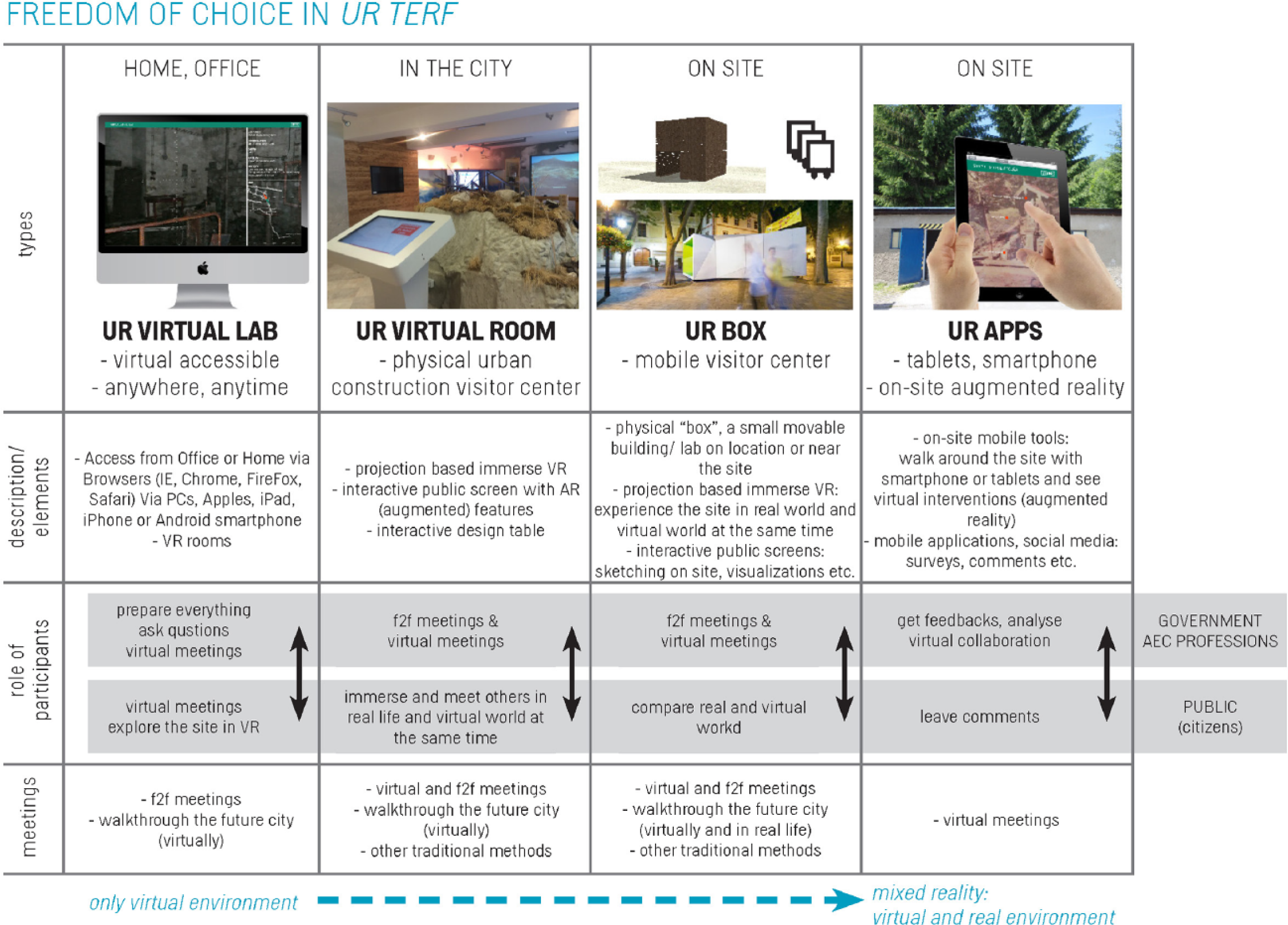
Example: freedom of choice in UR Terf.
Freedom of access
By moving from face-to-face collaboration to immersive collaboration, the freedom of access is higher, and they can adjust it to their daily routine and spend for it less time and be more organized (Figure 6). For example, in face-to-face collaboration, you must come to the specific spot where the meeting is taking place, while by immersive collaboration, you can access it from different places (from home, office, on the public transport, while walking through the city, waiting in the line in the market or on the site).
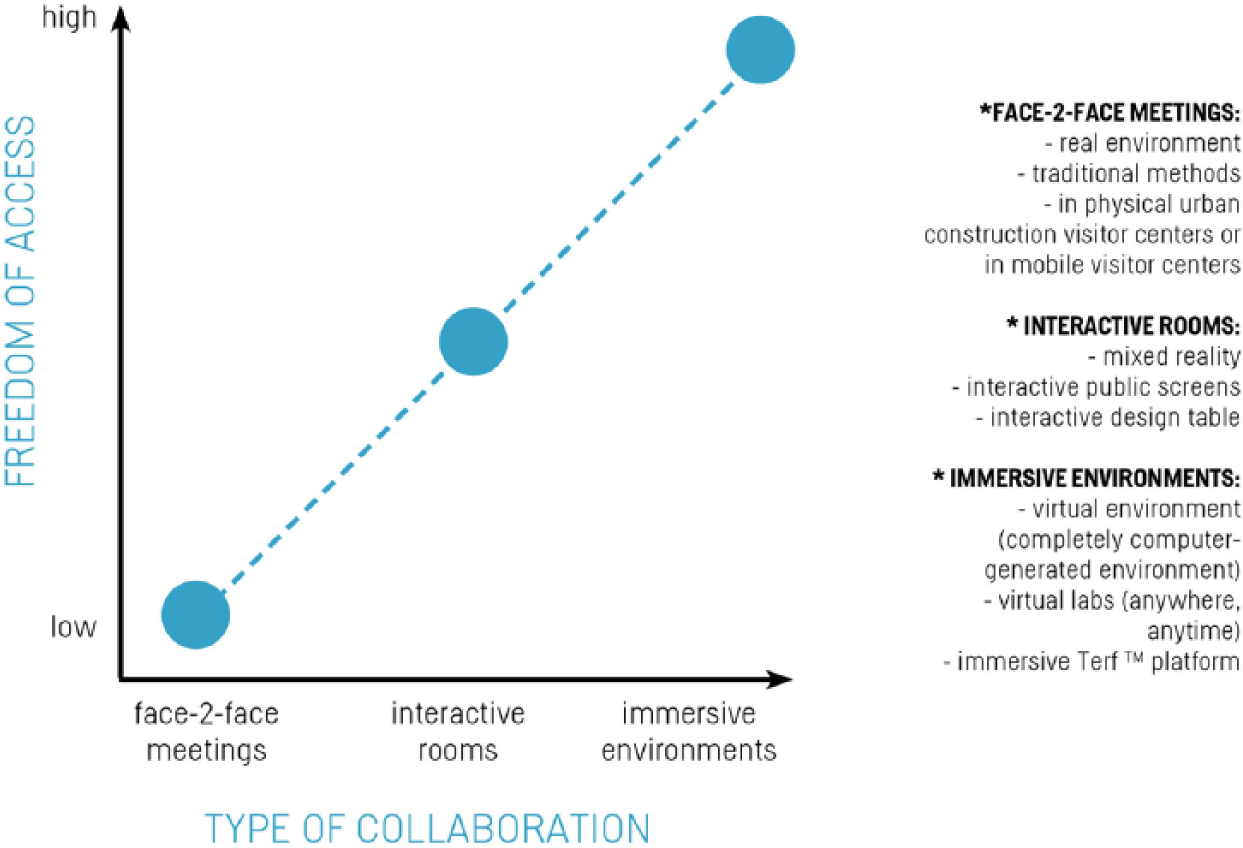
Freedom of choice: comparison between face-to-face collaboration, interactive rooms, and immersive environments.
Conclusion and future work
To conclude, immersive environments are virtually based, without time and location constraints, and they can also be combined with traditional ways of urban engagement. They are addressing the main questions of public participation: how to involve public into designing their neighborhood, public open spaces near their homes, how to motivate different categories of public (not only older people but also younger generations, people who does not have a lot of time for participation in the decision-making system) and so on. Some of the advantages of immersive environments are as following: 37 suitable also for younger generations (especially for younger than 40 years old, “internet generation”); similarities with computer games; suitable for profession and public (experts and non-experts); suitable for interdisciplinary collaboration and public participation; offer benefits to stakeholders: the city, the builders, the architects, neighborhood, product storage, delivery, and related efforts; and offer walk-through virtual world for residents and help them to see what proposed solutions mean for their city; simplify visualization of the proposed solution. Immersive environments also offer better satisfaction of the final solution (both public and profession), save time (shorten the period of the planning process), save money (less meetings, less organization costs, the process is faster). Last but not least, deep immersive collaboration on design will free participant’s mind, from designers to the public, their mind will get wider and they will also force them to think about alternative solutions which they would have never thought before. Unlike other tools for public participation, immersion increases the experience—it allows to experience the future urban development before it is actually built in real life. The public could walk-through future urban design, react on it and together with profession they could create shared urban vision.
Future work presents the implementation of UR Terf in real-life construction or urban planning projects and connection with other technologies (e.g. with social media, heads-up displays etc.).
Footnotes
Declaration of conflicting interests
The author(s) declared no potential conflicts of interest with respect to the research, authorship, and/or publication of this article.
Funding
The author(s) received no financial support for the research, authorship, and/or publication of this article.