



Abstract
Contemporary video games such as Mass Effect or Assassin’s Creed are emerging as a new form of media departing from traditional games purely seen as problem-solving exercises. They represent a new creative direction enjoyed by a broader audience, similar to those of TV and cinema. At the same time, they are significantly different from TV and cinema, since they place the user at the center of interactions, allowing content creation and forming strong emotional bonds. This article discusses the role of narratives in these new epic games as the main driver behind their social appeal and commercial success. It also poses a number of questions in the context of architecture and the possible fusion of both architecture and narrative.
Introduction
Visual arts are judged and consumed in ways that are not always based on their purely visual value. In building design, architects defer to a concept as an idea-driving vehicle that defines architecture and justifies final outcomes. Industrial design products are often judged on how they make users feel or the status they project. Conceptual art is heavily vested in the message it manifests through an associated idea.
Narrative is another important layer that reaches beyond literary works and significantly defines visual and interactive arts. While this has been evident for years with design, photography, and motion pictures, it is currently starting to make a strong impact on video games. With the continuous expansion of video game culture and the ways gaming integrates itself into everyday life, from entertainment and education to science and employee motivation, there is an emerging debate about the nature of this new interactive and, as many see it, artistic medium. 1 This broadening of video game reach and appeal also transforms the nature of gaming itself, from linear gameplay and problem-solving to social activism and storytelling. Applications of gaming, the so-called gamification, need to incorporate a broad range of devices such as user input, social networks (interconnectivity), and narratives to effectively address these new needs.
While these new video game frontiers may seem like uncharted waters, they parallel the role architecture played in society in the past, when it not only fulfilled compositional or functional needs but, most importantly, served as the great mass communicator of social values, histories, and ideas. It extended the reading of the tectonic and spatial qualities of the built environment from the purely visual and aesthetic into the realm of the semantic and cultural. In that role, architecture registered the past in petrified urban volumes of monuments and building facades as collective memories. 2
While architecture no longer serves as, or aspires to be, a unified social and cultural medium, the accumulated space-making knowledge does translate into other forms of immersive experience, specifically video games. The cinematic and narrative space created in the past by architects, and later adapted to performative arts and cinema, is now being rediscovered through immersive and interactive video games. This visceral interconnection between architecture and video games is best delineated by Will Wright, the creator of SimCity and Sims games: a more appropriate source of inspiration we have found is things like architecture, and product design, because those are inherently more interactive design fields. SimCity was actually originally inspired by Chris Alexander, and going back and looking at design in general I’ve found a lot of inspiration from Charles and Ray Eames, Jay Forrester, Jane Jacobs, all the people who are sort of spanning the division between design, theorist, and a specific field—you know, urban design, architecture or whatever. I find that triangle really interesting to draw inspiration from.
3
An important, and perhaps forgotten, part of the architectural legacy is its strong evocative and narrative tradition. In the past, buildings and city layouts were erected not only to commemorate events and histories but also to sanction ideologies and beliefs. Sculptures, paintings, and other building-integrated arts formed collective media that reinforced and completed purely architectural tectonic expressions. The architectural balancing, or perhaps dichotomy, between the use, the form, and the meaning also registers with a new collective medium—video games—with, however, a different set of components.
The relatively established mind-set that video games are based not on content, but on problems to solve, 4 sees gaming in its traditional sense without the modulation resulting from the introduction of the “video” quantifier. This mind-set fails to see three-dimensional immersive video games as environments that people inhabit spatially and emotionally, and which they consider as direct and continuous extensions of their offline lives: a virtual space that integrates well with human dreams, drives, and desires. Three-dimensional immersive video games are no longer games in the same category as chess, board games, or even early video games like Pong. 5 They should not be considered as such despite their common ancestry. The addition of immersive qualities to video games, especially their vast spatial and epic-scale environments, is the equivalent of introducing a time component into photography. The distinction between photography and film has little to do with the nature of the physical media used to produce the experience. This distinction is not based on the physicality of the media they use (in the past, photographic film) or on the different origination, but on the experiences they evoke. There is a different sensory engagement in playing a chess or Pong game than in more contemporary games like Myst or Mass Effect. The sense of inhabiting the virtual world is much closer to Martin Heidegger’s concepts expressed in the book Being and Time 6 (“Being in the World” essay) than a problem-solving exercise. Video gaming helps in forming a strong bond to the virtual environments, virtual lives, and virtual cohabitants. While it builds an evocative dimension on cinematography, it establishes itself as a separate and dominant space through its interactive and direct engagement.
Much as film departed from still photography, games such as Mass Effect and Assassin’s Creed emerge as a new form of media and free themselves from traditional games purely seen as problem-solving exercises. These narrative games are enjoyed by a broader audience, similar to those of TV, cinema, and architecture. At the same time, they are significantly different from TV and cinema, since they place the user at the center of interaction and content creation. They revert the content authoring and ownership of the narrative worlds to the user or at least provide a compelling alternative to the top-down worlds evident in older media and architecture. They creatively recognize that the virtual worlds are not only for the people but also “by the people.” While there are many similarities between video games, movies, and TV, the significant differences indicate that we are in the process of speciation: splitting the lineages of games and cinematic arts and forming a new type of transmodal media. This new type of media in many ways extends what public spaces and public architecture used to offer society.
Impressiveness and complexity
Video game narratives are becoming increasingly complex and engaging. In the near future, they will compete favorably with other already established genres such as books and movies. The Assassin’s Creed series combines good-quality graphics with historically situated narrative—not much different from historical fiction novels, such as The Name of the Rose by Umberto Eco. The game is based on historical events and conflicts, starting in the Third Crusade with the medieval Knights Templar (Figure 1), then moving to the Italian Renaissance in Venice (Assassin’s Creed II), to reemerge during the American Revolution (Assassin’s Creed III). The visual aspects attract players to the story in a way a book would not be able to. Assassin’s Creed III brings the 18th-century world to life in a dramatic and deeply satisfying way. Players on their quests meet historical figures, including Thomas Jefferson, Benjamin Franklin, and George Washington. They become part of historical events as their characters move along the game plot. Although the game is not strictly accurate in its depiction of the American Revolution, the gameplay is deeply satisfying, highly engaging, and almost addictive in its appeal. 7

Main character Desmond Miles navigates virtual urban environments.
Another similar example, the Mass Effect trilogy, has been highly valued for its engaging cinematic narrative, and it is seen by many as one of the most effective alternatives to traditional motion-picture arts. 8 The critical difference, and the upgrade from a traditional narrative, lies in the players’ ability to direct their experience. The decisions made by the main character in the first two games of the series determine the outcome in the third. This is unique to gaming, making the narrative highly engaging, and reflecting the consequences of players’ past actions. It diminishes the lack of consequences often associated with virtual worlds as compared to real life. Virtual characters have to live with their past decisions. 8 The continuity of actions and narrative is similar to that found in sequel books and movies, where individual events inform subsequent histories.
The differences are also significant. Since game-based narratives allow for multithread scenarios providing individualized stories, with prolonged series, there may also be a narrowing range of possible outcomes converging on a single or reduced set of solutions. This was keenly visible with the ending of Mass Effect, which left players with only three choices. 9 Many players were looking for a more meaningful or “real” conclusion, as expressed in one of the online forums: “It’s not about a happy ending; it’s about an ending that makes sense.” 10 Perhaps this video game trilogy departed too much from its gaming roots and followed the mainstream approach of the Hollywood genre defined by the Matrix or Harry Potter movies.
Another game with great use of narrative is World of Warcraft. The game largely depends on the storyline for gameplay and is similar to the collection of J. R. R. Tolkein’s narratives dubbed The Silmarillion. The story is extremely important to the game itself, since the player can only proceed through the levels by understanding the intricacies of the fictional world.
The narrative qualities of the World of Warcraft game are evident in its underlying structure, with the focus on the journey itself rather than the actual endgame. The narrative drives the play to fulfill missions and achieve specific objectives. It allows the player to move from one point to the next and accomplish particular goals on each level. It is up to the players to choose whether or not they will read the text and engage the deeper story and meaning. Some players choose to play it in a simplified way, without full engagement in the narrative. This, however, does not take away from the importance of narrative in the game and mirrors the ways more in-depth films and books are often watched and read.
Experience as gameplay | gameplay as experience
The narrative qualities of video games are visible in the mechanics of the gameplay. The use of cinematic techniques in the introduction, setting the game context, and in the transitions between levels reinforces the use and the role of storytelling. While the introduction is often necessary to place the player immediately into the action and events (e.g. the original Star Wars opening sequence), cinematic pieces are often introduced into the gameplay to make level switching and loading seamless and less interrupted.
Successful video games position themselves on the border between mission-oriented, problem-solving games and storyline-based games. This is present in the Grand Theft Auto (GTA) series, 11 where players need to complete the majority of the storyline missions to progress through the game and to unlock various content and parts of the city. However, there is not a particular time frame that drives the progression of the game. Players can complete tasks and missions at their own pace. When not fulfilling storyline missions, players can roam freely and engage in other side activities. Side missions, also called sub-missions or odd jobs, depart from the main storyline and involve participating in street races, car thefts, and assassinations. They can keep the player occupied for a long time without the need to continue with the main narrative. In this aspect, GTA and Assassin’s Creed function to some extent like sandbox games such as Minecraft that present the players with no specific goals to accomplish, allowing them freedom in choosing how to engage with the virtual world. This combination of gameplay, narrative, and an open world provides a very potent framework for current video games, and in many ways reflects actual lives with a similar combination of direction, story, and freedom to make choices.
The focus on the missions in games such as Assassin’s Creed, GTA, or World of Warcraft represents an evolution in the gaming structure and organization based on various levels of a continuous world and storyline with individual missions. While this may seem like a relatively minor change, it further reinforces the narrative quality of these games, which feel like a unified story with cinematic episodes.
This inhabiting of the virtual space associated with sandbox games is reminiscent of the ways people function within real urban environments. When playing and engaging in virtual environments, players adopt similar behaviors as when they visit new and unknown cities as tourists. They wander around looking for clues and in search of meaningful moments to frame their experiences.
Epic games, epic spaces
For years, we valued literature for contextualizing narratives in historical and cultural settings. Hemingway’s depiction of human struggle in the framework of the Spanish Civil War is just one of many examples. We looked into literature to bring us the realities of the past and to educate us. Naturally, films followed the same pattern. Particularly, early 20th-century movies, with their extensive and expensive sets, large number of actors, and epic stories, resemble the current genre of epic video games.
While epic video games (Figure 2) continue the scale and magnitude of past productions in other media such as architecture, literature, panorama paintings, and later cinematography, they have been evolving into more simulative environments. They directly reference the era of grandiose world expositions (Figure 3) or epic movies characteristic of early 20th-century cinematography. However, epic gaming worlds not only look grandiose but also feel and behave like the worlds they simulate. In games such as World of Tanks (WOT), individual tanks (players) possess properties that closely correspond to historical military vehicles in their performance parameters. Learning about the successes of the Battle of Kursk or Stalingrad acquires a new relevance once the player experiences the differences in virtual combat between heavily armored and precise-shooting German vehicles such as the Tiger or the Ferdinand, which excelled in distance combat, and less precise but more mobile Soviet vehicles such as the T-34, which had short barrels and inflicted high damage but were effective only in close battles due to the aiming precision and perhaps the training of tankers. These virtual realities provide firsthand experience in understanding both logically and viscerally the nature of these historical facts and topics. They provide a very potent narrative reality that is comprehended in highly intuitive and visceral ways.

Mirror’s Edge game with its spectacular urban landscapes.
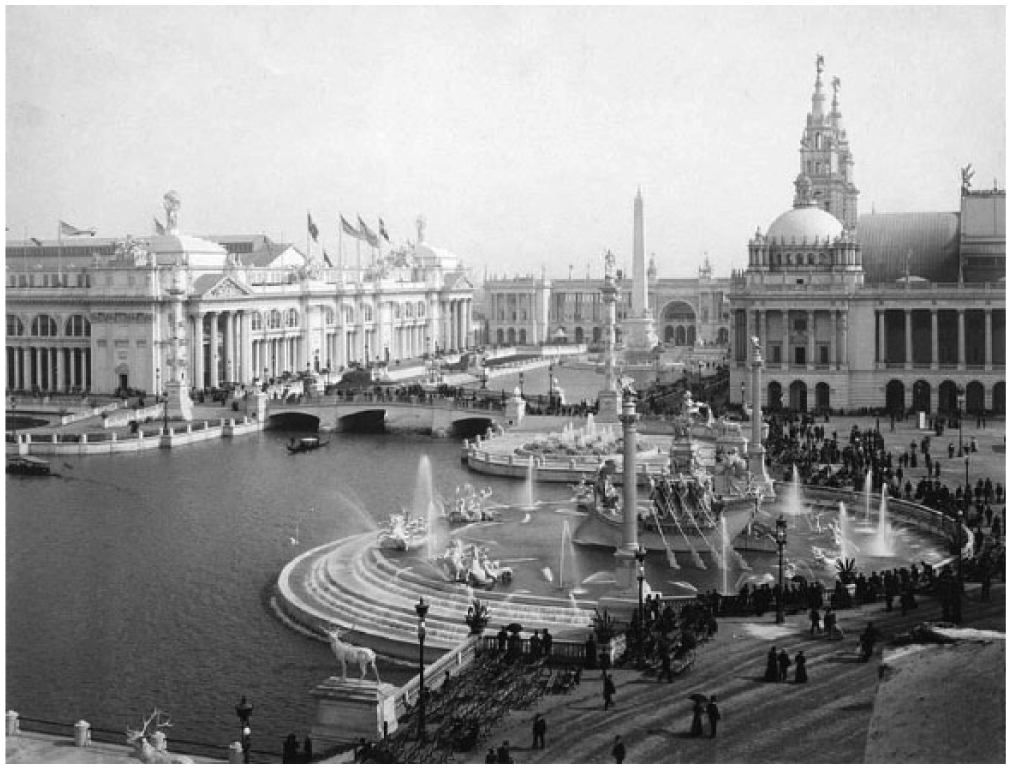
Epic spaces: Columbian Exposition in Chicago, 1893.
Not only problem-solving
Let’s reposition the argument. Instead of asking whether narrative is native to the video game medium, let’s ask if problem-solving is present in other media, such as movies or books. Obviously, the latter two forms are not as interactive as video games; nevertheless, we should not ignore mental activities that occur when the audience or participant in one of these forms of entertainment is experiencing it. When we try to make sense of what we read or watch, we do go through a form of problem-solving.
Memento is a movie each individual viewer must try to make sense of. It is not a problem-solving exercise in the narrow definition of the term; however, it does provide multiple lines of reasoning and possible scenarios.
If you consider David Lynch’s comments on Mulholland Drive, you could consider watching a movie and making sense out of what we see a form of problem-solving. The clues (Contained within the original DVD release is a card titled “David Lynch’s 10 Clues to Unlocking This Thriller.” The clues are “(1) Pay particular attention in the beginning of the film: at least two clues are revealed before the credits. (…) (3) Can you hear the title of the film that Adam Kesher is auditioning actresses for? Is it mentioned again?”) that directors put in their movies are there both to comfort us and to challenge our understanding of reality, thus holding on to our attention. The fact that the human brain always tries to make sense out of the surrounding chaos of nature makes movies, or any narratives, which play with this Pavlovian reflex an interesting genre. Mulholland Drive is not an isolated example; Memento and, to some extent, Hitchcock’s movies such as Psycho have a similar approach. Similarly, books like Umberto Eco’s Foucault’s Pendulum and The Name of the Rose are literary examples of problem-solving focused around unlocking a puzzle. Even if the narrative is linear and non-interactive, what happens in a viewer’s or reader’s head is purely problem-solving—running various scenarios and trying to make sense of what we see or read.
The viewer experience was further reflected by one of Mulholland Drive’s lead actors, Justin Theroux, who stated that “the whole turns out to be more mystifying than the parts.” 12 The actors projected this sense of confusion into the movie scenes and made it more authentic.
The magic circle
The magic circle is a place of dreams and fantasy. It’s an escape for everyday problems and chores. And the most important: everything inside the magic circle is, in some way, transformative. Each time a person leaves the magic circle they bring meaning and experience.
13
Johan Huizinga’s idea of the magic circle as discussed in Homo Ludens expresses the transformative role games play in everyday lives. They allow for the suspension of rules and norms of the outside world to pursue, even if momentarily, alternative realities. The magic circle is both reflective and projective, allowing for processing of offline lives and speculating about the future (Figure 4).

The Magic Circle as transformative experience.
This concept should be, and effectively has been, applied to architecture and other media arts. Architecture was a magic circle laid at the foundations of the past public realm, reinforcing rituals and social structures, and on occasion providing an emotional shelter or an aspirational mental space. This covenant between built physical space and the magic circle is no longer part of architecture. This is probably why society does not engage architecture, while it can be obsessed with a popular TV show. Architecture no longer plays a central role in social and cultural life. The question of whether virtual and media components could potentially rebalance this perception and reception of architecture remains open and warrants serious consideration.
Environmental undercurrents
Is the ability to explore parallel worlds and life scenarios unique to video games? The choose-your-own-story possibilities tree (Figure 5) looks very much like a typical game tree (Figure 6). The difference lies with a number of competing variables and with what defines a win state. In video games, you would not choose whether or not to enter a house out of simple curiosity; rather, your actions are driven by the overall objective and a score count. In games, you are presented with dilemmas of whether to choose a strong and slow or weaker but faster character. The choices are usually about competing benefits that are closely balanced to provide a high number of possible scenarios. The right choice is determined locally, based on the types of other players involved and missions undertaken. Values are more contextualized and as such less predictable than in other narrative media. In literature and film narratives, the choices and dilemmas that the characters face are usually global and commonly shared by a broad audience. This broad appeal is necessary, since these media do not provide viewer-specific narratives. In narrative video games, logic and flow can be more fragmented than in linear stories. Since the event sequence is controlled by a player, there is no need to overly tighten a script to lead through the game. However, some video games do not expect players to progress at all, not unlike a tourist in a foreign city who is happy to just stroll along.
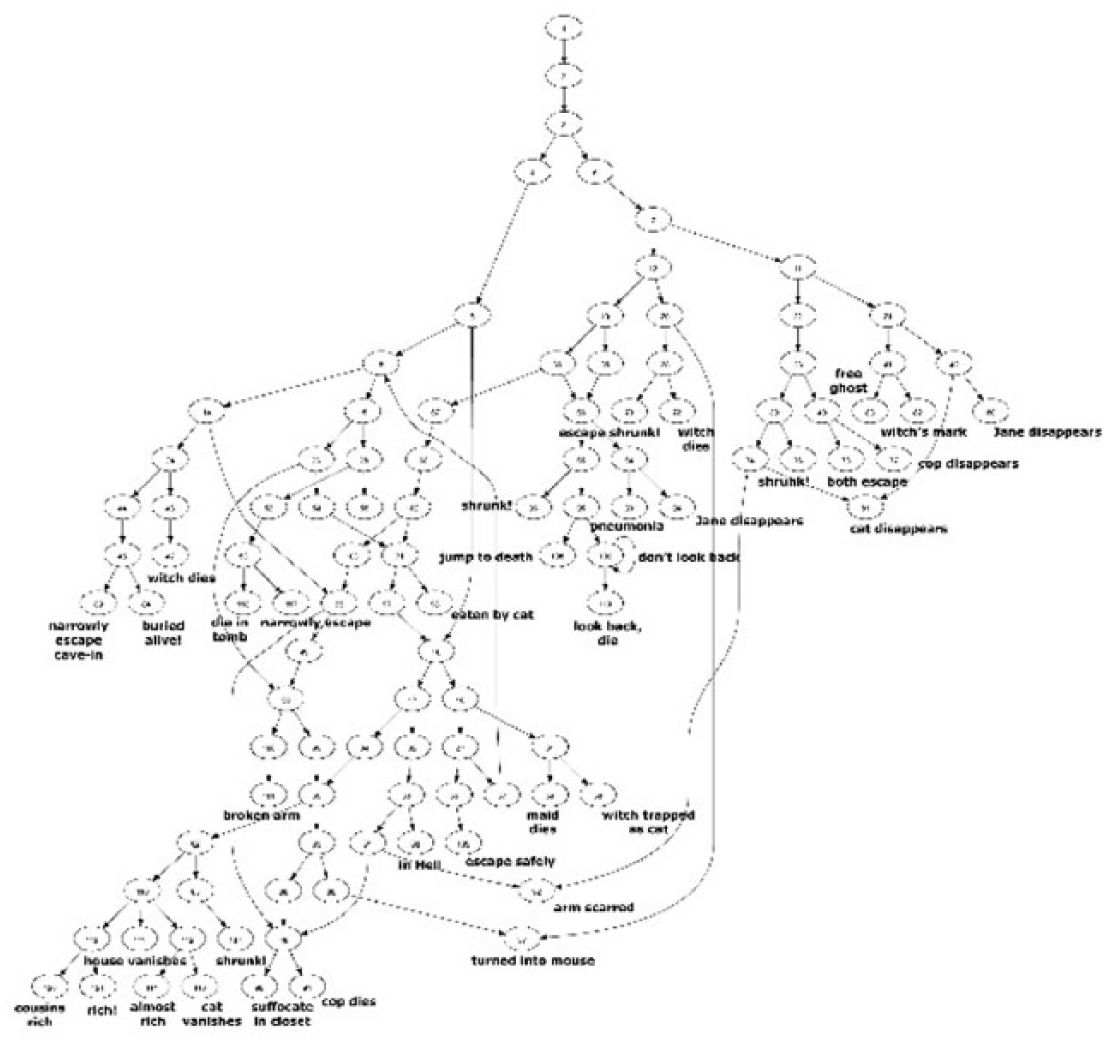
Choose-your-own-adventure possibility tree for The Mystery of Chimney Rock.
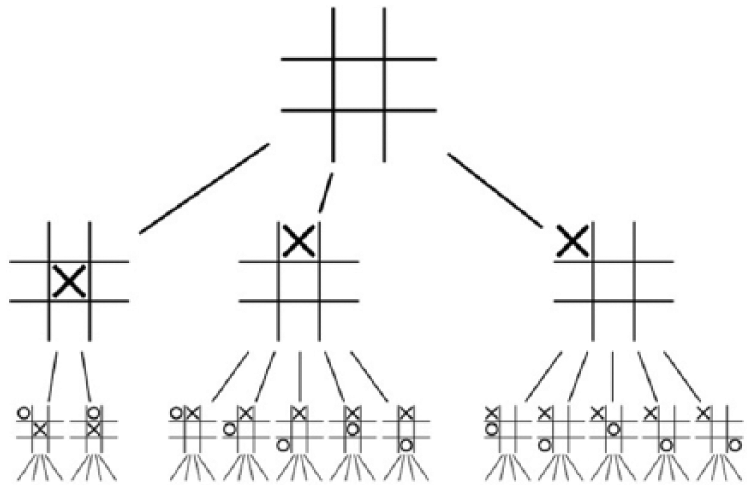
The first two plies of the game tree for tic-tac-toe (Wikipedia).
Goals versus the win state
While most games have an objective, this does not constitute a problem-solving proposition in the same sense as with games that have a win state. Building a castle or Star Trek’s Enterprise in Minecraft may be a suitable goal, but it is not in any way better than accomplishing another virtual structure. Even having an end goal that is a win state in many cases may feel like a default solution—the “unbearable lightness of playing.” In Assassin’s Creed, a heavily narrative video game, while all the missions build up toward an ultimate endgame, there is no inverse time mechanism that would compel players to achieve the goal in the shortest, best way possible, with the exception of timed side missions. At any time, a player can wander around and explore historic settings without penalty. There are mechanics in place to encourage a player to progress within the game and narrative, including the need to achieve certain missions to unlock new parts of the kingdom.
Games without a goal
While a rough definition of video games as problem-solving activities is established in the literature and in discussion blogs, there are major limitations to this approach. This definition has been challenged by the increased popularity of sandbox games such as Minecraft, particularly in its less competitive “creative mode,” where players do not only have to fight for survival but also need to have a clear objective. Although building a world can be a suitable goal, it is not a game, in the same sense that building with Lego blocks is not. In both examples, there is no single condition or even class of conditions that could be defined as the “win state.” Any outcome is equally good.
The need for the narrative
The idea of virtuality as an extension of physicality, not only as a spatial construct but also as a chronological scale, is probably best foreseen by Adolfo Bioy Casares in his seminal The Invention of Morel. 14 The story revolves around multisensory immersive projections (environments), not unlike proto-video games, which ultimately outcompete the physical reality, at least in the actions of the main protagonist. The book provides an uncanny and poignant, yet plausible, scenario of future virtual environments, where virtuality is framed by an infinitely perpetual narrative-without-a-narrative: like a pure form of gameplay without the storyline, without the deeper purpose, without the meaning.
The pure gameplay (without an active narrative) resembles the circular projection recording provided by Morel’s invention. It results in the endless repetition of the gameplay mechanics leading into the self-referential environment. In this scenario, a narrative becomes the only device enabling an entrance to and escape from this encapsulated virtual world. While the dialectic nature of The Invention of Morel fits well into the current debate about the relationship between virtual and physical realities, it also underlines the role of the narrative as a bridging structure between both realities. In a similar way, narratives in contemporary video games provide a natural transition framework into virtual worlds through emotional engagement and personal identification.
Simulating lives
Games as a form of active simulation that tests defining constraints provide a good feedback on the type of solutions and edge conditions specific to a particular set of initial rules. Narrative video games extend this simulation from a purely mathematical puzzle to one that is social, psychological, and cultural. Video games as a new marketplace for human interactions form a powerful space for experimentation and idea testing. Their disconnect from physical reality provides a partial umbrella to discover and process thoughts and possible scenarios. This is not unique to video games but characteristic of all virtual media that provide emotionally real and physically detached forms of existence. However, narratives extend this to a broader audience with more significant social and cultural impact. They do what public art and public architecture once did to form public spaces and shared cultural identity.
Final thoughts
Interactivity in games breaks the monodirectional mode of traditional media—including architecture—where a creative center and the audience have strictly defined roles with no ability for information exchange, narrative feedback loops, or crowdsourcing. The limitation of traditional mass media such as radio and television was recognized early by Bertolt Brecht, who pointed out that “radio is one-sided when it should be two-. It is purely an apparatus for distribution, for mere sharing out. So here is a positive suggestion: change this apparatus over from distribution to communication.” 15 While radio and television have evolved little to satisfy Brecht’s aspirations, video games and electronic technology in general provide an effective apparatus to move media from distribution and sharing out to communication, collaboration, and collective authorship. With video games having a distinct lineage from other narrative arts such as architecture, literature, and film, there is a natural hesitation as to whether they should expand to areas of storytelling and whether this would compromise their core meaning and character. However, video games’ potent immersive nature and ability to engage users in content creation naturally move these games to new territories of narrative arts that cannot be fulfilled as effectively by other established media. While this seems evident, there are still semantic questions of whether these new narrative games are an extension of current game arts or a genetic transposition between multiple lineages and genres forming a new, perhaps unified creative medium.
There seems to be a clear relationship between the narrative aspects of architecture, literature, film, and video games. The challenge for video game developers is to create environments that are as intellectually stimulating as books and movies are. This perhaps will be resolved by future, more sophisticated virtual worlds. However, the real answer lies in the player and the audience. Since interactive and authoring media, such as video games, give players the ability to cocreate content and narratives, the qualities of stories and experiences will ultimately depend on the sophistication of the player’s input. Furthermore, since interactive storytelling could adapt to the individual needs and capabilities of a consumer, with smart artificial intelligence (AI), it has the potential to become more meaningful to a wider range of users, possibly exceeding the way a good book or film provides various meanings to different audiences.
The discussion of whether video games require narrative becomes irrelevant, since the evolution of media arts, literature, theater, and film unavoidably intersects with the emergence of video games as a new immersive and fully interactive form of art. Perhaps these interactive, narrative-based, and user-driven environments should be called something else, but certainly they are a genetically derived offspring of video games and media arts. Pervasive Media Studio’s proclamation that “video games are the new cinema” 16 seems increasingly accurate. While contemporary narrative-based video games are significantly defined by other narrative media, including architecture, the prospect of a unified narrative medium encompassing architecture, cinematography, and interactive arts emerges on the horizon.
Finally, epic video games have begun to address a wide spectrum of everyday lives, broader than other media arts, including architecture. Video games contextualize our virtual lives within history (Assassin’s Creed) and recognize the real world (WOT) through physical accuracy and physical behavior. They are evocative and visually rich, with positive role models (Mirror’s Edge), and provide open-ended scenarios (GTA) with choices that can be good or bad. They inspire our imagination (BioShock Infinite) and function like a sandbox without the endgame or the need ever to leave the world of the game (Minecraft). And, … , they engage in narratives and mirror life experiences (Mass Effect).
As such, it is important to consider the feedback mechanism enabled by current video game developments toward other disciplines: how interactive, immersive, and narrative-based virtual environments redefine the physical world and people’s expectations of architecture and cities.
Footnotes
Declaration of conflicting interests
The author(s) declared no potential conflicts of interest with respect to the research, authorship, and/or publication of this article.
Funding
The author(s) received no financial support for the research, authorship, and/or publication of this article.