




Abstract
This article introduces the theoretical and technical framework for the design of a temporary rooftop canopy on the red generator—one of the buildings designed by Bernard Tschumi for the Florida International University School of Architecture. The project, Lumifoil, was designed using both top-down and bottom-up computational techniques, including surface modeling via projected geometries and scripted cellular subdivisions and assemblies. Lumifoil attempts to synthesize these two often-conflicting design approaches into a generative design process which leverages context, form, surface, and structure as affective and effective actors. Lumifoil is the result of a design methodology which is both active and reactive to existing conditions of the site and new opportunities afforded by the program. It is contextual in its top-down relationship to Tschumi’s existing building and theory, generative in how details emerge bottom-up through scripts which lack any reference to site, and emergent in the resulting synthetic processes and effects which are produced. Through this methodological development, the project both tracks and responds to popular architectural theory and design from the mid-1990s to today. The theoretical underpinnings of the project build upon the idea that the actual (the real-life physical manifestation of matter) and the virtual (the potential for an object to be) are two constantly shifting paradigms in which design processes can intervene to help develop an architectural solution from a range of possibilities. The technical aspect of the project includes the collaborative workflow between the architecture offices of OTA+ and studio MODO with Arup Engineers to resolve structural issues using parametric modeling tools and structural analysis software. The final project is entirely parametric and fabrication is completely automated.
A rooftop intervention
In 2001, Bernard Tschumi completed the Paul L. Cejas School of Architecture Building at Florida International University in Miami, Florida. In 2016, the FIU Emerging Architects Initiative was launched seeking proposals to design a rooftop canopy on the third-floor terrace of the “Red Generator,” one of the central buildings in Tschumi’s project. The design was to withstand Miami’s weather, provide shade for events, and be easily assembled and disassembled, while also engaging Tschumi’s conceptual framework for the project. The goal of the project, Lumifoil, was to introduce a new intrusion at the heart of the red generator, thereby heeding Tschumi’s call for provocation in the form of an architectural intervention.
Tschumi’s concept for the building was to define a space and then activate it. 1 In an interview with Enrique Walker, he describes the project as a group of “generic programs (the studios and offices) [as] the defining elements; [and] public programs (the auditorium, the art gallery, and the café) [as] the activators,” or generators. 1 These generators were designed to provide a space in which spontaneous events would occur. The hope was that conversations, activities, and debates would fill empty spaces defined by the tiled exterior walls marked with apertures that frame views to and from these emergent events.
Tschumi 2 argued that “any relationship between a building and its users is one of violence, for any use means the intrusion of a body into a given space, the intrusion of one order into another.” In this sense, Lumifoil, as a spatio-formal event, can be seen as the first intrusion in Tschumi’s building, heeding his provocation. The body, and in this case, a group of bodies, is the third. By increasing the order of magnitude by one, the project aims to expand the latent potential of the space exponentially. In this way, the project is organized around contextually responsive and computationally generative motives which are addressed and synthesized through the design process. Context is understood as the first affective condition which yields an armature from which the first intrusion unfolds. This first intrusion is procedurally followed by bottom-up design processes which ultimately generate spatial, lighting, and programmatic effects that in-turn form a new context that affects users in a way that is categorically different from the existing building.
Another core tenet of Tschumi’s pedagogy is that the introduction of a multiplicity of characters (program, form, and/or people) into what is otherwise an empty space gives rise to an event space. In his book Manhattan Transcripts, Tschumi laid out a “tripartite mode of notation.” Architecture, according to Tschumi, 3 should offer “a new understanding of experience through event, movement and space.” Lumifoil builds on this idea. Though primarily a canopy, the project is connected to the enclosing walls and firmly rooted on the ground of the terrace where the surface becomes a platform and a perforated wall, dividing the terrace into two flexible event spaces. These new event spaces are not fully enclosed and remain open to a larger, third-event space near the entry. Activity in this zone can be viewed from both of the newly formed zones, increasing the number of potential uses for the terrace significantly. The design is more than a shading device; it is an incubator that takes advantage of the conceptual framework latent in the design of the existing building (Figure 1).
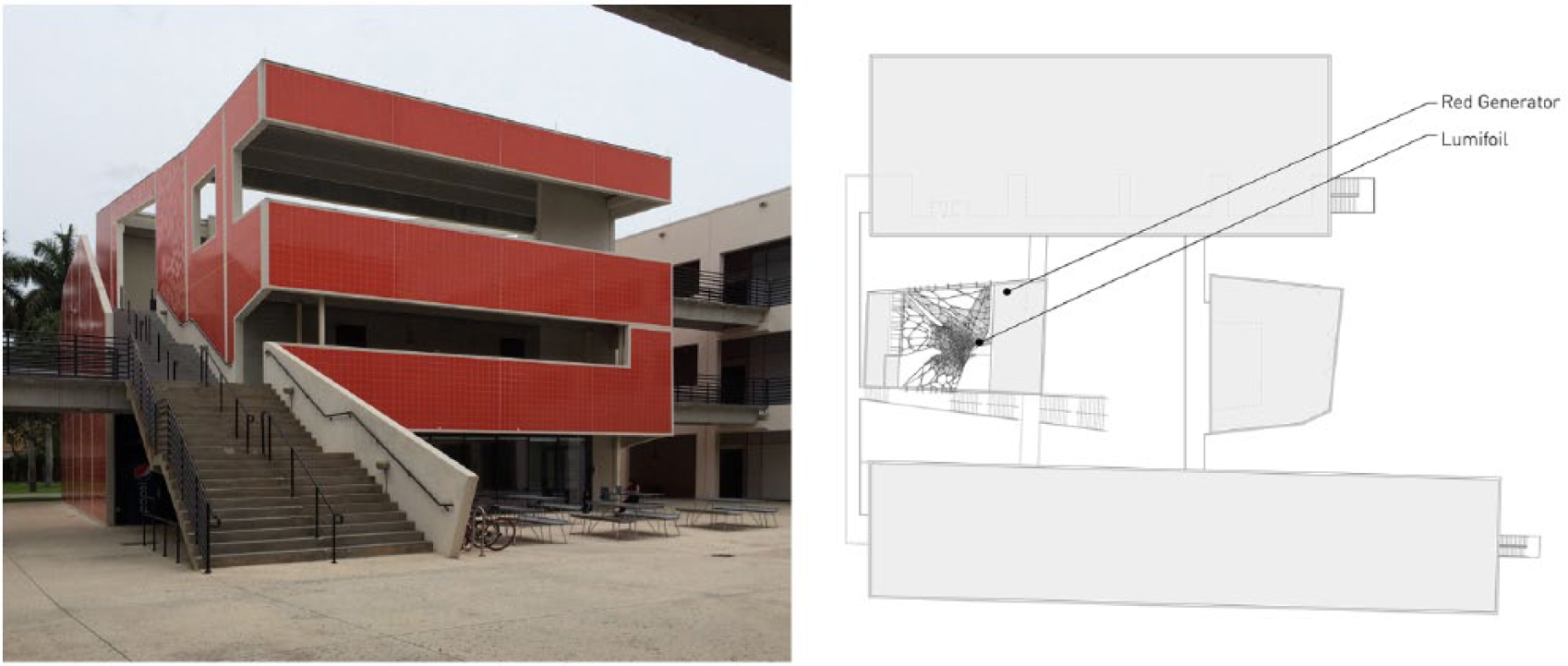
Paul L. Cejas School of Architecture, Red Generator. Architect: Bernard Tschumi and Roof Plan.
The 1990s and 2000s
The Paul L. Cejas School of Architecture Building was designed and built at the turn of the 21 century during a period when the emergence and growth of digital design sparked a series of theoretical debates and schisms in the field, such as digital versus real, conceptual versus rational, and object versus program. In particular, the deconstructivists (including Tschumi, who invited philosopher Jacques Derrida to participate in the translation of his philosophy into an architectural theory) were at odds with postmodernists. Ironically, both deconstructivists and postmodernists were reading many of the same texts, and their different viewpoints, in some ways, could be understood as simply a difference in translation. As Mark Wigley
4
notes in his book, The Architecture of Deconstruction,
there is some kind of gap … that translation is called in to cover, to cover precisely by forcing it open even further to liberate what is hidden within … a translation is not simply a departure from the original that is either violent of faithful, as the original is already internally divided.
Translation is an imprecise recapitulation of something already fraught with error, so the more a source is reframed, the more the translation diverges from the original. In Lumifoil, projection is not used to map or represent existing conditions, but to expose latency and provide an armature for the generation of new form and space.
Though the first step in the design process for Lumifoil draws directly from the existing building (formally, spatially, and theoretically), subsequent steps are more autonomous allowing for emergent conditions to develop that are not explicitly tied to the context. The divergence generated through translational errors is only amplified as these gaps are filled with personal agendas that reinforce particular views. Though Tschumi is associated with the deconstructivists, his architecture differs significantly from that of other deconstructivists of the time, including Zaha Hadid, Daniel Libeskind, and Coop Himmelb(l)au. Tschumi’s architecture in the 1990s sat somewhere between the representation of destabilization through formal gesture, and the cohesion of program through circulatory flow and the formation of event spaces. Likewise, Lumifoil is a translation that acknowledges without mollifying the various struggles that were happening at the time, nor does it favor one side over the other or attempt to recreate a Tschumi project from the 1990s. It asserts a contemporary, non-dialectical, parametric point of view that acts as a projective, contemporary methodology within a set of constantly shifting but still-relevant architectural paradigms.
In an effort to encompass a variety of design pedagogies, while offering a new point of view, the project was designed using both top-down design strategies of form-making and bottom-up, generative computational techniques. The use of exo- and endo-genic methodologies allowed for the resolution of conditions required of the project while simultaneously supporting theoretical engagement with the existing building. Through the directed integration of translational errors and the introduction of new conditions, we enabled a broader set of formal exploration and fostered emergence throughout the design process.
Lumifoil is a project about form as an event in space. Through the design process, the project moves formally from top-down logics which exhibit continuity and smoothness to the systematic assembly of differentiated parts and the generation of effects. Ultimately, its surface, structure, and effects are controlled and conflated into one coherent, yet variegated assembly. By design, the project’s interplay between the actual and the virtual worlds addresses the debates of architecture’s recent past while also promoting contemporary digital theory and practice.
Virtual and actual
Of particular interest to the development of the project as both a methodology and proposal was the motivation of many architects in the late 1990s to contemporize the traditional disciplinary impulse to make the invisible visible. To this end, many architects’ work from the era was rooted in phenomenology and the writings of Merleau-Ponty and Lefort. 5 Other architects, including Tschumi, turned to philosophers Deleuze and Guattari 6 and embraced their position on multiplicities and the capacity of bodies to differentiate themselves. This project engages both of these interests by attempting to reveal the capacity of Tschumi’s building to facilitate or otherwise “make the invisible visible” through the use of design processes which generate alternative architectures and to do so in a way that Lumifoil might one day influence that which is generated in the space long after the project has been removed.
In Intensive Science and Virtual Philosophy, Manuel De Landa 7 argues that objects “populating the actual world [are] the discontinuous spatial or metric structures which condense out of a nonmetric, virtual continuum.” He provides the example of cells dividing: “when cells begin their embryological development they are pluripotent, that is, they are capable of becoming any of the different types of cells which characterize the adult individual.” 7 For De Landa, every object is just one manifestation of a range of potential other objects that might have been actualized under a different set of conditions.
Lumifoil emerges from the forces already latent in the space designed by Tschumi. Lumifoil is a parametric manifestation of one state given by the buildings’ capacity for multiple versions of form and event to emerge. However, the transition from virtual to actual is not simply the distillation of one form from a range of potentials. During the morphogenesis of an object, there lies the possibility for internal and external influence to guide an objects’ evolution. Interference, and even the hand of the author, can radically affect an object’s coming to being. These interventions encourage the development of new and emergent formations. As Ali Rahim 8 notes, “the transition from the virtual to the actual always involves the emergence of something previously unanticipated.” Lumifoil is not purely a representation of the invisible spaces which are latent within Tschumi’s architecture, rather, it is an emergent new space that is affected by both the existing (theoretical and built) context and the result of external factors (generative, bottom-up processes). By doing so, Lumifoil becomes part of the building’s virtual memory and contributes to a continuing set of future interventions and provocations brought by other designers to the space.
Projecting form
One of Tschumi’s 2 core polemics is the use of the frame as a tool to “derive significance [and] establish memory.” The design and fabrication of Lumifoil builds on this discourse and speculates how the building itself—as a manifestation of its theoretical context—might become the frame for a contemporary parametric digital project. Rather than designing a canopy that is entirely emergent—a bottom-up strategy in which the whole is the sum of its parts, and in many ways, disconnected from its environment—we began with an overall form that was derived from a series of projected geometries generated from the cut-outs in the building’s envelope. These invisible forms intersect inside the empty container, providing both a contextual link and a framework for generating a new surface whose smoothness and continuity become a host for further development and articulation.
In this way, the project is woven into the existing fabric of the space by actualizing one of many virtual architectural events already latent within the form of the building itself. The form is actualized as a smooth surface, marking the first intrusion into Tschumi’s context (items 1–3; Figure 2). Though stylistically different, the project finds conceptual common ground by generating a new generator within the generator. Lumifoil fits securely in the existing theoretical and built contexts and reveals its hidden capacity to suggest new forms while synthesizing novel methodologies out of historic disciplinary concerns.
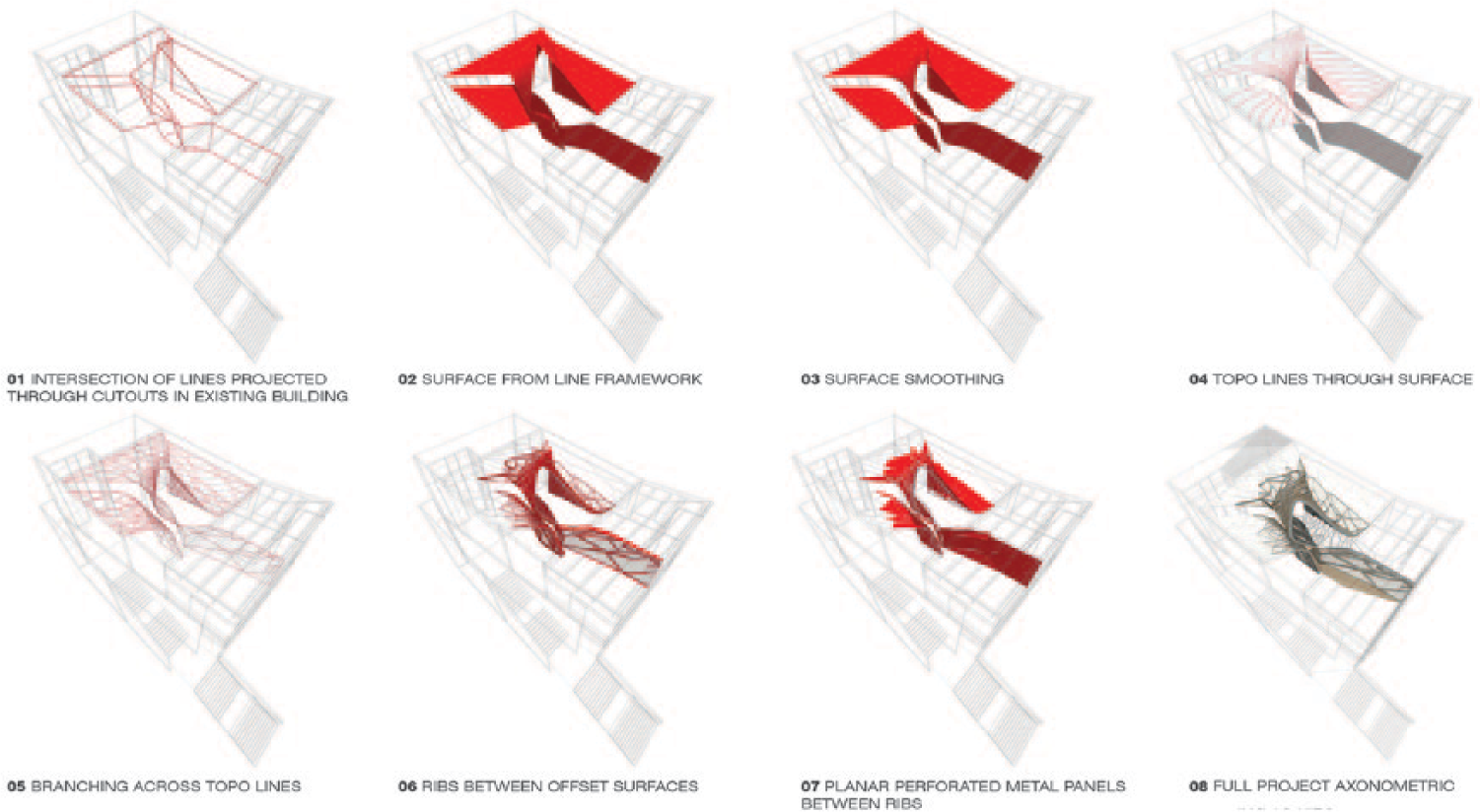
Process diagram showing top-down and bottom-up design processes.
In his discussion of the dome at the Royal Chapel in Anet by Philibert De L’Orme, Robin Evans notes that De L’Orme used distorted projection as a technique to achieve more expressive patterns. De L’Orme himself propagated the myth that the curved ribs of the dome were projected directly upwards from the tile pattern on the floor, but a cursory inspection of the dome’s geometry reveals obvious differences. The projected lines were distorted before they intersected the form of the dome in order to make a pattern more befitting to De L’Orme’s vision. As Evans 9 notes, “from this we may infer that, for De L’Orme, in the end, the desire for perceptible likeness took precedence over the desire to demonstrate rigorous method through which the visible difference had been achieved.” The distortion of the geometry by the hand of the author to match some other goal was not constrained by the prescriptive rigor of orthographic projection. Evans 9 goes on to write that “[projection] is the translator’s dream. Within its axioms the most complex figures may be moved at will into perfectly congruent formations.”
For Lumifoil, lines were projected obliquely to draw out new forms through the intersection and subsequent distortion of differential geometries. Next, irregular voids were projected from the existing building’s walls inward to introduce spatial differentiation in the form of overlapping volumes and intersecting planes. From these, an underlying, proximate surface was formed.
Just as De L’Orme shaped the Royal Chapel in Anet, the authors’ hands in Lumifoil acted as another form of intervention during the translation from virtual to actual. As a result, the final surface contains errors and is not an exact replica of the projected lines. Instead, it is the unification of the existing building’s capacity to elicit form and our own interests in exploring affective, generative processes for the project. Though digital modeling tools were used to project lines and create a surface, the first step in the design of Lumifoil was driven by a more basic, top-down approach to form-making. However, translating these larger conceptual forms into a fine-grained design that both grows from and fits fully within Tschumi’s existing structure required a more generative, bottom-up approach to digital design. As the project continued, the design process took on increasing nuance as we shifted from the design of a singular object to the design of a system.
Surface to system to object
The surface was designed as an armature, or scaffold, for generating the cells and structure for the project. We developed a set of Grasshopper definitions to subdivide the object and moved from a project about surface to one that is systemic and deals with aggregation, assembly, and local differentiation. Kathy Velikov and Geoffrey Thun
10
suggest in Paradigms in Computing that
[systems] thinking turns our attention far more intently to the processes of formation, production and operation of these masses and surfaces, which, within this new paradigm, are increasingly understood as thickly layered material assemblies, defined not only by their multi-faceted characteristics and behaviors, but also by their processes of formation, production and manufacture.
By moving from the design of a singular, extensive surface to the systematic, intensive subdivision and the development of discrete objects, we were better able to embed material, structural, and manufacturing logics in the morphogenesis of each cell.
Using Grasshopper, we tested a variety of permutations independent of the larger form. A successful permutation was one that worked within structural, assembly, and fabrication constraints, while retaining some independence from neighboring cells both in terms of qualities and metrics.
As we moved from surface to system, we looked at different methods of subdivision. The subdivision of the project’s surface takes advantage of the computational system’s capacity to generate emergent conditions at the cellular level within these latent envelopes. We avoided the use of Voronoi and Delaunay subdivision, or the vertical projection of a pattern in favor of a more differentiated subdivision. These approaches were rejected due to their prescriptive natures which would have undermined our theoretical stance on the project. Instead, once the underlying surface was generated, we settled on a two-step process for subdividing the surface. We contoured the surface vertically and used the curvature of the overall surface to determine the spacing between contours (step 4; Figure 2).
We also wrote a Grasshopper definition to develop bifurcating structures that branched from one contour to the next. Each branch was generated according to a simple set of rules that included the number of branches per tree and the angle between branches as they split at each contour. Each branch formed an independent tree that, once propagated across the form, began to intersect and overlap with other branching structures. The superimposed branching structures produced what appeared to be a random distribution of cells which are simultaneously discrete and conditional. As Kostas Terzidis
11
explains,
Randomness functions as a transformation from one state into another producing a new form from an existing one … unlike chaos, a random rearrangement of elements within a rule-based system produces effects that even though unpredictable are intrinsically connected through the rules that govern that system.
Randomizing the subdivision of the surface through an uneven distribution of lines on the initial form of the project provided a greater range of variation than if we had used a continuous, grid-based method. The articulation of cells as independent units, though connected to each other by an overall organizational system, act as discrete units when analyzed locally.
In Lumifoil, we introduced variation and extreme local differentiation to each cell while maintaining the composition of the whole by linking them loosely with the proxy surface. Every cell is part of a design and material system that is attached to others through shared logics and qualities, yet with interior properties that are free to change within the limits set by the system. Cells are both autonomous units and a group of interconnected constituents. Lumifoil attempts to realize Rudolf Arnheim’s theory of successful part/whole relations. In his book, The Dynamics of Architectural Form, Arnheim argues that “a successful piece of architecture is the search for a sensible whole achieved by balancing individual relations.” He continues,
such an arrangement resembles the attempt of a group of musicians to improvise a piece of music: each player contributes the character of his instrument, proceeds according to that character, and puts forward some melodic invention of his own, responding and being responded to, trying to serve the emerging piece of music to the best of his ability. Together the musicians search for the theme of the whole. It is a spirit of collective cooperative.
12
The objects—the cells—that compose Lumifoil retain some level of independence while working as part of a larger system to generate spatial, lighting, and other visual effects to define an architectural event (Figure 3).
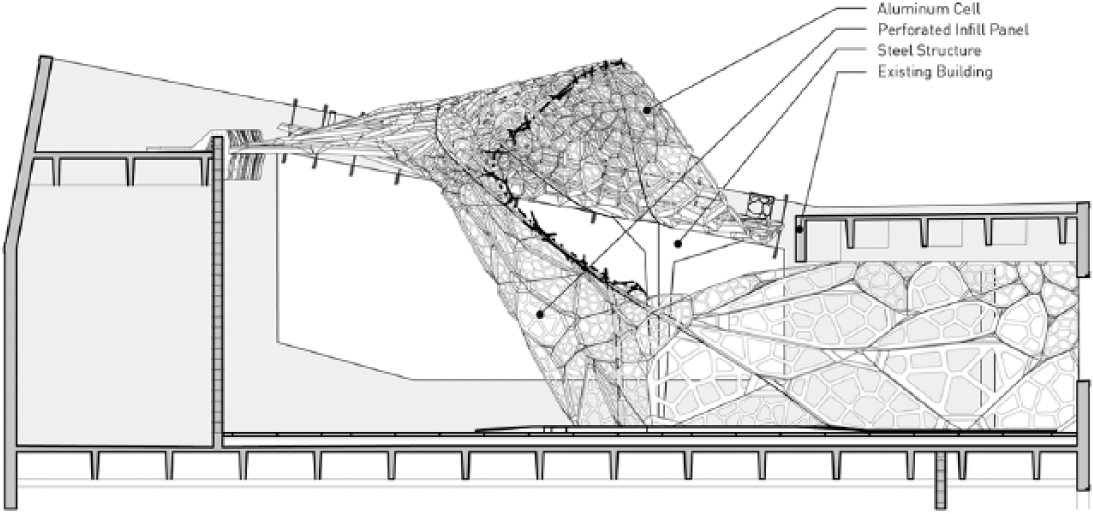
Section through apex of Lumifoil.
Cells
The tile pixilation on the outside surface of the red generator is one of the most striking aspects of Tschumi’s project. Using variation within a material field to generate new formal, spatial, and atmospheric effects is a key factor in Lumifoil as well. The use of overlapping branching structures to subdivide the surface resulted in a field of irregular subdivisions with a high degree of differentiation throughout. Cells range from 3-sided to 10-sided. The pattern is unpredictable and lacks any apparent overall organization. Though the cells aggregate to subsume and approximate the extensive geometry of the underlying surface, these irregularities grant some independence to each cell as well (Figure 4).

Exploded axonometric: panels, cells, and steel structure.
Because the cell walls are extruded according to their normals and are not projected uniformly from one consistent direction, the corners of each cell must fold inward to avoid conflicting with neighboring cell walls, leaving an opening at each corner. The void at the corner accentuates both the differences between cells and the appearance of randomness across the surface. By introducing conditions in the design that reinforce the separation between cells, we were able to consider the morphogenesis of each cell independently. The unique orientation of each cell generates patterns and effects that differ per location, rather than by overall gradation. Similar to Tschumi’s existing building, these data are existent, but latent, or virtual in its potential. At each cell, novelty, that is simultaneously contextual and expansive in its implications, emerges from the system and computational methodology.
We considered a range of alternative cellular patterns that could have also been drawn forth from the cues given by the geometry of the existing building. The cellular development selected was a recapitulation of our conceptual design process at a smaller scale. The transition from virtual to actual, therefore, is not only a condition of the overall form of Lumifoil but also a condition of the cells that comprise its geometry. By thinking of each cell as an actualization of one item selected from a much broader catalog, the capacity of Tschumi’s generator to generate new forms increases by another order of magnitude.
Another limitation of conventional subdivision strategies is that they depend too much on the form of a surface. Our goal from the outset was to not only engage both top-down, analog strategies of design that connect the project to the context but also allow for bottom-up computational processes to generate emergent new conditions and unpredictable geometries that—though linked to the context via the overall formal armature—can develop some properties which are particular to each cell and that are independent of their neighbors. Likewise, had the cell formation or infill pattern been wed to an attractor point, the potential for each cell to differentiate locally would have been diminished as the attractor point would pre-determine most of the cell’s parameters. By disconnecting cells from the restrictions imposed by conventional subdivision strategies, each cell comprising Lumifoil develops according to its own intrinsic logic. Each cell is shaped within the boundaries of the surface irregularities at its particular location rather than by external factors, pressures, or constraints.
Infill panels
Though the cell-wall depth provides some shade, a majority of the shading is handled by perforated plates that infill each cell. The pattern that is cut from the infill panel is derived from the cell’s geometry and uses a similar branching script to that used for the surface subdivision. The use of a bottom-up design logic that is derived from the geometry of each cell leads to a perforation pattern that is unique to the cell, further increasing the differentiation from cell to cell across the form. This local differentiation generates additional opportunities to introduce new effects in the project, such as the variation of color between panels. The blue-to-purple coloring takes its cue from the pixelated exterior of Tschumi’s building.
As light passes through the pattern and casts shadows across the inner wall of the cell, the depth of the cell exaggerates, further increasing the sense that each cell is its own independent object existing within an aggregation of other unique units. Robin Evans 9 notes that “[to] imply depth within a solid three-dimensional body is to conceive of it as being made up of flat surfaces modulated within a thin layer yet giving the impression of being much deeper.” As light passes beyond the cell and shadows are projected onto the rooftop deck, the pattern merges back into a unified field of lines. Just as we used the projection of lines from Tschumi’s buildings to guide the formation of the surface, we used the projection of shadows from the infill panels into the building as a way to re-stitch the differentiation of each cell back into a cohesive form (Figure 5).

Projection of shadows through perforated cells.
Of course, the shadows also change throughout the day. As these constantly shifting shadows are cast by each cell across the surface of the flat roof deck, we can see, once again, different permutations of the virtual coming to life in the actual. Evans 9 notes that when De L’Orme designed the dome at Anet, he “attempt[ed] to make virtual space and real space at one and the same time and in the same place,” using patterns of lines from which he “project(ed), by a well-understood reflex of over-determination, a deeper space.” Thus, just as projection was used to create the larger armature of Lumifoil, projection once again links the computational processes happening inside each cell to a larger, existing context.
Structure
Though each cell is inherently strong, only through aggregation are Lumifoil’s cells and infill panels able to perform as a composite structure that is self-supporting. However, the threat of seasonal hurricanes required the introduction of primary steel ribs to tie the aggregation together under extreme loading. Working with Arup, we developed a structural design that included a composite of computer numerical control (CNC)-fabricated aluminum cells with infill panels and structural steel ribs. The forces through the project are mitigated by the continuous steel ribs running throughout the form and the aggregation of the cells (Figure 6).
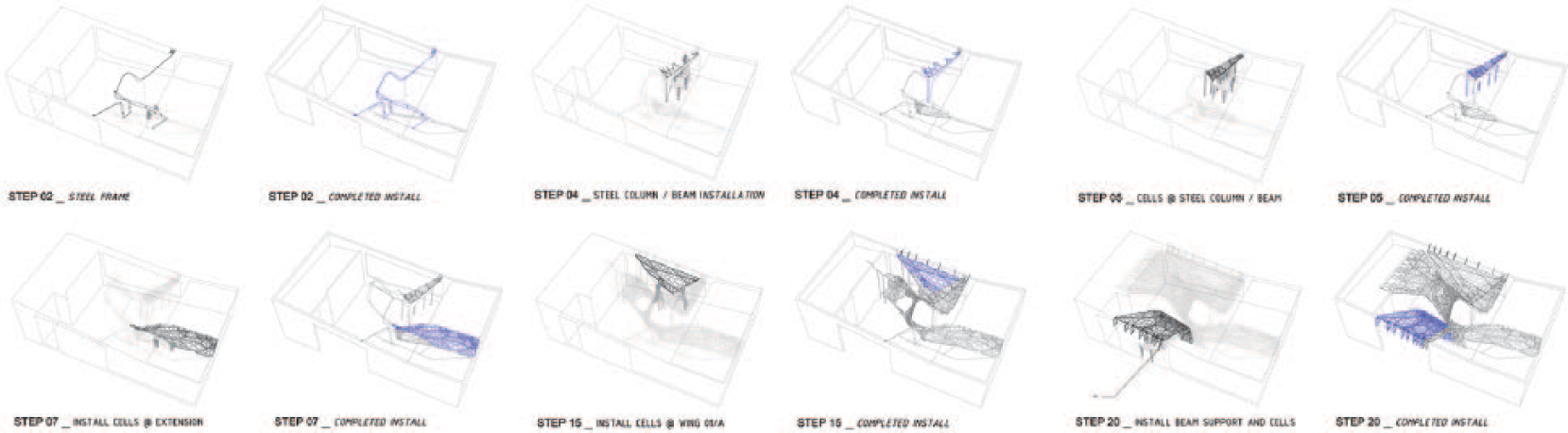
Assembly sequence (selected steps).
Because the cell walls are projected locally, it was difficult to find locations where we could run continuous ribs from one wall of the existing building to the other. Working with our parametric model and Arup, we were able to find three locations where cell walls could align with the continuous steel ribs to handle potential live loads. This allowed us to create a triangulated steel infrastructure that is embedded within the cell aggregation and stabilized by the existing building’s walls, the roof deck, and a single steel column. The primary steel system also aids assembly by creating a frame in which groups of pre-assembled cells can be lifted into place and attached, reducing the need for temporary shoring or other secondary structural systems.
Though the form initially began as a single-surface envelope, the final armature is a set of two variably offset surfaces. The depth between the surfaces varies according to the need to resist both dead and live loading. This depth is taken up by the depth of the cell walls. Thus, the depth is not only an implied condition but also actualized globally and influences the properties of each cell. To reinforce our original intent to limit the dependence of Lumifoil’s cells on external constraints, the depth of each cell varies randomly, but within limits that are structurally appropriate and determined by the surface offset. For the cells adjacent to the primary steel frame, cell depth is always greater than the depth of the steel. This effectively masks the presence of the frame and suppresses the appearance of continuity and continuous lines (Figure 7).
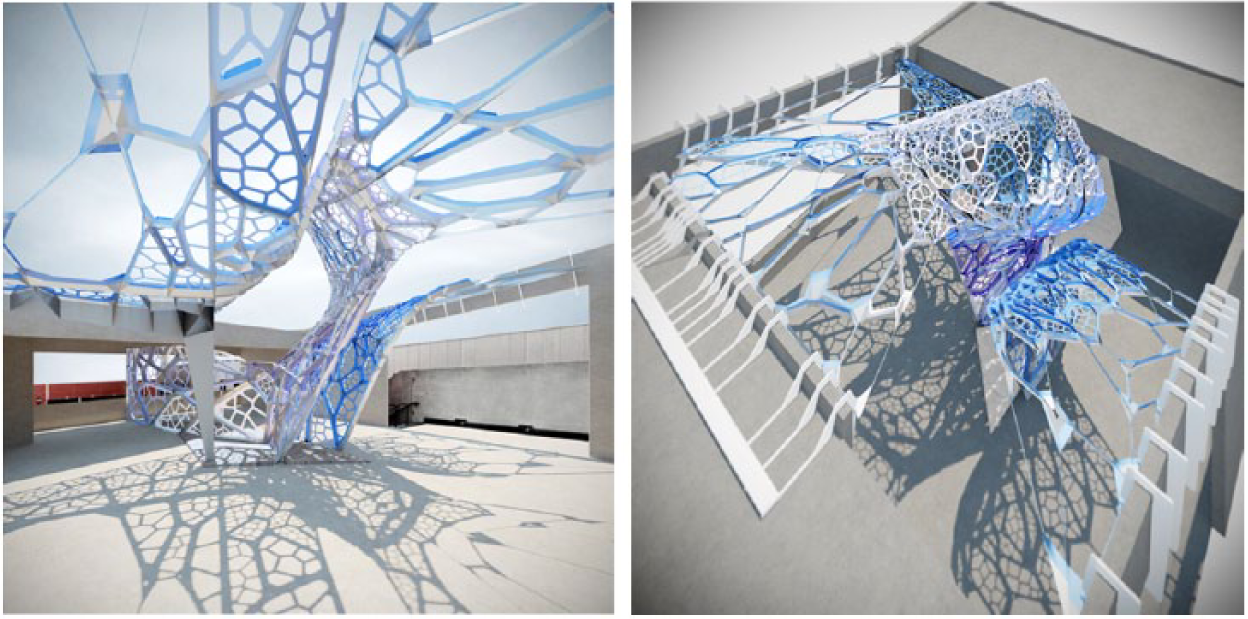
Project renderings.
Conclusion
Lumifoil is a project that connects to its context via a form derived through projections from the existing building’s apertures, while simultaneously fostering emergent design conditions using computational design strategies that are generative and emerge from within the project itself. The project is developed through a methodology which seeks to unveil responsive and generative capacities through rigorous systems. The form of the project emerges as a synthetic manifestation of one instance produced by an affective condition of context. As a material proposition, both the overall scale and the scale of each unit tows the line between what is virtual (a catalog of potential permutations that might come to be) and what is actual (the manifestation of one of those permutations). In this way, the form attempts to reveal a figure that is both hidden and present, and past and future.
Using an expansive design approach engaging historic and contemporary theory, and design processes, we are able to establish conditions that offer more design opportunities than what either approaches would have offered alone. We used these limits as both constraints and as catalysts that affect both the holistic design of the form and the computational morphogenesis of each cell. It is in these messy conflicts that emergent new conditions lie and differentiation thrives. We used conflict as a generator, but never a barrier. Ultimately, the system is an opportunity-generating machine that still requires the designer’s engagement.
In his Advertisements for Architecture, Tschumi 2 makes the point: when architecture is carried “to excess … it will reveal both the traces of reason and the experience of space.” In Architecture and Disjunction, he calls this in-between space “the rotten point, the very point that taboos and culture have always rejected.” 2 Our project lies somewhere near a contemporary manifestation of this generative rotten point. It is responsive in its contextualism, parametric in its fabrication agency, performative in its requirements, and simultaneously formal and effects-producing in its design conception. It forms a wall to sequester quasi-separate event spaces and is an event in and of itself.
Footnotes
Declaration of conflicting interests
The author(s) declared no potential conflicts of interest with respect to the research, authorship, and/or publication of this article.
Funding
The author(s) received no financial support for the research, authorship, and/or publication of this article.