



Abstract
This article is an overview focused on functionality and usability of selected contemporary approaches for the computational floor plan generation of architectural objects. This article describes current solutions for generative architectural design and focuses on their usability from the point of view of architectural design practice. Recent research papers and prototypes, as well as the most important tools (selected computer-aided design and BIM software) for generative design from the architectural perspective, are described. The functionalities and level of usability of present-day software and prototypes are described. In addition, the descriptive review of the research prototypes architectural design outcomes is present. Furthermore, the survey among active architects regarding the usage of computational tools in the professional practice and possible guidelines for the development of such tools are present. This article summarises with the conclusion about the current state of generative floor plan design tools, the lack of fully functional and developed commercial tools of this type on the market and future directions for the development of generative floor plans tools.
Keywords
Introduction
The aim of this study is to review the existing contemporary knowledge about the computational design of architectural objects basing on selected publications and applications created over the last decades within such disciplines as architecture, urban planning and designing computer games. In particular, this article focuses on finding answers to two questions. Are there available contemporary digital tools which can automatically successfully solve the problem of designing floor plans? Can contemporary computer-aided design (CAD) commercial software be used to further develop tools to optimise floor plan design process? While the majority of similar studies focus on computer-aided methods,1–4 this summary puts special emphasis on usability of these tools and the validity of their results from the point of view of architectural design. According to the authors’ knowledge, few studies approach the problem of computational architectural design in this way. It is worth mentioning the article by Lobos and Donath, 5 in which the authors gathered and analysed the existing research and commercial applications in terms of usability in architectural design. This article can thus be regarded as a kind of update of the above-mentioned review.
The following overview includes 18 research and prototype studies on computational design in architecture, urban planning and architectural design, as well as an analysis of 5 the most advanced commercial software (and software sets) for architectural design. The selection of research prototypes for study purposes was based on the popularity of a given scientific study, its significance to the researchers of the computational floor plan generation, the variety of scientific approaches and the study actuality. Each of them is described using three main criteria: design and functionality criteria taken into account in designing a software/prototype, geometric parameters of an architectural object available and parameters used to optimise the generated architectural objects. Then, the results of the analysed scientific studies and existing commercial tools are presented. All features, parameters and results are additionally presented in tables to facilitate the analysis of the applicability of each application from the architect’s point of view and the assessment of trends in the development of computational tools for architectural design.
This article includes an additional study conducted in the form of a questionnaire on a group of professionally active architects examining whether the group uses tools for computational floor plan generation of architectural objects or other computational tools supporting the architectural design process. The study investigates the characteristics of the design process, the most commonly designed architectonic objects and software used. The survey also included questions which are the directions for developers of tools for the computational design of architectural objects about hypothetical functionalities of such tools, which most architects would choose to use in design work.
The study is based on the usability assessment and reasonableness of design outcomes from the perspective of architectural practice of existing commercial software and research prototypes for the computational design tools of architectural objects. The source of knowledge for this study was primarily the extensive literature review, analysis of available web sources and partially the independent tests of existing commercial architectural software and survey conducted among a group of active architects. An additional source of information is the practical work experience arising from the authors’ design practice and generic, well-established architectural knowledge consistent with academic experience and bibliographic resources such as Neufert and Neufert 6 design handbook.
This article is organised as follows: section ‘Features and functionalities of research prototypes – identification of the most advanced solution and its capabilities’ describes features and functionalities of research prototypes and possible architectural design outcomes. Section ‘Features and functionalities of commercial and WIP software – identification of capabilities for computational design’ presents commercial and work in progress (WIP) software for the generative architectural design and the incidence of functionalities identified in section ‘Features and functionalities of research prototypes – identification of the most advanced solution and its capabilities’ in evaluated commercial software. Section ‘Architectural generative design in architectural offices – survey’ includes the survey regarding the architectural generative design tools in architectural offices and possible architects demand of these tools. Sections ‘Discussion’ and ‘Conclusion’ include discussion, reflection and main conclusions of this article. This article is concluded in section ‘Future works’ with the future directions for the development of generative floor plan tools.
Study methodology
The authors identified the following sets of attributes which should be considered in computational-supporting tool for architectural design. The evaluation criteria identified by the authors reflect the spirit of this article – the usefulness evaluation of existing commercial software and research prototypes from the user point of view and are consistent with the features identified by Lobos and Donath. 5 The proposed features were grouped as follows:
Criteria and functionalities taken into account when developing the application – set of functionalities of each prototype. Those criteria are the mixture of application usability features identified based on intuitive usage of the tool and understanding of this meaning.
Geometric criteria of an architectural object taken into account by the application – set of architectural objects geometrical features critical in various stages of architectural design. This set is consistent with the practice of architectural design.
Possible parameters taken into account when optimising the body of the building (possible optimisation assessment criteria) – set of all general assessment criteria identified in various papers, for example, Rodrigues, 7 which are consistent with the typical architectural practice.
Additional information: Boundary conditions are crucial from the point of view set of design possibilities and tested in the architects’ work environment – this information is vital from the point of view of usefulness and reliability of the solution from the point of view of the architect.
In addition, identification of evaluation criteria was based on the following guidelines:
Identification and classification of mechanisms and approaches used in contemporary research on architectural computational design (computational floor plan generation in particular) based on bibliographic studies.
The frequency of occurrence of a given criterion in scientific studies and software.
Usability criteria determined based on the user experience design.
Identification and selection of research prototypes for study purposes was based on the following guidelines:
The popularity of a given scientific study based on the number of citations in articles in the field, the frequency of occurrence of a given research in scientific search engines.
Dates of publication of a given study and its relevance to the researchers of the computational floor plan generation based on the number of citations.
The cross-sectional description of the prototype.
A variety of approach to the subject of computational floor plan generation such as author’s background or properties used in the prototype.
The identification and selection of commercial software for testing were based on the following guidelines:
The popularity of software among the community connected in computational architectural design.
Software usability from the perspective of computational design: module for a parametric or another form of computational design, the number of available educational materials and so on.
The size of the community connected with the development of selected software.
The research prototypes and commercial software were evaluated using evaluation criteria as follows:
Based on the available digital tools, textual prototypes were evaluated for the presence of a given evaluation criterion.
The usability has been assessed based on prototype testing (if the prototype was available) and textual and graphic material contained in a particular research paper.
The level of the meaningfulness of architectural design outcomes.
Evaluation of the prototype design outcomes was based on the widely accepted architectural knowledge resulting from years of design practice and sources of knowledge such as Neufert and Neufert. 6 Design outcomes were reviewed based on the typical architectural design principles regarding the layout and space functionality, topological and geometrical features and design reasonableness.
Features and functionalities of research prototypes – identification of the most advanced solution and its capabilities
The authors’ intention is to present recent trends in the development of tools for architectural design in terms of the computational and generative design of architectural objects. Below a brief description of main features and functionalities of each studied prototypes can be found. In particular, this section examines the following questions:
What functionalities are currently being studied in the research prototypes?
What is the current advancement level of state-of-the-art solutions?
Are the architectural design outcomes meaningful from the architectural perspective?
Can the current research provide in the near future useful tools, which can be used in architectural work?
Evaluation of research prototypes
In this paragraph, a brief review of selected research prototypes (research papers and software prototypes and proposals of solutions regarding the computing generation of architectural layouts) is presented. The prototypes are ordered by date. Each study is described as follows: brief summary, main functional features of the prototype, geometric criteria of the architectural object included and possible optimisation assessment criteria.
A polyomino assembly procedure for architectural floor planning
It is the example of early solution of space layout solving problem in architectural planning. 8 The study refers to the DOMINO software for creating simplified functional diagrams of public buildings. The software was used by Welton Becket and Associates (Los Angeles, CA) for designing hospitals. The prototype takes into account design guidelines, space functionality (size and shape) and layout space topology. Geometric criteria of the generated architectural plans include non-orthogonal geometry (based on orthogonal modular units), room connectivity and lack of a defined building envelope. The possible optimisation assessment criteria are topology (connections between the respective rooms) and the layout geometry. The prototype was tested in the architects’ work environment.
Algorithmic support of creative architectural design
It is the presentation of a tool prototype used by the architect to design a layout plan by directing the ‘evolution’ of a building. 9 Consecutive versions of the layout plan are treated as different types of the developing species. The evolving elements are usually form and function of each room. The application interface enables to select the preferred functional system, generated on the basis of design guidelines. The application works iteratively until the generated design solution is satisfactory to the user. The prototype takes into account interactive use, software functionality, user architectural design guidelines, room space functionality (dimensions and proportions) and the layout topology. Geometric features of an architectural object include internal doorways, communication between the rooms and boundary conditions. Optimisation assessment criteria are topology (connections between the respective rooms) and the layout geometry.
New generation of CAD in space planning methods: a survey and a proposal, form development with spatial character
It is a theoretical proposal of an advanced design tool.2,10 The system called Space Planning Design Assistant (SPDA) consists of complementary modules: an input module, a module creating the geometry of a layout or a body of a structure and a module allowing the user to make design decisions, combined with a module creating an actual building body. The system is also supplemented by a module for testing design decisions and an intelligent learning system based on the testing module. The proposed model takes into account urban context, user’s design guidelines, space ergonomics, space functionality (size, shape and proportions), layout topology and architectural styles based on spatial connectivity and character. Geometric criteria of the proposed model include floors (model be applied in three-dimensional (3D)), non-orthogonal geometry, proximity of neighbouring buildings, communication between rooms and no boundary conditions. Proposed optimisation parameters are layout topology and geometry of the rooms and building.
Genetic programming + unfolding embryology in automated layout planning: master’s thesis
It is a design study exploring the possibilities of implementation of social conditions and historical context in the application for architectural object generation. 11 The prototype attempts to translate complex social variables into the language of mathematics. The application was tested in a real urban context. The prototype takes into account urban context, layout space functionality (size and shape), topology of the layout and architectural styles. Geometric criteria of generated architectural object contain floors (prototype be applied in 3D), non-orthogonal geometry, internal doorways, proximity of neighbouring buildings, communication between the rooms and boundary conditions. Possible optimisation criteria are layout topology and geometry of the rooms.
Constraint-based design in participatory housing planning
It is a proposal to use computational design in a dense urban tissue of South America. 12 The authors present two prototypes exemplifying different aspects of architectural design. The first has the ability to interact with predefined functional volumes of bodies of structures and their possible layouts on a building plot in 3D, so the user can explore all the possible configurations. The second prototype is focused on optimising the layout plan and its functions working on the basis of predefined boundary conditions for the layout of the rooms. It searches through spatial solutions, looking for optimal functional arrangements operating on two-dimensional (2D) layout plans. The prototypes were tested in the architects’ work environment, nevertheless have not been developed into a fully functional design tool. Criteria and functionalities taken into account by the prototype are interactivity and functionality of the prototype, urban context, user’s design guidelines and layout topology. Geometric criteria of an architectural object taken into account by the prototype include floors, proximity to neighbouring buildings, room orientation in relation to world sides, room connectivity and boundary conditions. Optimisation assessment criteria are layout topology and layout geometry.
Procedural arrangement of furniture for real-time walkthroughs
It is an interactive tool for procedural furniture layout arrangement in existing rooms. 13 The generative process is conducted in real time and can be applied to big spaces (multi-level buildings, cities, etc.), which ensures time efficiency. The generated layouts are visually accurate and are, therefore, often can be used in computer games. The tool provides a variety of interior styles. Functionalities of the prototype include interactivity of use, functionality of space and architectural styles perceived as various styles of furniture arrangement. Geometric layout criteria contain non-orthogonal geometry, furniture planning and defined building envelope. Optimising parameters include accurate visual arrangement of furniture.
Computer-generated residential building layouts
It is one of the most advanced tools to generate layouts of buildings. 14 It takes into account the functional layout of rooms, their surfaces as well as windows and doorways. For the purpose of the study, the authors have analysed and listed the existing examples of, among others, functional systems and limit dimensions of each room, thus creating a set of valid design data. After analysis, the ‘learning’ algorithms create valid design results. The application was tested in architects’ work environment. Prototype features include user’s design guidelines, space ergonomics, space size functionality, layout topology and architectural styles. Geometric criteria of an architectural object taken into account are floors (prototype be applied in 3D), internal and external doorways, windows generation and their proper orientation in relation to the cardinal directions, room orientation in relation to world sides, communication between the rooms and lack of stiff boundary conditions. Possible optimisation criteria are heating, layout topology, geometry of the rooms and layout circulation.
Generating floor plan layouts with k-d trees and evolutionary algorithms
It is the study that presents a different approach to the problem of layout generation. 15 The prototype proposes a functional application combining evolutionary algorithms with a k-d tree. The system prototype enables to interact with the user in real time so that the application responds immediately to changes in the design. Properties of the prototype include interactivity of the interface, functionality of the software, user’s design guidelines, space functionality and topology of the layout. Geometric criteria taken into account are room connectivity and boundary conditions. Possible optimisation parameters are layout topology and room geometry.
Interactive furniture layout using interior design guidelines
It is another interactive tool for procedural furniture layout arrangement in existing rooms. 16 The application responds to user input, suggesting design solutions that meet the ergonomics requirements. It operates on the basis of a predefined database of furniture and relationships between the elements. The tool was tested by interior designers. Criteria and functionalities of the prototype include interactive and functional usage, user’s design guidelines, space ergonomics and space psychology perception. Geometric criteria of generated layouts are non-orthogonal geometry, furniture and boundary conditions. Possible optimisation parameters taken into account are accurate functional and visual arrangement of furniture.
Rethinking automated layout design: developing a creative evolutionary design method for the layout problems in architecture and urban design and hierarchical structuring of layout problems in an interactive evolutionary layout system
It is an interactive application giving the opportunity to work on a layout for non-proficient users.17,18 A clear interface allows the users to upload their own project data. The application operates in real time based on a floor plan in an enclosed rectangular bounding box (corrections of the floor plan are made by moving or deleting room data). Application properties include interactive usage, functionality of the software, user’s design guidelines, space ergonomics, layout functionality based on room size and proportions and topology of the layout. Geometric criteria of generated layout are internal doorways, room connectivity and a firmly defined building envelope. Optimisation assessment criteria are layout topology and geometry of the rooms.
Make it home: automatic optimisation of furniture arrangement
It is a study on the automatic distribution of furniture in existing spaces. 19 In planning the arrangement of furniture, this tool takes into account functional and visual conditions and ergonomics; however, the workflow is not interactive – lack of the possibility to use the tool with the user input in real time. It is addressed primarily to applications related to the video game industry. Criteria and functionalities of the prototype include space ergonomics and space perception psychology. Geometric criteria of the generated layout taken into account are furniture generation and a firmly defined building envelope. Possible optimising parameters consider layout circulation and accurate functional and visual furniture arrangement.
Digital morphogenesis: a computational housing typology and a parametric multi-criterion housing typology
It is an advanced, cross-sectional tool for the comprehensive design of single-family houses (catalogue designs) used on the US real estate market, created in Grasshopper™.20,21 It has a comprehensive approach to house design, from general concept to construction. The application was tested in architects’ work environment. Functionalities of the prototype include legal conditions, urban context, user’s design guidelines, space ergonomics construction generation, space functionality based on room size and proportions, topology of the layout and architectural styles. Geometry properties of the generated architectural object include plot terrain layout, floors, internal and external doorways, windows, location of the building on the plot relatively to word sides, communication between the rooms and no boundary conditions. Optimisation parameters taken into account are layout topology, room geometry, visual axes and construction costs.
Generating and exploring good building layouts
It is a functional application enabling to explore potential and accurate bodies of buildings, depending on a set of design guidelines. 22 This intuitive tool with a clear graphic interface provides a quick way to create a concept of an accurate building body, while the generation process runs in real time. It uses predefined systems of building layouts. Functionalities of the layout include interactivity of the interface, urban context, functionality of the software, user’s design guidelines and architectural styles. Geometric features included in the generated layout include floors, windows, external doorways, proximity of neighbouring buildings and lack of boundary conditions. Considered optimising parameters are layout geometry and internal and external lighting.
Constraint-aware interior layout exploration for precast concrete-based buildings
It is an application enabling to design an apartment layout, with a module generating construction structures. 23 Focusing on reinforced concrete constructions, it is one of few examples of specialised uses of this type of application. The user can use the tool in an interactive way by modifying functional properties during the generation process. Prototype functionalities include interactive interface, construction generation, layout space functionality based on room size and proportions and layout topology. Geometric criteria of the generated layout are internal and external doorways, windows, communication between rooms and lack of a defined building envelope. Optimisation possibilities include heating, layout topology, geometry of the rooms and construction costs.
Computing layouts with deformable templates
A study that presents a system which allows to fill with the predefined functional blocks of arbitrary chosen polygon envelope, enabling to create complex functional and spatial systems (urban designs, office buildings, etc.). 24 Functional features of the prototype include user’s design guidelines, layout ergonomics, space functionality and topology of the layout. Geometric criteria of an architectural object taken into account by the application are non-orthogonal geometry, internal doorways, room connectivity and a firmly defined building envelope. Optimisation parameters include layout topology and layout.
Computational urban planning using the value lab as control centre
It is an advanced study of urban design aimed at the generation of urban tissue in an existing context. 25 An application operating in real time, enabling to enter urban data, design street layouts and bodies of buildings, achieve optimal distribution of structures in terms of density on the plot as well as visual optimisation and so on. Prototype functionalities include interactive usage, urban context, functionality of the software, user’s design guidelines and building ergonomics understood as a plausible location of the building in the urban context. Geometric features of the generated objects include terrain layout, floors, non-orthogonal geometry, proximity of neighbouring buildings, orientation of doorways and windows relatively to word sides and location of the building on the plot in terms of cardinal directions. Possible optimisation parameters consider heating, building geometry, internal and external lighting and visual axes.
The optimisation potential of floor plan typologies in early design energy modelling, procedures for automated building energy model production for urban and early design
It is a research examining the influence of internal divisions on efficient energy use.26,27 It enables to analyse energy use in buildings with various functional layouts. Functionalities of the prototype include legal conditions and space ergonomics. Geometric criteria of an architectural object taken into account by the application are non-orthogonal geometry and boundary conditions. Only one optimisation parameter exists – heating (energy usage).
GerAPlanO – a new building design tool: design generation, thermal assessment and performance optimisation and automated floor plan design: generation, simulation and optimisation
GerAPlanO is the most advanced design supporting application in this review.7,28 The main goal of the authors is the creation of a fully functional design tool for architects. Prototype was created by an interdisciplinary team in cooperation with architects, a software development company and a construction company, and it was also tested in architects’ work environment. Criteria and functionalities taken into account when developing the application are interactive usage, legal conditions, urban context, functionality of the software, user’s design guidelines, space ergonomics, space functionality based on room size and proportions and layout topology. Geometric criteria of a generated architectural object are floors, internal and external doorways, windows and their orientation in relation to the cardinal directions, proximity of neighbouring buildings, room location in relation to world sides, room connectivity and lack of the boundary conditions. Possible optimisation parameters are heating, layout topology, room geometry, internal and external lighting, circulation and construction costs.
All information contained in the above prototype descriptions are presented in a concise, graphical form in Table 1. The occurrence of the features has been marked with (√). Identified by the authors, features are inextricably linked to the practice of architectural design. Table 1 allows an intuitive assessment of the sophistication level of each prototype (the greater the number of desirable features, the higher the level of prototype development).
Features, functionalities and criteria as reflected in the above-mentioned studies.
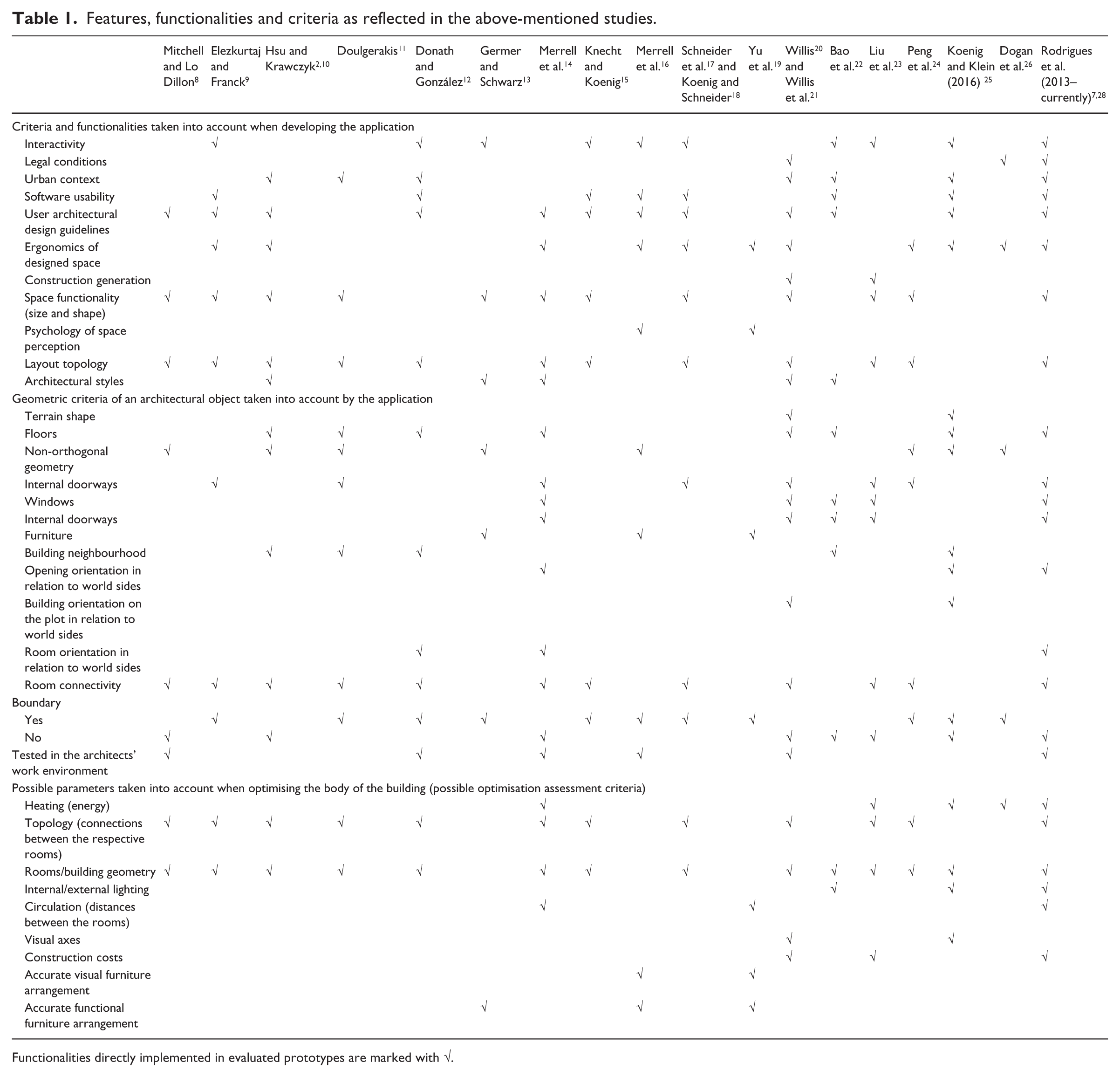
Functionalities directly implemented in evaluated prototypes are marked with √.
Table 1 concisely summarises characteristics of described prototypes identified by the authors. These features are grouped into three main categories:
Criteria and functionalities taken into account when developing the application – software features of prototype and architectural categories on which the prototype operates.
Geometric criteria of an architectural object taken into account by the application – characteristics and criteria included in the prototype shaping the geometry of the architectural object.
Possible parameters taken into account when optimising the body of the building – possible optimisation assessment criteria.
Additional information regarding the use of boundary is present. The information indicates whether the criterion of the building envelope is present. In addition, the information whether described prototype was tested in the architects’ work environment is present. Preferred criteria, functionalities and architectural features of described prototypes were subjectively identified based on the practical experience of the authors and bibliographic resources. The criteria were selected subjectively but to the best knowledge of the authors, cover all main theoretical properties of assisting computing tool for the architectural design process. In addition, similar criteria were identified by other authors, for example, Lobos and Donath. 5 Each prototype was evaluated based on extensive studies of available research papers connected with each study.
Design outcomes of research prototypes
This section presents a descriptive review and meaningfulness of the prototype architectural design outcomes. Design outcomes are evaluated based on the review of available bibliographical resources, web sources and partially the independent tests of available architectural software. The sequence is consistent with section ‘Evaluation of research prototypes’.
Mitchell and Lo Dillon. 8
The generated functional layout is simplified but reasonable from the point of view of functional connections. The tool takes into account surfaces of individual rooms from a functional programme. The prototype is useful for creating flowcharts of architectural concepts. Its main limitation was the computing power and poor functionality of computers available at that time.
Elezkurtaj and Franck. 9
It is an attempt to create an application meeting real-life requirements of a functional design tool. It is useful in designing accurate flowcharts of the building functions. The application is available only as a prototype; further development was cancelled.
Hsu and Krawczyk.2,10
It is a theoretical, comprehensive proposal including many elements of design process enabling to create a fully practical design tool. The proposal does not take into account the design data input. Unfortunately, no prototype application has been implemented.
Doulgerakis. 11
This innovative attempt to translate complex human nature into the language of mathematics cannot be regarded as successful. The generated buildings to some extent reflect historical context, but layouts are not functional. The applied mathematical concepts are detached from the realities of the architect’s work environment.
Donath and González. 12
A two-module software prototype generates a body of a structure, including the arrangement of individual functional parts. Its flaws are a low level of architectural detail (a general proposal of a body of the building on the plot), difficulties in operation and the lack of implementation for an independent application. Moreover, the use of the programme is further impeded by the division into two modules addressing separate issues (body of a structure in space and functional layout) and an unintuitive interface.
Germer and Schwarz. 13
The main advantage of this application is time efficiency, as it easily generates visually accurate furniture arrangements. Their functional quality leaves, however, some room for improvement because sometimes furniture is blocked, and some arrangements are not supported by the application (e.g. a TV in front of the couch). The tool is more useful in the computer gaming industry than in architectural design.
Merrell et al. 14
The application provides plausible design outcomes; however, the authors used idealised situation without site-specific and client-specific features. The prototype generates 3D visuals with a complete context and detailed layout plans. The disadvantage of this solution is the lack of interactive workflow which means the user cannot manage the input in real time.
Knecht and Koenig. 15
A different approach to the problem means that the results of the application are limited to generating a schematic block layout of the function in a building’s floor plan, within a rectangular bounding box. The ability to interact directly with the system in real time is a promising functionality providing flexibility in using this tool.
Merrell et al. 16
The application gives satisfactory design results in terms of spatial furniture arrangements. Interactivity and a transparent interface make it a useful design tool, which has been confirmed by testers. The only significant limitation is a predefined database of furniture and arrangement in the rooms.
Schneider et al. 17 and Koenig and Schneider. 18
The tool has a simple interface enabling to quickly create concepts of functional layouts based on user-specified design data. Layout plans of buildings appear to lack accuracy and are limited to a rectangular bounding box, which makes the application useful only at the stage of creating concise design concepts of a flowchart of the function.
Yu et al. 19
This application is addressed to developers of computer games. The prototype generates meaningful furniture arrangements in a room while keeping the hierarchy between items; the user, however, cannot work with the tool in real time. Tests carried out by the authors have confirmed the visual accuracy of the generated layouts compared to arrangements created by designers.
Willis 20 and Willis et al. 21
Implementation of the application with an object-oriented programming language Grasshopper limits its use to advanced users. It provides a comprehensive approach to home design – from concept to construction. However, this powerful tool is adapted only to the realities of real estate project in the United States. Additional constraints for the creativity of the designer are predefined sets of the building characteristics. Final results can meet catalogue standards.
Bao et al. 22
Due to a handy interface, the application is suitable for creating quick concepts of bodies of structures in different urban contexts. The prototype is one of the few handy and usable tools for the concept stage of architectural design which produces meaningful design propositions. It lacks the option of user detailed input and working with finer architectural details.
Liu et al. 23
The tool enabling to design structurally optimal layout plans. Design outcomes offered by this solution are not plausible. The user can operate only on a single layout of the apartment, and the introduction of more complex functional systems is problematic.
Peng et al. 24
The application enables to create spatial divisions in envelopes of any shape. It is useful in creating repetitive functional systems in large-scale architectural objects (e.g. industrial plants and office buildings). Now, a harbinger of a new technology, in the future, it can become a fully functional design tool.
Koenig and Klein. 25
It is a useful tool in urban design. The prototype offers a set of landscape analyses, the interactive workflow with the changeable user input and the ability to enter user design data which enables to generate rational urban planning layouts.
Dogan et al. 26 and Dogan. 27
The studies enable to check the existing functional systems for energy use, in accordance with the ASHRAE Standard 90.1 Appendix G, which is useful in the concept stage. The studies do not propose specific tools but rather promote ‘energy-oriented design’.
Rodrigues et al. 28 and Rodrigues. 7
GerAPlanO is one of the most advanced design tools. An intuitive interface enables to use online data (Google Maps, weather data, etc.). It generates reasonable results in real urban contexts. One of few tools that have a chance to become fully fledged tools supporting architectural design by means of computational design.
Research prototype design outcomes summary
This section presents the summary of prototypes feature review and the main corresponding conclusions. Table 2 shows the average percentage prevalence of a given feature or functionality in all described prototypes. In the light of above statistic, one can conclude that the most common features described in these scientific studies are coded design guidelines and the ability to enter design guidelines by the user, taking into account layout topology and spatial (functional) limitations of individual rooms. Of the total of 18 reviewed prototypes, 11 (61%) have a boundary condition defined, which limits the freedom of design. Approximately 30% of the solutions were tested in architects’ work environment. The most common optimisation option is an optimisation in terms of geometry and topology. This stems from the fact that most of the solutions still focus on functional optimisation of an architectural layout.
Percentage of implemented functionalities in the reviewed prototypes.
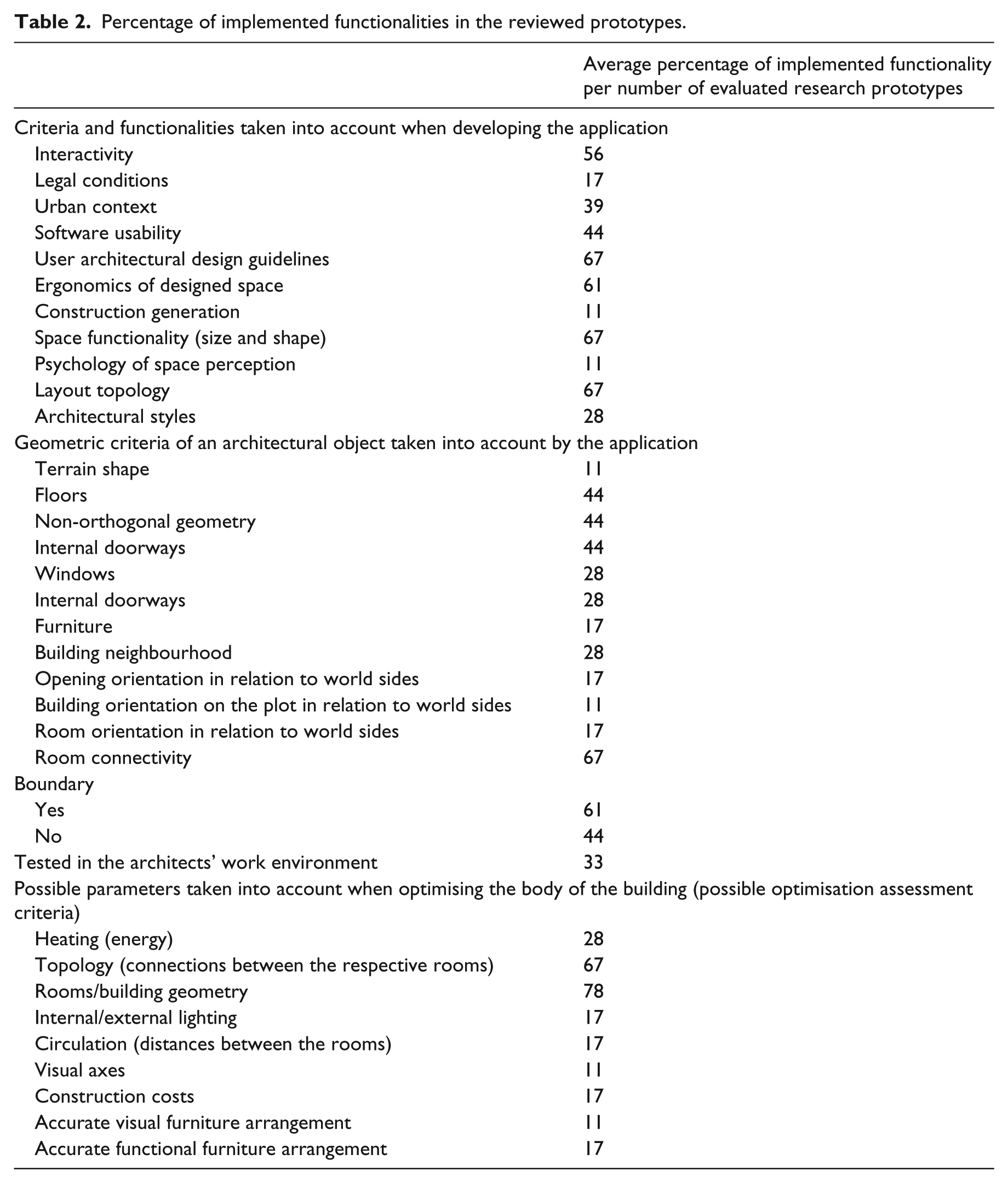
Table 3 describes the percentage of occurrence of the preferred functionalities identified by the authors in a given prototype. An arbitrary assumption was made that a higher percentage indicates a higher level of advancement of described prototype. Table 3 shows that the GerAPlanO 28 application is the most advanced design tool. Moreover, it is still being developed. Currently, it lacks mainly modules for furniture optimisation, and it does not take into account all optimisation options. Its main drawback is the lack of compatibility with any commercial application available on the market.
Number of desired features implemented in a software.
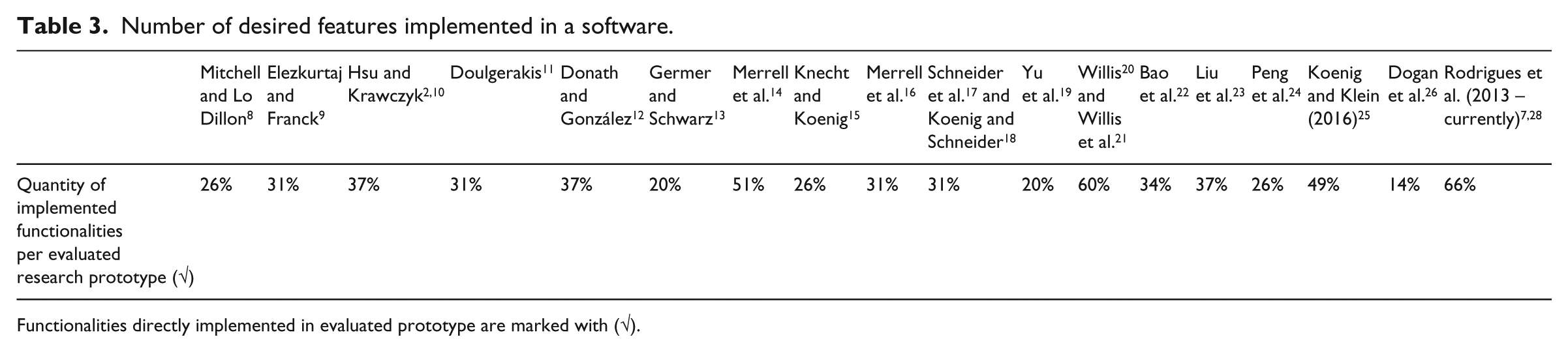
Functionalities directly implemented in evaluated prototype are marked with (√).
Features and functionalities of commercial and WIP software – identification of capabilities for computational design
This section briefly describes analysed commercial software focusing mainly on the practical application of examined tools in the architectural practice. In particular, this section examines the following questions:
Does the current commercial CAD software have computational design capabilities present in the studied research prototypes?
What is the degree of implementation and usability of these functionalities?
In addition, a brief description of the main features and functionalities of each studied commercial architectural software can be found.
Evaluation of commercial and WIP software
This section presents a brief review of the most advanced commercial architectural software available currently on the market.
Project Fractal 2016
A research project led by Autodesk®29 aimed at exploring generative design and optimisation techniques of the architectural design process. In the future, the tool is to be used in design, combining the cloud computing power with architectural design application Revit® via Dynamo scripting environment. It allows to explore the architectural design spaces defined by Dynamo visual programming language. It is one of the first generally available intuitive tools for architectural generative design. The project is currently in dynamic development stage.
Archicad® 20 + Grasshopper 0.9.0076 + Rhinoceros® 5.0
It is a connection of leading applications for architectural design: Archicad 20 30 developed by Graphisoft® application for architectural design, based on the BIM philosophy, Rhinoceros 5 31 and Grasshopper. 32 Thanks to the incorporation of Grasshopper, a visual programming language developed by Robert McNeel & Associates® for the Rhinoceros 5, users can create their own scripts, which significantly extend the functionality of the core software, especially in terms of generative design elements.
Rhinoceros 5.0 + Grasshopper 0.9.0076
A Rhinoceros 5 is one of the most important CAD application for architecture design. Together with Grasshopper extension, a visual programming language developed by David Rutten at Robert McNeel & Associates, users can create their own scripts, which significantly extend the functionality of the core software, especially in terms of generative design elements.
Revit 2016 + Dynamo 1.2.0
Revit 2016 33 is an application for architectural design, based on the BIM philosophy. Thanks to Dynamo 34 extension, a visual programming language developed by Autodesk, users can create their own scripts, expanding the capabilities of the core software.
Microstation Generative Components v.08.11.09.436
Generative Components 35 is a CAD application developed by Bentley Systems®. Scripts created using visual programming language enable parametric 3D modelling. It is one of the first tools for parametric design accessible to a wider audience. In comparison to other similar tools, this software seems to be the most outdated.
Based on the analysed software, the authors argue that the main trends in the development of commercial tools for architectural design go towards integration of leading BIM tools with tools for parametric design. As shown in Table 4, a lot of features can be implemented in the existing commercial software, thanks to some visual scripting extensions. The integration offers a wide range of possibilities giving the user virtually unlimited scope for manipulation of design information and geometry of the architectural object. Unfortunately, these solutions are targeted to a small, elite group of professional users, resulting in a lack of wider use of those tools. Such systems require advanced programming knowledge and experience. Working with visual scripting languages often do not resemble a typical workflow of the architectural design process which causes these tools to be not intuitive for architects which greatly reduces the scope of such solutions. Ultimately, there are still no simple tools for computing design available for a wide group of architects.
Features of the existing software for architectural design.
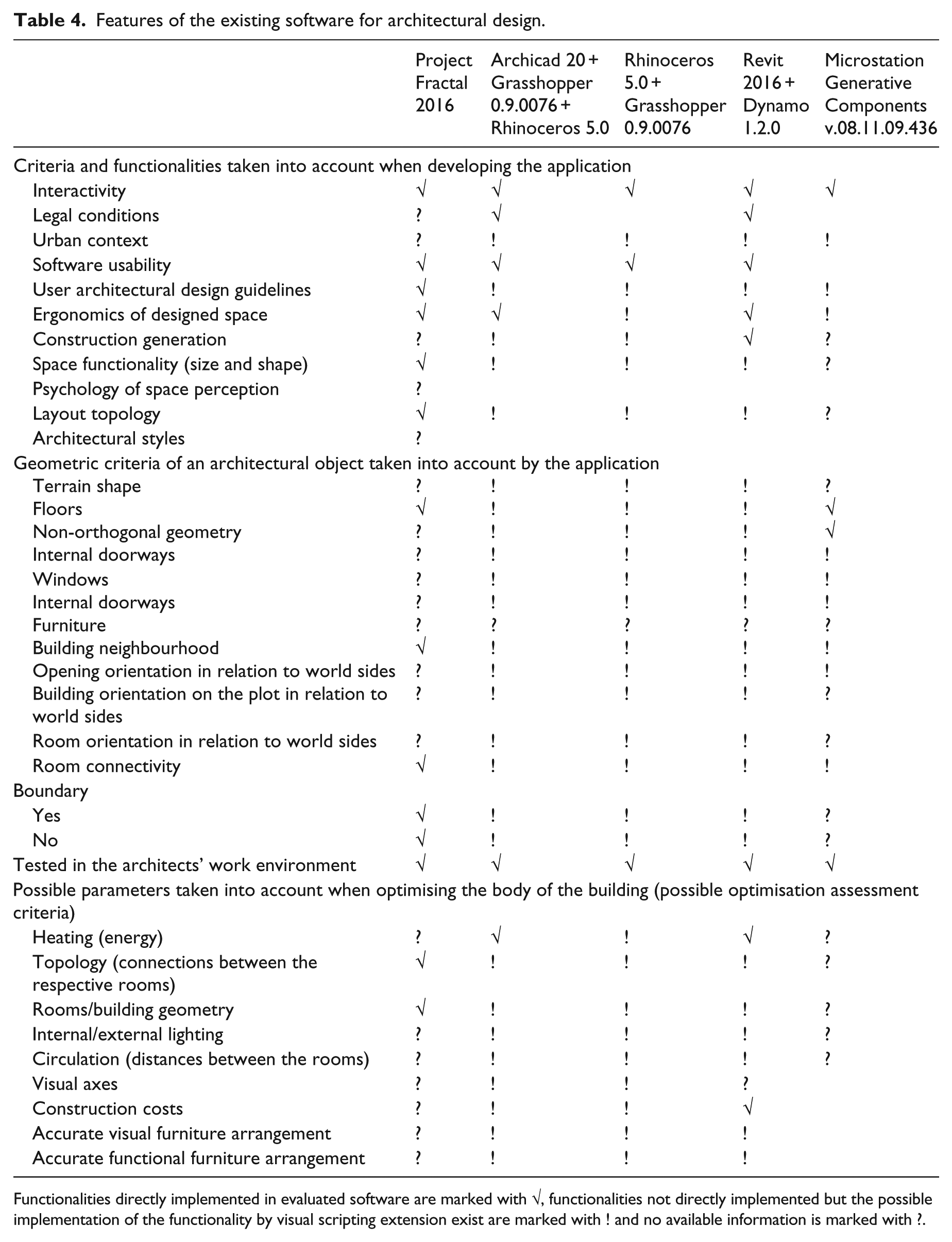
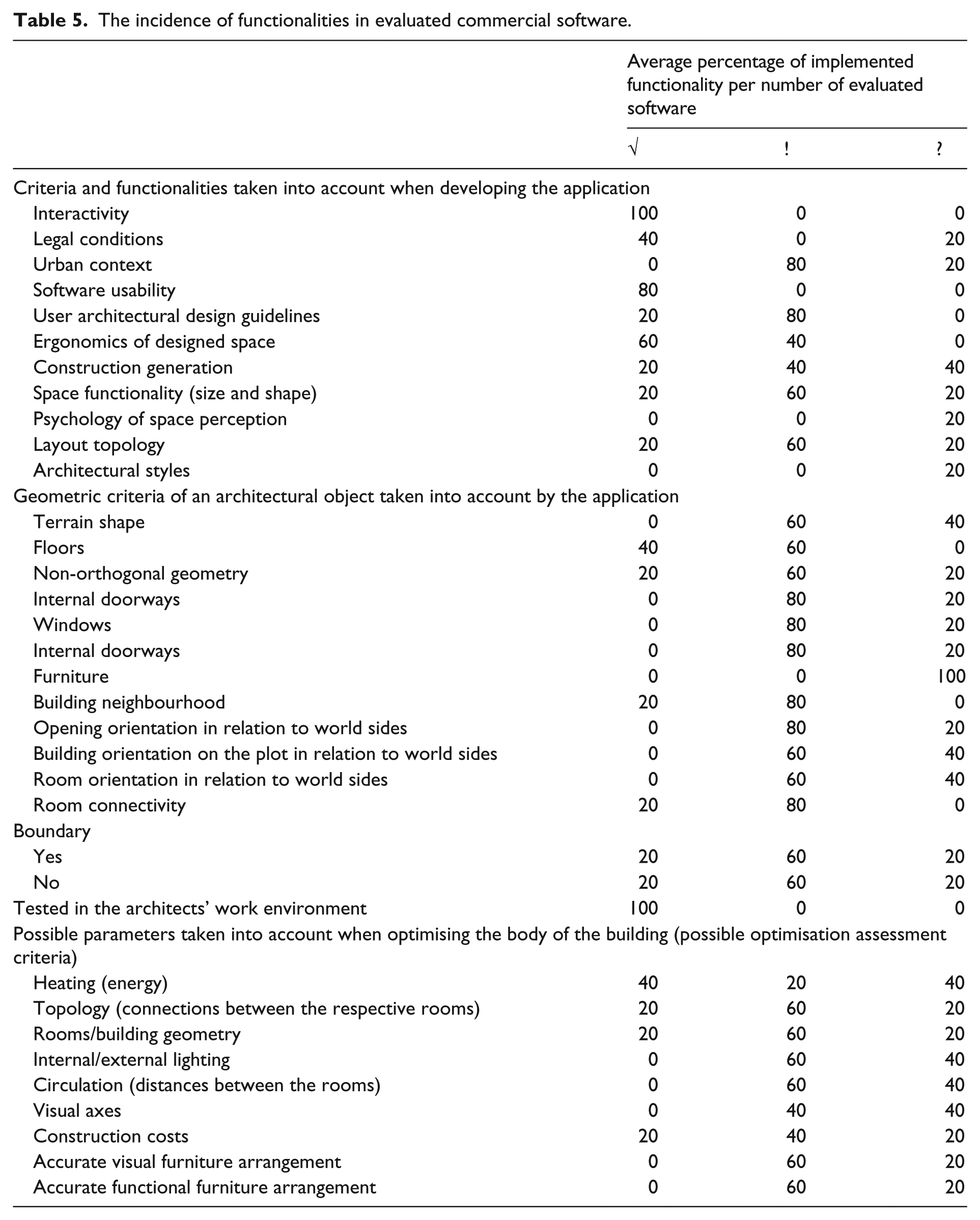
Functionalities directly implemented in evaluated software are marked with √, functionalities not directly implemented but the possible implementation of the functionality by visual scripting extension exist are marked with ! and no available information is marked with ?.
Software evaluation results are based on authors’ practice experience as well as extensive studies of bibliographic resources and software manuals. In some cases, there are limited data available (e.g. Project Fractal) due to the early stage of software development. The evaluation is subjective, but all necessary measures have been taken to minimise any possible errors. The development rate of software for architectural design is high; therefore, data collected in this article are (to authors’ best knowledge) actual at the date of writing of this article. Results of research conducted by the authors may differ in detail from actual state but as a whole give an overall view of the current development stage of architectural design tools for the computational design of architectural objects. These results should be considered as an approximation of some general trends in the development of architectural software as well as a general reference to further detailed studies.
Commercial and WIP software results summary
An arbitrary assumption was made that a higher percentage of direct implementation or implementation via visual scripting indicates a higher level of advancement of described software. The study shows that the Project Fractal is the most advanced application from the point of view of a direct implementation of functionalities identified in this article – out of a total number of 35 features, 14 are implemented (40%). As this tool should be treated as a research project, there is little information about full capabilities of this software – the presence of 21 (60%) out of total 35 identified features cannot be evaluated. Currently, the most advanced and practical solutions available in the market are the Archicad connected via Rhinoceros with the Grasshopper extension and Revit with the Dynamo extension. Both solutions are dynamically developing; however, despite the existing visual programming potential of Grasshopper or Dynamo, there are no specific implementations of many identified by the authors features. The most promising combination is Revit with Dynamo and Project Fractal, created on the common platform (Autodesk), which could mean a combination in the near future of all their functionalities into a unified solution.
Table 5 shows the average percentage prevalence of a given feature or functionality in all evaluated software. The statistic was divided by the stage of implementation of a given functionality. Direct implementation is marked with √, and implementation via visual scripting extension is marked with !. Table 5 shows that the existing applications are functional and interactive. However, they lack optimisation features and a generative design option. Usually, it is possible to implement such functionalities using visual programming (Grasshopper, Dynamo), but it requires advanced programming knowledge. The lack of implementation of specific features has a high impact on the usability of the reviewed applications.
The incidence of functionalities in evaluated commercial software.
Architectural generative design in architectural offices – survey
To investigate the architects in terms of the tools used in their practice and the possible use of computational design tools, the authors have conducted a survey among the group of active Polish architects. The study reviled current state of the architectural market as well as potential guidelines and properties that should be used in the development of future computational tools supporting the process of architectural design.
Study methodology
The aim of the study was to collect basic information regarding the usage of computational tools in the professional practice, about the design process and establish possible guidelines for the development of tools for generative architectural design. The study was conducted via Internet surveys. Participants answered anonymously. The survey was distributed electronically to several dozens practising Polish architects in the age group of 25–50 years, working individually as well as running their own design studios. Directly in the survey attended by 21 people. The survey included 14 questions divided into three sections: information about the design process, information about tools used in the design process and information about the expected functionalities of the hypothetical tool for generative architectural design. In total, 10 questions were questions of single choice and 4 questions were multiple choice questions with up to three possible answers.
Tools used in design work
The most popular software used in the architectural practice is Autodesk Autocad® 43% – the most common CAD programme for architectural design (Figure 1). The more advanced BIM software – Archicad and Revit – is used in 19% and 14% cases, respectively (Figure 2).
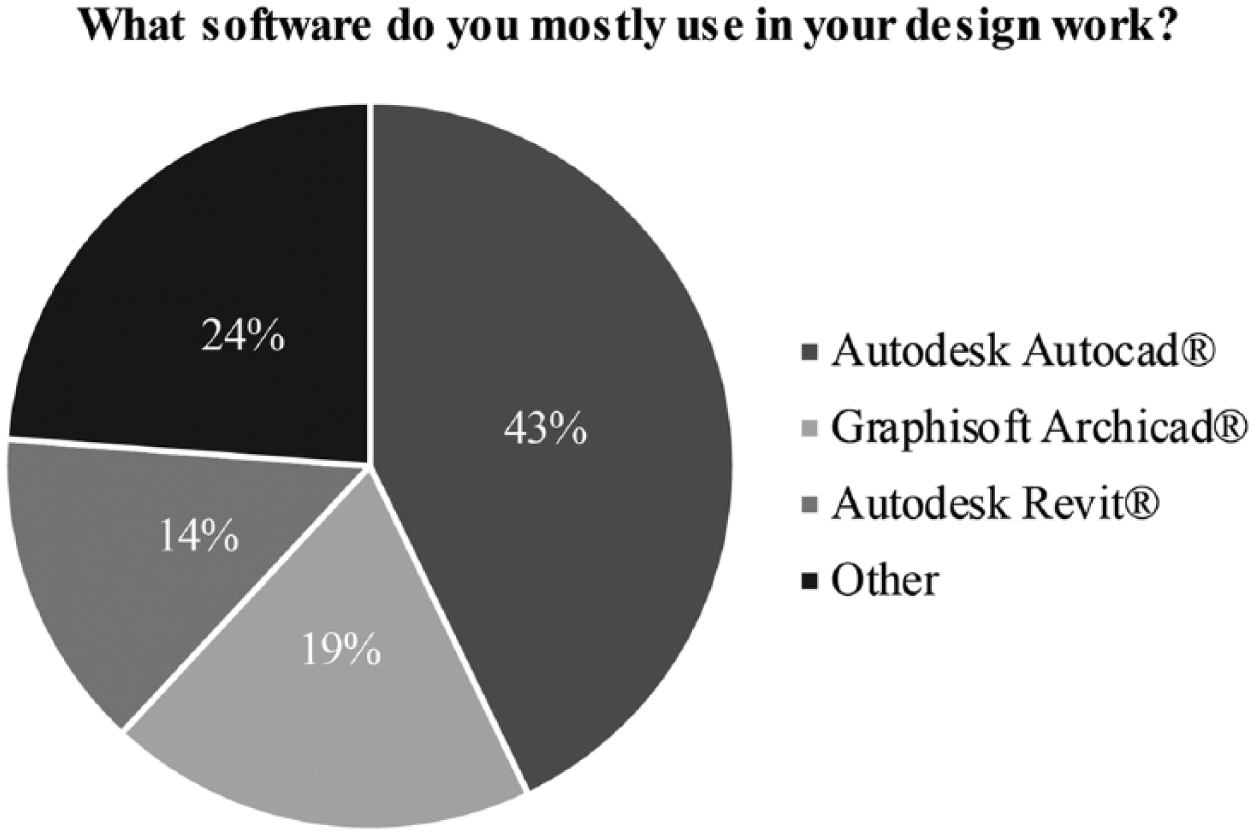
Most popular CAD software used in architectural design practice.

Percentage of architects who encountered advanced tools for computational design.
Although 67% of respondents came across or used parametric design tools (Grasshopper, Dynamo), none of the surveyed respondents use these tools in their professional work.
A high percentage of respondents encountered parametric design, but its complete absence in architectural practice shows an attachment to a proven set of CAD tools, but the relatively high share of BIM software as a major tool in project design demonstrates the growing role of technology in architectural design. The change in architectural education in Poland, emphasising BIM programmes, the policy of the European Union putting more and more emphasis on the creation of complete design documentation at BIM, announces the forthcoming qualitative breakthrough in computer architectural design tools.
Design process basic information
The questionnaire also included questions about the basis of the design process – the most commonly designed building types and basic information used during the design process. These questions were aimed at identifying a general outline of the field in which potentially computational aiding tools for architectural design could be used.
The most popular types of architectural buildings usually designed by architects are public buildings (33%), multi-family houses (24%) and single-family houses (19%; Figure 3). The most common set of architectural brief information obtained by the designers is room area and total house area, types and quantity of rooms and architectural formal style (Figure 4). The most common types of architectural analyses performed during the design process are sunlight analysis and landscape analysis.
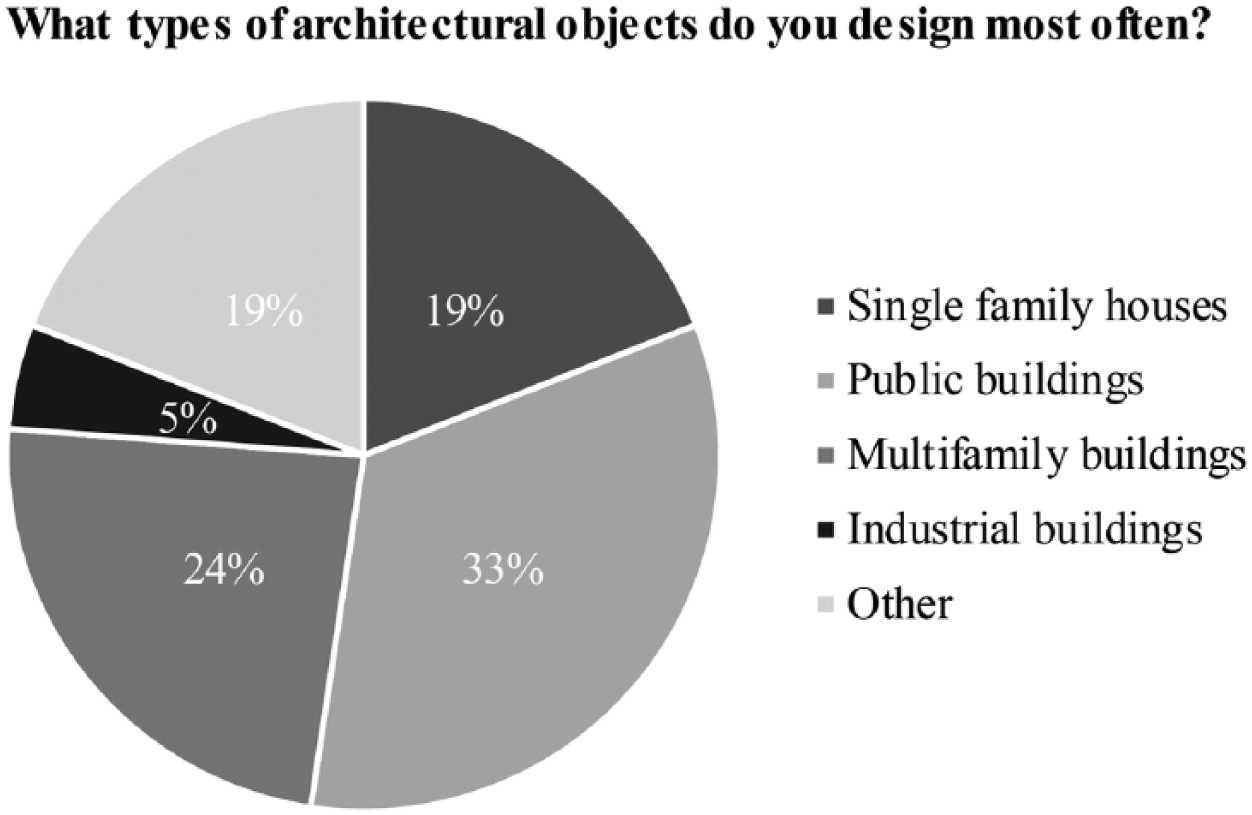
The most popular types of architectural objects designed by architects.
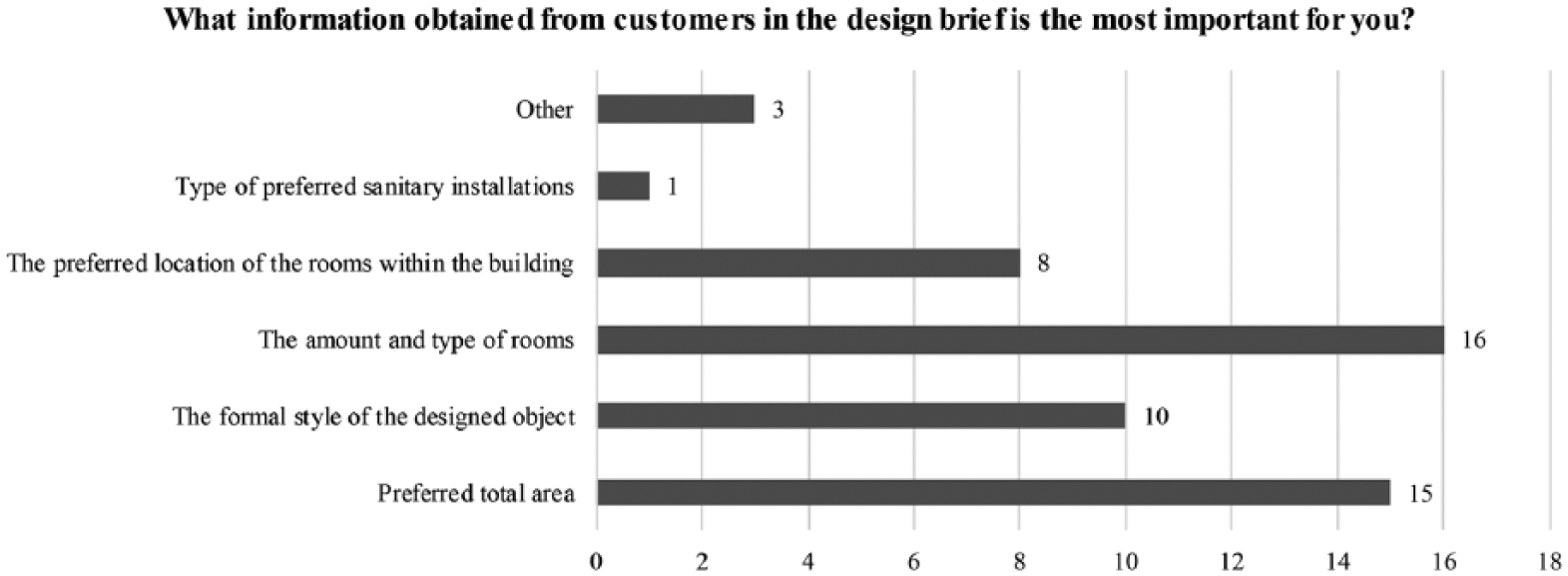
Answers to sample questions regarding the design process.
Requested properties of computational design tools
Additional questions regarding the properties and functionalities regarding the hypothetical computational aiding tool for architectural design process are present.
More than 52% of the respondents would prefer an application for the computational design of architectural objects in the form of an addition (plugin) to the existing software (Figure 5). The most desired functionalities of the hypothetical aid tool for the computational design of architectural objects are a generation of building volume studies, generation of functional zones inside the building and generation of functional floor layout (Figure 6). The additional features that most architects would like to see are optimisation on the fly – ability to edit floor layout in real time (removal of unnecessary elements, selection of items that are well located, etc.) and evaluation and optimisation of existing single-family house projects (in terms of energy, functional quality, etc.).
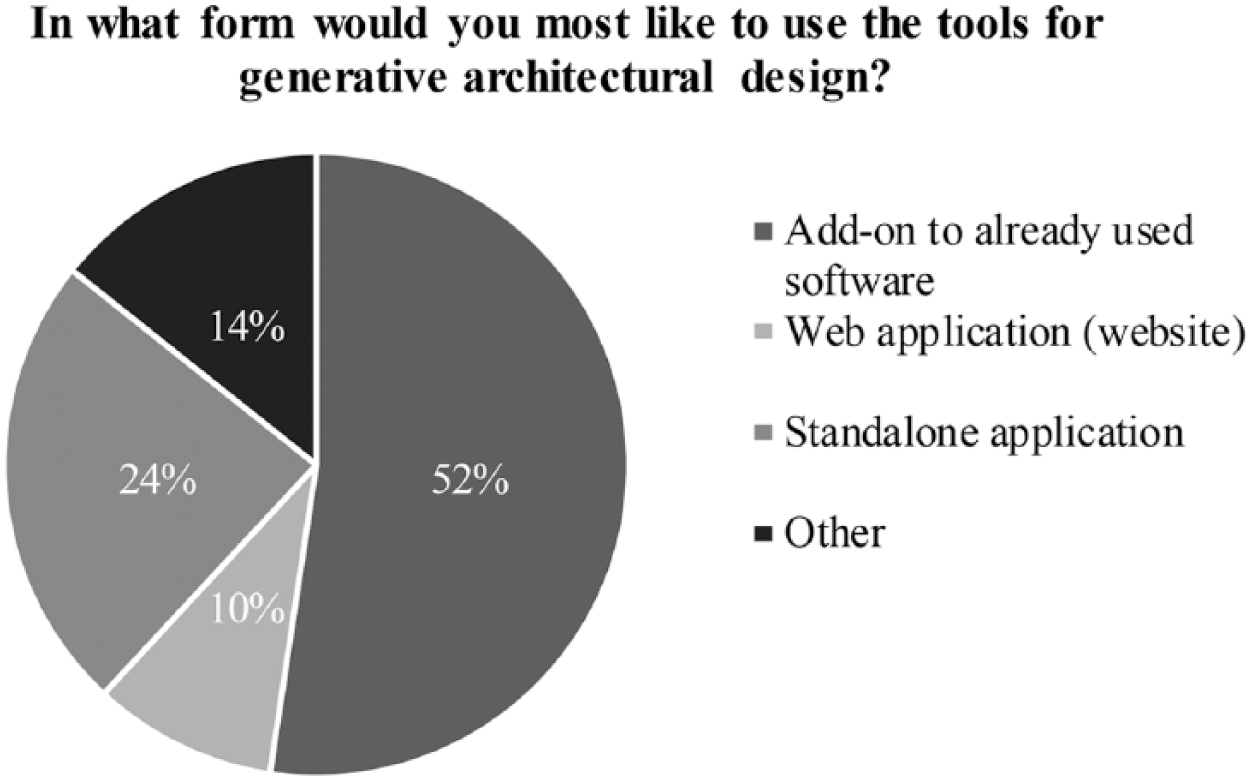
Answers to sample question regarding in what form the architects would like to use tools for generative architectural design.
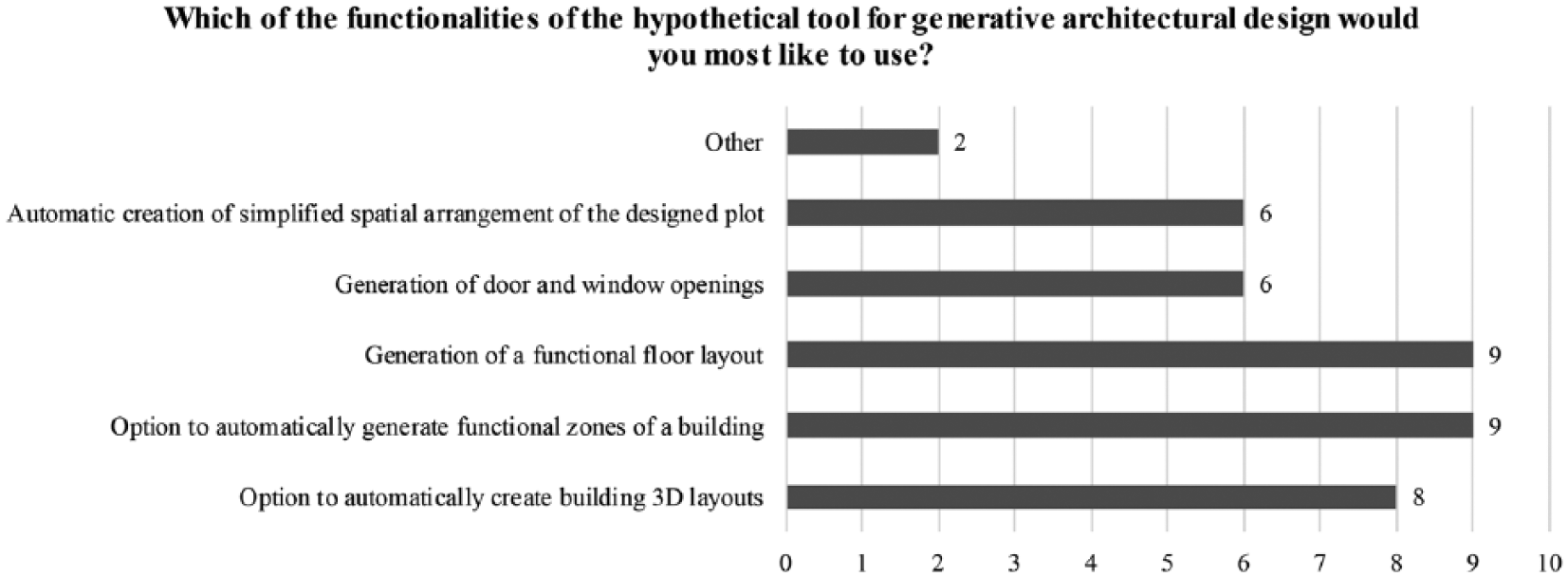
Answers to sample question regarding the functionalities of the hypothetical tool for generative architectural design.
Summary
Current market trends and architects’ answers indicate that the best way to support the architect’s work in a computational way is to develop an existing programming base. Growing trend of extending the BIM functionalities by combining it with parametric design software and the potential growth of these programmes in the architectural tools market points to a natural place for the proposed computational design tools – plugins for Grasshopper or Dynamo platform.
The survey results can be considered as a signal from the architectural community. The high number of people who encountered new architectural design tools (parametric design and computational design) combined with the lack of these tools in everyday design practice, clear indications of expected functionalities, shows the willingness to use tools for computational architectural design. However, the development of this type of tools must be focused on the needs of main users – architects.
Discussion
Research on the problem of architectural design support by computational tools has been conducted for over 50 years. The early examples can be found in various papers.8,36,37 Based on the analysis of available research, the authors conclude that some prototypes have already reached a satisfactory level of support for design work within the meaning of creation of meaningful architectural projects.14,28 At the same time, only few research approaches22,28 take into account tool usability or are focused on the actual usefulness of developed tools for architects. Most studies emphasise the technical aspects of the computational aided design, proposing new IT methods, operation speed optimisations or simply testing technical theories in solving particular problems.
The architectural design software market overview clearly points to the lack of usable tools to support the architect’s work in a computational way. Despite the fact that leading software companies (Autodesk, Graphisoft) begin to explore this niche, the process is still slow and, above all, do not respond fully to the architectural market needs directing still to technical aspects. The exploration is mainly absorbed by two trends: enhancement of BIM software capabilities through connection with parametric design platforms (Archicad and Grasshopper; Revit and Dynamo) and academic research projects. One of the most significant Autodesk Project Fractal is currently the most advanced example of how digital design tools might be developed in near future.
At the same time, the results of a survey among practising architects clearly indicate that there is a market opportunity for computational aiding tools for architectural design. This opportunity can be used only when the development of such tools will be focused not only on technical aspects but also on usability and intuitiveness.
Possible different approaches
The growing role of technology in today’s world will inevitably affect the whole process of architectural design. Today’s conviction of the limitations of CAD tools, especially in the aspect as ephemeral as creativity, seems wrong. As William Fawcett stated, ‘We should consider whether the conventional wisdom reflects prejudice or the weakness of existing CAD tools’. 38
The development of current design tools is focused mainly on the latter stages of design process. The modern architectural tools are developed as advanced ‘drawing aids’ and are already very advanced in this role. 39 In recent years, more and more research is focused on the supporting the initial conceptual stage of architectural design with various approaches showing great potential in this field. Zboinska 39 proposes conceptual proposition of multi-tool platform for early concept design connecting various existing CAD software for advanced 3D modelling, parametric design, simulation and analysis. The main purpose of the platform is to allow the designer to direct and manage the concept generation processes and to develop procedures for their execution, while the computer does all of the laborious tasks. Weng et al. 40 propose the exploration of feasible architectural designs by usage of an interactive tool for energy-building optimisation which takes into account the interior functional plan as well as the building’s body. Kwon et al. 41 introduce interactive system supporting architects creativity at the conceptual drawing stage, trying to translate information about particular design style in an algorithmic language. Hua 42 proposes the system for fast exploration of possible architectural design spaces by blending fragments of existing 3D models into new architectural objects which lead to novel design outcomes.
Conclusion
Computing power is still not fully utilised creatively, despite years of research and diversity of approach to the problem of computational design of architectural objects. The best evidence of this state is a lack of a fully functional software of this type which is widely used in architectural studios. Examined scientific studies, research prototypes and commercial architectural software still do not have a fully functional solution for the computational design of architectural objects.
Most studies ignore the issue of cooperation with design studios. There is no evaluation of the software in real architectural projects or in the designers’ work environment. From an architect’s point of view, what is also significant is the fact that most of these applications are created to optimise a part of or the whole body of the designed structure, rather than enhance the architect’s creativity by providing valid design solutions. There are no operational and fully functional applications for architects, which could support at least the process of generating a layout plan of the building. The existing solutions usually lack an intuitive interface and are very limited in their functionalities. Many of them operate on basic orthogonal shapes (in most cases, only in 2D). Their calculations take into account a limited number of design criteria (e.g. they do not take into account design rules, plot conditions and urban and legal context). The most advanced solutions are research projects based on commercial applications or scientific studies undergoing commercialisation, which can be best exemplified by GerAPlanO. 28
The study shows that current research is still focused on the finding correct and efficient computational methods for the computational floor plan generation. Thus, the research is not focused on a particular aspect briefly examining the effectiveness of a particular algorithm or IT solution. The authors argue that current research is still too focused on IT methods, despite their considerable degree of advancement and satisfactory computational efficiency. The authors also note the lack of cooperation with architects in the prototype research and development process, resulting in lack of consideration of their needs and omitting the tool usability aspects. In addition, there is no link between existing vibrant online communities of computational design focused especially around parametric architecture with the development of commercial software. This results in a lack of use of tools already created in the development of CAD software. The authors believe that the deep connection between parametric community, architects, researchers and the businesses developing commercial architectural software will produce good results. This combination will streamline the flow of information and technical solutions, dramatically accelerate product testing and will better determine the actual demand of the architectural community for computational tools for floor plan generation.
The future development of computational tools for architectural design must be inseparably connected with the architectural practice. Future tools must be developed based on the specific nature of the design process, in constant contact with its key users – the architects. The study of design methods preferred by architects should be a very important guideline for the development of computational tools. 43 As suggested by research study, 44 many phases of the design process can be perceived as the mechanical processing of certain data sets. These solutions should primarily support architectural creative work specifically by accelerating the analysis of available, quantifiable data (ergonomics, legal conditions, user’s functional preferences, etc.) leaving the most important design decisions to the architect. Only in this way seemingly incompatible aspects of architectural design can be combined into fully intuitive and functional tool.
Future works
Collected observations and conclusions will be used by the authors in the future works on the architectural design supporting tool. Particular emphasis in the proposed application will be given to usability, acceptable design outcomes of generated architectural plans, determinants of architectural design work (legal conditions, design standards collected in the classical textbooks for architectural design, the specifics course of design process, etc.), modularity (modules of multiple optimisation criteria, generative modules of various design aspects, etc.), cloud computing, access to existing digital data sets useful in architectural design (weather data, maps, etc.) and usage of BIM philosophy. The authors hope that this will result in a complete and functional supporting tool of the architectural design process – intuitive, interactive, customisable and above all scalable. The application operating on the principle of suggestions system of meaningful design solutions in a given urban and legal context. The tool takes into account a set of individual design requirements and is flexible enough to adapt to individual design style, while not limiting possible creative solutions. A consulting tool, which can complement the technical architectural knowledge being particularly useful at the conceptual stage of the design process. 43
Classification of design process mechanisms will be helpful in the development of proposed tool. Multiple stages of the design process can be directly translated into computing actions, allowing the architect to create freely, without the need for mechanical processing of starting design data sets. The connection of computing power with architect creativity will produce entirely new design quality.
Based on the above analysis, the postulate ‘Migration from design to designer-centric computational tools’ 44 seems to be justified.
The proposed tool can also be used as a way to develop of individual design style, as it can depend heavily on the knowledge arising from analysis of various possible design solutions. This proposal dispels a common complaint allegedly generative tools produce mass, ‘empty’ architecture. Through the continuous processing of possible (fulfilling all specified by the user design requirements) and meaningful design solutions suggested by the application, an architect will be able to develop his own creative workshop and improve the process of achieving design goals. 45
Footnotes
Acknowledgements
The authors wish to thank Prof. Dr Jacek Kosciuk who provided proofreading and writing assistance during the work on this paper. The authors would also want to thank the reviewers for the valuable comments that have served to increase the value of this article.
Declaration of conflicting interests
The author(s) declared no potential conflicts of interest with respect to the research, authorship and/or publication of this article.
Funding
The author(s) disclosed receipt of the following financial support for the research, authorship, and/or publication of this article: This research is a part of a Maciej Nisztuk’s doctoral research project conducted on The Wrocław University of Science and Technology.