




Abstract
In the contemporary ‘envisioned’ environment, Internet webcams, low- and high-altitude unmanned aerial vehicles and satellites are the new vantage points from which to construct the image of the city. Armed with hi-resolution digital optical technologies, these vantage points effectively constitute a ubiquitous visioning apparatus serving either the politics of promotion or surveillance. Given the political dimensions of this apparatus, it is important to note that this digital imaging of public urban space refers to the human visual system model. In order to mimic human vision, a set of algorithm patterns are used to direct numerous ‘soft’ and ‘hard’ technologies. Mimicry thus has a cost because this insistence on the human visual system model necessitates multiple transformative moments in the production and transmission pipeline. If each transformative moment opens a potential vulnerability within the visioning apparatus, then every glitch testifies to the artificiality of the image. Moreover, every glitch potentially interrupts the political narratives be communicated in contemporary image production and transmission. Paradoxically, the current use of scripting to create glitch-like images has reimagined glitches as a discrete aesthetic category. This article counters this aestheticisation by asserting glitching as a disruption in communication. The argument will rely on scaled tests produced by one of the authors who show how duplicating the digital algorithmic patterns used within the digital imaging pipeline on any exterior building surface glitches the visual data captured within that image. Referencing image-based techniques drawn from the Baroque and contemporary modes of camouflage, it will be argued that the visual aberrations created by these algorithm-based patterned facades can modify strategically the ‘emission signature’ of selected parts of the urban fabric. In this way, the glitch becomes a way to intercede in the digital portrayal of city.
Introduction
The Fraunhofer diffraction pattern is one of numerous naturally occurring optical glitches that interfere with a digital camera’s capacity to capture and transmit clean visual data (The data of the digital image quantifies the two-dimensional (2D) representation of physical space according to an array matrix (screen image), in which each pixel has an intensity value (represented by a digital number) and a location address (referenced by its row and column numbers).). Camera manufacturers tend to avoid diffraction at all costs to maintain the integrity of image transmission. With hidden, proprietary enhancements embedded in the more inaccessible aspects of the digital processing pipeline, the visual product of contemporary camera technology is thus a highly controlled and normalised product tied to the legalities of copyright. As Carpo 1 notes, ‘in practice, it is extremely rare to have access to any history of the processes to which image data has been subject’.
In camera optics, a Fraunhofer pattern is a unique type of Fresnel diffraction pattern. As the online Oxford A Dictionary of Physics 2 describes, these diffraction patterns occur as light passes through slits in a diffracting object. Fraunhofer patterns result when the distance between the light source and the receiving screen is of such an order that the wavefronts passing through the slits travel in a parallel and planar, rather than polar and spherical, trajectory. The simple act of replicating different Fraunhofer diffraction patterns on an architectural surface as a backlit screen can disrupt the algorithmic processes governing the digital image pipeline. These disruptive ‘glitches’ are prototypical camera responses; the replication of the multiple pattern algorithms used in the digital image pipeline creates new visual ‘impediments’. At the same time, the algorithmic basis of these patterns means that it is possible to calibrate these glitches precisely. If glitch aesthetics have formalised the idea of the designed glitch, then it is reasonable to argue that these façade patterns can be designed strategically to foul the digital image. Effectively, the predictability of these designed aberrations allows the designer to camouflage architectural form at the very instant of its digital dissemination.
The current interest in glitches and glitching gives these architectural surfaces added significance. On one hand, the predictive nature of glitches challenges the common narrative that the digital design process provides an explicable teleological transmission of data into form. On the other hand, the ability to calibrate the surface to a range of visual effects presents the paradox of the predictive glitch. It is significant that these surfaces demonstrate a causal link between action and outcome while also conforming to the general idea that glitches corrupt the lines of communication. However, this causal link is not teleological. These surfaces disrupt the linearity of the imaging process; they do not provide an explicit or explicable account of the formal mediation of data. The visual effects of these façades may be predictable, but the resulting glitches sit outside the predetermined disciplinary figures and forms that typically guided postmodern authorship. Like the techniques of the ‘first digital turn’, the contingencies of digital image production require authorship to be reactive to what the process presents. In turn, the procedural diminishment of authorship requires a reconsideration of the question of formal novelty. Just as importantly, the return of novelty counters the dominant orthodoxy of the ‘second digital turn’. 3 The glitch not only introduces a newfound instrumentality to images and image-making, but these techniques rupture the teleological predictability, guiding so many parametric and algorithmic design processes. 4
The proliferation of images and interfaces operating in the space between the physical world and the camera suggests that the techniques used to disrupt or modify the digital image are essential to the designer’s ‘bag of tricks’. The political agency of these techniques becomes more pressing, given the proliferation in the use of unmanned aerial vehicles (UAVs) to produce high-quality images of the city for consumption or surveillance. In this increasingly ‘envisioned’ environment, a newfound agency comes as a direct consequence of the ability of these surfaces to curate the image of the city. The assessment of such an agency requires a dissection of what it means to use the architectural surface to design a digital glitch. Such a discussion would outline the conditions and parameters by which surfaces can control the degree of visual aberration in camera reception. To explore this claim, this article focuses specifically on the patterns of image disruption associated with Fraunhofer diffraction. The discussion concludes with a description of how the duplication of these algorithmic patterns provides productive opportunities to intercede in how digital images are used to portray the city. These low-cost, readily deployable techniques not only make it possible to ‘target’ ambiguity across a global platform but transform the glitch from a ‘flaw in the system’ into a productive political tool.
Glitch: ‘pure’ or ‘alike’
In discussing the perceived and real effects of cyberterrorism, Peter Knapp 5 focuses on the role played by the digital network under attack as a way to differentiate genuine political action from rhetorical posturing. ‘To take the real threats of cyberterrorism seriously is certainly not alarmist, but it is irresponsible not to distinguish between a Net sit-in and the failure of an ATM network, between conceptual Net art and attacks on a hospital generator’. 5 Uncoupling the notion of political agency from cyberterrorism, it is worth noting that impact places the type of network before the quantum of damage done. On this basis, Knapp dismisses ‘hacktivism’ as a minor, impotent disturbance to existing government and private network systems. Exploiting ‘the processing rhythms of certain system resources’, such attacks are ‘nothing more or less than digital demonstrations’. 5
The recent emergence of the electronic glitch as a digital art phenomenon presents an interesting parallel to Knapp’s words. Glitch, from the Middle High German glitschen: ‘to slip’, is commonly defined as a brief fault within an electronic system. Unsurprisingly in a media-dominated world, glitch aesthetics has now established itself as a discrete digital art movement. Glitch art is unique because it ‘… explores imperfection by producing or saving unwanted images’. 6 Significantly, glitching, as an art practice, forces one to make a choice about one’s preferred process. As glitch artist Tony Scott’s 7 website notes, users have two options: they can ‘wait for something to go wrong, or force something to go wrong if you’re a busy full-time glitch professional’. On one level Scott sees this decision on process as a choice between having a professional or amateur practice. The professional converts the accident into the deliberate process to produce complex network ‘errors’ of immense aesthetic appeal. However, such ‘forced’ glitching involves a direct intervention by an author. Unlike the accidental or pure glitch, production’s reliance on individual aesthetic decisions means that ‘forced’ glitches do not lend themselves to indexical systems. Rather, such images are a facsimile of an aberration or error. The techniques of ‘forced’ glitching make such images reproducible, but this reproducibility duplicates the one image. The logics of ‘forced’ glitching cannot populate a taxonomy of familial variations of itself. Such glitches may be unique, but their fixed form makes them a simple ‘digital demonstration’. 5
If Knapp links impact to the importance of the network, then Joachim’s distinction between glitches that ‘produce’ and glitches that ‘save’ provides the strong conceptual basis that is distinguished by the posture one takes to that network. Taken together, Knapp and Joachim circumvent the aesthetic and figural limits of ‘forced’ glitching. The combination of Knapp’s and Joachim’s thinking provides useful general principles which free glitching from the temporal limits imposed by being linked to a specific ‘electronic’ technology. As a consequence, glitching can cut across historical periods to offer a new epistemological lens with which to assess all types of image production. The utility of this newfound historical inclusiveness is that work that might have previously been discarded can be used to extend contemporary thinking. The value of such an epistemological shift is demonstrated in the technological changes seen in the transition to Renaissance painting.
The inability of pre-Renaissance representation to overcome the flatness of the image can be accounted for by an unwillingness to challenge the convention of scenes being illuminated using a uniform source. By the 16th century, the lack of spatial depth caused by this low dynamic range was altered through two important technical innovations accompanying the representation of transparency and translucency. This technical transformation was achieved by replacing egg tempera with oil paint and using canvas instead of wooden picture panels. These two innovations elevated the painting’s dynamic range, or range of luminance, allowing artists to extend the composition and content through the painterly manipulation of spatial depth. Throughout the Renaissance and Baroque periods, Chiaroscuro techniques were developed to contextualise much larger scenes within three-dimensional space. Correggio’s 1526–1530 ceiling fresco of the Assumption of the Virgin expresses the ‘unknowable’ contours of the heavenly realm by seamlessly blending highly articulated tectonics from the terrestrial world with high-contrast images. The shift in dynamic range is most stark between the edges and the deliberately ‘glitched’ centre of the ceiling fresco (Figure 1).
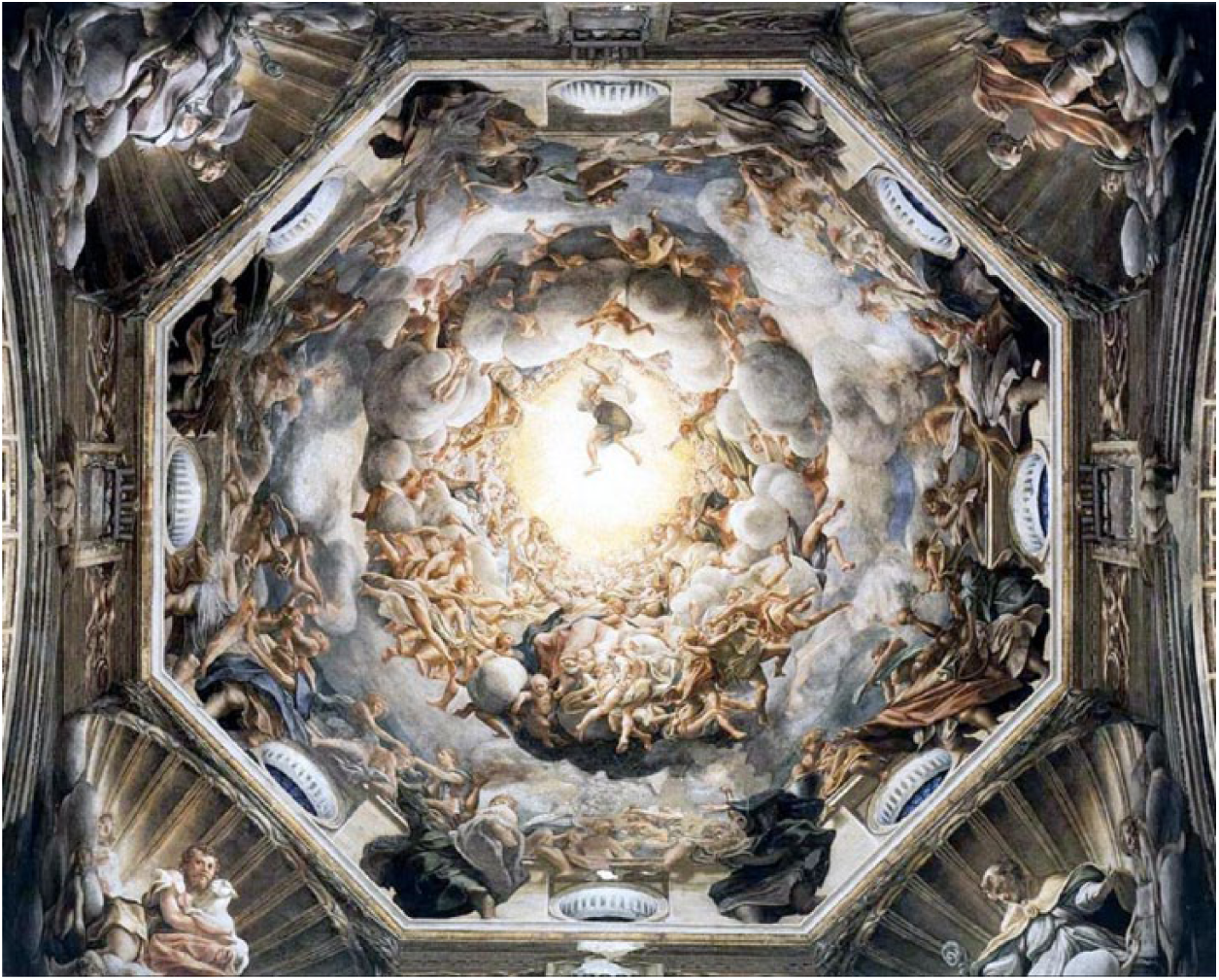
Il Correggio, Assumption of the Virgin, 1526–1530, from Creative Commons, 2015. 8
Andrea Pozzo’s Allegory of the Jesuits’ Missionary Work (1691–94) utilises this same shift in the tonal gradient of a painting to elevate its dynamic range so that any pictorial content near the upper limit (and therefore associated with the heavenly realm) becomes almost illegible. This technique, in which the figural content of the work was literally suppressed in favour of the affective properties of light in the form of brightness, permitted both perceptual mechanisms of the human visual system (HVS), spatial contrast and optical glare, to be addressed simultaneously.
The deliberate incorporation of optical glare, or image artefacts, into representations through the manipulation of dynamic range thus came to be seen as the merging of the heavenly and the earthly. This technique continued into the 19th century in the work of artists like W.J.M. Turner, who used optical glare artefacts as a way of diverting the viewer’s attention from the painting’s formal aspects in favour of the scene’s qualitative properties of colour and brightness. Similarly, the use of short brush strokes of pure unmixed colour by the impressionist artists was explicitly designed to produce the effect of intense colour vibration through an optical mixture that superseded the mixture of colour pigments in the palette. 9
With the advent of photography, representation became less concerned with the experiential effect of the synthesis of colour and light and more preoccupied with the erasure of any image property that might diminish an exact reproduction of the scene. The reproductive capacity of the photographic medium, in contrast to the interpretative powers of paint, came to be associated with ‘truth’, returning the image to scientific principles where it became an exact ‘replica’ of the real-time scene. This also meant that it had to be purged of its aberrant properties. In this respect, the advent of the camera and photography effectively deprived image-making of the visual ambiguities offered by the spatial contrast and brightness that earlier artists had explored and developed so effectively.
The deliberate avoidance of the image glitch still thrives in all the hardware and collateral softwares of contemporary digital image-making. Regarded as a primary image artefact, diffraction operates across the ultraviolet, visible and infrared spectra. 10 Fraunhofer diffraction is formed by internal light scattering on the image sensor mechanism of the camera, which acts like a diffraction grating when the light falling on the sensor exceeds the range of luminance that it can measure accurately. 11 While camera response functions are therefore tuned to perform in low-contrast, uniformly illuminated scenes specifically to avoid an optical overload or ‘glare spread function’, diffraction effects, nevertheless, cannot be rigorously or comprehensively removed by calculation. 12 In glitch terminology, diffraction is therefore a ‘pure’ glitch, or ‘the result of a malfunction or error’ rather than the glitch-alike, which arises from the deliberate creation of ‘the environment that is required to invoke a glitch and anticipate one to happen’, 13 nor is its application delimited by artificial constructs or facsimiles. Furthermore, the field of optical science invokes a vast array of diffraction effects that, when brought into play with the camera mechanism, are able to be endlessly invoked. As a naturally occurring error between two independent systems that are deliberately rather than accidentally brought together, the diffraction phenomenon thus begins to suggest itself as an ideal mechanism for the deliberate mediation of unwanted ‘emission signatures’ through the disruption of the camera’s successful transmission of visual data.
The camera view: between concealment and surveillance
Advances in digital sensing technologies and sensor platforms have resulted in a proliferation of overhead surveillance that relies on the transmission of accurate image data. With technology such as Internet webcams, drones (UAVs) and high-altitude aircraft now widely available, the successful concealment of ground-based structures and small-scale objects is a growing concern for both the military and commercial entrepreneurs.
As an example of this expanding representational field, Kurgan, 14 in her work on the scale and levels of pixel data within the satellite image, reveals how image intensity and contrast data can be precisely indexed to situated events (Figure 2). The pervasive time-lapse recording of the planet by a French SPOT satellite imaging system in 1999 reveals images of mass war graves in Kosovo. In this scenario, each pixel has an address expressed in longitude and latitude that corresponds with a unique location, and each reveals the heat value of that place at the time the image was captured. With this type of pervasive aerial scrutiny operating and with a camera resolution of a single pixel equalling 10 square metres in this case, there is little opportunity for data to remain undisclosed.
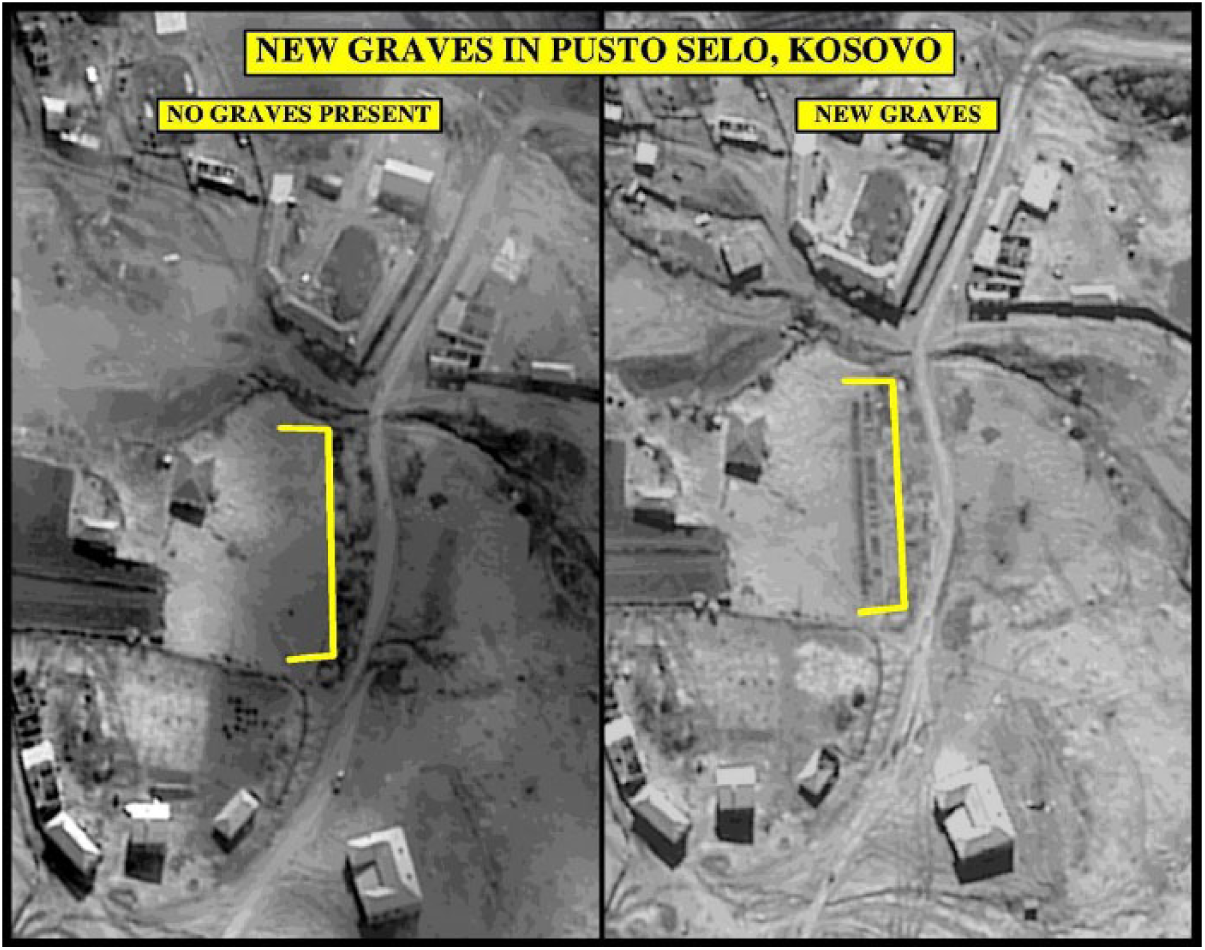
Satellite images showing (left) no graves present and (right) evidence of a massacre and disturbed ground in Izbica, Kosovo, taken at an altitude of 822 km, from Creative Commons, 1999. 15
As terrorist activities become a growing global concern, defence-related camouflage tactics are increasingly concerned with the broader surveillant capabilities of foreign target acquisition systems. Military-based research to date has led to the development of techniques to make facilities invisible in remote combat locations. 16 However, security-related operational centres are increasingly situated in dense urban zones, thus introducing a need to disrupt or diminish the data content transmitted to unwanted multispectral reconnaissance from UAVs and high-altitude aircraft cameras. Past research on camouflage tactics at a built scale has focussed on the painted application of pixelated patterns to military buildings.17–19 In these cases, camouflage is only operational within a narrow band of the electromagnetic spectrum visible to the human eye. More recent military approaches to building camouflage now incorporate tactics that attempt to respond to either space-based or airborne hyperspectral imaging technologies that capture both spatial and spectral (infrared) information.20–22 Yet, these techniques remain highly complex and cumbersome, requiring the generation of ‘counter-data’ for invisibility, 16 meaning they produce a different camouflage pattern for different backgrounds. Consequently, effective camouflage needs to satisfy a broader range of requirements that include the capacity to produce a spectral match to multispectral or hyperspectral remote-sensing instruments using minimal technical infrastructure at low cost.23,24
In a completely different arena of camouflage, the highly competitive car industry has developed a means of concealing its latest features. Called ‘Brick’ camouflage, Ford has produced vinyl camouflage stickers, which are ‘uniquely’ applied to each vehicle to disrupt the ability of eye or camera to distinguish new exterior features in sunlight. Tailored to multiple environments, the surface and colour of the pattern delay the brain’s ability to discern the vehicle’s shape (Figure 3). While easily deployed and cheap, this solution is currently limited to a narrow band of the visual spectrum.

Ford test track camouflage, from Johnston. 25
Disruptive surfaces
A series of practical tests was designed to investigate how Fraunhofer or far-field diffraction grating patterns could demonstrate an operational basis for a ‘productive’ glitch to camouflage a range of ‘surveilled’ building surfaces. The intention of the tests was to demonstrate how the surfaces, wrapped with backlit screens perforated in the shape of magnified Fraunhofer diffraction patterns, could disrupt images captured by overhead digital cameras in both day and night contexts. Existing as an algorithm sitting within the digital image process, the Fraunhofer patterns disrupt the camera’s image-processing pipeline protocols by scattering light falling onto the camera’s image sensor mechanism, thus making the surface behave like a diffraction grating. While there are already algorithms situated within the digital imaging pipeline designed to remove these visual aberrations, these tests show that translating the patterns onto a physical surface produces a new set of visual aberrations. Significantly, these aberrations contaminate both the image and the operation of the camera mechanism. It is worth noting again here that unlike the ‘forced’ glitch whose construct is a single or ‘one-off’ facsimile of a network error, this instead deliberately draws upon a naturally occurring and repeatable collision between the system of optics and the camera mechanism. Unlike the aesthetic and figural limits of ‘forced’ glitching, these surface tests evidence a productive type of glitching.
A further objective of the tests was to observe the effect of the adapted diffraction grating patterns for a series of the camera’s f-stop settings. This would potentially provide a vast array of interrelated effects for an architectural surface, which could be deliberately calculated and applied by referencing the data obtained in the test. The compilation of these pattern effects into a matrix that tabulates pattern behaviour in a quantifiable way according to predictable instances of camera lens proximity would thus make them accessible tools for incorporation within an ‘envisioned’ formal context.
Four diffraction patterns were selected (Figure 4). Two were derived from the camera’s internal data-scanning or raster-scanning procedure (The raster scan procedure subdivides an image into a sequence of horizontal strips or scan lines. Each of the lines is then divided into individual pixels for image processing. This process is known as raster scan order.), a third was based on the HVS comprising hexagonal elements, 26 and a fourth random non-digital pattern was used, based on the randomly generated type to which Cantoni refers. 27 The patterns were created using the open-source software Fresnel Diffraction Explorer and a fast Fourier transform algorithm. The tests were conducted using a Sony SX43E Handycam digital video recorder, comparable to the Kintronics long-range IR PTZ surveillance camera (The Kintronics long-range PTZ camera is a ground-based surveillance camera with a long-range lens and special pan–tilt mechanisms that allow details over two miles away to be seen.).28,29 Both cameras have charge-coupled device (CCD) sensors, which use interlaced scanning, and both have a zoom capacity of 60×.

Left to right: standard horizontal raster scan-order pattern in a 45°-rotated orientation; recursive Z scan-order pattern; hexagonal, HVS-based pattern; random or non-periodic pattern. Images © Linda Matthews (2015).
The diffraction gratings were cut from 2-mm thick opaque black acrylic squares and then placed individually in front of a single light source, a 30-W Par 64 RGB LED lamp, to simulate the building light emission conditions that would operate at night within an urban context (Figure 5). The camera was placed at 5 and 8 m from the image plane. Video footage that recorded the camera’s zoom trajectory was captured and processed into individual stills or an ‘image stack’ using ImageJ software. Individual stills from this video footage were then selected according to specific camera f-stops and extracted for processing and analysis. The light source was located directly behind the image plane at a distance of 0.5 m. This represents a scaled approximation of a mid-range Internet camera or drone camera viewing distance from a brightly lit image source, where a relative scale of 1:10 operates; that is, the 8-m image plane distance in the test correlates with an 80 m distance in an exterior environment, and so on. While the detectability capabilities of both Internet cameras and drone cameras operate across a broad range of distances of up to several kilometres, a mid-range distance was selected in these tests for practical purposes. Similarly, the grating elements used were 500 mm2, correlating with a typical building façade element of 5 m2. The aim of this was to enable specific features observed in individual stills extracted from the recorded video footage to be tabulated in accordance with the camera’s f-stop settings. The results of the individual patterns were processed using ImageJ and HyperCube2 analysis tools.

Test rig. © Linda Matthews (2015). (This test was undertaken by the author as part of a PhD thesis. The thesis can be accessed at: https://opus.lib.uts.edu.au/handle/10453/43377) 30
ImageJ’s Reslice tool allows the individual stills of a video, such as that captured by an Internet camera or a drone camera, to be separated and stacked into quantifiable data. The tool does this by constructing an orthogonal slice through the image volume of the stacked stills. 31 This method of processing the video was particularly useful for Fraunhofer grating patterns given the considerable variation in the amount of light diffracted by each pattern. By converting the video into a visual data set with the same test constraints described previously, the reslicing technique established a comparative method of assessment to differentiate the effects of each Fraunhofer pattern.
It is vital to emphasise that the primary objective of the test was to gauge the disruptive effects of each diffraction grating on the webcam’s image-processing function. ImageJ was an ideal analytical tool because of its capacity to assess both the luminosity (brightness) and the number of unique colours each pattern produced. Procedurally, the image at the high end of the camera’s aperture, or f-stop range, was selected because this is the point at which these disruptive effects are most likely to occur. ImageJ made it possible to observe the number of diffraction artefacts present by determining the number of unique colours diffraction produced. In addition, ImageJ’s Z Project function, which combines the stills in an image stack along the z-axis (the plane perpendicular to the image plane), was useful in synthesising the visual data within the image stack into a single image. From this single image, it was possible to measure the sum and standard deviation of the pixel intensities across the image stack. The SUM tool evaluated the total effects of the reprocessed images according to the number of unique colours present across the entire f-stop range or camera aperture range. In contrast, the standard deviation function revealed the extent of variation, or range of unique colours within, the aperture range (and thus zoom trajectory) of each grating pattern. Finally, ImageJ’s Particle Data Count function was used as a supplementary tool to corroborate the previous results. This command counts and measures objects in binary or thresholded images and operates by scanning the image for the maxima of luminance until it finds the edge of an object. In this case, luminance was defined as the weighted or unweighted average of the colours. In this case, the greater the number of maxima or diffraction artefacts, the greater the disruptive effect to the camera.
HyperCube2 was used to visualise the data. The software has the capacity to produce spectral plots from an image cube (a technique for examining the cyclic structure of wavelengths in the visible electromagnetic spectrum); the vertical axis shows the minimum and maximum reflectance value of all the vectors relative to the wavelength on the horizontal axis. This software was used to provide the static and dynamic display of the image cube and to determine the hyperspectral effects of the patterns. In this study, the software was used to assess the quantum of luminosity emitted at a specific wavelength. In order to corroborate the data obtained from the ImageJ luminance tests, it was decided to select the mid-range of wavelengths (545 nm) emitted by the patterns.
Test results
The tests showed that digital-based Fraunhofer diffraction patterns (derived from a digital algorithm) deliver extremely strong brightness artefacts that become more exaggerated as the camera’s zoom factor increases. Of these, the Fraunhofer pattern derived from the horizontal raster scan-order pattern (The raster scan procedure subdivides an image into a sequence of horizontal strips or scan lines. Each of the lines is then divided into individual pixels for image processing. This process is known as raster scan order.) in a 45°-rotated orientation produced the highest number of diffraction artefacts. This was evident in the number of unique colours that each diffraction pattern produced. This can be seen in the ImageJ montage in Figure 6, which shows the addition of all images within the inward and outward zoom trajectory (A zoom lens allows the focal length (and thus angle of view) of the camera to be varied) of the camera (Because a comparative assessment of the effects of each pattern and its Fraunhofer counterpart was needed, and because the quantum of diffracted light varied considerably between each of these two patterns, ImageJ’s Reslice tool was used to reassemble all individual stills of each video into quantifiable data by reconstructing an orthogonal slice through the image stack. By converting the video of each grating pattern into a data set with the same constraints, a comparable result was obtained.). The non-digital-based Fraunhofer pattern (not derived from an algorithm) that was tested produced noticeably fewer diffraction artefacts.

The effects of the pattern upon the camera (top); and the total disruptive effect (the SUM of all resliced images in the camera trajectory) of digital diffraction patterns (images 1–3) upon camera reception over a range of camera apertures (bottom). Image 4 on the right demonstrates the lesser disruptive effect of a non-digital pattern. Images © Linda Matthews (2015).
While an example of each of the camera views is included in Figure 6, this is not indicative of the full extent of the diffractive effects of the patterns across the camera’s total zoom trajectory. The processed images in the bottom row of this figure describe the SUM of each pattern’s diffractive effects.
The results of the Particle Data counts using ImageJ’s Floyd Steinberg Dithering Algorithm confirmed the unique colour measurements, both in terms of empirical observation and quantitative analysis. Other digital-based Fraunhofer patterns also produced significantly more brightness artefacts than non-digital patterns.
HyperCube2 tests showed the hyperspectral effects of the Fraunhofer patterns. Figure 7 shows the high level of camera interference produced by the use of this pattern as a hypothetical building surface. The tests showed that the use of a magnified Fraunhofer diffraction pattern as a perforated screen, backlit and attached to a building surface, can radically modify image legibility across multiple spectra.

Left: montage of Fraunhofer pattern assembled as a modular array for a building surface. Right: the proposed disruptive effect of this array upon camera reception calculated using HyperCube2 software. Images © Linda Matthews (2015).
Materialised as a series of modular, milled or routed screens covering the entire building surface at a range of varying scales and orientations, these super-sized diffraction grating patterns are a cost-effective way in which to disrupt the clean transmission of visual data. The patterns can be manufactured as a system of detachable units, which can be cheaply manufactured and easily assembled into arrays for any building surface. As modular units, they are also easily flat-packed and transported to any location (Figure 8).
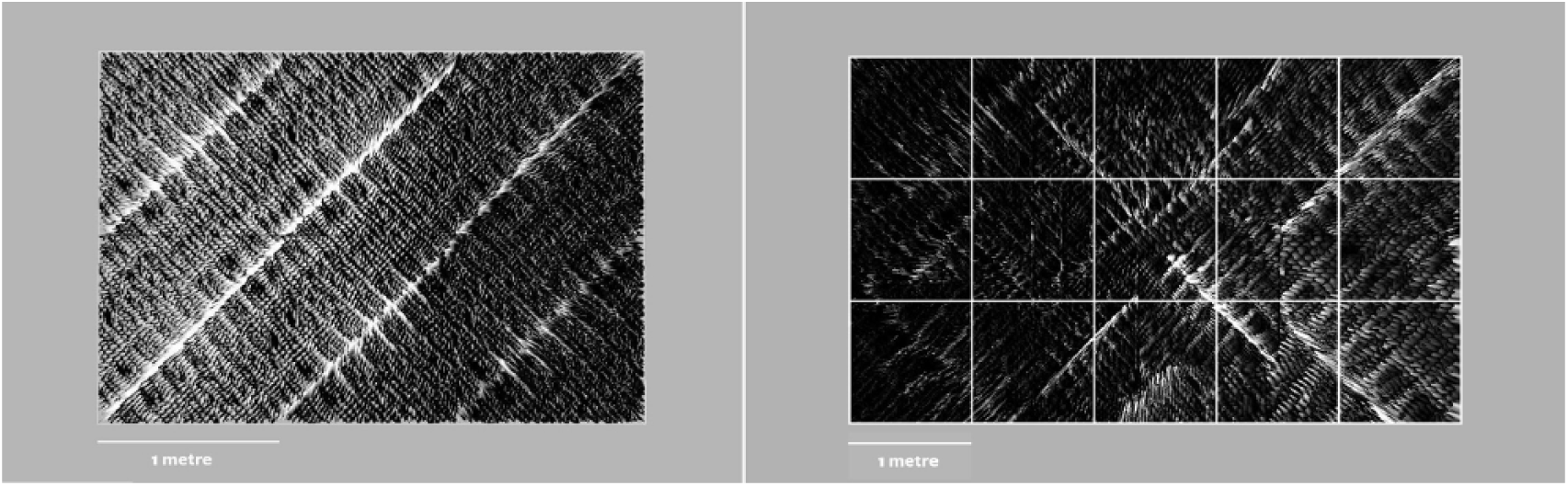
Left: Fraunhofer pattern adapted from a digital raster pattern transformed into a flat modular screen of 6 × 1 m2 assembled units; Right: hypothetical assembly of 1 m2 modular units into a façade screen showing scale and varying orientation of the arrayed pattern. Images © Linda Matthews (2015).
Conclusion
The reconsideration of the glitch within an architectural field raises dual issues of disciplinary productivity and agency. Its transformation from a perceived ‘systemic flaw’ to a productive architectural tool is made possible by the blending and subsequent application of two independent systems, one electronic and the other optical, to an emerging urban condition of ‘envisioned space’.
As a demonstration of glitch productivity, the tests underpin how new opportunities to configure the architectural surface might arise from the orchestration of a natural collision between an existing physical system and the way in which a digital camera receives and disseminates visual data. A key outcome of the tests is the ready availability of diverse design solutions drawn from the sheer volume of naturally occurring phenomena. The capacity to customise diffraction patterns to accommodate a bespoke contextual response is thus limitless, with a building’s specific camouflage requirements able to be tailored to its specific programme and location. The tests also showed that the exact dimensions of the pattern will need to vary in order to respond to the different resolutions of the aerial camera’s trajectory. This suggests that a range of pattern scales and orientations, possibly fractal variants of the original pattern, need to be incorporated into a single, hybrid surface to comprehensively disrupt the ability of a moving overhead camera to capture coherent imagery.
The intention to magnify the degree of visual aberration in a camera’s reception of a building surface also aligns this work with newfound disciplinary agency. Reconceived as the contemporary digital version of a long-standing mode of representational disruption, the re-emergence of the purposeful diffraction glitch in modern mediating technology is a testament to the ongoing desire of designers to contest predetermined visual narratives that define not only urban space but the human condition. In this respect, by reinforcing the ambiguous, and by allowing the designer to draw upon an endless array of formal and material possibilities, these techniques transform the glitch from a ‘flaw in the system’ into a productive political tool.
Footnotes
Declaration of conflicting interests
The author(s) declared no potential conflicts of interest with respect to the research, authorship and/or publication of this article.
Funding
The author(s) received no financial support for the research, authorship and/or publication of this article.


