




Abstract
This article proposes that designers and planners can better manage wicked problems by developing a strategic alignment of computational technology with a theory of change. Together with an understanding of the most effective places to intervene in a system, designers’ informed use of technology enables them to orchestrate community action and leverage large-scale environmental change. Aligning technology with a theory of change deepens the relevance of computational tools and suggests that technologies or tools that augment one’s ability to perceive, understand relevance, or prioritize raise the potential for action; technologies or tools that aggregate information on collective beliefs or actions help to build a community of concern; and technologies that elevate community capacity and create a sense of identity can contribute to the long-term transformation of values. Through a case study, this article demonstrates a nested approach to computation, which enhances public awareness and enables action in a small community which is trying to manage an extra-territorial problem of air quality. This article also proposes that while computational tools have extended the reach and effectiveness of advocacy, designers should continue to push for expanded application. By aggregating lessons learned from technological networks, such as the emerging clean air network described in this article, we can add another socio-ecological dimension to the practices of landscape and urbanism.
Keywords
Introduction
Technology as a lever of change in the environment
Computational tools, like other types of tools, are often created for narrow applications, perhaps created to fulfill a distinct need and to address a limited set of issues. For a tool to proliferate beyond its inception, it needs to be adopted by a cohort, adapted as the task is better defined, reapplied in situations for which it was not originally intended, and possibly considered as part of an ecosystem of technologies contributing to a larger campaign or effort. The cycling of tools, computational or otherwise, and the use of the tools within a network are instructive as we examine how computation can leverage change in a system.
While computational technology in any of these areas can advance practice, no single application can address multidimensional and complex systems such as the socio-ecological issues surrounding air quality. This article proposes that designers and planners facing wicked problems should consider an ecosystem of technology and computational tools within an arena of action, and that the use of the tools should be informed by a theory of change (see Taplin et al. 1 ) and aligned with the most effective places of intervention in a system.
Millvale’s Breathe Easy project: the wicked problem of air quality
While communities have to surmount a myriad of visible problems, contending with acute “invisible” issues like poor air quality is challenging, especially in communities like Millvale, Pennsylvania. Millvale and its metropolitan region of Pittsburgh, Pennsylvania, have consistently ranked in the top 10 regions in the United States with the worst air quality. Not surprisingly, Millvale’s population has high levels of related illnesses such as asthma, lung disease, and cancer. In Millvale, the general public’s understanding of air quality often focuses on the body as a sensory indicator, either through the levels of related chronic diseases like asthma or through the daily perception of odors and smog. However, the body is an imperfect sensor, and even computational augmentation has limited outcomes. Air quality is ephemeral and difficult to perceive or control. Illnesses can take decades to develop, and years of exposure may quietly develop into difficult-to-attribute illnesses. It is possible to combat the challenge of poor air quality at the corporeal level through sensory awareness and adaptive behavior, but it is a narrow opportunity for the application of technology (Image 1).
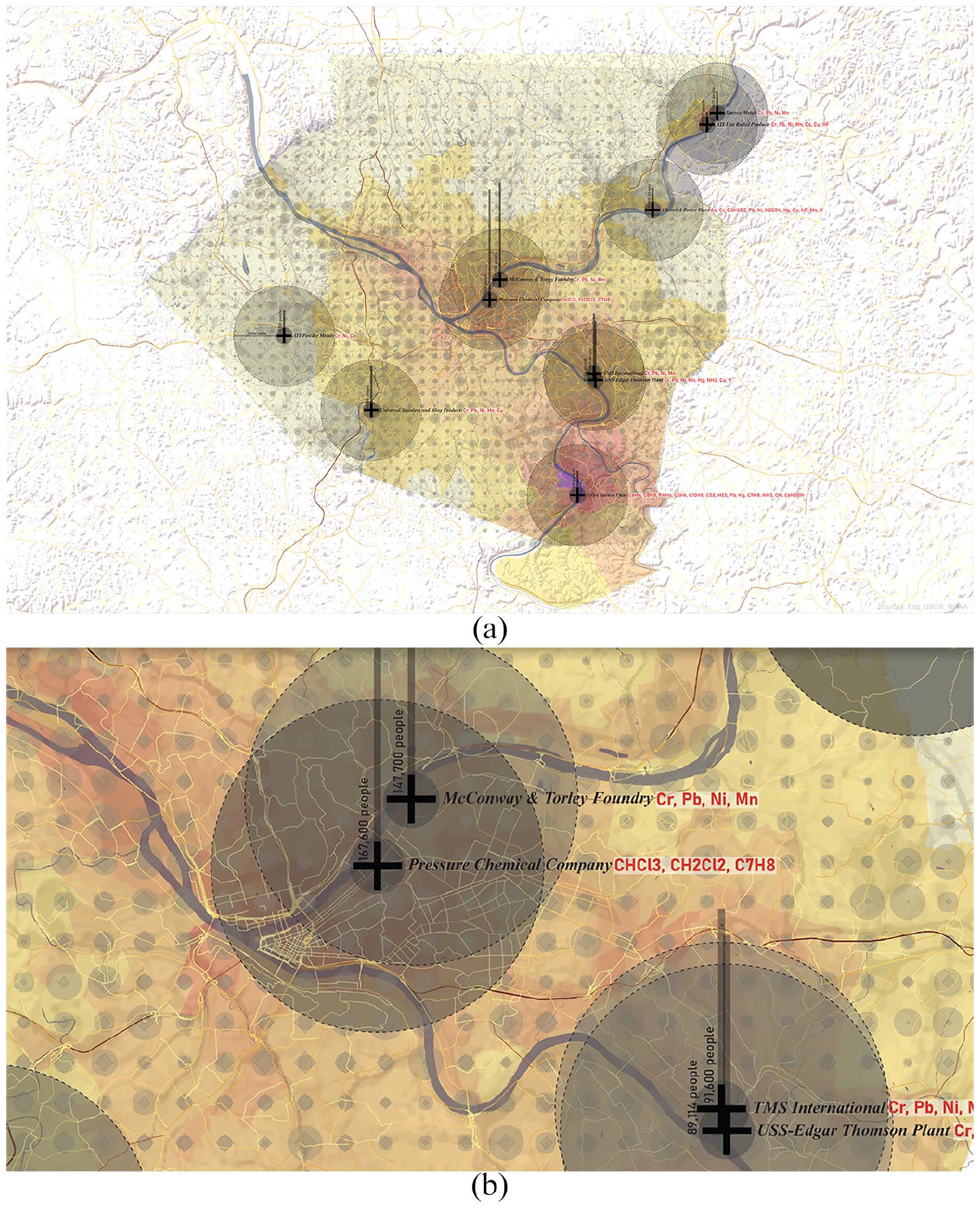
(a) Allegheny County air quality map showing pollutant matrix and major emitters. (b) Allegheny County air quality map detail.
Millvale’s poor air quality is the result of a collection of agents whose aggregated actions create a difficult-to-control macro-scale system. Pollution emitters are both large and small, mobile and stationary, located in close proximity or outside the region. The movement of air is not controllable or predictable. Although access to breathable, unpolluted air is as essential as access to clean water, it eludes the structure of standard systems of infrastructure. Computational tools that monitor air quality, or operate emission controls, can inform the management of smaller elements within the system, but they are used without coordination, and while computation informs management of the physical infrastructure, the management of the system as a whole is a socio-ecological problem—not a technical problem. Within this context, tools need to be evaluated in their capacity to leverage change, whether that be collective action or physical change in a system.
Addressing both the macro- and micro-scale system issues, Breathe Easy is a campaign of coordinated actions and tools to mitigate poor air quality in the Millvale Ecodistrict in Millvale, Pennsylvania. The project began in 2014, funded by the Heinz Endowments, and is in a small town just outside of Pittsburgh. It involves residents, community organizations, regional institutions, and national actors—each of whom have a unique intermediary role in the fight for clean air. The goal of the project is to empower individuals to take action at a local and system-wide level, by relying on layers of computation to create expanded feedback loops, allowing the outcomes of each tool to compound and leverage changes within the larger system.
In Millvale, the coordinated use of technologies through Breathe Easy is supported by The Breathe Project—an air quality campaign funded by the Heinz Endowments. Breathe Easy has tapped the projects and organizations of the Breathe Project to create a formal and informal network and an emerging digital infrastructure around air quality with computational tools that are essential to perceiving, engaging, and managing an infrastructural system. Together, the agents in this network have successfully lobbied the regulatory agencies for stricter enforcement, and the network has created an increasingly insistent public discourse highlighting that current levels of pollution are no longer acceptable and pressing for regulatory action. Millvale and other communities are considering zoning ordinances to limit sources and resident exposure through stricter building code requirements in areas of high pollution. Property owners have improved their properties and individuals have modified their behavior to avoid exposure to pollution.
Breathe Easy’s arenas of action
The Breathe Easy project identified three arenas of action that describe opportunities to mitigate pollution in the physical environment. They were formulated by organizing best practices into operational categories, each with a different set of actors, regulatory mechanisms, and resources and each with a different opportunity for deploying computational tools.
Environment as source
The most effective arena of action is to limit the release of pollution. Technology, in the form of adaptive controls and monitoring, can directly control emissions, whether it be from a car or a factory. While this is a well-accepted practice, it is unevenly implemented and has limitations. Technologically, many of the major emitters near Pittsburgh perform poorly because their older controls are not able to monitor and adjust emissions. Regulation sets the goals for all control systems, and enforcement can be difficult. Compounding these factors, feedback loops connecting emission and effect are often broken, as sources of pollution are often spatially remote from their area of impact or have a long time frame until negative consequences are known. Millvale residents have the greatest control over local point sources, mobile sources, and indoor air quality; however, these sources contribute far less than the emissions from difficult-to control regional and out-of-state sources.
Environment as mediator
Buildings and landscapes serve as direct and indirect mediators of atmospheric conditions. Technologies, like embedded sensing and responsive controls, can modulate a building envelope based on temperature and air quality, and mechanical and biological systems can filter air for optimal interior environments. Exterior building materials that capture pollutants and vegetative solutions may have some diffused localized effect and are important to global environmental quality. Millvale has opportunities to create structures and landscapes that can serve as protection or filtering devices for residents.
Environment as indicator
The environment can inform a person of the need to take evasive actions, serving as a prosthetic device that extends the senses. Adaptive behavior requires that a person perceives the condition, understand their options, and be able to act accordingly. Technology can inform a person’s choices to remain indoors, to put on a filter mask, or to take other evasive action. While it may seem that individual agency informed by computational tools is important, this information is not useful if the person has few options to avoid pollution—this inability to avoid exposure is at the core of environmental justice rationale. Millvale residents have some ability to limit their environmental exposure if they understand the risk and the options for action.
The arenas of action expand upon the research of Stephen Ervin and others who are proposing frameworks for the role of technology in the environment. In Ervin’s 2 article, “Turing landscapes: Computational and algorithmic design approaches and futures in landscape architecture,” he describes the various platforms in which computation can be applied, including, but not limited to, computer-aided design, the finding and manipulation of shape grammar, and embedded computation in an Internet of Things. Ervin summarizes three ways to deploy technology: (1) software can be used within the design process to simulate and generate formal logics and evaluate functional systems, (2) embedded technologies and adaptive physical environments create reactive landscapes that can actively respond to dynamic conditions, and (3) information about the environment can create a two-way exchange between users and environments.
Ervin’s findings have implications for how designers operationalize technology and how we define the scope of the design problem. Because there are few pollution sources in its direct control, Millvale’s most direct means of action is to limit exposure, either through technologically enabled and responsive environments or by adaptive behavior informed by environmental indicators. These arenas of action align with the latter two points in Ervin’s framework, reactive landscapes, and two-way exchange between users and environments and can be strengthened with a theory of change model that describes how we might respond to these landscapes.
Engaging in all arenas through a theory of change
The Breathe Easy project leaders determined that all arenas of action were important and that the most difficult arena—source control—was in fact the most effective in terms of reducing emissions. To keep all arenas open, the Breathe Easy project invented, aligned, or applied computational tools with a socio-cultural theory of change to create a complex web of actions that is replicable in other settings.
The Breathe Easy theory of change 3 was created through a multi-tiered approach that connects the individual to the greater whole. Technologies were used to raise the awareness of individuals, to create activated citizen cohorts, and consequently to build networks of concerned communities. The premise is that individuals can best be reached through their lived experience. They become part of a cohort through the validation of shared experiences. Groups of concerned citizens have greater strength and are able to articulate and advocate for their shared values and leverage the larger system. This is especially important when the lever for change is in the political realm, with the governmental agencies that set or enforce regulations on the emitters (Image 2).
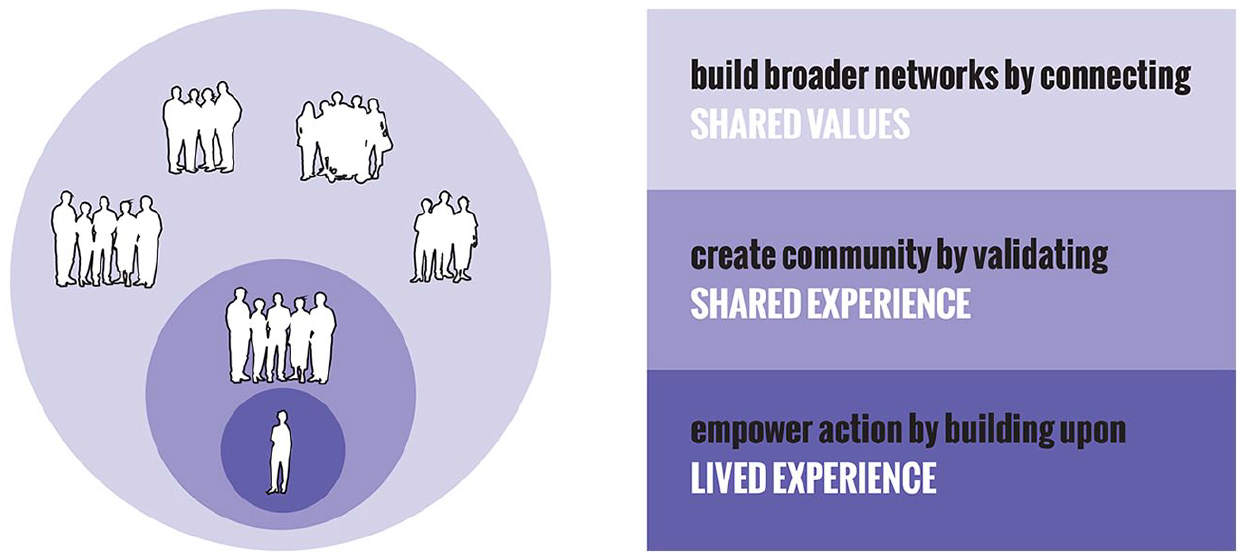
Breathe Easy theory of change diagram.
Technology’s role is unique at each level. Lived experience is deeply meaningful to individuals as we all ultimately perceive importance in relation to our egocentric worldview. Technologies or tools that augment one’s ability to perceive, understand relevance, and prioritize increase the potential for action. Shared experience is a validation of individual perceptions and beliefs; technologies or tools that aggregate information on collective beliefs or actions help to build a community of concern. Finally, shared values result from broader networks that are prepared to take action on their beliefs. Creating communities of action depends on the community’s capacity and may be defined by the group’s ability to share knowledge and make decisions, its legal standing, and its available resources. Technologies that elevate community capacity and create a sense of identity can contribute to the long-term transformation of values.
The focus on the transformation of values aligns with the findings of Donella Meadows’ 4 seminal work, “Leverage points—places to intervene in a system.” Meadows’ 12 points can be characterized in three categories, from least effective to most effective—leverage points that control quantities or flows of a system, lever points that change the design or structure of the system, or lever points that change the goal or paradigm of the system. Meadows asserts that the latter, changes to mindsets, goals, or paradigms, are the most difficult to achieve, but also the most durable. For example, if one wants to prevent the ill effects of smoking, one can increase the price of cigarettes or change the design of the cigarette itself. However, until there is a new societal norm that categorizes smoking as not desirable, there is a high likelihood that previous patterns of consumption will reemerge when the restrictions are removed.
Thus, the most effective places to intervene in a system are also the most difficult to attain and are at the heart of the environmental justice argument—the changing of socio-ecological values in a way that transforms the goals or paradigm of the system. To this end, technology that builds social networks and aids cultural alignment can collectively define new social or cultural norms, such as the fundamental right to clean air and water or a societal commitment to net-zero emissions.
An ecosystem of technology
As a long-term project, Breathe Easy’s goal was to build on this approach by deploying an ecosystem of technologies, which shift values through lived experience, shared experiences, and action. Some technologies raised individual awareness and constructed new shared knowledge. Others deepened engagement and enabled transformed spatial practices. The application of technologies was both premeditated and opportunistic and was considered part of the iterative process to advance the theory of change.
It was helpful to learn from projects that expand our ability to sense and understand our environment, with the belief that knowledge may change behavior or influence values. Some of the most profound examples function on both technological and socio-cultural levels. For example, Natalie Jeremijenko et al.’s 5 Feral Robotic Dogs was intended to detect and gather around areas of pollution, alerting their human companions to its presence. The power of this project is twofold: it is a perceptual prosthetic device, while its spatial practices cross the uncanny valley by recalling a hunter–hunting dog relationship. Other projects make the direct connection between knowledge and action, such as Nuage Vert (2008), a project in Helsinki where real-time data illuminated the emissions from a regional power plant, adjusting to the minute-by-minute demand of energy use and providing visual feedback for changes in behavior. Although future installations were criticized as an aesthetic overlay without the ability to take meaningful action, the project sparked robust conversation. 6 Similarly, other installations combine knowledge with aesthetic appeal, such as Studio Roosegaarde’s 7 stoking of consumer desire for beautiful jewelry created from the emissions captured with their Smog Free Towers. The tower is not simply a technological solution or a communicating device but becomes an indirect means of changing a societal value.
The installations described above enact indirect impact on their environment, but they highlight the complex relationship between technology and cultural practices. However, they represent a singular provocation and, while effective in raising global awareness, they are not sustained or systematically deployed in a way that directly changes practices. The Breathe Easy project developed tools, or used the computational tools developed by others, to embed air quality more deeply within the community’s concerns. The technologies were deployed at three levels, based on the theory of change.
Breathe Easy used technologies and tools to augment individuals’ abilities to perceive pollution and understand its relevance, raising the potential for action
1. Millvale’s Air Quality Dashboard is a graphic representation of complex monitoring data, with an emphasis on clear calls to action and data translation.
A simplified interface, compelling graphic imagery, and distillation of key technical data make the information more relevant and easy to understand. In addition to the technical data, the air quality is distilled to somewhat ironic and relatable commentary (Image 3).
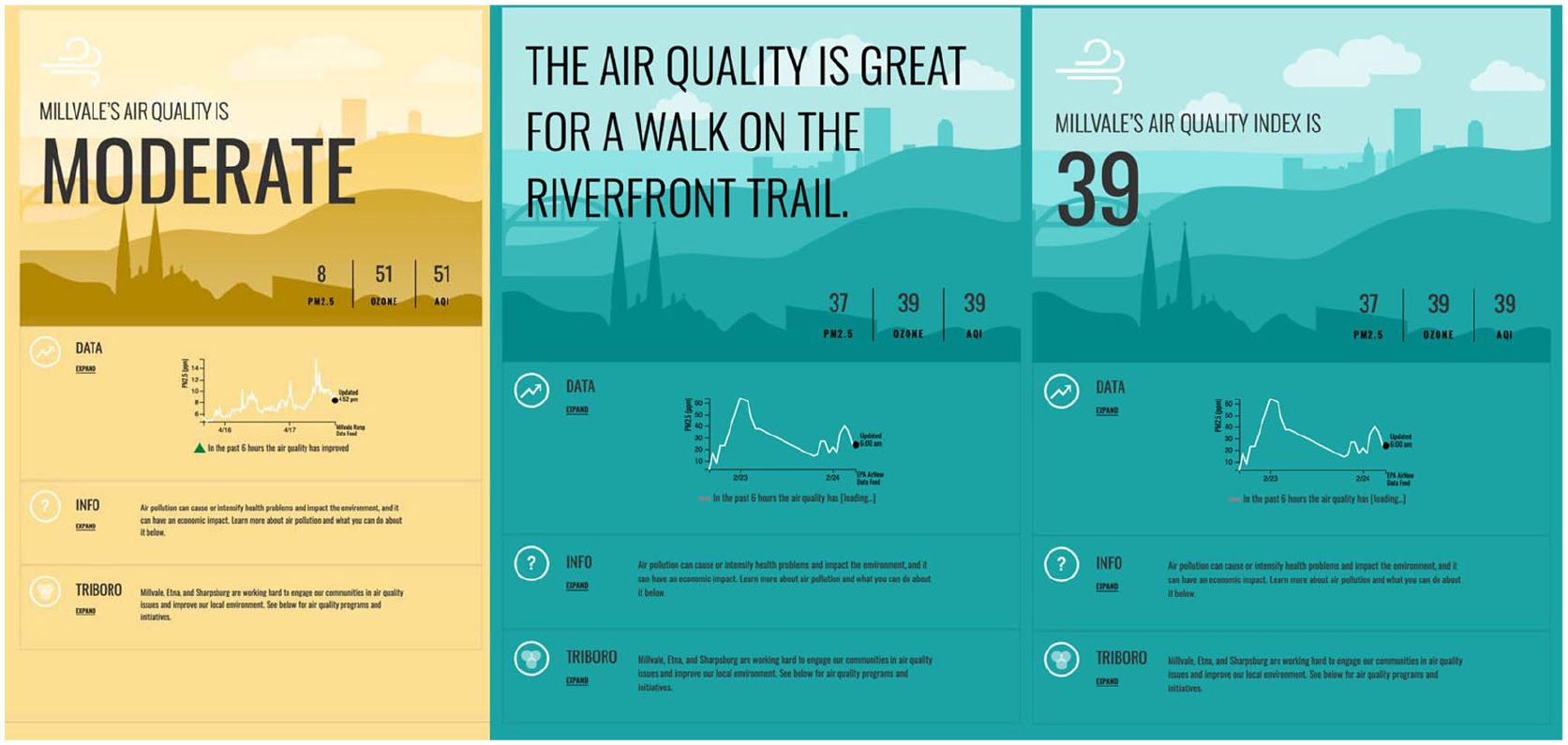
Millvale’s Air Quality Dashboard.
The dashboard is available through an app, a website, monitors in public spaces, and Spatial Dashboards—site installations that create immersive displays. The web-based dashboard provides information on three levels. For easy engagement, an “ambient narrative” of observations and recommendations is prioritized over technical data. For those with more time or interest, additional data are layered with an opportunity to engage a social network, and finally, a more robust level of technical information is provided for those who may be interested in deeper inquiry (Image 4).
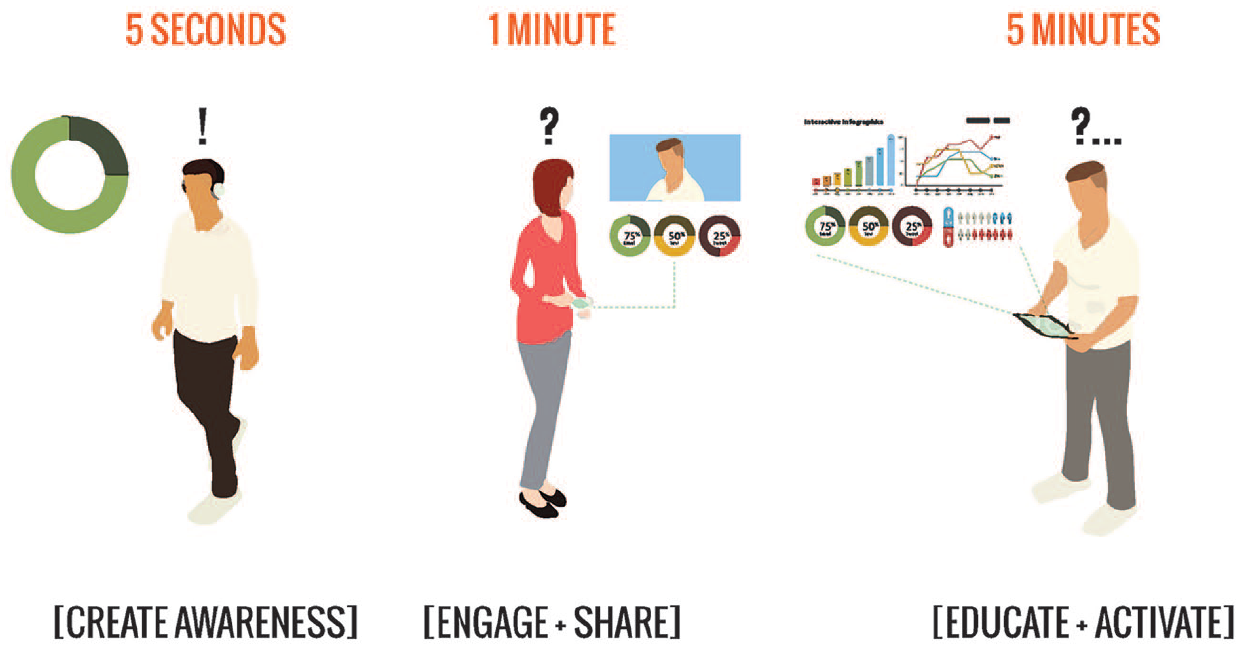
Breathe Easy interaction diagrams.
2. Modeling: The Heinz Endowments (who also funded the Breathe Easy project) has funded Carnegie Mellon University researcher Albert Presto to develop a Pollution Map at a 5-m resolution that models the average annual concentrations of different pollutants, based on 3 years of air quality monitoring data from a mobility laboratory and 70 sites. This map has been used by many to illustrate the relationship between sources, exposure, and adverse health effects.
Breathe Easy used technologies or tools to aggregate information on collective beliefs or actions and to establish a community of concern
3. The Breathe Easy AQ Station creates an interface for the real-time, affordable, multi-pollutant (RAMP) sensor data with installations that encourage users to perceive and report the pollution. Currently under construction for six sites, these installations attempt to bring attention to the air pollution that residents often perceive as normal. The AQ Station is a perceptual frame for seeing the air quality, encouraging people to stop, notice, document with a photograph, and post the evidence to a website that establishes a community of concern (Image 5).
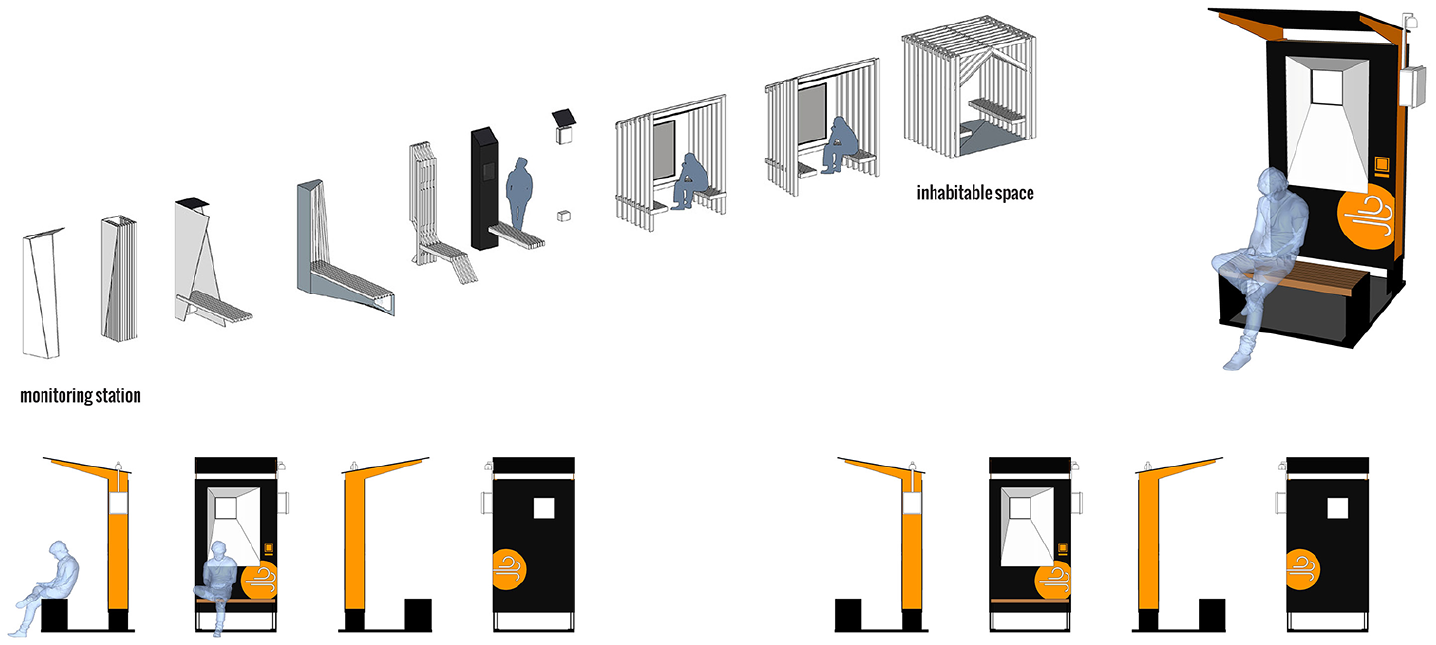
Breathe Easy monitoring stations.
4. Purple Air sensors 8 enabled residents to become aware of their physical environment and see their data as part of a regional or national trend by adopting off-the-shelf consumer monitors. In an attempt to help residents make informed behavioral choices, monitors show data when users check their regional maps. They also discover who shares their concerns as they see the locations of other citizens who maintain monitors. The results on a Purple Air map show pollution levels as well as concentrations of concerned citizens.
5. The Reducing Outdoor Contaminants in Indoor Spaces (ROCIS) program 9 encouraged residents to become citizen scientists and monitor their dwellings inside and outside. Through the program, residents could borrow monitors, including Speck and Dylos monitors, to provide an immediate feedback loop that suggested short-term behavior and spatial changes. In addition to providing immediate feedback on environmental conditions, the ROCIS program aggregated data to determine geospatial trends.
6. RAMP sensors 10 provided more verifiable data. The network of equipment deployed across Pittsburgh is a project by Carnegie Mellon University’s Center for Atmospheric Particle Studies (CAPS) and provides a more nuanced understanding of the movement of pollutants through the city. The RAMP network added fidelity to the limited information gathered from the ROCIS program and compliance monitors positioned near to emitting sources.
7. The SmellPGH app 11 is a perceptual mapping tool created by Carnegie Mellon’s Create Lab and was used actively by Millvale residents and others across the region. SmellPGH gathers data by using the body as a perceptual device, asking the user to describe what he or she smells. The app socially validates user perceptions by showing the smell report indicator on a map with aggregated user data. Finally, the app provides scientifically monitored data to inform users of the actual conditions. Most importantly, it directly facilitates collective action by asking whether the user wants to send his or her report to the regulating agency—the county health department. The accessibility of the app and its data has allowed it to be used extensively by the community in a range of contexts, from public testimony to artists’ works like Ginger Brooks Takahashi’s Braddock Poem.
Breathe Easy–employed technologies that change visible behaviors and create a sense of identity can contribute to the long-term transformation of values
8. Spatial dashboards. 3 Data can be translated spatially into immersive or large-scale environments that give visual and experiential presence to otherwise ephemeral data. The environments can change, with unique characteristics or spatial qualities of differing data conditions. The environments range from a forest that is monitored for pollution removal services—an invisible process made visible with a constellation of indicator lights—to the animation of parks and highly visible community landmarks with artist installations. In the former, the environment of the forest becomes a dramatic nighttime experience, as that is when the majority of regional pollution events occur. The latter advances a regional practice of landmarks serving as indicators of local conditions, such as skyscraper peaks that are lit to communicate future weather forecasts (Image 6).

Breathe Easy spatial dashboards.
Critique and next steps
The Breathe Easy project has made great progress since the publication of its planning document in 2016 and has demonstrated that when people have access to—and an understanding of—air quality information, they may use their urban context differently. To this end, computational tools have extended the reach and effectiveness of advocacy, and activated residents have made changes to their physical environment, extending the benefit to the broader community.
While this is admirable, the Breathe Easy projects thus far still rely on the communication of information either to change individual behavior or to promote collective advocacy. Breathe Easy’s future projects need to push for expanded application of technologies—especially in the restructuring of the public realm—to inspire and enable new spatial practices. For example, the Breathe Easy project speculated on a network of safe harbors and zones that could create visibly different spatial practices and open new opportunities for community formation.
The safe harbors and zones are networks of places that could shift focus from the functional value of air quality technology to the social significance and cultural meaning of air quality practices. Since air quality technologies are still in development, it is helpful to look at the integration of new practices in early stages of technological adoption, 12 such as the transformation of driving to make other practices possible to motoring as a practice. 13 Future Breathe Easy projects, such as those mentioned below, offer the opportunity to address the cultural meaning of air as a way to “reproduce and enact registers of social distinction” and further the values-shift in Breathe Easy’s theory of change.
Clean air library: During Breathe Easy, the newly created community library was established as the first clean air harbor, with mechanical systems creating higher quality air than might be available in homes and other businesses. Residents can check out monitors and filters. This is a literal translation of technology to solve the air quality issues. However, there are unexamined aspects to the library that offer intriguing opportunities for technological and poetic expansion, especially when considered with a crossover of cultural and technological practices inherent in Jeremijenko’s pollution sniffing dog project. Could the books themselves become an air quality sensor or mediation device? How could their circulation enable better air quality or data collection? Perhaps, in the course of checking out a book and bringing it to one’s home, some added device or material cleans the air or, with permission, records the air quality in their home. Returning the book catalogs the air quality of homes in the community, creating a new repository of data with corporeal presence. Like British artist Michael Pinsky’s 14 Pollution Pods, the data or material collected could recreate a library of sensory experience and create a center for shared understanding.
Clean air cafe: Breathe Easy offered a certification system for businesses to become clean air harbors and to display their designation in their storefronts, effectively becoming a “network of healthy places” in the community. Again, extending this idea one step further, through the use of additional technologies to create clean air bars, could demonstrate the value of clean air through its commodification. As they are currently marketed, oxygen bars are for user enrichment and not remediation, and appeal to a demographic far wealthier than Millvale’s working-class residents. Playing on the perception of oxygen as a premium product, residents in certain high-exposure zones would be credited with visits to the bar, ideally stoking a desire to partake of a benefit, not avoid a negative condition. This approach may be rife with pitfalls but should be examined as the location and design of these spaces offer potential for new spatial practices for a community that has a history of small places of consumption such as bars, pubs, and coffee shops.
Clean air park: The Gap Park is a vacant lot in downtown Millvale with a large area of pavement and a modest number of benches and trees. The slab of concrete covers Girty’s Run, a culverted stream that, like the air quality, is largely invisible to the community until there is an extreme condition like a flood. Breathe Easy identified this park as an area where sensors and responsive technology could be combined with planting and an enclosure system that reshaped the park given the air quality and water conditions. The physical reconfiguration of the park offers new opportunities for occupancy, as the proximity of living material and mediating technologies could create microzones for activities.
Clean air zones: The dense neighborhood of modest worker housing inspired an idea to create a clean air zone of buildings where exterior building materials clean the air and communicate the purpose. Research suggests that certain materials like titanium, some glass, and ceramics could potentially remove pollutants from the air. While there may not be a net benefit considering the embodied energy of said materials, the installation of pollution-sensitive siding and building envelope systems, combined with ubiquitous sensing and advanced building controls, raises the potential of a district where the building material and configuration can be read as a response to the current condition.
Emissions hive: A Millvale beekeeper who tracks the presence of invasive plants through her honey harvest inspired a proposal for a robotic bee-monitoring device that could dynamically track the sources, record the levels of pollution, and bring back material samples to be put into an emissions hive that visually records the regional air characteristics.
Conclusion
The goal of the Breathe Easy project was to empower individuals to take action at a local and system-wide level. Breathe Easy relies on layers of computation to create expanded feedback loops, allowing the outcomes of each tool to compound and leverage changes within the larger system. The Breathe Easy project’s theory of change translates to the use of technology in three ways: (1) technologies or tools that augment one’s ability to perceive, understand relevance, or prioritize raise the potential for action; (2) technologies or tools that aggregate information on collective beliefs or actions help to establish a community of concern; and (3) technologies that change visible behaviors and create a sense of identity can contribute to the long-term transformation of values. Breathe Easy’s approach has proven successful but needs to be expanded. Computational tools have extended the effectiveness of advocacy, but future projects that deliberately shape new spatial practices will provide greater opportunities for change.
The Breathe Easy project’s application of technologies through a theory of change has enabled real change to occur. Breathe Easy has created a formal and informal network and an emerging digital infrastructure around air quality, with computational tools that are essential to perceiving, engaging, and managing an infrastructural system. Together, the agents in this network have successfully lobbied the regulatory agencies for stricter enforcement and the network has created an increasingly insistent public discourse. Computational technologies have helped transform community values with an enhanced understanding that current levels of pollution are no longer acceptable and that the system will only change with collective action.
Footnotes
Acknowledgements
The authors thank The Heinz Endowments’ Breathe Project and Philip Johnson, PhD, Program Officer.
Author contributions
Anna Rosenblum and Chris Guignon (project managers); Daniel Klein, Elijah Hughes, and Marantha Dawkins; Zaheen Hussain (program manager); Brian Wolovich; and the Millvale Community Library contributed to this study.
Declaration of conflicting interests
The author(s) declared no potential conflicts of interest with respect to the research, authorship, and/or publication of this article.
Funding
The author(s) disclosed receipt of the following financial support for the research, authorship, and/or publication of this article: The Breathe Easy Project was funded by The Heinz Endowments.
