




Abstract
This paper is a concise report of Drawing Fields, a temporary performance venue on the campus of Ragdale, a nonprofit artists’ community just north of Chicago. Drawing Fields utilizes GPS-controlled field marking robots to draw site-specific, building-scale drawings on the Ragdale campus. Each drawing in the series explores a different theme with Drawing Fields 1 probing robotic kinetics, Drawing Fields 2 delineating socially-distanced zones for a scattered audience, and Drawing Fields 3 saturating the campus with colorful patterns. The report discusses the project implementation and includes a brief discussion of the project’s cultural, ecological and technological resonances.
Drawing Fields is a temporary performance venue on the campus of Ragdale, a nonprofit artists community located north of Chicago on the former summer retreat of Chicago architect Howard Van Doren Shaw. A private and idyllic refuge, Ragdale is considered a masterpiece of Arts and Crafts architecture. Shaw’s landscape approach constituted, as Ragdale historians Alice Hayes and Susan Moon describe, “an informal country setting” for his estate. 1 Native flora like violet deliberately invaded meadows with tree canopies growing wild and thick. Today, the estate’s sprawling grounds are well-groomed, however, reinforcing the idealism of the American pastoral lawn; a space replete of activity or occupancy.
With this bucolic setting providing an enormous canvas, Drawing Fields reimagines public performance amid ecological and health crises. The project appropriates semi-autonomous field marking robots typically used for marking sports fields to delineate temporary performance spaces throughout Shaw’s historic estate (Figure 1). Drawing Fields opens a discreet and private refuge to the larger community with interdisciplinary public installations and projects a vibrant and temporary public realm directly on the existing manicured monoculture. Drawing Field’s dynamic landscape paintings acknowledge the latent connections linking the Ragdale campus buildings, landscapes, and the larger region. The project combines technical drawing with robotics and on-demand media to produce unique collective experiences for a dispersed virtual audience. Drawing Fields proposes a model of prototyping wherein architecture can be impactful and at the same time inexpensive, temporal, and open-ended. This novel approach also allows the project to eschew the labor exploitation and waste consequences often associated with temporary architecture. Field marking robot painting drawing fields 2 on site.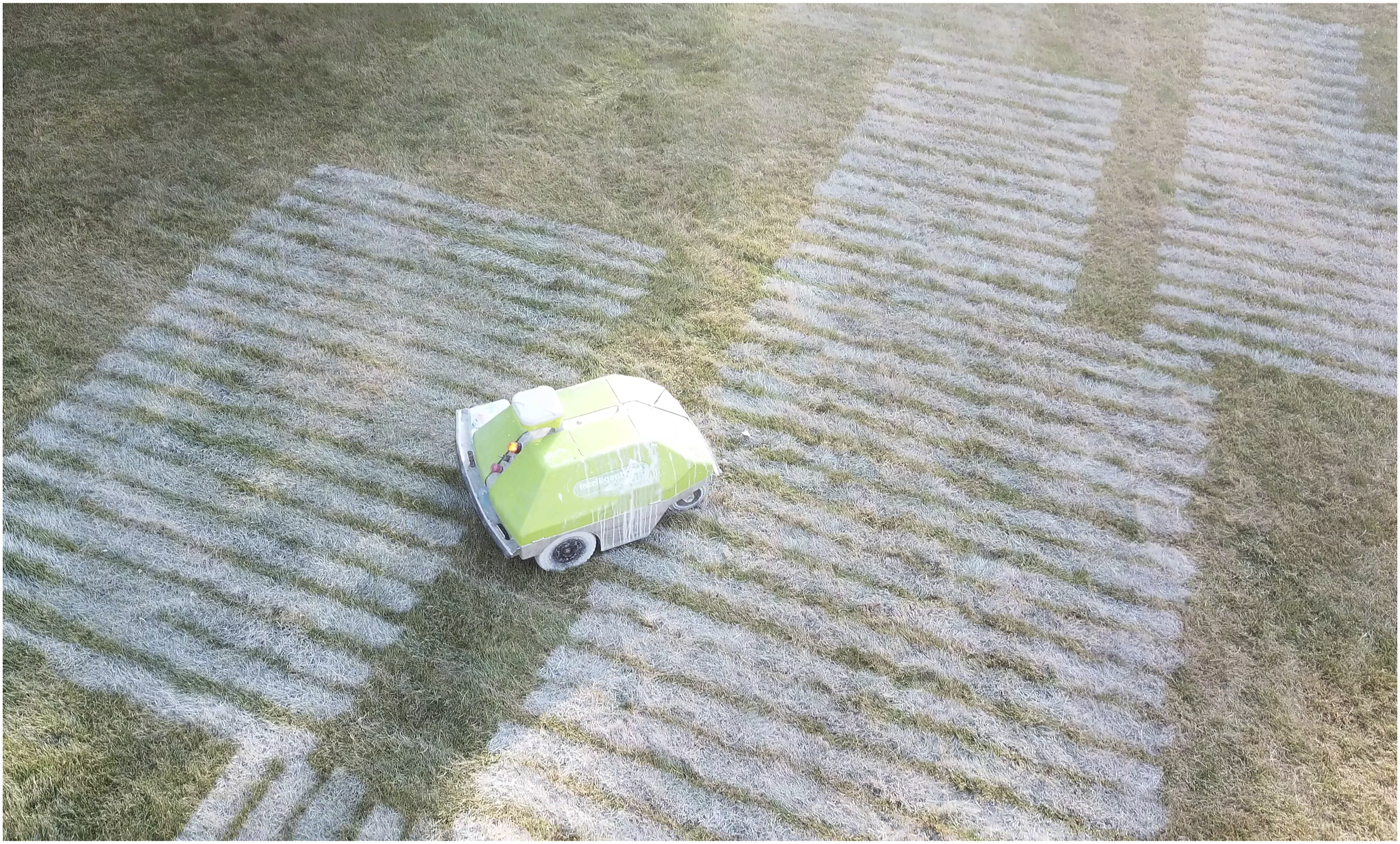
The story of Drawing Fields begins at the onset of the coronavirus pandemic. In early Spring 2020, Ragdale canceled all artist residencies, limited site access to a few essential staff, and ceased all public programming. With the organization suddenly unable to open its grounds to the public, two related design challenges emerged for Ragdale relating to its annual public performance venue: how to fabricate responsibly on a restricted site and how best to engage a radically distributed audience.
Drawing Fields proposes GPS-controlled field marking robots to draw site-specific, building-scale drawings throughout the Ragdale campus. The proposal recommended a series of monthly drawings or paintings in place of conventional large-scale structures. Each drawing performance includes contributions from collaborating artists, and events included public readings, interpretive dance performances, and music concerts. Drawing Fields is a spatial proposition and multimedia event requiring coordination between semi-autonomous robots, experimental performance artists, and aerial videographers. This unique mix of actors and agents made each performance a dynamic and challenging interdisciplinary effort.
The graphic scores of Drawing Fields calibrate to robotic kinematics, digital optics, and human presence. Drawing Fields 1, for example, focused on robotic kinematics (Figure 2). The end effector paint sprayer painted continuously as the robot roamed the Ragdale grounds, resulting in a set of lyrical gestures as the guidance vectors dictating the acceleration and direction of movement were modified. For the inaugural performance, contemporary dancer Sara Zalek adapted her rhythmic movements to these lyrical kinematics. Her improvised movements often echoed the idiosyncratic behavior of the robot as it crisscrossed the idyllic landscape. At twilight, a drone flew overhead to broadcast the performance for the first of three broadcasts. These broadcasts were critical to the Ragdale Foundation, as they aspired, despite the difficult circumstances, to provide dynamic performances free-of-charge to an extended digital audience. Photogrammetry scan of Ragale campus after drawing fields 2.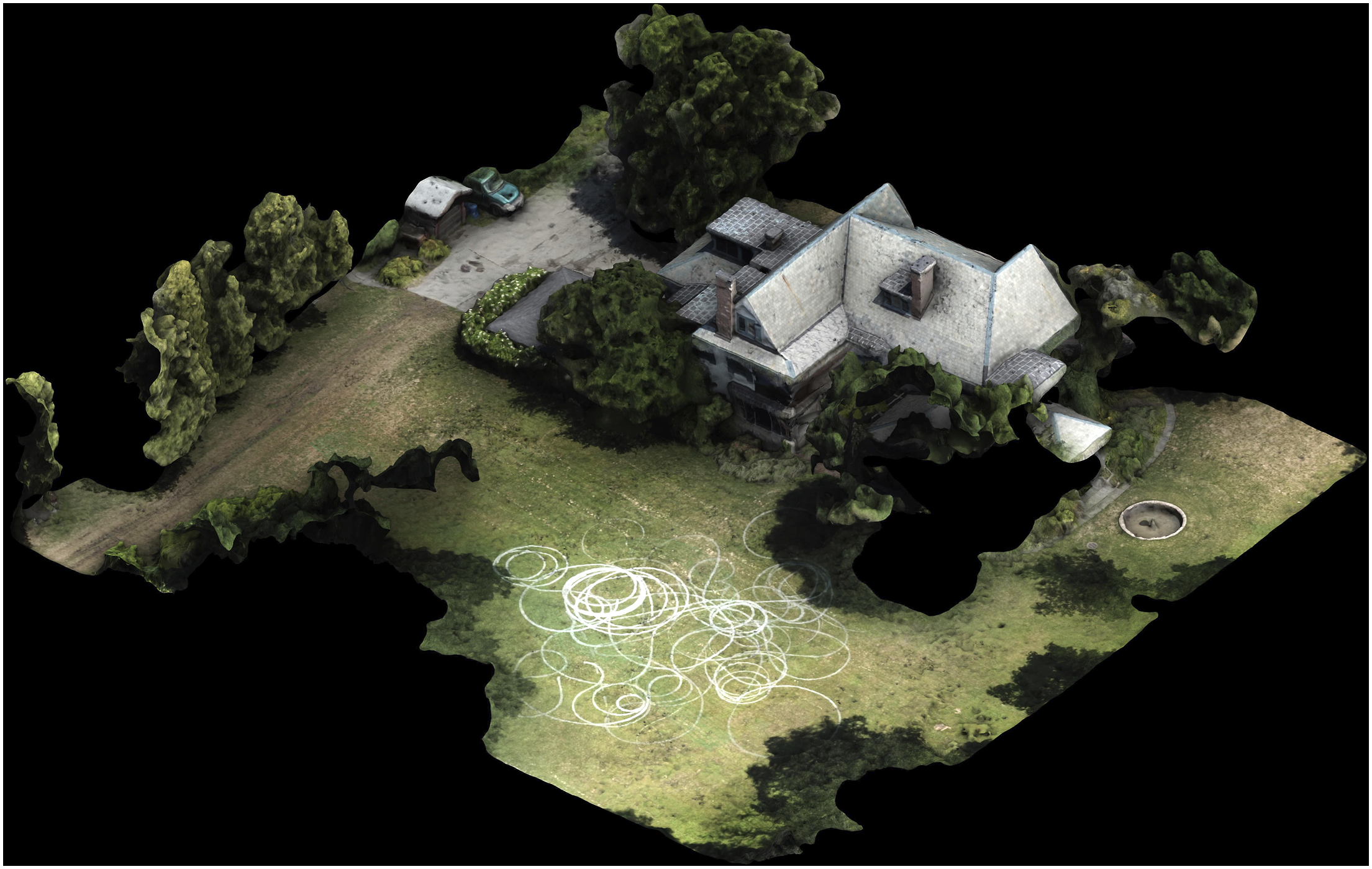
Drawing Fields 2 appropriates patterns used in the calibration of aerial photography (Figure 3). These patterns were an opportunity to educate visitors about the role of aerial photography and other semi-autonomous technologies to surveil and control vast territories. The typical application of the GPS-guided robot used in Drawing Fields is for the painting of sports fields. As a result, its onboard pre-programmed grammar includes sports field templates and a few geometric primitives like lines, rectangles, and circles. The Drawing Fields timeline was compressed and had a modest budget. The development of proprietary tools was out of the question. The project necessitated creative approaches to create dynamic, site-specific compositions with the limited repertoire of the robot. Drawing fields 2.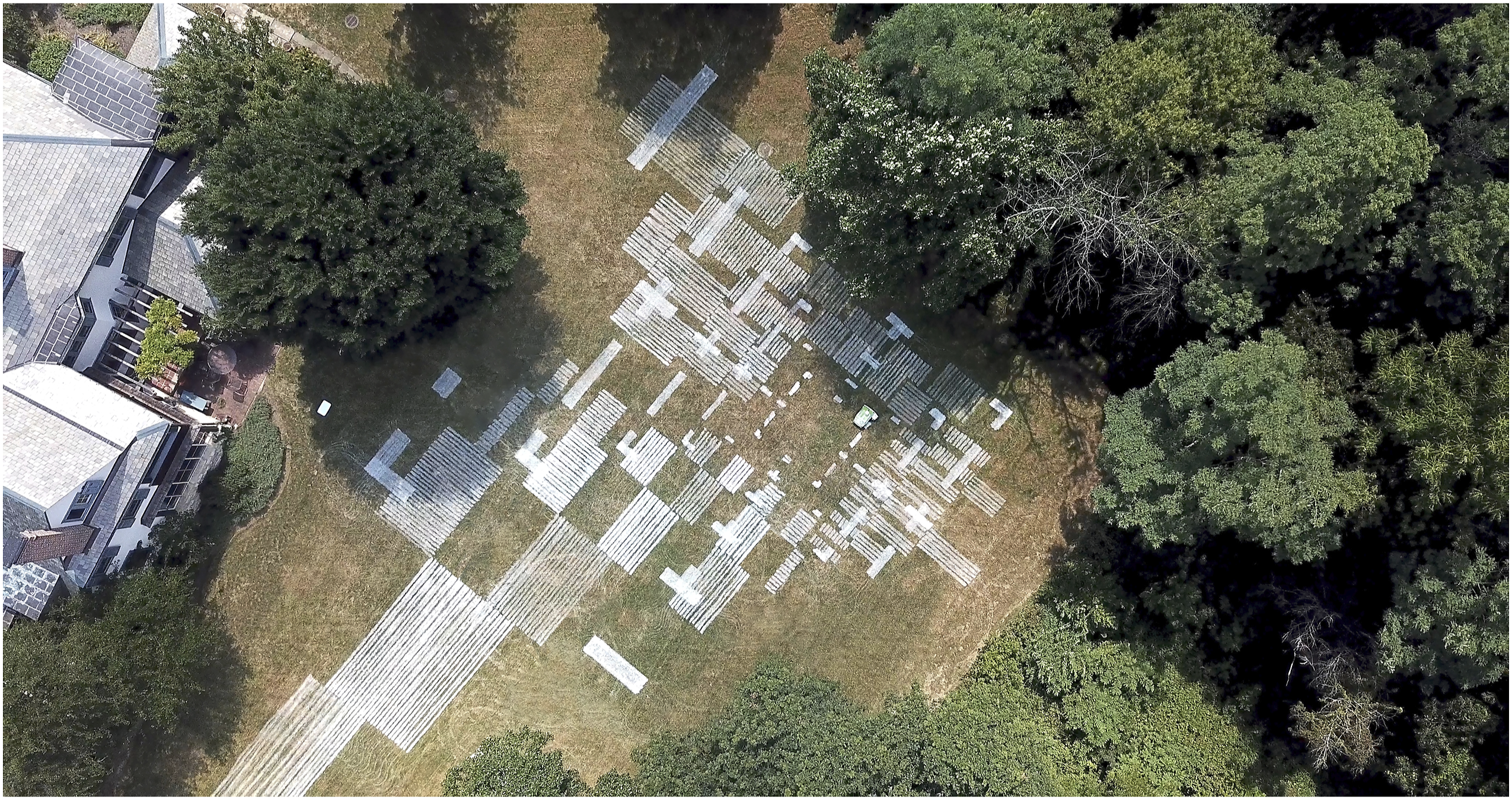
This scenario resembles early computer art when artists used crude peripherals like pen plotters to draw generative patterns with incredible perceptual effects. To automate their work, early computer artists developed algorithmic methods for generating complex patterns from discrete rulesets. These deceptively simple deductive or algorithmic rulesets produced intricate final compositions. This incongruity was perhaps best encapsulated by computer artist Manred Mohr, an early pioneer of digital design who once stated, “the paradox of my generative work is that form-wise it is minimalist and content-wise it is maximalist.” 2 Mohr was unique amongst his peers, staging live demonstrations of his drawing machine in art galleries. Computer artists generally mounted their work in galleries as static compositions, but Mohr’s drawing performances allowed visitors to follow the drawing process live, helping patrons better understand the rudimentary procedures and logic rulesets underlying his dynamic mechanical compositions. Drawing Fields performances follow suit with robots performing live during public events.
Drawing Fields patterns reflect the unique perspectives possible through aerial photography. The unique vantage points and kinematics of UAVs drove many compositional studies. Each public broadcast included extensive drone photography. Animations studied the perceptual effects of the drawing patterns in stasis as well as through rapid shifts in perspective. Workflows including generative parametric tools like Grasshopper considered the perceptual range of patterns based on the robot’s limited geometric repertoire. Studies explored variations in linework density, color, and other optical effects. Embedded perceptual phenomenon in Drawing Fields 2 includes embedded recursive patterns that amplify the effects of zooming in and out of the landscape.
The patterns, however, are also scaled for human presence, creating distinct, physically distanced zones for safe viewing. For Drawing Fields 2, Ragdale opened its campus to a limited, masked audience, and the design proposal delineated physically-distanced zones for families and individuals to watch the performance from a safe vantage. Visitors to Ragdale performances traditionally bring their blankets and chairs for spectating the events. The Drawing Fields 2 pattern functions as a large communal quilt that holds the audience together as a collective despite the exaggerated distances from one another.
The patterns appear crisp and precise from the perspective of drones overhead, but zooming in reveals all the idiosyncrasies created by the robot. The project attunes campus visitors to unique atmospheric or environmental qualities: subtle changes in humidity, sunlight, turf length, and even grass blade orientation dramatically alter the legibility of Drawing Fields. Many visitors noted how the vibrancy of patterns altered throughout a twilight performance.
These subtle differences were key for Drawing Fields 3 (Figure 4), which explored interlacing, a graphic technique for producing a full spectrum from a limited repertoire of colors, like how an LED screen mixes blue, red, and green light to create the spectrum of digital color. Applying green paint to the green lawn produces uncanny effects as the patterns draw in and out of focus. Drawing fields 3.
Drawing Fields adapts to financial and ecological precarity, mounted with few materials on a fraction of a conventional budget. There are no disposal costs or waste. Each installation is water-soluble, non-toxic, and disappears with rain, sun, and growth. Within a few weeks, the site is ready for the next ring. Drawing Fields suggests more opportunities for robotically-assisted spatial practices to engage the disjointed fabric of the built landscape. Projects like Drawing Fields offer architects the capacity to leverage spatial expertise to envision new collective spaces. Many image sequences of Drawing Fields reference Charles and Ray Eames and their famous Powers of Ten, a film based on a lakeside picnic staged in Chicago, very close to the Ragdale site (Figure 5). Charles and Ray’s project is a powerful precedent for Drawing Fields; a reminder of how media as an extension of architecture can communicate complex connections between space, time, and scale. Drawing fields 1 zoom sequence.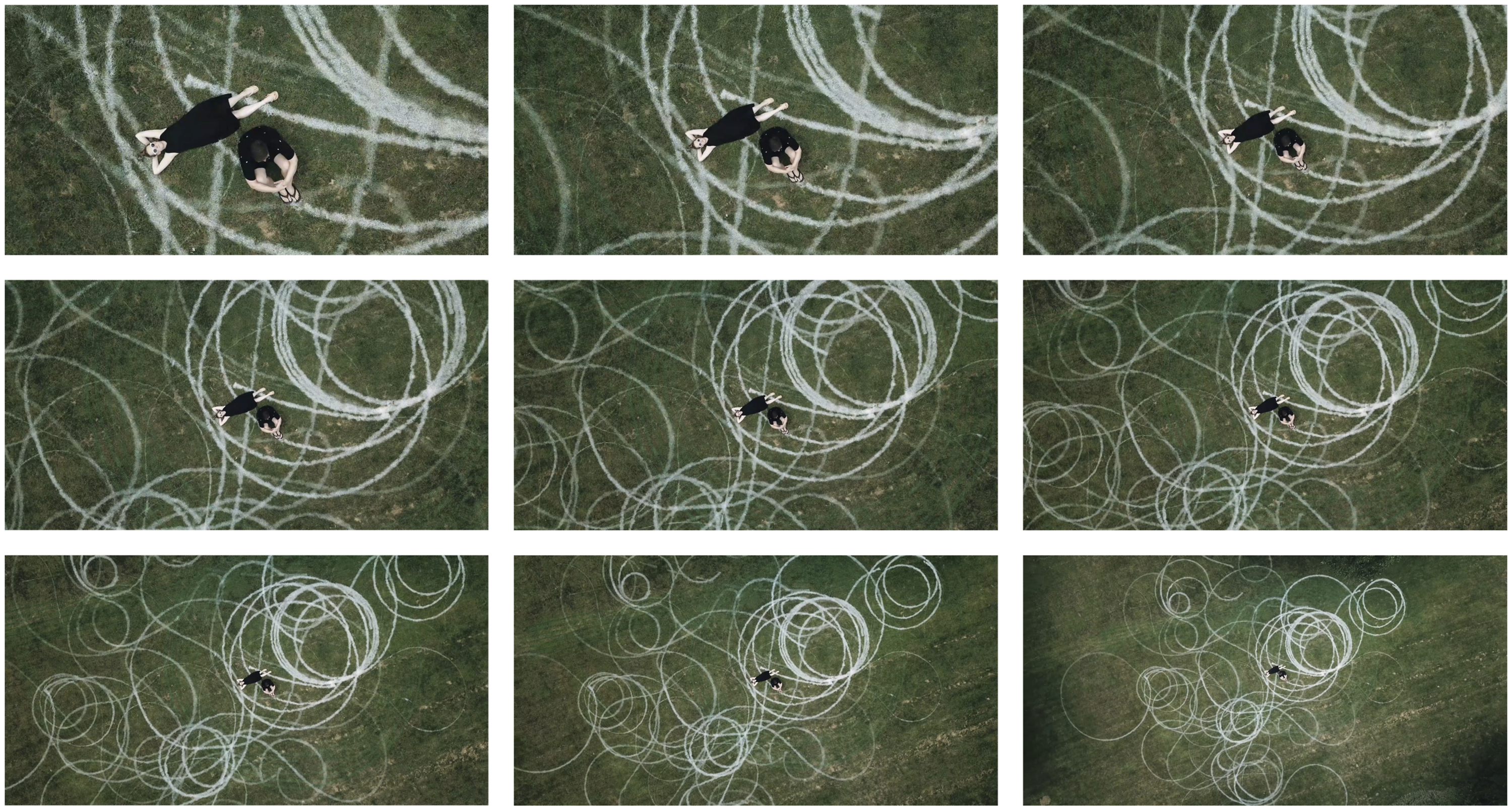
Footnotes
Declaration of conflicting interests
The author(s) declared no potential conflicts of interest with respect to the research, authorship, and/or publication of this article.
Funding
The author(s) received no financial support for the research, authorship, and/or publication of this article.
