



Abstract
Digital fabrication and its cultivated spaces promise to break disciplinary boundaries and enable access to its technologies and computation for the broader public. This paper examines the trope of “access” in digital fabrication, design, and craft, and illustrates how it unfolds in these spaces and practices. An equitable future is one that builds on and creates space for multiple bodies, knowledges, and skills; allows perceptual interaction and corporeal engagement with people, materials, and tools; and employs technologies accessible to broad groups of society. By conducting comparative and transnational ethnographic studies at digital fabrication and crafting sites, and performing craft-centered computational design studies, we offer a critical description of what access looks like in an equitable future that includes digital fabrication. The study highlights the need to examine universal conceptions and study how they are operationalized in broader narratives and design pedagogy traditions.
Introduction
Digital fabrication has caused a paradigm shift in architecture by transgressing dichotomies and boundaries between design and construction, craft and design, digital and physical, concept and matter, professionals and laypeople, South and North, and so forth. 1 For Picon, 2 digital fabrication is “as much a new narrative as a technological and social program.” Reliance on advanced methods and practices that this new narrative implies should entail understanding of their socio-technical (pre)conditions in moving toward inclusivity and equity. An equitable future is one that supports and makes space and time for pluralities of knowledges in design (among other practices). However, the practice and discourse in digital fabrication continues to prioritize technical merits: focusing on precision, accuracy, efficiency, and optimization as its primary evaluation criteria. This hierarchy of priorities inevitably results in the reproduction of mainstream conceptions of what counts as adequate design knowledge, leaving inherent messiness and uncertainty of design and making processes outside the scope. Thus, the subtle formulation of digital fabrication practices as one that privileges intellectual and technological knowledge is problematic in its prioritization of one type of knowledge above others.
In this paper, we focus on the question of access and how it unfolds through spaces and practices of digital fabrication, design, and craft. We argue that issues of access and equity in digital design and fabrication can only be addressed by revealing hidden, taken-for-granted ecologies and entanglements in acts of design, making, and teaching. Only after shedding light on omissions in knowledge making, and critically (re)contextualizing technology, can we advance inclusivity, equity, and diversity in our field.
Context
Equitable access to education in architecture continues to be an issue. Historically, exclusivity, lack of access, and separations between intellectual and manual labor have shaped the profession and its use of technologies. According to Vitruvius, architecture emerged from craft as a discipline, uniting practice (fabrica), and theory (ratiocinatio). Architectural education at the time was accessible only to free men obtaining a liberal arts education (ars liberalis). 3 In contrast, craft was an inclusive and accessible occupation that did not exclude slaves, women, and non-citizens. In the 15th century, Alberti et al. 4 continued to emphasize the architect’s intellectual labor over manual labor by separating the architect from the craftsperson, positioning craftspeople as “instrument[s] in the hands of the architect.” However, contemporary scholars have shown that separating and privileging labors, especially with the inclusion of technology, has obscured architectural labor and harmed the profession. 5
With the proliferation of computational tools and digital fabrication technologies today, architecture seeks to reunite design and fabrication in a single person and space, connecting bits and atoms in a cohesive workflow from computer-aided design (CAD) to computer-aided manufacturing (CAM). 6 Access to computational tools for material production through digital fabrication fosters “a renewed role in design thinking.” 7 Digital fabrication spaces play key roles as providers of skills and expertise through hands-on experience in design and fabrication. 8 However, issues like technology access, steep learning curves in acquiring technical skills, levels of automation, machine histories, and knowledge dissemination and documentation, are rarely raised in these spaces, clearly demonstrating that the idea of homogeneous processes in craft and digital fabrication is inadequate. 9 Advanced digital fabrication continues to reproduce gendered and colonial demarcation lines between theory and practice, laboratory and shop floor, science and craft, or mind and body. Research in science and technology studies, feminist technoscience, and postcolonial studies reveal that practices, processes, and communities of technology and design production have become associated with gendered and colonial images of technical knowledge, expertise, and authority. 10 So far, only a few studies have examined equity, social practice, and community empowerment through digital fabrication, local crafts knowledges, or the inclusion of differently-abled knowledges and perspectives in computational design processes.11–13
Research question
Against the backdrop of gender and colonial demarcation that defines the status quo of digital fabrication pedagogies and practices, our research questions are: How is access operationalized in digital fabrication? How are intellectual and technological knowledges privileged in computation? What knowledges exist in manual craft practices? Can a digital fabrication practice be rethought to center on access through inclusion of craft practices? We argue that a more equitable and inclusive future is one that builds on and creates space for multiple bodies, knowledges, and skills in making (and design); allows perceptual interaction and corporeal engagement with people, materials, and tools; and employs technologies accessible by broad groups of society. By combining scholarship and methods in design computation and science and technology studies (STS), we uncover the messiness of digital fabrication processes and account for excluded knowledges, histories, and geographies. By pairing ethnographic research on craft, design, digital fabrication, and questioning access in two different case studies, we offer a critical contextualization of what technology encompasses when it comes to an equitable future.
In the first study, one of the authors examines how access is operationalized in digital fabrication practices and spaces through compulsory machine training and related educational offerings. She participated in four training sessions as part of her multi-modal and multi-sited ethnographic survey of nineteen digital fabrication spaces in Western Europe and Canada between 2016 and 2018. The investigation follows methodological practices of “laboratory studies,” 14 which have expanded to cover practices and work in engineering design, architecture studios, and the free and open software movement.15–17 In the second study, another author investigates knowledges present in a craft practice—wire-bending—based on ethnographic fieldwork conducted in Trinidad and Tobago between 2012 and 2015. She then draws on design studies conducted in Trinidad and Tobago in 2017, a Situated Computations approach, 18 and a workshop she taught in architectural design education in the USA in 2019 where craft was used as a site and method for critical thinking about computation. Together, these studies shed light on and reconceptualize access and knowledges in digital fabrication practices.
This paper is organized as follows: the first section, Access, knowledges, and digital fabrication environments, examines how “access” in CAD/CAM workflows and digital fabrication sites miss underlying socio-technical elements by revealing the location of knowledge in these highly technical spaces and how they are shared. The second section, Access, knowledges, and craft-centered practices examines embodied and social knowledges in a craft-centered practice and demonstrates how we might integrate multi-modal interactions and knowledges in computational practices and pedagogy. In the Discussion, we describe what our findings mean and some of the work’s limitations. The Conclusion describes our contribution to the field and directions for future research.
Access, knowledges, and digital fabrication environments
Digital fabrication and its wider uptake across spaces for collaboration and peer production popularized the idea of material production through fab labs, makerspaces, and hackerspaces. Such cultivated spaces promise to soften disciplinary boundaries and enable access to digital fabrication technologies and computation for the broader public. 19 Though open to the public, primary users mostly include design and architecture professionals, engineers, and post-secondary students. Publicly accessible spaces for digital fabrication provide infrastructure if post-secondary institutions still lack such spaces or where students’ demands for studio projects and term assignments exceed institutional capacities. Thus, architecture and design students constitute up to a third of site membership. This study will illustrate that providing access to digital fabrication within these spaces is an intricate and complex undertaking. Access is often taken quite literally and lacks concern for and reflection of what (pre)conditions it. 20 A limited discussion of access misses underlying socio-technical elements like the roles of experiential and embodied knowledge, its codification in different material instances, material feedback, and the disconnect of CAD/CAM workflows. As the following case study will show, access to software and hardware does not inherently imply access to knowledges embedded in machines and their operators.
This study combines a document analysis approach with an ethnographic participant observation method described as “participant comprehension.” In the former, the author conducted a composite survey of training and course offerings at the research sites. Regarding the latter, participant observation suggests quiet, unobtrusive observations of interactions. When studying practices and technologies of a participatory phenomenon like digital fabrication, participation of the researcher becomes inevitable. The concept of “participant comprehension” offers a more acceptable description of a research method in which “the participant does not seek to minimize interaction with the group under investigation, but to maximize it [. . .] [where] the development of native competence may be the end point of participant comprehension.” 21 The opportunity to develop near-native competence in digital fabrication and CNC milling occurred when the author registered as a participant in four sessions of CNC milling over 6 weeks. Participation, as described below, included observing the training program and noting its different levels of hands-on practice.
Training survey
Digital fabrication spaces emphasize the need for training and acquisition of technical and creative skills. Training can be as methodologically and structurally diverse as the spaces. Training sessions that are a mandatory prerequisite for working with digital fabrication machines ensure that users familiarize themselves with basic machine settings and learn about safety measures to prevent harm. From this perspective, training mainly focuses on machine operation by providing basic CAM knowledge, leaving the CAD component outside the nexus of CAD/CAM, separating design from making. This dissonance led to a survey of training programs at study sites through document analysis of their publicly accessible data. The following criteria were mapped: the form of training, duration, knowledge prerequisites, targeted participants, and levels of distinction between CAD and CAM.
A training session’s duration is the first indicator of the complexity of its CAM technologies and the detail of the training. Time assigned for mandatory guided training varies significantly from one place to another and from one machine to another. Variations in training time suggest the variety of CAD/CAM approaches present in digital fabrication training. Combined training in CAD and CAM is not entirely absent from digital fabrication pedagogies, nor is it the rule for most spaces. For instance, one site strictly introduces each machine’s particularities within 1 h and excludes hands-on training. At another site, training sessions end with participants performing a test on the machine. Passing the test allows successful students to use the machine. At this site, instructors recommended that participants inform themselves in advance by providing them with learning materials and referrals to other informal sources. In all these instances, focus remained on the CAM part of the workflow. Design and preparation of two-dimensional (2D) and three-dimensional (3D) CAD models for fabrication were often assumed as prerequisite skills. If participants lacked such skills, spaces responded by offering additional design courses. By separating CAD from CAM, such spaces attended to a seemingly expert user group, thereby relinquishing access through specific knowledge and skill expectations. In the next section, the author describes her participation in four CNC milling training sessions and explicitly outlines issues through examples.
Training experience
The author participated in one demonstration and three different mandatory safety and operation training sessions in CNC milling to analyze their training approaches and how they enabled access to this practice. CNC milling counts as an advanced digital fabrication technology. With its long history in manufacturing, CNC milling enacts an unequaled instance of digital fabrication’s promise to connect design to fabrication in a closed interdependent loop of design and fabrication operations. Each space structured its training sessions around its specific social and technical infrastructure (Figure 1). The assemblage of embodied, technical, and material knowledge required to attend the sessions, design a manufacturable model, set up and operate the mill, and determine the material fitting suggests that much of the necessary knowledge remains hidden, uncoded, and experiential. In addition, the researcher was the only woman in all training sessions. Other participants, including the trainers, were men with different technical education backgrounds.
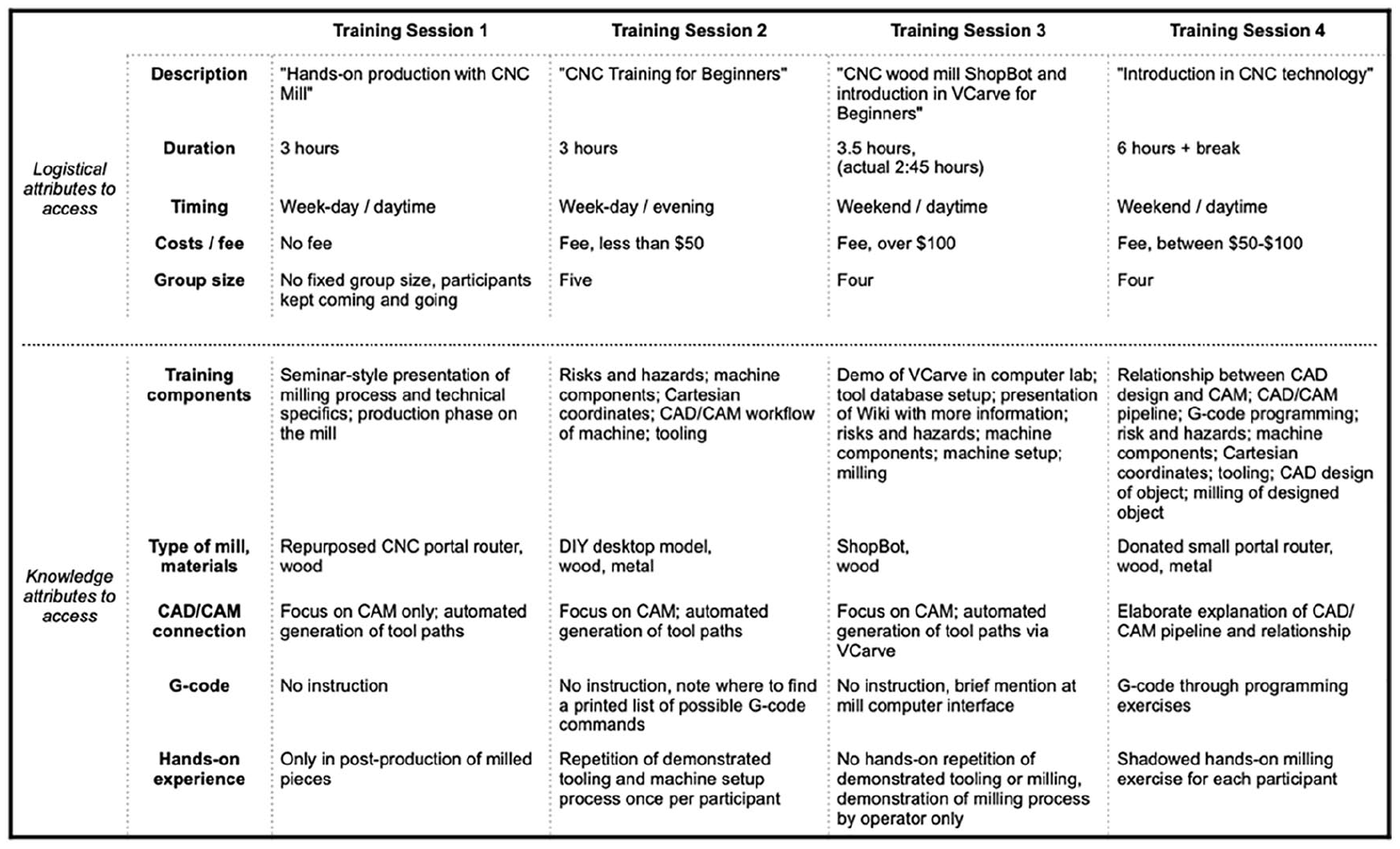
Summary of attributes characterizing the four training sessions in CNC milling.
The first training session was informative with a “hands-on” demonstration by the trainers. It was not a mandatory prerequisite for the operation of a CNC router. As part of a 3-day networking meeting of open shared machine shops, the training primarily catered to staff in digital fabrication spaces. Split into two parts: screen-based presentation of the milling process, and “hands-on production” at the CNC router—this demonstration provided minimal digital fabrication skills beyond participants’ assumed prior knowledge. The session was accompanied by open group debates on the advantages and disadvantages of proprietary and open-source CNC software, procedural specifics of model conversion for fabrication, and toolpath and error simulations. Lack of attention to access in the form of belonging to a community became especially explicit in these discussions that remained limited to individuals with expert knowledge.
During the second surveyed training session, similar topics were raised in the instructor’s anecdotes about the machine having “the power to destroy itself.” Humoristic narratives such as this frequently work to loosen up the situation, ignoring the complexity of skewed expert-learner power hierarchy in this learning environment. In this session the instructor used a piece of wood with a drawing of Cartesian coordinates to illustrate the mill’s axes orientation. This simple exercise in translation exemplifies how residues of medieval construction practices such as hand-eye coordination remain essential to the precision and accuracy promises of digital fabrication and its ideas of unified processes (Figure 2), despite contradicting them at times. Recent feminist scholarship on material practice suggests that the dependence on embodied experience obscures technical concepts of precision or accuracy in technological practice. 22

Spatial and material organization in CNC milling training sessions two (upper right), three (left), and four (bottom right) illustrating local and embodied knowledges and practices interwoven in CNC milling.
The third surveyed training session, held at a professional profit-oriented space, listed the most training components regarding CNC milling’s basic functions. Unlike the previous sessions, this one started with a CAM-software demo in a computer lab and a general tool database setup introduction within the software. Tool setup for digital fabrication machines demands an advanced level of experience when working with different cutters and materials, especially as tool manufacturers avoid defining standard values and recommend local experimentation.23,24 Like in other sessions, questions arising from inconsistencies in values and tools are passed on to Wikis as further references on materials and their behavior. Given the time limit, the second part of the class focused on covering the necessary information on machine components, risks, and setup with a process demonstration by the instructor (Figure 2). Such training is tailored to professionals and people with technical knowledge and socio-economic capital, thereby excluding or marginalizing interested persons who may not have access to such knowledge and capital.
The last surveyed training session took place in a non-profit, shared machine shop open to the broader public with no membership requirements. It was the only one devoting time and effort to CAD design, CAM material processes, and G-code/toolpath programing. Despite the usual “beginner” label attached to the titles, many digital fabrication spaces presume that participants attending training sessions already have related design skills and knowledge. In this case, however, the training pedagogy considered a variety of taken-for-granted details that might need more explanation. Using a repurposed CNC desktop router with a pencil instead of a milling cutter, participants learned to program the G-code of a figurative toolpath (Figure 2). This simple exercise serves a two-fold function: first, it illustrates the different toolpaths to increase understanding, and second, it diminishes the commonly experienced uneasiness around advanced technologies. Combining a (semi-)automated technology with familiar tools like pencils and paper works as an instrument of translation. By swapping a milling cutter with a graphite pencil, users better understand the machine logic of milling through material sensibility without the fear of breaking down expensive tools and materials. Moreover, the instructor’s emphasis on the CNC router settings dependence on personal experience and interactions between machine, tool, material, and potential environmental impact, reconfirms our claim about the role of embodied-material knowledge.
The above-outlined experiences demonstrate how implicit and explicit forms of exclusion are maintained in digital fabrication spaces through the formats of training sessions on advanced CNC technologies. These experiences underline disparities between rhetoric and the actual skills needed to partake in digital fabrication practices. The particular spatial organization and format of the CNC training sessions indicate that these environments cultivate and rely on technical skills. The dependence on practical workarounds, material and tacit knowledge, and potential beginner-level participation highlights the need for more nuanced, considerate, and culturally diverse pedagogies in digital fabrication and computation. The following section proposes an alternative training and knowledge acquisition methodology that centers on developing embodied forms of knowledge and providing access to broader groups of learners.
Access, knowledges, and craft-centered practices
Every culture, society, and community have traditional and manual craft practices. People, materials, skills, and tools come together to make artifacts, representations and culture. In Trinidad and Tobago, wire-bending is a craft integral to the design and construction of costumes and dancing sculptures in the cultural practice of Trinidad Carnival. This situated craft practice has been disappearing due to a declining number of practitioners, an absence of comprehensive pedagogy, and changing practices in the Carnival, to name a few. 25 Although historically a male-dominated practice, there has been renewed interest in the craft by creatives, artists, designers, and craft-lovers of different ages and genders.18,26 In wire-bending, linear materials like wire, cane, fiberglass and plastic rods, etc., are sculpted, bent, and assembled to create 2D and 3D-forms. Through the activities in this craft, people create, communicate, and express meaning, esthetic sensibilities, histories, and ideas through rich interactions.27–29 Wire-bending is “a milieu of interactions between community, senses, and the moving body, sculpting, painting, and drawing with static and dynamic linear materials for concurrent expression of each in three-dimensional space.” 26
Other knowledges in craft
Previous research by the author introduced a computational method for describing the wire-bending craft: the Bailey-Derek Grammar. 25 The method addresses the lack of documentation in this embodied practice and validates its ability to restore craft and create new social roles. While recasting wire-bending in formal and procedural terms aids in recording and transmitting this knowledge, it reduces the craft to a set of static and immobile rules—neglecting its social, corporeal, and material characteristics. This ordering in computation strips acts of making clean of the bodies, histories, relations of gender, power, and inequalities that should inform understanding. In this study, the author examines non-technological knowledges in wire-bending and investigates how access is operationalized in digital fabrication and computation practices that center hands-on making and embodied knowledges. The study goes beyond representation and is concerned with practices, material objects, and the body.30–32 Practices are characterized as material bodies of work through corporeal routines, actions, and devices; material objects as the results of our perceptions and embodied experiences; and the body as the body’s interactions and relations with other things both human and non-human.21,30,33,34
Embodied knowledges in wire-bending include sociality, corporeality, and materiality. Sociality is characterized as “acts of kindness and compassion,” cooperation and association with others, as well as “active dislike [. . .] and all the other ritual pleasures of everyday life.” 30 Sociality in wire-bending gives persons access to and knowledges in communal support, social interactions with different types of people, learning and teaching, and organization of events to keep communities together. Corporeality is characterized as the physical body in relation to and in conversation with things and materials as wire-benders perform wire-bending, thinking in movement or “bodying.” 35 The body not as something containing ideas but as a movement of thought, a “motional-notion,” the body as a “compendium of gestures” that is performative and embodied through practice, and inter-relational between gesture and body. 36 Corporeality in wire-bending gives persons access to and knowledges of how the body’s gender, power, limits, and opportunities relate to space, tools, materials, and techniques. When it comes to materiality, materials are not rendered as passive things but as “contingent, temporal, and active” matter.36,37 Materiality in wire-bending gives access to and knowledges of material limits and behaviors in relation to bodies, space, and tools. Salter et al. 38 call for active engagement and interplay between senses, bodies, and material objects for the emergence of knowledge. We assert that direct perceptual and physical engagement with different people, materials, tools, and cultures through craft can teach us sociality, corporeality, and materiality—elements currently missing from our digital design and fabrication practices. Additionally, these entanglements expose social and racial inequalities in design research and pedagogy.
Craft-centered computational practice
In this part of the study, the author problematizes access by combining hands-on making, computational tools, digital and analog methods, and enskilment through craft. Enskilment involves fine-tuning one’s perception and action by “expanding their focus of attention” to attune to the world around them, learn about their actions and how they shape materials, tools, and their peers.39,40 Unlike the passive learning interaction revealed in the first case study, participants here actively engaged in manipulating materials, making drawings, making code, making digital models, and making artifacts—for knowledge to emerge through their senses, their bodies, and the materials (Figure 3). The study builds on previous research in 2017 where art educators and students interested in art and craft aged between 14 and 22 learned hands-on computational approaches to the wire-bending craft. 18 It also builds on the development of digital approaches to wire-bending with speculative software, digital technologies, and methods.25,41

Summary of attributes characterizing the three training sessions in computational approaches to wire-bending.
Inquiry into access and how it is operationalized in digital fabrication and computation practices centering hands-on making, sociality, corporeality, and materiality in craft combined surveys, open-ended interviews, artifact analysis, and participant observation. Through surveys, participants indicated their levels of experience in wire-bending, digital design, and fabrication tools and methods before and after their participation. They answered interview questions about their interest in the course and what they were learning. In artifact analysis, the author examined objects to deduce design approaches and techniques, review technical skill, innovations, structural integrity, and participants’ understanding and exploration of material behaviors. As creator and instructor of the course, participant observation involved giving lectures, demonstrations, and feedback on techniques, taking photographs and notes, and observing students as they were designing and making artifacts.
This design study was conducted in a School of Architecture at a public research university in the United States in 2019. The experienced instructor-researcher is a Black woman and originally from Trinidad and Tobago. The 11 participants were architecture students from different parts of the world, 8 women and 3 men, 3 students were undergraduates, and 8 of them graduate students. Participants self-reported that their average experience in wire-bending and computational design was “none at all” or a “small degree.” Their average experience in making by hand was “moderate” and their average experience in digital fabrication was a “small degree.” During the 5-week study, participants were encouraged to work in pairs to foster sociality. When asked at the beginning why they were interested in the course, students said:
“I like making things! And wire-bending is a technique/skill that is new to me, so I find [it] interesting.”
“I am interested in modeling with my hands.”
“Wire-bending seems like an interesting art to learn and this along with computational tools can give me skills and ideas that can be of use [. . .] as an architect or designer.”
“My inclination toward craft making along with eagerness to learn computational making.”
“I like the idea of making things by hand instead of modeling everything digitally. I feel there is material value [. . .] which can be used to create a more materially aware project.”
In the first session, Computational Crafting, participants learned technical knowledge in wire-bending using the Bailey-Derek Grammar. They acquired technical skills by focusing their attention on the instructor, her corporeal movements, gestures, interactions with tools, materials, and the workspace as she demonstrated the techniques. In addition, they practiced sociality via conversations and interactions with the instructor and their peers. In the second session, Crafting fabrication, participants learned how to design and fabricate using a CNC wire-bending machine and its proprietary software, enabling digital drawing and G-code programing. Again, learning involved focusing attention on the instructor’s gestures and interactions with the machine. In the third session, Digital Crafting, participants used a speculative digital design and fabrication software created by the instructor, and 3D printing machines. At all stages, the instructor-researcher-author performed demonstrations, observed participants, processes, and analyzed artifacts.
Computational Crafting
In this session, students were taught visual computing with shapes and rules via shape grammars and the Bailey-Derek Grammar through manual making. Participants actively learned the “theory” of wire-bending, how the Grammar worked, and practiced hands-on making. Tools included pliers, bolt-cutters, pencils, paper, and adhesive tapes. The instructor-researcher demonstrated how to make connections, grip wires with hands, fingers, and tools, rotate wrists to achieve tight bends, and how to wrap adhesive tape to make connections (Figure 4). After this process of enskilment, students practiced these techniques, designed, and made their artifacts. The instructor then analyzed the artifacts and provided feedback. Feedback included recreating wire-bending connections to demonstrate proper technique, showing new connection possibilities, and commenting on poor, good, and interesting techniques. An assemblage of communal, embodied, technical, spatial, and material knowledges could be revealed due to these multi-modal interactions during the workshop.
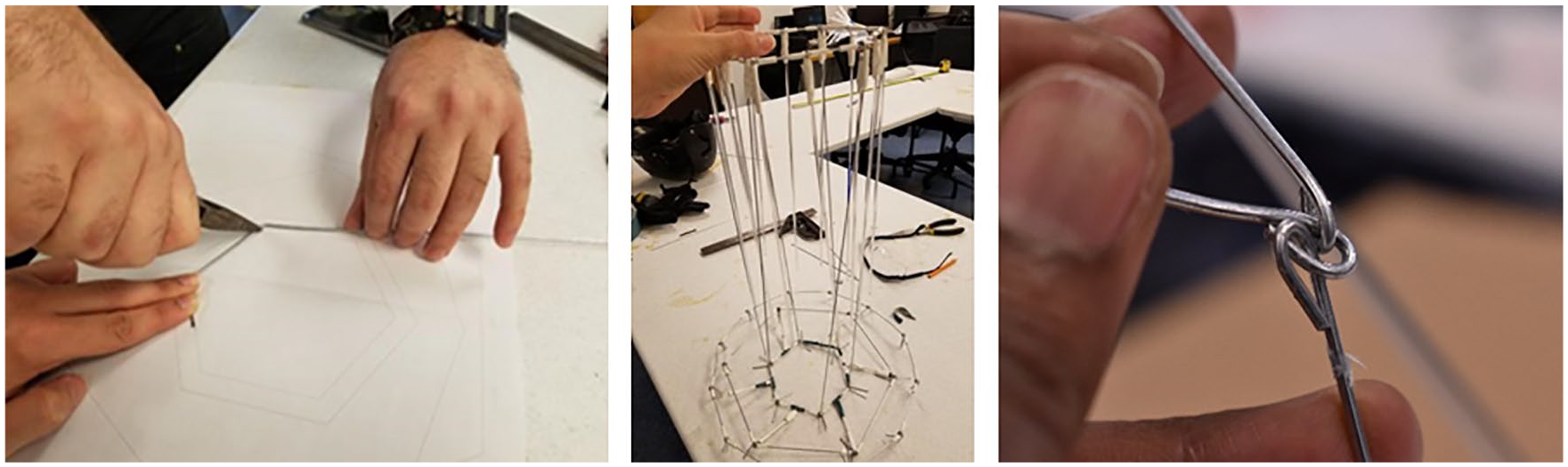
Participants design and fabricate artifacts with hands-on engagement in computational ways of wire-bending with materials, hand tools, the Bailey-Derek Grammar, and paper templates they created (left and middle). Instructor conducting artifact analysis to give feedback (right).
Crafting Fabrication
In this second session, students were again taught shape grammars, this time by visually computing designs with shapes and rules, and CNC wire-bending.42,43 Tools included those aforementioned as well as a computer, CNC wire-bending machines, and their associated software. The author demonstrated how to handle the machine, load materials, and exercise safety during use. Students were trained to create shapes by either using the machine’s software, importing vector files from other software, or writing G-code. After this enskilment process, students practiced these methods to understand the machine and how it worked, how to write code, and how to interact with the machine and their materials. They then design and fabricated artifacts using the machine, generative design rules (shape calculations), digital drawing, scripting (writing G-code), and wire-bending techniques, thereby building upon what they previously learned (Figure 5). Assemblages of previous knowledges, now including machine knowledges, continued to be revealed through multi-modal interactions. Most students enjoyed this method the most. When asked why, they said:
“We were able to play with the material and understand the limitation of the wire and the machine much better.”
“The process allowed for the greatest level improvisation throughout the making process. As you worked through the making [. . .], you were able to test in real time if the joints and connections would work.”
“I enjoyed the shape calculations [. . .] because through our experimentation [. . .] we ended up with a design that [. . .] was an unexpected and exciting result.”
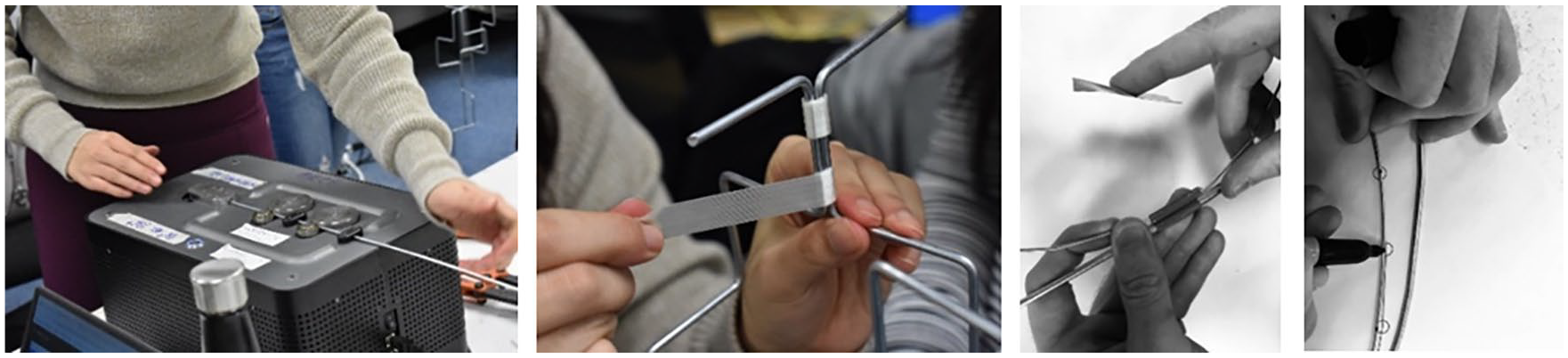
Participants design and fabricate artifacts with hands-on engagement with CNC wire bending machines, materials, hand tools, digital drawings, and/or code.
Digital Crafting
In the third and final session, students used an experimental CAD tool developed by the author for design and fabrication. The instructor-researcher demonstrated how to use the speculative software to design, carry out fabrication explorations, and use the 3D printer. Students designed and fabricated artifacts using these digital methods in combination with those previously learned (Figure 6). Physical interactions, gestures, and movements between the instructor, 3D printer, materials, and participants were different from the previous methods. Hands-on, corporeal interactions between the body, 3D printing machines, and discrete plastic materials revealed little embodied knowledge about wire-bending. Most participants enjoyed this approach the least, saying:
“It gave me feeling like I was participating [in] the design process at very minimum.”
“3D printing [. . .] does not allow us to view the materials connecting. The connections also lacked individual identity. All the connections look very similar to each other.”
“Dependency on 3D printers [. . .] decreased [my] interest.”
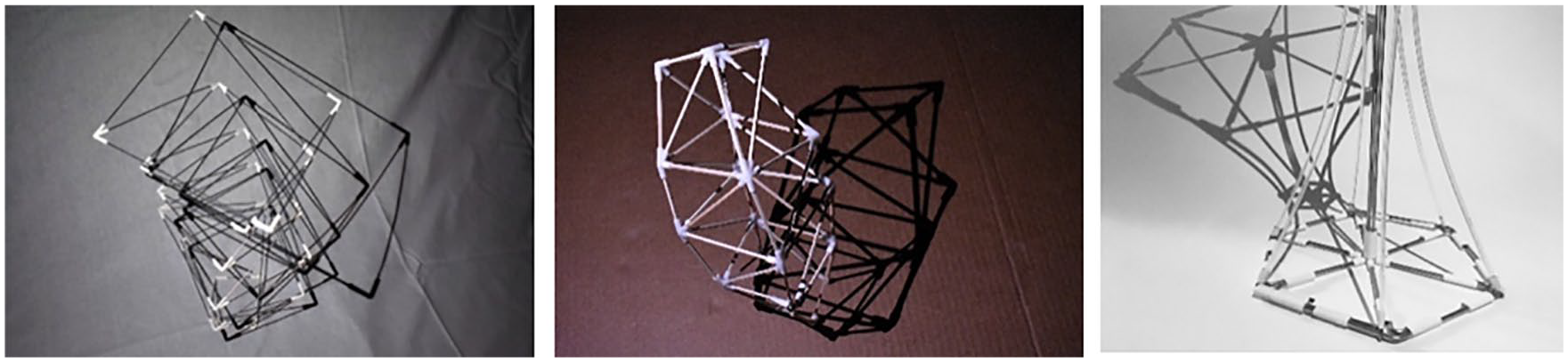
Participants design and fabricate artifacts with hands-on engagement with materials, 3D printers, hand tools, and speculative digital design and fabrication software.
Throughout these three studies, it was observed that even though participants were often reminded and encouraged to explore and use material behaviors when designing, most neglected the material behaviors in their projects. For the most part, materials were dealt with as straight abstract lines with no properties and agency, rather than materials that curl, whip, spring, bounce, and interact with humans and non-humans. Through these three craft-based computational methods, students could interact with tools and materials, with each other, with their instructor, those inside and outside the class, and engage in conversations and discussions. They could learn about their bodies’ power, limits, and opportunities in relation to space, gender, tools, machines, materials, and techniques. 39 Through this experience, the author recognizes the powerful effect of corporeal making and material manipulation on pedagogy, theory, practice, and otherwise. Including craft and physical material engagement in digital and computational practices can help us slow down, reflect, share, and become more aware of ourselves and the world around us. 44
Discussion
In this paper, we questioned access and knowledge in computation and digital fabrication practices and pedagogies by investigating how access is operationalized, how intellectual and technological knowledges are privileged, and by examining other knowledges in manual craft and their interactions with digital fabrication. We show that a limited discussion of access ignores underlying socio-technical elements, and the privileging of technological knowledge misses other social, corporeal, and material ways of knowing. Our findings indicate that a more equitable and inclusive future builds on and creates space for multiple bodies, knowledges, and skills in making. It allows perceptual interaction and corporeal engagement with people, materials, and tools and employs technologies accessible to broad groups of society.
Our first finding that physical and social factors can play a role in access is supported by the first case study on the mandatory training sessions in digital fabrication spaces as sites of knowledge production. We show how exclusivity prevails in design and fabrication practices through taken-for-granted conceptions of knowledge prerequisites. If digital fabrication and computation aim to effectuate accessibility, inclusivity, and equity, learning the multiple skills involved in them requires a sensibility for their social attributes. Mundane limitations like a training session’s duration can translate into prerequisite knowledge of machines and processes required by students. Simultaneously, such sessions serve to certify future machine users without any knowledgeable oversight.
Our second finding that intellectual and technological knowledges are privileged is shown in the fundamental contradictions between technological and social programs of digital fabrication. The knowledge required for handling a complex machine like a CNC router is hardly attained in a few hours’ time, if we consider, for instance, the extensive education of a carpenter who regularly employ CAD and CNC technologies. Besides that, the complex interaction of a multiplicity of knowledges—human, machine, material, environmental, and tacit—provokes a discussion around digital fabrication’s positive characteristics. 13 Failure to acknowledge the role of these knowledges and make amends in acquiring them through and for digital fabrication, instead of their presupposition, could compromise a more equitable future.
Our third finding that privileging the technological misses other social, corporeal, and material ways of knowing is based on our analysis of knowledges in wire-bending. Centering perceptual interactions and corporeal engagement with people, materials, and tools can enable sharing and engagement with multi-modal interactions and knowledges to create mutual understanding and mutual respect. 45 In wire-bending, each line is a material gesture of corporeality, strength, force, and sociality. Arms, hands, and bodies develop tactile memories of their engagements with the artifact’s formation as a process rather than as a finished product. 36 In craft, the body remembers artifacts as gestures, with hands and bodies as a “compendium of gestures,” 36 a series of “body schemas,” and thought-like aspects of action. 35 Wire-bending is performative as the body inscribes three-dimensional lines in space with actions and gestures tied to physical space, the body’s form, its limits, movement, and mind.
Additional insights include opportunities to address expert-learner power hierarchies in making spaces, strengthen the concerns and attention of computational designers back to social matters, and consider how identity may factor into participants’ feelings of inclusion in spaces in which they are rarely seen. When it comes to the expert-learner power hierarchy in digital fabrication, spaces emphasized the acquisition of creative skills and technical knowledges hidden in software, hardware, and mostly male, white trainers. On the other hand, craft-based spaces may facilitate technical knowledge and skill acquisition in and from a wider variety of people from different backgrounds, genders, race, and ways of learning, thereby flipping power hierarchies in these environments. For instance, the site of the fourth CNC training has existed long before the digital fabrication concept and its recent manifestations. The site’s objective is to provide affordable access to traditional crafts such as woodworking, metalworking, ceramics, and highly technological machines to enable enskilment of local residents and facilitate their social interactions. While creativity is seen as something to be acquired in digital fabrication sites, in craft, creativity is assumed to be inherent, ready for expression, nurturing, and flourishing in the process.
In the second study, the author observed students’ inability to engage material behaviors so that these behaviors inform design approaches and train their sensory and perceptual development. This might signal a need for more awareness and consideration of material and social behaviors in design pedagogy. The harmful premise of computational design as an intellectual and technological endeavor with little to no engagement with the social, material, and corporeal, risks depriving (future) architects of their social concern and relevance, shifting their attention to purely technological and esthetic ones.5,46 Students’ acknowledgment and enjoyment of the play, improvisation, and experimentation afforded through hands-on crafting and material engagement (observed in the study) is an opportunity to intertwine better social and corporeal concerns in our field of computational design.
Another important point to mention is the question of gender, race, and geographies in digital fabrication and craft practices. In the digital fabrication study centered on these highly technological machines, the only female participant was the researcher. Such details are unsurprising given the demographics of CNC manufacturing technologies. Women have widely been restricted access to training in traditionally technical male work domains. 47 On the other hand, the study centering craft as a site and method for critical thinking about computation was conducted by a Black woman, native to a region usually left out of computational discourses. The visible identity of the instructor may have contributed to a majority female group—a stark contrast from the first study. Architecture, design computation, and other related engineering and technological fields are currently white male-dominated despite the contributions of people of color and women to computing.48,49 Creating spaces for more women and people of color to participate in discourses in design and technology is pertinent and exciting.
One limitation of this analysis is that each site of our case studies is situated within different social, historical, and cultural contexts. Although this is the case, it adds to scholarship and understanding of computation and making cultures through its comparative and transnational nature. Additionally, our analysis emphasizes the role of situatedness in socio-technical practices and the need to examine universal conceptions and study how they are operationalized in broader narratives and design pedagogy traditions.
Conclusion
In this study, we argue that issues of access in digital fabrication and computational practices and their pedagogy can only be addressed by revealing hidden social entanglements in design and making. Our broad questions and findings call for an urgent, critical assessment of architectural computation, its exclusive nature, and implied separations between the intellectual and the manual, design, and production. It also calls for investigating lineages of knowledges, skills, and technologies we privilege such that it excludes and marginalizes others. Our project demonstrates and rethinks how these questions can be pursued by drawing on ethnography and STS approaches for research and pedagogy in computational design and digital fabrication. Additionally, art and craft practices are more accessible than highly technological and industrialized ones and can provide multiple entry points.
Creating spaces for craft-based knowledges, practices, and people in computation can signal a commitment to pursue equity. In these times of heightened inequity, social and environmental injustices, we must include who and what we are leaving out. Future studies would expand on intersectional perspectives beyond gender and race to consider disability, age, and socio-economic conditions in order to resist the decontextualization of computation and digital fabrication practices. Investigations will also examine how we can embed and raise awareness of socio-political and economic issues in computational design pedagogy related to software, hardware, and curriculum.
Footnotes
Acknowledgements
Special thanks to Pensa Labs for their support. Grateful acknowledgment to students in craft and computation course. We thank the three anonymous reviewers for their extremely insightful reviews.
Declaration of conflicting interests
The author(s) declared no potential conflicts of interest with respect to the research, authorship, and/or publication of this article.
Funding
The author(s) disclosed receipt of the following financial support for the research, authorship, and/or publication of this article: The research of the first author is funded by the Ventulett NEXT Generation Fellowship from the School of Architecture at the Georgia Institute of Technology. The research of the second author is partially funded by the DFG, German Research Foundation under Grant EXC 2120/1—390831618.
