




Abstract
If we understand architecture as a three-part system formed by the building, its image, or drawings and images describing buildings, and the critical discourse around architecture, then the texts or ways of speaking about architecture play a key role in understanding the field and its development. By analysing a corpus of around 4.6 million words from texts written between 2005 and 2020 that form a part of critical discourse in computational architecture (understood as the result of the intense digitalization of the field), this paper aims to map ways of speaking about computational architecture. This contributes to architectural theory and might help gain a better understanding of the evolution of the digitalization of construction in general. Findings show that computational architecture is surrounded by a specific way of speaking, hybridized with words from fields such as biology, neuroscience, arts and humanities, and engineering. While some topics such as ‘sustainability’ or ‘biology’ come up consistently in the discourse, others, such as ‘people’ or ‘human’, have periods when they are more and less popular. After highlighting open research questions, the paper concludes by presenting a map of periodic and recurring topics in ways of speaking about computational architecture over the last 15 years, thus tracking and documenting long-term trends, and illuminating patterns in the broader field of digital construction.
Keywords
As computation is retooling most fields, 1 over the past 30 years, the avant-garde in architecture has been connected to the heavy use of technology. The digitalization that architectural design has been going through has had an impact on the profession’s conceptual agenda, design and materialization. Repurposing software tools built for other industries and using them for architecture has created star practices such as Gehry Partners with CATIA, 2 and Zaha Hadid Architects with Maya. 3 Moreover, some architects from the younger generation have started to code as they discover that there is a lack of tools for specific tasks, or that existing tools are inadequate or insufficient.4–8 As new tools are developed, so are new ways of thinking, writing, designing and doing. The logic of tools feeds back into the mentality of the operators9,10 as design is always affected by the choice of tools.11–14
All this has produced many terms referring to architectural projects that make extensive use of digital technologies such as: ‘digital architecture’, ‘parametric architecture’, ‘computational architecture’, ‘algorithmic’, ‘generative architecture’ and ‘advanced architecture’. These terms are explained and discussed extensively in architectural texts.
Menges and Ahquist 15 define computational architecture as the explicit use of scripting and/or programming in the design and/or the fabrication phase. According to Leach, 16 algorithmic architecture involves the use of programming languages and/or paradigms. One definition for parametric architecture is that it implies working through software interfaces that allow relational design: virtual objects contain interconnected features and changing one feature will change the others automatically. 16 In this case, the designer produces objects as well as the relationships between objects. The debate around what parametric, computational, algorithmic and digital architecture mean 17 is ongoing. As has been shown by Caetano et al. in Ref. 18, all these terms have been used ambiguously, inconsistently and interchangeably.
In this article, computational architecture is used as an umbrella term to discuss architecture shaped by technological advancements, and thus includes digital, parametric, algorithmic and parametric architecture. The term ‘computational’ is used instead of digital or digitalization because the focus is on early adopters of advanced technologies for architectural design and not on how software applications designed for architecture are being implemented across the discipline. Therefore, this study deals with the early phases of the digitalization of architecture.
Hensel identified a series of problems that computational architecture faces: fragmented discourse, exhausted idiosyncrasy, redundant form-function dialectic, and shallow ecological and sustainability approaches. However, most importantly, contemporary discourse does not reflect on the larger context in which computational architecture exists. 19 Similarly, Cash 20 makes a compelling case on the poor state of theory and meta-theory building in design research in general.
Forty 21 describes architecture as a three-part system formed by the building, its image (drawings and photographic representations), and its accompanying critical discourse. Modernist architecture was not only a new style of building, but also a new way of talking about architecture, ‘instantly recognizable by a distinct vocabulary’. 21 By studying how architects write, Medway argues that much of writing is done to motivate action, stating that ‘architects finish a sentence with a sketch’. 22 Furthermore, according to Damron and Spector, 23 sketches are illuminated by sentences, as writing is part of the doing. Language then becomes an integral part of architecture.21–24 Therefore, mapping and investigating the vocabulary of computational architecture becomes important for understanding the practice in general, for building theory and meta-theory for architecture, and for reflecting on the larger context in which the field evolves.
This paper investigates how computation is changing architecture by studying texts about architecture and is guided by the following research questions: RQ1: What is the language of computational architecture? RQ2: Does this language change over time and in what ways?
This study aims to add to the body of work that investigates the digital turns in architecture.9,25 In order to answer these questions, a corpus linguistics representative for computational architecture was built. This corpus contains texts written over a 15-year period between 2005 and 2020 from two sources: the journal Architectural Design and the eVolo skyscraper competition.
The rest of the paper is structured as follows: after related work is presented in ‘Analysing Ways of Speaking in Architecture’ section, the tools, methods, and research framework for investigating the research questions are introduced in ‘Materials and Methods’ Section, and the findings are presented in ‘Findings: Architectural Design’ Section 3. Finally, in ‘Findings: eVolo Skyscraper Competition Section’, the main topics found in the corpus and surrounding computational architecture are discussed, and a conceptual map of the topics surrounding computational architecture over time is presented.
Analysing Ways of Speaking in Architecture
The term ways of speaking is sometimes used to refer to the discourse a certain community creates.26–28 The ways of speaking of an academic community help to build discipline-specific knowledge and establish its cultural identity.28,29 In ‘Words and Buildings’, Forty 21 argues that the ways of speaking of modernist architects were integral in helping them frame their vision, while Bearn 30 goes so far as to say that modernist architecture was ‘more basically, a body of documents defining modernism and interpreting those buildings’. In ‘The Words Between the Spaces: Buildings and Language’, Cameron and Markus 31 read the history of architecture through the development of architectural texts discussing the role of language in producing buildings. In Ref. 24, Markus argues that ‘the use of language should be investigated in design simply because language is involved at every stage’.
It is generally accepted that architecture has a specific vocabulary,32,33 yet little work has been done on analysing ways of speaking in computational architecture. Caetano et al. 18 study a corpus of texts trying to find unified definitions for parametric, generative, and algorithmic design. Beloso 34 and Cabrera 35 both collect and analyse corpuses of texts about architecture in general and report findings related to the particularities of these texts: architecture has a specific vocabulary impregnated by topics which come from connected fields, the language is technical and often metaphorical, and new words are created ‘with ease’.
Materials and Methods
To analyse the ways of speaking about computational architecture, a corpus linguistics in English, built to be representative of the subfield, was created. This corpus, ComPara, is different from previous work by Beloso 34 and Cabrera 35 in two ways. First, ComPara looks at a specific area of architecture, namely, computational architecture. Second, ComPara covers the period between 2005 and 2020. This section describes the design, collection and analysis methods for ComPara. After selecting relevant sources, data was extracted and analysed quantitatively to extract the main topics and trends in the text. The data were then assessed qualitatively. The analysis of ComPara represents a corpus-based interpretative study.
Selection of relevant sources – criteria for corpus design
The first step in building a corpus is to select relevant sources. Beloso 34 uses three criteria in designing her corpus – representativeness, accessibility and contemporariness. Representative sources are those that are relevant in describing the professional discourse of architecture. Accessible sources are those that are available for professionals and those that can be found and placed in a digital database. Contemporariness refers to up-to-date sources.
Two sources that fit the three criteria were selected: the journal Architectural Design (AD), and winners and honourable mentions of the eVolo Skyscraper Competition. AD and eVolo were chosen because they both specifically deal with technological innovations in relation to architecture. Established in 1930, AD is widely considered to be at the forefront of architectural thought. Over the last three decades, AD has also featured many articles about technology and architecture to such an extent that Mario Carpo states that ‘Not all things related to computational design have been published in AD, but a large part of them have’. 25 On the other hand, eVolo’s About section describes the journal as ‘focused on technological advances in architecture and design’. 36 The eVolo Skyscraper Competition is arguably one of the most popular of its kind worldwide, with around 1200 yearly submissions from over 150 countries. 37 This is why AD and eVolo are representative of computational architecture. The period between 2005 and 2020 was chosen because of the accessibility of digital texts from this time. For AD, only issues starting in 2005 are available digitally on the journal’s page, 38 while the first edition of the eVolo Skyscraper Competition was released in 2006.
Collecting the data and size of ComPara
The following inputs from the period between 01/2005 and 12/2020 were collected from AD for use in the corpus: (a) all issue titles, (b) the titles of all 1795 articles from each issue, (c) the text of these articles, and (d) keywords associated with the Introduction article. This forms a corpus of around 4.5 million words. The keywords were collected from the Information section next to the article on the journal’s webpage. It seems that they are generated automatically using a language processing algorithm, but details of the algorithm are inaccessible to external users. Keywords represent ‘words which are statistically characteristic of a text’. 39
Data from 2006 to 2020 were obtained from eVolo using the following bases: (a) titles of all winning and honourable mentioned projects and (b) the descriptions (abstracts) submitted by authors for these projects. This forms a corpus of around 100,000 words.
The current total size of ComPara is around 4.6 million words and forms a special purpose medium-sized corpus. 34
Tools for processing ComPara
The study presented here is corpus-driven, 40 meaning there were no pre-assumptions or hypotheses before the analysis was conducted.
The analysis of ComPara was done in two stages. First, the corpus was analysed quantitatively with the use of natural language processing (NLP) tools. Next, a qualitative analysis of the results that emerged from the quantitative analysis was carried out.
An array of NLP tools exists, with each tool implementing different algorithms derived from statistical techniques for topic modelling (Ref. 41,42 or 43). In this study, two browser-based text analysis applications were used, namely, Voyant Tools 44 and Infranodus. 45 These applications implemented well-known algorithms, such as the Latent Dirichlet Association,41,42 as well as proprietary algorithms.
Voyant Tools includes a large collection of tools. The ones used here are Summary, Trends, Phrases and Cirrus. Using Cirrus, word clouds were created to display words that were dimensioned based on their frequency in a text.46,47 Common connection words and punctuation are excluded. Word clouds are useful for seeing key terms in a text and have been successfully used as tools for the preliminary analysis of texts. 48 However, in classical word clouds, all connections between words are lost.
Infranodus is an NLP tool that transforms pieces of text into contextual word clouds. 49 Infranodus is based on a text network analysis algorithm, similar to the Latent Dirichlet Association (but described as better), that represents any text as a network and identifies the most influential words in a discourse based on terms’ co-occurrence. An algorithm is applied to identify different topical clusters, which represent the main topics in the text as well as the relations between them. 45 Thus, contextual word clouds represent the most common words in a text, the connections between the words, and topics, which are words that appear next to each other in text, but not with the other words.
Data analysis
The data in ComPara contains titles, keywords, and prose text. These different data types were analysed using two different approaches. Keywords are words without a context, and titles are only short sentences. As a result, contextual word clouds would either not be created or the connections between words would be too weak to produce meaningful results. The titles and keywords were transformed into word clouds to address this while the prose text was directly transformed into contextual word clouds.
Word clouds were created from titles and keywords from AD and titles from eVolo. These clouds were then printed out. After a period of becoming familiar with the data, the clouds were coded all together in initial subsets using an emerging coding approach. 50 Then, these emergent codes went through a period of analysis, where Voyant tools’ Trends and Phrases were used to query the data for different keywords that were traced back to their original contexts. This ensured that the meaning in context was understood correctly and helped in the production of the final list of codes. The generated list was used to code all word clouds. Afterwards, the codes were affinity diagrammed 51 until a final theme structure was created.
The prose text from AD articles and eVolo project descriptions was transformed into contextual word clouds and main topical groups, and the most influential elements were generated automatically using Infranodus NLP.
Findings: Architectural Design
Issue titles, article titles, article text, and the Introduction keywords from entries between 2005 and 2020 were retrieved from AD. The titles and keywords were transformed into word clouds and categorized under six main themes that emerged after affinity diagramming: (a) profession-specific terms, (b) places, (c) time periods and currents in art and architectural history, (d) technology, (e) sustainability and (f) mathematics, physics and biology. The texts in the articles were transformed into contextual word clouds, and the topical clusters and most influential elements from each issue are presented.
Data from AD issue titles (2005–2020)
Figure 1 shows the word cloud made from the titles of the 96 AD issues. These are discussed below under the six main themes. Word cloud of all words, scaled according to frequency, forming the 96 issue titles of AD (01/2005–12/2020). 550 total words and 293 unique words.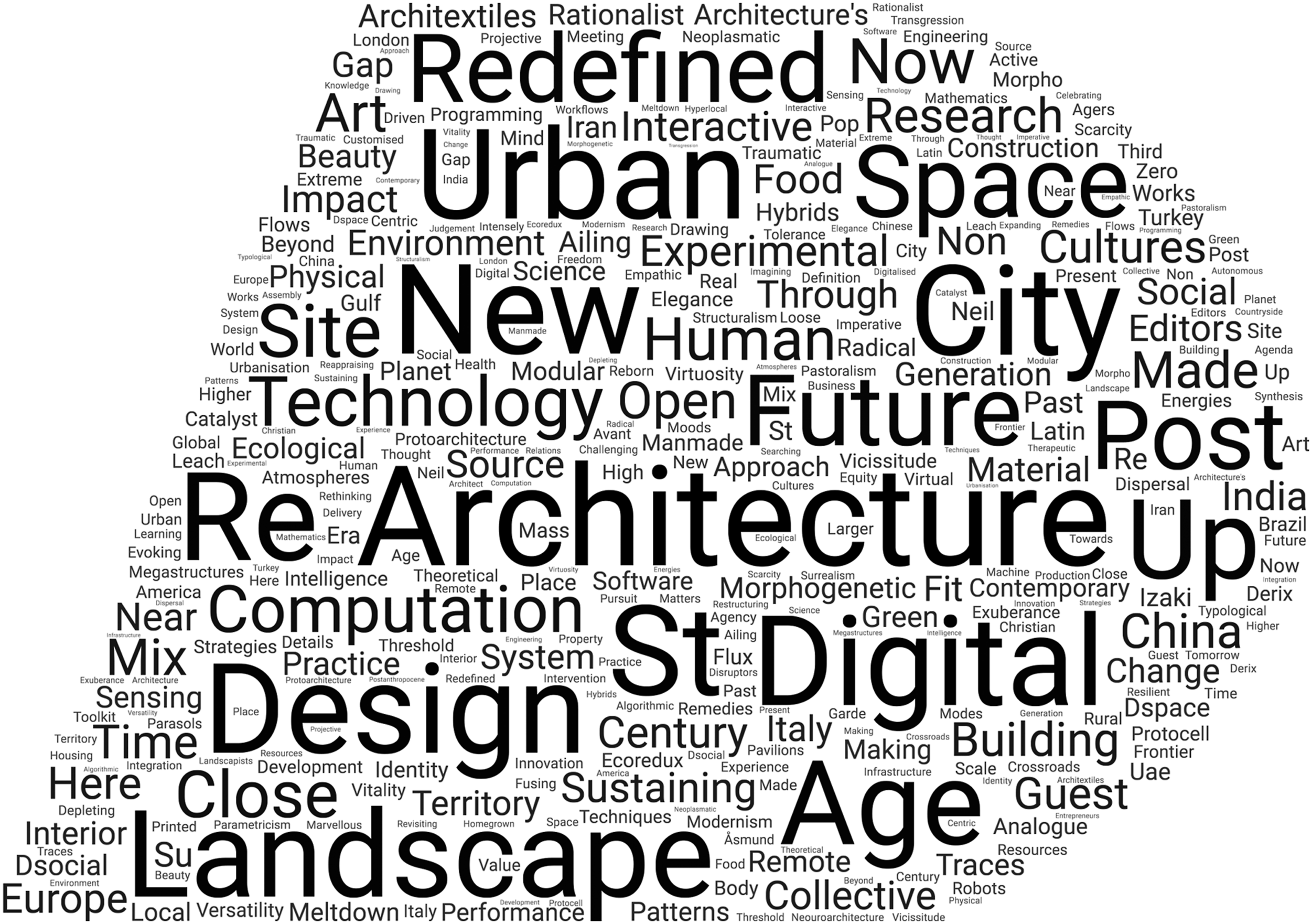
References to
Words related to
Words relating to
Then, there are words related to
References to the field of
Data from AD article titles (2005–2020)
The titles of the 1795 AD articles are made up of 12,929 words with 4146 unique words. The most frequent words in the titles are ‘architecture’ (199), ‘design’ (194), ‘new’ (97), ‘urban’ (90) and ‘city’ (86). The word clouds from the article titles are relatively similar to the word cloud made from the issue titles, as each issue called for articles fitting these themes. However, analysing the titles year by year reveals an interesting progression, which is also visible in the analysis of the texts of these articles. This will be discussed in succeeding subsections. Word clouds of article titles year by year are available at Ref. 52.
Keywords associated with the AD Introduction (2005–2020)
There are 13,835 keywords with 5961 unique words associated with the Introduction of each of the 96 AD issues, and the most frequent keywords are ‘architecture’ (166), ‘university’ (85), ‘architects’ (75), ‘design’ (70) and ‘new’ (63). Figure 2 illustrates the 500 most frequent keywords scaled according to their frequency and loosely grouped in the six thematic clusters. Word cloud showing 500 most used keywords associated with the Introduction in the 96 issues of AD (01/2005–12/2020) scaled according to frequency and grouped based on thematic clusters. There are 13,835 keywords with 5961 unique words.
Names of
Words related to
Colour-coding the
The upper left corner of Figure 2 has grouped together terms which have to do with
Words related to
Finally, there are words related to
Data from the text of AD articles (2005–2020)
The texts forming the 1795 AD articles are made up of 4,544,090 words and 92,963 unique words. The most frequent words are ‘design’ (19,892), ‘architecture’ (16,915), ‘new’ (16,701), ‘building’ (10,528) and ‘city’ (9668). Figures 3–7 show the main topical clusters and most influential elements in each AD issue. These were retrieved from the contextual word clouds generated using the Infranodus NLP tool. Texts making up the 1795 AD articles between 2005 and 2020. Main topical groups and most influential elements as analysed using the Infranodus NLP. The topics are presented for each AD issue, year by year. The texts total 4,544,090 words and 92,963 unique words. Texts making up the 1795 AD articles between 2005 and 2020. Main topical groups and most influential elements as analysed using the Infranodus NLP. The topics are presented for each AD issue, year by year. The texts total 4,544,090 words and 92,963 unique words. Texts making up the 1795 AD articles between 2005 and 2020. Main topical groups and most influential elements as analysed using the Infranodus NLP. The topics are presented for each AD issue, year by year. The texts total 4,544,090 words and 92,963 unique words. Texts making up the 1795 AD articles between 2005 and 2020. Main topical groups and most influential elements as analysed using the Infranodus NLP. The topics are presented for each AD issue, year by year. The texts total 4,544,090 words and 92,963 unique words. Texts making up the 1795 AD articles between 2005 and 2020. Main topical groups and most influential elements as analysed using the Infranodus NLP. The topics are presented for each AD issue, year by year. The texts total 4,544,090 words and 92,963 unique words.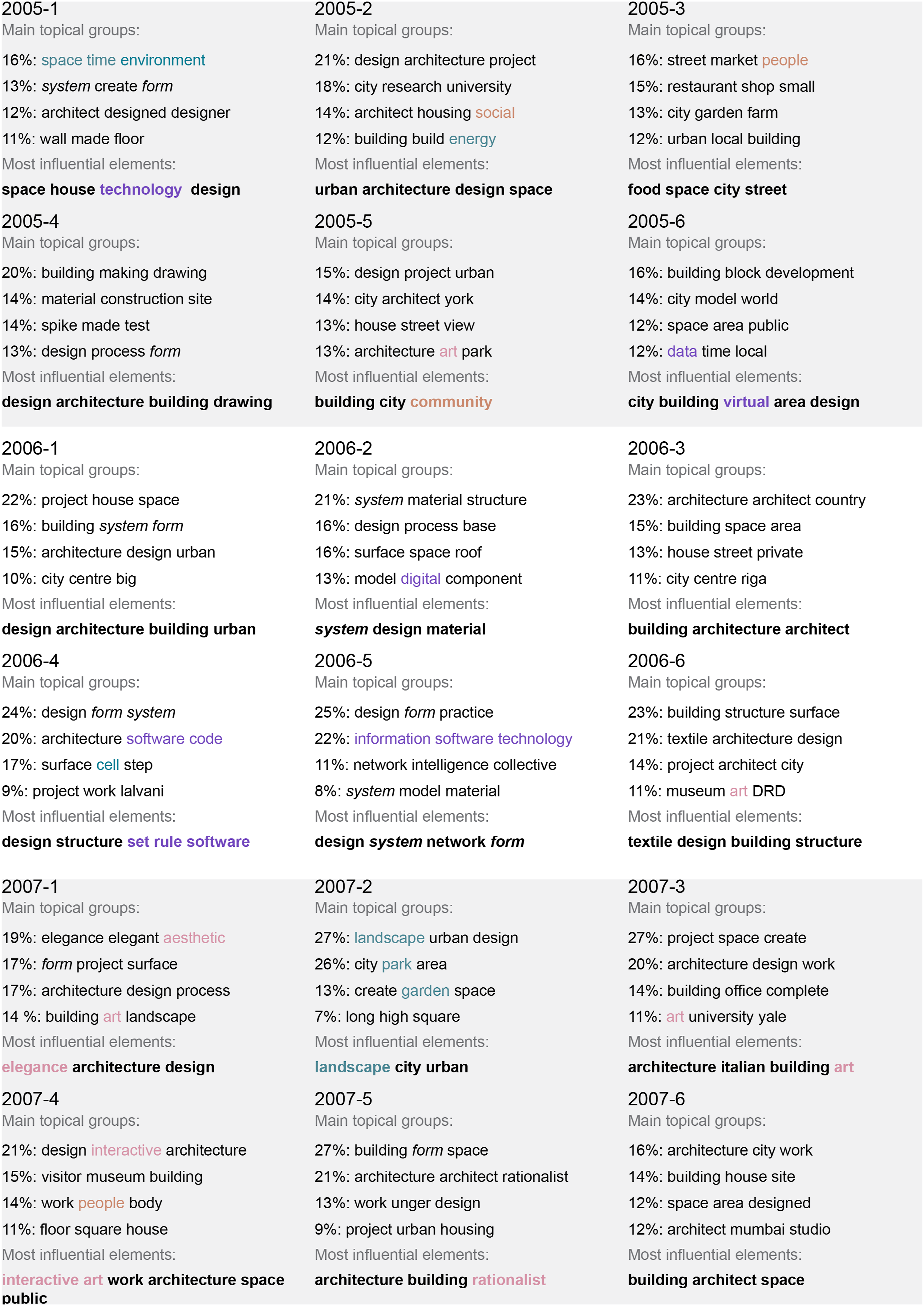
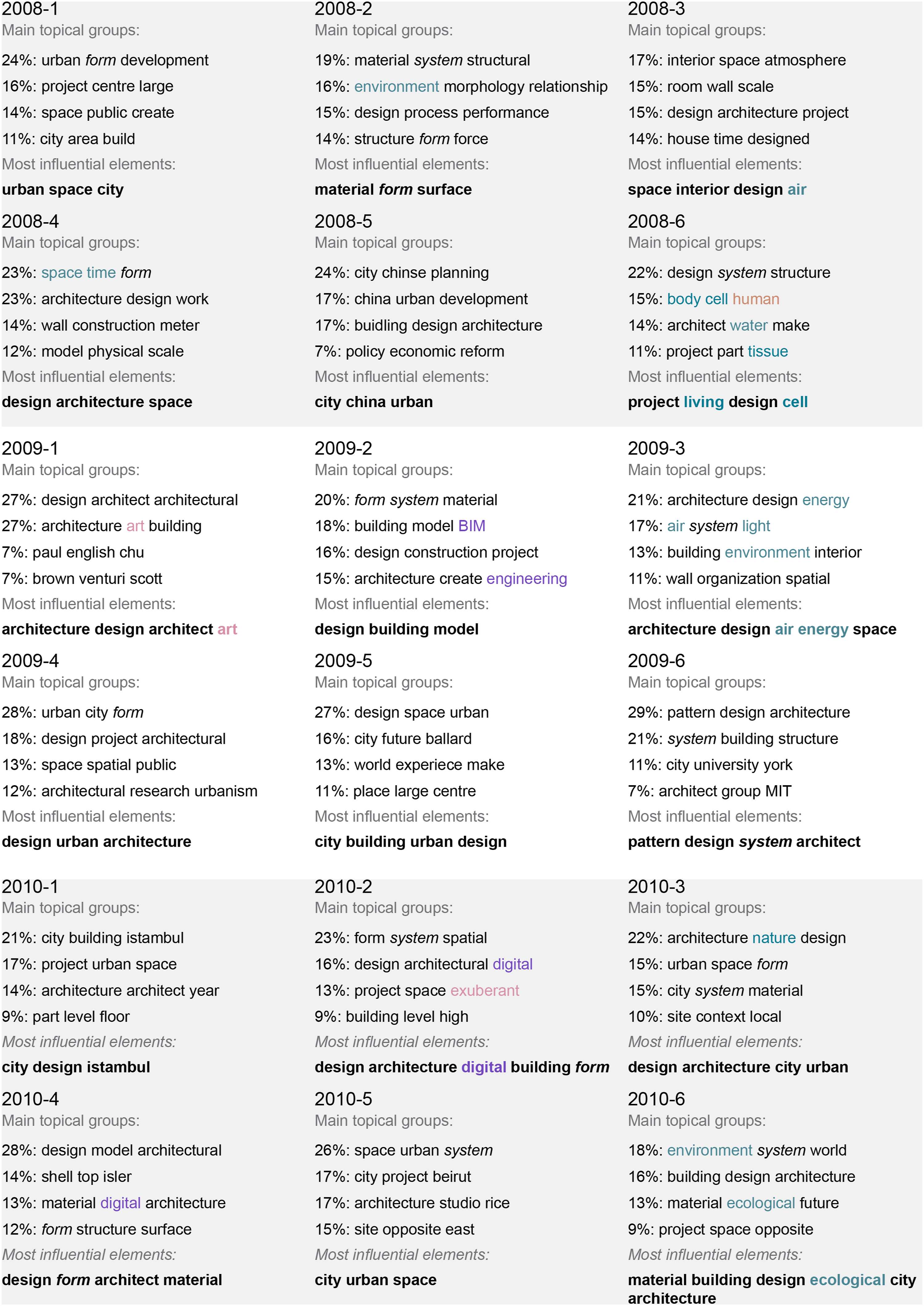


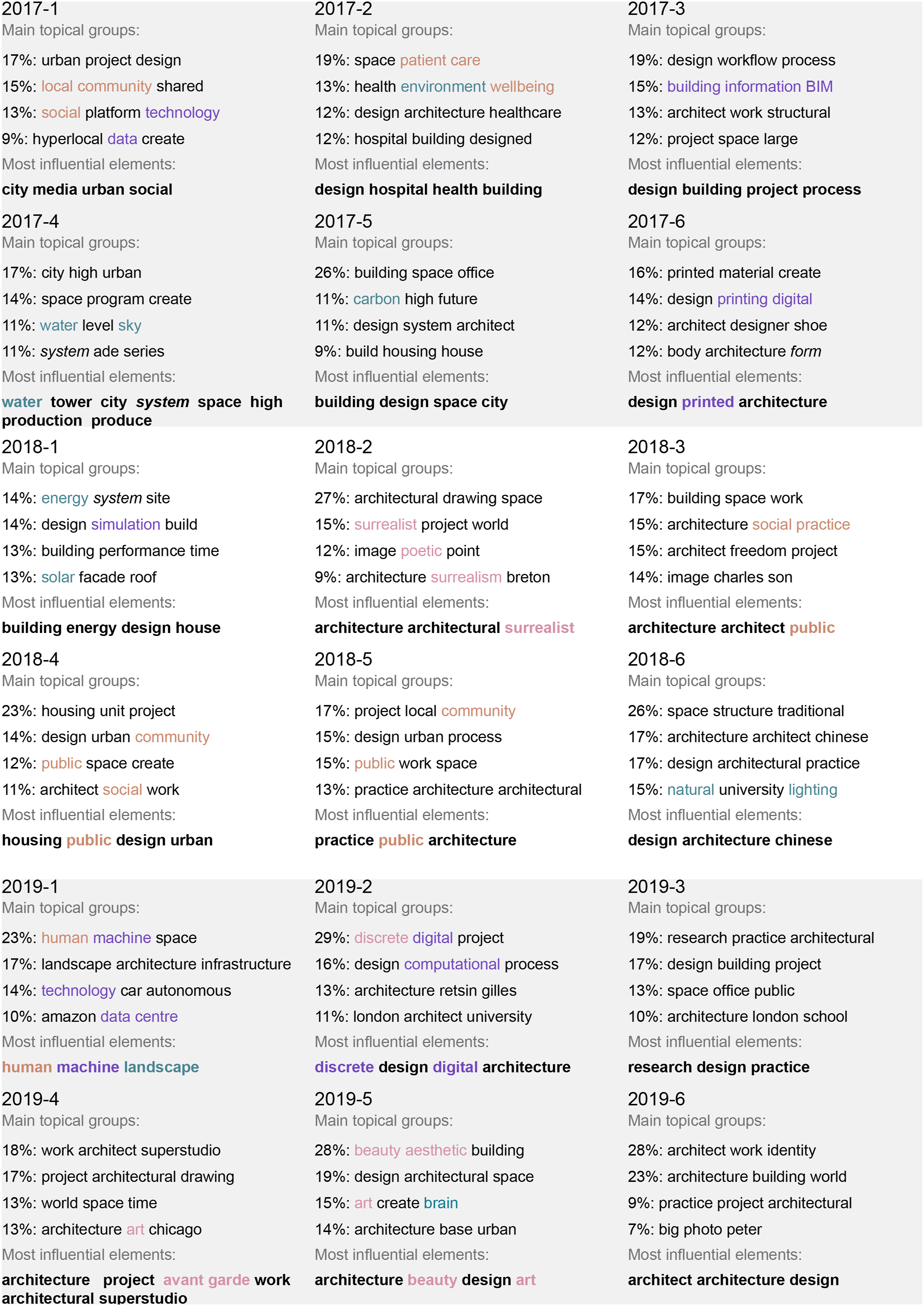
Most of the topics shown are
Words that have to do with
Words that could be connected to
Words that can be associated with
Lastly, words which can be associated with Texts making up the 1795 AD articles between 2005 and 2020. Main topical groups and most influential elements as analysed using the Infranodus NLP. The topics are presented for each AD issue, year by year. The texts total 4,544,090 words and 92,963 unique words.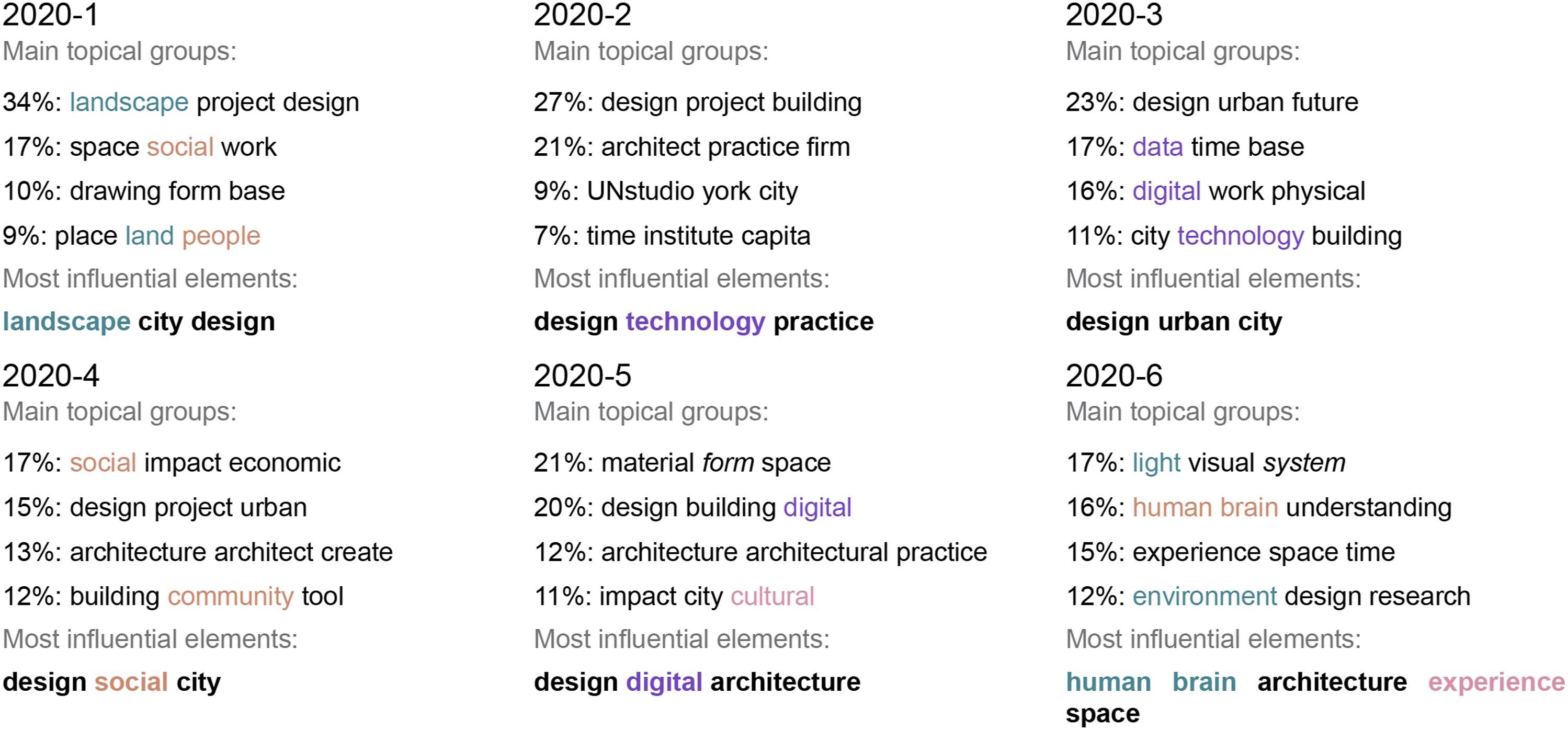
Findings: eVolo Skyscraper Competition (2006–2020)
There are 42 winning projects and 307 honourable mentions in the eVolo Skyscraper competition between 2006 and 2020, which in total form 349 projects. Some of these projects have been described and categorized in detail over the years in Refs. 37,53,54. Below, the topics forming the titles of eVolo projects are presented under the same main themes used for AD. The abstracts describing the projects were transformed into contextual word clouds. The main topical clusters and the most influential elements from these contextual word clouds are presented year by year.
Data from the titles of eVolo winning projects and honourable mentions (2006–2020)
Figure 9 shows the words forming all titles of the winning projects and honourable mentions of the eVolo skyscraper competition between 2006 and 2020. Word cloud of all words, dimensioned according to frequency, in titles of winning projects and honourable mentions for the eVolo skyscraper competition (2006–2020). 1483 total words, 753 unique words.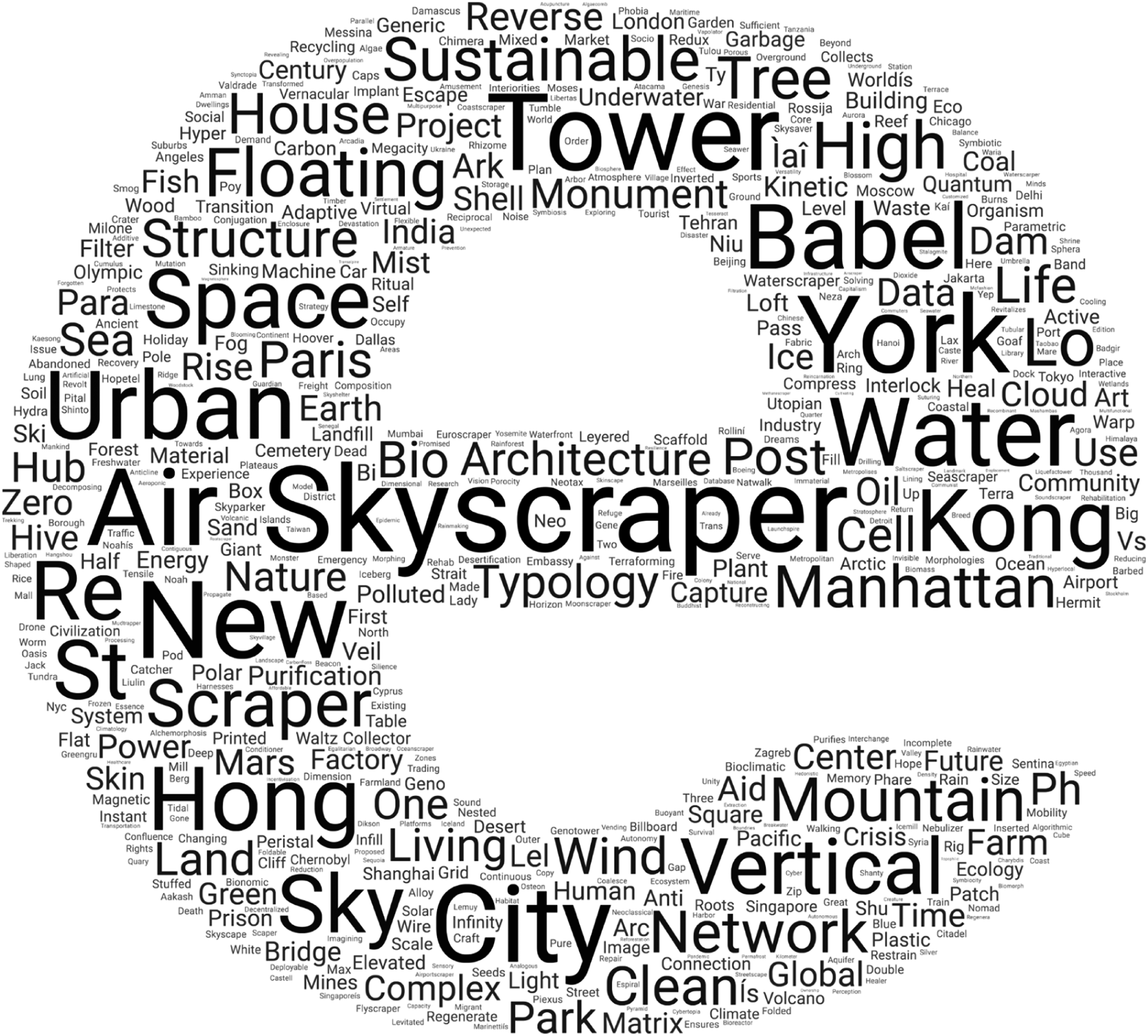
Terms connected to architecture, and more specifically to high rises, such as ‘vertical’, ‘tower’, ‘skyscraper’, ‘city’, ‘urban’ and ‘structure’ stand out at first glance. Architectural functions that have high frequencies are ‘airport’, ‘bridge’, and strangely, ‘pyramid’.
The names of places of high density, such as New York, Hong Kong, Paris, London, India and Shanghai, have high frequencies. But ‘Babel’ is used as often as these real places and appears as part of titles six times in total (twice in 2012 and 2014, and once in both 2016 and 2017). Babel is connected to a skyscraper under perpetual construction (The New Tower of Babel 55 ), a home built at almost any height with the help of aerostatic construct 56 ), an ecological structure designed as a scientific facility and tourist attraction for the desert (Sand Babel 57 ), a massive collage of cultural symbols (Taiwan Babel Tower 58 ), and a memorial for workers in the building industry (The Scaffold of Babel 59 ). A series of projects look at outer space as a place to build human habitats. The word ‘Mars’ appears relatively frequently in the titles: twice in 2013 and once in 2017. ‘Moon’ is also part of titles with the Moonscraper in 2011, 60 while ‘stratosphere’ is mentioned in 2013. 61 Generally, these projects describe concepts of terraforming that would save humanity in the face of overpopulation, depleting resources, and the negative effects of climate change.
On the other hand, maps of geographies that produced successful eVolo submissions can be found in Ref. 52 but also under Refs. 37,53,54. For the winning submissions, the 42 projects came from 16 countries. When looking at the countries of both winning projects and honourable mentions, 48 countries are represented, but the distribution is uneven. The United States is clearly dominating (88 projects), with China (51 project) second, the United Kingdom (41 projects) third, France (26 projects) fourth, South Korea fifth (19 projects), and Poland (11 projects) and Russia (11 projects) sixth. Africa is almost off the map, with only two honourable mentions from Egypt, while South America is only represented by Chile (3 projects), Peru (one project) and Venezuela (one project).
The most referenced
When it comes to names, the prevalence of ‘Babel’ is complemented by other Christian religious references such as ‘Noah’ and ‘Moses’ (in the context of depicting apocalyptic scenarios). An honourable mention from 2011 called Rhizome Tower: A Thousand Underground Plateaus 62 makes the influence of both Deleuze and Guattari explicitly present in the titles of eVolo projects.
References to
While direct technology references are not as common in the eVolo titles as they are in AD, there are more words that can be connected with
There are no direct references to
Data from eVolo abstracts of winning projects and honourable mentions (2006–2020)
The abstracts of winning projects and honourable mentions in the eVolo skyscraper competition between 2006 and 2020 have 96,016 words and 9988 unique words. The most frequently used words are ‘city’ (482 mentions), ‘building’ (371 mentions), ‘new’ (360 mentions), ‘water’ (322 mentions) and ‘structure’ (298 mentions). Figure 10 presents the most influential topics and elements in the eVolo abstracts year by year between 2006 and 2020. eVolo abstracts of winning projects and honourable mentions 2006–2020. Main topical groups and most influential elements as analysed using the Infranodus NLP. There are 96,016 total words and 9988 unique words. The topics are presented year by year.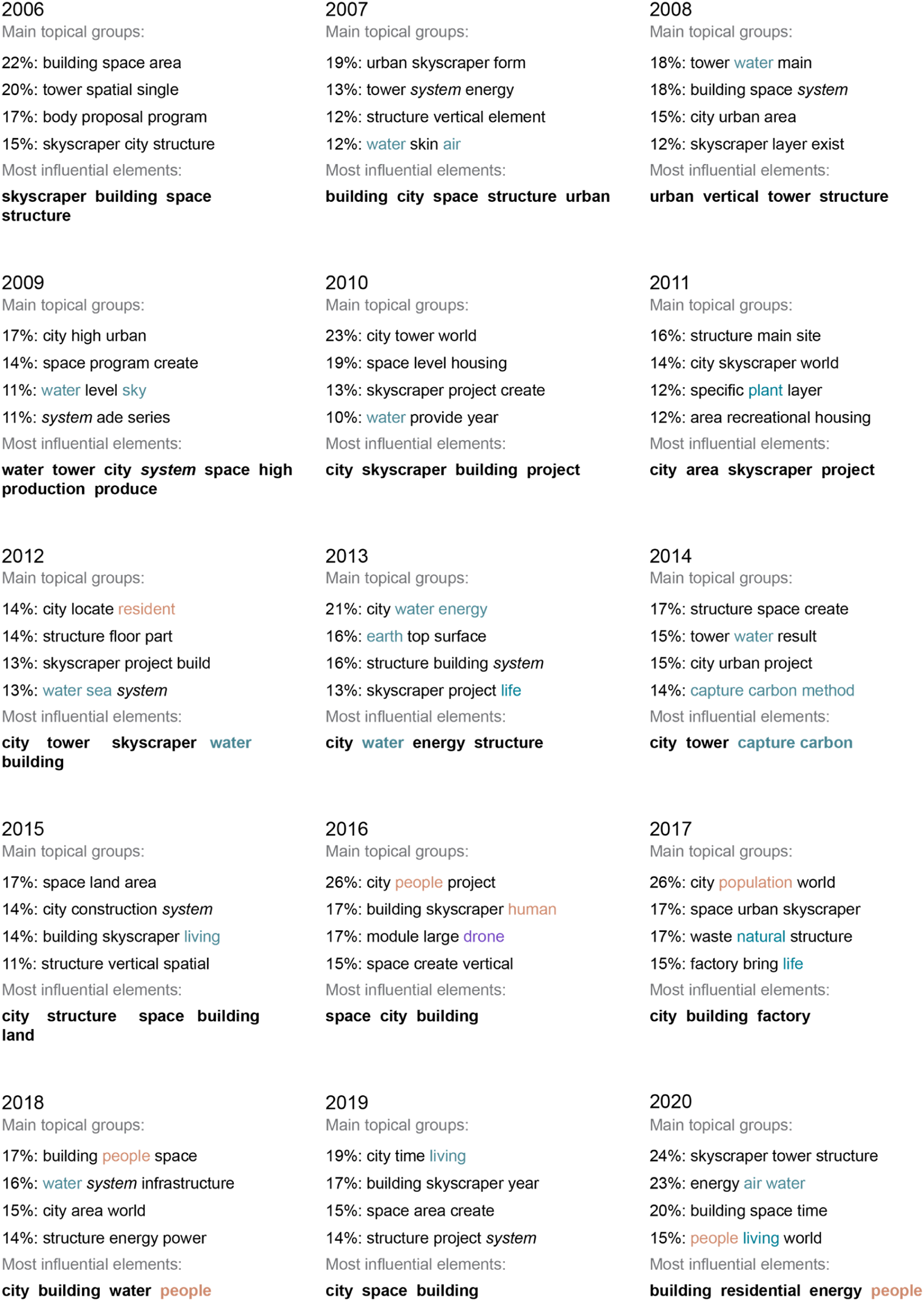
Among the most common topics in the abstracts are
There are no
It is interesting to note that the word ‘water’ is among the words that are part of both the most influential topics and the most influential elements in the abstracts, and this has a rather uniform distribution throughout the years (see 2008–2010, 2012–2014, 2018–2020 in Figure 10). ‘Water’ is used in connection to
Words that can be connected to
Discussion
Computational architecture makes use of specific vocabulary that allows for the refinement of ideas and the cultivation of culture around the field. This section discusses the topics that consistently appear in ways of talking about computational architecture and the topics that come in a periodic fashion.
Recurring topics in ways of speaking about computational architecture
Computational architecture is more interested in the future rather than the past, in the new rather than the historical, and in the urban rather than the rural – all this broadly follows the field of technology. In architectural theory, the ‘rejection of history’ has been well debated, at least since modernism. The discourse is dominated by the West, although projects from China have won mentions in eVolo in recent years (see ‘Data from eVolo abstracts of winning projects and honourable mentions [2006–2020]’ section). The avant-garde of the 70s is mentioned across the corpus, and there are references to the Moon, Mars and space exploration.
In general, the discourse is developed and hybridized with topics coming from the natural sciences, specifically biology and physics. Topics from mathematics are also prevalent, but explicit mathematical topics was concentrated in the period between 2010 and 2012. Importantly, the topic of sustainability comes up often and consistently.
Strangely, eVolo contains words related to biblical characters such as Noah and Moses, and biblical places such as Babel – which comes up in titles with a surprising frequency. Almost every year, a number of eVolo Skyscraper Competition winners or honourable mentions have the word ‘Babel’ in their titles. It might be interesting to investigate the origin of projects which make these biblical references.
The words ‘form’, ‘space’ and ‘system’ often appear as main topics in ComPara. While ‘space’ and ‘form’ are traditional concerns in architectural theory, the word ‘system’ might be newer in architectural discourse, and understanding how and where it is used could uncover interesting patterns.
Sustainability
In general, sustainability is described as a problem to which architecture (many times enhanced by technology) is seen as a solution. Investigating how sustainability is understood in the field of computational architecture over time is a possible direction for future research. The following are potential research questions that can be investigated: What does it mean to be sustainable? Can sustainability be achieved? How will we know when we have achieved it? Can sustainability be described without reaching tensions about diverging interests?
Sustainability comes up as a topic more often in the eVolocorpus, where most projects state problems related to the environment and climate change that the project can solve. Generally, the projects start with stating a problem that is dramatic and large, and continue with suggesting highly technological, built (conceptual) solutions that can solve the problem. The problems mostly deal with high population density and its associated issues of overpopulation and pollution of the sea, earth and sky. Stressedinfrastructures, desertification, the depletion of natural resources, potential nuclear disasters, or the melting of polar caps are frequently mentioned. This results in a series of words hinting at rather pessimistic realities and futures such as ‘cemetery’, ‘landfill’, ‘Chernobyl’, ‘garbage’, ‘plastic waste’ and ‘pollution’ (see Figure 10). However, these futures are saved by the solutions suggested through the projects. But starting in 2015, the word ‘problem’ becomes more frequent than the word ‘solution’ in the abstracts. This might show a transition towards a different understanding of sustainability as a complex or wicked problem. 65 To exemplify the problem-solution dynamic, Noah’s Ark: Sustainable City (an honourable mention from 2012) is a floating city that could support all living species once they have been evicted from land ‘by natural disasters, warfare, whatever disasters the end days may bring’. 66 Oceanscraper 67 is a large underwater architectural structure that ‘does not have to abide by the laws of gravity’ and would use decommissioned Russian submarines lying on the sea bed as nuclear power sources. Moses: A Decentralized Floating Network of Skyscraper Cities 68 and The Promised Land Waterscraper 69 are solutions to rising sea levels. The metaphor of the ark appears a couple of times in the projects as a solution to apocalyptic futures. All of these conceptual projects clearly articulate a real-world problem, usually related to sustainability, and then continue to offer solutions to that problem. The solution does not have to be feasible, or even realistic, in any way, but the problem needs to be real and of monumental proportion. This corresponds to design’s inbuilt optimism in general, 70 and also follows hopeful views that technology will solve most problems.
While investigating sustainability understandings in the winning projects and honourable mentions of the eVolo skyscraper competition would be a research topic on its own, it can be said that sustainability is understood as a limitation in these conceptual projects, and as a problem, or something to resolve. It is important to note here that the calls of the competition frame the projects responses and that the calls change slightly year by year, although the core focus remains on high rise architecture, technology and sustainability. AD and eVolo reference sustainability and technology differently: while AD is filled with topics that have to do with technology and with fewer references to sustainability, the opposite is true for eVolo, where sustainability is a recurring topic throughout the years, and technology is less often referenced directly.
Biology
Throughout the years, biology and topics which can be associated to it frequently appear in both AD and eVolo. This simply puts quantitative data behind Phillip Steadman’s 71 statement that ‘as a matter of historical fact, biology, of all sciences, has been that to which architectural and design theory have most frequently turned to. Recently, other studies have looked at the relationship between biology and architecture, and similar points were made in Refs.71–75. Biology comes up as a topic strongly connected to computational architecture. Tracing the depth and scope of biology’s influence as a model, as a metaphor, as an analogy, as a source for novel building materials, and as a field to entangle to computational architecture into a new paradigm, as suggested by Pasquero and Poletto 76 can be subject for fruitful future research. Looking specifically at the relationship between sustainability, biology and computation in contemporary architecture can also make for interesting investigations. Technological advancements help to integrate biology and architecture and revisit the idea of growing living buildings.
Based on the topics that come up constantly surrounding computational architecture, namely, technology, sustainability and biology (and to a lesser extent, mathematics and physics), it can be argued that the field is currently shaped according to the following model: (Mathematics + Physics +
Technology helps to explore and enhance old (but yet unexplored) or new ideas from mathematics (as argued, for example, in Ref. 77), biology, physics (as discussed for example in Ref. 78) in architecture, while sustainability comes as a constraint or limitation to avoid creating purely technological explorations, at least in recent years.
Waves of influence
While the topics described above appear with a rather even distribution, there are topics that are more popular in certain periods. In Ref. 79, Heinrich Wölfflin read the history of art in waves, explaining that art takes turns between being fascinated with the static aspect of life (the classical) to focusing on the dynamic aspect of life (the baroque) and returns in an upward spiral. Looking at the topics that come up in ways of speaking about computational architecture, similar waves of influence are visible. Figure 11 shows a map of topics that come up when speaking about computational architecture. On the upper part are the topics that come up in waves, and at the bottom are topics that come up constantly in the corpus. Topics that come up consistently and topics which came up in waves in ways of speaking about computational architecture.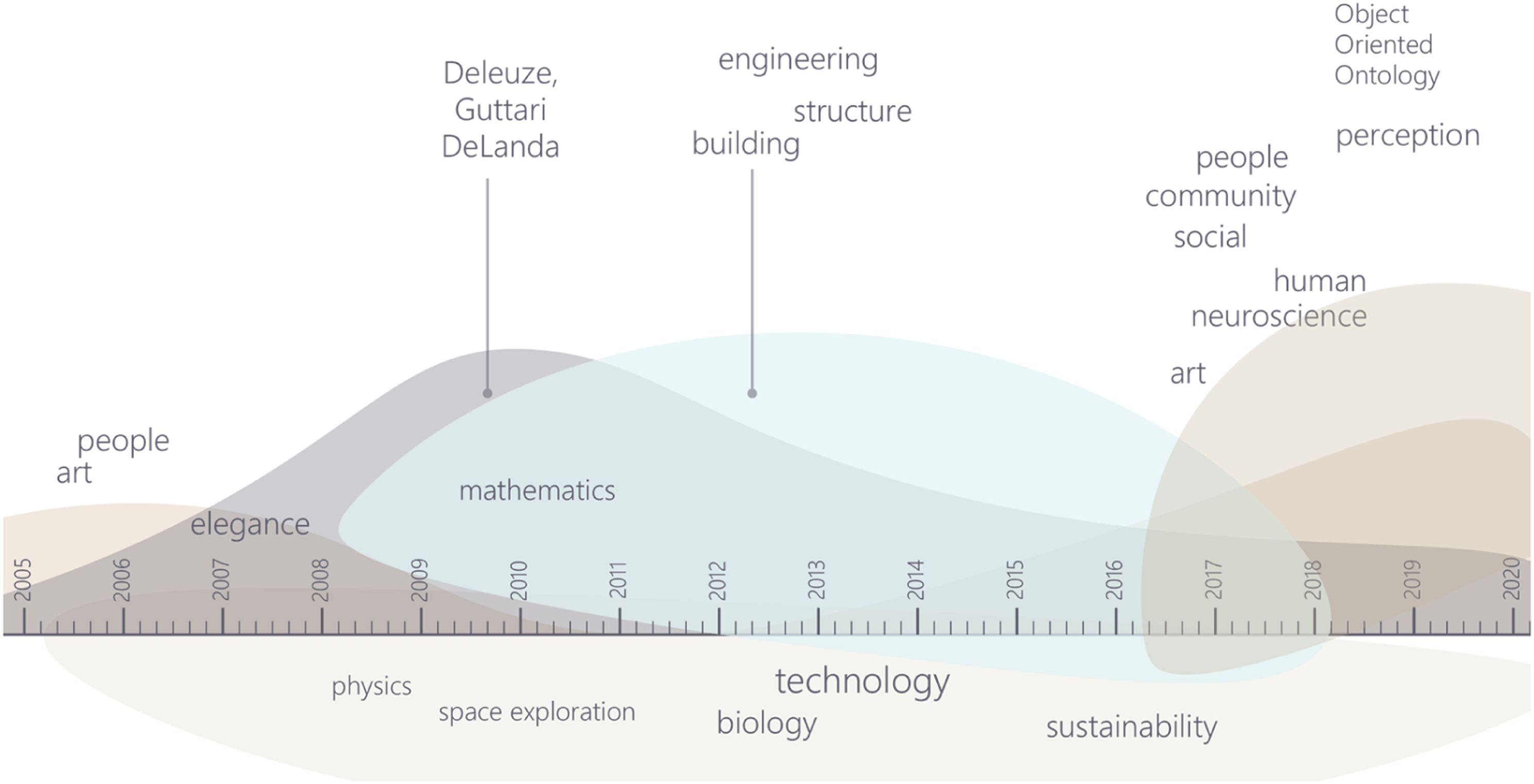
Computational architecture between engineering and art
In the entire corpus, art comes up as a topic more often than engineering in general. However, there is a period roughly between 2007 and 2012 when there are more references to engineering and words connected to it (such as ARUP). This also corresponds to the two traditions of architecture-as-technology and architecture-as-art established after the Enlightenment. 31 In the words of Nigel Cross, designerly ways of knowing do not fall neither in the humanities nor within the sciences. 80
The Deleuze connection might be fading
ComPara shows numerous references to philosophers Deleuze, Deleuze-Guattari and DeLanda, who was the philosopher whose declared role was to explain Deleuze to architects, 81 and who has done so by teaching in many of the avant-garde architectural programmes around the world. All three names appear in the keywords associated with the Introduction article in AD. A title of one eVolo project from 2011: ‘Rhizome Tower: A Thousand Underground Plateaus’ makes a direct reference to Deleuze and Guattari. These correspond to the so-called Deleuze connection to architecture.82–86 Since 2016, neither ‘Deleuze’ nor ‘DeLanda’ have appeared in the AD Introduction keywords. ‘Deleuze’ still appears in the texts of AD articles, but with less frequency. On the other hand, object-oriented ontology (OOO) has been gaining popularity: ‘Harman’ and ‘Morton’, together with ‘Merleau-Ponty’ and ‘Heidegger’, were part the keywords six times since 2012. The word ‘perception’ is also much more frequent in 2020 than in previous years in AD article texts.
From object to subject
Perhaps the most interesting trend in the corpus is a transition in interests from object to subject. The frequency of the word ‘perception’ might be connected to the progression of trends throughout the years. In the period between 2008 and 2012, the main topics revolved around structures, engineering, and building (both as a noun and as a verb). In 2012, both AD and eVolo began including topics that involved humans. In 2012, the word ‘human’ appeared for the first time in the issue titles of AD, while the word ‘resident’ is mentioned in one of the influential eVolo abstracts. Since then, topics related to humans and people have been used more frequently (see Figures 6–8, 10) and they are discussed in the following ways: 1. Architecture in relationship to the social (‘people’, ‘community’, ‘social’)
The social is a traditional concern in architectural theory in general. The literature on design for sustainability shows that design is moving from product-level approaches to a social-technical system focus.
87
Reappraising the social might also be connected to the frequency of the word system over the years in the corpus. For computational architecture, this has interesting implications, as computational architecture has long been dominated by: an interest in the objects that can be created by means of computation, the design processes that computation can facilitate, and the development of novel materials and new tools, rather than social and experiential aspects. 2. Architecture in relation to perception (‘human’)
Perception has also been a topic connected to architecture and its theory,
88
although less frequently or directly than the social. Again, this trend echoes what is happening in other design fields. For example, in interaction design, rooted in Dewey’s Art as Experience,
89
the interest has similarly moved from investigating objects to focusing on and studying experiences.
90
3. Human creativity and artificial intelligence (‘neuro’, ‘brain’, ‘AI’, ‘machine learning’)
Here, the discussions run between the future role of the architect, digital authorship and toolmaking. Some question whether AI will render the role of the architect obsolete, 91 while others state that it will simply become a prosthesis, helping architecture evolve and allowing architects to generate more and better solutions. 92 In this way, AI would simply be a continuation of CAAD tools. Recently, much work has been dedicated to using computation to partly automate the generation of architectural solutions.93–95 while others have tried to articulate the relationship between neuroscience, artificial intelligence and architecture.96,97
In the last few years, the ways of speaking about computational architecture have shown more topics that have to do with subjects rather than objects. It can be said that computational architecture is surrounded by a new subjectivity which has at its core ‘people’: those for whom architecture is and how they perceive space, but also the future role and relevance of the architect herself.
Footnotes
Declaration of Conflicting Interests
The author(s) declared no potential conflicts of interest with respect to the research, authorship, and/or publication of this article.
Funding
The author(s) received no financial support for the research, authorship, and/or publication of this article.