



Abstract
Generative design is emerging as an important approach for design exploration and design analysis in architectural practice. At the interior design scale, although many approaches exist, they do not meet many requirements for implementing generative design in practice. These requirements include the need for end-user accessible tools and skills, rapid execution, the use of standard inputs and outputs, and being scalable and reusable. In this paper, we describe a hybrid process that uses both space allocation and shape grammar algorithms to solve workplace and space planning interior design problems. Space allocation algorithms partition spaces according to program requirements while shape grammar automates the placement of inventory and the production of high-resolution drawings. We evaluate using three real world example projects how this hybrid approach meets the identified requirements of generative space planning in architectural practice.
Introduction
Architectural practice is evolving towards approaches that integrate conventional design processes with computational design. Previous computational paradigms in architecture did not give agency to machines in the design process; the manual effort of design presentation and production were transferred from the drafting table and the cutting table to the computer screen but the computer itself was not involved in decision making. Thus, computer-aided design (CAD) is a misnomer; it is more appropriately referred to as computer-aided drafting. And while building information modeling (BIM) is more than just an evolution to 3D drafting, design decision making is still exclusively in the hands of the designer with the computer primarily facilitating manual tasks like 3D modeling and information management.
Recent computational design paradigms are beginning to involve computational processes in the actual decision making of design. In the area of building performance, for example, computational analysis can now optimize design performance with the designer playing a secondary role. In the area of form making, computational methods can automatically generate viable building geometries from which a designer only needs to select. Similarly in space planning, computers can automatically partition spaces and allow designers to select rather than direct the configuration of the design.
Prediction based methods are a particularly trenchant example of computational agency in the design process. Machine learning algorithms have been initially used for performance-based problems where they facilitate analysis by replacing time consuming simulation processes. However, predictions are now also being used to generate design geometry by way of tools such as generative adversarial neural networks (GANs).
Prediction based methods overlap with general generative design methods for solving automated space planning problems. As will be discussed in this paper, GANs, for example, have been used for automated space planning problems as have other generative design methods such as space partitioning and shape grammar. The idea in both cases is to evolve computational design in a fashion that integrates computational intelligence better with design and advances machines from being substitutes for manual processes to becoming co-designers in the creative process. The combined use of computation for generative design and design analysis may well promise a new paradigm in architectural practice where man and machine cooperate in solving complicated design problems that could not be solved by either alone, or even just solving simpler problems more expeditiously.
Automated space planning
Space planning is a ubiquitous activity of the architectural design process. It is required for all project types including healthcare planning, workplace planning, residential design, commercial space design, among others (Figure 1). Generative space planning is automated space planning that rapidly creates several space plans and as such establishes a design space of alternatives. Automating space planning using generative design can benefit the designer allowing her more exploration of design alternatives, better visualization of the design problem and its potential solutions, as well as data-driven design analysis and optimization. Healthcare planning (a) and workplace planning (b) (Perkins&Will, 2021).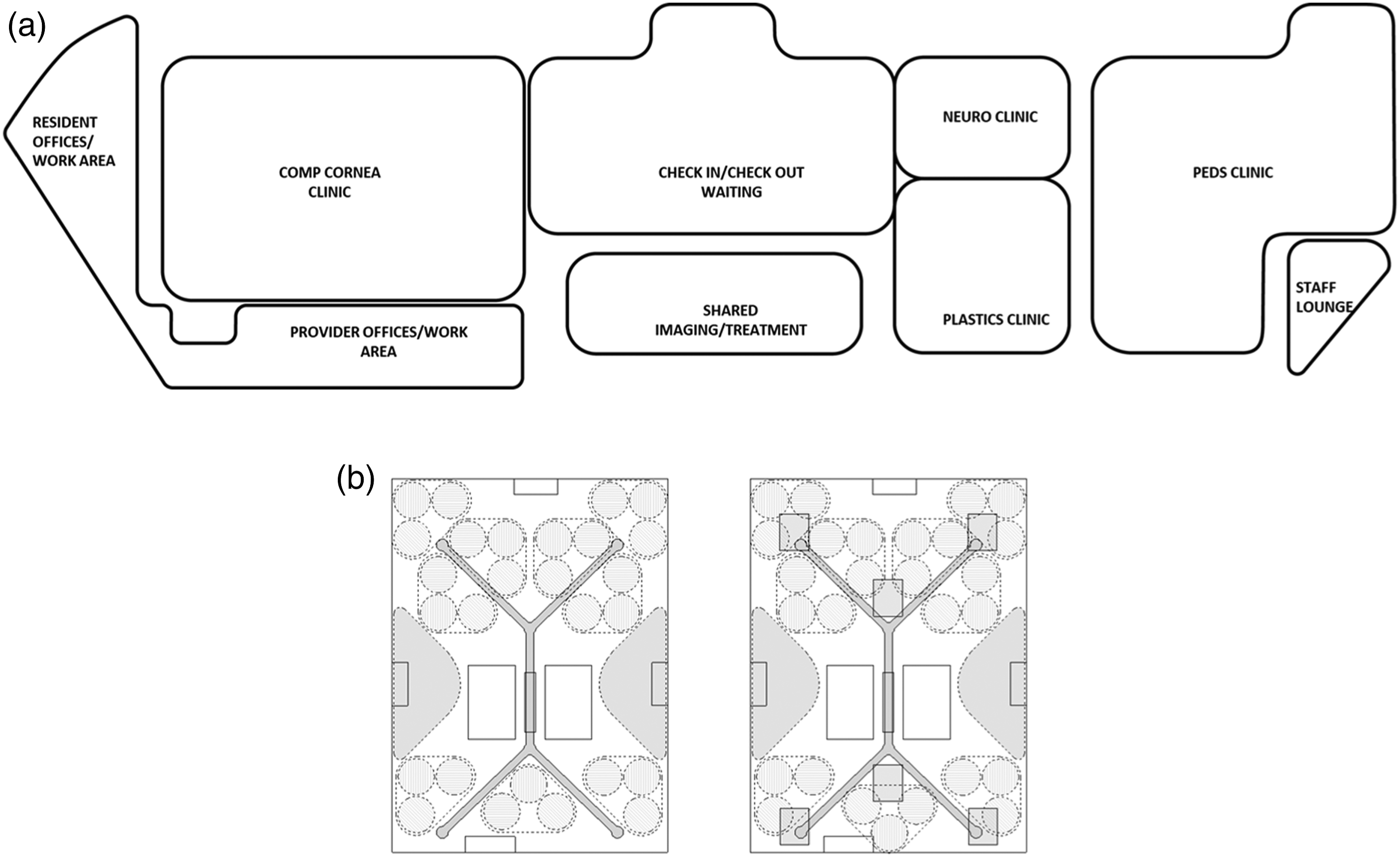
Automated space planning has been researched for more than half a century. Whitehead & Eldars 1 described a computer-aided approach to the space planning of a hospital operating theater suite. They used string-diagrams and adjacency matrices to capture spatial relationships between the program spaces, analyzed the relationships and then used the results to build adjacency diagrams that could be drawn up as functional floor plans.
Eastman 2 investigated computer programs that allow for the automatic resolution of arrangement problems which he referred to as space planning problems. He anticipated that such programs could be used for giving first approximation solutions to complex and ill-defined arrangement problems, geometry layouts of certain types of service spaces as well as for prototyping plans for facilities like hospitals and military installations.
Krishnamurti and Roe 3 presented a general approach to the problem of generating and enumerating architectural plans based on rectangular grids. Their method used algorithms for counting and classifying rectangular dissections. 4
Many other researchers have discussed automated space planning.5–9 Although automated space planning has been researched for such a long time, it is still not widely used in architectural practice. In this paper, we propose that automated space planning tools must meet five pragmatic criteria (Figure 2) to be successfully implemented in practice. These criteria are identified from the authors’ observations and experiences in a large global architectural firm (Perkins&Will Architects). We then propose a hybrid automated space planning solution that uses both space allocation algorithms and shape grammar algorithms. We evaluate on three real-world example projects how this hybrid approach satisfies the proposed space planning criteria.
Literature review
We acknowledge that there are several activities in the conceptual design stage related to space planning such as bubble and adjacency diagramming. In this paper, we consider space planning to be the more concretized activity where rooms and spaces together with their content, dimensions and relationships are shown in readable architectural formats rather than as abstract diagrams (Figure 3). We will refer to this type of space plan as high resolution to distinguish from more diagrammatic drawings. When doing test fits, for example, high-resolution drawings are required to ensure inventory has been correctly placed. High-resolution workplace floor plan drawing output (Perkins&Will, 2021).
Experience teaches that generative space planning in practice comes with pragmatic requirements that should be met for effective implementation (Figure 2). We acknowledge that there is a distinction between the user experience of a software developer and that of an end-user. The developer writes the underlying programs that enable computational tools to function as required. The end-user is typically the designer who applies computational tools to the solving of design problems. When discussing the pragmatic requirements of generative space planning, we are speaking from the point of view of the end-user (designer). Requirements for application of generative space planning in architectural practice.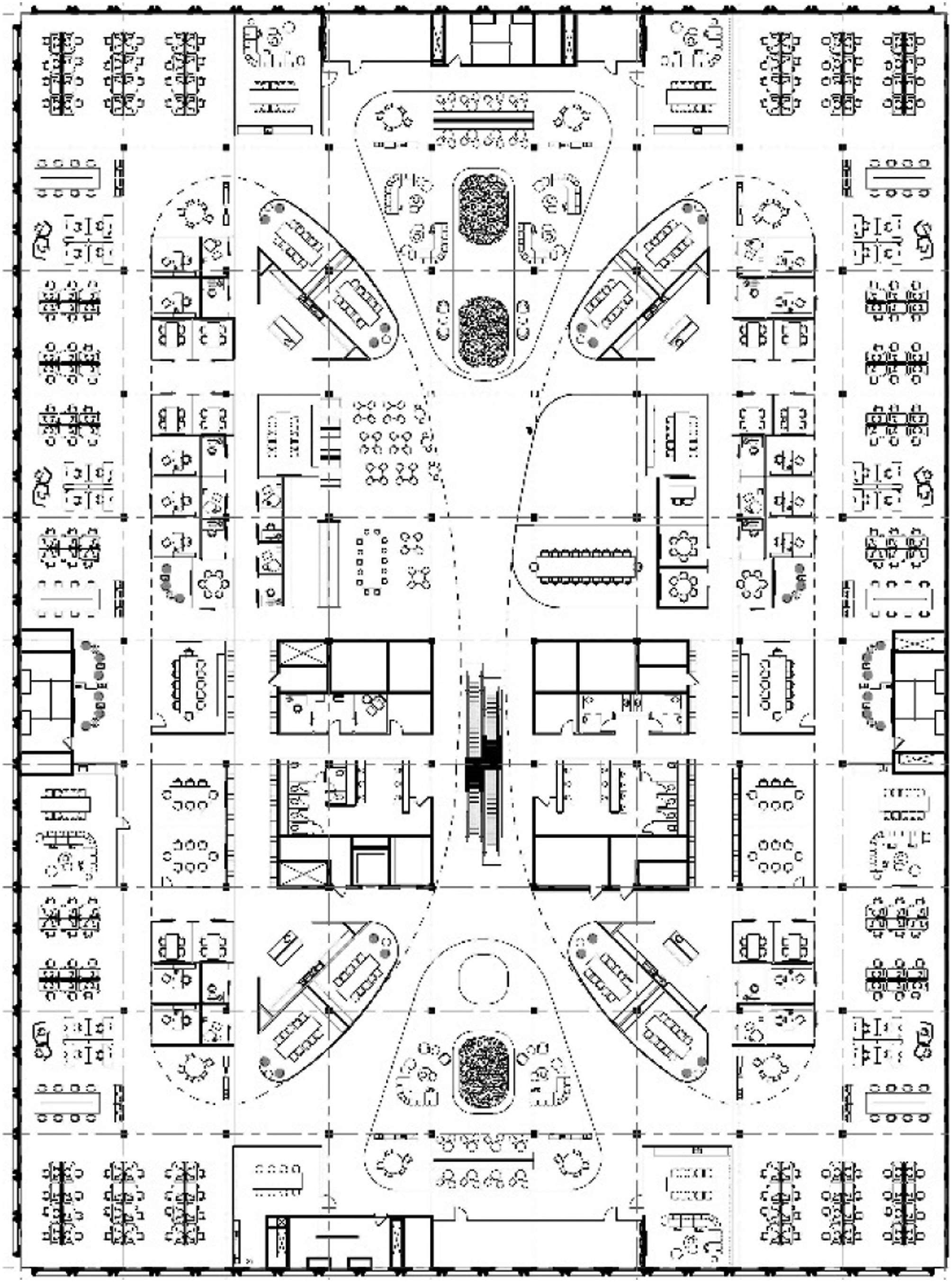
First, the generative process must be end-user accessible to the skillset of practicing architects. It should not depend on deep experience in computer programming and other specialized skills or require specialist tools not commonly used by architects.
Second, the end-to-end process for developing the design alternatives must fit into the typical schedule and budget of an architectural project. Given the speed of decision making in current practice this should be no more than a day or two for average projects (10,000–50,000 sqft).
Third, the process should explicitly accept the standard inputs of the space planning process. These will include a building footprint contextualized in an existing building or as part of a new build, and a program of activities or functions, and possibly inventory, to accommodate within the footprint. Building footprints will, in addition, have constraints that must be respected such as internal circulation, and location of vertical circulation and exits.
Fourth, the outputs should have high resolution and closely resemble the drawing standards of architectural practice to be included as part of the architect’s design presentations. The resolution of such drawings will typically depend on the stage of the project, but they should include wall thickness, door swings and locations, corridors and circulation, and layouts of inventory.
Fifth, to be useful on an ongoing basis the process should be scalable. It should handle projects of a range of sizes typical for an architectural practice as well as projects of different types. In addition to these key requirements, the output of the automation process should also support various types of available design analysis such as daylighting, energy, thermal comfort, acoustics, and others.
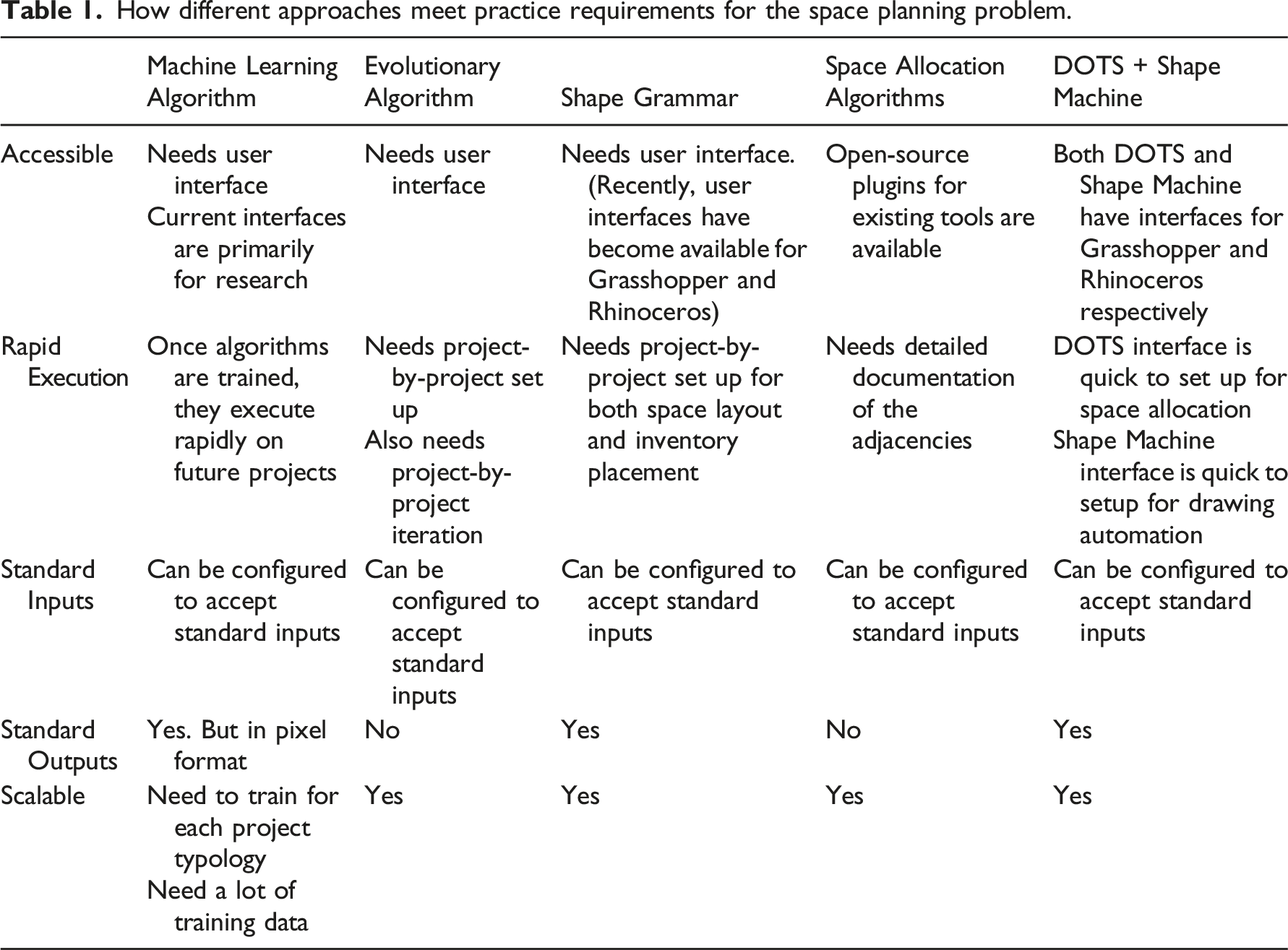
Researchers have proposed several solutions to the automated space layout problem. These include approaches based on machine learning, evolutionary algorithms, shape grammars, and spatial allocation algorithms. As discussed below these approaches, by themselves, often do not meet all the practice requirements mentioned above and as such have not been broadly adopted by practitioners.
Machine learning
Nauata et al. 10 presented a novel generative model that employed generative adversarial networks (GAN) for the generation of house layouts. They trained a GAN on 117,587 instances and outperformed existing methods and baselines based on metrics of realism, compatibility, and diversity. Rahbar et al. 11 used a conditional-generative adversarial network (cGAN) to generate apartment layouts. They trained the cGAN on 300 images and found that it generated layouts of comparable quality to expert designers. Chaillou 12 described a Pix2Pix GAN model trained to generate footprint massing, place program in footprints and place furniture layouts in programmed space. He reports using 800+ drawings of apartments for training the program placement stage of the process.
In general, the machine learning methods function well on a project type with predictable program like residential design. There is no evidence yet of how well the approach scales to project types of less predictable character. Unless the machine learning pipelines terminate with user interfaces the direct manipulation of GANs by architects is not accessible. In addition, large training sets like Nauata would be too expensive to procure. As such training needs to be possible on the limited data sets available to architectural firms. Chaillou shows that additional data gathering, and training, is needed to achieve high-resolution graphic outputs. Since GANs are pixel-based models, the final output also needs to be converted to vector formats for use by architects.
Evolutionary algorithms
Sonmez 13 proposed a similarity-based development of layout designs using evolutionary algorithms. He diagrammatically arrayed program spaces across a series of building floors. The evolutionary algorithm was driven by objectives extracted from existing layouts. Nisztuk & Myszkowski 14 used a hybrid evolutionary and greedy algorithm to automate floor plan generation. The evolutionary algorithm evaluated outputs from the greedy algorithm and tried to improve input values to get better output in the next iteration. The greedy algorithm took proposed input values and attempted to create a floor plan of related spaces as the output. Chen et al. 15 attempted to use two nested genetic algorithms to test fit open plan offices that maximized space utilization by minimizing non-functional area. The first algorithm found the best combination of room locations while the second algorithm minimized circulation area.
Like machine learning algorithms, without user interfaces evolutionary algorithms would be challenging for designers to use. Although they can be more versatile than machine learning algorithms, they need to be set up on a project-by-project basis, whereas machine learning algorithms can be trained for a whole class of projects in one shot. Not only do evolutionary algorithms require this setting up they must also run thousands of iterations to find optimal solutions. These two factors impede rapid execution. The outputs from evolutionary algorithms are not standardized for architectural production and tend to be schematic or diagrammatic.
Shape grammars
Shape grammars in architecture have been researched beginning with Stiny & Gips. 16 They described a formalism for the generation of paintings using a geometric approach to computational grammars. Following these beginnings, both the theory as well as applications of shape grammars have been investigated side by side.
Many authors have contributed to the fundamental development of shape grammars.17–26 In parallel, multiple applications have been implemented in architectural case studies.27–33 Although shape grammars do not need to iterate to convergence like evolutionary algorithms, shape grammars have to be set up on a project-by-project basis. This typically requires separate rule sets for space layouts and inventory layouts protracting the set up process even more. While outputs from shape grammars can be standardized to a high resolution, the application of rules frequently requires manual end-user interaction. This makes shape grammars less automated in their generative process than machine learning or evolutionary algorithms.
Still, the challenges for the implementation of a shape grammar interpreter that is able to compute the shape rewrite productions envisioned by the shape grammar formalism are formidable.34–36 Recently, three general-purpose shape grammar interpreters, namely, GRAPE, SORTAL, and Shape Machine, have begun to claim a substantive support of regular design workflows (see, respectively, Refs. 37–39). Among them, the Shape Machine has managed to successfully resolve the challenges underlying shape embedding in the algebra
Space allocation algorithms
The space allocation problem refers to the constrained generation of spaces to develop floor plans of buildings. 44 Ligget 45 identified several approaches and algorithms for solving the facilities layout problem. Grobman et al. 46 reviewed the use of computers for form generation and evaluation in the early design process. Singh and Gu 47 identified five generative design techniques: cellular automata, genetic algorithms, L-systems, shape grammars and swarm intelligence. Calixto & Celani 48 presented a survey of applications and reviews of space planning using evolutionary algorithms.
Ligget & Mitchell 5 treated the problem of assigning activities to floor plans as forms of the general quadratic assignment problem that is concerned with finding optimal locations for a set of interrelated objects. In practice, for problems with realistic size, there are too many combinations to compute. Liggett & Mitchell proposed a solution strategy that involved constructive initial placement and iterative improvement to refine the details.
Picard & Queyranne 49 considered the problem of designing the layout of rooms in a hospital. Rooms are laid out in linear fashion along the corridors of a rectangular hospital and the algorithm seeks to find the most efficient configuration that minimizes a defined travel distance metric.
Michalek et al. 50 proposed to represent the layout problem in two parts: topology and geometry. Topology refers to logical relationships between layout components while geometry refers to the position and size of each component. They proposed a mathematical model for the geometric decisions using gradient based and hybrid local-global methods. This model was embedded into a model for topological decisions and solved using heuristic global methods.
Cao & Dewancker 51 used the theoretical framework of space syntax to investigate how to arrange functional spaces in nursing homes in order to provide better living experiences. They examined the impacts of different numbers of corridors, different corridor combinations and different spatial distributions of subjects. They used partitioning theory to study how spatial function affects the depth of space.
Although space allocation algorithms, like shape grammars, have been extensively researched, attempts to apply these methods to generative design in real world practice expose some challenges. Shape grammar implementations are not as versatile in alternative creation as other generative methods and often need manual interaction. Space allocation algorithms, on the other hand, are quite versatile and can quickly generate a broad range of design alternatives. They, however, tend to output schematic diagrams and lack capabilities for quick placement of furniture and inventory.
How different approaches meet practice requirements for the space planning problem.
Methodology
The first task in developing the methodology was to identify appropriate tools for the exercise. Two platforms were selected for the investigation: Shape Machine and DOTS. They were selected because, taken together, we thought they could help address all the identified requirements of generative space planning.
Both platforms run in Rhinoceros, 53 a software tool that is in common use by architectural practitioners. They are also both accessible through a user interface (Shape Machine in Rhinoceros) and a visual scripting interface (DOTS in Grasshopper). Despite the complexity of the computations they perform, both are fast executing typically completing operations in seconds. DOTS accepts commonly used input formats: building footprint geometry in CAD format and programming in csv format. Shape Machine automates the drawing process and outputs high-resolution graphic outputs. In the example projects, both DOTS and Shape Machine were comfortably used on footprints of between 10,000 sqft and 50,000 sqft in size showing good scalability.
DOTS
DOTS (Figure 4) is a Rhinoceros-Grasshopper plugin developed in C# that allows designers to interactively generate geometry at multiple scales of the design process. At the urban design scale DOTS allows designers to partition site objects with flexible circulation and site subdivision markers; to further partition subdivisions into appropriate parcels; to allocate program to the different parcels with explicit adjacency relationships defined, and to define massing typologies on the parcels with appropriate setbacks, floor heights and floor area ratios. Example DOTS output (Saha, 2020).
At the space planning scale DOTS enables designers to input a program in csv file format, to define desirable adjacencies within the program, to input building footprint geometry and to partition it based on the program sizes, adjacency requirements and desired circulation. DOTS supports several space planning conceptual schemes such as constrained partitions, curve skeletons, and Markov chain explorations.
Shape machine
Shape Machine (Figure 5) is a computational technology that redefines the way shapes are represented, indexed, queried, and operated upon. Its foregrounding of visual rules (shape rules drawn in a 2D or 3D modeling system) over symbolic rules (instructions defined in some programming language) provides a robust interface for professionals who use drawings and visual models to develop and communicate their ideas. Shape Machine example output (Vaivodiss, 2020).
Shape Machine is a plugin implemented in Python within the Rhinoceros modeling software. The core concepts of Shape Machine include three main parts: first, a new implementation of the reduction rules, a set of algorithms that provide a unique description to every shape in terms of the smallest number of maximal elements that specify it; second, a new implementation of shape recognition for all shapes consisting of straight lines, arcs and their combinations under isometry, similarity, affinity, and linearity transformations; and third, a new implementation of a rule compiler of shape modification for all shapes consisting of straight lines, arcs and their combinations under all isometry, similarity, affinity, and linearity transformations.
Workflow process
The second task in the methodology was to develop a workflow process for generative space planning. Shape Machine needs a drawing framework upon which to apply shape grammar rules for drawing automation. The DOTS generated engine can quickly supply this. DOTS, however, generates output as diagrammatic line drawings. Shape Machine can act on these line drawings and quickly convert them into high-resolution outputs. Thus, it was felt that the capabilities of DOTS and Shape Machine were naturally complementary (Figure 6). DOTS line drawing output (left) and Shape Machine high-resolution output (right).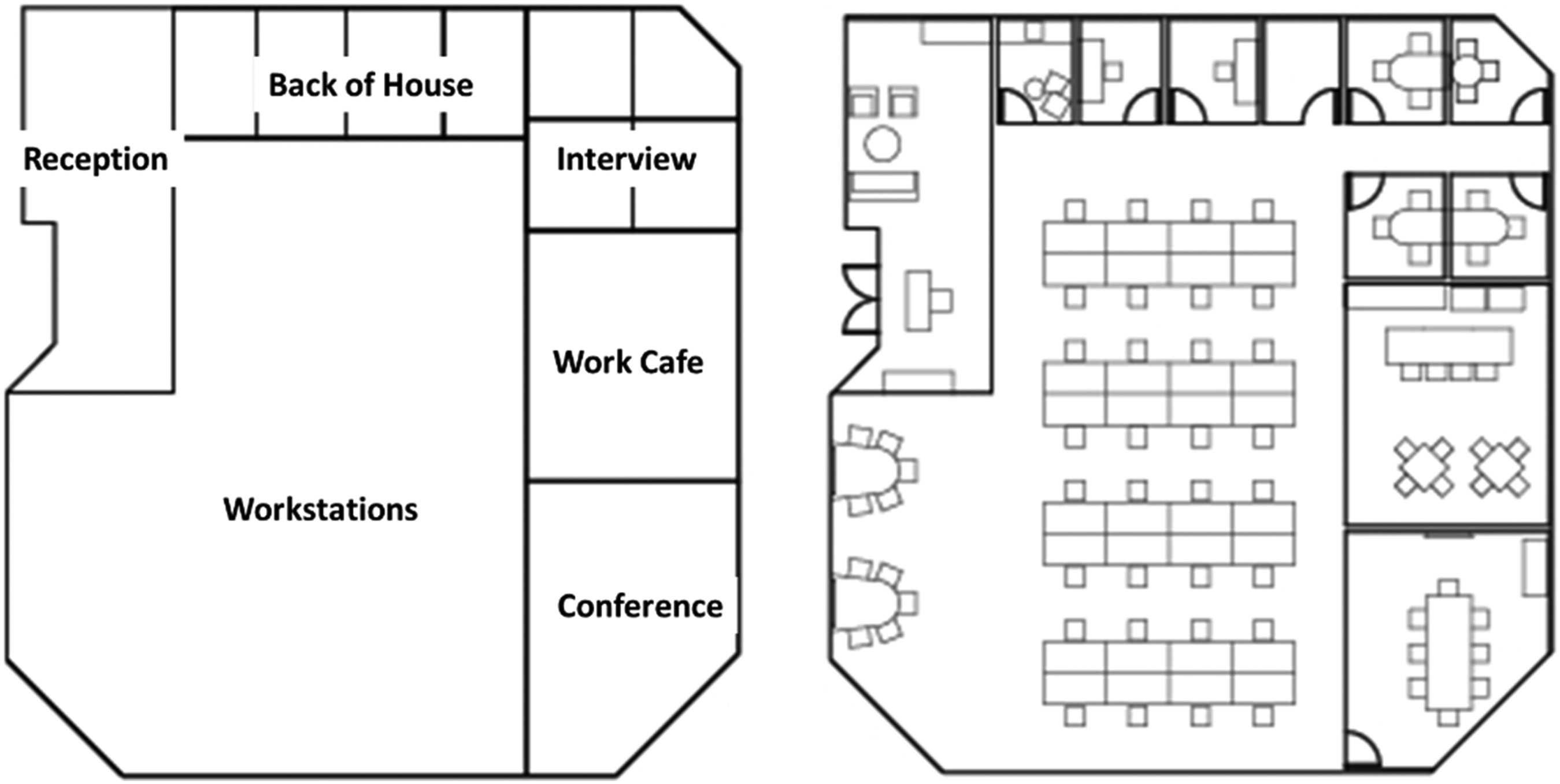
The workflow process (Figure 7) involved obtaining a footprint in CAD format and a program in csv format as inputs into DOTS. DOTS was used to generate a range of viable alternatives as linework drawings, The linework was used as input into Shape Machine. Based on shape grammar rulesets Shape Machine transforms the linework into high-resolution output by adding circulation, wall thickness, door locations and swings, and furniture and fixtures. Workflow process.
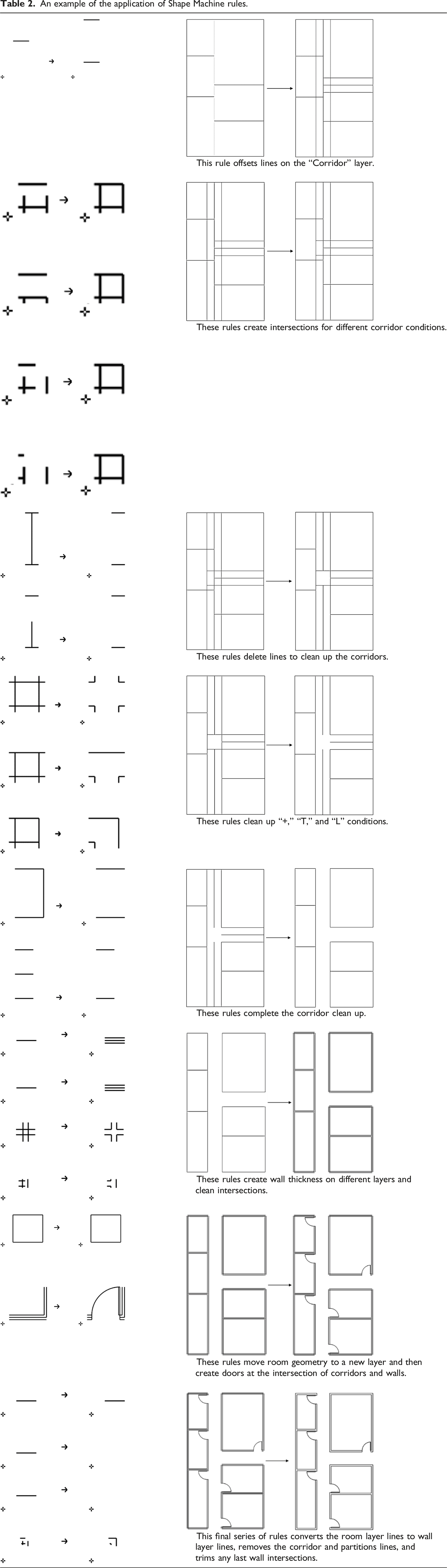
The application of Shape Machine rules for drawing automation can be described by an example. Shape Machine rules have a left-hand side and a right-hand side. The rules transform the geometry on the left-hand side to geometry on the right-hand side. For example, in Figure 8, the rule transforms a plain rectangle to a rectangle with a diagonal line. A simple shape machine rule.
An example of the application of Shape Machine rules.
Results
We evaluated the DOTS + Shape Machine hybrid process on three example projects designed by Perkins&Will Architects. The projects were a corporate workplace (11,000 sqft), a layout for an administrative wing of a health sciences building (20,000 sqft), and a layout for a science lab building (51,000 sqft). The projects were selected based on the project types undertaken at Perkins&Will Architects. They provided a range of sizes and functionality to test the process under varied conditions.
Example project: Corporate head quarter
Corporate HQ
54
was a workplace design for the headquarters of a gaming company. The project vision was to create a welcoming, clean, efficient, and flexible workplace that supports collaboration and creativity and encourages innovation. The guiding principles of design were a people first approach, adaptability of use, “cool” and comfortable, and enhancing corporate identity (Figure 9). Corporate HQ, space planning guidelines (Perkins&Will, 2019).
The generative design was carried out on a typical floor plan with a program size of about 11,000 sqft. The program comprised of personal spaces, collaboration spaces, and shared spaces. Personal spaces were mainly workstations (5400 sqft.). Collaboration spaces included phone rooms and small, medium, and large meeting rooms (3600 sqft.), while shared spaces included storage, café, lockers, print area, etc. (2700 sqft.) The design concept at the typical level involved considerations of vertical circulation, social hubs, separation buffers and work zones (Figure 10). Corporate HQ, concept design sequence (Perkins&Will, 2019).
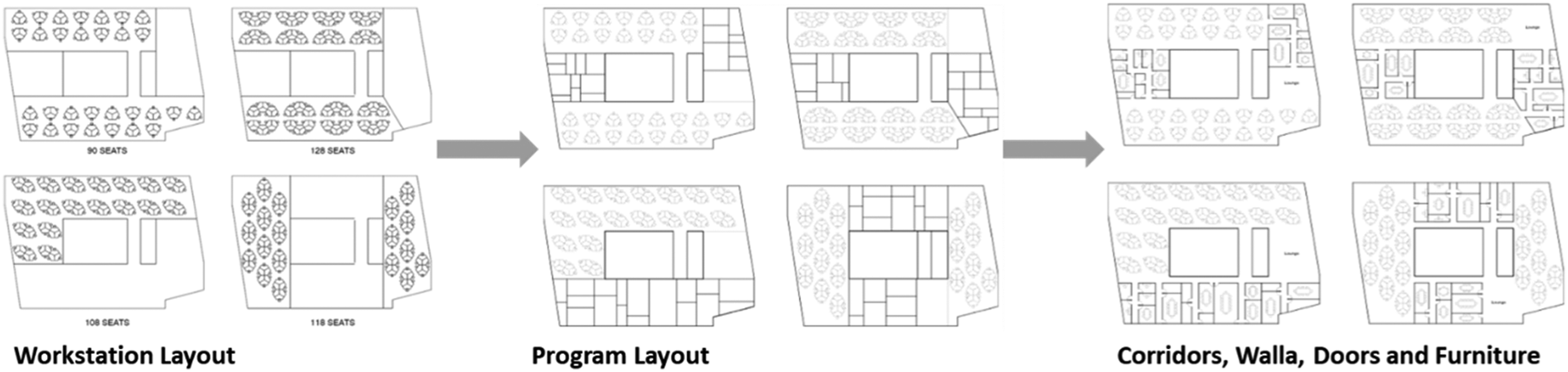
The generative design workflow (Figure 11) involved obtaining the footprint and csv file with the program as inputs for DOTS; defining adjacencies in the csv input file; developing several linework based alternative layouts in DOTS; using linework layouts as inputs for Shape Machine; defining rulesets in Rhinoceros for use with the Shape Machine engine; systematically applying the rule sets to the linework geometry to obtain corridors, wall thicknesses, door locations and swings, and furniture placement. The shape grammar-based design sequence and outputs for Corporate HQ are shown in Figure 12. Corporate HQ, generative design workflow process (Perkins&Will, 2019). Corporate HQ, shape grammar design sequence (Perkins&Will, 2019).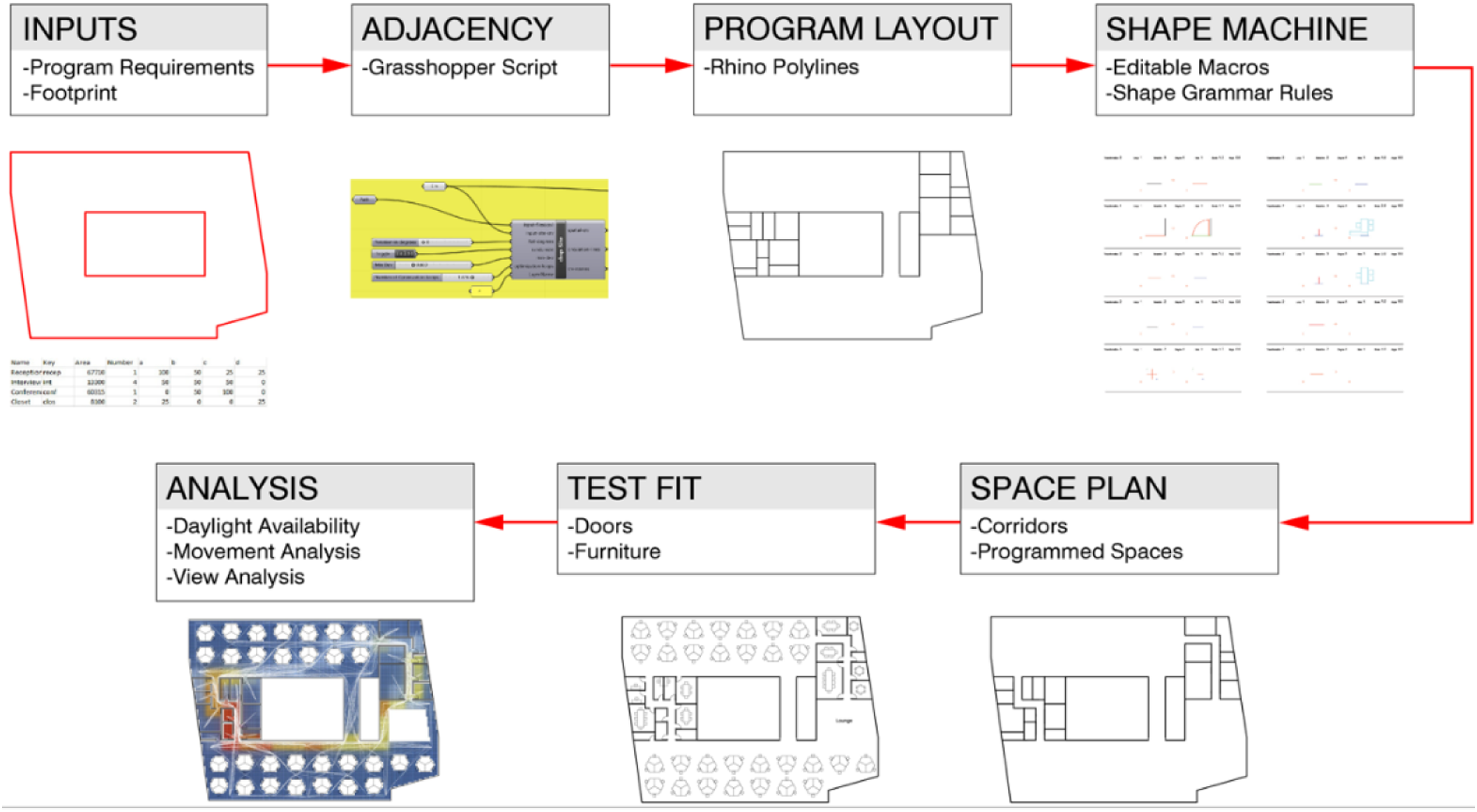
In addition to generating design alternatives, design optimization was performed by analyzing all the design layouts to identify the strengths and weaknesses of each with respect to performance metrics. Analyses were performed and metrics reported for daylighting, movement analysis, view analysis and visibility analysis (Figure 13). Corporate HQ, performance analysis (Perkins&Will, 2019).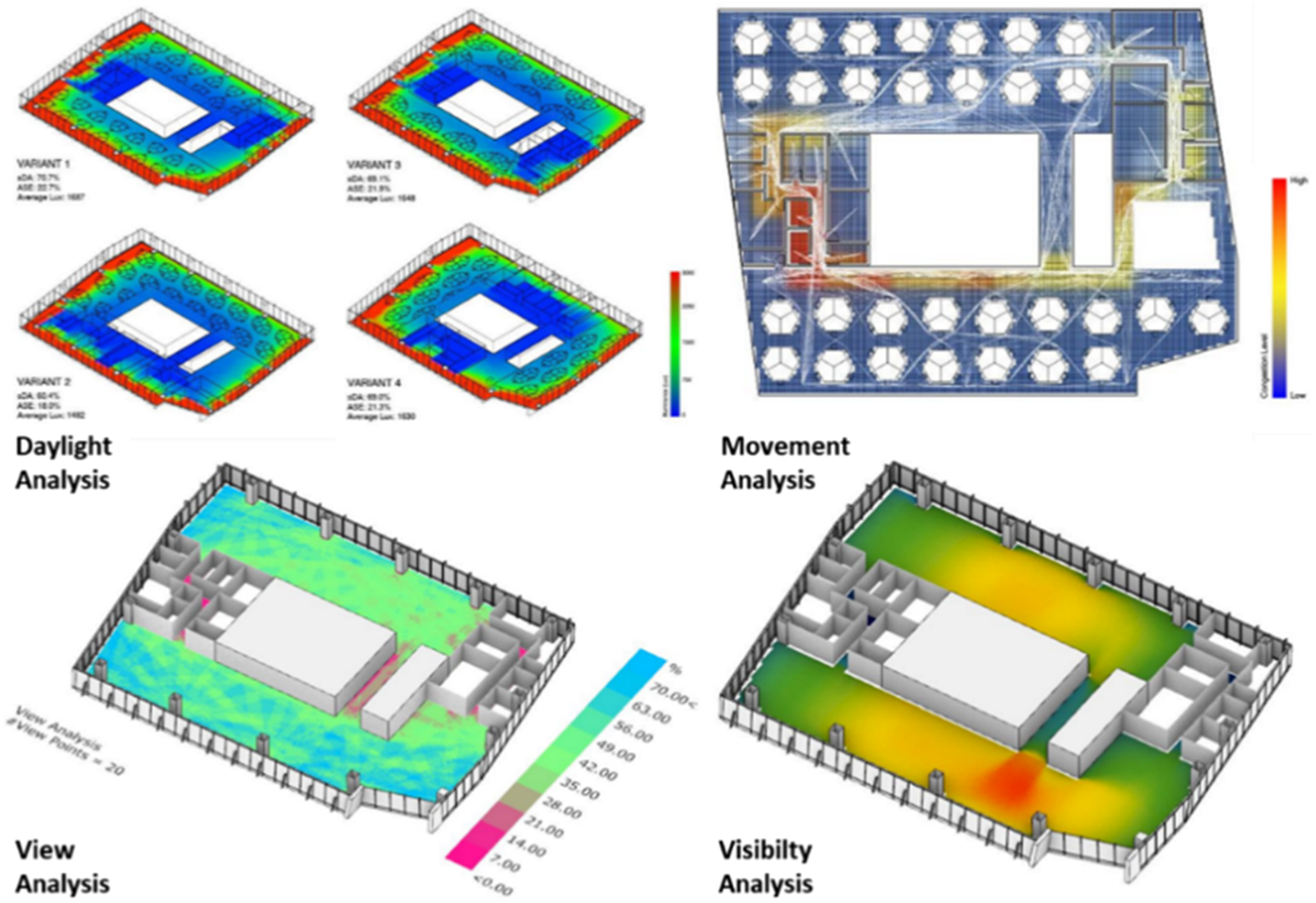
Example project: Nurse lab
Nurse Lab
55
was part of a health sciences building on a university campus. The project vision for the building was to express a sense of welcome, invite people to the heart of the campus and inspire feelings of well-being. It would convey the university as a place of innovation, sustainability, leading research, and forward thinking. The design and layout would support collaborative and team-based learning, innovative approaches to teaching, cross pollination between user groups, and places to gather and socialize as well as for contemplation and privacy (Figure 14). Nurse Lab, massing and façade concepts (Perkins&Will, 2019).
Space types in the building included classrooms, teaching laboratories, research laboratories, offices and support spaces, clinical spaces, shared lounges, and building support. The generative design was carried out on the academic offices and related spaces of the School of Nursing (20,000 sqft.). On the early prototypes these spaces were located on the West wing of the third level of the building (Figure 15). The program included offices for directors, faculty administrators and researchers. Nurse Lab, West wing of Level 3 (Perkins&Will, 2019).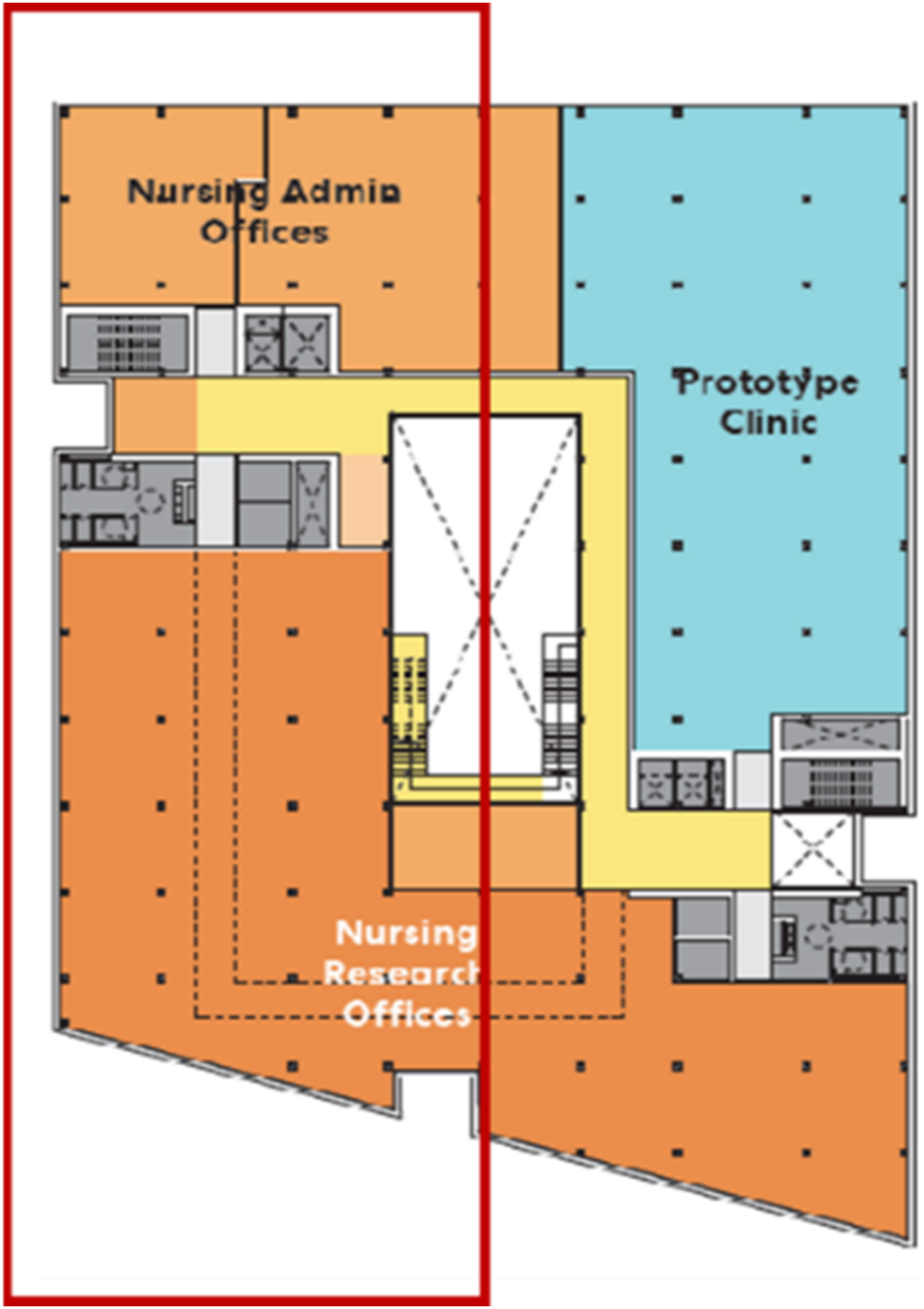
The generative design (Figure 16) for Nurse Lab was based on the workflow process and was identical to the process described for Corporate HQ. The shape grammar-based design sequence and outputs for Nurse Lab are shown in Figure 17. Nurse Lab, generative design workflow process (Perkins&Will, 2019). Nurse Lab, shape grammar design sequence (Perkins&Will, 2019).

Example project: Science Lab
Science Lab
55
was part of an interdisciplinary science and innovation center at a university campus. The project vision was to create a high-quality environment that put occupants first; a future proof facility in design and operations; a facility that supported excellence in research teaching, with an exceptional public realm (Figure 18). Science Lab, massing diagram (Perkins&Will, 2019).
The building program (gross 370,000 sqft.) included a vivarium, departmental research spaces, administrative spaces, public access programs, rooftop functions and building support. The research was conducted on the Level 1 floor plan (51,000 sqft.) which on early prototypes included science teaching labs, a car lab, vivarium logistics and building loading. A prototype of the space planning on the Level 1 footprint is shown in Figure 19. Science Lab, Level 1 proposed (Perkins&Will, 2019).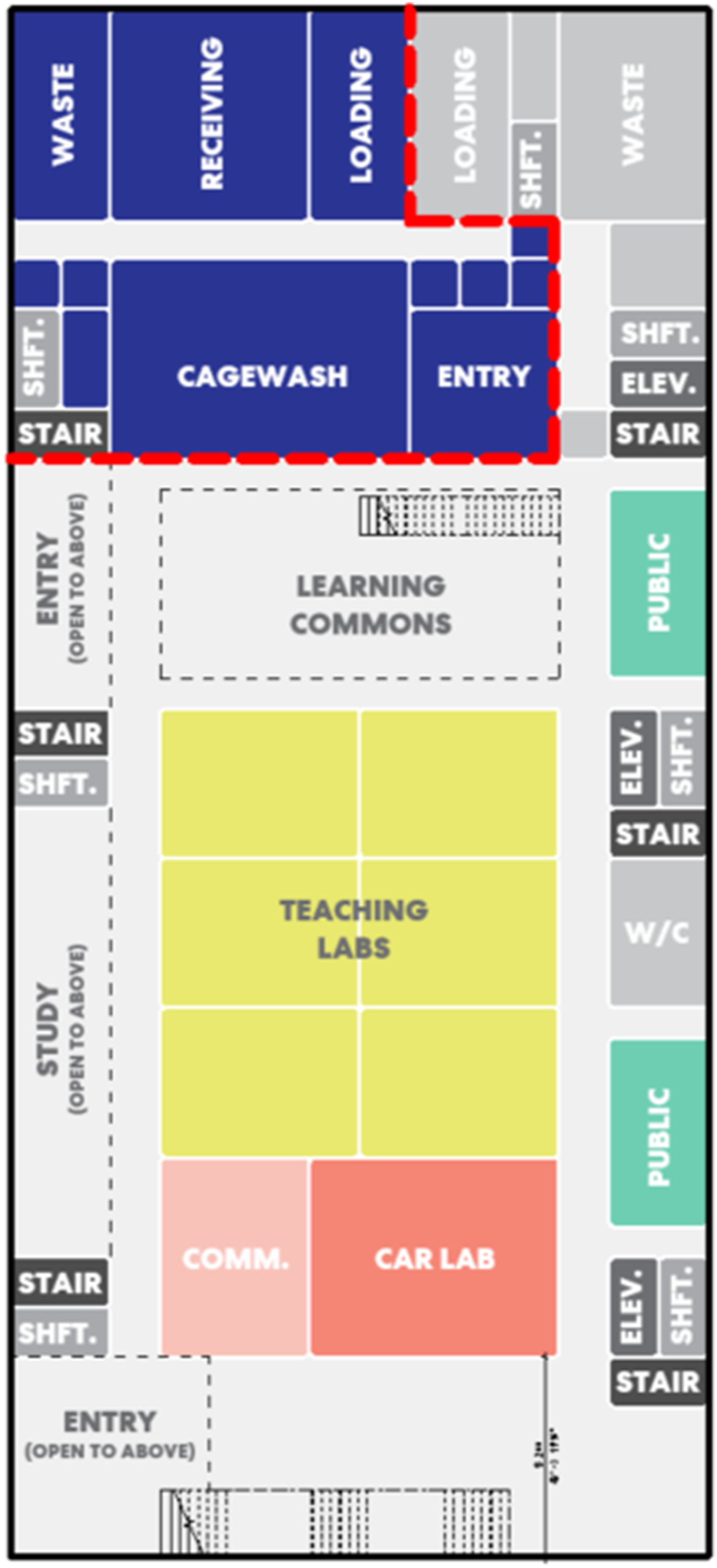
The generative design workflow (Figure 20) for Science Lab was like both Corporate HQ and Nurse Lab. The shape grammar-based design sequence and outputs for Science Lab are shown in Figure 21. Science Lab, workflow process (Perkins&Will, 2019). Science Lab, shape grammar design sequence (Perkins&Will, 2019).

Discussion
To validate the outcomes of the investigation we asked two questions. First, did the DOTS and Shape Machine hybrid process satisfy the requirements we identified in Figure 2. Second, did architectural designers find the hybrid process and its outputs credible. In other words, could they use it for their own design presentations.
For the first question, we examined all three example projects in the light of end-user access, rapid execution, standard inputs, standard outputs, and scalability. In terms of end-user access, it was clear across the three projects that the hybrid process requires two distinct user levels of expertise: a regular designer and a computational designer. A regular designer in this context is one who does not have deep experience in computational design. A computational designer was needed to set up the DOTS and Shape Machine scripts and rulesets. Thereafter, the regular designer could apply them to the standard inputs and obtain outputs. The hybrid process was thus only partially successful in creating an end-user accessible tool.
In terms of rapid execution working in DOTS took on average three hours in total, per project, while working in Shape Machine took on average seven hours, per project, to generate six design alternatives. The time spent in DOTS included time to develop a generative script. The time spent in Shape Machine included time to develop the initial rulesets (about four hours) and then time to apply the rulesets to DOTS layouts (about thirty minutes for each layout). It should be noted that script and ruleset development time is anticipated to decrease on subsequent projects since there is a high level of repetition in design logic on similar project types.
For comparison purposes, it takes designers at Perkins&Will between two to four hours to sketch a single conceptual layout of an average floor plan (10,000–50,000 sqft). It then takes an additional one or two days to create a high-resolution graphic representation of the floor plan. Thus, the hybrid process can deliver floor layouts at about six times the rate of the conventional manual process.
In terms of inputs the hybrid process used footprints in CAD format and programs in csv format. These are both formats regularly encountered in standard practice. DOTS takes a reference to the floor plan footprint geometry together with a program in csv format and outputs line work layout of program spaces. This is the input to Shape Machine which uses shape grammar rulesets to transform this input into high-resolution output. The generated outputs had the resolution of standard schematic design drawings as seen by comparing them to real-world proposals (Figure 22). Case study comparisons of proposed designs (left ) vs generative designs (right).
It is worth noting that circulation is a particularly challenging aspect of floor plan automation. Conventional design processes can quickly and intuitively introduce circulation as part of their conceptual design sketching. Space allocation algorithms, however, struggle to provide rational, functional circulation schemes and are often unreliable. Shape Machine provides an interactive approach where the designer can use linework to indicate circulation pathways within partitioned diagrams and then Shape Machine can flesh these out into actual circulation routes. This ensures functional solutions, although the interactive aspect reduces the rapid execution of generative design.
In terms of scalability and repeatability the process scaled from an example project of 10,000 sqft to an example project of 50,000 sqft. Many components of the shape grammar ruleset logic like wall creation and door placement had reusable logic and can be repeated on future projects.
For the second question, designers were interviewed regarding the hybrid process and asked whether they could use the process and its outputs on their projects. The interviewees were a junior designer with a year of experience, an intermediate designer with three years’ experience, a computational designer with five years’ experience and a design principal with twenty years’ experience.
It was universally acknowledged by this group of interviewees that generative design, and the proposed hybrid process, could not be used as a primary design authoring tool. The generated designs were not seen as meeting the threshold of responsiveness to design constraints that conventional design solutions meet. As an example, the generative process for the Science Lab project led to L-shaped classroom spaces in some design alternatives which were thought to be undesirable. The resolution of generative design alternatives to the threshold of conventional design would likely take too much time and effort to be a rapidly executing process.
However, it was also universally agreed that generative design can be useful as a design analysis tool. In particular, the alternatives generated can be useful for comparative analysis. This analysis can be visual or simulated. For example, in the Corporate HQ project, the generated alternatives were simulated for a range of performance metrics. This can give designers an intuition into which configurations perform well for different metrics and why. They can then use this information in the context of their primary design authoring approach.
One additional observation is that there are likely demographic and background considerations when assessing the adoption in practice of new digital design technologies like generative design. The junior architect and the computational designer were more amenable to learning and using the hybrid process than the intermediate designer or the design principal. This suggests that a younger generation, or people with an inherent interest in computation, is a better target for this type of innovation.
Conclusion
In this paper, we observed that although generative design methods for space layout problems have long been researched, they have hardly been used in practice. Based on our experiences at a large architectural practice, we proposed five criteria we felt a generative design process should exhibit in order to be successfully implemented (Figure 2). We argued that many existing generative methods like evolutionary algorithms, machine learning, and shape grammars do not, by themselves, satisfy the proposed criteria. We proposed that a hybrid process combining two or more of the popular research methods might satisfy the identified criteria better. In particular, we investigated the use of shape grammar and space allocation algorithms as a hybrid generative design method for the space layout problem.
The research was limited to projects designed by Perkins&Will Architects. This limited the type of project and range of sizes investigated. In addition, two specific implementations of shape grammar and space allocation algorithms were used—namely, Shape Machine and DOTS. It is possible that different implementations of these methods may yield different findings than what we have reported. The research found that the proposed hybrid process only partially fulfilled the requirement of easy accessibility for practicing architects. In their current state, both Shape Machine and DOTS require the participation of a computational designer for effective use. The need for rapid execution was also compromised by the need for manual interaction with Shape Machine rulesets during application. The circulation placement problem, in particular, required the designer to manually indicate circulation lines within the design geometry which takes away from the automated generation aspect of the exercise.
That being said, the hybrid process performed well in the ability to integrate with existing design processes. Execution time was within the two-day recommended window for decision making in the conceptual stage of space layout design. Inputs of the process were simple line drawings and spreadsheets, while the output had the graphic resolution of comparable outputs from the conventional design process (Figure 22). The hybrid process scaled comfortably for the range of floor sizes that were examined.
The research highlighted some questions for near term future research. One is the circulation problem. For generative space layout methods to achieve their full potential they need to incorporate robust automated circulation algorithms. A second question, in the case of workspace layouts, is the need to optimize (in other words to maximize) workstation counts. This was identified by designers as being central to the success of generative workspace design algorithms. Last, there emerged opportunities for sub-automation. This refers to a more detailed automation of whole parts of a floor plan layout that have a consistent and repeatable character across projects. Examples of spaces that could be sub-automated are building cores and washrooms.
Footnotes
Declaration of conflicting interests
The author(s) declared no potential conflicts of interest with respect to the research, authorship, and/or publication of this article.
Funding
The author(s) received no financial support for the research, authorship, and/or publication of this article.
